Skeletal Muscle Physiology
And training for optimal performance
through the life time

Jason Cholewa, Ph.D., CSCS
All else being equal…
Tyson Gay

Bernard Lagat
Specifically…
• Average human fiber type composition is
50/50
– 50% fast twitch
– 50% slow twitch

• Elite sprinter: 80/20
• Elite weight lifter: 70/30
• Elite marathoner: 30/70
Agenda
• Describe the muscle twitch
• Discuss muscle fiber types
• Discuss and apply fiber type response to
training
• Identify changes in aging skeletal muscle
• Discuss training for older adults
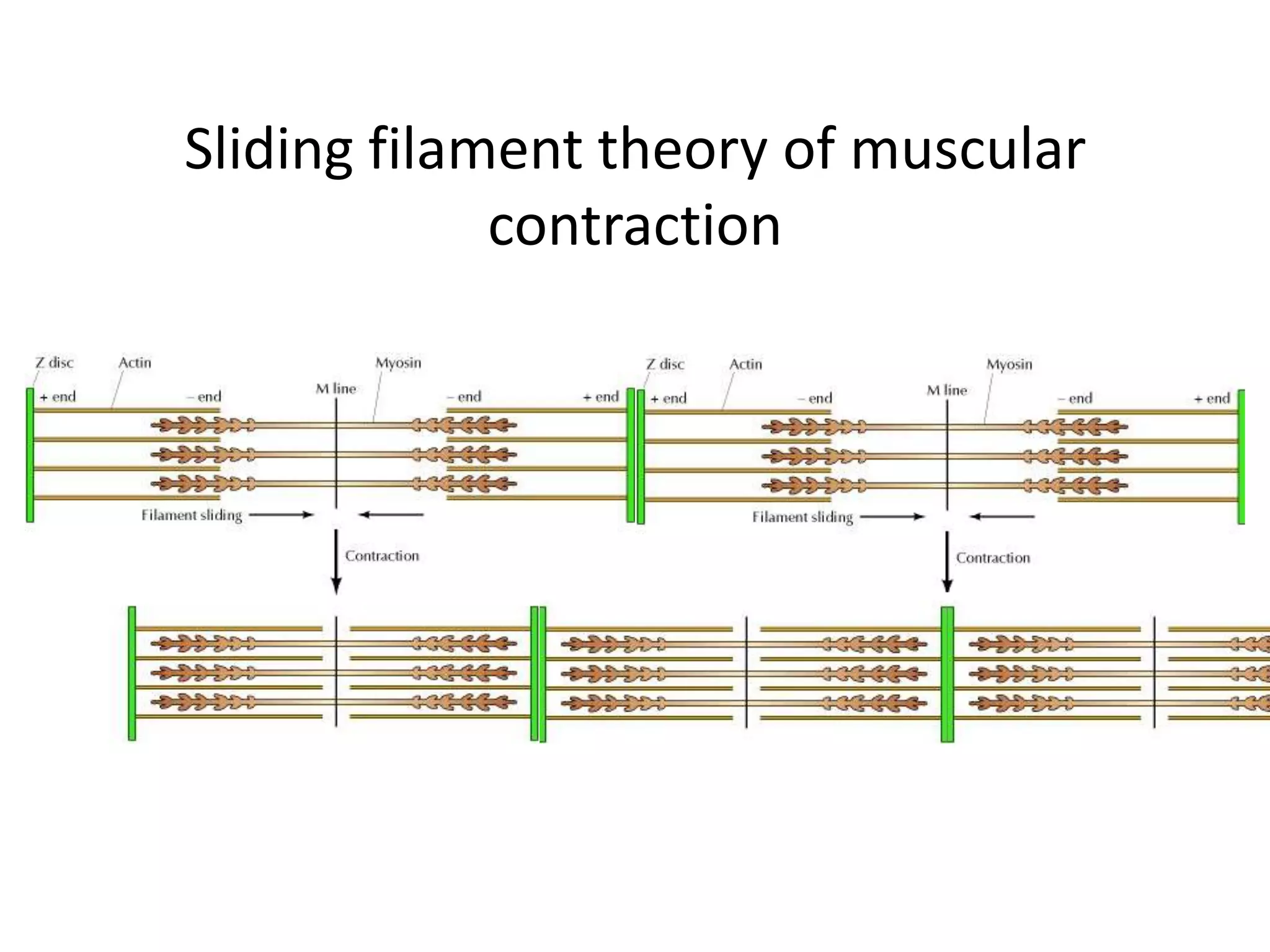
What is a “twitch”
– Twitch is a single cross-bridge cycle
Sliding filament theory of muscular
contraction
How do we classify muscle fibers
• Muscle Fiber Types
– Type I (slow-twitch)
– Type II (fast-twitch)
Fast Twitch
Slow Twitch
Fiber types display a continuum
•
•
•
•
•
•
•

I
IC
IIC
IIAC
IIA
IIAX
IIX
Slow Twitch:
Increased period of contraction
 Requires more time to reach peak force
Increased period of relaxation
 Less twitches per unit time

Fast Twitch:
Shorter period of contraction
 Less time required to reach peak force
Shorter period of relaxation
 More twitches per unit time
Fiber and Motor Nerve Diameter
Fasting neural firing yields greater
force production
Classifications based upon MHC
Differences in MHC and Force

MHC= myosin heavy chain
Classification based on myosin ATPase
Differences in in myosin ATPase and
fuel usage

Rapid contractions require a greater rate of ATP breakdown
Fast Vs. Slow
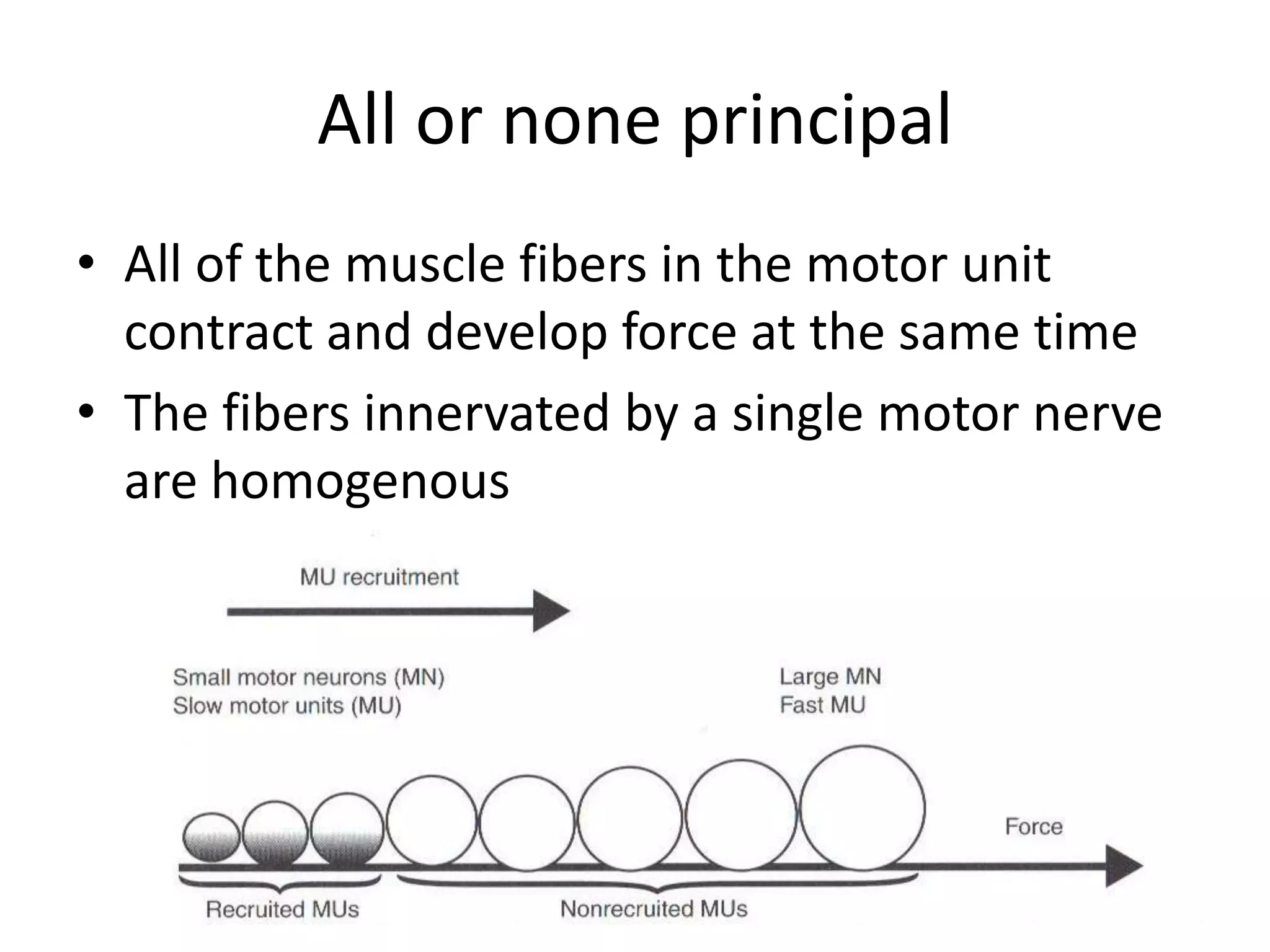
Motor Unit
All or none principal
• All of the muscle fibers in the motor unit
contract and develop force at the same time
• The fibers innervated by a single motor nerve
are homogenous
Which fiber does this require most?
True or False
• A single motor unit can consist of BOTH Type I
and Type II fibers
What happens to fibers during
resistance training?
• A shift of the type of myosin ATPase and MHCs
takes place during training.
• Type II and I fibers hypertrophy with
resistance training
• Transformations from IIx to IIax to IIa occur

Not in mammals
Why the transition?

Transition is due to stimuli, in this case force and duration
Notice how rapidly IIX burns through ATP compared to IIAX & IIA
Movements requiring longer duration >3 sec (i.e.: heavy squats or high reps)
relies heavily on IIA
What type of fiber was most
responsible for these match changing
spikes?
Improving/preserving “explosive”
power
• Training protocols that require maximal force
output in a very short duration (< 5-8 sec)
• Examples?
– Plyometrics
– Dynamic effort training
– Reactive training

• May reduce the transition from IIAX to IIA/C
Aging skeletal muscle
• Physical function is decreased with age
– Muscle atrophy with aging results from decreases
in both number and size of muscle fibers
• Type II fibers are lost
• Type I fibers hypertrophy

• Loss of Type II’s = decreased strength and
power
– Loss of Type II’s associated with loss of bone mass
– 10% loss per decade after the age of 40
Aging Muscle
• Loss of power is biggest predictor of frailty
and disability
• Reductions in muscle size and strength are
amplified in weight-bearing extensor muscles.
– Hip extensors are “lost” first
– What should (or shouldn’t) we focus their training
on?
• (google “weight training elderly”)
Training Application
• Need to increase tension production at high
rates of muscular contraction
• Power training (50-60% 1 rm, fast
contractions, 3-6 repetitions) may be best for
improving or delaying loss of function in the
elderly
Performance for all ages

RESEARCH PROJECTS
Inspiration- What can be accomplished??

Ivan Abadjiev is 80 years old!
Frailty and sarcopenia
• Dynapenia is highly associated with frailty
• Muscle CSA is reduced by 50% by age 80
• Decreases in GH and IGF-1 associated with
sarcopenia
Frailty and Fatness
• high fatness associated with lower muscle
quality and an accelerated loss of lean mass
– Elevated resistin production
• Reduced ability of insulin to suppress muscle protein
breakdown

– Elevated interlukin-6 production
• Promotes muscle protein catbolism

– Reduced GH/IGF-1 responsiveness with inactivity
Muscular Power and Frailty
• Muscular power positively associated with
ability to perform daily tasks
– Power output at 40% MER associated with
improved gait and stair climbing

• Power decline is nearly 2-fold that of strength
between ages 65 and 80
Betaine
• Trimethylglycine found in dark greens and
extracted from sugar beets
• Organic osmolyte with high absorption
qualities
• Average human consumption is 50-100
mg/day
Betaine and Body Composition
• Improves body composition when combined
with training in healthy men (Cholewa)
– Increased muscle mass and limb CSA
– Reduced body fat mass
Betaine and Strength
• Results have been conflicting, but all studies
show some positive results
– Increased max effort isometric bench press and
squat force production (Lee et al.)
– Increased repetitions at > 90% peak/mean force
(Hoffman et al.)
– Increased bench press and back squat work
capacity (Cholewa et al., Trepanoski et al.)
Betaine and Power
• No differences in vertical jump or bench press
power (Hoffman et al.)
• Trend for improved vertical jump (Cholewa)
– Did not train specifically for power

• Increased vertical jump and bench press
throw power (Lee et al.)
– Had 2 power training sessions over 14 days
Betaine and Anabolic Signaling
• Increased GH and IGF-1 in humans (Apicella)
• Increased insulin mediated protein synthesis (Akt)
(Apicella et al.)
• HCTL inhibits insulin stimulated protein
synthesis, increases resistin production, and
triggers an immune response
– Betaine attenuates dietary rise in HCTL in healthy
subjects (Cholewa)
– Betaine decreases HCTL in MTHFR- and BHMTdeficient patients (Li et al.)
Research Project Specific Aims (#1)
• Compare changes in physical function with
changes in muscular performance
– Subjects (characteristics and groups)
– Training program
– Functional tests
– Muscular performance
Specific Aim 2
• Compare changes in body composition
between groups and compare to changes in
muscular performance
Specific Aim 3
• To relate changes in GH and IGF-1 to
improvements in body composition, muscular
performance, and physical function.
– measure GH and IGF-1 at baseline and every 2
weeks for 16 weeks
Potential Faculty Collaborations
• Dr. Flynn – Exercise, aging and the immune
reponse
• Tom Carrol – Evaluation of power and torque
• Students – opportunity to work with older
adults
• Fulfilling current HPL research objectives:
– Effect of Nutritional Supplements on Performance
and Biological Markers
Research Inspiration 2
Cystic Fibrosis and Resistance Training
Cystic Fibrosis
• Exercise improves CF survival
– Higher VO2 associated with lower risk of dying

• Aerobic exercise may reduce airway
inflammation via mechanical deformation
(Cholewa & Paolone, 2012)
Exercise - Limiting Factors
• Peripheral muscle atrophy occurs with disease
progression
• Peripheral muscle strength major limiting factor
in exercise capacity
– In adults with CF (Reilly et al., 2011)

• ~ 62% of young adults with CF either have
osteopenia or osteoporosis (Paccou et al., 2010)
CF and Inflammation
• CF patients have higher levels of inflammation
• Exercise induced inflammation is lower in
response to HIIT vs. MISS in CF (Nguyen et
al., 2011)
• Inflammation accelerates bone loss (Haworth
et al., 2004)
– IL-6, TNF-α

• Cross sectional studies indicate exercise
capacity is associated with higher BMD
Lack of Research
• No intervention studies investigating exercise
and BMD in CF (Bradley & Moran, 2011)
• Lack of studies examining inflammatory and
growth factor response to resistance training
• Lack of studies investigating work
capacity, BMD and muscle adaptations to
resistance training in CF
• No studies comparing resistance, aerobic, and
combination training in CF
Extended Projects
• Effects of varying intensities of resistance training
on muscular strength and function
• Effects of strength gains on VO2, work
capacity, bone mineral density, and muscle mass
• Effects of varying intensities and modalities of
resistance training on inflammatory cytokines
and growth factors
Long Term Goals for CF Research
• Network with Cystic Fibrosis Foundation Mt.
Pleasant
• Network with Medical School USC
• Network with Boomer Esiason Fund
• Contribute to ACSM guidelines for exercise
testing and prescription in CF
Potential Collaborations
• Dr. Flynn – Inflammation response to exercise
in chronic disease
• Dr. Smail – Resistance training in youth
subjects
• Students – opportunity to work with youth
with reduced physical capacity

Skeletal muscle physiology and applications to training

  • 1.
    Skeletal Muscle Physiology Andtraining for optimal performance through the life time Jason Cholewa, Ph.D., CSCS
  • 2.
    All else beingequal… Tyson Gay Bernard Lagat
  • 3.
    Specifically… • Average humanfiber type composition is 50/50 – 50% fast twitch – 50% slow twitch • Elite sprinter: 80/20 • Elite weight lifter: 70/30 • Elite marathoner: 30/70
  • 4.
    Agenda • Describe themuscle twitch • Discuss muscle fiber types • Discuss and apply fiber type response to training • Identify changes in aging skeletal muscle • Discuss training for older adults
  • 5.
    What is a“twitch” – Twitch is a single cross-bridge cycle
  • 6.
    Sliding filament theoryof muscular contraction
  • 7.
    How do weclassify muscle fibers • Muscle Fiber Types – Type I (slow-twitch) – Type II (fast-twitch)
  • 8.
  • 9.
  • 10.
    Fiber types displaya continuum • • • • • • • I IC IIC IIAC IIA IIAX IIX
  • 11.
    Slow Twitch: Increased periodof contraction  Requires more time to reach peak force Increased period of relaxation  Less twitches per unit time Fast Twitch: Shorter period of contraction  Less time required to reach peak force Shorter period of relaxation  More twitches per unit time
  • 13.
    Fiber and MotorNerve Diameter
  • 14.
    Fasting neural firingyields greater force production
  • 15.
  • 16.
    Differences in MHCand Force MHC= myosin heavy chain
  • 17.
  • 18.
    Differences in inmyosin ATPase and fuel usage Rapid contractions require a greater rate of ATP breakdown
  • 19.
  • 20.
  • 21.
    All or noneprincipal • All of the muscle fibers in the motor unit contract and develop force at the same time • The fibers innervated by a single motor nerve are homogenous
  • 22.
    Which fiber doesthis require most?
  • 23.
    True or False •A single motor unit can consist of BOTH Type I and Type II fibers
  • 24.
    What happens tofibers during resistance training? • A shift of the type of myosin ATPase and MHCs takes place during training. • Type II and I fibers hypertrophy with resistance training • Transformations from IIx to IIax to IIa occur Not in mammals
  • 25.
    Why the transition? Transitionis due to stimuli, in this case force and duration Notice how rapidly IIX burns through ATP compared to IIAX & IIA Movements requiring longer duration >3 sec (i.e.: heavy squats or high reps) relies heavily on IIA
  • 26.
    What type offiber was most responsible for these match changing spikes?
  • 27.
    Improving/preserving “explosive” power • Trainingprotocols that require maximal force output in a very short duration (< 5-8 sec) • Examples? – Plyometrics – Dynamic effort training – Reactive training • May reduce the transition from IIAX to IIA/C
  • 28.
    Aging skeletal muscle •Physical function is decreased with age – Muscle atrophy with aging results from decreases in both number and size of muscle fibers • Type II fibers are lost • Type I fibers hypertrophy • Loss of Type II’s = decreased strength and power – Loss of Type II’s associated with loss of bone mass – 10% loss per decade after the age of 40
  • 29.
    Aging Muscle • Lossof power is biggest predictor of frailty and disability • Reductions in muscle size and strength are amplified in weight-bearing extensor muscles. – Hip extensors are “lost” first – What should (or shouldn’t) we focus their training on? • (google “weight training elderly”)
  • 31.
    Training Application • Needto increase tension production at high rates of muscular contraction • Power training (50-60% 1 rm, fast contractions, 3-6 repetitions) may be best for improving or delaying loss of function in the elderly
  • 32.
    Performance for allages RESEARCH PROJECTS
  • 33.
    Inspiration- What canbe accomplished?? Ivan Abadjiev is 80 years old!
  • 34.
    Frailty and sarcopenia •Dynapenia is highly associated with frailty • Muscle CSA is reduced by 50% by age 80 • Decreases in GH and IGF-1 associated with sarcopenia
  • 35.
    Frailty and Fatness •high fatness associated with lower muscle quality and an accelerated loss of lean mass – Elevated resistin production • Reduced ability of insulin to suppress muscle protein breakdown – Elevated interlukin-6 production • Promotes muscle protein catbolism – Reduced GH/IGF-1 responsiveness with inactivity
  • 36.
    Muscular Power andFrailty • Muscular power positively associated with ability to perform daily tasks – Power output at 40% MER associated with improved gait and stair climbing • Power decline is nearly 2-fold that of strength between ages 65 and 80
  • 37.
    Betaine • Trimethylglycine foundin dark greens and extracted from sugar beets • Organic osmolyte with high absorption qualities • Average human consumption is 50-100 mg/day
  • 38.
    Betaine and BodyComposition • Improves body composition when combined with training in healthy men (Cholewa) – Increased muscle mass and limb CSA – Reduced body fat mass
  • 39.
    Betaine and Strength •Results have been conflicting, but all studies show some positive results – Increased max effort isometric bench press and squat force production (Lee et al.) – Increased repetitions at > 90% peak/mean force (Hoffman et al.) – Increased bench press and back squat work capacity (Cholewa et al., Trepanoski et al.)
  • 40.
    Betaine and Power •No differences in vertical jump or bench press power (Hoffman et al.) • Trend for improved vertical jump (Cholewa) – Did not train specifically for power • Increased vertical jump and bench press throw power (Lee et al.) – Had 2 power training sessions over 14 days
  • 41.
    Betaine and AnabolicSignaling • Increased GH and IGF-1 in humans (Apicella) • Increased insulin mediated protein synthesis (Akt) (Apicella et al.) • HCTL inhibits insulin stimulated protein synthesis, increases resistin production, and triggers an immune response – Betaine attenuates dietary rise in HCTL in healthy subjects (Cholewa) – Betaine decreases HCTL in MTHFR- and BHMTdeficient patients (Li et al.)
  • 42.
    Research Project SpecificAims (#1) • Compare changes in physical function with changes in muscular performance – Subjects (characteristics and groups) – Training program – Functional tests – Muscular performance
  • 43.
    Specific Aim 2 •Compare changes in body composition between groups and compare to changes in muscular performance
  • 44.
    Specific Aim 3 •To relate changes in GH and IGF-1 to improvements in body composition, muscular performance, and physical function. – measure GH and IGF-1 at baseline and every 2 weeks for 16 weeks
  • 45.
    Potential Faculty Collaborations •Dr. Flynn – Exercise, aging and the immune reponse • Tom Carrol – Evaluation of power and torque • Students – opportunity to work with older adults • Fulfilling current HPL research objectives: – Effect of Nutritional Supplements on Performance and Biological Markers
  • 46.
    Research Inspiration 2 CysticFibrosis and Resistance Training
  • 47.
    Cystic Fibrosis • Exerciseimproves CF survival – Higher VO2 associated with lower risk of dying • Aerobic exercise may reduce airway inflammation via mechanical deformation (Cholewa & Paolone, 2012)
  • 48.
    Exercise - LimitingFactors • Peripheral muscle atrophy occurs with disease progression • Peripheral muscle strength major limiting factor in exercise capacity – In adults with CF (Reilly et al., 2011) • ~ 62% of young adults with CF either have osteopenia or osteoporosis (Paccou et al., 2010)
  • 49.
    CF and Inflammation •CF patients have higher levels of inflammation • Exercise induced inflammation is lower in response to HIIT vs. MISS in CF (Nguyen et al., 2011) • Inflammation accelerates bone loss (Haworth et al., 2004) – IL-6, TNF-α • Cross sectional studies indicate exercise capacity is associated with higher BMD
  • 50.
    Lack of Research •No intervention studies investigating exercise and BMD in CF (Bradley & Moran, 2011) • Lack of studies examining inflammatory and growth factor response to resistance training • Lack of studies investigating work capacity, BMD and muscle adaptations to resistance training in CF • No studies comparing resistance, aerobic, and combination training in CF
  • 51.
    Extended Projects • Effectsof varying intensities of resistance training on muscular strength and function • Effects of strength gains on VO2, work capacity, bone mineral density, and muscle mass • Effects of varying intensities and modalities of resistance training on inflammatory cytokines and growth factors
  • 52.
    Long Term Goalsfor CF Research • Network with Cystic Fibrosis Foundation Mt. Pleasant • Network with Medical School USC • Network with Boomer Esiason Fund • Contribute to ACSM guidelines for exercise testing and prescription in CF
  • 53.
    Potential Collaborations • Dr.Flynn – Inflammation response to exercise in chronic disease • Dr. Smail – Resistance training in youth subjects • Students – opportunity to work with youth with reduced physical capacity