
Muscle relaxants
Comparison of the advantages and disadvantages of rocuronium versus suxamethonium in
the setting of rapid sequence induction of anaesthesia in a retrieval setting
Or
Roc rocks and Sux sucks
Apologies to any anaesthetists present
Closer to this level
Few weeks ago
 Flew into Quairading
 53 year old male, 130 kg with asthma
 History of NIDDM, 30 cpd smoker
 Stable airport pick up
 Patient arrived at airstrip not quite so stable
Things went downhill quickly
 Quickly transferred him to the aircraft on NRB, then even more quickly
transferred him back off it!
 Agitated, sats 85-90%, P120, bilateral creps, hypotensive, on iv salbutamol
 BiPaP applied in hanger, transferred back to hospital
 Noted ECG to have elevation in aVr and widespread ST depression anterlaterally
 CO2 78 HCO3 suggested mostly chronic
 Noted cpap machine in patients bag later
What next?
 Transfer on BiPaP versus RSI in remote location?
 Failing on BiPaP
 Not adequately preoxygenated
 Likely difficult airway
 Possibly hard to bag valve mask ventilate
Decision to RSI
 Which induction agent?
 Which muscle relaxant?
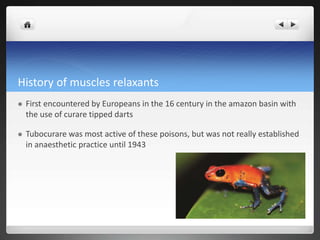
History of muscles relaxants
 First encountered by Europeans in the 16 century in the amazon basin with
the use of curare tipped darts
 Tubocurare was most active of these poisons, but was not really established
in anaesthetic practice until 1943
Depolarizing agents
 Acetylcholine
 Succinylcholine (suxamethonium)
 Decamethonium
 Small molecules , can enter NMJ
Non depolarizing agents
 Aminosteroids eg.pancuronium, vecuronium, rapacuronium, dacuronium,
maloutine, duador, dipyrandium, pipecuronium
 Tetrahydroisoquinoline derivatives atracurium, mivacurium, doxacurium,
tubocurare
 Gallamine
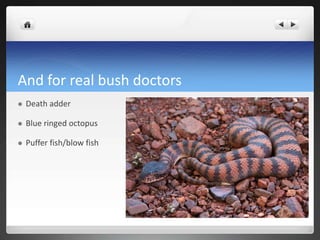
And for real bush doctors
 Death adder
 Blue ringed octopus
 Puffer fish/blow fish
Our choices
 Vecuronium
 Rocuronium
 suxamethonium
rocuronium
 Dose adult RSI 0.6 – 1.2 mg/kg
 Duration of action 30 to 90 minutes
 BMI >40 use ideal body weight x 1.2 mg / kg, provides good or excellent intubation
conditions at 60 seconds ( Gaszynski 2011)
 Tracheal intubation (not RSI) 0.3 or 0.45 – 0.6 mg /kg
 Can be used for ongoing paralysis 0.1 – 0.2 mg/ kg bolus prn or 10 – 12 mcg/kg/min
 Children same dose onset time reduces as dose increases, however not recommended by
manufacturer, however successfully used in children > 1 year (Chong 2002, Fuchs-Buder
1996, Mazurek 1998, Naguib 1997)
Rocuronium continues
 Geriatric dose , same
 Renal impairment, same dose , duration may vary
 Hepatic impairment, no dose change advised from manufacturer, however
ascites may result in need for dose at higher end of range and duration may
be increased
 Stable in D5NS, D5, RL, NS
 Not incompatible with anything we have (mitafungin!)
Adverse reactions
 Cardiovascular , increased peripheral vascular resistance, tachycardia (< 5%,
incidence greater in children), hypertension, transient hypotension
 Hypersensitivity <1%
 Contraindications hypersensitivity to rocuronium , any component thereof
or other neuromuscular blocking drugs
Roc, disease related concerns
 Burn injury , resistance may occur if > 20 % TBSA(Han 2009)
 CV disease, use with caution, action may be delayed and duration prolonged
 Conditions that antagonize neuromuscular blockade: resp alkalosis,
hypercalcaemia, demyelinating lesions, peripheral neuropathies may
antagonize NM blockade (Greenberg 2013, Miller 2010, Naguib 2002)
 Conditions that potentiate NM blockade, v low Ca , low K, cachexia, NM
disease, pH disturbances, myasthenia gravis
 Pulmonary hypertension, may increase PVR
Suxamethonium
 Depolarizing muscle relaxant
 Iv 1- 1.5 mg/kg, can be used IM
 Obesity use total body weight
 Renal imapirment no dosage adjustment
 Hepatic impairment no dosage adjustments
 Compatibility, stable in all common fluids, but incompatible with
thiopentone
Does have a few little problems though
 Cardiovascular: arrhythmias, bradycardia, cardiac arrest, hyper/hypotension,
tachycardia
 Dermatologic: rash
 Metabolic: hyperkalaemia (check K first and all will be well?)
 Gastrointesinal: salivation (excessive)
 Neuromuscular and skeletal, jaw rigidity, muscle fasciculation, post
operative muscle pain, rhabdomyolysis (with possible myoglobinuric renal
failure)
And the rest
 Ocular: increased intraoccular pressure
 Resp: sux apnoea
 Miscellaneous: anaphylaxis, malignant hyperthermia
 Case reports: acute quadriplegic myopathy syndrome, myositis ossificans
(prolonged use)
Case report of hyperkalaemic arrest
 Piotrowski et al. Paed critical care Med 2007: vol8 no2
 Hyperkalaemia and cardiac arrest following succinylcholine administration in
a 16 year old boy with acute non lymphoblastic leukaemia and sepsis
 Pre induction K 3.1 mmol
 30 minutes post sux cardiac arrest K 8.64 mmol
 90 minutes later (survived) K 3.8 mmol/l
Contraindications from up to date
 Hypersensitivity to sux, or any part thereof
 Personal or family history of malignant hyperthermia
 Myopathies associated with a raised CK
 Acute phase injury following major burns
 Multiple trauma !!!
 Extensive denervation of skeletal muscle or upper motor neurone injury
Sux disease related concerns (utd)
 Burns : high risk 7-10 days
 Conditions which may antagonize NMB: alkalosis, hypercalcaemia,
demyelinating lesions, peripheral neuropathies, denervation, infection,
muscle trauma and DM
 Conditions which may potentiate NMB: electrolyte abnormalities, severe
low Na, Low Ca, low K, high Mg, NM disease, acidosis, porphyria,
myaesthenia gravis, Eaton Lambert, renal failure and hepatic failure
 Plasma pseudocholinesterase disorders
Sux drug interactions (utd)
 abobbotulinumtoxinA, Acetylcholinesterase inhibitors, Aminoglycosides
 Analgesia, may increase the bradycardic effect of opiodes
 Bambuterol, clindamycin, cyclophosphamide, cyclosporin, echothiophate
 Lincosamide antibiotics, lithium, loop diuretics (diminish effect), magnesium
salts, phenelzine, polymyxin B, procainamide, quinidine
 Tetracycline derivative
 Vancomycin most of these will enhance effect
If they both new drugs which would you
choose?
Advantages of Rocuronium
 Few side effects
 Few/ no real contraindications
 Predictable dose dependent kinetics
 Safe in burns, hyperkalaemia, renal failure, hepatic failure, denervation
conditions
 Longer duration of action *
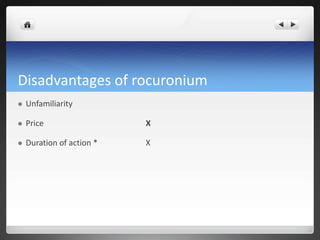
Disadvantages of rocuronium
 Unfamiliarity
 Price
 Duration of action *
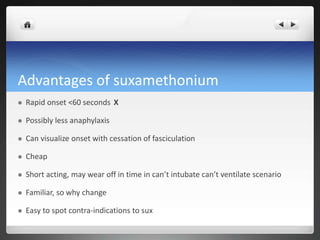
Advantages of suxamethonium
 Rapid onset <60 seconds
 Possibly less anaphylaxis
 Can visualize onset with cessation of fasciculation
 Cheap
 Short acting, may wear off in time in can’t intubate can’t ventilate scenario
 Familiar, so why change
 Easy to spot contra-indications to sux
disadvantages
 Burns
 Hyperkalaemia
 Denervation conditions, MS
 Autonomic instability
 Crush injuries
 Malignant hyperthermia
 Masseter spasm
Sux disadvantages continued
 Bradycardia, increased with second dose or children, incidence reduced with
atropine
 Increased intraoccular pressure, use with caution in narrow angle glaucoma
or penetrating eye injury
 Vagal tone may be increased
So let’s look at those advantages of sux
 First rapid onset
 Sluga et al,Anaesth Analg. 2005: 101:1356-61, prospective study
 Compared 0.6 mg /kg rocuronium with 1 mg / kg suxamethonium
 They found that suxamethonium had a statistically significant improvement
on intubating conditions at 60 seconds
 So far so good?
McCourt et al, Anaesthesia 2006;
101:1356-61
 Compared roc 0.6 mg/kg, 1.0 mg/kg and sux 1.0 mg/kg, ? blinded
 Found 1.0 mg/kg better than 0.6 mg/kg of rocuronium at 50 seconds
 Comparison of the rocuronium 1.0 mg/kg group and the sux 1.0 mg/ kg
group revealed had similar frequency of acceptable intubating conditions at
50 seconds
 However there was a higher incidence of “excellent” intubating conditions in
the sux 1.0 mg/kg group
Lauren et al, Acad Emerg Med 2000;
7:1362-9
 Basically found the same
 They used the same rocuronium doses but 1.7 mg /kg suxamethonium
 so far so good?
however
 Patanwala et al, Comparison of succinylcholine and rocuronium for first
attempt intubation success in the emergency department. Acad Emerg Med.
2011; 18:11-14
 Retrospective analysis
 Compared a mean dose of 1.65 mg/kg of sux (n=113) and roc mean 1.19
mg/kg
 “no difference at success rate for first intubation attempt or number of
attempts regardless of the type of paralytic used or the dose administered.”
Then Cochrane chipped in their 2 cents
worth in 2008
 “rocuronium versus succinylcholine for rapid sequence induction”
 Combined 37 studies
 Concluded “no statistical difference in intubating condition when
[suxamethonium] was compared to 1.2 mg/kg of rocuronium”
 So let’s review the advantages of sux
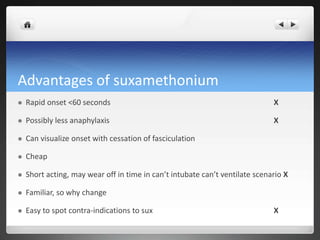
Advantages of suxamethonium
 Rapid onset <60 seconds X
 Possibly less anaphylaxis
 Can visualize onset with cessation of fasciculation
 Cheap
 Short acting, may wear off in time in can’t intubate can’t ventilate scenario
 Familiar, so why change
 Easy to spot contra-indications to sux
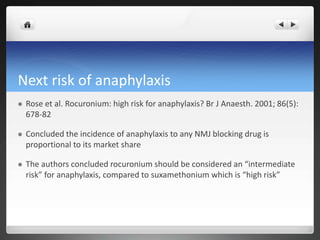
Next risk of anaphylaxis
 Rose et al. Rocuronium: high risk for anaphylaxis? Br J Anaesth. 2001; 86(5):
678-82
 Concluded the incidence of anaphylaxis to any NMJ blocking drug is
proportional to its market share
 The authors concluded rocuronium should be considered an “intermediate
risk” for anaphylaxis, compared to suxamethonium which is “high risk”
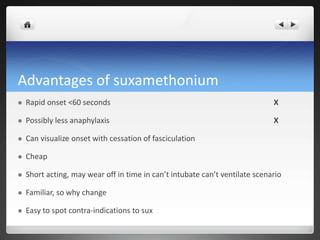
Advantages of suxamethonium
 Rapid onset <60 seconds X
 Possibly less anaphylaxis X
 Can visualize onset with cessation of fasciculation
 Cheap
 Short acting, may wear off in time in can’t intubate can’t ventilate scenario
 Familiar, so why change
 Easy to spot contra-indications to sux
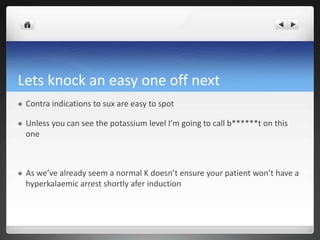
Lets knock an easy one off next
 Contra indications to sux are easy to spot
 Unless you can see the potassium level I’m going to call b******t on this
one
 As we’ve already seem a normal K doesn’t ensure your patient won’t have a
hyperkalaemic arrest shortly afer induction
Advantages of suxamethonium
 Rapid onset <60 seconds X
 Possibly less anaphylaxis X
 Can visualize onset with cessation of fasciculation
 Cheap
 Short acting, may wear off in time in can’t intubate can’t ventilate scenario
 Familiar, so why change
 Easy to spot contra-indications to sux X
However sux is still safer, right?
 Many clinicians believe that by using sux the have inserted a safety margin
into their RSI protocol
 Only lasts 5 to 10 minutes
 NMB may wear off and patient will spontaneously breath, and all will be
well, and they all lived happily ever after…….
 Whereas roc will last 30-90 minutes
Heier et al. Desaturation after succinylcholine-induced apnoea.
Anaesthesiology 2001;94.754-9
 12 healthy volunteers aged 18 -45
 All pre-oxygenated to end-tidal O2 > 90%, after 3 mins FiO2 1.0
 Administration of thiopentone and sux @1mg/kg
 No assisted ventilation
 1/3 desaturated to <80 %, then BVM
 This is not our usual patient cohort
Neguib et al. Succinylcholine dosage and apnoea induced
haemoglobin desauration in patients. Anaesthesiology.
2005;b102(1)35-40
 Similar experiment
 Except used 0.6 mg /kg sux instead of 1.0 mg/kg
 Found SpO2 desaturation to <90% in 65 % (was 85 % in Heier study)
 Did not however shorten time to spontaneous diaphragmatic movement
 Therefore probably doesn’t support the “might be safer as will breathe
yourself” theory
Advantages of suxamethonium
 Rapid onset <60 seconds X
 Possibly less anaphylaxis X
 Can visualize onset with cessation of fasciculation
 Cheap
 Short acting, may wear off in time in can’t intubate can’t ventilate scenario X
 Familiar, so why change
 Easy to spot contra-indications to sux X
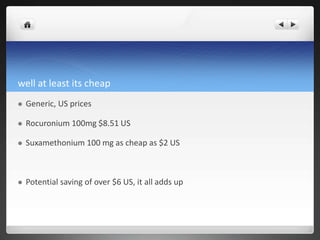
well at least its cheap
 Generic, US prices
 Rocuronium 100mg $8.51 US
 Suxamethonium 100 mg as cheap as $2 US
 Potential saving of over $6 US, it all adds up
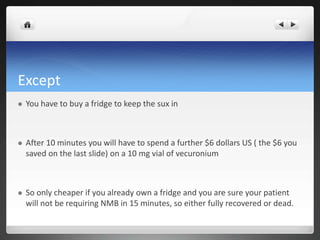
Except
 You have to buy a fridge to keep the sux in
 After 10 minutes you will have to spend a further $6 dollars US ( the $6 you
saved on the last slide) on a 10 mg vial of vecuronium
 So only cheaper if you already own a fridge and you are sure your patient
will not be requiring NMB in 15 minutes, so either fully recovered or dead.
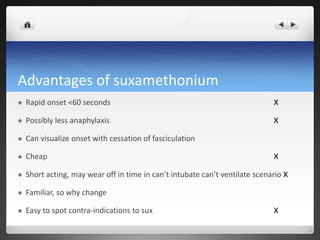
Advantages of suxamethonium
 Rapid onset <60 seconds X
 Possibly less anaphylaxis X
 Can visualize onset with cessation of fasciculation
 Cheap X
 Short acting, may wear off in time in can’t intubate can’t ventilate scenario X
 Familiar, so why change
 Easy to spot contra-indications to sux X
Disadvantages of rocuronium
 Unfamiliarity
 Price X
 Duration of action * X
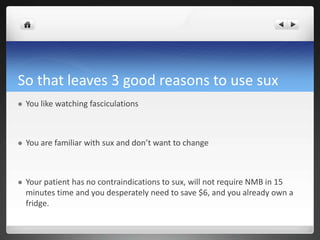
So that leaves 3 good reasons to use sux
 You like watching fasciculations
 You are familiar with sux and don’t want to change
 Your patient has no contraindications to sux, will not require NMB in 15
minutes time and you desperately need to save $6, and you already own a
fridge.
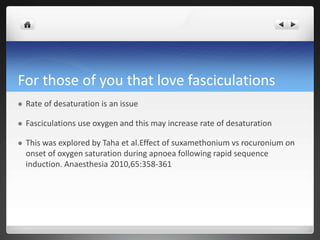
For those of you that love fasciculations
 Rate of desaturation is an issue
 Fasciculations use oxygen and this may increase rate of desaturation
 This was explored by Taha et al.Effect of suxamethonium vs rocuronium on
onset of oxygen saturation during apnoea following rapid sequence
induction. Anaesthesia 2010,65:358-361
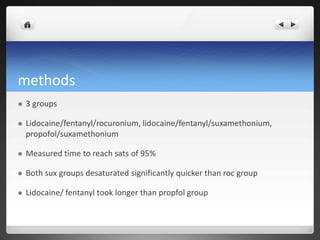
methods
 3 groups
 Lidocaine/fentanyl/rocuronium, lidocaine/fentanyl/suxamethonium,
propofol/suxamethonium
 Measured time to reach sats of 95%
 Both sux groups desaturated significantly quicker than roc group
 Lidocaine/ fentanyl took longer than propfol group
Another study backs this up
 Tang et al. Desaturation following rapid sequence induction using
succinylcholine vs rocuronium in overweight patients. Act Anaesthesiology
scand. 2011; 55:203-6
 BMI of 25-30 undergoing elective surgery
 Either 1.5 mg /kg sux or 0.9 mg/kg rocuronium
 No assisted ventilation until sats <92%
 Measured time to get to 92%, then measured the time to sats >97% with
assisted ventilation
 Results desaturated faster with sux, and took longer to recover sats to 97%
Scared of a little commitment?
Sugammadex, (for those without the
courage of their convictions)
 Effective reversal for rocuronium
 Gamma cyclodextrin that enccapsulates rocuronium
 Lee et al. Reversal of profound neuromuscular block by sugammadex administered 3
minutes after rocuronium. Anaesthesiology. 2009; 110:1020-5
 1.2 mg / kg of rocuronium given
 Then at 3 minutes 16 mg /kg of sugammadex given
 Mean time to 1st twitch on To4 4.4 minutes for roc, 7.1 minutes for sux
 Another study De Boer, Anaesthesiology.2007; 107: 239-44 found the mean recovery to
90 % at 1.9 minutes
Is a long duration of action a good or a bad
thing?
 Encourages definite plan to take control
 Possibly reduces incidence of “can’t ventilate” situations
 Our cohort of patients waking up is not usually an option
 Removes the need for adding a non depolarizing agent in the 10 minutes
post induction, when everything is happening
Going back to the Quairading patient
 Choice of muscle relaxant?
One good reason left to use sux
 You don’t want to change
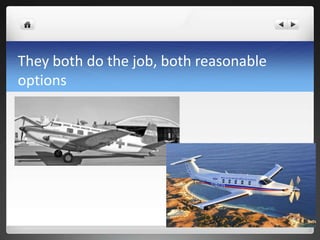
They both do the job, both reasonable
options

Muscle relaxants

  • 1.
    Muscle relaxants Comparison ofthe advantages and disadvantages of rocuronium versus suxamethonium in the setting of rapid sequence induction of anaesthesia in a retrieval setting
  • 2.
  • 3.
    Apologies to anyanaesthetists present
  • 4.
  • 5.
    Few weeks ago Flew into Quairading  53 year old male, 130 kg with asthma  History of NIDDM, 30 cpd smoker  Stable airport pick up  Patient arrived at airstrip not quite so stable
  • 6.
    Things went downhillquickly  Quickly transferred him to the aircraft on NRB, then even more quickly transferred him back off it!  Agitated, sats 85-90%, P120, bilateral creps, hypotensive, on iv salbutamol  BiPaP applied in hanger, transferred back to hospital  Noted ECG to have elevation in aVr and widespread ST depression anterlaterally  CO2 78 HCO3 suggested mostly chronic  Noted cpap machine in patients bag later
  • 7.
    What next?  Transferon BiPaP versus RSI in remote location?  Failing on BiPaP  Not adequately preoxygenated  Likely difficult airway  Possibly hard to bag valve mask ventilate
  • 8.
    Decision to RSI Which induction agent?  Which muscle relaxant?
  • 9.
    History of musclesrelaxants  First encountered by Europeans in the 16 century in the amazon basin with the use of curare tipped darts  Tubocurare was most active of these poisons, but was not really established in anaesthetic practice until 1943
  • 10.
    Depolarizing agents  Acetylcholine Succinylcholine (suxamethonium)  Decamethonium  Small molecules , can enter NMJ
  • 11.
    Non depolarizing agents Aminosteroids eg.pancuronium, vecuronium, rapacuronium, dacuronium, maloutine, duador, dipyrandium, pipecuronium  Tetrahydroisoquinoline derivatives atracurium, mivacurium, doxacurium, tubocurare  Gallamine
  • 12.
    And for realbush doctors  Death adder  Blue ringed octopus  Puffer fish/blow fish
  • 13.
    Our choices  Vecuronium Rocuronium  suxamethonium
  • 14.
    rocuronium  Dose adultRSI 0.6 – 1.2 mg/kg  Duration of action 30 to 90 minutes  BMI >40 use ideal body weight x 1.2 mg / kg, provides good or excellent intubation conditions at 60 seconds ( Gaszynski 2011)  Tracheal intubation (not RSI) 0.3 or 0.45 – 0.6 mg /kg  Can be used for ongoing paralysis 0.1 – 0.2 mg/ kg bolus prn or 10 – 12 mcg/kg/min  Children same dose onset time reduces as dose increases, however not recommended by manufacturer, however successfully used in children > 1 year (Chong 2002, Fuchs-Buder 1996, Mazurek 1998, Naguib 1997)
  • 15.
    Rocuronium continues  Geriatricdose , same  Renal impairment, same dose , duration may vary  Hepatic impairment, no dose change advised from manufacturer, however ascites may result in need for dose at higher end of range and duration may be increased  Stable in D5NS, D5, RL, NS  Not incompatible with anything we have (mitafungin!)
  • 16.
    Adverse reactions  Cardiovascular, increased peripheral vascular resistance, tachycardia (< 5%, incidence greater in children), hypertension, transient hypotension  Hypersensitivity <1%  Contraindications hypersensitivity to rocuronium , any component thereof or other neuromuscular blocking drugs
  • 17.
    Roc, disease relatedconcerns  Burn injury , resistance may occur if > 20 % TBSA(Han 2009)  CV disease, use with caution, action may be delayed and duration prolonged  Conditions that antagonize neuromuscular blockade: resp alkalosis, hypercalcaemia, demyelinating lesions, peripheral neuropathies may antagonize NM blockade (Greenberg 2013, Miller 2010, Naguib 2002)  Conditions that potentiate NM blockade, v low Ca , low K, cachexia, NM disease, pH disturbances, myasthenia gravis  Pulmonary hypertension, may increase PVR
  • 18.
    Suxamethonium  Depolarizing musclerelaxant  Iv 1- 1.5 mg/kg, can be used IM  Obesity use total body weight  Renal imapirment no dosage adjustment  Hepatic impairment no dosage adjustments  Compatibility, stable in all common fluids, but incompatible with thiopentone
  • 19.
    Does have afew little problems though  Cardiovascular: arrhythmias, bradycardia, cardiac arrest, hyper/hypotension, tachycardia  Dermatologic: rash  Metabolic: hyperkalaemia (check K first and all will be well?)  Gastrointesinal: salivation (excessive)  Neuromuscular and skeletal, jaw rigidity, muscle fasciculation, post operative muscle pain, rhabdomyolysis (with possible myoglobinuric renal failure)
  • 20.
    And the rest Ocular: increased intraoccular pressure  Resp: sux apnoea  Miscellaneous: anaphylaxis, malignant hyperthermia  Case reports: acute quadriplegic myopathy syndrome, myositis ossificans (prolonged use)
  • 21.
    Case report ofhyperkalaemic arrest  Piotrowski et al. Paed critical care Med 2007: vol8 no2  Hyperkalaemia and cardiac arrest following succinylcholine administration in a 16 year old boy with acute non lymphoblastic leukaemia and sepsis  Pre induction K 3.1 mmol  30 minutes post sux cardiac arrest K 8.64 mmol  90 minutes later (survived) K 3.8 mmol/l
  • 22.
    Contraindications from upto date  Hypersensitivity to sux, or any part thereof  Personal or family history of malignant hyperthermia  Myopathies associated with a raised CK  Acute phase injury following major burns  Multiple trauma !!!  Extensive denervation of skeletal muscle or upper motor neurone injury
  • 23.
    Sux disease relatedconcerns (utd)  Burns : high risk 7-10 days  Conditions which may antagonize NMB: alkalosis, hypercalcaemia, demyelinating lesions, peripheral neuropathies, denervation, infection, muscle trauma and DM  Conditions which may potentiate NMB: electrolyte abnormalities, severe low Na, Low Ca, low K, high Mg, NM disease, acidosis, porphyria, myaesthenia gravis, Eaton Lambert, renal failure and hepatic failure  Plasma pseudocholinesterase disorders
  • 24.
    Sux drug interactions(utd)  abobbotulinumtoxinA, Acetylcholinesterase inhibitors, Aminoglycosides  Analgesia, may increase the bradycardic effect of opiodes  Bambuterol, clindamycin, cyclophosphamide, cyclosporin, echothiophate  Lincosamide antibiotics, lithium, loop diuretics (diminish effect), magnesium salts, phenelzine, polymyxin B, procainamide, quinidine  Tetracycline derivative  Vancomycin most of these will enhance effect
  • 25.
    If they bothnew drugs which would you choose?
  • 26.
    Advantages of Rocuronium Few side effects  Few/ no real contraindications  Predictable dose dependent kinetics  Safe in burns, hyperkalaemia, renal failure, hepatic failure, denervation conditions  Longer duration of action *
  • 27.
    Disadvantages of rocuronium Unfamiliarity  Price  Duration of action *
  • 28.
    Advantages of suxamethonium Rapid onset <60 seconds  Possibly less anaphylaxis  Can visualize onset with cessation of fasciculation  Cheap  Short acting, may wear off in time in can’t intubate can’t ventilate scenario  Familiar, so why change  Easy to spot contra-indications to sux
  • 29.
    disadvantages  Burns  Hyperkalaemia Denervation conditions, MS  Autonomic instability  Crush injuries  Malignant hyperthermia  Masseter spasm
  • 30.
    Sux disadvantages continued Bradycardia, increased with second dose or children, incidence reduced with atropine  Increased intraoccular pressure, use with caution in narrow angle glaucoma or penetrating eye injury  Vagal tone may be increased
  • 31.
    So let’s lookat those advantages of sux  First rapid onset  Sluga et al,Anaesth Analg. 2005: 101:1356-61, prospective study  Compared 0.6 mg /kg rocuronium with 1 mg / kg suxamethonium  They found that suxamethonium had a statistically significant improvement on intubating conditions at 60 seconds  So far so good?
  • 32.
    McCourt et al,Anaesthesia 2006; 101:1356-61  Compared roc 0.6 mg/kg, 1.0 mg/kg and sux 1.0 mg/kg, ? blinded  Found 1.0 mg/kg better than 0.6 mg/kg of rocuronium at 50 seconds  Comparison of the rocuronium 1.0 mg/kg group and the sux 1.0 mg/ kg group revealed had similar frequency of acceptable intubating conditions at 50 seconds  However there was a higher incidence of “excellent” intubating conditions in the sux 1.0 mg/kg group
  • 33.
    Lauren et al,Acad Emerg Med 2000; 7:1362-9  Basically found the same  They used the same rocuronium doses but 1.7 mg /kg suxamethonium  so far so good?
  • 34.
    however  Patanwala etal, Comparison of succinylcholine and rocuronium for first attempt intubation success in the emergency department. Acad Emerg Med. 2011; 18:11-14  Retrospective analysis  Compared a mean dose of 1.65 mg/kg of sux (n=113) and roc mean 1.19 mg/kg  “no difference at success rate for first intubation attempt or number of attempts regardless of the type of paralytic used or the dose administered.”
  • 35.
    Then Cochrane chippedin their 2 cents worth in 2008  “rocuronium versus succinylcholine for rapid sequence induction”  Combined 37 studies  Concluded “no statistical difference in intubating condition when [suxamethonium] was compared to 1.2 mg/kg of rocuronium”  So let’s review the advantages of sux
  • 36.
    Advantages of suxamethonium Rapid onset <60 seconds X  Possibly less anaphylaxis  Can visualize onset with cessation of fasciculation  Cheap  Short acting, may wear off in time in can’t intubate can’t ventilate scenario  Familiar, so why change  Easy to spot contra-indications to sux
  • 37.
    Next risk ofanaphylaxis  Rose et al. Rocuronium: high risk for anaphylaxis? Br J Anaesth. 2001; 86(5): 678-82  Concluded the incidence of anaphylaxis to any NMJ blocking drug is proportional to its market share  The authors concluded rocuronium should be considered an “intermediate risk” for anaphylaxis, compared to suxamethonium which is “high risk”
  • 38.
    Advantages of suxamethonium Rapid onset <60 seconds X  Possibly less anaphylaxis X  Can visualize onset with cessation of fasciculation  Cheap  Short acting, may wear off in time in can’t intubate can’t ventilate scenario  Familiar, so why change  Easy to spot contra-indications to sux
  • 39.
    Lets knock aneasy one off next  Contra indications to sux are easy to spot  Unless you can see the potassium level I’m going to call b******t on this one  As we’ve already seem a normal K doesn’t ensure your patient won’t have a hyperkalaemic arrest shortly afer induction
  • 40.
    Advantages of suxamethonium Rapid onset <60 seconds X  Possibly less anaphylaxis X  Can visualize onset with cessation of fasciculation  Cheap  Short acting, may wear off in time in can’t intubate can’t ventilate scenario  Familiar, so why change  Easy to spot contra-indications to sux X
  • 41.
    However sux isstill safer, right?  Many clinicians believe that by using sux the have inserted a safety margin into their RSI protocol  Only lasts 5 to 10 minutes  NMB may wear off and patient will spontaneously breath, and all will be well, and they all lived happily ever after…….  Whereas roc will last 30-90 minutes
  • 42.
    Heier et al.Desaturation after succinylcholine-induced apnoea. Anaesthesiology 2001;94.754-9  12 healthy volunteers aged 18 -45  All pre-oxygenated to end-tidal O2 > 90%, after 3 mins FiO2 1.0  Administration of thiopentone and sux @1mg/kg  No assisted ventilation  1/3 desaturated to <80 %, then BVM  This is not our usual patient cohort
  • 43.
    Neguib et al.Succinylcholine dosage and apnoea induced haemoglobin desauration in patients. Anaesthesiology. 2005;b102(1)35-40  Similar experiment  Except used 0.6 mg /kg sux instead of 1.0 mg/kg  Found SpO2 desaturation to <90% in 65 % (was 85 % in Heier study)  Did not however shorten time to spontaneous diaphragmatic movement  Therefore probably doesn’t support the “might be safer as will breathe yourself” theory
  • 44.
    Advantages of suxamethonium Rapid onset <60 seconds X  Possibly less anaphylaxis X  Can visualize onset with cessation of fasciculation  Cheap  Short acting, may wear off in time in can’t intubate can’t ventilate scenario X  Familiar, so why change  Easy to spot contra-indications to sux X
  • 45.
    well at leastits cheap  Generic, US prices  Rocuronium 100mg $8.51 US  Suxamethonium 100 mg as cheap as $2 US  Potential saving of over $6 US, it all adds up
  • 46.
    Except  You haveto buy a fridge to keep the sux in  After 10 minutes you will have to spend a further $6 dollars US ( the $6 you saved on the last slide) on a 10 mg vial of vecuronium  So only cheaper if you already own a fridge and you are sure your patient will not be requiring NMB in 15 minutes, so either fully recovered or dead.
  • 47.
    Advantages of suxamethonium Rapid onset <60 seconds X  Possibly less anaphylaxis X  Can visualize onset with cessation of fasciculation  Cheap X  Short acting, may wear off in time in can’t intubate can’t ventilate scenario X  Familiar, so why change  Easy to spot contra-indications to sux X
  • 48.
    Disadvantages of rocuronium Unfamiliarity  Price X  Duration of action * X
  • 49.
    So that leaves3 good reasons to use sux  You like watching fasciculations  You are familiar with sux and don’t want to change  Your patient has no contraindications to sux, will not require NMB in 15 minutes time and you desperately need to save $6, and you already own a fridge.
  • 50.
    For those ofyou that love fasciculations  Rate of desaturation is an issue  Fasciculations use oxygen and this may increase rate of desaturation  This was explored by Taha et al.Effect of suxamethonium vs rocuronium on onset of oxygen saturation during apnoea following rapid sequence induction. Anaesthesia 2010,65:358-361
  • 51.
    methods  3 groups Lidocaine/fentanyl/rocuronium, lidocaine/fentanyl/suxamethonium, propofol/suxamethonium  Measured time to reach sats of 95%  Both sux groups desaturated significantly quicker than roc group  Lidocaine/ fentanyl took longer than propfol group
  • 52.
    Another study backsthis up  Tang et al. Desaturation following rapid sequence induction using succinylcholine vs rocuronium in overweight patients. Act Anaesthesiology scand. 2011; 55:203-6  BMI of 25-30 undergoing elective surgery  Either 1.5 mg /kg sux or 0.9 mg/kg rocuronium  No assisted ventilation until sats <92%  Measured time to get to 92%, then measured the time to sats >97% with assisted ventilation  Results desaturated faster with sux, and took longer to recover sats to 97%
  • 53.
    Scared of alittle commitment?
  • 54.
    Sugammadex, (for thosewithout the courage of their convictions)  Effective reversal for rocuronium  Gamma cyclodextrin that enccapsulates rocuronium  Lee et al. Reversal of profound neuromuscular block by sugammadex administered 3 minutes after rocuronium. Anaesthesiology. 2009; 110:1020-5  1.2 mg / kg of rocuronium given  Then at 3 minutes 16 mg /kg of sugammadex given  Mean time to 1st twitch on To4 4.4 minutes for roc, 7.1 minutes for sux  Another study De Boer, Anaesthesiology.2007; 107: 239-44 found the mean recovery to 90 % at 1.9 minutes
  • 55.
    Is a longduration of action a good or a bad thing?  Encourages definite plan to take control  Possibly reduces incidence of “can’t ventilate” situations  Our cohort of patients waking up is not usually an option  Removes the need for adding a non depolarizing agent in the 10 minutes post induction, when everything is happening
  • 56.
    Going back tothe Quairading patient  Choice of muscle relaxant?
  • 57.
    One good reasonleft to use sux  You don’t want to change
  • 58.
    They both dothe job, both reasonable options