WILSON’S DISEASE
Copper (Cu)
 Total body copper is about 100mg
 Sources :liver, fish, meat, lentils
milk is a poor source
 RDA: 1-3mg
Functions
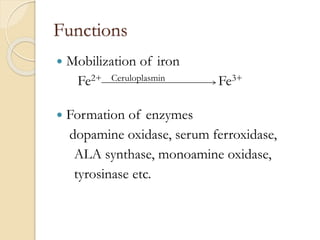
 Mobilization of iron
Fe2+ Ceruloplasmin Fe3+
 Formation of enzymes
dopamine oxidase, serum ferroxidase,
ALA synthase, monoamine oxidase,
tyrosinase etc.
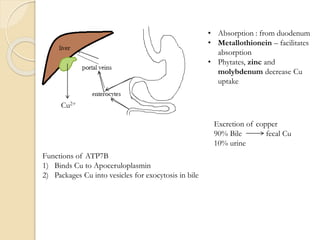
Functions of ATP7B
1) Binds Cu to Apoceruloplasmin
2) Packages Cu into vesicles for exocytosis in bile
Cu2+
• Absorption : from duodenum
• Metallothionein – facilitates
absorption
• Phytates, zinc and
molybdenum decrease Cu
uptake
Excretion of copper
90% Bile fecal Cu
10% urine
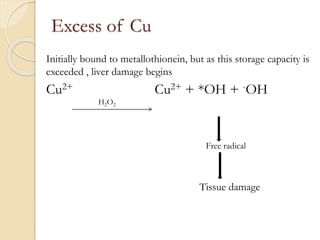
Excess of Cu
Initially bound to metallothionein, but as this storage capacity is
exceeded , liver damage begins
Cu2+ Cu2+ + *OH + -OH
H2O2
Free radical
Tissue damage
DEFINITION
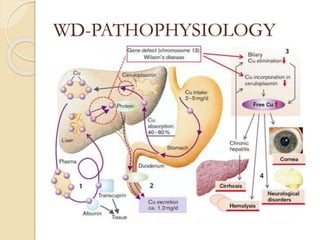
 Wilson’s disease occurs due to a defect of
copper transport by the hepatic lysosomes.
 Genetic defect in excretion of Cu resulting
in excess deposition of Cu in body tissues.
 It is autosomal recessive disorder.
 Frequency of carriers ~1%
 Siblings of diagnosed patient have a 1 in 4
risk
 Whereas children of affected individual
have 1 in 200 risk.
ETIOLOGY
 Mutations in the ATP7B gene,
A membrane bound, copper transporting
ATPase.
WD-PATHOPHYSIOLOGY
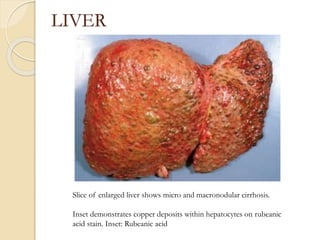
LIVER
Slice of enlarged liver shows micro and macronodular cirrhosis.
Inset demonstrates copper deposits within hepatocytes on rubeanic
acid stain. Inset: Rubeanic acid
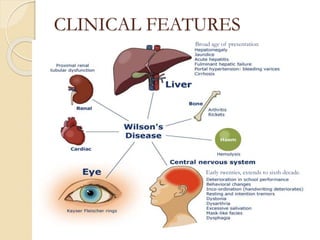
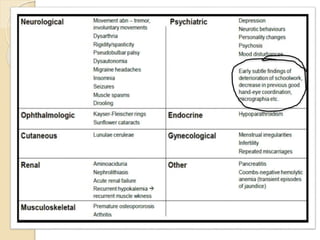
CLINICAL FEATURES
Broad age of presentation
Early twenties, extends to sixth decade.
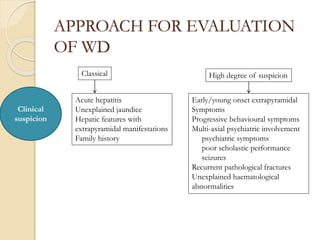
APPROACH FOR EVALUATION
OF WD
Clinical
suspicion
Classical
Acute hepatitis
Unexplained jaundice
Hepatic features with
extrapyramidal manifestations
Family history
High degree of suspicion
Early/young onset extrapyramidal
Symptoms
Progressive behavioural symptoms
Multi-axial psychiatric involvement
psychiatric symptoms
poor scholastic performance
seizures
Recurrent pathological fractures
Unexplained haematological
abnormalities
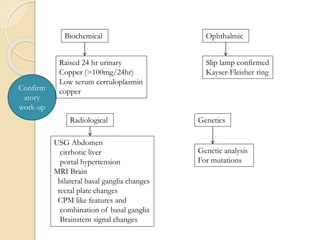
Confirm
atory
work-up
Biochemical
Raised 24 hr urinary
Copper (>100mg/24hr)
Low serum cerruloplasmin
copper
Ophthalmic
Slip lamp confirmed
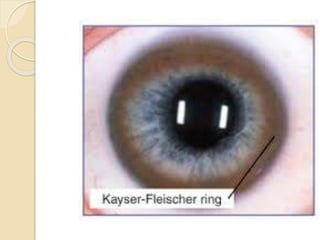
Kayser-Fleisher ring
Radiological
USG Abdomen
cirrhotic liver
portal hypertension
MRI Brain
bilateral basal ganglia changes
tectal plate changes
CPM like features and
combination of basal ganglia
Brainstem signal changes
Genetics
Genetic analysis
For mutations
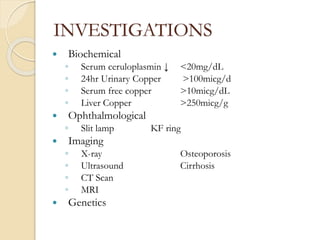
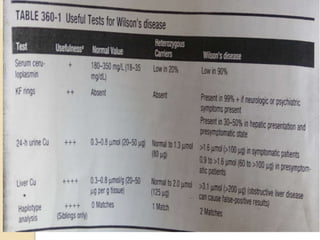
INVESTIGATIONS
 Biochemical
◦ Serum ceruloplasmin ↓ <20mg/dL
◦ 24hr Urinary Copper >100micg/d
◦ Serum free copper >10micg/dL
◦ Liver Copper >250micg/g
 Ophthalmological
◦ Slit lamp KF ring
 Imaging
◦ X-ray Osteoporosis
◦ Ultrasound Cirrhosis
◦ CT Scan
◦ MRI
 Genetics
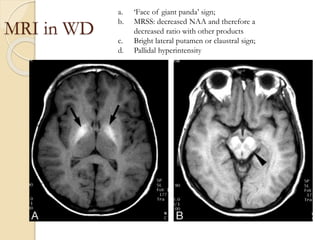
MRI in WD
a. ‘Face of giant panda’ sign;
b. MRSS: decreased NAA and therefore a
decreased ratio with other products
c. Bright lateral putamen or claustral sign;
d. Pallidal hyperintensity
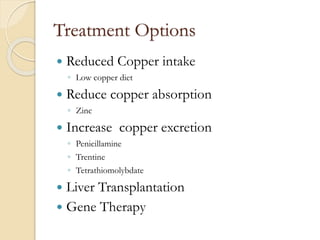
Treatment Options
 Reduced Copper intake
◦ Low copper diet
 Reduce copper absorption
◦ Zinc
 Increase copper excretion
◦ Penicillamine
◦ Trentine
◦ Tetrathiomolybdate
 Liver Transplantation
 Gene Therapy
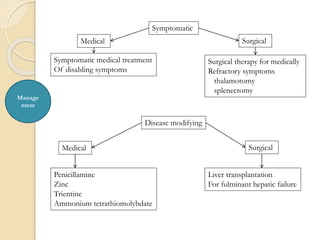
Manage
ment
Symptomatic
Medical Surgical
Symptomatic medical treatment
Of disabling symptoms
Surgical therapy for medically
Refractory symptoms
thalamotomy
splenectomy
Disease modifying
Medical Surgical
Penicillamine
Zinc
Trientine
Ammonium tetrathiomolybdate
Liver transplantation
For fulminant hepatic failure
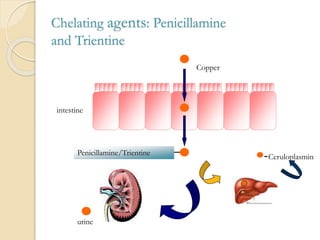
Chelating agents: Penicillamine
and Trientine
intestine
Copper
Ceruloplasmin
Penicillamine/Trientine
urine
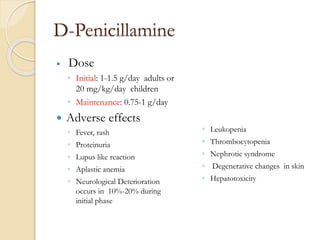
D-Penicillamine
 Dose
◦ Initial: 1-1.5 g/day adults or
20 mg/kg/day children
◦ Maintenance: 0.75-1 g/day
 Adverse effects
◦ Fever, rash
◦ Proteinuria
◦ Lupus like reaction
◦ Aplastic anemia
◦ Neurological Deterioration
occurs in 10%-20% during
initial phase
◦ Leukopenia
◦ Thrombocytopenia
◦ Nephrotic syndrome
◦ Degenerative changes in skin
◦ Hepatotoxicity
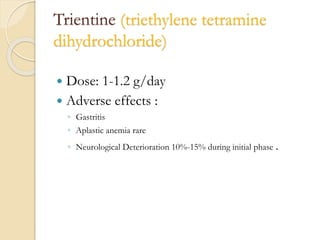
Trientine (triethylene tetramine
dihydrochloride)
 Dose: 1-1.2 g/day
 Adverse effects :
◦ Gastritis
◦ Aplastic anemia rare
◦ Neurological Deterioration 10%-15% during initial phase .
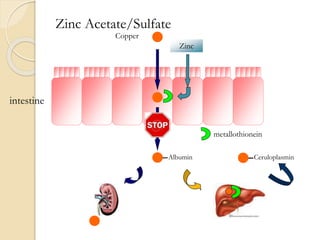
intestine
Copper
Albumin Ceruloplasmin
Zinc
metallothionein
Zinc Acetate/Sulfate
Zinc
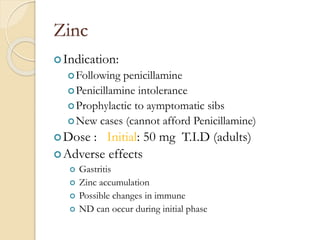
Indication:
Following penicillamine
Penicillamine intolerance
Prophylactic to aymptomatic sibs
New cases (cannot afford Penicillamine)
Dose : Initial: 50 mg T.I.D (adults)
Adverse effects
 Gastritis
 Zinc accumulation
 Possible changes in immune
 ND can occur during initial phase
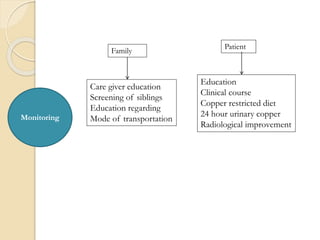
Monitoring
Family
Care giver education
Screening of siblings
Education regarding
Mode of transportation
Patient
Education
Clinical course
Copper restricted diet
24 hour urinary copper
Radiological improvement
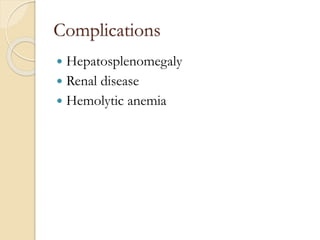
Complications
 Hepatosplenomegaly
 Renal disease
 Hemolytic anemia
Prognosis
 Life long treatment is needed to control
Wilson’s disease.
 If not treated early, Wilson’s disease is fatal.
Wilson's disease

Wilson's disease

  • 1.
  • 2.
    Copper (Cu)  Totalbody copper is about 100mg  Sources :liver, fish, meat, lentils milk is a poor source  RDA: 1-3mg
  • 3.
    Functions  Mobilization ofiron Fe2+ Ceruloplasmin Fe3+  Formation of enzymes dopamine oxidase, serum ferroxidase, ALA synthase, monoamine oxidase, tyrosinase etc.
  • 4.
    Functions of ATP7B 1)Binds Cu to Apoceruloplasmin 2) Packages Cu into vesicles for exocytosis in bile Cu2+ • Absorption : from duodenum • Metallothionein – facilitates absorption • Phytates, zinc and molybdenum decrease Cu uptake Excretion of copper 90% Bile fecal Cu 10% urine
  • 5.
    Excess of Cu Initiallybound to metallothionein, but as this storage capacity is exceeded , liver damage begins Cu2+ Cu2+ + *OH + -OH H2O2 Free radical Tissue damage
  • 6.
    DEFINITION  Wilson’s diseaseoccurs due to a defect of copper transport by the hepatic lysosomes.  Genetic defect in excretion of Cu resulting in excess deposition of Cu in body tissues.  It is autosomal recessive disorder.
  • 7.
     Frequency ofcarriers ~1%  Siblings of diagnosed patient have a 1 in 4 risk  Whereas children of affected individual have 1 in 200 risk.
  • 8.
    ETIOLOGY  Mutations inthe ATP7B gene, A membrane bound, copper transporting ATPase.
  • 9.
  • 10.
    LIVER Slice of enlargedliver shows micro and macronodular cirrhosis. Inset demonstrates copper deposits within hepatocytes on rubeanic acid stain. Inset: Rubeanic acid
  • 11.
    CLINICAL FEATURES Broad ageof presentation Early twenties, extends to sixth decade.
  • 14.
    APPROACH FOR EVALUATION OFWD Clinical suspicion Classical Acute hepatitis Unexplained jaundice Hepatic features with extrapyramidal manifestations Family history High degree of suspicion Early/young onset extrapyramidal Symptoms Progressive behavioural symptoms Multi-axial psychiatric involvement psychiatric symptoms poor scholastic performance seizures Recurrent pathological fractures Unexplained haematological abnormalities
  • 15.
    Confirm atory work-up Biochemical Raised 24 hrurinary Copper (>100mg/24hr) Low serum cerruloplasmin copper Ophthalmic Slip lamp confirmed Kayser-Fleisher ring Radiological USG Abdomen cirrhotic liver portal hypertension MRI Brain bilateral basal ganglia changes tectal plate changes CPM like features and combination of basal ganglia Brainstem signal changes Genetics Genetic analysis For mutations
  • 16.
    INVESTIGATIONS  Biochemical ◦ Serumceruloplasmin ↓ <20mg/dL ◦ 24hr Urinary Copper >100micg/d ◦ Serum free copper >10micg/dL ◦ Liver Copper >250micg/g  Ophthalmological ◦ Slit lamp KF ring  Imaging ◦ X-ray Osteoporosis ◦ Ultrasound Cirrhosis ◦ CT Scan ◦ MRI  Genetics
  • 17.
    MRI in WD a.‘Face of giant panda’ sign; b. MRSS: decreased NAA and therefore a decreased ratio with other products c. Bright lateral putamen or claustral sign; d. Pallidal hyperintensity
  • 19.
    Treatment Options  ReducedCopper intake ◦ Low copper diet  Reduce copper absorption ◦ Zinc  Increase copper excretion ◦ Penicillamine ◦ Trentine ◦ Tetrathiomolybdate  Liver Transplantation  Gene Therapy
  • 20.
    Manage ment Symptomatic Medical Surgical Symptomatic medicaltreatment Of disabling symptoms Surgical therapy for medically Refractory symptoms thalamotomy splenectomy Disease modifying Medical Surgical Penicillamine Zinc Trientine Ammonium tetrathiomolybdate Liver transplantation For fulminant hepatic failure
  • 21.
    Chelating agents: Penicillamine andTrientine intestine Copper Ceruloplasmin Penicillamine/Trientine urine
  • 22.
    D-Penicillamine  Dose ◦ Initial:1-1.5 g/day adults or 20 mg/kg/day children ◦ Maintenance: 0.75-1 g/day  Adverse effects ◦ Fever, rash ◦ Proteinuria ◦ Lupus like reaction ◦ Aplastic anemia ◦ Neurological Deterioration occurs in 10%-20% during initial phase ◦ Leukopenia ◦ Thrombocytopenia ◦ Nephrotic syndrome ◦ Degenerative changes in skin ◦ Hepatotoxicity
  • 23.
    Trientine (triethylene tetramine dihydrochloride) Dose: 1-1.2 g/day  Adverse effects : ◦ Gastritis ◦ Aplastic anemia rare ◦ Neurological Deterioration 10%-15% during initial phase .
  • 24.
  • 25.
    Zinc Indication: Following penicillamine Penicillamine intolerance Prophylacticto aymptomatic sibs New cases (cannot afford Penicillamine) Dose : Initial: 50 mg T.I.D (adults) Adverse effects  Gastritis  Zinc accumulation  Possible changes in immune  ND can occur during initial phase
  • 26.
    Monitoring Family Care giver education Screeningof siblings Education regarding Mode of transportation Patient Education Clinical course Copper restricted diet 24 hour urinary copper Radiological improvement
  • 27.
  • 28.
    Prognosis  Life longtreatment is needed to control Wilson’s disease.  If not treated early, Wilson’s disease is fatal.