Overview
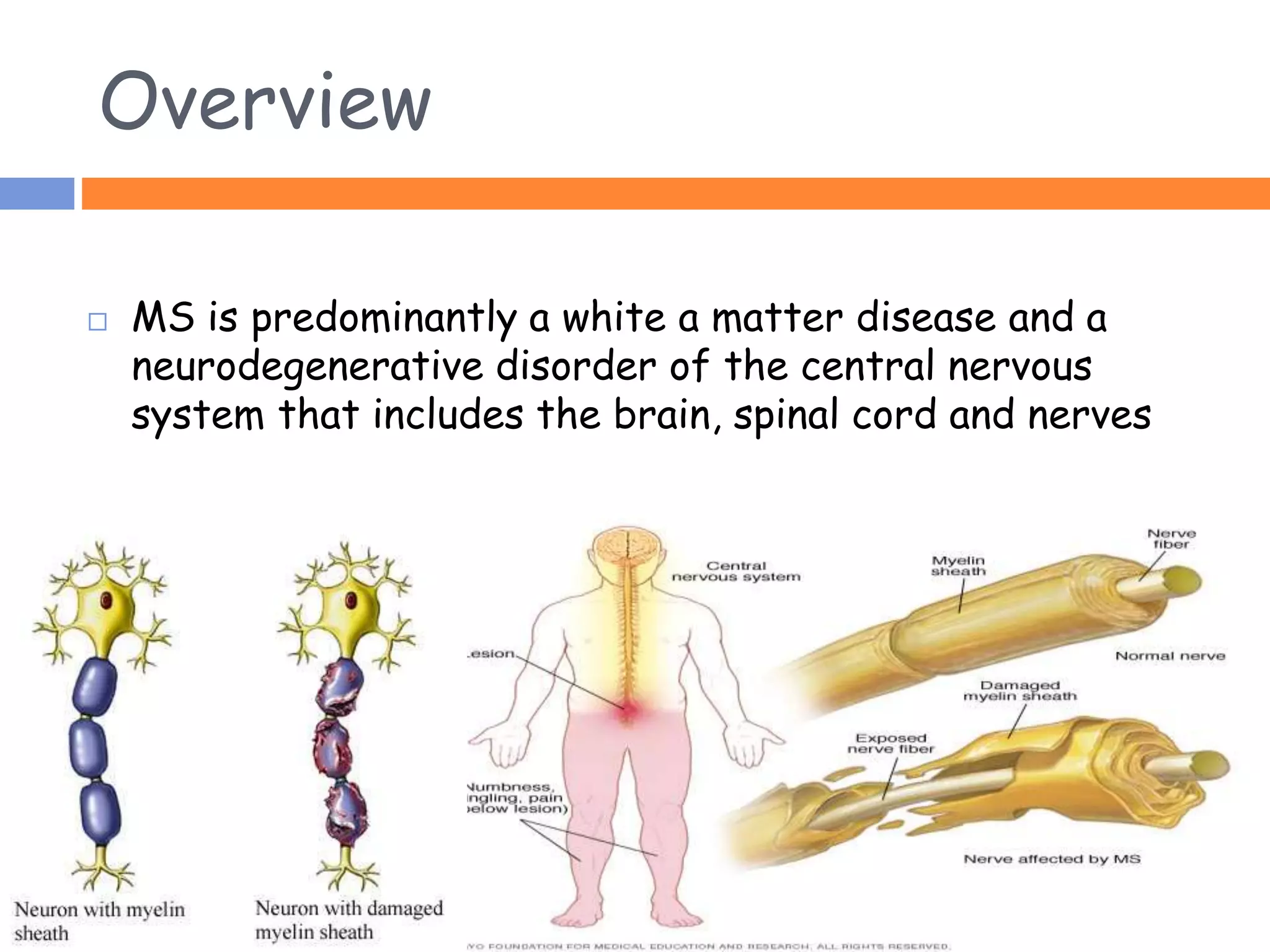
 MS is predominantly a white a matter disease and a
neurodegenerative disorder of the central nervous
system that includes the brain, spinal cord and nerves
Introduction
 It is an inflammatory and demyelinating disease.
 Inflammation: body’s own immune cells attack the
nervous system.
 Demyelination: myelin (protective covering of the
nerves) is destroyed leaving multiple areas of scar
tissue or sclerosis.
 It is progressive disease
 Most common age of occurrence – between 20 and 40
Epidemiology
 MS is particularly common in northern Europe , the
northern U.S.A., southern Canada, New Zealand, and
southwest Australia.
 Worldwide occurrence:1.1 – 2.5 million cases.
 Its not contagious.
 There are the main of peculiarities:
1. MS affects women more than men in a ratio
of about 1.5 to 1.
2. There are also some clinical differences in
different localities.
3. MS is predominantly a disease of young
adults.
Risk factors
Etiology
There are some of the causes :
1) Genetic susceptibility
2)Infections (rubella, mumps, corona virus, parainfluenza,
herpes simplex, Epstein-Barr, human T-cell lymphotropic
virus type I viruses)
3) Dysbalance of steroid hormones (estrogenic)
4)Geographical (ground, water properties) other (toxic,
trauma)
Signs and symptoms
Clinical manifestation
 Retro bulbar neuritis
 Disturbances of ocular motility
 Lhermitte sign
 Pyramidal tract signs
 Cerebellar signs
 Gait impairment
 Sensory deficits
 Bladder dysfunction
 Ictal phenomena
 Mental disturbances
Retro bulbar neuritis
 Retro bulbar neuritis is usually
unilateral
 Patient develops
Impairment of color vision
Impairment of visual acuity
(finger counting is barely possible).
Orbital pain is often present
Able to see flashes of light on
movement of globe
The temporal side of the optic
disc becomes pale three or four weeks.
Retro bulbar neuritis rarely
affects both eyes, either at the same
time
Disturbance in ocular motility
 Diplopia particularly due to abducens palsy
, is a common early symptom.
 Nystagmus
 Internuclear ophthalmoplegia in a young
patient is relatively specific for multiple
sclerosis. This condition is caused by a
lesion of the medial longitudinal fasciculus
(MLF).
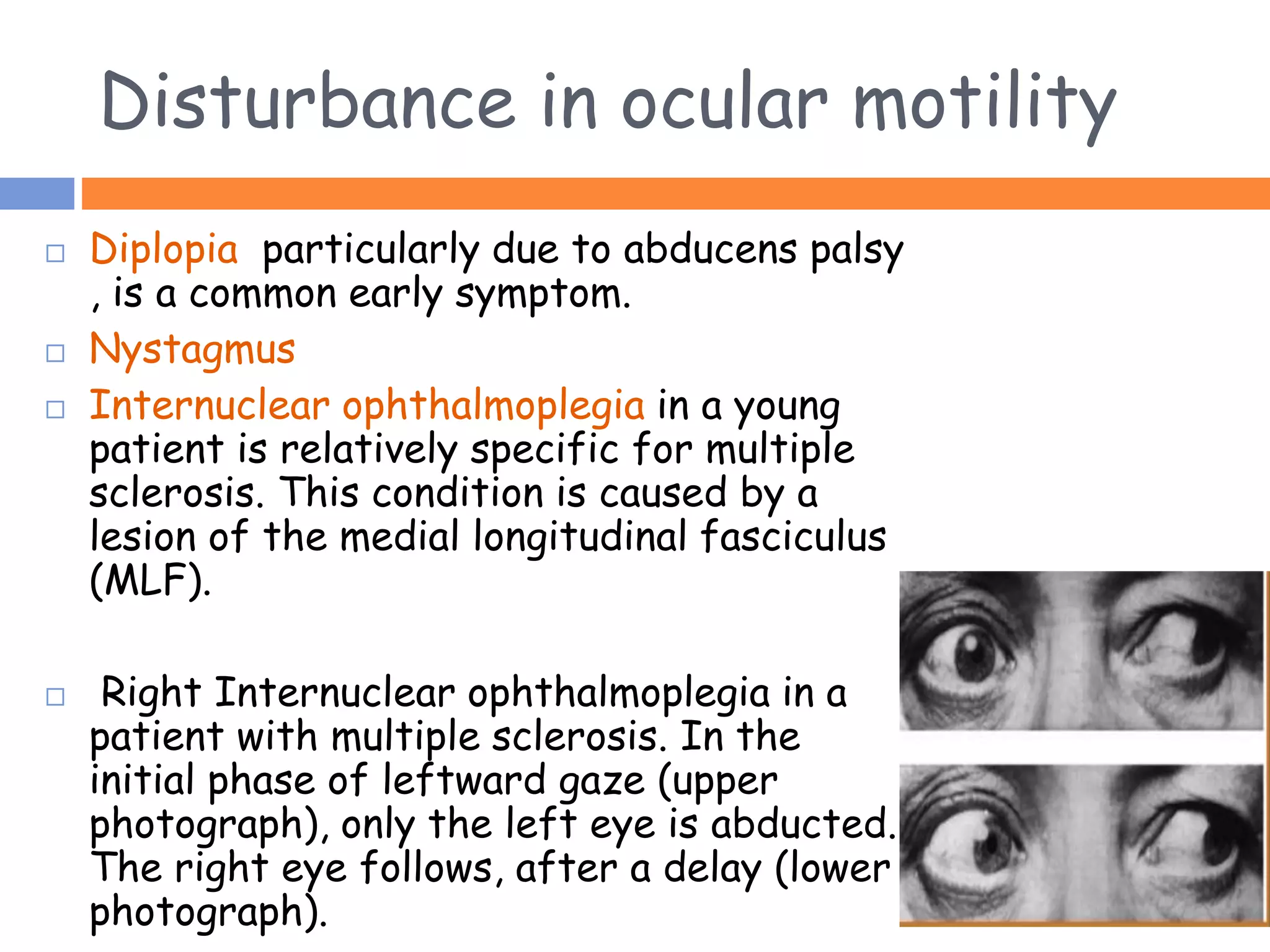
 Right Internuclear ophthalmoplegia in a
patient with multiple sclerosis. In the
initial phase of leftward gaze (upper
photograph), only the left eye is abducted.
The right eye follows, after a delay (lower
photograph).
Pyramidal tract signs
 Pyramidal tract signs and exaggerated intrinsic muscle
reflexes may be present early in the course of the
disease.
 Abdominal cutaneous reflexes are absent.
 Spastic paraparesis or quadriparesis develops.
 Motor disturbances:
(central paresis, spasticity, abnormal fatigability)
Cerebral signs
 Present in advanced MS
impaired coordination , ataxia ,
and frequently a very characteristic
intention tremor.
 Gait impairment
severe early in the course of
the disease.
spastic paraparesis and
ataxia results in a spastic−ataxic,
uneven, uncoordinated, and
stiff gait .
MS degrees
I – patient has difficulty to walk only after physical
training
II – patient has difficulty to walk and weakness on 2-3 km
III – patient has spastic-paretic gait, difficulty to walk
and weakness on 200-300m
IV – patient can not to walk without help
V – patient can not to walk or has blindness
Differential diagnosis
Multiple sclerosis
Multiple sclerosis
Multiple sclerosis
Multiple sclerosis
Multiple sclerosis
Multiple sclerosis

Multiple sclerosis

  • 2.
    Overview  MS ispredominantly a white a matter disease and a neurodegenerative disorder of the central nervous system that includes the brain, spinal cord and nerves
  • 3.
    Introduction  It isan inflammatory and demyelinating disease.  Inflammation: body’s own immune cells attack the nervous system.  Demyelination: myelin (protective covering of the nerves) is destroyed leaving multiple areas of scar tissue or sclerosis.  It is progressive disease  Most common age of occurrence – between 20 and 40
  • 4.
    Epidemiology  MS isparticularly common in northern Europe , the northern U.S.A., southern Canada, New Zealand, and southwest Australia.  Worldwide occurrence:1.1 – 2.5 million cases.  Its not contagious.  There are the main of peculiarities: 1. MS affects women more than men in a ratio of about 1.5 to 1. 2. There are also some clinical differences in different localities. 3. MS is predominantly a disease of young adults.
  • 6.
  • 7.
    Etiology There are someof the causes : 1) Genetic susceptibility 2)Infections (rubella, mumps, corona virus, parainfluenza, herpes simplex, Epstein-Barr, human T-cell lymphotropic virus type I viruses) 3) Dysbalance of steroid hormones (estrogenic) 4)Geographical (ground, water properties) other (toxic, trauma)
  • 10.
  • 11.
    Clinical manifestation  Retrobulbar neuritis  Disturbances of ocular motility  Lhermitte sign  Pyramidal tract signs  Cerebellar signs  Gait impairment  Sensory deficits  Bladder dysfunction  Ictal phenomena  Mental disturbances
  • 12.
    Retro bulbar neuritis Retro bulbar neuritis is usually unilateral  Patient develops Impairment of color vision Impairment of visual acuity (finger counting is barely possible). Orbital pain is often present Able to see flashes of light on movement of globe The temporal side of the optic disc becomes pale three or four weeks. Retro bulbar neuritis rarely affects both eyes, either at the same time
  • 13.
    Disturbance in ocularmotility  Diplopia particularly due to abducens palsy , is a common early symptom.  Nystagmus  Internuclear ophthalmoplegia in a young patient is relatively specific for multiple sclerosis. This condition is caused by a lesion of the medial longitudinal fasciculus (MLF).  Right Internuclear ophthalmoplegia in a patient with multiple sclerosis. In the initial phase of leftward gaze (upper photograph), only the left eye is abducted. The right eye follows, after a delay (lower photograph).
  • 14.
    Pyramidal tract signs Pyramidal tract signs and exaggerated intrinsic muscle reflexes may be present early in the course of the disease.  Abdominal cutaneous reflexes are absent.  Spastic paraparesis or quadriparesis develops.  Motor disturbances: (central paresis, spasticity, abnormal fatigability)
  • 15.
    Cerebral signs  Presentin advanced MS impaired coordination , ataxia , and frequently a very characteristic intention tremor.  Gait impairment severe early in the course of the disease. spastic paraparesis and ataxia results in a spastic−ataxic, uneven, uncoordinated, and stiff gait .
  • 16.
    MS degrees I –patient has difficulty to walk only after physical training II – patient has difficulty to walk and weakness on 2-3 km III – patient has spastic-paretic gait, difficulty to walk and weakness on 200-300m IV – patient can not to walk without help V – patient can not to walk or has blindness
  • 17.