Prepared By: Rozelle Mae Birador
Huntington’s Disease
Huntington’s Disease or HD is a progressive or
degenerative brain disorder or also known as a
Neurodegenerative. Huntington’s slowly diminishes
the ability think, walk, and talk. Chorea are jerking
motions which is a developed symptom of HD. HD
slowly ruins the nerves in your brain. As of the
science right now Huntingtons is an incurable
disease.
The Discovery of HD
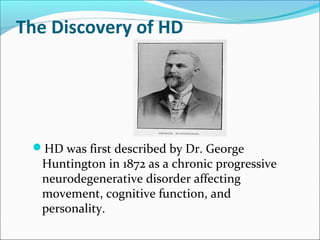
HD was first described by Dr. George
Huntington in 1872 as a chronic progressive
neurodegenerative disorder affecting
movement, cognitive function, and
personality.
What causes it?
Huntington’s is caused by an abnormality of the 4th
chromosome and HTT gene(makes huntingtin), and
the gene mutates,making a defective protein. This
flawed gene holds the blueprint for the defective
version of the protein “huntingtin.” The Huntington
gene defect also has 40 repeats of genetic code, unlike
the normal gene that only has 17-20 repetitions.
What parts of the body are affected?
Huntington’s affects you neurons(brain cells),
eyes, and muscles by destroying the
interneuron,motor and sensory neurons.
Etiology and Pathophysiology
1. Inherited disorder, considered autosomal dominant
2. Progressive atrophy of the basal ganglia and some
portions od the cerebral cortex
3. Appears during the middle adult years
4. Onset usually occurs between the age of 30-50,
death usually follow 12 years after onset
Pathophysiology Continued
mHtt will cause decaying of neurons in various
regions of the brain such as the basal ganglia, frontal
and temporal lobe
Basal ganglia is responsible for motor function
control, cognition, emotion, and learning
Sign and Symptoms
Subjective
Memory loss
Disorientation
Eventual dementia
Sign and Symptoms
Objective
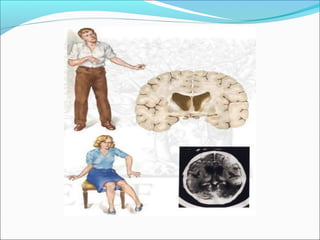
Uncontrolled jerky movements of the extremities,
trunk, face, or tongue
Disorganized gait
Uncontrolled periods of anger
Hesitant or explosive patterns of speech
Grimacing facial movements
Impaired chewing and swallowing
Incontinence
What are the Exams or Tests?
There exams or tests for Huntington’s Chorea are a
test to see if you have the genetic mutation of gene
HTT, and how many repeats are within the HTT gene.
Therapeutic Interventions
1. Control of jerky movements with phenothiazines,
butyrophenones, and thioxanthenes
2. Reserpine may be used to decrease presynaptic
dopamine and tetrabenzine to reduce dopaminergic
transmission
3. Symptoms are treated as they occur
What are treatments for Chorea?
Deep brain stimulation - A procedure in which
miniature electrodes that release pulses of electricity
are implanted into the brain. This treatment may
prove useful for reducing symptoms of uncontrollable
movement known as chorea in patients with HD.
Atypical antipsychotic drugs also have been proven to
help with Chorea
What is an appropriate diet?
An appropriate diet for Huntington’s Chorea is
 Avoid Tyramine foods (red-wine, aged cheese)
Antioxidants (blueberries)
Phytonutrients (Tomatoes, pink grapefruit,
watermelon, guava)
High Calorie Snacks
Nutrient dense foods (Lobster)
Nursing care of Clients with
Hungtington’s Chorea
Assessment
Neurologic status, noting uncontrolled movements
and cognitive ability
Family history of Hungtington’s chorea
Nursing care of Clients with
Hungtington’s Chorea
Analysis/ Nursing Diagnoses
Risk for aspiration
Body image disturbance
Bowel incontinence
Chronic confusion
Risk for injury
Altered role performance
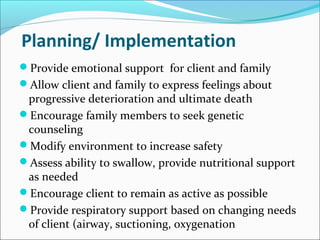
Planning/ Implementation
Provide emotional support for client and family
Allow client and family to express feelings about
progressive deterioration and ultimate death
Encourage family members to seek genetic
counseling
Modify environment to increase safety
Assess ability to swallow, provide nutritional support
as needed
Encourage client to remain as active as possible
Provide respiratory support based on changing needs
of client (airway, suctioning, oxygenation
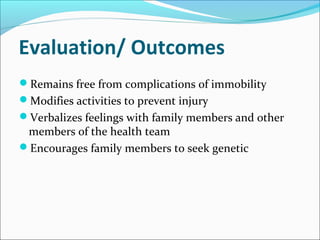
Evaluation/ Outcomes
Remains free from complications of immobility
Modifies activities to prevent injury
Verbalizes feelings with family members and other
members of the health team
Encourages family members to seek genetic
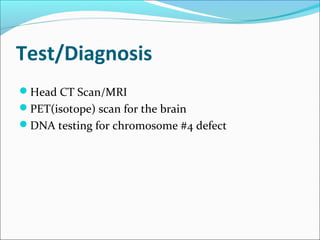
Test/Diagnosis
Head CT Scan/MRI
PET(isotope) scan for the brain
DNA testing for chromosome #4 defect

HUNGTINGTON'S CHOREA

  • 1.
  • 3.
    Huntington’s Disease Huntington’s Diseaseor HD is a progressive or degenerative brain disorder or also known as a Neurodegenerative. Huntington’s slowly diminishes the ability think, walk, and talk. Chorea are jerking motions which is a developed symptom of HD. HD slowly ruins the nerves in your brain. As of the science right now Huntingtons is an incurable disease.
  • 4.
    The Discovery ofHD HD was first described by Dr. George Huntington in 1872 as a chronic progressive neurodegenerative disorder affecting movement, cognitive function, and personality.
  • 5.
    What causes it? Huntington’sis caused by an abnormality of the 4th chromosome and HTT gene(makes huntingtin), and the gene mutates,making a defective protein. This flawed gene holds the blueprint for the defective version of the protein “huntingtin.” The Huntington gene defect also has 40 repeats of genetic code, unlike the normal gene that only has 17-20 repetitions.
  • 6.
    What parts ofthe body are affected? Huntington’s affects you neurons(brain cells), eyes, and muscles by destroying the interneuron,motor and sensory neurons.
  • 7.
    Etiology and Pathophysiology 1.Inherited disorder, considered autosomal dominant 2. Progressive atrophy of the basal ganglia and some portions od the cerebral cortex 3. Appears during the middle adult years 4. Onset usually occurs between the age of 30-50, death usually follow 12 years after onset
  • 8.
    Pathophysiology Continued mHtt willcause decaying of neurons in various regions of the brain such as the basal ganglia, frontal and temporal lobe Basal ganglia is responsible for motor function control, cognition, emotion, and learning
  • 9.
    Sign and Symptoms Subjective Memoryloss Disorientation Eventual dementia
  • 10.
    Sign and Symptoms Objective Uncontrolledjerky movements of the extremities, trunk, face, or tongue Disorganized gait Uncontrolled periods of anger Hesitant or explosive patterns of speech Grimacing facial movements Impaired chewing and swallowing Incontinence
  • 11.
    What are theExams or Tests? There exams or tests for Huntington’s Chorea are a test to see if you have the genetic mutation of gene HTT, and how many repeats are within the HTT gene.
  • 12.
    Therapeutic Interventions 1. Controlof jerky movements with phenothiazines, butyrophenones, and thioxanthenes 2. Reserpine may be used to decrease presynaptic dopamine and tetrabenzine to reduce dopaminergic transmission 3. Symptoms are treated as they occur
  • 13.
    What are treatmentsfor Chorea? Deep brain stimulation - A procedure in which miniature electrodes that release pulses of electricity are implanted into the brain. This treatment may prove useful for reducing symptoms of uncontrollable movement known as chorea in patients with HD. Atypical antipsychotic drugs also have been proven to help with Chorea
  • 14.
    What is anappropriate diet? An appropriate diet for Huntington’s Chorea is  Avoid Tyramine foods (red-wine, aged cheese) Antioxidants (blueberries) Phytonutrients (Tomatoes, pink grapefruit, watermelon, guava) High Calorie Snacks Nutrient dense foods (Lobster)
  • 15.
    Nursing care ofClients with Hungtington’s Chorea Assessment Neurologic status, noting uncontrolled movements and cognitive ability Family history of Hungtington’s chorea
  • 16.
    Nursing care ofClients with Hungtington’s Chorea Analysis/ Nursing Diagnoses Risk for aspiration Body image disturbance Bowel incontinence Chronic confusion Risk for injury Altered role performance
  • 17.
    Planning/ Implementation Provide emotionalsupport for client and family Allow client and family to express feelings about progressive deterioration and ultimate death Encourage family members to seek genetic counseling Modify environment to increase safety Assess ability to swallow, provide nutritional support as needed Encourage client to remain as active as possible Provide respiratory support based on changing needs of client (airway, suctioning, oxygenation
  • 18.
    Evaluation/ Outcomes Remains freefrom complications of immobility Modifies activities to prevent injury Verbalizes feelings with family members and other members of the health team Encourages family members to seek genetic
  • 19.
    Test/Diagnosis Head CT Scan/MRI PET(isotope)scan for the brain DNA testing for chromosome #4 defect