PREPARED BY
PROF. BLESSY THOMAS
MSC NURSING
MSN (NEUROSCIENCE NURSING)
FNCON ,SPN
MULTIPLE SCLEROSIS
• Multiple means many, sclerosis means dissemination or
degeneration.
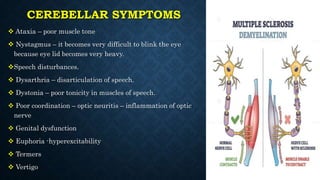
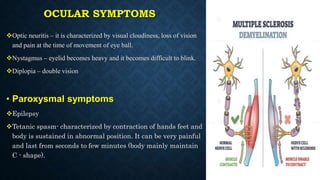
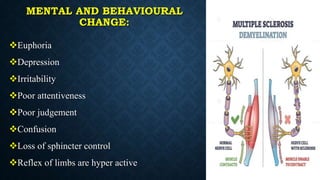
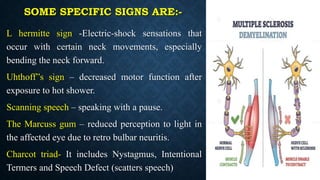
• Multiple Sclerosis is a chronic progressive neurological
disorder characterized by demyelination (damaging of
myelin sheath) of nerve fibers of brain and spinal cord.
DEFINITION
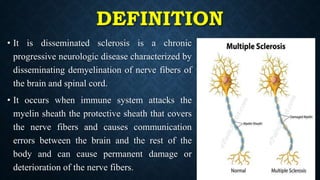
• It is disseminated sclerosis is a chronic
progressive neurologic disease characterized by
disseminating demyelination of nerve fibers of
the brain and spinal cord.
• It occurs when immune system attacks the
myelin sheath the protective sheath that covers
the nerve fibers and causes communication
errors between the brain and the rest of the
body and can cause permanent damage or
deterioration of the nerve fibers.
INCIDENCE
More common in women or female.
Occurs mainly in 20-40 years of age.
Only 20% peoples are affected after 50 years of age.
Family history of multiple sclerosis.
CAUSES
Unknown
An autoimmune disease
Slow virus theory where some viral infection causes the disease.
Hereditary factors
Some environmental factors
RISK FACTORS
Age- can occur at any age, but onset usually occurs around 20 and 40
years of age.
Gender -Women are more than 2 to 3 times as likely as men.
Family history- If the disease is running in family there is higher risk
of developing the disease.
Infections- Epstein-Barr, the virus that causes infectious
mononucleosis.
Climate- common in countries with temperate climates.
Vitamin D deficiency
Obesity -An association with obesity and multiple sclerosis has been
found in females. This is especially true for female childhood and
adolescent obesity.
RISK FACTORS
Certain autoimmune diseases- people with the disorders
such as thyroid disease, pernicious anaemia, psoriasis,
type 1 diabetes or inflammatory bowel disease.
Smoking habit.
CLASSIFICATION
Clinically isolated syndrome (CIS):
In this type the patient experiences the first
episodes of symptoms but doesn’t meet the criteria of
multiple sclerosis and later it may develop into MS.
RELAPSING-REMITTING MULTIPLE
SCLEROSIS (RRMS):
This is the most common way that multiple sclerosis .
85% of people diagnosed with MS have this type.
MS causes flare-ups (relapses or attacks) of new or old
symptoms.

Periods of remission follow (when symptoms stabilize or
go away).
SECONDARY PROGRESSIVE MULTIPLE
SCLEROSIS (SPMS):
 RRMS eventually progresses to SPMS.
 Nerve damage accumulates and symptoms gradually
worsen.
 Patients experience some relapses or flares, but periods
of remission (a state that symptoms stabilize or go away)
are less likely to happen.
 50% of patients will not return to normal condition.
CHRONIC PROGRESSIVE /PRIMARY
PROGRESSIVE MULTIPLE SCLEROSIS
(PPMS):
MS symptoms may start off slowly and gradually
worsen over time from the starting stage.
Cerebral or spinal dysfunction occurs.
Poor coordination and sensory loss will occur.
There will be any periods of clear relapses or remission
STABLE MULTIPLE SCLEROSIS
Patient becomes completely disable
No recovery is possible.
MS VARIANTS
Tumefactive multiple sclerosis:
The formation of large areas of demyelination in the
brain, which may appear similar to tumors.
Balo’s concentric sclerosis:
Lesions with the appearance of concentric rings (in the
shape of a target) of myelin damage appearing on an
MRI.
MARBURG VARIANT MULTIPLE
SCLEROSIS:
 It is a very rare and aggressive form of MS
characterized by rapid progression, which may result in
death if left untreated.
PATHOPHYSIOLOGY
Due to etiological factors.
T -cell abnormally crosses the BBB (blood brain barrier).
In brain T cell are over active or hyper stimulated.
Over production of cytokinin.
This cytokinin stimulate B cell, microphages, microglia.
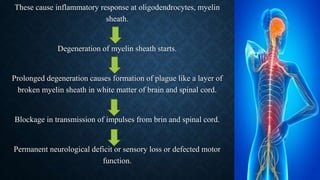
These cause inflammatory response at oligodendrocytes, myelin
sheath.
Degeneration of myelin sheath starts.
Prolonged degeneration causes formation of plague like a layer of
broken myelin sheath in white matter of brain and spinal cord.
Blockage in transmission of impulses from brin and spinal cord.
Permanent neurological deficit or sensory loss or defected motor
function.
CLINICAL MANIFESTATIONS
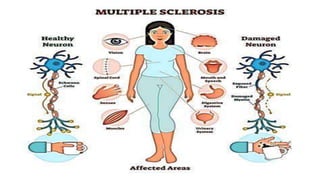
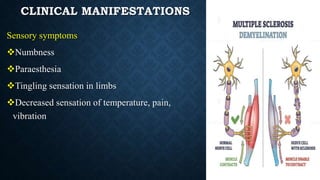
Sensory symptoms
Numbness
Paraesthesia
Tingling sensation in limbs
Decreased sensation of temperature, pain,
vibration
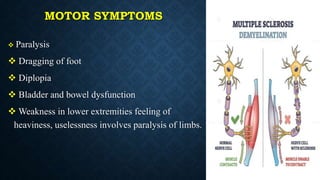
MOTOR SYMPTOMS
 Paralysis
 Dragging of foot
 Diplopia
 Bladder and bowel dysfunction
 Weakness in lower extremities feeling of
heaviness, uselessness involves paralysis of limbs.
CEREBELLAR SYMPTOMS
 Ataxia – poor muscle tone
 Nystagmus – it becomes very difficult to blink the eye
because eye lid becomes very heavy.
Speech disturbances.
 Dysarthria – disarticulation of speech.
 Dystonia – poor tonicity in muscles of speech.
 Poor coordination – optic neuritis – inflammation of optic
nerve
 Genital dysfunction
 Euphoria -hyperexcitability
 Termers
 Vertigo
OCULAR SYMPTOMS
Optic neuritis – it is characterized by visual cloudiness, loss of vision
and pain at the time of movement of eye ball.
Nystagmus – eyelid becomes heavy and it becomes difficult to blink.
Diplopia – double vision
• Paroxysmal symptoms
Epilepsy
Tetanic spasm- characterized by contraction of hands feet and
body is sustained in abnormal position. It can be very painful
and last from seconds to few minutes (body mainly maintain
C - shape).
MENTAL AND BEHAVIOURAL
CHANGE:
Euphoria
Depression
Irritability
Poor attentiveness
Poor judgement
Confusion
Loss of sphincter control
Reflex of limbs are hyper active
SOME SPECIFIC SIGNS ARE:-
L hermitte sign -Electric-shock sensations that
occur with certain neck movements, especially
bending the neck forward.
Uhthoff”s sign – decreased motor function after
exposure to hot shower.
Scanning speech – speaking with a pause.
The Marcuss gum – reduced perception to light in
the affected eye due to retro bulbar neuritis.
Charcot triad- It includes Nystagmus, Intentional
Termers and Speech Defect (scatters speech)
DIAGNOSTIC MEASURES
 History collection
 Physical examination
 C T Scan
 Neurological examination
 PET scan
 Immunoglobulin test
 Blood test
 Electro myelography
 MRI- it shows the involvement of white matter of brain and spinal cord.
 CSF examination - Spinal tap (lumbar puncture), in which a small sample of cerebrospinal
fluid is removed from the spinal canal for laboratory analysis.
 MRI, which can reveal areas of MS (lesions) on the brain, cervical and thoracic spinal cord.
Patient receives an intravenous injection of a contrast material to highlight lesions that
indicate the disease is in an active phase.
MANAGEMENT
Symptomatic management can be given.
Drug therapy includes: -
Steroid therapy
Oral prednisone-methyl prednisone 0.5 -1gm/daily
Immune suppressive therapy
Methotresate 150 mg daily
It is given to supress the T-cell to stop degeneration of myelin sheath.
Copolymer – an injectable immunosuppressor
Azathioprine
Antibiotics
Antiviral drugs
Advice the patient to take adequate bed rest.
Care of bladder- Atropine, Belladonna is given to reduce
incontinence.
To prevent pressure sores- change the position every 2 hourly
Physical therapy
Exercises
Plasma exchange (plasmapheresis).
The liquid portion of part of the blood (plasma) is removed and
separated from the blood cells.
The blood cells are then mixed with a protein solution
(albumin) and put back into body.
Plasma exchange may be used if the symptoms are new, severe
and haven't responded to steroids.
SURGICAL MANAGEMENT
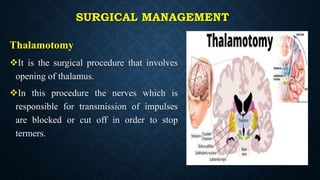
Thalamotomy
It is the surgical procedure that involves
opening of thalamus.
In this procedure the nerves which is
responsible for transmission of impulses
are blocked or cut off in order to stop
termers.
NURSING MANAGEMENT
Nursing diagnosis
Impaired physical mobility related to muscle weakness /paralysis
and in coordinated movements.
Sensory perceptual alteration (visual) kinesthetic and tactile.
Self-care deficit in daily activities like bathing, hygiene, dressing
grooming and elimination needs due to muscle weakness,
paralysis, incoordination.
Risk for injury related to muscle weakness.
Impaired elimination pattern constipation, incontinence/retention
related to altered peristaltic movement in the colon secondary to
nerve paralysis.
MULTIPLE SCLEROSIS PPT for nursing students.pptx

MULTIPLE SCLEROSIS PPT for nursing students.pptx

  • 1.
    PREPARED BY PROF. BLESSYTHOMAS MSC NURSING MSN (NEUROSCIENCE NURSING) FNCON ,SPN
  • 2.
    MULTIPLE SCLEROSIS • Multiplemeans many, sclerosis means dissemination or degeneration. • Multiple Sclerosis is a chronic progressive neurological disorder characterized by demyelination (damaging of myelin sheath) of nerve fibers of brain and spinal cord.
  • 3.
    DEFINITION • It isdisseminated sclerosis is a chronic progressive neurologic disease characterized by disseminating demyelination of nerve fibers of the brain and spinal cord. • It occurs when immune system attacks the myelin sheath the protective sheath that covers the nerve fibers and causes communication errors between the brain and the rest of the body and can cause permanent damage or deterioration of the nerve fibers.
  • 4.
    INCIDENCE More common inwomen or female. Occurs mainly in 20-40 years of age. Only 20% peoples are affected after 50 years of age. Family history of multiple sclerosis.
  • 5.
    CAUSES Unknown An autoimmune disease Slowvirus theory where some viral infection causes the disease. Hereditary factors Some environmental factors
  • 6.
    RISK FACTORS Age- canoccur at any age, but onset usually occurs around 20 and 40 years of age. Gender -Women are more than 2 to 3 times as likely as men. Family history- If the disease is running in family there is higher risk of developing the disease. Infections- Epstein-Barr, the virus that causes infectious mononucleosis. Climate- common in countries with temperate climates. Vitamin D deficiency Obesity -An association with obesity and multiple sclerosis has been found in females. This is especially true for female childhood and adolescent obesity.
  • 7.
    RISK FACTORS Certain autoimmunediseases- people with the disorders such as thyroid disease, pernicious anaemia, psoriasis, type 1 diabetes or inflammatory bowel disease. Smoking habit.
  • 8.
    CLASSIFICATION Clinically isolated syndrome(CIS): In this type the patient experiences the first episodes of symptoms but doesn’t meet the criteria of multiple sclerosis and later it may develop into MS.
  • 9.
    RELAPSING-REMITTING MULTIPLE SCLEROSIS (RRMS): Thisis the most common way that multiple sclerosis . 85% of people diagnosed with MS have this type. MS causes flare-ups (relapses or attacks) of new or old symptoms. Periods of remission follow (when symptoms stabilize or go away).
  • 10.
    SECONDARY PROGRESSIVE MULTIPLE SCLEROSIS(SPMS):  RRMS eventually progresses to SPMS.  Nerve damage accumulates and symptoms gradually worsen.  Patients experience some relapses or flares, but periods of remission (a state that symptoms stabilize or go away) are less likely to happen.  50% of patients will not return to normal condition.
  • 11.
    CHRONIC PROGRESSIVE /PRIMARY PROGRESSIVEMULTIPLE SCLEROSIS (PPMS): MS symptoms may start off slowly and gradually worsen over time from the starting stage. Cerebral or spinal dysfunction occurs. Poor coordination and sensory loss will occur. There will be any periods of clear relapses or remission
  • 12.
    STABLE MULTIPLE SCLEROSIS Patientbecomes completely disable No recovery is possible.
  • 13.
    MS VARIANTS Tumefactive multiplesclerosis: The formation of large areas of demyelination in the brain, which may appear similar to tumors. Balo’s concentric sclerosis: Lesions with the appearance of concentric rings (in the shape of a target) of myelin damage appearing on an MRI.
  • 14.
    MARBURG VARIANT MULTIPLE SCLEROSIS: It is a very rare and aggressive form of MS characterized by rapid progression, which may result in death if left untreated.
  • 15.
    PATHOPHYSIOLOGY Due to etiologicalfactors. T -cell abnormally crosses the BBB (blood brain barrier). In brain T cell are over active or hyper stimulated. Over production of cytokinin. This cytokinin stimulate B cell, microphages, microglia.
  • 16.
    These cause inflammatoryresponse at oligodendrocytes, myelin sheath. Degeneration of myelin sheath starts. Prolonged degeneration causes formation of plague like a layer of broken myelin sheath in white matter of brain and spinal cord. Blockage in transmission of impulses from brin and spinal cord. Permanent neurological deficit or sensory loss or defected motor function.
  • 18.
    CLINICAL MANIFESTATIONS Sensory symptoms Numbness Paraesthesia Tinglingsensation in limbs Decreased sensation of temperature, pain, vibration
  • 19.
    MOTOR SYMPTOMS  Paralysis Dragging of foot  Diplopia  Bladder and bowel dysfunction  Weakness in lower extremities feeling of heaviness, uselessness involves paralysis of limbs.
  • 20.
    CEREBELLAR SYMPTOMS  Ataxia– poor muscle tone  Nystagmus – it becomes very difficult to blink the eye because eye lid becomes very heavy. Speech disturbances.  Dysarthria – disarticulation of speech.  Dystonia – poor tonicity in muscles of speech.  Poor coordination – optic neuritis – inflammation of optic nerve  Genital dysfunction  Euphoria -hyperexcitability  Termers  Vertigo
  • 21.
    OCULAR SYMPTOMS Optic neuritis– it is characterized by visual cloudiness, loss of vision and pain at the time of movement of eye ball. Nystagmus – eyelid becomes heavy and it becomes difficult to blink. Diplopia – double vision • Paroxysmal symptoms Epilepsy Tetanic spasm- characterized by contraction of hands feet and body is sustained in abnormal position. It can be very painful and last from seconds to few minutes (body mainly maintain C - shape).
  • 22.
    MENTAL AND BEHAVIOURAL CHANGE: Euphoria Depression Irritability Poorattentiveness Poor judgement Confusion Loss of sphincter control Reflex of limbs are hyper active
  • 23.
    SOME SPECIFIC SIGNSARE:- L hermitte sign -Electric-shock sensations that occur with certain neck movements, especially bending the neck forward. Uhthoff”s sign – decreased motor function after exposure to hot shower. Scanning speech – speaking with a pause. The Marcuss gum – reduced perception to light in the affected eye due to retro bulbar neuritis. Charcot triad- It includes Nystagmus, Intentional Termers and Speech Defect (scatters speech)
  • 24.
    DIAGNOSTIC MEASURES  Historycollection  Physical examination  C T Scan  Neurological examination  PET scan  Immunoglobulin test  Blood test  Electro myelography  MRI- it shows the involvement of white matter of brain and spinal cord.  CSF examination - Spinal tap (lumbar puncture), in which a small sample of cerebrospinal fluid is removed from the spinal canal for laboratory analysis.  MRI, which can reveal areas of MS (lesions) on the brain, cervical and thoracic spinal cord. Patient receives an intravenous injection of a contrast material to highlight lesions that indicate the disease is in an active phase.
  • 25.
    MANAGEMENT Symptomatic management canbe given. Drug therapy includes: - Steroid therapy Oral prednisone-methyl prednisone 0.5 -1gm/daily Immune suppressive therapy Methotresate 150 mg daily It is given to supress the T-cell to stop degeneration of myelin sheath. Copolymer – an injectable immunosuppressor Azathioprine Antibiotics Antiviral drugs Advice the patient to take adequate bed rest.
  • 26.
    Care of bladder-Atropine, Belladonna is given to reduce incontinence. To prevent pressure sores- change the position every 2 hourly Physical therapy Exercises Plasma exchange (plasmapheresis). The liquid portion of part of the blood (plasma) is removed and separated from the blood cells. The blood cells are then mixed with a protein solution (albumin) and put back into body. Plasma exchange may be used if the symptoms are new, severe and haven't responded to steroids.
  • 27.
    SURGICAL MANAGEMENT Thalamotomy It isthe surgical procedure that involves opening of thalamus. In this procedure the nerves which is responsible for transmission of impulses are blocked or cut off in order to stop termers.
  • 28.
    NURSING MANAGEMENT Nursing diagnosis Impairedphysical mobility related to muscle weakness /paralysis and in coordinated movements. Sensory perceptual alteration (visual) kinesthetic and tactile. Self-care deficit in daily activities like bathing, hygiene, dressing grooming and elimination needs due to muscle weakness, paralysis, incoordination. Risk for injury related to muscle weakness. Impaired elimination pattern constipation, incontinence/retention related to altered peristaltic movement in the colon secondary to nerve paralysis.