
Aptitude
Presented by
Subhankar Rana
School of Education
Central University of Himachal
Pradesh
 What is Aptitude?
o The word Aptitude has been derived from Latin word
'Aptus' which means 'Fitted for'.
o Aptitude is a unique combination of abilities and
personal characteristics which predisposes a person to
do better than another and increase his chance of
success as it (basis of the habits, skills and abilities).
o Aptitude is the success potentiality of an ability.
o Future potentialities of an individual.
o Speed and accuracy in problem solving.
o Aptitude is a one type of Psychometric test.
Aptitude = Ability + Success potentiality
 What is Aptitude?
 Definition:-
According to Woodworth and Marquis (1963), “Aptitude
is a predicted achievement.”
 According to Traxler, ‘Aptitude is a present condition which
is indicative of an individual’s potentialities for the future.’
According to Woodworth, “Possession of the ability to do a
certain thing amounts to saying that one can do it.”
Aiken (1985: p.224) defined it as “Aptitude has
traditionally referred to a person’s capacity to profit from
further training.”
 Nature and Characteristics of
Aptitude
(1) Aptitude of a person is the total sum of his present
qualities which points towards the future capacities.
(2) A particular aptitude of a person indicates his fitness for
doing a particular task.
(3) Aptitude is an abstract noun and not a concrete object or
ability, which expresses a specific quality in the whole
personality of a person.
(4) Aptitude exists in the present but it indicates the future
capacities.
(5) There is close relation among aptitude interest, inclination
and satisfaction.
(6) Aptitudes of different people are different and they are
more or less in degree.
(7) Aptitude is the chief cause of individual differences.
(8) Generally, an aptitude is stationary, very few changes can
be effected in it.
Aptitude tests have been used to measure aptitudes of a
person.
An aptitude test is such a test which measures a person’s
or a group of persons hereditary abilities, capacities or
potentialities, and on its basis guides for creation of
environment, teaching and training work in the future.
 Definition:-
According to Aiken(1985: p. 302), “A measure of person’s ability
to profit from further training or experience in an occupation or
skill.”
 According to Freeman, ‘An aptitude test is one designed to
measure a person’s potential ability in an activity of a specialised
kind and within a restricted range.’
Aptitude tests were first developed by Bingham in 1830s.
 Categorize of Aptitude Test
The aptitude tests can be divided into three types
keeping in view their nature.
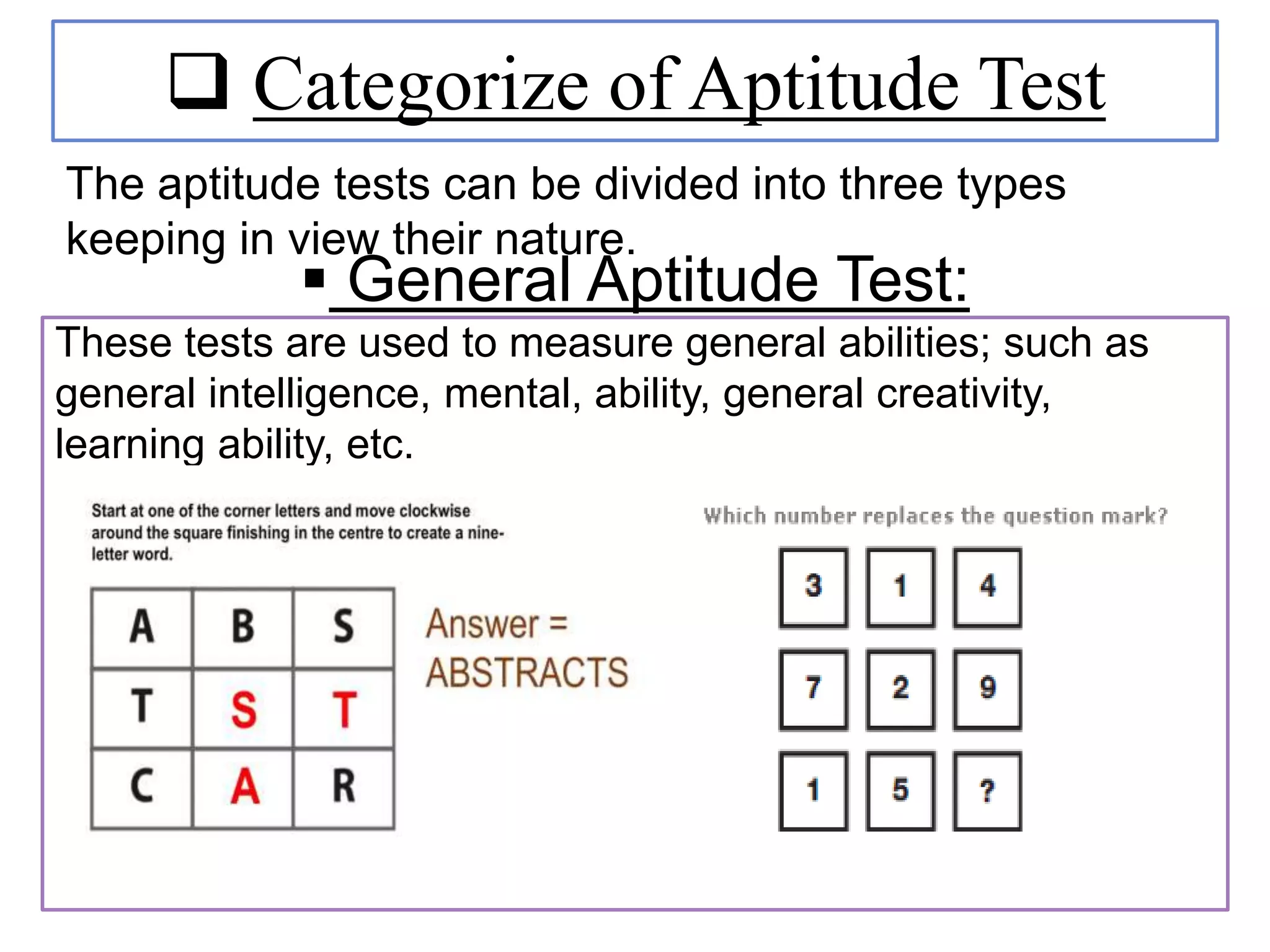
 General Aptitude Test:
These tests are used to measure general abilities; such as
general intelligence, mental, ability, general creativity,
learning ability, etc.
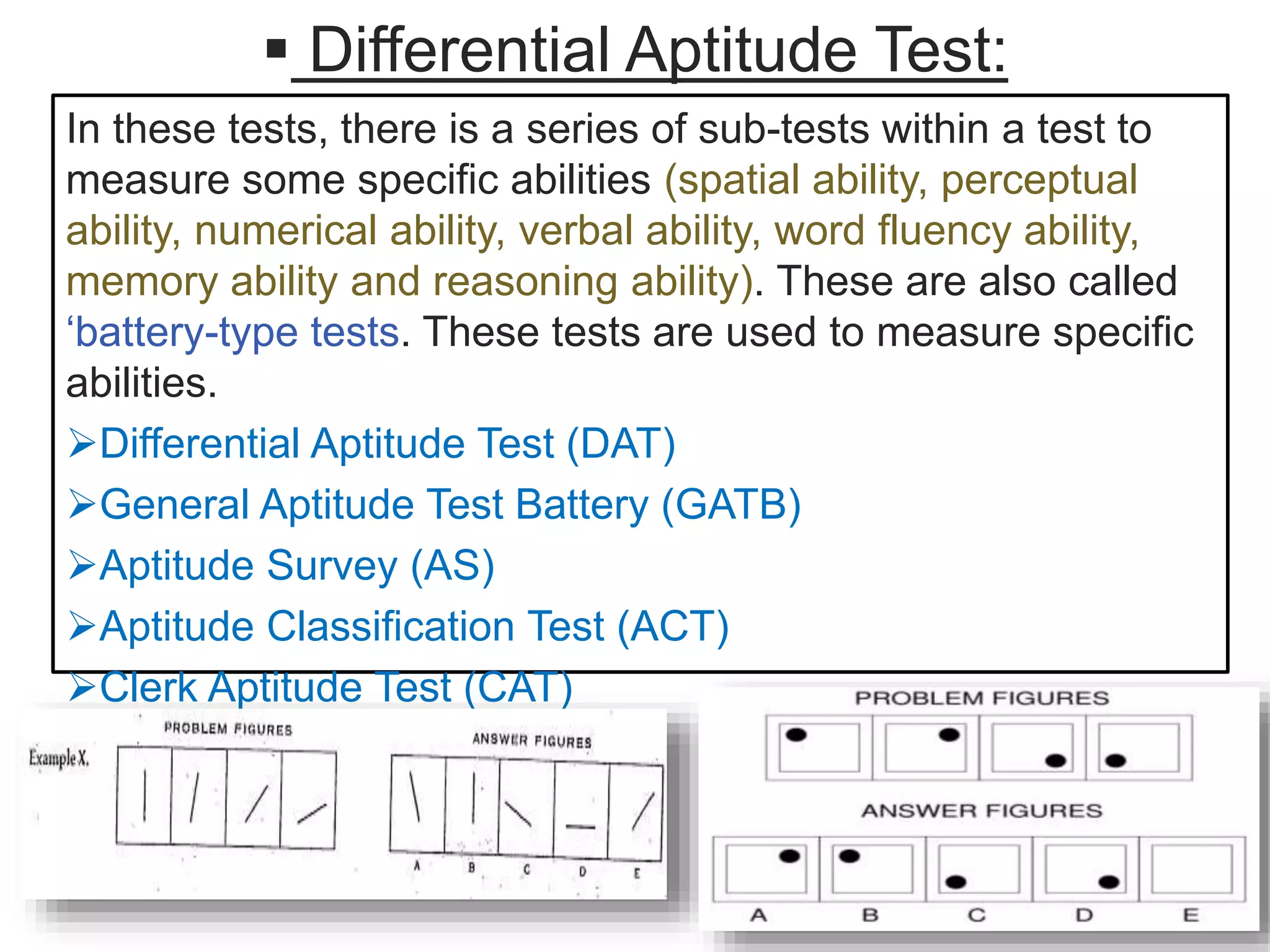
 Differential Aptitude Test:
In these tests, there is a series of sub-tests within a test to
measure some specific abilities (spatial ability, perceptual
ability, numerical ability, verbal ability, word fluency ability,
memory ability and reasoning ability). These are also called
‘battery-type tests. These tests are used to measure specific
abilities.
Differential Aptitude Test (DAT)
General Aptitude Test Battery (GATB)
Aptitude Survey (AS)
Aptitude Classification Test (ACT)
Clerk Aptitude Test (CAT)
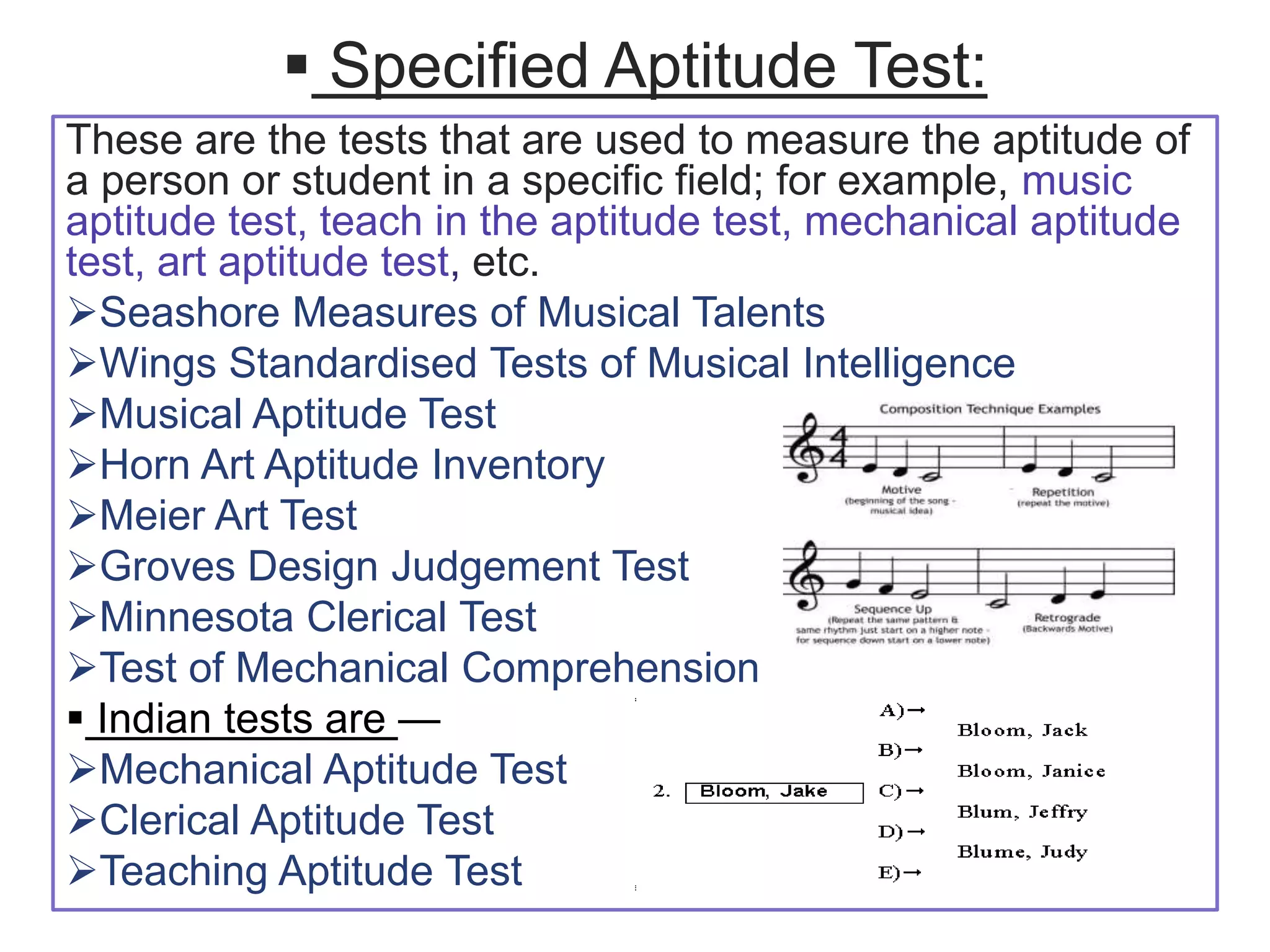
 Specified Aptitude Test:
These are the tests that are used to measure the aptitude of
a person or student in a specific field; for example, music
aptitude test, teach in the aptitude test, mechanical aptitude
test, art aptitude test, etc.
Seashore Measures of Musical Talents
Wings Standardised Tests of Musical Intelligence
Musical Aptitude Test
Horn Art Aptitude Inventory
Meier Art Test
Groves Design Judgement Test
Minnesota Clerical Test
Test of Mechanical Comprehension
 Indian tests are —
Mechanical Aptitude Test
Clerical Aptitude Test
Teaching Aptitude Test
Types of Aptitude Test
Verbal Reasoning
Numeric Reasoning
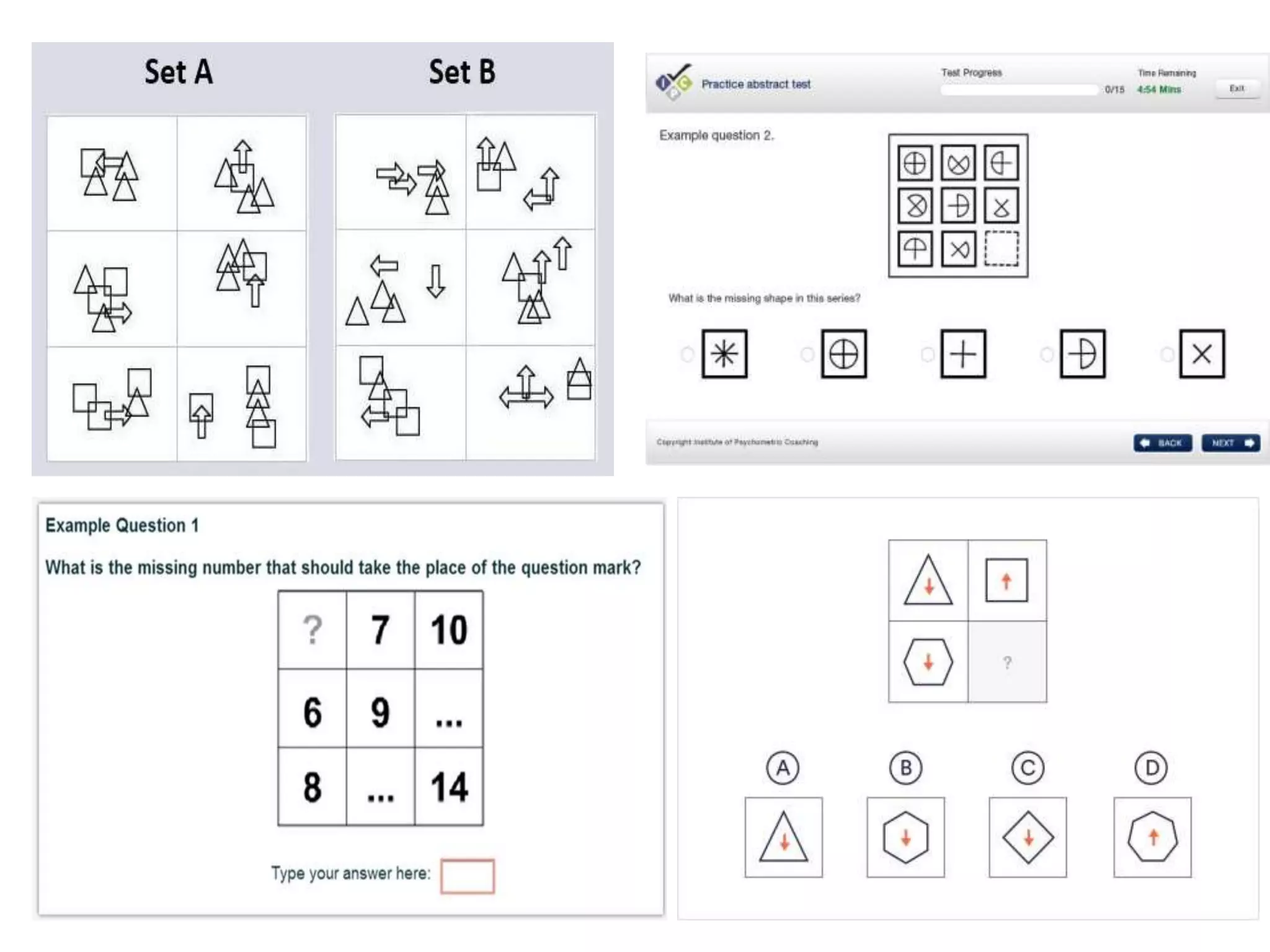
Abstract Reasoning
Spatial Reasoning
Mechanical Reasoning
Data Checking
Fault Diagnosis
Work Sample
Advantages
(i) Aptitude tests are used for the purpose of prediction for future
success both in educational and vocational careers.
(ii) These tests are used to help the students in the proper choice of
courses, subjects and careers.
(iii) They are used as they supplement other psychological tests.
(iv) Aptitude tests are used to help the students in the improvement
of certain special traits.
(v) They are used for the purpose of admission and selection of
students in the college and technical institutions.
(vi) They are given educational and vocational guidance on the
basis of obtained results.
(vii) Aptitude tests are valuable in making programme and curricula
decision.
Limitations
(i) The physical, social and emotional environment of
the pupil is often different from the actual
environment in the job or college. Therefore chances
for wrong prediction.
(ii) An Aptitude test gives us a prediction of the
probability only.
(iii) There is never any certainty that predictions will
always come true. (Sometimes, Brilliant student may
be fail to top the list while an average student)
Aptitude (Test) and their Nature and Characteristics

Aptitude (Test) and their Nature and Characteristics

  • 1.
    Aptitude Presented by Subhankar Rana Schoolof Education Central University of Himachal Pradesh
  • 2.
     What isAptitude? o The word Aptitude has been derived from Latin word 'Aptus' which means 'Fitted for'. o Aptitude is a unique combination of abilities and personal characteristics which predisposes a person to do better than another and increase his chance of success as it (basis of the habits, skills and abilities). o Aptitude is the success potentiality of an ability. o Future potentialities of an individual. o Speed and accuracy in problem solving. o Aptitude is a one type of Psychometric test. Aptitude = Ability + Success potentiality
  • 4.
     What isAptitude?  Definition:- According to Woodworth and Marquis (1963), “Aptitude is a predicted achievement.”  According to Traxler, ‘Aptitude is a present condition which is indicative of an individual’s potentialities for the future.’ According to Woodworth, “Possession of the ability to do a certain thing amounts to saying that one can do it.” Aiken (1985: p.224) defined it as “Aptitude has traditionally referred to a person’s capacity to profit from further training.”
  • 5.
     Nature andCharacteristics of Aptitude (1) Aptitude of a person is the total sum of his present qualities which points towards the future capacities. (2) A particular aptitude of a person indicates his fitness for doing a particular task. (3) Aptitude is an abstract noun and not a concrete object or ability, which expresses a specific quality in the whole personality of a person. (4) Aptitude exists in the present but it indicates the future capacities. (5) There is close relation among aptitude interest, inclination and satisfaction. (6) Aptitudes of different people are different and they are more or less in degree. (7) Aptitude is the chief cause of individual differences. (8) Generally, an aptitude is stationary, very few changes can be effected in it.
  • 6.
    Aptitude tests havebeen used to measure aptitudes of a person. An aptitude test is such a test which measures a person’s or a group of persons hereditary abilities, capacities or potentialities, and on its basis guides for creation of environment, teaching and training work in the future.  Definition:- According to Aiken(1985: p. 302), “A measure of person’s ability to profit from further training or experience in an occupation or skill.”  According to Freeman, ‘An aptitude test is one designed to measure a person’s potential ability in an activity of a specialised kind and within a restricted range.’ Aptitude tests were first developed by Bingham in 1830s.
  • 7.
     Categorize ofAptitude Test The aptitude tests can be divided into three types keeping in view their nature.  General Aptitude Test: These tests are used to measure general abilities; such as general intelligence, mental, ability, general creativity, learning ability, etc.
  • 8.
     Differential AptitudeTest: In these tests, there is a series of sub-tests within a test to measure some specific abilities (spatial ability, perceptual ability, numerical ability, verbal ability, word fluency ability, memory ability and reasoning ability). These are also called ‘battery-type tests. These tests are used to measure specific abilities. Differential Aptitude Test (DAT) General Aptitude Test Battery (GATB) Aptitude Survey (AS) Aptitude Classification Test (ACT) Clerk Aptitude Test (CAT)
  • 9.
     Specified AptitudeTest: These are the tests that are used to measure the aptitude of a person or student in a specific field; for example, music aptitude test, teach in the aptitude test, mechanical aptitude test, art aptitude test, etc. Seashore Measures of Musical Talents Wings Standardised Tests of Musical Intelligence Musical Aptitude Test Horn Art Aptitude Inventory Meier Art Test Groves Design Judgement Test Minnesota Clerical Test Test of Mechanical Comprehension  Indian tests are — Mechanical Aptitude Test Clerical Aptitude Test Teaching Aptitude Test
  • 10.
    Types of AptitudeTest Verbal Reasoning Numeric Reasoning Abstract Reasoning Spatial Reasoning Mechanical Reasoning Data Checking Fault Diagnosis Work Sample
  • 12.
    Advantages (i) Aptitude testsare used for the purpose of prediction for future success both in educational and vocational careers. (ii) These tests are used to help the students in the proper choice of courses, subjects and careers. (iii) They are used as they supplement other psychological tests. (iv) Aptitude tests are used to help the students in the improvement of certain special traits. (v) They are used for the purpose of admission and selection of students in the college and technical institutions. (vi) They are given educational and vocational guidance on the basis of obtained results. (vii) Aptitude tests are valuable in making programme and curricula decision.
  • 13.
    Limitations (i) The physical,social and emotional environment of the pupil is often different from the actual environment in the job or college. Therefore chances for wrong prediction. (ii) An Aptitude test gives us a prediction of the probability only. (iii) There is never any certainty that predictions will always come true. (Sometimes, Brilliant student may be fail to top the list while an average student)