WHAT IS MULTIPLE INTELLIGENCE?
• The Multiple Intelligences Theory states that it is to the benefit of both the student
and the instructor if the student’s intelligence can be identified. Identifying a
student’s intelligence allows the instructor to select appropriate activities for the
student in the classroom and guide their learning journey more effectively.
• Was developed in 1983 by Dr. Howard Gardner, professor of education at
Harvard University. It suggests that the traditional notion of intelligence, based
on I.Q. testing, is far too limited. Instead, Dr. Gardner proposes eight different
intelligences to account for a broader range of human potential in children and
adults.
8 Different Intelligences
• Linguistic intelligence (“word smart”)
• Logical-mathematical intelligence (“number/reasoning smart”)
• Spatial intelligence (“picture smart”)
• Bodily-Kinesthetic intelligence (“body smart”)
• Musical intelligence (“music smart”)
• Interpersonal intelligence (“people smart”)
• Intrapersonal intelligence (“self smart”)
• Naturalist intelligence (“nature smart”)
LINGUISTIC INTELLIGENCE
• The ability to express oneself using words and language and
a person’s ability to use language effectively, both oral and
written.
• This intelligence is unique because it is the most commonly
shared human ability. It allows us to apply meaning to words
and express appreciation for complex phrases. Through
reading, writing and sharing stories orally, we are able to
marvel at our use of language.
• Example: Public speaker, Poets, writing a short poem,
storytelling, group discussions, debates etcs.
LOGICAL-MATHEMATICAL
INTELLIGENCE
• Sometimes misconstrued as simply the ability to calculate
mathematical equations, logical-mathematical intelligence is
much more than that. Individuals with this developed
intelligence demonstrate excellent reasoning skills, abstract
thought, and the ability to infer based on patterns.
• They are able to make connections based on their prior
knowledge and are drawn to categorization, patterning, and
relationships between ideas. With experiments and strategy
games as two coveted activities, it would make sense that
possible careers would include a scientist, a mathematician,
and a detective.
SPATIAL INTELLIGENCE
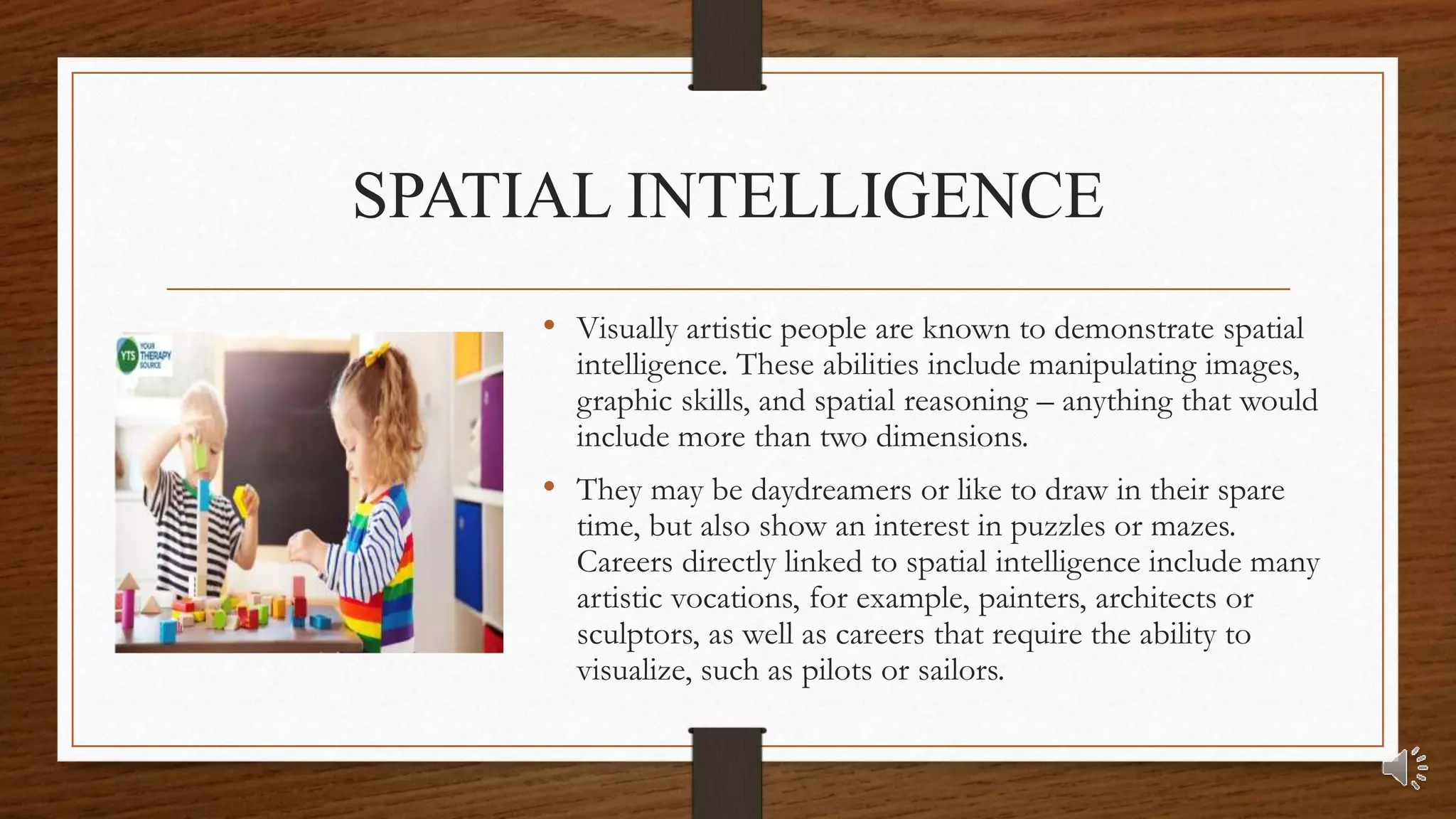
• Visually artistic people are known to demonstrate spatial
intelligence. These abilities include manipulating images,
graphic skills, and spatial reasoning – anything that would
include more than two dimensions.
• They may be daydreamers or like to draw in their spare
time, but also show an interest in puzzles or mazes.
Careers directly linked to spatial intelligence include many
artistic vocations, for example, painters, architects or
sculptors, as well as careers that require the ability to
visualize, such as pilots or sailors.
BODILY-KINESTHETIC INTELLIGENCE
• The ability to manipulate both the body and objects with a
keen sense of timing.
• These people are able to accurately manipulate objects due to
a strong mind-body union. This can be demonstrated in the
form of physical skills, for example, athletes and dancers, or in
precision and steady movement, such as surgeons and crafts
people.
MUSICAL INTELLIGENCE
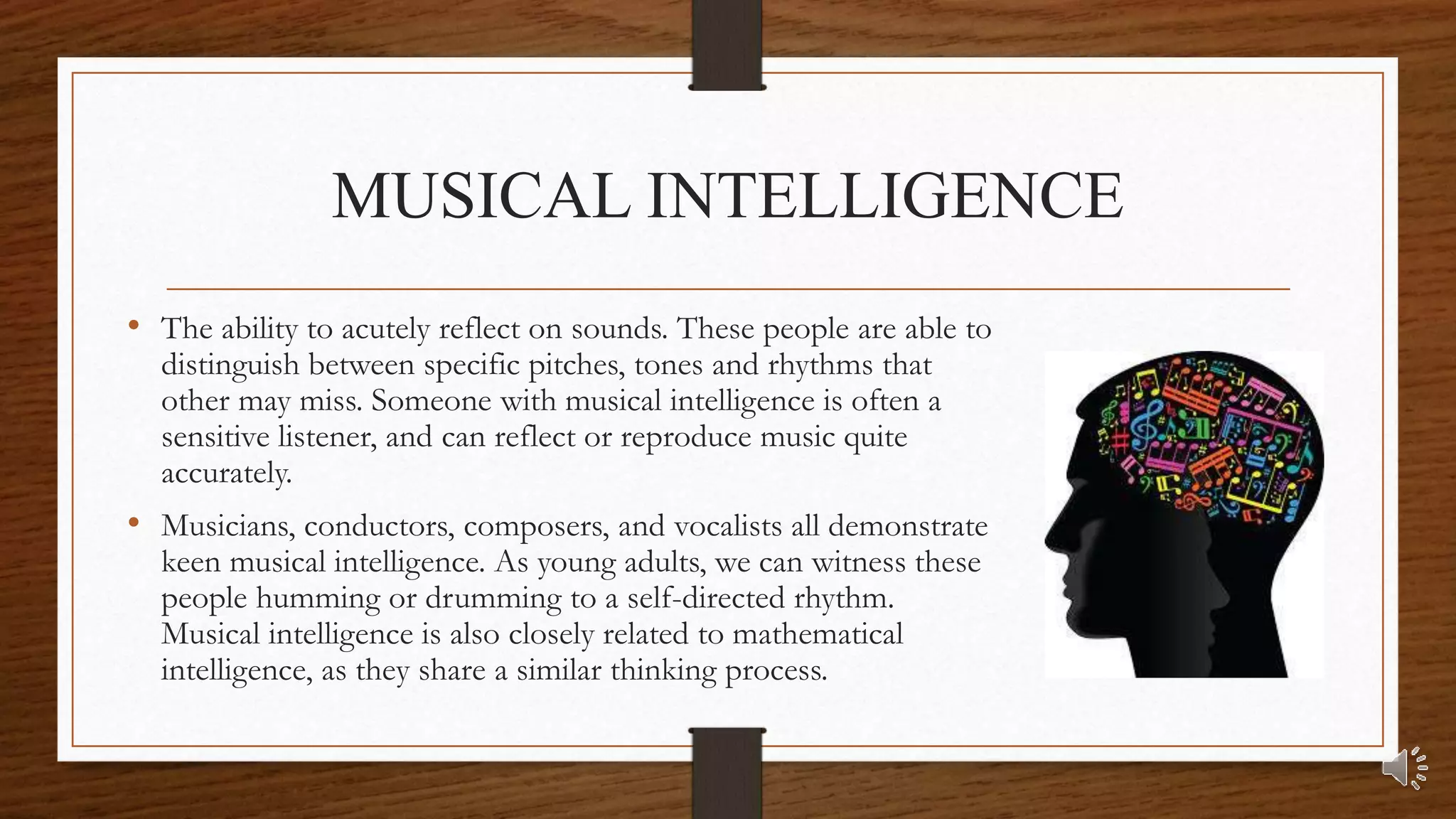
• The ability to acutely reflect on sounds. These people are able to
distinguish between specific pitches, tones and rhythms that
other may miss. Someone with musical intelligence is often a
sensitive listener, and can reflect or reproduce music quite
accurately.
• Musicians, conductors, composers, and vocalists all demonstrate
keen musical intelligence. As young adults, we can witness these
people humming or drumming to a self-directed rhythm.
Musical intelligence is also closely related to mathematical
intelligence, as they share a similar thinking process.
INTERPERSONAL INTELLIGENCE
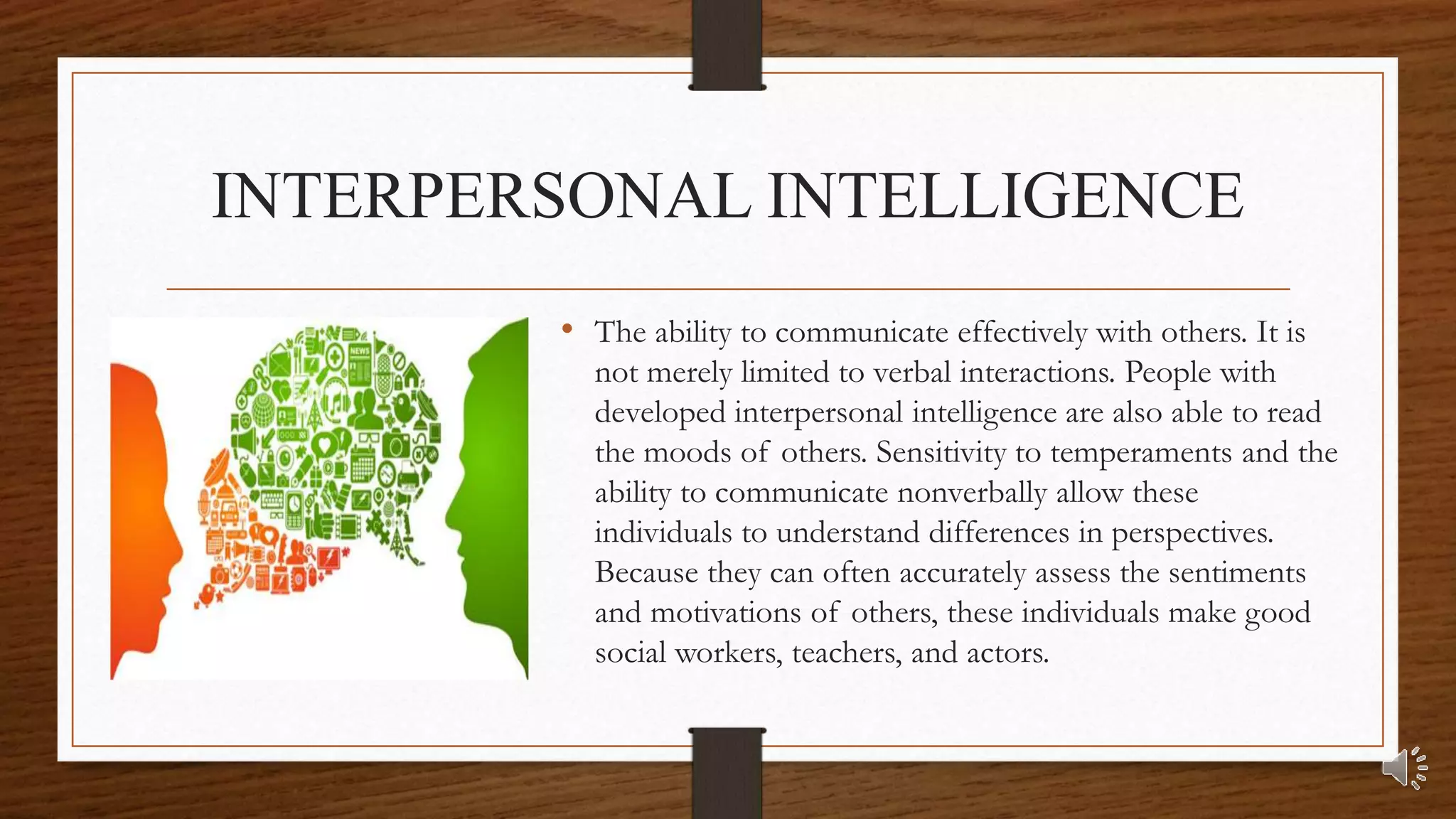
• The ability to communicate effectively with others. It is
not merely limited to verbal interactions. People with
developed interpersonal intelligence are also able to read
the moods of others. Sensitivity to temperaments and the
ability to communicate nonverbally allow these
individuals to understand differences in perspectives.
Because they can often accurately assess the sentiments
and motivations of others, these individuals make good
social workers, teachers, and actors.
INTRAPERSONAL INTELLIGENCE
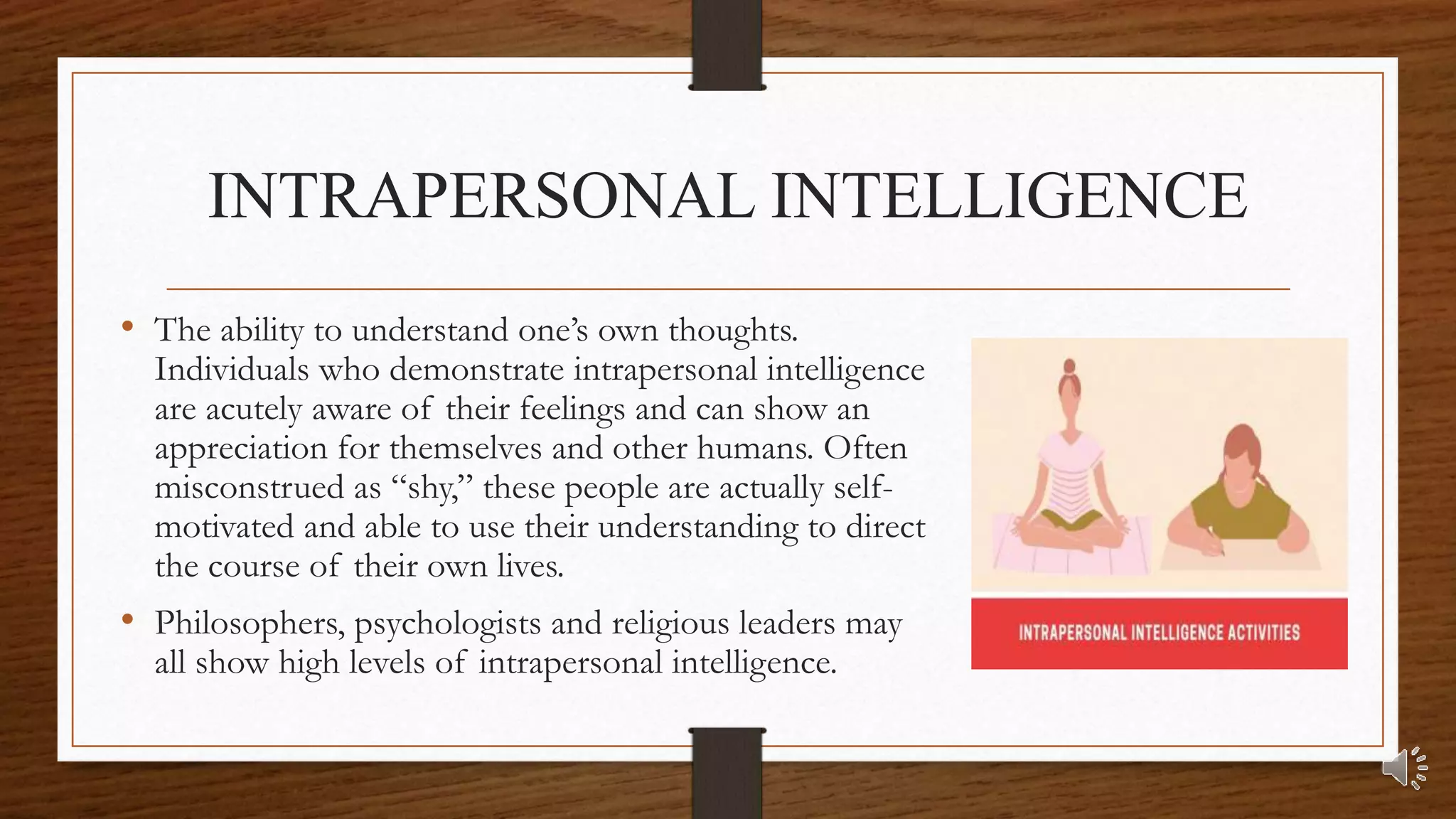
• The ability to understand one’s own thoughts.
Individuals who demonstrate intrapersonal intelligence
are acutely aware of their feelings and can show an
appreciation for themselves and other humans. Often
misconstrued as “shy,” these people are actually self-
motivated and able to use their understanding to direct
the course of their own lives.
• Philosophers, psychologists and religious leaders may
all show high levels of intrapersonal intelligence.
NATURALIST INTELLIGENCE
• The ability to distinguish between living and non-living
things was notably more valuable in the past when humans
were often farmers, hunters or gatherers and the sensitivity
to features in the natural world is most closely tied.
• Nowadays, this intelligence has evolved to more modern-
day roles such as a chef or a botanist. We still carry traces
of naturalist intelligence, some more so than others, which
is evident by our preferences for certain brands over
others.
CONCLUSION
Multiple Intelligences theory has more benefits than limitations.
• An opportunity to introspect and analyze on their capabilities
• A paradigm shift in their experiences - can create more learner-centered
classes
• Educators can raise the level of linguistic skills of their learners.
• It develops their communicative skills.
• A great potential to bring out the best in both the educators as well as learners.
THANK YOU! ;)
COLLIN KARL C. LICUDAN
Block G

MULTIPLE-INTELLIGENCES-GARDNER.pptx

  • 2.
    WHAT IS MULTIPLEINTELLIGENCE? • The Multiple Intelligences Theory states that it is to the benefit of both the student and the instructor if the student’s intelligence can be identified. Identifying a student’s intelligence allows the instructor to select appropriate activities for the student in the classroom and guide their learning journey more effectively. • Was developed in 1983 by Dr. Howard Gardner, professor of education at Harvard University. It suggests that the traditional notion of intelligence, based on I.Q. testing, is far too limited. Instead, Dr. Gardner proposes eight different intelligences to account for a broader range of human potential in children and adults.
  • 3.
    8 Different Intelligences •Linguistic intelligence (“word smart”) • Logical-mathematical intelligence (“number/reasoning smart”) • Spatial intelligence (“picture smart”) • Bodily-Kinesthetic intelligence (“body smart”) • Musical intelligence (“music smart”) • Interpersonal intelligence (“people smart”) • Intrapersonal intelligence (“self smart”) • Naturalist intelligence (“nature smart”)
  • 4.
    LINGUISTIC INTELLIGENCE • Theability to express oneself using words and language and a person’s ability to use language effectively, both oral and written. • This intelligence is unique because it is the most commonly shared human ability. It allows us to apply meaning to words and express appreciation for complex phrases. Through reading, writing and sharing stories orally, we are able to marvel at our use of language. • Example: Public speaker, Poets, writing a short poem, storytelling, group discussions, debates etcs.
  • 5.
    LOGICAL-MATHEMATICAL INTELLIGENCE • Sometimes misconstruedas simply the ability to calculate mathematical equations, logical-mathematical intelligence is much more than that. Individuals with this developed intelligence demonstrate excellent reasoning skills, abstract thought, and the ability to infer based on patterns. • They are able to make connections based on their prior knowledge and are drawn to categorization, patterning, and relationships between ideas. With experiments and strategy games as two coveted activities, it would make sense that possible careers would include a scientist, a mathematician, and a detective.
  • 6.
    SPATIAL INTELLIGENCE • Visuallyartistic people are known to demonstrate spatial intelligence. These abilities include manipulating images, graphic skills, and spatial reasoning – anything that would include more than two dimensions. • They may be daydreamers or like to draw in their spare time, but also show an interest in puzzles or mazes. Careers directly linked to spatial intelligence include many artistic vocations, for example, painters, architects or sculptors, as well as careers that require the ability to visualize, such as pilots or sailors.
  • 7.
    BODILY-KINESTHETIC INTELLIGENCE • Theability to manipulate both the body and objects with a keen sense of timing. • These people are able to accurately manipulate objects due to a strong mind-body union. This can be demonstrated in the form of physical skills, for example, athletes and dancers, or in precision and steady movement, such as surgeons and crafts people.
  • 8.
    MUSICAL INTELLIGENCE • Theability to acutely reflect on sounds. These people are able to distinguish between specific pitches, tones and rhythms that other may miss. Someone with musical intelligence is often a sensitive listener, and can reflect or reproduce music quite accurately. • Musicians, conductors, composers, and vocalists all demonstrate keen musical intelligence. As young adults, we can witness these people humming or drumming to a self-directed rhythm. Musical intelligence is also closely related to mathematical intelligence, as they share a similar thinking process.
  • 9.
    INTERPERSONAL INTELLIGENCE • Theability to communicate effectively with others. It is not merely limited to verbal interactions. People with developed interpersonal intelligence are also able to read the moods of others. Sensitivity to temperaments and the ability to communicate nonverbally allow these individuals to understand differences in perspectives. Because they can often accurately assess the sentiments and motivations of others, these individuals make good social workers, teachers, and actors.
  • 10.
    INTRAPERSONAL INTELLIGENCE • Theability to understand one’s own thoughts. Individuals who demonstrate intrapersonal intelligence are acutely aware of their feelings and can show an appreciation for themselves and other humans. Often misconstrued as “shy,” these people are actually self- motivated and able to use their understanding to direct the course of their own lives. • Philosophers, psychologists and religious leaders may all show high levels of intrapersonal intelligence.
  • 11.
    NATURALIST INTELLIGENCE • Theability to distinguish between living and non-living things was notably more valuable in the past when humans were often farmers, hunters or gatherers and the sensitivity to features in the natural world is most closely tied. • Nowadays, this intelligence has evolved to more modern- day roles such as a chef or a botanist. We still carry traces of naturalist intelligence, some more so than others, which is evident by our preferences for certain brands over others.
  • 12.
    CONCLUSION Multiple Intelligences theoryhas more benefits than limitations. • An opportunity to introspect and analyze on their capabilities • A paradigm shift in their experiences - can create more learner-centered classes • Educators can raise the level of linguistic skills of their learners. • It develops their communicative skills. • A great potential to bring out the best in both the educators as well as learners.
  • 13.
    THANK YOU! ;) COLLINKARL C. LICUDAN Block G