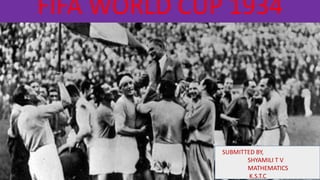
FIFA WORLD CUP 1934
SUBMITTED BY,
SHYAMILI T V
MATHEMATICS
K.S.T.C
The 1934 FIFA World Cup
was the second FIFA
World Cup, the world
championship for men’s
national association
football teams. It took
place in Italy from 27 May
to 10 June 1934.
OFFICIAL POSTER
TOURNAMENT DETAILS
Host country : Italy
Dates : 27 May-10 June(15 days)
Teams : 16 (from 4 confederations)
Venue(s) : 8 (in 8 host cities)
Final positions
Champions : Italy
Runners-up : Czechoslovakia
Third place : Germany
Fourth place : Austria
Tournament statistics
Matches played : 17
Goals scored : 70 (4.12 per match)
Attendance : 363000 (21,353 per match)
Top scorer(s) : Oldrich Nejedly (5 goals)
The 1934 World Cup was the first for
which teams had to qualify to take part.
Thirty-two nations entered the
competition, and after qualification, 16
teams participated in the finals
tournament. Reigning champions
Uruguay refused to participate due to the
fact just four European teams had
accepted their invitation to the 1930
tournament. Italy became the second
World Cup champions and the first
European team to win, beating
Czechoslovakia 2–1 in the final.
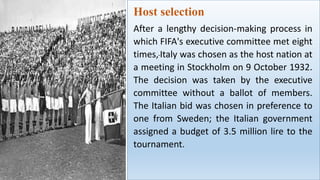
Host selection
After a lengthy decision-making process in
which FIFA's executive committee met eight
times,Italy was chosen as the host nation at
a meeting in Stockholm on 9 October 1932.
The decision was taken by the executive
committee without a ballot of members.
The Italian bid was chosen in preference to
one from Sweden; the Italian government
assigned a budget of 3.5 million lire to the
tournament.
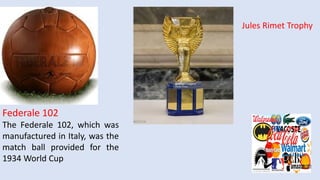
Federale 102
The Federale 102, which was
manufactured in Italy, was the
match ball provided for the
1934 World Cup
Jules Rimet Trophy
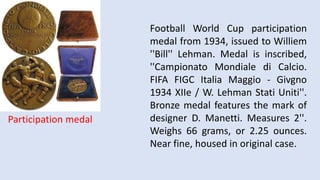
Football World Cup participation
medal from 1934, issued to Williem
''Bill'' Lehman. Medal is inscribed,
''Campionato Mondiale di Calcio.
FIFA FIGC Italia Maggio - Givgno
1934 XIIe / W. Lehman Stati Uniti''.
Bronze medal features the mark of
designer D. Manetti. Measures 2''.
Weighs 66 grams, or 2.25 ounces.
Near fine, housed in original case.
Participation medal
Qualification and participants
36 countries applied to enter the tournament, so qualifying matches were
required to thin the field to 16. Even so, there were several notable absentees.
Reigning World Cup holders Uruguay declined to participate, in protest at the
refusal of several European countries to travel to South America for the
previous World Cup, which Uruguay had hosted in 1930. As a result, the 1934
World Cup is the only one in which the reigning champions did not participate.
The British Home Nations, in a period of self-imposed exile from FIFA, also
refused to participate. Football Association committee member Charles
Sutcliffe’s view was: "the national associations of England, Scotland, Wales and
Ireland have quite enough to do in their own International Championship
which seems to me a far better World Championship than the one to be staged
in Rome".
Despite their role as hosts, Italy were still required to qualify, the first and
only time the host nation was not granted automatic qualification.[4] The
qualifying matches were arranged on a geographical basis. Withdrawals by
Chile and Peru meant Argentina and Brazil qualified without playing a single
match.
Twelve of the 16 places were allocated to Europe, three to the Americas, and
one to Africa or Asia (including Turkey).
Only 10 of the 32 entrants, and four of the 16 qualified teams (Brazil,
Argentina, United States and Egypt, the first African team to qualify for a
World Cup finals tournament), were from outside Europe. The last place in
the finals was contested between the United States and Mexico only three
days before the start of the tournament in a one-off match in Rome, which
the United States won.
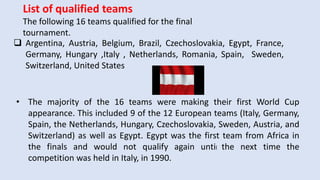
List of qualified teams
The following 16 teams qualified for the final
tournament.
 Argentina, Austria, Belgium, Brazil, Czechoslovakia, Egypt, France,
Germany, Hungary ,Italy , Netherlands, Romania, Spain, Sweden,
Switzerland, United States
• The majority of the 16 teams were making their first World Cup
appearance. This included 9 of the 12 European teams (Italy, Germany,
Spain, the Netherlands, Hungary, Czechoslovakia, Sweden, Austria, and
Switzerland) as well as Egypt. Egypt was the first team from Africa in
the finals and would not qualify again until the next time the
competition was held in Italy, in 1990.
Italy as hosts
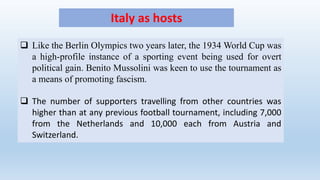
 Like the Berlin Olympics two years later, the 1934 World Cup was
a high-profile instance of a sporting event being used for overt
political gain. Benito Mussolini was keen to use the tournament as
a means of promoting fascism.
 The number of supporters travelling from other countries was
higher than at any previous football tournament, including 7,000
from the Netherlands and 10,000 each from Austria and
Switzerland.
1. Stadio littoriale
Capacity: 50,100
STADIUMS
Stadio Renato Dall'Ara is a multi-
purpose stadium in Bologna, Italy. It is
currently used mostly for football
matches and the home of Bologna F.C
1909. The stadium was built in 1927 and
holds 38,279. It has also been named
Stadio Littoriale. It replaced the Stadio
Sterlino.[
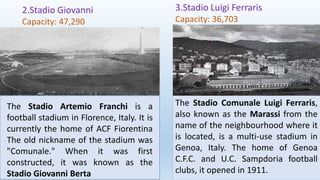
2.Stadio Giovanni
Capacity: 47,290
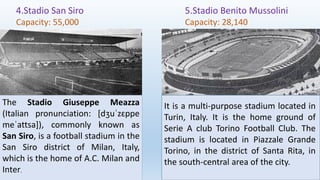
3.Stadio Luigi Ferraris
Capacity: 36,703
The Stadio Comunale Luigi Ferraris,
also known as the Marassi from the
name of the neighbourhood where it
is located, is a multi-use stadium in
Genoa, Italy. The home of Genoa
C.F.C. and U.C. Sampdoria football
clubs, it opened in 1911.
The Stadio Artemio Franchi is a
football stadium in Florence, Italy. It is
currently the home of ACF Fiorentina
The old nickname of the stadium was
"Comunale." When it was first
constructed, it was known as the
Stadio Giovanni Berta
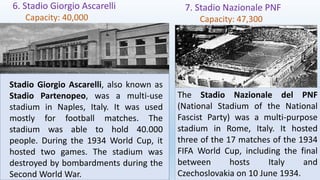
4.Stadio San Siro
Capacity: 55,000
5.Stadio Benito Mussolini
Capacity: 28,140
The Stadio Giuseppe Meazza
(Italian pronunciation: [dʒuˈzɛppe
meˈattsa]), commonly known as
San Siro, is a football stadium in the
San Siro district of Milan, Italy,
which is the home of A.C. Milan and
Inter.
It is a multi-purpose stadium located in
Turin, Italy. It is the home ground of
Serie A club Torino Football Club. The
stadium is located in Piazzale Grande
Torino, in the district of Santa Rita, in
the south-central area of the city.
6. Stadio Giorgio Ascarelli
Capacity: 40,000
7. Stadio Nazionale PNF
Capacity: 47,300
Stadio Giorgio Ascarelli, also known as
Stadio Partenopeo, was a multi-use
stadium in Naples, Italy. It was used
mostly for football matches. The
stadium was able to hold 40.000
people. During the 1934 World Cup, it
hosted two games. The stadium was
destroyed by bombardments during the
Second World War.
The Stadio Nazionale del PNF
(National Stadium of the National
Fascist Party) was a multi-purpose
stadium in Rome, Italy. It hosted
three of the 17 matches of the 1934
FIFA World Cup, including the final
between hosts Italy and
Czechoslovakia on 10 June 1934.
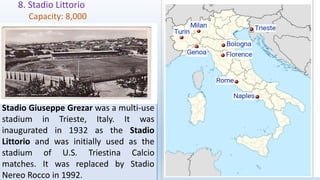
8. Stadio Littorio
Capacity: 8,000
Stadio Giuseppe Grezar was a multi-use
stadium in Trieste, Italy. It was
inaugurated in 1932 as the Stadio
Littorio and was initially used as the
stadium of U.S. Triestina Calcio
matches. It was replaced by Stadio
Nereo Rocco in 1992.
Format
 The group stage used in the first World Cup was discarded in favour of a
straight knockout tournament. If a match was tied after ninety minutes,
then thirty minutes of extra time were played. If the score was still tied
after extra time, the match would be replayed the next day.
 The eight seeded teams – Argentina, Brazil, Germany, Italy, the
Netherlands, Austria, Czechoslovakia and Hungary – were kept apart in
the first round.
SUMMARY
The great day, 27 May 1934, was fast approaching, and the fascist
propaganda machine was in full motion. All 16 teams were set for an eight-
city simultaneous kick-off that was to be a grand pan-Italian extravaganza.
It was the first major tournament to be broadcast widely on the radio, and
while individuals were not as likely to own a radio in Italy as they would be
in Germany or Holland, who had each procured rights to broadcast the
event, it was very common for Italians to gather in communal places to listen
to major broadcasts.
Internal disputes meant Argentina's squad for the tournament did not
contain a single member of the team which had reached the final in 1930.
Against Sweden in Bologna, Argentina twice took the lead, but two goals by Sven
Jonasson and a winner by Knut Kroon gave Sweden a 3–2 victory.
Fellow South Americans Brazil also suffered an early exit. Spain beat them
comfortably; 3–1 the final score.
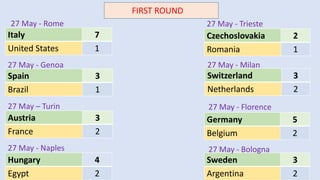
All eight first round matches kicked off at the same time. Hosts and favourites Italy
won handsomely, defeating the USA 7–1; The New York Times correspondent wrote
that "only the fine goal-tending of Julius Hjulian of Chicago kept the score as low as
it was".
For the only time in World Cup history, the last eight consisted entirely of European
teams – Austria, Czechoslovakia, Germany, Hungary, Italy, Spain, Sweden, and
Switzerland. All four non-European teams who made the journey to Italy were
eliminated after one match.
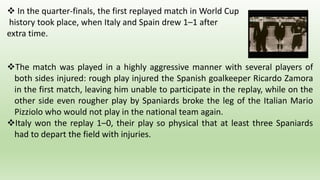
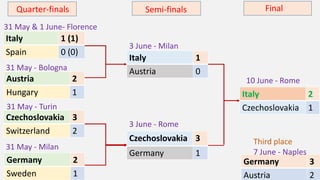
 In the quarter-finals, the first replayed match in World Cup
history took place, when Italy and Spain drew 1–1 after
extra time.
The match was played in a highly aggressive manner with several players of
both sides injured: rough play injured the Spanish goalkeeper Ricardo Zamora
in the first match, leaving him unable to participate in the replay, while on the
other side even rougher play by Spaniards broke the leg of the Italian Mario
Pizziolo who would not play in the national team again.
Italy won the replay 1–0, their play so physical that at least three Spaniards
had to depart the field with injuries.
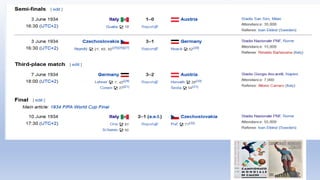
Italy then went on to beat Austria in the semi-finals by the same score.
Meanwhile, Czechoslovakia secured their place in the final by beating Germany
3–1.
The Stadium of the National Fascist Party was the venue for the final. With
80 minutes played, the Czechoslovaks led 1–0. The Italians managed to score
before the final whistle, and then added another goal in extra time to be
crowned World Cup winners.
Italy's total of three goals conceded in five matches
was a record low for a team winning the
World Cup.
RESULTS
Italy 7
United States 1
Czechoslovakia 2
Romania 1
Spain 3
Brazil 1
Hungary 4
Egypt 2
Austria 3
France 2
Switzerland 3
Netherlands 2
FIRST ROUND
Germany 5
Belgium 2
Sweden 3
Argentina 2
27 May - Rome
27 May - Genoa
27 May – Turin
27 May - Naples
27 May - Trieste
27 May - Milan
27 May - Florence
27 May - Bologna
Italy 1 (1)
Spain 0 (0)
Austria 2
Hungary 1
Czechoslovakia 3
Switzerland 2
Germany 2
Sweden 1
Italy 1
Austria 0
Czechoslovakia 3
Germany 1
Italy 2
Czechoslovakia 1
Germany 3
Austria 2
Quarter-finals Semi-finals Final
31 May & 1 June- Florence
31 May - Bologna
31 May - Turin
31 May - Milan
3 June - Milan
3 June - Rome
10 June - Rome
Third place
7 June - Naples
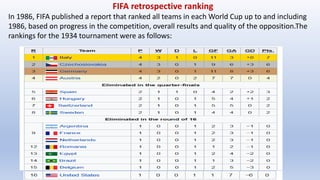
FIFA retrospective ranking
In 1986, FIFA published a report that ranked all teams in each World Cup up to and including
1986, based on progress in the competition, overall results and quality of the opposition.The
rankings for the 1934 tournament were as follows:
Football world cup 1934