Multimodal Transportation
&
Electronic Data Interchange
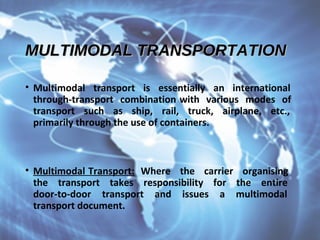
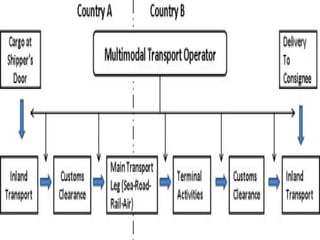
Where the carrier
organizes the transport
&
takes responsibility
for the entire door-
to-door transport
&
issues a multimodal
transport document.
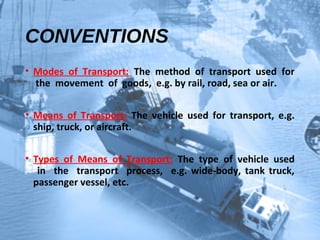
Modes of
Transport
The method of
transport
used for the
movement of
goods, e.g. by
rail, road, sea
or air.
Means of
Transport
The vehicle
used for
transport,
e.g. ship,
truck, or
aircraft.
TransportTransport
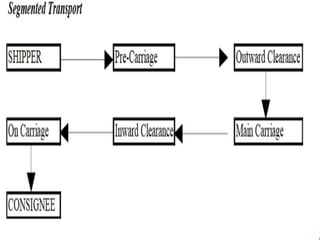
The transport
by one mode
of transport
only, where
each carrier
issues his own
transport
document
(B/L,
airwaybill,
consignment
Combined Transport:
The transportation of goods
in one and the same loading
unit or vehicle by a
combination of road, rail, and
inland waterway modes.
MULTIMODAL
TRANSPORT OPERATOR
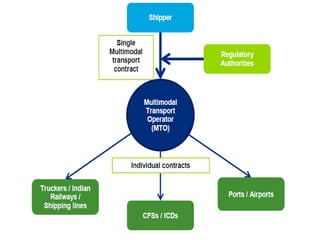
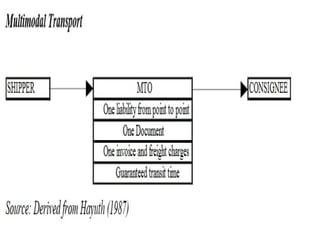
A multimodal transport operator (MTO) acts as a as
a “carrier”, because the MTO contracts with the
shipper to carry goods by one or more modes of
transport as may be necessary.
The MTO accepts total responsibility and liability to
perform the transport contract;
And
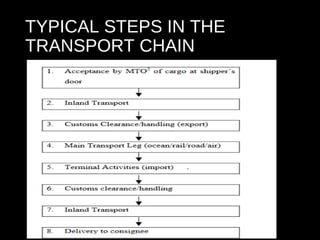
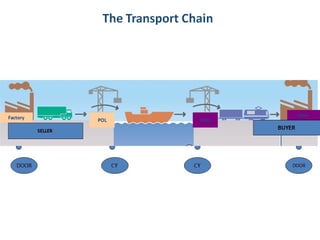
TRANSPORT
CHAIN
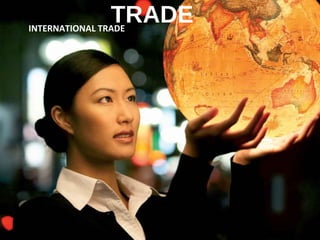
INTERNATIONAL TRADE
SEGMENTED &
MULTIMODAL
TRANSPORT
INTERNATIONAL TRADE
TRADE
FACILITATION
INTERNATIONAL TRADE
TRADE
FACILITATI
ON
FALPRO is
standardizing
simplifying documentation
trade procedures
through regional or national
facilitation organizations.
NORMALISATIONNORMALISATION
HARMONISATIONHARMONISATION
ELECTRONIC
DATA
INTERCHANGE
INTERNATIONAL TRADE
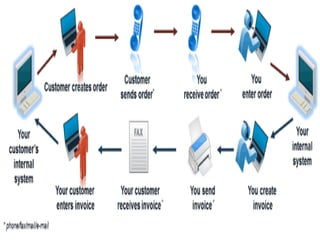
computer-to-computer based
exchange of business documents in a
standard electronic format between
business partners.
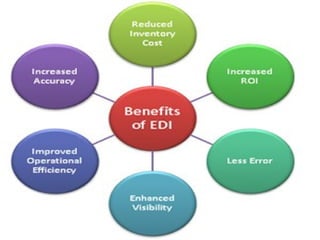
BENEFITS OF EDI
Cost SavingCost Saving
Speed & AccuracySpeed & Accuracy
Increase inIncrease in
Business EfficiencyBusiness Efficiency
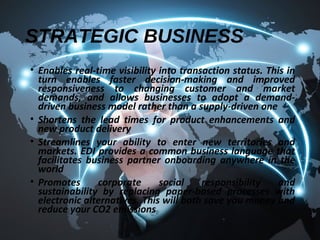
Strategic BusinessStrategic Business
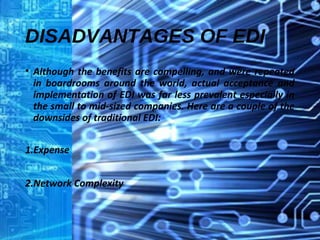
DISADVANTAGES
OF
EDI
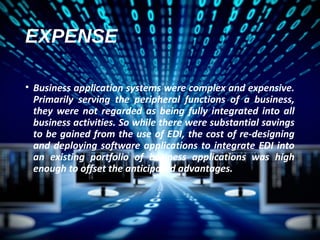
ExpensiveExpensive
Network ComplexityNetwork Complexity
Required Skill TechnicianRequired Skill Technician
Difficult For SME’sDifficult For SME’s
to Implementto Implement
EDI
IN
INTERNATIONAL
TRADE
EDI
at
Ports
(Air/Sea)
Port communities
throughout the
world are applying
electronic data
interchange (EDI)
for trade functions
Enables open communications
among many partners.
EDI enables not only
internal efficiencies
but also the creation of
new trade services.
Provides quick
communications
for relatively low cost, and
offers the prospect of
significant
savings
in time and cost through
• The framework specifies the information systems and
technology needed to enable EDI in international
trade.
• Two Levels of framework of infrastructure:
1.1.communications and documentary;communications and documentary;
2.2.both supporting a third superstructure of businessboth supporting a third superstructure of business
processes.processes.
Port communities are
offering advanced data-
handling and processing
systems as well.
.
Port communities may follow
several models of
infrastructure integration in
moving towards their
strategic objectives
•The contributions of EDI to governments and
corporations are primarily to provide, and insight into
•technology transfer
•corporate competitiveness and
•policy formulation.
ORGANIZATIONS
INVOLVEDIN
USING/
PROMOTING EDI
IN
INTERNATIONAL
• EC/EDI Council of India
• India EDIFACT Committee
• Working Group
• Technical Assessment Group
• VAN Service Providers
• DGFT
• AEPC
• TEXPROCIL
• Central Excise
• Indian Banks Association
•Sea Ports
•CONCOR
•Indian Railways
•Airport Authority of India (AAI)
•Express Courier System
•Process re-engineering
EDI IN MULTIMODAL
TRANSPORTATION/
INTERNATIONAL BUSINESS
INTERNATIONAL TRADE
Enhanced Visibility:Enhanced Visibility:
Increasing Shipment
Visibility
Reduced labor costs.
Minimized freight costs.
Improved customer service
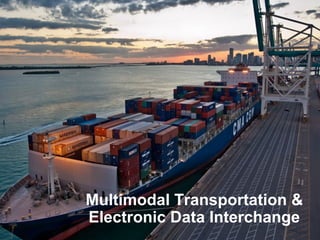
Multimodal transportation& Electronic Data Interchange

Multimodal transportation& Electronic Data Interchange

Editor's Notes

  • #16 This is one of the reason for the success of courier services but courier services are however not the ideal solution to the problem of getting the various documents to their destination fast enough.
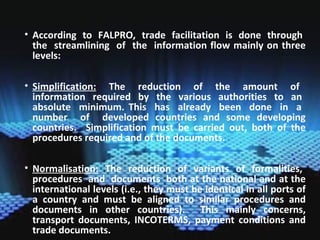
  • #17 Simplification: The reduction of the amount of information required by the various authorities to an absolute minimum. This has already been done in a number of developed countries and some developing countries. Simplification must be carried out, both of the procedures required and of the documents. Normalisation: The reduction of variants of formalities, procedures and documents both at the national and at the international levels (i.e., they must be identical in all ports of a country and must be aligned to similar procedures and documents in other countries). This mainly concerns, transport documents, INCOTERMS, payment conditions and trade documents. Harmonisation: The harmonisation of statistics of streamlining of the transmission of data using EDI. Such change from paper documents to electronically transmitted information is difficult to carry out but will greatly facilitate trade. However, because of the many different systems in use, harmonisation of such systems is required.
  • #37 EDI can enable a sharper understanding of your supply chain to reduce inventory carrying costs. You can stock only what you need. Companies using EDI for advanced shipping notices (ASNs) can save up to 40 percent of labor costs associated with inbound processing. Using EDI in concert with a transportation management system can minimize transport expenses while maintaining high service levels through load consolidation and mode selection. Customers, suppliers, and regulators benefit from the seamless flow of critical business information among partners. Increasing Shipment Visibility Import regulations change often and continually require more data to be captured and reported. For example, Customs and Border Protection's Importer Security Filing initiative, commonly known as 10+2, requires importers and vessel operating carriers to provide additional advance trade data. Companies can leverage this data to increase inbound supply chain visibility.