

Electronic Data
Interchange
Muhammad Musa
Syed Hamza Hussain
Ansar Ilyas
What is Electronic Data Interchange
• Electronic Data Interchange (EDI), is the computer-to-computer
exchange of standard business documents in electronic format
between two companies
•
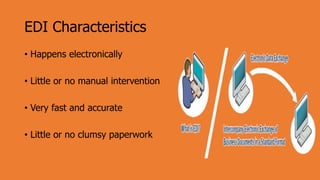
EDI Characteristics
• Happens electronically
• Little or no manual intervention
• Very fast and accurate
• Little or no clumsy paperwork
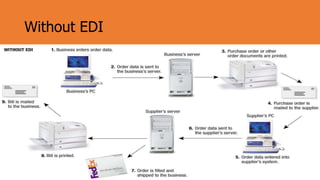
Without EDI
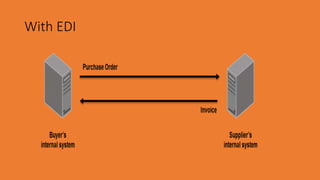
With EDI
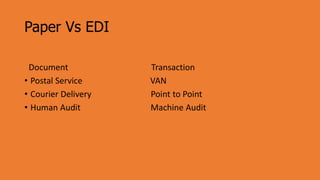
Paper Vs EDI
Document Transaction
• Postal Service VAN
• Courier Delivery Point to Point
• Human Audit Machine Audit
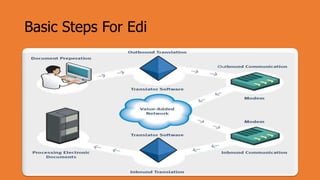
Basic Steps For Edi
Basic steps for EDI
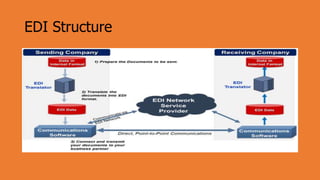
• Prepare the document
• Translate the document
• Transmit the document to your partner
Prepare The Document
• The first step is to collect and organize the data.
• Instead of printing a purchase order .
• Your system creates an electronic file with the necessary
information to build an EDI document
Translate The Document
• The next step is to feed your electronic data through translator
software.
• EDI Translator convert your internal data format into the EDI
standard format using the appropriate segments and data
elements.
Transmit the Documents
• Business documents are translated to the appropriate EDI
format they are ready to be transmitted to your business
partner.
• The most common way to send EDI files is to use a value added
network.
• The VAN takes the transmitted data from your computer system
and stores it securely before the receiver's system tells it that it
is ready to pick it up , bypassing the VAN's storage system.
EDI Structure
EDI Standards
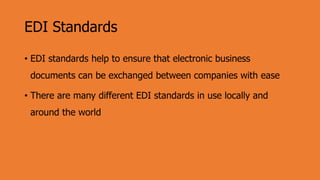
• EDI standards help to ensure that electronic business
documents can be exchanged between companies with ease
• There are many different EDI standards in use locally and
around the world
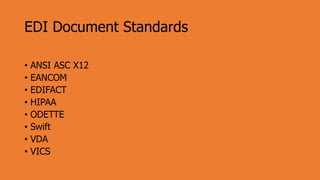
EDI Document Standards
• ANSI ASC X12
• EANCOM
• EDIFACT
• HIPAA
• ODETTE
• Swift
• VDA
• VICS
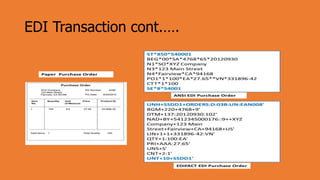
EDI Transactions
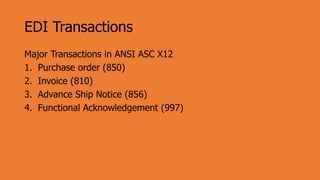
Major Transactions in ANSI ASC X12
1. Purchase order (850)
2. Invoice (810)
3. Advance Ship Notice (856)
4. Functional Acknowledgement (997)
EDI Transaction cont.….
Advantages
• Reduces the flow of paper between organizations.
• Improves productivity.
• Reduce labor cost.
• Improves accuracy of information and reduces errors .
Draw Backs
 Very high initial costs.
 Barrier to entry.
 Standardizes programs and procedures.
 Complex to use.
Case Study Furniture Whole Saler
• Objective
• To achieve greater supply chain efficiency
Steps to Success
• Implement a PC-based solution to exchange orders and invoices
• Operate a customer-facing supply chain with continuous flow of information between the
organization and its customers
• Remove error-and time-consuming manual tasks for a process
Results
• Competitive advantage and improved cash flow
• A more efficient supply chain means the organization can offer increased seasonal order periods,
providing a clear competitive advantage
• Improved cash flow because electronic invoicing has increased speed of payment from customers
• Benefit of improved cash flow shared with manufacturers, thus improving loyalty and
commitment
Thank You

Electronic data interchange

  • 1.
  • 2.
    What is ElectronicData Interchange • Electronic Data Interchange (EDI), is the computer-to-computer exchange of standard business documents in electronic format between two companies •
  • 3.
    EDI Characteristics • Happenselectronically • Little or no manual intervention • Very fast and accurate • Little or no clumsy paperwork
  • 4.
  • 5.
  • 6.
    Paper Vs EDI DocumentTransaction • Postal Service VAN • Courier Delivery Point to Point • Human Audit Machine Audit
  • 7.
  • 8.
    Basic steps forEDI • Prepare the document • Translate the document • Transmit the document to your partner
  • 9.
    Prepare The Document •The first step is to collect and organize the data. • Instead of printing a purchase order . • Your system creates an electronic file with the necessary information to build an EDI document
  • 10.
    Translate The Document •The next step is to feed your electronic data through translator software. • EDI Translator convert your internal data format into the EDI standard format using the appropriate segments and data elements.
  • 11.
    Transmit the Documents •Business documents are translated to the appropriate EDI format they are ready to be transmitted to your business partner. • The most common way to send EDI files is to use a value added network. • The VAN takes the transmitted data from your computer system and stores it securely before the receiver's system tells it that it is ready to pick it up , bypassing the VAN's storage system.
  • 12.
  • 13.
    EDI Standards • EDIstandards help to ensure that electronic business documents can be exchanged between companies with ease • There are many different EDI standards in use locally and around the world
  • 14.
    EDI Document Standards •ANSI ASC X12 • EANCOM • EDIFACT • HIPAA • ODETTE • Swift • VDA • VICS
  • 15.
    EDI Transactions Major Transactionsin ANSI ASC X12 1. Purchase order (850) 2. Invoice (810) 3. Advance Ship Notice (856) 4. Functional Acknowledgement (997)
  • 16.
  • 17.
    Advantages • Reduces theflow of paper between organizations. • Improves productivity. • Reduce labor cost. • Improves accuracy of information and reduces errors .
  • 18.
    Draw Backs  Veryhigh initial costs.  Barrier to entry.  Standardizes programs and procedures.  Complex to use.
  • 19.
    Case Study FurnitureWhole Saler • Objective • To achieve greater supply chain efficiency Steps to Success • Implement a PC-based solution to exchange orders and invoices • Operate a customer-facing supply chain with continuous flow of information between the organization and its customers • Remove error-and time-consuming manual tasks for a process Results • Competitive advantage and improved cash flow • A more efficient supply chain means the organization can offer increased seasonal order periods, providing a clear competitive advantage • Improved cash flow because electronic invoicing has increased speed of payment from customers • Benefit of improved cash flow shared with manufacturers, thus improving loyalty and commitment
  • 20.