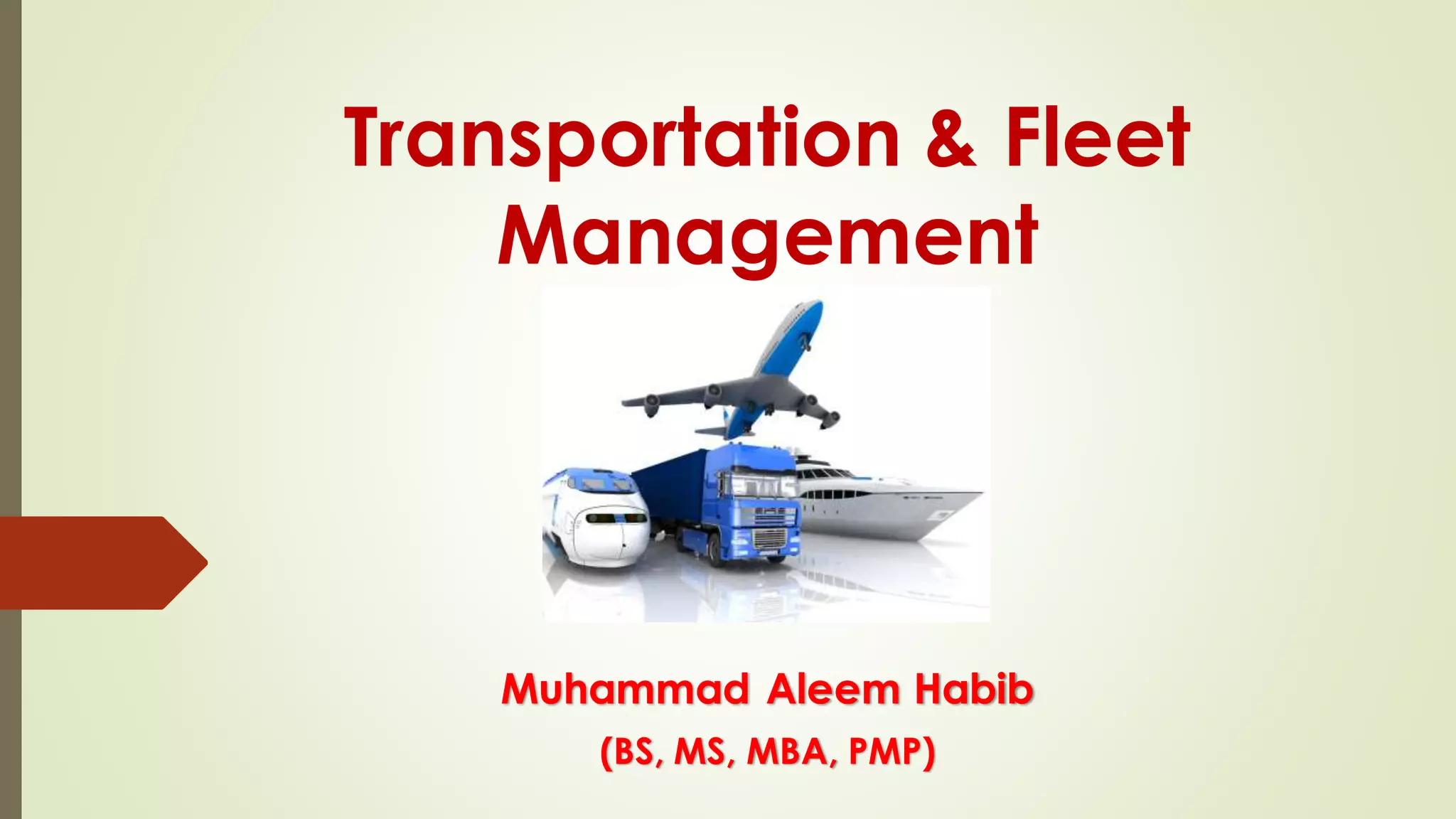
Transportation & Fleet
Management
Muhammad Aleem Habib
(BS, MS, MBA, PMP)
Transportation
Transportation refers to the movement of
product from one location to another as it
makes its way from the beginning of supply
chain to the customer.
Transportation is an important supply chain
driver because products are rarely produced
and consumed in the same location.
The Role of Transportation in Logistics
In 2009, as a percentage of sales, transportation was
3.24%, warehousing 1.84%, customer service 0.48%,
administration 0.38%, and carrying cost 1.52%.
Outbound transportation was clearly the largest
component of total physical distribution costs.
Cost trade-offs abound in transportation and are typified
by trading lower inventory costs for higher transportation
costs.
Role of transportation in supply chain
management
The Transport Selection Decision
Firms need to recognize that the lowest cost
carrier does not necessarily guarantee that this
carrier will result in the lowest landed cost.
Therefore, firms need to keep the big picture in
mind when attempting to select a carrier.
Carrier Selection Determinants
Transit time
Reliability
Capability
Accessibility
Security
Carrier Selection Determinants
Service Determinant Implication
Transit Time Inventory, Stockout Costs
Reliability Inventory, Stockout Costs
Accessibility Transit Time, Transportation Cost
Capability
Meets Products’ Unique Physical
and Marketing Requirements
Security Inventory, Stockout Costs
Importance Ranking of Carrier Selection
Determinants
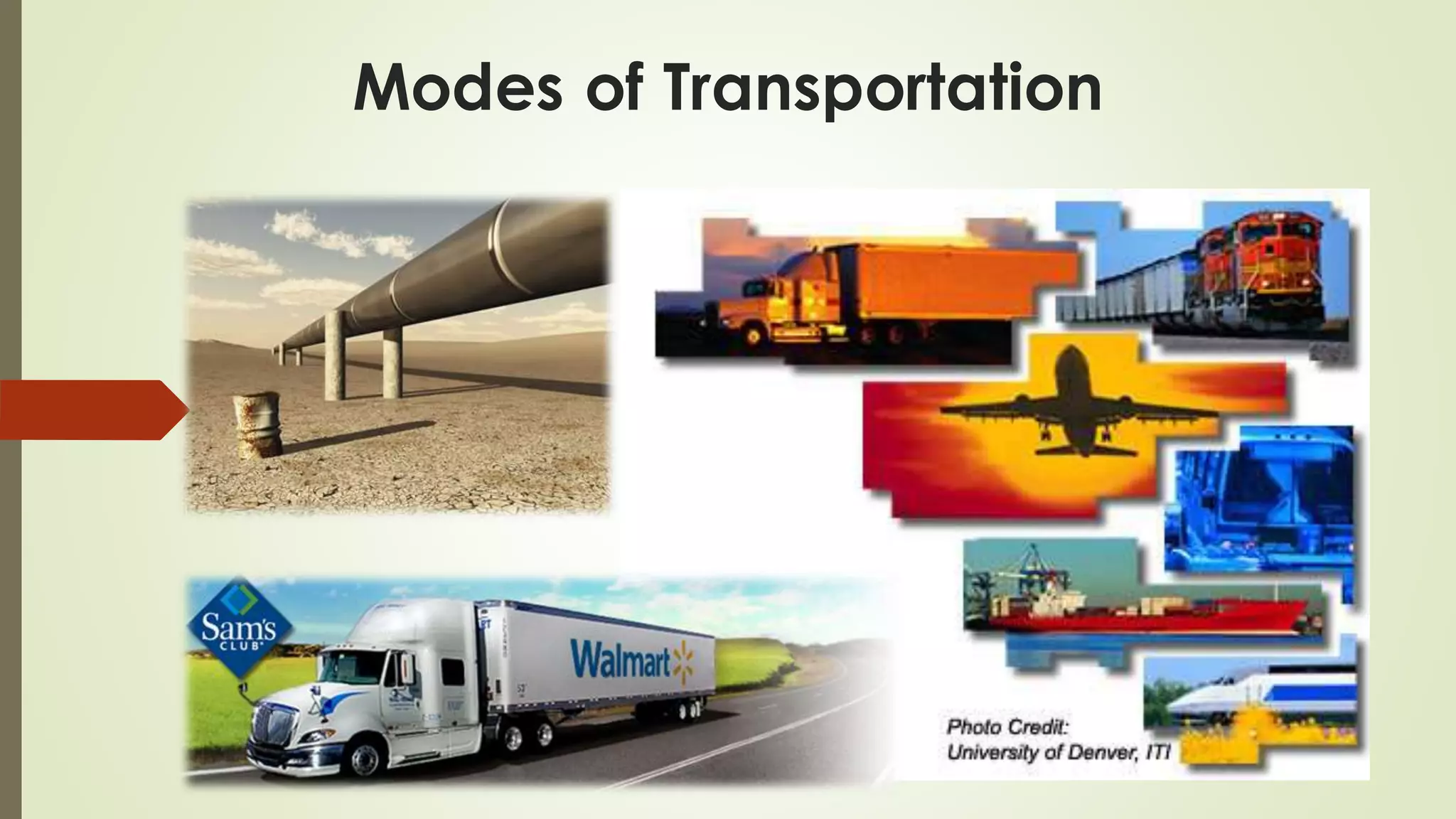
Modes of Transportation
Railroads
Capable of carrying a wide variety of products,
much more so that other modes.
Very small number of carriers; likely only one will
be able to serve any one customer location.
Trend is to merge smaller companies into larger
ones with ultimate goal of having perhaps two
transcontinental rail carriers.
Railroads
Rail is a long haul, large volume system (high fixed
costs; own rights-of-way).
Accessibility can be a problem.
Transit times are spotty, but are generally long.
Reliability and safety are improving and are
generally good.
Motor Carriers
The motor carrier industry is characterized by a
large number of small firms.
Low cost of entry causes these large numbers.
Used by almost all logistics systems and account
for 82 percent of U.S. freight expenditures.
Consists of for-hire and private carriers.
Motor Carriers
Characterized by low fixed costs and high
variable costs.
Do not own their rights-of-way.
Limited operating authority regarding service
areas, routes, rates and products carried.
Motor Carriers
 High accessibility
 Transit times faster than rail or water.
 Reliability can be affected greatly by weather.
 Small vehicle size coincides with lower inventory
strategies and quick replenishment (QR).
 Relatively high cost compared to rail and water;
trade-off is faster service.
Water Carriers
Relatively low cost mode; do not own the rights-
of-way.
Typically a long distance mover of low value,
bulk-type mineral, agricultural and forest
products
Low rates but long transit times
Low accessibility but high capability
Water Carriers
General cargo ships
Large high capacity cargo holds
Engaged on a contract basis
Many have self-contained cranes for
loading/unloading
Tankers
Specially designed for liquid cargoes
Largest vessels afloat, some VLCCs at 500k+ tons
Water Carriers
Container ships
High speeds for ships; increasingly more common
and important
Larger vessels can handle up to 5,000 containers.
RO-RO (Roll on-Roll off)
Basically a large ferry that facilitates the loading
and unloading process by using drive on/off ramps
May also have the capacity to haul containers
Air Carriers
Limited number of large carriers earn about 90% of the
revenue.
Any of the air carriers can carry air freight although some
haul nothing but freight.
Cost structure is highly variable; do not own rights-of-way.
Transit times are fastest of the modes, but rates are highest.
Air Carriers
Average revenue per ton mile 18 times higher than
rail; twice that of motor carriers.
Seek goods with a high value to weight ratio.
Accessibility is low as is capability.
Reliability subject to weather more than other
modes.
Pipelines
Unique mode of transportation as the equipment is fixed in
place and the product moves through it in high volume.
They can move large quantities of certain types of
commodities, mainly fluids, over long distances at relatively
low cost.
The operations are dependable and continuous.
Not suitable for general transportation.
Pipelines Advantages
They are insensitive to surface conditions such as storms,
inclement weather, etc.
High fixed versus low variable. Operating costs are low.
They are environmentally friendly.
Own rights-of-way much like the railroads.
Accessibility is very low.
Pipelines Projects
Iran-Pakistan-India gas pipeline project of 27755Km.
proposed to deliver the natural gas from Iran to Pakistan &
India.
Cost of the project – US $7 billion.
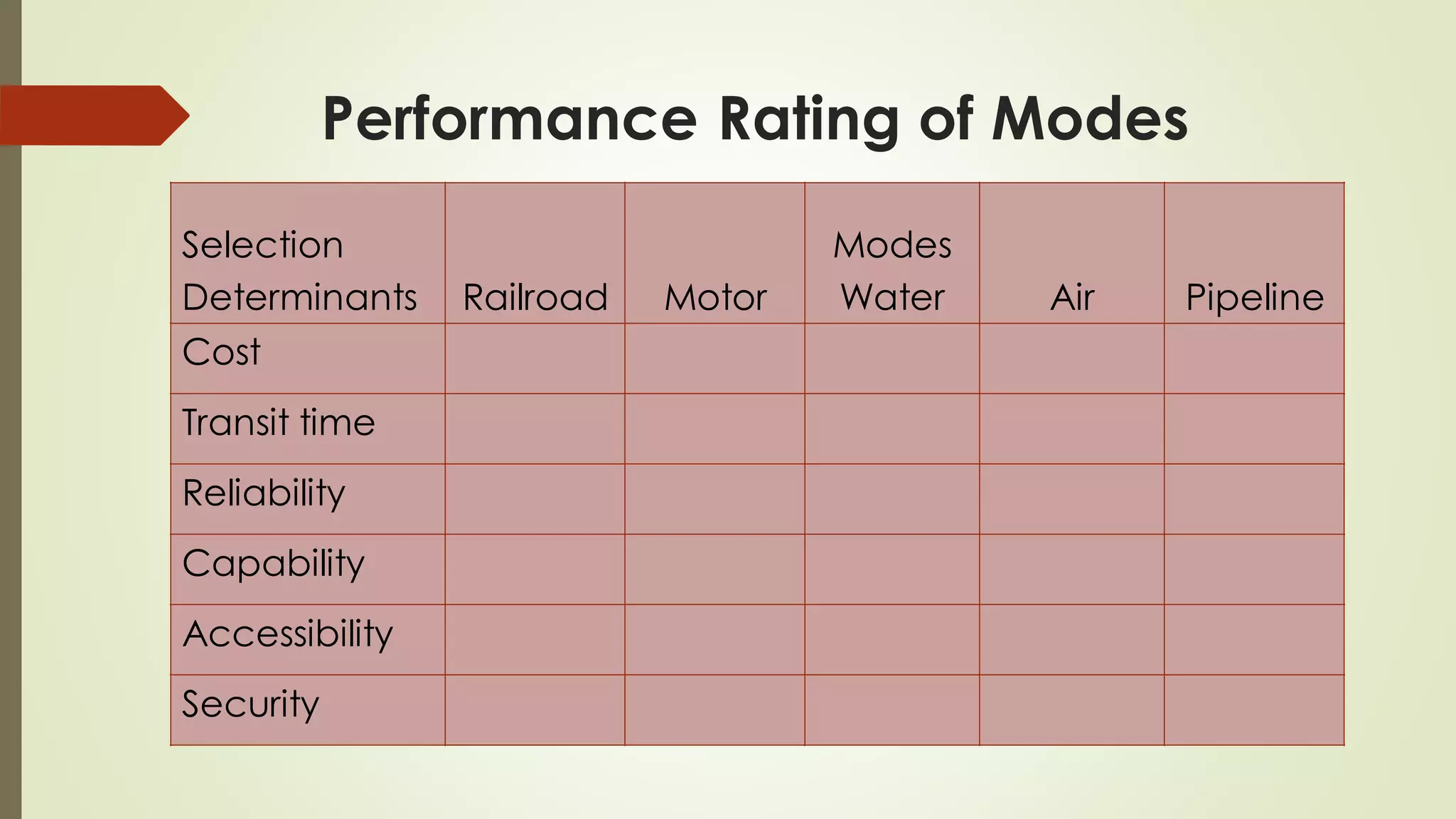
Performance Rating of Modes
Selection
Determinants Railroad Motor
Modes
Water Air Pipeline
Cost
Transit time
Reliability
Capability
Accessibility
Security
Performance Rating of Modes
Selection
Determinants Railroad Motor
Modes
Water Air Pipeline
Cost 3 4 2 5 1
Transit time 3 2 4 1 ---
Reliability 2 1 4 3 ---
Capability 1 2 4 3 ---
Accessibility 2 1 4 3 ---
Security 3 2 4 1 ---
Legal Classifications of Carriers
Common Carrier
For-hire carrier that serves the general public at
reasonable rates and without discrimination.
Carrier is liable for damages to products carried.
Exceptions to liability include acts of God, acts of
the public enemy, acts of the shipper and defects
inherent in the goods.
Backbone of the transportation industry.
Regulated Carrier
Regulated carriers are found in motor and water
carriage.
Regulations including entry controls, reasonable
rates, and nondiscrimination provisions.
Must provide safe and adequate service.
Contract Carriers
 For-hire carrier that does not have to serve the general
public.
 May serve one or a few shippers exclusively.
 May offer specialized equipment.
 Other aspects of the carrier/shipper relationship are
made a part of the contract between the two parties.
 Rates usually lower than common or regulated carriers.
Private Carriers
Private carriage is the firm’s own transportation.
Not for-hire and not subject to Federal regulations.
May not be the firm’s primary business but can charge
a intracompany fee for transportation services.
Almost exclusively motor, but some rail, air and water
also exist.
Private Carriers
Firms gain ultimate control over shipments and achieve
maximum flexibility in moving goods.
Backhauls are usually empty or return materials to the
firm’s plants and/or warehouses.
Requires a large capital investment.
Requires management time and expertise.
Inter Modal Transportation
Intermodal Transportation
Refers to use of two or more modes of transportation
cooperating on the movement of shipment by publishing a
through rate.
Logistics managers are looking for the best way to move
shipments and these often attempt to take advantage of
multiple modes of transportation, each of which has certain
useful characteristics.
Certain types have been fairly well developed, such as
rail/water, motor/water, rail/motor, and motor/air.
Types of Intermodal Services
Intermodal Transportation:
Containerization
 Referred to as Container-on-Flat-Car (COFC)
 Goods are placed in a large box, where they are
untouched until they arrive at the consignee's unloading
dock.
 Reduces theft, damage, multiple handling costs and
intermodal transfer time.
 Changes materials handling from labor intensive to
capital intensive and may reduce costs from 10 to 20%.
Containerization
Land bridge” concept may apply for international
shipments where oceans are separated by a large land
mass.
For example, containers moving from Japan to Europe
may dock at Long Beach, CA, transfer the containers to a
railroad, and reload the containers onboard another ship
in Norfolk, VA., continuing on to a European port.
Intermodal Transportation: Piggyback
Trailer-on-Flat-Car (TOFC)
Over the road trailers ride in special rail cars.
Takes advantage of motor flexibility and rail’s
long haul economic advantage.
Trailers loaded by driving, crane hoisting, or fork-
lift hoisting.
RoadRailers
Newest concept referred to as a
“RoadRailer”
Essentially a trailer that has been
reinforced to ride on a rail bogey and be
coupled together directly without first
being placed on a rail flat car
Saves weight and locomotive power and
thus fuel for the railroad
Indirect and Special Carriers
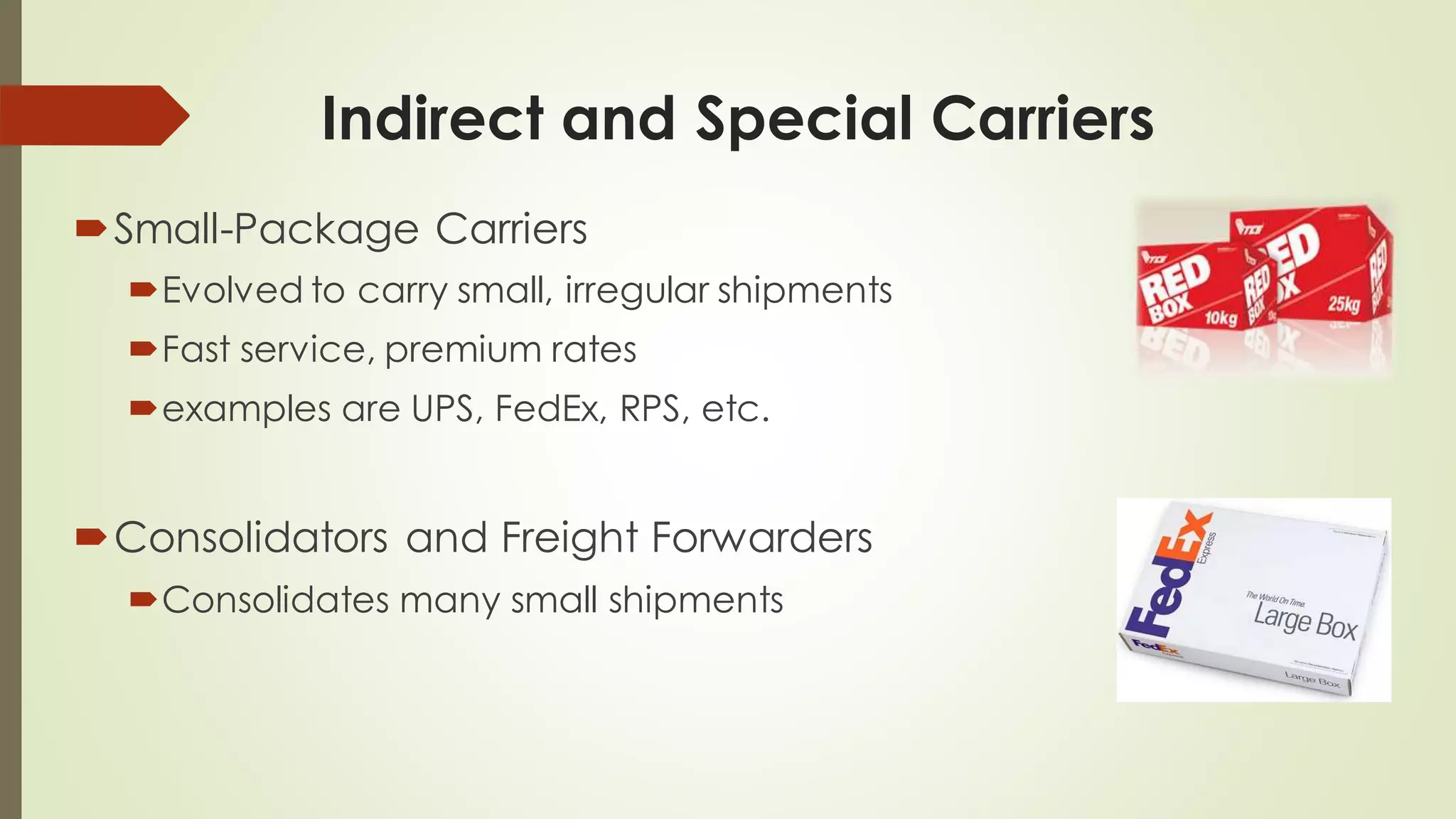
Small-Package Carriers
Evolved to carry small, irregular shipments
Fast service, premium rates
examples are UPS, FedEx, RPS, etc.
Consolidators and Freight Forwarders
Consolidates many small shipments

Transportation Management

  • 1.
    Transportation & Fleet Management MuhammadAleem Habib (BS, MS, MBA, PMP)
  • 2.
    Transportation Transportation refers tothe movement of product from one location to another as it makes its way from the beginning of supply chain to the customer. Transportation is an important supply chain driver because products are rarely produced and consumed in the same location.
  • 3.
    The Role ofTransportation in Logistics In 2009, as a percentage of sales, transportation was 3.24%, warehousing 1.84%, customer service 0.48%, administration 0.38%, and carrying cost 1.52%. Outbound transportation was clearly the largest component of total physical distribution costs. Cost trade-offs abound in transportation and are typified by trading lower inventory costs for higher transportation costs.
  • 4.
    Role of transportationin supply chain management
  • 5.
    The Transport SelectionDecision Firms need to recognize that the lowest cost carrier does not necessarily guarantee that this carrier will result in the lowest landed cost. Therefore, firms need to keep the big picture in mind when attempting to select a carrier.
  • 6.
    Carrier Selection Determinants Transittime Reliability Capability Accessibility Security
  • 7.
    Carrier Selection Determinants ServiceDeterminant Implication Transit Time Inventory, Stockout Costs Reliability Inventory, Stockout Costs Accessibility Transit Time, Transportation Cost Capability Meets Products’ Unique Physical and Marketing Requirements Security Inventory, Stockout Costs
  • 8.
    Importance Ranking ofCarrier Selection Determinants
  • 9.
  • 10.
    Railroads Capable of carryinga wide variety of products, much more so that other modes. Very small number of carriers; likely only one will be able to serve any one customer location. Trend is to merge smaller companies into larger ones with ultimate goal of having perhaps two transcontinental rail carriers.
  • 11.
    Railroads Rail is along haul, large volume system (high fixed costs; own rights-of-way). Accessibility can be a problem. Transit times are spotty, but are generally long. Reliability and safety are improving and are generally good.
  • 12.
    Motor Carriers The motorcarrier industry is characterized by a large number of small firms. Low cost of entry causes these large numbers. Used by almost all logistics systems and account for 82 percent of U.S. freight expenditures. Consists of for-hire and private carriers.
  • 13.
    Motor Carriers Characterized bylow fixed costs and high variable costs. Do not own their rights-of-way. Limited operating authority regarding service areas, routes, rates and products carried.
  • 14.
    Motor Carriers  Highaccessibility  Transit times faster than rail or water.  Reliability can be affected greatly by weather.  Small vehicle size coincides with lower inventory strategies and quick replenishment (QR).  Relatively high cost compared to rail and water; trade-off is faster service.
  • 15.
    Water Carriers Relatively lowcost mode; do not own the rights- of-way. Typically a long distance mover of low value, bulk-type mineral, agricultural and forest products Low rates but long transit times Low accessibility but high capability
  • 16.
    Water Carriers General cargoships Large high capacity cargo holds Engaged on a contract basis Many have self-contained cranes for loading/unloading Tankers Specially designed for liquid cargoes Largest vessels afloat, some VLCCs at 500k+ tons
  • 17.
    Water Carriers Container ships Highspeeds for ships; increasingly more common and important Larger vessels can handle up to 5,000 containers. RO-RO (Roll on-Roll off) Basically a large ferry that facilitates the loading and unloading process by using drive on/off ramps May also have the capacity to haul containers
  • 18.
    Air Carriers Limited numberof large carriers earn about 90% of the revenue. Any of the air carriers can carry air freight although some haul nothing but freight. Cost structure is highly variable; do not own rights-of-way. Transit times are fastest of the modes, but rates are highest.
  • 19.
    Air Carriers Average revenueper ton mile 18 times higher than rail; twice that of motor carriers. Seek goods with a high value to weight ratio. Accessibility is low as is capability. Reliability subject to weather more than other modes.
  • 20.
    Pipelines Unique mode oftransportation as the equipment is fixed in place and the product moves through it in high volume. They can move large quantities of certain types of commodities, mainly fluids, over long distances at relatively low cost. The operations are dependable and continuous. Not suitable for general transportation.
  • 21.
    Pipelines Advantages They areinsensitive to surface conditions such as storms, inclement weather, etc. High fixed versus low variable. Operating costs are low. They are environmentally friendly. Own rights-of-way much like the railroads. Accessibility is very low.
  • 22.
    Pipelines Projects Iran-Pakistan-India gaspipeline project of 27755Km. proposed to deliver the natural gas from Iran to Pakistan & India. Cost of the project – US $7 billion.
  • 23.
    Performance Rating ofModes Selection Determinants Railroad Motor Modes Water Air Pipeline Cost Transit time Reliability Capability Accessibility Security
  • 24.
    Performance Rating ofModes Selection Determinants Railroad Motor Modes Water Air Pipeline Cost 3 4 2 5 1 Transit time 3 2 4 1 --- Reliability 2 1 4 3 --- Capability 1 2 4 3 --- Accessibility 2 1 4 3 --- Security 3 2 4 1 ---
  • 25.
  • 26.
    Common Carrier For-hire carrierthat serves the general public at reasonable rates and without discrimination. Carrier is liable for damages to products carried. Exceptions to liability include acts of God, acts of the public enemy, acts of the shipper and defects inherent in the goods. Backbone of the transportation industry.
  • 27.
    Regulated Carrier Regulated carriersare found in motor and water carriage. Regulations including entry controls, reasonable rates, and nondiscrimination provisions. Must provide safe and adequate service.
  • 28.
    Contract Carriers  For-hirecarrier that does not have to serve the general public.  May serve one or a few shippers exclusively.  May offer specialized equipment.  Other aspects of the carrier/shipper relationship are made a part of the contract between the two parties.  Rates usually lower than common or regulated carriers.
  • 29.
    Private Carriers Private carriageis the firm’s own transportation. Not for-hire and not subject to Federal regulations. May not be the firm’s primary business but can charge a intracompany fee for transportation services. Almost exclusively motor, but some rail, air and water also exist.
  • 30.
    Private Carriers Firms gainultimate control over shipments and achieve maximum flexibility in moving goods. Backhauls are usually empty or return materials to the firm’s plants and/or warehouses. Requires a large capital investment. Requires management time and expertise.
  • 31.
  • 32.
    Intermodal Transportation Refers touse of two or more modes of transportation cooperating on the movement of shipment by publishing a through rate. Logistics managers are looking for the best way to move shipments and these often attempt to take advantage of multiple modes of transportation, each of which has certain useful characteristics. Certain types have been fairly well developed, such as rail/water, motor/water, rail/motor, and motor/air.
  • 33.
  • 34.
    Intermodal Transportation: Containerization  Referredto as Container-on-Flat-Car (COFC)  Goods are placed in a large box, where they are untouched until they arrive at the consignee's unloading dock.  Reduces theft, damage, multiple handling costs and intermodal transfer time.  Changes materials handling from labor intensive to capital intensive and may reduce costs from 10 to 20%.
  • 35.
    Containerization Land bridge” conceptmay apply for international shipments where oceans are separated by a large land mass. For example, containers moving from Japan to Europe may dock at Long Beach, CA, transfer the containers to a railroad, and reload the containers onboard another ship in Norfolk, VA., continuing on to a European port.
  • 36.
    Intermodal Transportation: Piggyback Trailer-on-Flat-Car(TOFC) Over the road trailers ride in special rail cars. Takes advantage of motor flexibility and rail’s long haul economic advantage. Trailers loaded by driving, crane hoisting, or fork- lift hoisting.
  • 37.
    RoadRailers Newest concept referredto as a “RoadRailer” Essentially a trailer that has been reinforced to ride on a rail bogey and be coupled together directly without first being placed on a rail flat car Saves weight and locomotive power and thus fuel for the railroad
  • 38.
    Indirect and SpecialCarriers Small-Package Carriers Evolved to carry small, irregular shipments Fast service, premium rates examples are UPS, FedEx, RPS, etc. Consolidators and Freight Forwarders Consolidates many small shipments