Integrated Logistics: Transportation
Laura Andrade
David Coto
David Cox
Arianna Espinoza
Nicole García
Helanny Rendón
Carolina Vélez
Logistic II “A”
Date: February/15/2016
• Lecturer
Mr Max Galarza
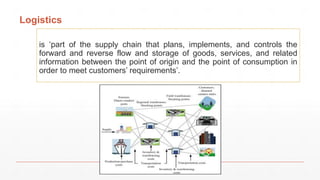
Logistics
is ‘part of the supply chain that plans, implements, and controls the
forward and reverse flow and storage of goods, services, and related
information between the point of origin and the point of consumption in
order to meet customers’ requirements’.
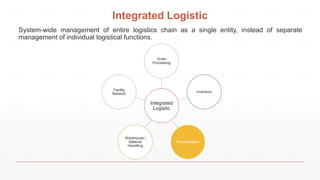
Integrated Logistic
System-wide management of entire logistics chain as a single entity, instead of separate
management of individual logistical functions.
Integrated
Logistic
Order
Processing
Inventory
Transportation
Warehouse /
Material
Handlling
Facility
Network
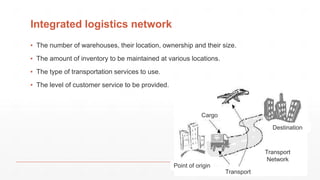
Integrated logistics network
▪ The number of warehouses, their location, ownership and their size.
▪ The amount of inventory to be maintained at various locations.
▪ The type of transportation services to use.
▪ The level of customer service to be provided.
Point of origin
Cargo
Transport
Transport
Network
Destination
Transportation
Logistic
&
Transport is a component of many
national or
international logistics networks,
managing and controlling the flow of
goods, energy, information and
other resources like products,
services, and people, from the
source of production to the
marketplace.
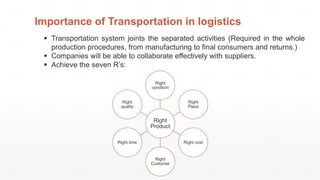
 Transportation system joints the separated activities (Required in the whole
production procedures, from manufacturing to final consumers and returns.)
 Companies will be able to collaborate effectively with suppliers.
 Achieve the seven R’s:
Importance of Transportation in logistics
Right
Product
Right
condition
Right
Place
Right cost
Right
Customer
Right time
Right
quality
Factors to be considerer to choose means of transport
▪ Points available to load and discharge the merchandise.
▪ Goods characteristics: weight, volume, shape, size, special requirements.
▪ Costs related to charge, discharge.
▪ Distance that can separate a firm from its customers.
Transport Management
Deals with four areas that are economically interrelated:
▪ Transportation mode
▪ Fleet size
▪ Route selection
▪ Vehicle scheduling
▪ Freight consolidation
Means of transport
Air
Land
Water
Others
Air freight
▪ The characteristics are:
1. Airplanes and airports are separated. (industries only need to prepare planes
for operation)
2. It is not affected by landforms.
3. Air freight logistics is cooperative with other transport modes, such as maritime
and land transport, to provide a service base on Just-In-Time, and door-to-door.
▪ It provides the delivery with speed, lower risk of damage, security, flexibility,
accessibility and good frequency for regular destinations.
▪ Disadvantage is high delivery fee.
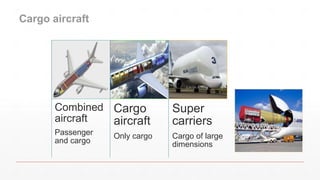
Combined
aircraft
Passenger
and cargo
Cargo
aircraft
Only cargo
Super
carriers
Cargo of large
dimensions
Cargo aircraft
Land logistics
The most positive characteristics are:
▪ High accessibility level in land areas.
▪ Flexibility and adaptation: the schedule (routes and timings) can be adjusted, for
example allow “just in time” and door to door service.
▪ Low cost and less time: fast delivery.
The disadvantages:
▪ The excessive usage of land transport also brings many problems, such as traffic jams,
pollution and traffic crashes.
Land transportation: Railway transport
Advantages
High carrying capacity
Lower influence by weather
conditions, and
Lower energy consumption
Disadvantages
High cost of essential facilities.
Difficult and expensive
maintenance
Lack of elasticity of urgent
demands.
Land transportation: Road freight
Advantages
Cheaper investment funds
High accessibility
Mobility and availability
Disadvantages
Low capacity
Lower safety
Slow speed.
Land transportation: Pipeline transport
Advantages
Less effect by weather conditions
High capacity
Cheaper operation fee
Continuous conveyance
Disadvantages
Expensive infrastructures
Harder supervision
Regular maintenance needs. .
Maritime Logistics
▪ It can provide a cheap and high carrying capacity conveyance for consumers.
▪ Its disadvantage is that it needs longer transport time and its schedule is strongly
affected by the weather factors.
▪ Maritime transport industry can be divided into three main types:
1. Liner Shipping: The business is based on the same ships, routes, price, and
regular voyages.
2. Tramp Shipping: irregular transport price, unsteady transport routes, and schedule.
It usually delivers particular goods, such as Dry Bulk Cargo and crude oil.
3. Industry Shipping is to ensure the supply of raw materials. This sometimes needs
specialized containers, such as the high-pressure containers for natural gas.
Bulk Carriers Container ships
Tankers
• Fluids (oil, LPG)
Freight Transport by sea
Refrigerated ships
Perishable commodities
Usually ships are painted
white
Roll on/roll off ship
Cargo as Automobiles,
trailers
Ferries
Freight Transport by sea
Multimodal Transport
▪ Also known as combined transport is the transportation of goods under a single contract,
but performed with at least two different means of transport.
▪ The carrier is liable (in a legal sense) for the entire carriage, even though it is performed
by several different modes of transport (by rail, sea and road).
▪ The carrier does not have to possess all the means of transport (performed by sub-
carriers.)
Advantages
▪ Allows handling and faster movement of cargo, including transshipment
operations
▪ Ensures greater protection to the cargo, reducing risk of damage.
▪ Reduce transportation costs from the unitization and consolidation of cargo
▪ Stimulate competitiveness in international trade where the practice is widespread
among developed countries
▪ Improve service quality by using operators responsible and efficient transport
services
Disadvantages
▪ High economic costs
▪ Unfamiliarity with new technology
▪ Presence of legal and operational constraints in implementing international
standards with new technology
▪ Safety requirements : inspections by different authorities in terminals and roads
remain a limiting
Conclusion
▪ Transportation is the base of efficiency and economy in business (expands other
functions of logistics system).
▪ If there is not a well-developed transportation systems, company could not obtain the
all benefits from logistics such as decrease in operation cost, and promote service
quality.
▪ A well-operated logistics system could increase both the competitiveness of the
company and service quality.
“Goods could be sent to the right place at right time in order to satisfy customers’
demands.”
Sources
Kurman, G. Transportation The Key Player In Logistics Management. Retrieved February 7, 2016, from
http://www.borjournals.com/a/index.php/jbmssr/article/download/357/974
Business dictionary. Integrated Logistic: Definition. Retrieved February 7, 2016, from
http://www.businessdictionary.com/definition/integrated-logistics.html
Gómez, G (2013). Transportation. Retrieved February 7, 2016, from http://es.slideshare.net/co-
marca/transporte-aereo-20940150
Oxford Dictionaries. (n.d.). Transportation. Retrieved from
http://www.oxforddictionaries.com/definition/english/transportation?q=transportation
Internacionalmente.com. (2013). International transport. Retrieved from
http://internacionalmente.com/transporte-carretera/
Martín, D. (n.d.). Means of Transport for international cargo. Retrieved from
http://es.slideshare.net/daniloricle/medios-de-transporte-para-cargas-internacionales
Robinson, A. (2013). What is transportation and logistics?. Retrieved from
http://cerasis.com/2013/08/13/transportation-and-logistics-management/
SUDALAIMUTHU, S., & RAJ, S. A. (2009). Logistics Management for International Business: Text and Cases.
PHI Learning Pvt. Ltd.
Sánchez, C. Characteristics of road freight. Retrieved February 7, 2016, from
http://extralinelogistic.blogspot.com/2014/02/characteristics-of-road-freight.html
WG. (n.d.). What is freight transport?. Retrieved from http://www.wisegeek.com/what-is-freight-transport.htm

Integrated logistics transportation

  • 1.
    Integrated Logistics: Transportation LauraAndrade David Coto David Cox Arianna Espinoza Nicole García Helanny Rendón Carolina Vélez Logistic II “A” Date: February/15/2016 • Lecturer Mr Max Galarza
  • 2.
    Logistics is ‘part ofthe supply chain that plans, implements, and controls the forward and reverse flow and storage of goods, services, and related information between the point of origin and the point of consumption in order to meet customers’ requirements’.
  • 3.
    Integrated Logistic System-wide managementof entire logistics chain as a single entity, instead of separate management of individual logistical functions. Integrated Logistic Order Processing Inventory Transportation Warehouse / Material Handlling Facility Network
  • 5.
    Integrated logistics network ▪The number of warehouses, their location, ownership and their size. ▪ The amount of inventory to be maintained at various locations. ▪ The type of transportation services to use. ▪ The level of customer service to be provided. Point of origin Cargo Transport Transport Network Destination
  • 6.
  • 7.
    Transport is acomponent of many national or international logistics networks, managing and controlling the flow of goods, energy, information and other resources like products, services, and people, from the source of production to the marketplace.
  • 8.
     Transportation systemjoints the separated activities (Required in the whole production procedures, from manufacturing to final consumers and returns.)  Companies will be able to collaborate effectively with suppliers.  Achieve the seven R’s: Importance of Transportation in logistics Right Product Right condition Right Place Right cost Right Customer Right time Right quality
  • 9.
    Factors to beconsiderer to choose means of transport ▪ Points available to load and discharge the merchandise. ▪ Goods characteristics: weight, volume, shape, size, special requirements. ▪ Costs related to charge, discharge. ▪ Distance that can separate a firm from its customers.
  • 10.
    Transport Management Deals withfour areas that are economically interrelated: ▪ Transportation mode ▪ Fleet size ▪ Route selection ▪ Vehicle scheduling ▪ Freight consolidation
  • 11.
  • 12.
    Air freight ▪ Thecharacteristics are: 1. Airplanes and airports are separated. (industries only need to prepare planes for operation) 2. It is not affected by landforms. 3. Air freight logistics is cooperative with other transport modes, such as maritime and land transport, to provide a service base on Just-In-Time, and door-to-door. ▪ It provides the delivery with speed, lower risk of damage, security, flexibility, accessibility and good frequency for regular destinations. ▪ Disadvantage is high delivery fee.
  • 13.
  • 14.
    Land logistics The mostpositive characteristics are: ▪ High accessibility level in land areas. ▪ Flexibility and adaptation: the schedule (routes and timings) can be adjusted, for example allow “just in time” and door to door service. ▪ Low cost and less time: fast delivery. The disadvantages: ▪ The excessive usage of land transport also brings many problems, such as traffic jams, pollution and traffic crashes.
  • 15.
    Land transportation: Railwaytransport Advantages High carrying capacity Lower influence by weather conditions, and Lower energy consumption Disadvantages High cost of essential facilities. Difficult and expensive maintenance Lack of elasticity of urgent demands.
  • 16.
    Land transportation: Roadfreight Advantages Cheaper investment funds High accessibility Mobility and availability Disadvantages Low capacity Lower safety Slow speed.
  • 17.
    Land transportation: Pipelinetransport Advantages Less effect by weather conditions High capacity Cheaper operation fee Continuous conveyance Disadvantages Expensive infrastructures Harder supervision Regular maintenance needs. .
  • 18.
    Maritime Logistics ▪ Itcan provide a cheap and high carrying capacity conveyance for consumers. ▪ Its disadvantage is that it needs longer transport time and its schedule is strongly affected by the weather factors. ▪ Maritime transport industry can be divided into three main types: 1. Liner Shipping: The business is based on the same ships, routes, price, and regular voyages. 2. Tramp Shipping: irregular transport price, unsteady transport routes, and schedule. It usually delivers particular goods, such as Dry Bulk Cargo and crude oil. 3. Industry Shipping is to ensure the supply of raw materials. This sometimes needs specialized containers, such as the high-pressure containers for natural gas.
  • 19.
    Bulk Carriers Containerships Tankers • Fluids (oil, LPG) Freight Transport by sea
  • 20.
    Refrigerated ships Perishable commodities Usuallyships are painted white Roll on/roll off ship Cargo as Automobiles, trailers Ferries Freight Transport by sea
  • 21.
    Multimodal Transport ▪ Alsoknown as combined transport is the transportation of goods under a single contract, but performed with at least two different means of transport. ▪ The carrier is liable (in a legal sense) for the entire carriage, even though it is performed by several different modes of transport (by rail, sea and road). ▪ The carrier does not have to possess all the means of transport (performed by sub- carriers.)
  • 22.
    Advantages ▪ Allows handlingand faster movement of cargo, including transshipment operations ▪ Ensures greater protection to the cargo, reducing risk of damage. ▪ Reduce transportation costs from the unitization and consolidation of cargo ▪ Stimulate competitiveness in international trade where the practice is widespread among developed countries ▪ Improve service quality by using operators responsible and efficient transport services
  • 23.
    Disadvantages ▪ High economiccosts ▪ Unfamiliarity with new technology ▪ Presence of legal and operational constraints in implementing international standards with new technology ▪ Safety requirements : inspections by different authorities in terminals and roads remain a limiting
  • 24.
    Conclusion ▪ Transportation isthe base of efficiency and economy in business (expands other functions of logistics system). ▪ If there is not a well-developed transportation systems, company could not obtain the all benefits from logistics such as decrease in operation cost, and promote service quality. ▪ A well-operated logistics system could increase both the competitiveness of the company and service quality. “Goods could be sent to the right place at right time in order to satisfy customers’ demands.”
  • 25.
  • 26.
    Kurman, G. TransportationThe Key Player In Logistics Management. Retrieved February 7, 2016, from http://www.borjournals.com/a/index.php/jbmssr/article/download/357/974 Business dictionary. Integrated Logistic: Definition. Retrieved February 7, 2016, from http://www.businessdictionary.com/definition/integrated-logistics.html Gómez, G (2013). Transportation. Retrieved February 7, 2016, from http://es.slideshare.net/co- marca/transporte-aereo-20940150 Oxford Dictionaries. (n.d.). Transportation. Retrieved from http://www.oxforddictionaries.com/definition/english/transportation?q=transportation Internacionalmente.com. (2013). International transport. Retrieved from http://internacionalmente.com/transporte-carretera/ Martín, D. (n.d.). Means of Transport for international cargo. Retrieved from http://es.slideshare.net/daniloricle/medios-de-transporte-para-cargas-internacionales Robinson, A. (2013). What is transportation and logistics?. Retrieved from http://cerasis.com/2013/08/13/transportation-and-logistics-management/ SUDALAIMUTHU, S., & RAJ, S. A. (2009). Logistics Management for International Business: Text and Cases. PHI Learning Pvt. Ltd. Sánchez, C. Characteristics of road freight. Retrieved February 7, 2016, from http://extralinelogistic.blogspot.com/2014/02/characteristics-of-road-freight.html WG. (n.d.). What is freight transport?. Retrieved from http://www.wisegeek.com/what-is-freight-transport.htm