(N)ICT & logistics
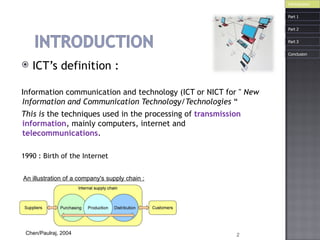
ICT’s  definition  : Information communication and technology (ICT or NICT for "  New Information and Communication  Technology/Technologies   “ This  is   the techniques used in the processing of  transmission   information , mainly computers, internet and  telecommunications . 1990 :  Birth of the Internet Chen/Paulraj, 2004 An illustration of a company's supply chain : Introduction Part 1 Part 3 Part 2 Conclusion
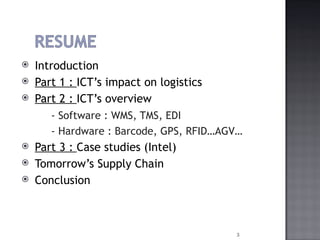
Introduction  Part 1 :  ICT’s  impact on  logistics Part 2 :  ICT’s   overview   - Software : WMS, TMS, EDI  - Hardware :  Barcode,  GPS, RFID…AGV…  Part 3 :  Case  studies  (Intel) Tomorrow’s   Supply   Chain Conclusion
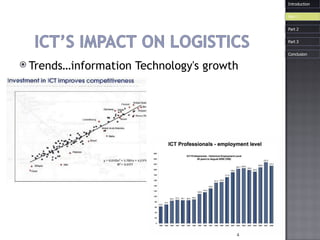
Trends…information  Technology's   growth Introduction Part 1 Part 3 Part 2 Conclusion
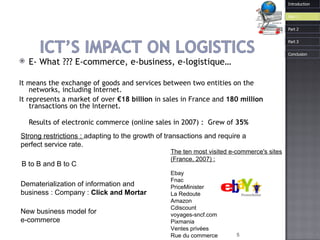
E- What ??? E-commerce, e-business, e-logistique… It means the exchange of goods and services between two entities on the networks, including Internet .  It represents a market of over  €18 billion  in sales in France and  180 million  transactions on the Internet. Results   of electronic commerce (online sales in 2007) :  Grew of  35% New  business model for  e-commerce Introduction B to B and B to C Dematerialization of information and business  :  Company  :  Click and Mortar The ten most visited e-commerce's sites (France, 2007) : Ebay Fnac PriceMinister La Redoute Amazon Cdiscount voyages-sncf.com Pixmania Ventes privées  Rue du commerce Strong restrictions :  adapting to the growth of transactions and require a perfect  service rate . Part 1 Part 3 Part 2 Conclusion
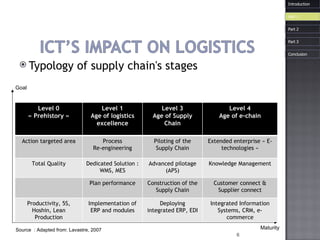
Typology of supply chain's stages Maturity Goal Introduction Source  : Adapted from: Lavastre, 2007 Level 0 « Prehistory » Level 1 Age of logistics excellence Level 3 Age of Supply Chain Level 4 Age of e-chain Action targeted area Process Re-engineering Piloting of the Supply Chain Extended enterprise « E-technologies » Total  Quality Dedicated  Solution : WMS, MES Advanced pilotage (APS) Knowledge Management Plan performance Construction of the Supply Chain Customer connect & Supplier connect Productivity , 5S, Hoshin, Lean Production Implementation  of ERP and modules Deploying integrated ERP, EDI Integrated   Information   Systems , CRM, e-commerce Part 1 Part 3 Part 2 Conclusion
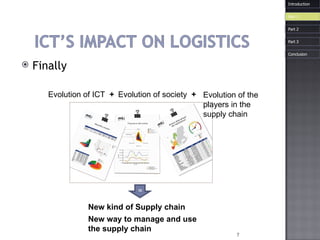
Finally Evolution of the  players in the  supply chain Evolution of ICT  + New kind of Supply chain = Evolution of society  + Introduction New way  to manage and use the supply chain Part 1 Part 3 Part 2 Conclusion
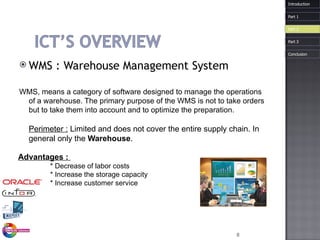
WMS :  Warehouse  Management System WMS, means a category of software designed to manage the operations of a warehouse. The primary purpose of the WMS is not to take orders but to take them into account and to optimize the preparation.  Perimeter :  Limited and does not cover the entire supply chain. In general only the  Warehouse . Introduction Advantages :  * Decrease of labor costs * Increase the storage capacity  * Increase customer service Part 1 Part 3 Part 2 Conclusion
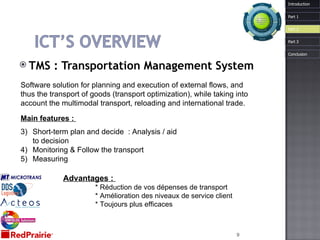
TMS : Transportation Management System Software solution for planning and execution of external flows, and thus the transport of goods (transport optimization), while taking into account the multimodal transport, reloading and international trade. Main features :  Short-term plan and decide  : Analysis / aid to decision Monitoring & Follow the transport  Measuring Introduction Advantages :  *  Réduction de vos dépenses de transport  *  Amélioration des niveaux de service client  *  Toujours plus efficaces Part 1 Part 3 Part 2 Conclusion
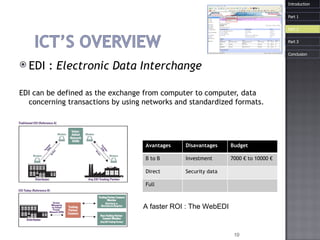
EDI :  Electronic Data Interchange EDI can be defined as the exchange from computer to computer, data concerning transactions by using networks and standardized formats. Introduction A faster ROI : The WebEDI Part 1 Part 3 Part 2 Conclusion Avantages Disavantages Budget B to B Investment 7000 € to 10000 € Direct Security data Full
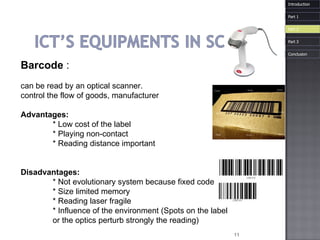
Barcode   : can be read by an optical scanner.  control the flow of goods, manufacturer Advantages:  * Low cost of the label  * Playing non-contact  * Reading distance important  Disadvantages:  * Not evolutionary system because fixed code  * Size limited memory  * Reading laser fragile  * Influence of the environment (Spots on the label  or the optics perturb strongly the reading) Introduction Part 1 Part 3 Part 2 Conclusion
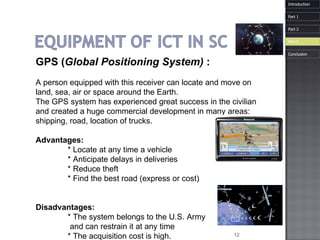
GPS ( Global Positioning System)  : A person equipped with this receiver can locate and move on  land, sea, air or space around the Earth.  The GPS system has experienced great success in the civilian  and created a huge commercial development in many areas:  shipping, road, location of trucks. Advantages:  * Locate at any time a vehicle  * Anticipate delays in deliveries  * Reduce theft  * Find the best road (express or cost)  Disadvantages:  * The system belongs to the U.S. Army    and can restrain it at any time * The acquisition cost is high. Introduction Part 1 Part 3 Part 2 Conclusion
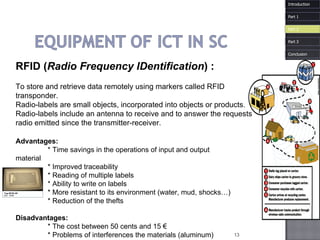
RFID ( Radio  Frequency   IDentification ) : To store and retrieve data remotely using markers called RFID transponder.  Radio-labels are small objects, incorporated into objects or products. Radio-labels include an antenna to receive and to answer the requests radio emitted since the transmitter-receiver. Advantages:  * Time savings in the operations of input and output  material  * Improved traceability  * Reading of multiple labels  * Ability to write on labels  * More resistant to its environment (water, mud, shocks…)  * Reduction of the thefts  Disadvantages:  * The cost between 50 cents and 15 €  * Problems of interferences the materials (aluminum) Introduction Part 1 Part 3 Part 2 Conclusion
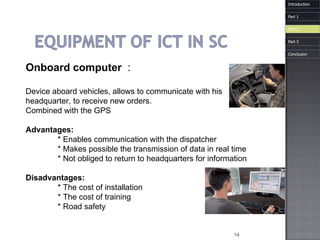
Onboard  computer   :  Device aboard vehicles, allows to communicate with his headquarter, to receive new orders. Combined with the GPS  Advantages:  * Enables communication with the dispatcher  * Makes possible the transmission of data in real time  * Not obliged to return to headquarters for information  Disadvantages:  * The cost of installation  * The cost of training  * Road safety Introduction Part 1 Part 3 Part 2 Conclusion
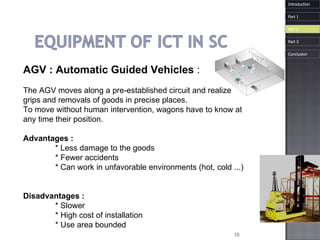
AGV : Automatic   Guided   Vehicles   : The AGV moves along a pre-established circuit and realize grips and removals of goods in precise places. To move without human intervention, wagons have to know at any time their position.  Advantages :  * Less damage to the goods  * Fewer accidents  * Can work in unfavorable environments (hot, cold ...)  Disadvantages :  * Slower  * High cost of installation  * Use area bounded Introduction Part 1 Part 3 Part 2 Conclusion
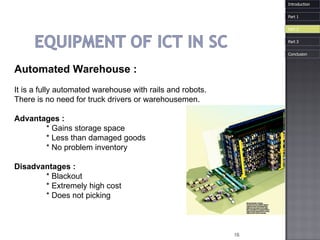
Automated   Warehouse  : It is a fully automated warehouse with rails and robots.  There is no need for truck drivers or warehousemen.  Advantages :  * Gains storage space  * Less than damaged goods  * No problem inventory  Disadvantages :  * Blackout  * Extremely high cost  * Does not picking Introduction Part 1 Part 3 Part 2 Conclusion
RFID to Intel Introduction Part 1 Part 3 Part 2 Conclusion
RFID to Intel Between Costa Rica and amsterdam Costa Rica is the manufacturer and amsterdam is the warehouse  Products are dispatching from Amsterdam to europe, Africa and  middle east, by wholesaler and after in the retaillers. THE CONTRIBUTIONS OF THE RFID : * Inventory efficiency * Redundancy elimination * Efficient Reversed Stream * Effective market strategy * Create demand forecast Introduction Part 1 Part 3 Part 2 Conclusion
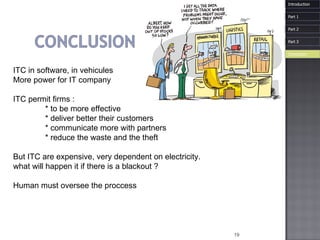
ITC in software, in vehicules More power for IT company ITC permit firms : * to be more effective * deliver better their customers * communicate more with partners * reduce the waste and the theft But ITC are expensive,  very dependent on electricity.  what will happen it if there is a blackout ? Human must oversee the proccess Introduction Part 1 Part 3 Part 2 Conclusion
ict & logistics

ict & logistics

  • 1.
  • 2.
    ICT’s definition : Information communication and technology (ICT or NICT for " New Information and Communication Technology/Technologies “ This is the techniques used in the processing of transmission information , mainly computers, internet and telecommunications . 1990 : Birth of the Internet Chen/Paulraj, 2004 An illustration of a company's supply chain : Introduction Part 1 Part 3 Part 2 Conclusion
  • 3.
    Introduction Part1 : ICT’s impact on logistics Part 2 : ICT’s overview - Software : WMS, TMS, EDI - Hardware : Barcode, GPS, RFID…AGV… Part 3 : Case studies (Intel) Tomorrow’s Supply Chain Conclusion
  • 4.
    Trends…information Technology's growth Introduction Part 1 Part 3 Part 2 Conclusion
  • 5.
    E- What ???E-commerce, e-business, e-logistique… It means the exchange of goods and services between two entities on the networks, including Internet . It represents a market of over €18 billion in sales in France and 180 million transactions on the Internet. Results of electronic commerce (online sales in 2007) : Grew of 35% New business model for e-commerce Introduction B to B and B to C Dematerialization of information and business : Company : Click and Mortar The ten most visited e-commerce's sites (France, 2007) : Ebay Fnac PriceMinister La Redoute Amazon Cdiscount voyages-sncf.com Pixmania Ventes privées Rue du commerce Strong restrictions : adapting to the growth of transactions and require a perfect service rate . Part 1 Part 3 Part 2 Conclusion
  • 6.
    Typology of supplychain's stages Maturity Goal Introduction Source : Adapted from: Lavastre, 2007 Level 0 « Prehistory » Level 1 Age of logistics excellence Level 3 Age of Supply Chain Level 4 Age of e-chain Action targeted area Process Re-engineering Piloting of the Supply Chain Extended enterprise « E-technologies » Total Quality Dedicated Solution : WMS, MES Advanced pilotage (APS) Knowledge Management Plan performance Construction of the Supply Chain Customer connect & Supplier connect Productivity , 5S, Hoshin, Lean Production Implementation of ERP and modules Deploying integrated ERP, EDI Integrated Information Systems , CRM, e-commerce Part 1 Part 3 Part 2 Conclusion
  • 7.
    Finally Evolution ofthe players in the supply chain Evolution of ICT + New kind of Supply chain = Evolution of society + Introduction New way to manage and use the supply chain Part 1 Part 3 Part 2 Conclusion
  • 8.
    WMS : Warehouse Management System WMS, means a category of software designed to manage the operations of a warehouse. The primary purpose of the WMS is not to take orders but to take them into account and to optimize the preparation. Perimeter : Limited and does not cover the entire supply chain. In general only the Warehouse . Introduction Advantages : * Decrease of labor costs * Increase the storage capacity * Increase customer service Part 1 Part 3 Part 2 Conclusion
  • 9.
    TMS : TransportationManagement System Software solution for planning and execution of external flows, and thus the transport of goods (transport optimization), while taking into account the multimodal transport, reloading and international trade. Main features : Short-term plan and decide : Analysis / aid to decision Monitoring & Follow the transport Measuring Introduction Advantages : * Réduction de vos dépenses de transport * Amélioration des niveaux de service client * Toujours plus efficaces Part 1 Part 3 Part 2 Conclusion
  • 10.
    EDI : Electronic Data Interchange EDI can be defined as the exchange from computer to computer, data concerning transactions by using networks and standardized formats. Introduction A faster ROI : The WebEDI Part 1 Part 3 Part 2 Conclusion Avantages Disavantages Budget B to B Investment 7000 € to 10000 € Direct Security data Full
  • 11.
    Barcode : can be read by an optical scanner. control the flow of goods, manufacturer Advantages: * Low cost of the label * Playing non-contact * Reading distance important Disadvantages: * Not evolutionary system because fixed code * Size limited memory * Reading laser fragile * Influence of the environment (Spots on the label or the optics perturb strongly the reading) Introduction Part 1 Part 3 Part 2 Conclusion
  • 12.
    GPS ( GlobalPositioning System) : A person equipped with this receiver can locate and move on land, sea, air or space around the Earth. The GPS system has experienced great success in the civilian and created a huge commercial development in many areas: shipping, road, location of trucks. Advantages: * Locate at any time a vehicle * Anticipate delays in deliveries * Reduce theft * Find the best road (express or cost) Disadvantages: * The system belongs to the U.S. Army and can restrain it at any time * The acquisition cost is high. Introduction Part 1 Part 3 Part 2 Conclusion
  • 13.
    RFID ( Radio Frequency IDentification ) : To store and retrieve data remotely using markers called RFID transponder. Radio-labels are small objects, incorporated into objects or products. Radio-labels include an antenna to receive and to answer the requests radio emitted since the transmitter-receiver. Advantages: * Time savings in the operations of input and output material * Improved traceability * Reading of multiple labels * Ability to write on labels * More resistant to its environment (water, mud, shocks…) * Reduction of the thefts Disadvantages: * The cost between 50 cents and 15 € * Problems of interferences the materials (aluminum) Introduction Part 1 Part 3 Part 2 Conclusion
  • 14.
    Onboard computer  : Device aboard vehicles, allows to communicate with his headquarter, to receive new orders. Combined with the GPS Advantages: * Enables communication with the dispatcher * Makes possible the transmission of data in real time * Not obliged to return to headquarters for information Disadvantages: * The cost of installation * The cost of training * Road safety Introduction Part 1 Part 3 Part 2 Conclusion
  • 15.
    AGV : Automatic Guided Vehicles : The AGV moves along a pre-established circuit and realize grips and removals of goods in precise places. To move without human intervention, wagons have to know at any time their position. Advantages : * Less damage to the goods * Fewer accidents * Can work in unfavorable environments (hot, cold ...) Disadvantages : * Slower * High cost of installation * Use area bounded Introduction Part 1 Part 3 Part 2 Conclusion
  • 16.
    Automated Warehouse : It is a fully automated warehouse with rails and robots. There is no need for truck drivers or warehousemen. Advantages : * Gains storage space * Less than damaged goods * No problem inventory Disadvantages : * Blackout * Extremely high cost * Does not picking Introduction Part 1 Part 3 Part 2 Conclusion
  • 17.
    RFID to IntelIntroduction Part 1 Part 3 Part 2 Conclusion
  • 18.
    RFID to IntelBetween Costa Rica and amsterdam Costa Rica is the manufacturer and amsterdam is the warehouse Products are dispatching from Amsterdam to europe, Africa and middle east, by wholesaler and after in the retaillers. THE CONTRIBUTIONS OF THE RFID : * Inventory efficiency * Redundancy elimination * Efficient Reversed Stream * Effective market strategy * Create demand forecast Introduction Part 1 Part 3 Part 2 Conclusion
  • 19.
    ITC in software,in vehicules More power for IT company ITC permit firms : * to be more effective * deliver better their customers * communicate more with partners * reduce the waste and the theft But ITC are expensive, very dependent on electricity. what will happen it if there is a blackout ? Human must oversee the proccess Introduction Part 1 Part 3 Part 2 Conclusion