[Transportation system – Evolution,
Infrastructure, Networks, Freight
Management and Transport economies]
Presentation by:
A. Raj Shravanthi
Introduction
• Fundamental logistics are - where
should resources be moved to, and
by what mode and route; when
should resources be moved.
• The “where” question includes the
topics of terminal location, vehicle
routing, and shortest path methods
and network flow allocation.
• The “when” question includes the
topic of distribution rules.
Definition
• Transport or transportation is the
movement of people and goods from one
location to another (acc 2 wikipidea)
• Transportation is the movement of products
from one node in the distribution channel to
another.
Transport Fundamentals
Transport involves
o equipment (trucks, planes, trains, boats, pipeline),
o people (drivers, loaders & un-loaders), and
o decisions (routing, timing, quantities, equipment size,
transport mode).
[In developing countries we often find it necessary to locate production close to
both markets and resources, while in countries with developed distribution
systems people can live in places far from production and resources.]
Most important component of logistics cost.
Usually 1/3 - 2/3 of total cost.
Role of Transportation in Logistics
• Transportation is the physical link
connecting the firm to its suppliers and
customers.
• In a nodes and links scenario, transportation
is the link between fixed facilities (nodes).
• Transportation also adds value to the product
by providing time and place utility for the
firm’s goods.
Strategy
The strategy, must acknowledge the following elements:
• Customer requirements
• Timely shipments
• Mode selection
• Carrier relationships
• Measurement
• Regulatory impact
• Flexibility
Transportation selection
Transport decision-making depends on:
• Responsiveness
• Reliability
• Relationships
Transportation Functions, Principles,
Participants
 Transportation Functions
oProduct Movement
oProduct Storage
 Transportation Principles
o Economy of Scale
oEconomy of Distance (Tapering Principle)
 Transportation participants
(shipper, consignee, public, government, carrier and agents )
Economies of Scale
Transportation
Cost per Book
Number of Books in Shipment
$.10/book
$100/book
1 1000
The more items (weight) is transported,
the less the transportation costs per item (unit of weight)
Economies of Distance
Tapering Principle
Transportation
Cost per Mile
Shipment Distance
1 mile 1000 miles
$50/mile
$.05/mile
$.10/mile
500 miles
The larger the distance, the less the transportation costs per
unit of distance (e.g., per mile)
Transportation Functions, Principles,
Participants
 Transportation Functions
oProduct Movement
oProduct Storage
 Transportation Principles
o Economy of Scale
oEconomy of Distance (Tapering Principle)
 Transportation participants
(shipper, consignee, public, government, carrier and agents )
Transportation Participants
I need something
shipped at the lowest
possible cost!
I need something
delivered at the lowest
possible cost!
Transportation Participants
Carriers: We have the
equipment!Carriers – we can find a shipper!
Shippers – we can find a carrier!
Transportation Participants
the transportation system is
vital for the country’s
economic health
purchase fuel,
transportation
equipment, supplies
match products needing to
be shipped with available
capacity
track shipments
Transportation Participants
Creates demand for
transportation by
purchasing products
Transportation network data
• It is a (directed) link connecting an origin(supplier or
facility) to the destination(facility or market) along
which a product may flow.
Transportation network submodels
The transportation components of a typical supply chain are as
follows:
o The inbound transportation network linking the company’s
suppliers to its facilities.
o The interfacility transportation network connecting its
facilities to one another.
o The outbound transportation network connecting the
company’s facilities to its customers and markets.
Routes of Goods
Goods at
shippers
Freight
forwarder
warehouse
Air
terminal
plane
air
Freight
forwarder
warehouse
Goods at
consignees
Container
terminal
vessel
sea May
change
transpor-
tation
modes
truck
land
railway
land barge
mid-streampier
bulk goodssea
Transportation Regulation
o Types of Transportation Regulation
o History of Transportation Regulation
Economic
Types of Transportation Regulation
• Investments in transportation infrastructure
(e.g., highways, airports, ports)
• Control of routes, pricing, schedules
• Protect the public, the environment
• Make sure equipment operates safely, cleanly
• Safe transportation of hazardous materials
(HAZMAT)
• Regulating hours worked
Social/Safety
History of Transportation Regulation
Pre-1920 – establish initial government control
o Act to Regulate Commerce (1887)
o Interstate Commerce Commission (ICC)
History of Transportation Regulation
1920-1940 – regulatory formalization, extension to other
transportation modes
o Motor Carrier Act (1935)
o Civil Aeronautics Act (1938)
o Civil Aeronautics Board (1940)
o Federal Aviation Administration (FAA)
o National Aeronautics & Space Administration (1951)
History of Transportation Regulation
1940-1970
o Regulation of water transportation by ICC (1940)
o Railroad Revitalization and Regulatory Reform Act of 1976
• AMTRAK
• CONRAIL
History of Transportation Regulation
1970-1980 – prelude to deregulation
o Shift from regulation/control to fostering competition
o Department of Transportation (DOT) 1961
o Airline Deregulation Act 1978
History of Transportation Regulation
1980-2000 – deregulation
o Motor Carrier Act 1980
o Staggers (Rail) Act 1980
o Interstate Commerce Commission (ICC) abolished 1996
o Ocean Shipping & Reform Act 1998
History of Transportation Regulation
2000-Present – focus on technology, safety, and
security
o Patriot Act
o Jones Act
Transportation Industry Structure
Five Basic Transportation Modes
Pipeline
Water
Rail
Air
Highway
Railroad
s
Railroads
o Capable of carrying a wide variety of products, much more so
than other modes.
o Very small number of carriers; likely only one will be able to
serve any one customer location.
o Trend is to merge smaller companies into larger ones with
ultimate goal of having perhaps two transcontinental rail
carriers.
Railroads
o This would permit seamless dock-to-
dock service by one company; a distinct
improvement over current systems.
o Rail is a long haul, large volume system
(high fixed costs; own rights-of-way).
o Accessibility can be a problem.
o Transit times are spotty, but are
generally long.
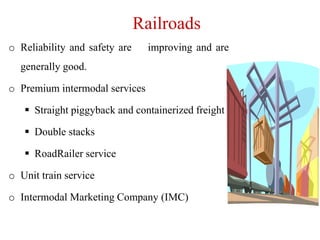
Railroads
o Reliability and safety are improving and are
generally good.
o Premium intermodal services
 Straight piggyback and containerized freight
 Double stacks
 RoadRailer service
o Unit train service
o Intermodal Marketing Company (IMC)
o It’s difficult to assess the railroad industry
without getting into the subject of service…
o Shippers complain; rail carriers say they are
trying to improve.
o Wall Street says that improving service is imperative.
o Actual improvements are coming, but slower than the
demand for faster, more reliable, and cheaper service.
One problem is that standards continue to increase.
Motor Carriers
o The motor carrier industry is characterized by a large number
of small firms. In 1999, there were 505,000 registered motor
carriers.
o Low cost of entry causes these large numbers.
o Used by almost all logistics systems and account for 82
percent of U.S. freight expenditures.
o Consists of for-hire and private carriers.
Overview of Interstate Motor Carrier
Industry
Motor Carriers
o Large number of small firms; in 1999, 505,000* total of which
12,500 were regulated carriers, only 7% of which had revenues
>$10 million, with 76% having revenues <$3 million.
o Characterized by low fixed costs and high variable costs.
o Do not own their rights-of-way.
o Limited operating authority regarding service areas, routes,
rates and products carried.
Motor Carriers
o High accessibility
o Transit times faster than rail or water.
o Reliability can be affected greatly by
weather.
o Small vehicle size coincides with
lower inventory strategies and quick
replenishment (QR).
o Relatively high cost compared to rail
and water; trade-off is faster service.
Overview of the Domestic Water
Carrier Industry
Domestic Water Carriers
o Available along the Atlantic, Gulf and
Pacific coasts, along the Mississippi,
Missouri, Tennessee and Ohio River
systems and the Great Lakes.
o Regulated common and contract
carriers haul about 5% of the freight,
while private and exempt carriers haul
the other 95% of the ton-miles.
Domestic Water Carriers
• Relatively low cost mode; do not
own the rights-of-way; easy entry
and exit.
• Typically a long distance mover of
low value, bulk-type mineral,
agricultural and forest products
• Low rates but long transit times
• Low accessibility but high capability
International Water Carriers
• General cargo ships
o Large high capacity cargo holds
o Engaged on a contract basis
o Many have self-contained cranes
for loading/unloading
• Bulk carriers
o Specially designed to haul
minerals
o Can handle multiple cargoes
International Water Carriers
• Tankers
o Specially designed for liquid
cargoes.
o Largest vessels afloat, some
VLCCs at 500k+ tons
• Container ships
o High speeds for ships; increasingly
more common and important.
o Larger vessels can handle more
than 7500 containers(TEU’s)
International Water Carriers
• RO-RO (Roll on-Roll off)
o Basically a large ferry that facilitates
the loading and unloading process by
using drive on/off ramps
o May also have the capacity to haul
containers
• Other
o OBO multipurpose carriers
o Barges (not transoceanic)
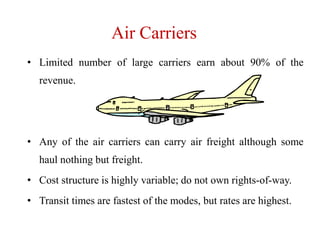
Air Carriers
• Limited number of large carriers earn about 90% of the
revenue.
• Any of the air carriers can carry air freight although some
haul nothing but freight.
• Cost structure is highly variable; do not own rights-of-way.
• Transit times are fastest of the modes, but rates are highest.
Air Carriers
o Average revenue per ton mile 18 times
higher than rail; twice that of motor
carriers??.
o Seek goods with a high value to weight
ratio.
o Accessibility is low as is capability.
o Reliability subject to weather more
than other modes.
Pipelines
o Refers only to the oil pipelines, not
natural gas
o Not suitable for general transportation
o Some research has been performed to
move minerals in a liquid medium, but
outside of a few attempts to transport
slurried-coal via pipeline, no real
successes have occurred.
Pipelines
o Accessibility is very low.
o Cost structure is highly fixed with
low variable costs.
o Own rights-of-way much like the
railroads.
o Major advantage is low rates.
Performance Rating of Modes
Selection
Determinants Railroad Motor
Modes
Water Air Pipeline
Cost 3 4 2 5 1
Transit time 3 2 4 1 ---
Reliability 2 1 4 3 ---
Capability 1 2 4 3 5
Accessibility 2 1 4 3 ---
Security 3 2 4 1 ---
Transportation costs
• Transportation costs are those associated with the flow of
products on links between facilities.
• They are the following 2 types of costs:
 Flow costs: direct cost per unit associated with product flows
between facilities.
 Transportation resource costs: indirect costs per unit
associated with managing flows.
Transport Cost Characteristics
o Fixed costs:
• Terminal facilities
• Transport equipment
• Carrier administration
• Roadway acquisition and maintenance [Infrastructure (road, rail,
pipeline, navigation, etc.)]
o Variable costs:
• Fuel
• Labor
• Equipment maintenance
• Handling, pickup & delivery, taxes
[NOTE: Cost structure varies by mode]
Cost Structure For Each Transportation Mode
Rail
• high fixed costs (land, tracks)
• low variable costs (operating costs, e.g.,
labor, fuel)
• slow, but inexpensive way to transport
heavy freight that doesn’t require special
handling, long distances
Highway
•low fixed costs (government builds,
maintains highways)
• medium-high variable costs (operating
costs, e.g., labor, fuel)
• most accessible mode (more highways
than railroads, waterways, pipelines); best
for transporting medium to high value
products short to moderate distances
Cost Structure For Each Transportation Mode
Water
• moderate fixed costs (ships and
freight handling equipment)
• low variable costs (operating
costs, e.g., labor, fuel)
• very slow, but inexpensive way
to transport large, heavy freight
over long distances (e.g., oceans,
rivers, inland waterways, lakes)
Air
• low fixed costs (aircraft and freight
handling equipment)
• highest variable costs (e.g., labor, fuel,
maintenance)
• very fast; used for transporting high value
and/or high perishability product over short
to medium distances.
Cost Structure For Each Transportation Mode
Pipeline
• highest fixed costs (right of way & construction costs of equipment)
• lowest variable costs (no significant labor or fuel costs)
• slow, but dependable (e.g., no weather, traffic disruptions); no flexibility
with regard to types of products that can be transported – must be liquid
(e.g., petroleum)
Transportation Services
Traditional Transportation Carriers
Package Services
Intermodal Transportation
Non Operating Intermediaries
oFreight Forwarders
oTransportation Brokers
oShipper Associations/Cooperatives/Agents
Legal Classifications of Carriers
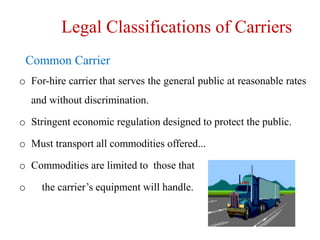
Common Carrier
o For-hire carrier that serves the general public at reasonable rates
and without discrimination.
o Stringent economic regulation designed to protect the public.
o Must transport all commodities offered...
o Commodities are limited to those that
o the carrier’s equipment will handle.
o Carrier is liable for damages to products carried.
o Exceptions to liability include acts of God, acts of the public
enemy, acts of public authority, acts of the shipper and defects
inherent in the goods.
o Continued service is assisted by ceiling and floor limits on the
rates charged.
o Backbone of the transportation industry.
Regulated carriers:
o Regulated carriers are found in motor and water carriage.
o The ICC Termination Act of 1995 eliminated most of the
common carrier economic regulation for these two modes,
including entry controls, reasonable rates, and
nondiscrimination provisions.
o When acting as a contract carrier, not subject to STB
economic regulations.
o Must provide safe and adequate service.
Contract Carriers:
o For-hire carrier that does not have to serve the
general public.
o May serve one or a few shippers exclusively.
o May offer specialized equipment.
o Not subject to regulation on services; rates usually lower than
common or regulated carriers.
Contract Carriers
o Other aspects of the carrier/shipper relationship are
made a part of the contract between the two parties.
o Becoming more popular as logistics managers
use contract carriage to assure rates and
service levels.
Exempt Carriers
o For-hire carrier exempt from economic
regulation regarding rates and services.
o Limited entry controls; low rates.
o Usually haul agricultural products, but
there are special rules as to what may be
hauled by each mode of transportation,
e.g., rail piggyback is exempt..
o Limited number of carriers restricts
availability.
o Private Carriers:
o Private carriage is the firm’s own transportation.
o Not for-hire and not subject to Federal regulations.
o May not be the firm’s primary business but can charge
a intracompany fee for transportation services.
o Almost exclusively motor, but some rail, air and water
also exist.
o Firms gain ultimate control over shipments and achieve
maximum flexibility in moving goods.
o Backhauls are usually empty or return materials to the
firm’s plants and/or warehouses. Not any longer
o Requires a large capital investment.
o Requires management time and expertise.
Continued….
Intermodal Transportation
o Refers to use of two or more modes of transportation
cooperating on the movement of shipment
by publishing a through rate.
o Logistics managers are looking for the best way to move
shipments and these often attempt to take advantage of
multiple modes of transportation, each of which has certain
useful characteristics.
Types of Intermodal Services
• Piggyback
• Trailer on Flat Car (TOFC)
• Container on Flat Car (COFC)
• Coordinated Air/Truck
• Fishyback
• Trainship
• Containership
Intermodal Transportation:
Containerization
o Referred to as Container-on-Flat-Car
(COFC); goods are placed in a large box,
where they are untouched until they arrive at
the consigee’s unloading dock.
o Reduces theft, damage, multiple handling
costs and intermodal transfer time.
o Changes materials handling from labor
intensive to capital intensive and may reduce
costs from 10 to 20%.
Intermodal Transportation:
Containerization
o “Land bridge” concept may apply
for international shipments where
oceans are separated by a large land mass.
o For example, containers moving from Japan to
Europe may dock at Long Beach, CA, transfer
the containers to a railroad, and reload the
containers onboard another ship in Norfolk,
VA., continuing on to a European port.
Intermodal Transportation:
Piggyback
o Trailer-on-Flat-Car (TOFC)
o Over the road trailers ride in special rail
cars.
o Takes advantage of motor flexibility and
rail’s long haul economic advantage.
o Multiple service plans for shippers.
o Some railroads provide varying levels of
service, differentially priced.
Intermodal Transportation:
RoadRailers
o Newest concept referred to as a “RoadRailer”
o Essentially a trailer that has been reinforced to ride on a rail bogey
and be coupled together directly without first being placed on a
rail flat car
o Saves weight and locomotive
power and thus fuel for the railroad
o Special lower rates
o Motor competitive transit times
Specialized Carriers
Basic Package Services:
Examples are UPS, RPS ,
U.S. Postal service
Premium Package Service:
Ex: Fed Ex, Emery Worldwide
Transportation Services
Traditional Transportation Carriers
Intermodal Transportation
Package Services
Non Operating Intermediaries
oFreight Forwarders
oTransportation Brokers
oShipper Associations/Cooperatives/Agents
Freight Forwarders
oA freight forwarder, forwarder, or forwarding agent is a
person or company that organizes shipments for individuals or
other companies and may also act as a carrier.
o A forwarder is often not active as a carrier and acts only as an
agent, in other words as a third-party (non-asset-based) logistics
provider that dispatches shipments via asset-based carriers and
that books or otherwise arranges space for these shipments.
 Consolidators and Freight Forwarders
o Consolidates many small shipments
o Saves shippers by using CL or TL rates
 Shippers Associations
o Acts as a consolidator for members
o Object is also to get lower rates
 Brokers
o Acts as an intermediary
o May be licensed by STB
o Often used to provide backhauls for private carriers
Intermodal Marketing Companies (IMC)
o An intermediary that solicits shipments for rail/motor
intermodal service.
o Can speed traffic through consolidation (fills the normal
two-trailer load on an intermodal flat car, avoiding delays
waiting for another trailer going to the same destination).
o Particularly advantageous for small (one trailer) shippers.
References:
Books:
• LogisticalManagement
TheIntegratedSupplyChainProcess
ByDonaldJ.Bowersox&DavidJ.Closs
• SupplyChainManagement
Theories&Practices
ByR.PMohanty&S.G.Deshmukh
• SupplyChainManagement
Strategy,Planning,andOperation
BySunilChopra,PeterMeindl&D.V.Kalra
• The Management of Business Logistics: A Supply Chain
Perspective
byJohnJ.Coyle,EdwardJ.Bardi,andC.JohnLangley
Internet:
www.wikipedia.com
www.stcthirdeye.com
www.logisticsmgmt.com
 Transportation

Transportation

  • 1.
    [Transportation system –Evolution, Infrastructure, Networks, Freight Management and Transport economies] Presentation by: A. Raj Shravanthi
  • 2.
    Introduction • Fundamental logisticsare - where should resources be moved to, and by what mode and route; when should resources be moved. • The “where” question includes the topics of terminal location, vehicle routing, and shortest path methods and network flow allocation. • The “when” question includes the topic of distribution rules.
  • 3.
    Definition • Transport ortransportation is the movement of people and goods from one location to another (acc 2 wikipidea) • Transportation is the movement of products from one node in the distribution channel to another.
  • 4.
    Transport Fundamentals Transport involves oequipment (trucks, planes, trains, boats, pipeline), o people (drivers, loaders & un-loaders), and o decisions (routing, timing, quantities, equipment size, transport mode). [In developing countries we often find it necessary to locate production close to both markets and resources, while in countries with developed distribution systems people can live in places far from production and resources.] Most important component of logistics cost. Usually 1/3 - 2/3 of total cost.
  • 5.
    Role of Transportationin Logistics • Transportation is the physical link connecting the firm to its suppliers and customers. • In a nodes and links scenario, transportation is the link between fixed facilities (nodes). • Transportation also adds value to the product by providing time and place utility for the firm’s goods.
  • 6.
    Strategy The strategy, mustacknowledge the following elements: • Customer requirements • Timely shipments • Mode selection • Carrier relationships • Measurement • Regulatory impact • Flexibility
  • 7.
    Transportation selection Transport decision-makingdepends on: • Responsiveness • Reliability • Relationships
  • 8.
    Transportation Functions, Principles, Participants Transportation Functions oProduct Movement oProduct Storage  Transportation Principles o Economy of Scale oEconomy of Distance (Tapering Principle)  Transportation participants (shipper, consignee, public, government, carrier and agents )
  • 9.
    Economies of Scale Transportation Costper Book Number of Books in Shipment $.10/book $100/book 1 1000 The more items (weight) is transported, the less the transportation costs per item (unit of weight)
  • 10.
    Economies of Distance TaperingPrinciple Transportation Cost per Mile Shipment Distance 1 mile 1000 miles $50/mile $.05/mile $.10/mile 500 miles The larger the distance, the less the transportation costs per unit of distance (e.g., per mile)
  • 11.
    Transportation Functions, Principles, Participants Transportation Functions oProduct Movement oProduct Storage  Transportation Principles o Economy of Scale oEconomy of Distance (Tapering Principle)  Transportation participants (shipper, consignee, public, government, carrier and agents )
  • 12.
    Transportation Participants I needsomething shipped at the lowest possible cost! I need something delivered at the lowest possible cost!
  • 13.
    Transportation Participants Carriers: Wehave the equipment!Carriers – we can find a shipper! Shippers – we can find a carrier!
  • 14.
    Transportation Participants the transportationsystem is vital for the country’s economic health purchase fuel, transportation equipment, supplies match products needing to be shipped with available capacity track shipments
  • 15.
    Transportation Participants Creates demandfor transportation by purchasing products
  • 16.
    Transportation network data •It is a (directed) link connecting an origin(supplier or facility) to the destination(facility or market) along which a product may flow.
  • 17.
    Transportation network submodels Thetransportation components of a typical supply chain are as follows: o The inbound transportation network linking the company’s suppliers to its facilities. o The interfacility transportation network connecting its facilities to one another. o The outbound transportation network connecting the company’s facilities to its customers and markets.
  • 18.
    Routes of Goods Goodsat shippers Freight forwarder warehouse Air terminal plane air Freight forwarder warehouse Goods at consignees Container terminal vessel sea May change transpor- tation modes truck land railway land barge mid-streampier bulk goodssea
  • 19.
    Transportation Regulation o Typesof Transportation Regulation o History of Transportation Regulation
  • 20.
    Economic Types of TransportationRegulation • Investments in transportation infrastructure (e.g., highways, airports, ports) • Control of routes, pricing, schedules • Protect the public, the environment • Make sure equipment operates safely, cleanly • Safe transportation of hazardous materials (HAZMAT) • Regulating hours worked Social/Safety
  • 21.
    History of TransportationRegulation Pre-1920 – establish initial government control o Act to Regulate Commerce (1887) o Interstate Commerce Commission (ICC)
  • 22.
    History of TransportationRegulation 1920-1940 – regulatory formalization, extension to other transportation modes o Motor Carrier Act (1935) o Civil Aeronautics Act (1938) o Civil Aeronautics Board (1940) o Federal Aviation Administration (FAA) o National Aeronautics & Space Administration (1951)
  • 23.
    History of TransportationRegulation 1940-1970 o Regulation of water transportation by ICC (1940) o Railroad Revitalization and Regulatory Reform Act of 1976 • AMTRAK • CONRAIL
  • 24.
    History of TransportationRegulation 1970-1980 – prelude to deregulation o Shift from regulation/control to fostering competition o Department of Transportation (DOT) 1961 o Airline Deregulation Act 1978
  • 25.
    History of TransportationRegulation 1980-2000 – deregulation o Motor Carrier Act 1980 o Staggers (Rail) Act 1980 o Interstate Commerce Commission (ICC) abolished 1996 o Ocean Shipping & Reform Act 1998
  • 26.
    History of TransportationRegulation 2000-Present – focus on technology, safety, and security o Patriot Act o Jones Act
  • 27.
  • 28.
    Five Basic TransportationModes Pipeline Water Rail Air Highway
  • 29.
  • 30.
    Railroads o Capable ofcarrying a wide variety of products, much more so than other modes. o Very small number of carriers; likely only one will be able to serve any one customer location. o Trend is to merge smaller companies into larger ones with ultimate goal of having perhaps two transcontinental rail carriers.
  • 31.
    Railroads o This wouldpermit seamless dock-to- dock service by one company; a distinct improvement over current systems. o Rail is a long haul, large volume system (high fixed costs; own rights-of-way). o Accessibility can be a problem. o Transit times are spotty, but are generally long.
  • 32.
    Railroads o Reliability andsafety are improving and are generally good. o Premium intermodal services  Straight piggyback and containerized freight  Double stacks  RoadRailer service o Unit train service o Intermodal Marketing Company (IMC)
  • 33.
    o It’s difficultto assess the railroad industry without getting into the subject of service… o Shippers complain; rail carriers say they are trying to improve. o Wall Street says that improving service is imperative. o Actual improvements are coming, but slower than the demand for faster, more reliable, and cheaper service. One problem is that standards continue to increase.
  • 34.
    Motor Carriers o Themotor carrier industry is characterized by a large number of small firms. In 1999, there were 505,000 registered motor carriers. o Low cost of entry causes these large numbers. o Used by almost all logistics systems and account for 82 percent of U.S. freight expenditures. o Consists of for-hire and private carriers.
  • 35.
    Overview of InterstateMotor Carrier Industry
  • 36.
    Motor Carriers o Largenumber of small firms; in 1999, 505,000* total of which 12,500 were regulated carriers, only 7% of which had revenues >$10 million, with 76% having revenues <$3 million. o Characterized by low fixed costs and high variable costs. o Do not own their rights-of-way. o Limited operating authority regarding service areas, routes, rates and products carried.
  • 37.
    Motor Carriers o Highaccessibility o Transit times faster than rail or water. o Reliability can be affected greatly by weather. o Small vehicle size coincides with lower inventory strategies and quick replenishment (QR). o Relatively high cost compared to rail and water; trade-off is faster service.
  • 38.
    Overview of theDomestic Water Carrier Industry
  • 39.
    Domestic Water Carriers oAvailable along the Atlantic, Gulf and Pacific coasts, along the Mississippi, Missouri, Tennessee and Ohio River systems and the Great Lakes. o Regulated common and contract carriers haul about 5% of the freight, while private and exempt carriers haul the other 95% of the ton-miles.
  • 40.
    Domestic Water Carriers •Relatively low cost mode; do not own the rights-of-way; easy entry and exit. • Typically a long distance mover of low value, bulk-type mineral, agricultural and forest products • Low rates but long transit times • Low accessibility but high capability
  • 41.
    International Water Carriers •General cargo ships o Large high capacity cargo holds o Engaged on a contract basis o Many have self-contained cranes for loading/unloading • Bulk carriers o Specially designed to haul minerals o Can handle multiple cargoes
  • 42.
    International Water Carriers •Tankers o Specially designed for liquid cargoes. o Largest vessels afloat, some VLCCs at 500k+ tons • Container ships o High speeds for ships; increasingly more common and important. o Larger vessels can handle more than 7500 containers(TEU’s)
  • 43.
    International Water Carriers •RO-RO (Roll on-Roll off) o Basically a large ferry that facilitates the loading and unloading process by using drive on/off ramps o May also have the capacity to haul containers • Other o OBO multipurpose carriers o Barges (not transoceanic)
  • 44.
    Air Carriers • Limitednumber of large carriers earn about 90% of the revenue. • Any of the air carriers can carry air freight although some haul nothing but freight. • Cost structure is highly variable; do not own rights-of-way. • Transit times are fastest of the modes, but rates are highest.
  • 45.
    Air Carriers o Averagerevenue per ton mile 18 times higher than rail; twice that of motor carriers??. o Seek goods with a high value to weight ratio. o Accessibility is low as is capability. o Reliability subject to weather more than other modes.
  • 46.
    Pipelines o Refers onlyto the oil pipelines, not natural gas o Not suitable for general transportation o Some research has been performed to move minerals in a liquid medium, but outside of a few attempts to transport slurried-coal via pipeline, no real successes have occurred.
  • 47.
    Pipelines o Accessibility isvery low. o Cost structure is highly fixed with low variable costs. o Own rights-of-way much like the railroads. o Major advantage is low rates.
  • 48.
    Performance Rating ofModes Selection Determinants Railroad Motor Modes Water Air Pipeline Cost 3 4 2 5 1 Transit time 3 2 4 1 --- Reliability 2 1 4 3 --- Capability 1 2 4 3 5 Accessibility 2 1 4 3 --- Security 3 2 4 1 ---
  • 49.
    Transportation costs • Transportationcosts are those associated with the flow of products on links between facilities. • They are the following 2 types of costs:  Flow costs: direct cost per unit associated with product flows between facilities.  Transportation resource costs: indirect costs per unit associated with managing flows.
  • 50.
    Transport Cost Characteristics oFixed costs: • Terminal facilities • Transport equipment • Carrier administration • Roadway acquisition and maintenance [Infrastructure (road, rail, pipeline, navigation, etc.)] o Variable costs: • Fuel • Labor • Equipment maintenance • Handling, pickup & delivery, taxes [NOTE: Cost structure varies by mode]
  • 51.
    Cost Structure ForEach Transportation Mode Rail • high fixed costs (land, tracks) • low variable costs (operating costs, e.g., labor, fuel) • slow, but inexpensive way to transport heavy freight that doesn’t require special handling, long distances Highway •low fixed costs (government builds, maintains highways) • medium-high variable costs (operating costs, e.g., labor, fuel) • most accessible mode (more highways than railroads, waterways, pipelines); best for transporting medium to high value products short to moderate distances
  • 52.
    Cost Structure ForEach Transportation Mode Water • moderate fixed costs (ships and freight handling equipment) • low variable costs (operating costs, e.g., labor, fuel) • very slow, but inexpensive way to transport large, heavy freight over long distances (e.g., oceans, rivers, inland waterways, lakes) Air • low fixed costs (aircraft and freight handling equipment) • highest variable costs (e.g., labor, fuel, maintenance) • very fast; used for transporting high value and/or high perishability product over short to medium distances.
  • 53.
    Cost Structure ForEach Transportation Mode Pipeline • highest fixed costs (right of way & construction costs of equipment) • lowest variable costs (no significant labor or fuel costs) • slow, but dependable (e.g., no weather, traffic disruptions); no flexibility with regard to types of products that can be transported – must be liquid (e.g., petroleum)
  • 54.
    Transportation Services Traditional TransportationCarriers Package Services Intermodal Transportation Non Operating Intermediaries oFreight Forwarders oTransportation Brokers oShipper Associations/Cooperatives/Agents
  • 55.
    Legal Classifications ofCarriers Common Carrier o For-hire carrier that serves the general public at reasonable rates and without discrimination. o Stringent economic regulation designed to protect the public. o Must transport all commodities offered... o Commodities are limited to those that o the carrier’s equipment will handle.
  • 56.
    o Carrier isliable for damages to products carried. o Exceptions to liability include acts of God, acts of the public enemy, acts of public authority, acts of the shipper and defects inherent in the goods. o Continued service is assisted by ceiling and floor limits on the rates charged. o Backbone of the transportation industry.
  • 57.
    Regulated carriers: o Regulatedcarriers are found in motor and water carriage. o The ICC Termination Act of 1995 eliminated most of the common carrier economic regulation for these two modes, including entry controls, reasonable rates, and nondiscrimination provisions. o When acting as a contract carrier, not subject to STB economic regulations. o Must provide safe and adequate service.
  • 58.
    Contract Carriers: o For-hirecarrier that does not have to serve the general public. o May serve one or a few shippers exclusively. o May offer specialized equipment. o Not subject to regulation on services; rates usually lower than common or regulated carriers.
  • 59.
    Contract Carriers o Otheraspects of the carrier/shipper relationship are made a part of the contract between the two parties. o Becoming more popular as logistics managers use contract carriage to assure rates and service levels.
  • 60.
    Exempt Carriers o For-hirecarrier exempt from economic regulation regarding rates and services. o Limited entry controls; low rates. o Usually haul agricultural products, but there are special rules as to what may be hauled by each mode of transportation, e.g., rail piggyback is exempt.. o Limited number of carriers restricts availability.
  • 61.
    o Private Carriers: oPrivate carriage is the firm’s own transportation. o Not for-hire and not subject to Federal regulations. o May not be the firm’s primary business but can charge a intracompany fee for transportation services. o Almost exclusively motor, but some rail, air and water also exist.
  • 62.
    o Firms gainultimate control over shipments and achieve maximum flexibility in moving goods. o Backhauls are usually empty or return materials to the firm’s plants and/or warehouses. Not any longer o Requires a large capital investment. o Requires management time and expertise. Continued….
  • 63.
    Intermodal Transportation o Refersto use of two or more modes of transportation cooperating on the movement of shipment by publishing a through rate. o Logistics managers are looking for the best way to move shipments and these often attempt to take advantage of multiple modes of transportation, each of which has certain useful characteristics.
  • 64.
  • 65.
    • Piggyback • Traileron Flat Car (TOFC) • Container on Flat Car (COFC) • Coordinated Air/Truck • Fishyback • Trainship • Containership
  • 66.
    Intermodal Transportation: Containerization o Referredto as Container-on-Flat-Car (COFC); goods are placed in a large box, where they are untouched until they arrive at the consigee’s unloading dock. o Reduces theft, damage, multiple handling costs and intermodal transfer time. o Changes materials handling from labor intensive to capital intensive and may reduce costs from 10 to 20%.
  • 67.
    Intermodal Transportation: Containerization o “Landbridge” concept may apply for international shipments where oceans are separated by a large land mass. o For example, containers moving from Japan to Europe may dock at Long Beach, CA, transfer the containers to a railroad, and reload the containers onboard another ship in Norfolk, VA., continuing on to a European port.
  • 68.
    Intermodal Transportation: Piggyback o Trailer-on-Flat-Car(TOFC) o Over the road trailers ride in special rail cars. o Takes advantage of motor flexibility and rail’s long haul economic advantage. o Multiple service plans for shippers. o Some railroads provide varying levels of service, differentially priced.
  • 69.
    Intermodal Transportation: RoadRailers o Newestconcept referred to as a “RoadRailer” o Essentially a trailer that has been reinforced to ride on a rail bogey and be coupled together directly without first being placed on a rail flat car o Saves weight and locomotive power and thus fuel for the railroad o Special lower rates o Motor competitive transit times
  • 70.
    Specialized Carriers Basic PackageServices: Examples are UPS, RPS , U.S. Postal service Premium Package Service: Ex: Fed Ex, Emery Worldwide
  • 71.
    Transportation Services Traditional TransportationCarriers Intermodal Transportation Package Services Non Operating Intermediaries oFreight Forwarders oTransportation Brokers oShipper Associations/Cooperatives/Agents
  • 72.
    Freight Forwarders oA freightforwarder, forwarder, or forwarding agent is a person or company that organizes shipments for individuals or other companies and may also act as a carrier. o A forwarder is often not active as a carrier and acts only as an agent, in other words as a third-party (non-asset-based) logistics provider that dispatches shipments via asset-based carriers and that books or otherwise arranges space for these shipments.
  • 73.
     Consolidators andFreight Forwarders o Consolidates many small shipments o Saves shippers by using CL or TL rates  Shippers Associations o Acts as a consolidator for members o Object is also to get lower rates  Brokers o Acts as an intermediary o May be licensed by STB o Often used to provide backhauls for private carriers
  • 74.
    Intermodal Marketing Companies(IMC) o An intermediary that solicits shipments for rail/motor intermodal service. o Can speed traffic through consolidation (fills the normal two-trailer load on an intermodal flat car, avoiding delays waiting for another trailer going to the same destination). o Particularly advantageous for small (one trailer) shippers.
  • 76.
    References: Books: • LogisticalManagement TheIntegratedSupplyChainProcess ByDonaldJ.Bowersox&DavidJ.Closs • SupplyChainManagement Theories&Practices ByR.PMohanty&S.G.Deshmukh •SupplyChainManagement Strategy,Planning,andOperation BySunilChopra,PeterMeindl&D.V.Kalra • The Management of Business Logistics: A Supply Chain Perspective byJohnJ.Coyle,EdwardJ.Bardi,andC.JohnLangley Internet: www.wikipedia.com www.stcthirdeye.com www.logisticsmgmt.com