UNIT- III
Electronic Data Interchange(EDI)
& Internet
Fundamentals of E-Commerce and
M-Commerce
Meaning of EDI
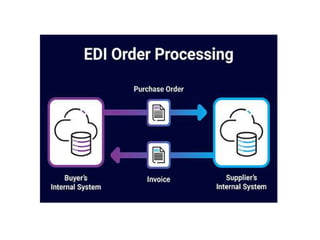
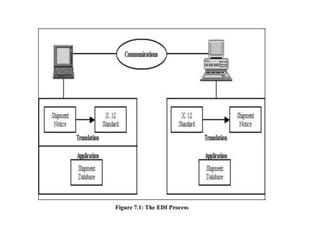
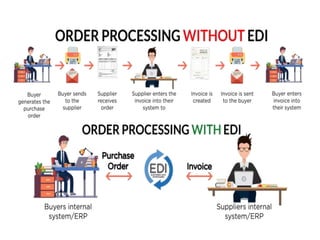
• Electronic Data Interchange (EDI) is defined as the inter-
process communication (computer application to computer
application) of business information in a standardized
electronic form.
• The EDI, trading partners establishes computer links that
enables them to exchange information electronically.
• Electronic Commerce is a term popularized by the advent of
commercial services of the Internet.
• EDI is used for regular and standardized transactions
between organizations.
Definition of EDI
• Electronic Data Interchange is the transmission, in a
standard syntax, of unambiguous information of
business or strategic significance between computers
of independent organizations - The Accredited
Standards Committee for EDI of the American
National Standards Institute.
• Simply EDI is “Paperless Trade”
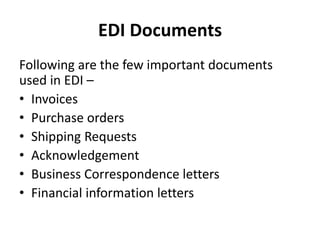
EDI Documents
Following are the few important documents
used in EDI –
• Invoices
• Purchase orders
• Shipping Requests
• Acknowledgement
• Business Correspondence letters
• Financial information letters
EDI Application in Business
• Retail Sector
• Manufacturing Sector
• Financial Sector
• Business documents
• Business partners
• Automobile Sector
Retail Sector
• In the retail sector profit margins usually depend
upon efficient inventory management.
• EDI provides a structured way to maintain and
replenish goods stocked at a retail outlet.
• Retailers use a common model stock for each
shop location and the point of sale stock position
is updated continuously and data in fed via EDI
enabled SCM (supply chain management)
network.
• The EDI software monitors all the logistics and
makes updates in the original stock.
Manufacturing Sector
• EDI ensures effective and efficient management of
materials required for production of a commodity.
• The Inventory position of OEM is constantly updated
through EDI and the supplier is notified about shortage
of materials.
• helps the supplier to plan and schedule supply
according to requirements of the manufacturer.
• The suppliers respond via EDI with an ASN to identify
the parts/materials to be delivered and the
approximate delivery time and as soon as the shipment
is delivered at the production plant the inventory is
updated again.
Financial Sector
• EDI replaces the labour intensive activities of
collecting, processing and dispersing payments
with an electronic system.
• It facilitates the flow of payment between the
bank accounts of trading partners without
requiring any human intervention.
• A payee`s bank account is electronically credited
and the payer`s account is electronically debited
on the scheduled day of payment; such an
exchange is known as electronic fund transfer
(EFT).
Automobile Sector
• keep customers updated with the current
product and pricing information during the
purchase cycle.
• An advance shipping notice is transmitted
through EDI to the customers to prepare a
loading schedule and to ensure proper receipt of
the product.
• The customer may also make payment on receipt
of goods via EDI to speed up the payment
process.
Business documents
• These are any of the documents that are
typically exchanged between businesses.
• The most common documents exchanged via
EDI are purchase orders, invoices and
advance ship notices.
• But there are many, many others such as bill
of lading, customs documents, inventory
documents, shipping status documents and
payment documents.
Business partners
• The exchange of EDI documents is typically
between two different companies, referred to
as business partners or trading partners.
• For example, Company A may buy goods from
Company B.
• Company A sends orders to Company B.
• Company A and Company B are business
partners
Other EDI Application in Business
• Business Information, Product design and
Procurement.
• Health Care and Insurance EDI
• Logistics
• Customs and International Trade
• Automated Clearing house transfers.
Examples of EDI Applications in
Business
• Railway rolling stock monitoring
• Tender tracking
• Order tracking
• Airway bills
• Custom clearance
• Scheduling Notices
• Cheque clearance
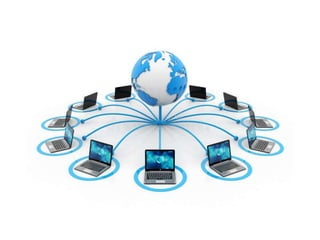
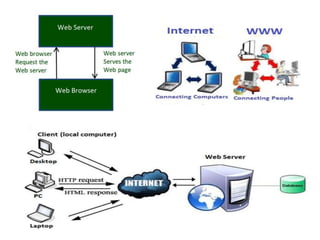
Internet
• The Internet, sometimes called simply "the Net," is a
worldwide system of computer networks - a
network of networks in which users at any one
computer can, if they have permission, get
information from any other computer (and
sometimes talk directly to users at other computers).
• It is a combination of two words “interconnection”
and “network”.
History of Internet
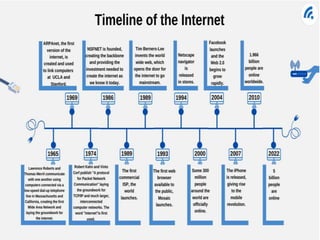
• The Internet was developed by Bob Kahn and Vint Cerf in
the 1970s.
• They began the design of what we today know as the
‘internet.’
• It was the result of another research experiment which was
called ARPANET, which stands for Advanced Research
Projects Agency Network.
• This was initially supposed to be a communications system
for the Defense Team of the United States of America - a
network that would also survive a nuclear attack.
• It eventually became a successful nationwide experimental
packet network.
World Wide Web
• The World Wide Web- referred to as WWW, W3, or
the Web is an interconnected system of public
webpages accessible through the Internet.
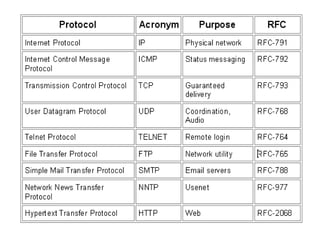
• Tim Berners-Lee was the man, who led the
development of the World Wide Web, the defining of
HTTP (Hyper Text Transfer Protocol), HTML
(hypertext markup language) used to create web
pages, and URLs (Universal Resource Locators).
• The development of WWW, HTTP, HTML and URLs
took place between 1989 and 1991.
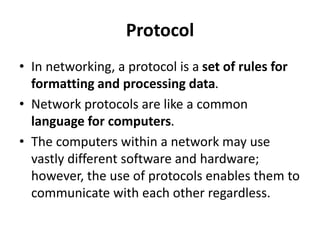
Protocol
• In networking, a protocol is a set of rules for
formatting and processing data.
• Network protocols are like a common
language for computers.
• The computers within a network may use
vastly different software and hardware;
however, the use of protocols enables them to
communicate with each other regardless.
1. EDI is ________.
2. What is the EDI standard format being used?
3. Invoices, Purchase orders, & Shipping
Requests are _________.
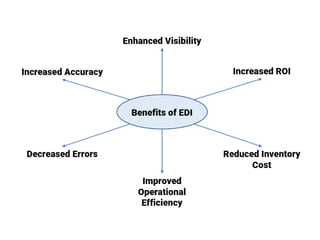
4. Name any two benefits of EDI.
5. _________ is a worldwide system of
computers.
6. Who is the father of Internet?
7. ________ is a set of rules for formatting and
processing data.
8. Differentiate Webpage and Website.
Expand the following:
1. EDI
2. ARPANET
3. INTERNET
4. WWW
5. TCP
6. HTTP/ HTTPS
7. URL
8. IP
Exam Point of View
1. Define EDI and its Process.
2. State the benefits of EDI.
3. Define Internet and terms associated with
Internet.
4. Explain the application of EDI in business.
MITHUN (21BCC532)
II B.COM(CA)- B
Department of Commerce with
Computer Applications

Electronic Data Interchange & Internet

  • 1.
    UNIT- III Electronic DataInterchange(EDI) & Internet Fundamentals of E-Commerce and M-Commerce
  • 2.
    Meaning of EDI •Electronic Data Interchange (EDI) is defined as the inter- process communication (computer application to computer application) of business information in a standardized electronic form. • The EDI, trading partners establishes computer links that enables them to exchange information electronically. • Electronic Commerce is a term popularized by the advent of commercial services of the Internet. • EDI is used for regular and standardized transactions between organizations.
  • 3.
    Definition of EDI •Electronic Data Interchange is the transmission, in a standard syntax, of unambiguous information of business or strategic significance between computers of independent organizations - The Accredited Standards Committee for EDI of the American National Standards Institute. • Simply EDI is “Paperless Trade”
  • 7.
    EDI Documents Following arethe few important documents used in EDI – • Invoices • Purchase orders • Shipping Requests • Acknowledgement • Business Correspondence letters • Financial information letters
  • 9.
    EDI Application inBusiness • Retail Sector • Manufacturing Sector • Financial Sector • Business documents • Business partners • Automobile Sector
  • 10.
    Retail Sector • Inthe retail sector profit margins usually depend upon efficient inventory management. • EDI provides a structured way to maintain and replenish goods stocked at a retail outlet. • Retailers use a common model stock for each shop location and the point of sale stock position is updated continuously and data in fed via EDI enabled SCM (supply chain management) network. • The EDI software monitors all the logistics and makes updates in the original stock.
  • 11.
    Manufacturing Sector • EDIensures effective and efficient management of materials required for production of a commodity. • The Inventory position of OEM is constantly updated through EDI and the supplier is notified about shortage of materials. • helps the supplier to plan and schedule supply according to requirements of the manufacturer. • The suppliers respond via EDI with an ASN to identify the parts/materials to be delivered and the approximate delivery time and as soon as the shipment is delivered at the production plant the inventory is updated again.
  • 12.
    Financial Sector • EDIreplaces the labour intensive activities of collecting, processing and dispersing payments with an electronic system. • It facilitates the flow of payment between the bank accounts of trading partners without requiring any human intervention. • A payee`s bank account is electronically credited and the payer`s account is electronically debited on the scheduled day of payment; such an exchange is known as electronic fund transfer (EFT).
  • 13.
    Automobile Sector • keepcustomers updated with the current product and pricing information during the purchase cycle. • An advance shipping notice is transmitted through EDI to the customers to prepare a loading schedule and to ensure proper receipt of the product. • The customer may also make payment on receipt of goods via EDI to speed up the payment process.
  • 14.
    Business documents • Theseare any of the documents that are typically exchanged between businesses. • The most common documents exchanged via EDI are purchase orders, invoices and advance ship notices. • But there are many, many others such as bill of lading, customs documents, inventory documents, shipping status documents and payment documents.
  • 15.
    Business partners • Theexchange of EDI documents is typically between two different companies, referred to as business partners or trading partners. • For example, Company A may buy goods from Company B. • Company A sends orders to Company B. • Company A and Company B are business partners
  • 16.
    Other EDI Applicationin Business • Business Information, Product design and Procurement. • Health Care and Insurance EDI • Logistics • Customs and International Trade • Automated Clearing house transfers.
  • 17.
    Examples of EDIApplications in Business • Railway rolling stock monitoring • Tender tracking • Order tracking • Airway bills • Custom clearance • Scheduling Notices • Cheque clearance
  • 18.
    Internet • The Internet,sometimes called simply "the Net," is a worldwide system of computer networks - a network of networks in which users at any one computer can, if they have permission, get information from any other computer (and sometimes talk directly to users at other computers). • It is a combination of two words “interconnection” and “network”.
  • 20.
    History of Internet •The Internet was developed by Bob Kahn and Vint Cerf in the 1970s. • They began the design of what we today know as the ‘internet.’ • It was the result of another research experiment which was called ARPANET, which stands for Advanced Research Projects Agency Network. • This was initially supposed to be a communications system for the Defense Team of the United States of America - a network that would also survive a nuclear attack. • It eventually became a successful nationwide experimental packet network.
  • 24.
    World Wide Web •The World Wide Web- referred to as WWW, W3, or the Web is an interconnected system of public webpages accessible through the Internet. • Tim Berners-Lee was the man, who led the development of the World Wide Web, the defining of HTTP (Hyper Text Transfer Protocol), HTML (hypertext markup language) used to create web pages, and URLs (Universal Resource Locators). • The development of WWW, HTTP, HTML and URLs took place between 1989 and 1991.
  • 26.
    Protocol • In networking,a protocol is a set of rules for formatting and processing data. • Network protocols are like a common language for computers. • The computers within a network may use vastly different software and hardware; however, the use of protocols enables them to communicate with each other regardless.
  • 28.
    1. EDI is________. 2. What is the EDI standard format being used? 3. Invoices, Purchase orders, & Shipping Requests are _________. 4. Name any two benefits of EDI. 5. _________ is a worldwide system of computers. 6. Who is the father of Internet? 7. ________ is a set of rules for formatting and processing data. 8. Differentiate Webpage and Website.
  • 29.
    Expand the following: 1.EDI 2. ARPANET 3. INTERNET 4. WWW 5. TCP 6. HTTP/ HTTPS 7. URL 8. IP
  • 30.
    Exam Point ofView 1. Define EDI and its Process. 2. State the benefits of EDI. 3. Define Internet and terms associated with Internet. 4. Explain the application of EDI in business.
  • 31.
    MITHUN (21BCC532) II B.COM(CA)-B Department of Commerce with Computer Applications