EDI in Action
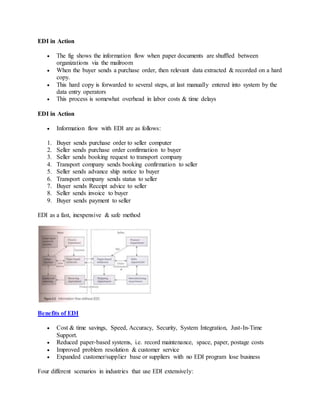
 The fig shows the information flow when paper documents are shuffled between
organizations via the mailroom
 When the buyer sends a purchase order, then relevant data extracted & recorded on a hard
copy.
 This hard copy is forwarded to several steps, at last manually entered into system by the
data entry operators
 This process is somewhat overhead in labor costs & time delays
EDI in Action
 Information flow with EDI are as follows:
1. Buyer sends purchase order to seller computer
2. Seller sends purchase order confirmation to buyer
3. Seller sends booking request to transport company
4. Transport company sends booking confirmation to seller
5. Seller sends advance ship notice to buyer
6. Transport company sends status to seller
7. Buyer sends Receipt advice to seller
8. Seller sends invoice to buyer
9. Buyer sends payment to seller
EDI as a fast, inexpensive & safe method
Benefits of EDI
 Cost & time savings, Speed, Accuracy, Security, System Integration, Just-In-Time
Support.
 Reduced paper-based systems, i.e. record maintenance, space, paper, postage costs
 Improved problem resolution & customer service
 Expanded customer/supplier base or suppliers with no EDI program lose business
Four different scenarios in industries that use EDI extensively:
1. International or cross-border trade
2. Electronic funds transfer
3. Health care EDI for insurance claims processing
4. Manufacturing & retail procurement
5. International or cross-border trade
 EDI has always been very closely linked with international trade.
 Trade efficiency, which allows faster, simpler, broader & less costly transactions
Role of EDI in international trade
 EDI facilitates the smooth flow of information
 It reduces paper work
 EDI benefits for international trade are
1. Reduced transaction expenditures
2. Quicker movement of imported & exported goods
3. Improved customer service through “track & trace” programs
4. Faster customs clearance & reduced opportunities for corruption, a huge problem in trade
Interbank Electronic Funds Transfer (EFT)
 EFT are credit transfers between banks where funds flow directly from the payer’s bank
to the payee’s bank.
 The two biggest funds transfer services in the United States are the Federal Reserve’s
system, Fedwire, & the Clearing House Interbank Payments System (CHIPS) of the New
York clearing house
Automated Clearinghouse (ACH) Transfers
 ACH transfers are used to process high volumes of relatively small-dollar payments for
settlement in one or two business days
 It provides services: preauthorized debits, such as repetitive bill payments; & consumer-
initiated payments
Health care EDI for insurance EDI
 Providing good & affordable health care is a universal problem
 EDI is becoming a permanent fixture in both insurance & health care industries as
medical provider, patients, & payers
 Electronic claim processing is quick & reduces the administrative costs of health care.
 Using EDI software, service providers prepare the forms & submit claims via
communication lines to the value-added network service provider
 The company then edits, sorts & distributes forms to the payer. If necessary, the
insurance company can electronically route transactions to a third-party for price
evaluation
 Claims submission also receives reports regarding claim status & request for additional
information
Manufacturing & retail procurement using EDI
 These are heavy users of EDI
 In manufacturing, EDI is used to support just-in-time.
 In retailing, EDI is used to support quick response
Just-In-Time & EDI
 Companies using JIT & EDI calculates how many parts are needed each
day based on the production schedule & electronically transmit orders.
 Delivery has to be responsive, or it will cost too much in money & time.
 Getting data to suppliers quickly
 A major benefit of JIT & EDI is a streamlined cash flow.
EDI Applications in Business
Quick Response & EDI
 For the customer, QR means better service & availability of a wider range of products
 For the retailer & supplier, QR may mean survival in a competitive marketplace
 Much focus of QR is in reduction of lead times using event-driven EDI.
 In QR, EDI documents include purchase orders, shipping notices, invoices, inventory
position, catalogs, & order status
Legal Status of EDI Messages
 To understand the legal framework, let’s take a look on three modes of communication
types: Instantaneous communication, delayed communication via the U.S. Postal Service
(USPS), & delayed communication via non-USPS couriers;
1. Instantaneous. If the parties are face to face or use an instantaneous communication
medium such as the telephone
2. Delayed (USPS). The “mailbox rule” provides that an acceptance communicated via
USPS mail is effectively when dispatched
3. Delayed (non-USPS). Acceptances transmitted via telegram, mailgram, & electronic
messages, are communicated & operable upon receipt.
Digital Signatures & EDI
 Digital signatures might be time-stamped or digitally notarized to establish dates & times
 If digital signatures are to replace handwritten signatures, they must have the same legal
statues as handwritten signatures.
 It provides a means for a third party to verify that notarized object is authentic.

Edi in action

  • 1.
    EDI in Action The fig shows the information flow when paper documents are shuffled between organizations via the mailroom  When the buyer sends a purchase order, then relevant data extracted & recorded on a hard copy.  This hard copy is forwarded to several steps, at last manually entered into system by the data entry operators  This process is somewhat overhead in labor costs & time delays EDI in Action  Information flow with EDI are as follows: 1. Buyer sends purchase order to seller computer 2. Seller sends purchase order confirmation to buyer 3. Seller sends booking request to transport company 4. Transport company sends booking confirmation to seller 5. Seller sends advance ship notice to buyer 6. Transport company sends status to seller 7. Buyer sends Receipt advice to seller 8. Seller sends invoice to buyer 9. Buyer sends payment to seller EDI as a fast, inexpensive & safe method Benefits of EDI  Cost & time savings, Speed, Accuracy, Security, System Integration, Just-In-Time Support.  Reduced paper-based systems, i.e. record maintenance, space, paper, postage costs  Improved problem resolution & customer service  Expanded customer/supplier base or suppliers with no EDI program lose business Four different scenarios in industries that use EDI extensively:
  • 2.
    1. International orcross-border trade 2. Electronic funds transfer 3. Health care EDI for insurance claims processing 4. Manufacturing & retail procurement 5. International or cross-border trade  EDI has always been very closely linked with international trade.  Trade efficiency, which allows faster, simpler, broader & less costly transactions Role of EDI in international trade  EDI facilitates the smooth flow of information  It reduces paper work  EDI benefits for international trade are 1. Reduced transaction expenditures 2. Quicker movement of imported & exported goods 3. Improved customer service through “track & trace” programs 4. Faster customs clearance & reduced opportunities for corruption, a huge problem in trade Interbank Electronic Funds Transfer (EFT)  EFT are credit transfers between banks where funds flow directly from the payer’s bank to the payee’s bank.  The two biggest funds transfer services in the United States are the Federal Reserve’s system, Fedwire, & the Clearing House Interbank Payments System (CHIPS) of the New York clearing house Automated Clearinghouse (ACH) Transfers  ACH transfers are used to process high volumes of relatively small-dollar payments for settlement in one or two business days  It provides services: preauthorized debits, such as repetitive bill payments; & consumer- initiated payments Health care EDI for insurance EDI  Providing good & affordable health care is a universal problem  EDI is becoming a permanent fixture in both insurance & health care industries as medical provider, patients, & payers  Electronic claim processing is quick & reduces the administrative costs of health care.  Using EDI software, service providers prepare the forms & submit claims via communication lines to the value-added network service provider  The company then edits, sorts & distributes forms to the payer. If necessary, the insurance company can electronically route transactions to a third-party for price evaluation
  • 3.
     Claims submissionalso receives reports regarding claim status & request for additional information Manufacturing & retail procurement using EDI  These are heavy users of EDI  In manufacturing, EDI is used to support just-in-time.  In retailing, EDI is used to support quick response Just-In-Time & EDI  Companies using JIT & EDI calculates how many parts are needed each day based on the production schedule & electronically transmit orders.  Delivery has to be responsive, or it will cost too much in money & time.  Getting data to suppliers quickly  A major benefit of JIT & EDI is a streamlined cash flow. EDI Applications in Business Quick Response & EDI  For the customer, QR means better service & availability of a wider range of products  For the retailer & supplier, QR may mean survival in a competitive marketplace  Much focus of QR is in reduction of lead times using event-driven EDI.  In QR, EDI documents include purchase orders, shipping notices, invoices, inventory position, catalogs, & order status Legal Status of EDI Messages  To understand the legal framework, let’s take a look on three modes of communication types: Instantaneous communication, delayed communication via the U.S. Postal Service (USPS), & delayed communication via non-USPS couriers; 1. Instantaneous. If the parties are face to face or use an instantaneous communication medium such as the telephone 2. Delayed (USPS). The “mailbox rule” provides that an acceptance communicated via USPS mail is effectively when dispatched 3. Delayed (non-USPS). Acceptances transmitted via telegram, mailgram, & electronic messages, are communicated & operable upon receipt. Digital Signatures & EDI  Digital signatures might be time-stamped or digitally notarized to establish dates & times
  • 4.
     If digitalsignatures are to replace handwritten signatures, they must have the same legal statues as handwritten signatures.  It provides a means for a third party to verify that notarized object is authentic.