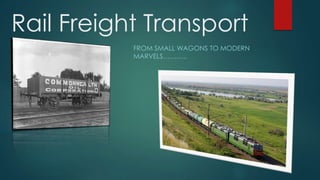
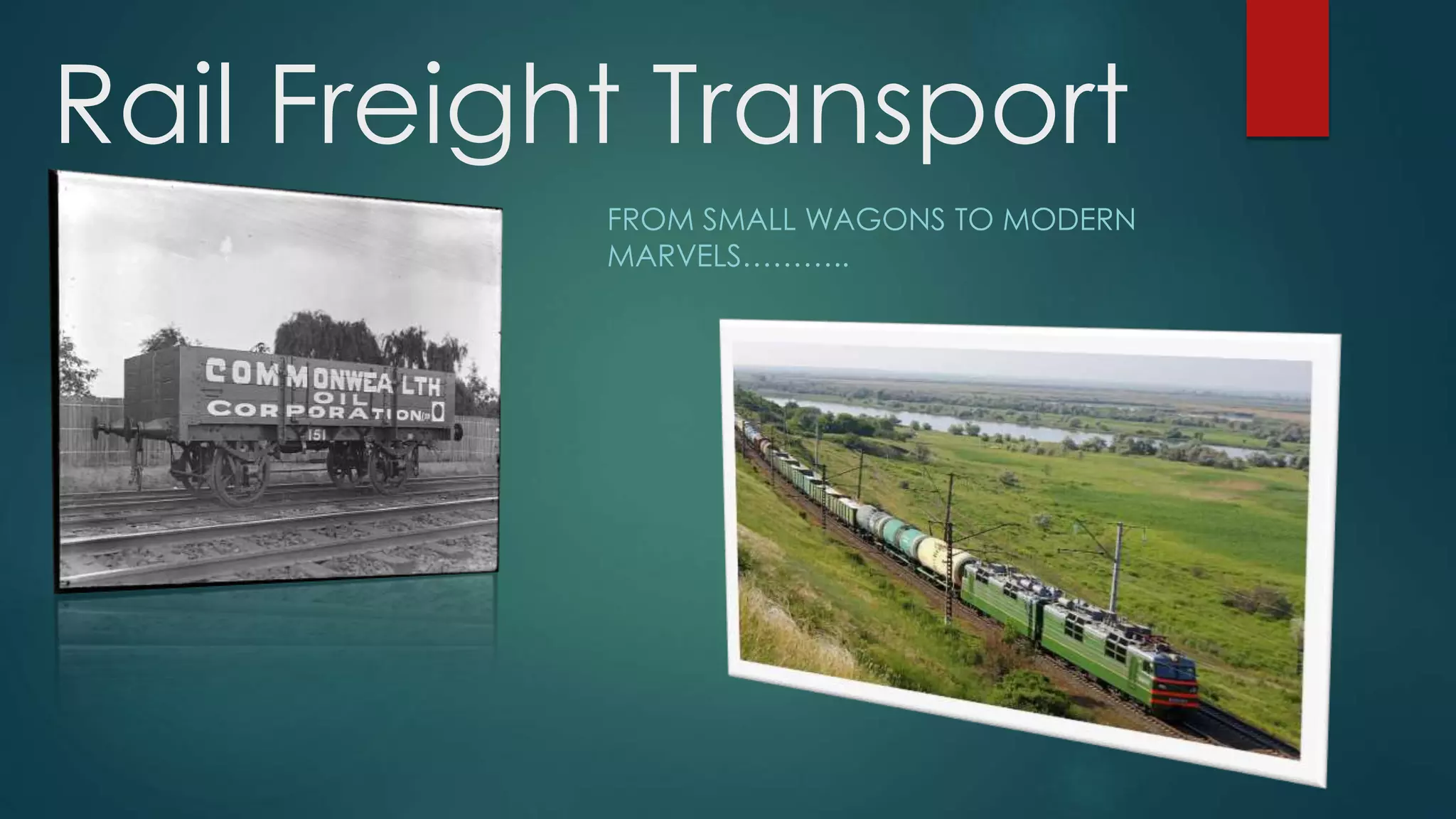
Rail Freight Transport
FROM SMALL WAGONS TO MODERN
MARVELS………..
Headings To Look At:
• HISTORY OF FREIGHT TRANSPORT;
• ABOUT RAIL FREIGHT TRANSPORT IN WORLD;
• LATEST STATISTICS;
• MODERNITY AND TECHNOLOGICAL ADVANCEMENTS;
• CASE STUDY;
• ???????
Where it started?
• 1776-development of Steam Engine
• 1807-construction of Cumberland Road
• 1825-completion of Eric Canal
• Mid 18th development of Conestoga wagon
• 1856-development of Pipeline
• 1869s-massive Railroad System in Utah
• 1887-formation of Interstate Commerce
Commission Act
• 19th-development due to construction of
Highways
• 1970-flowering Truck transport
• 1996-concept of containerization & intermodal
Transport
• 1996-air freight
Transportation History!
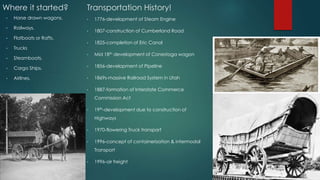
• Horse drawn wagons.
• Railways.
• Flatboats or Rafts.
• Trucks
• Steamboats.
• Cargo Ships.
• Airlines.
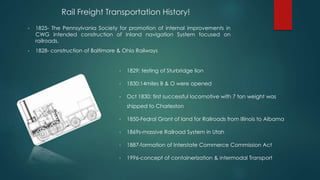
• 1829: testing of Sturbridge lion
• 1830:14miles B & O were opened
• Oct 1830: first successful locomotive with 7 ton weight was
shipped to Charleston
• 1850-Fedral Grant of land for Railroads from Illinois to Albama
• 1869s-massive Railroad System in Utah
• 1887-formation of Interstate Commerce Commission Act
• 1996-concept of containerization & intermodal Transport
Rail Freight Transportation History!
• 1825- The Pennsylvania Society for promotion of internal improvements in
CWG intended construction of Inland navigation System focused on
railroads.
• 1828- construction of Baltimore & Ohio Railways
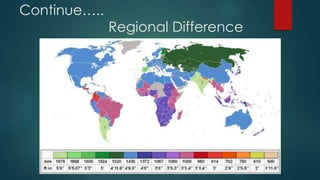
Regional Difference
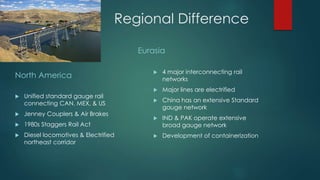
North America
 Unified standard gauge rail
connecting CAN, MEX, & US
 Jenney Couplers & Air Brakes
 1980s Staggers Rail Act
 Diesel locomotives & Electrified
northeast corridor
Eurasia
 4 major interconnecting rail
networks
 Major lines are electrified
 China has an extensive Standard
gauge network
 IND & PAK operate extensive
broad gauge network
 Development of containerization
Continue…..
Regional Difference
Oceania
 large rail network, mostly meter
gauge, with some broad gauge.
 Chile and Argentina have Indian
gauge networks in the south and
meter gauge networks in the
north.
Africa
 The railways of Africa were mostly
started by colonial powers to bring
inland resources to port.
 A 3 ft. 6 in (1,067 mm) gauge
network with Jenney couplers serves
southern Africa.
 East Africa uses meter gauge.
 North Africa uses standard gauge,
but potential connection the
European standard gauge network
is blocked by the Arab-Israeli
conflict.
South America
 Rail developed independently in
different parts of Australia and, as
a result, three major rail gauges
are in use. A standard gauge
Trans-Australian Railway spans the
continent.
Continue…..
Regional Difference
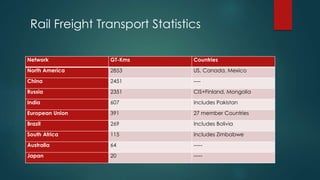
Network GT-Kms Countries
North America 2853 US, Canada, Mexico
China 2451 ----
Russia 2351 CIS+Finland, Mongolia
India 607 Includes Pakistan
European Union 391 27 member Countries
Brazil 269 Includes Bolivia
South Africa 115 Includes Zimbabwe
Australia 64 -----
Japan 20 -----
Rail Freight Transport Statistics
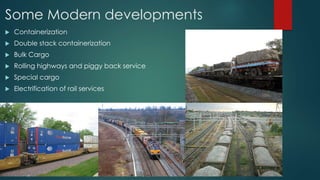
Some Modern developments
 Containerization
 Double stack containerization
 Bulk Cargo
 Rolling highways and piggy back service
 Special cargo
 Electrification of rail services
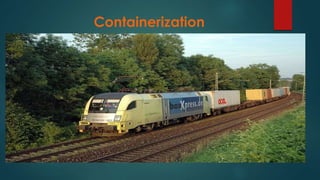
Containerization
 System of intermodal freight transport
 Intermodal containers
 Standardized dimensions
 They can be loaded and unloaded, stacked, transported
efficiently over long distances, and transferred from one
mode of transport to another
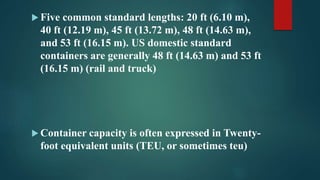
 Five common standard lengths: 20 ft (6.10 m),
40 ft (12.19 m), 45 ft (13.72 m), 48 ft (14.63 m),
and 53 ft (16.15 m). US domestic standard
containers are generally 48 ft (14.63 m) and 53 ft
(16.15 m) (rail and truck)
 Container capacity is often expressed in Twenty-
foot equivalent units (TEU, or sometimes teu)
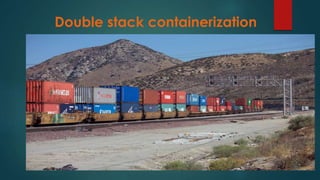
Double stack containerization
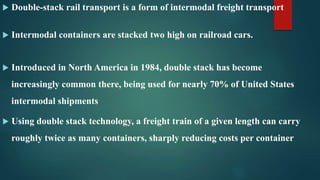
 Double-stack rail transport is a form of intermodal freight transport
 Intermodal containers are stacked two high on railroad cars.
 Introduced in North America in 1984, double stack has become
increasingly common there, being used for nearly 70% of United States
intermodal shipments
 Using double stack technology, a freight train of a given length can carry
roughly twice as many containers, sharply reducing costs per container
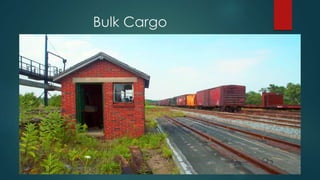
Bulk Cargo
 Bulk cargo is commodity cargo that is transported unpackaged in large
quantities
 It refers to material in either liquid or granular, particulate form, as a
mass of relatively small solids, such as petroleum/crude oil, grain, coal,
or gravel.
 Bulk cargo is classified as liquid or dry
 These cargo are usually dropped or poured, with a spout or shovel
bucket, as a liquid or solid, into a railroad car. Liquids, such as
petroleum and chemicals, and compressed gases are carried by rail
in tank cars..
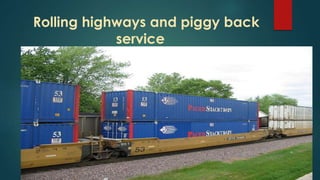
Rolling highways and piggy back
service
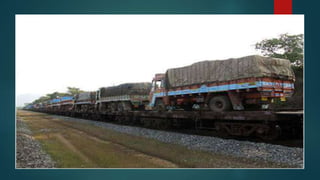
 In some countries rolling highway, or rolling road, trains are used
 Trucks can drive straight onto the train and drive off again when the
end destination is reached
 A system like this is used on the Channel Tunnel between the United
Kingdom and France, as well as on the Konkan Railway in India
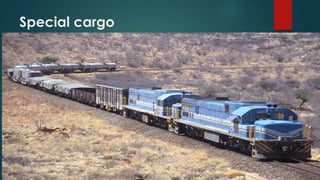
Special cargo
 Several types of cargo are not suited for containerization or bulk
 These are transported in special cars custom designed for the cargo.
 Goods that require certain temperatures during transportation can be
transported in refrigerator cars (or reefers - US) or refrigerated vans,
but refrigerated containers are becoming more dominant.
 Extra heavy and oversized loads are carried in Schnabel cars
 Center beam flat cars are used to carry lumber and other building
supplies.
 Steel plates are transported in modified gondolas called coil cars
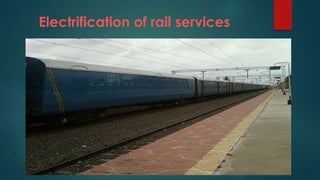
Electrification of rail services
 Experiments with electrical railways were started by Robert
Davidson in 1838
 He completed a battery-powered carriage capable of 6.4 km/h (4 mph).
 The first conventional completely electrified railway mainline was the
106 km Valtellina line in Italy that was opened on 4 September 1902.
 At first, all electric railways used direct current but, in 1904,
the Stubaital Line in Austria opened with alternating current
Thanks for your patience

Rail freight transport

  • 1.
    Rail Freight Transport FROMSMALL WAGONS TO MODERN MARVELS………..
  • 2.
    Headings To LookAt: • HISTORY OF FREIGHT TRANSPORT; • ABOUT RAIL FREIGHT TRANSPORT IN WORLD; • LATEST STATISTICS; • MODERNITY AND TECHNOLOGICAL ADVANCEMENTS; • CASE STUDY; • ???????
  • 3.
    Where it started? •1776-development of Steam Engine • 1807-construction of Cumberland Road • 1825-completion of Eric Canal • Mid 18th development of Conestoga wagon • 1856-development of Pipeline • 1869s-massive Railroad System in Utah • 1887-formation of Interstate Commerce Commission Act • 19th-development due to construction of Highways • 1970-flowering Truck transport • 1996-concept of containerization & intermodal Transport • 1996-air freight Transportation History! • Horse drawn wagons. • Railways. • Flatboats or Rafts. • Trucks • Steamboats. • Cargo Ships. • Airlines.
  • 4.
    • 1829: testingof Sturbridge lion • 1830:14miles B & O were opened • Oct 1830: first successful locomotive with 7 ton weight was shipped to Charleston • 1850-Fedral Grant of land for Railroads from Illinois to Albama • 1869s-massive Railroad System in Utah • 1887-formation of Interstate Commerce Commission Act • 1996-concept of containerization & intermodal Transport Rail Freight Transportation History! • 1825- The Pennsylvania Society for promotion of internal improvements in CWG intended construction of Inland navigation System focused on railroads. • 1828- construction of Baltimore & Ohio Railways
  • 5.
    Regional Difference North America Unified standard gauge rail connecting CAN, MEX, & US  Jenney Couplers & Air Brakes  1980s Staggers Rail Act  Diesel locomotives & Electrified northeast corridor Eurasia  4 major interconnecting rail networks  Major lines are electrified  China has an extensive Standard gauge network  IND & PAK operate extensive broad gauge network  Development of containerization
  • 6.
    Continue….. Regional Difference Oceania  largerail network, mostly meter gauge, with some broad gauge.  Chile and Argentina have Indian gauge networks in the south and meter gauge networks in the north. Africa  The railways of Africa were mostly started by colonial powers to bring inland resources to port.  A 3 ft. 6 in (1,067 mm) gauge network with Jenney couplers serves southern Africa.  East Africa uses meter gauge.  North Africa uses standard gauge, but potential connection the European standard gauge network is blocked by the Arab-Israeli conflict. South America  Rail developed independently in different parts of Australia and, as a result, three major rail gauges are in use. A standard gauge Trans-Australian Railway spans the continent.
  • 7.
  • 8.
    Network GT-Kms Countries NorthAmerica 2853 US, Canada, Mexico China 2451 ---- Russia 2351 CIS+Finland, Mongolia India 607 Includes Pakistan European Union 391 27 member Countries Brazil 269 Includes Bolivia South Africa 115 Includes Zimbabwe Australia 64 ----- Japan 20 ----- Rail Freight Transport Statistics
  • 9.
    Some Modern developments Containerization  Double stack containerization  Bulk Cargo  Rolling highways and piggy back service  Special cargo  Electrification of rail services
  • 10.
  • 11.
     System ofintermodal freight transport  Intermodal containers  Standardized dimensions  They can be loaded and unloaded, stacked, transported efficiently over long distances, and transferred from one mode of transport to another
  • 12.
     Five commonstandard lengths: 20 ft (6.10 m), 40 ft (12.19 m), 45 ft (13.72 m), 48 ft (14.63 m), and 53 ft (16.15 m). US domestic standard containers are generally 48 ft (14.63 m) and 53 ft (16.15 m) (rail and truck)  Container capacity is often expressed in Twenty- foot equivalent units (TEU, or sometimes teu)
  • 13.
  • 14.
     Double-stack railtransport is a form of intermodal freight transport  Intermodal containers are stacked two high on railroad cars.  Introduced in North America in 1984, double stack has become increasingly common there, being used for nearly 70% of United States intermodal shipments  Using double stack technology, a freight train of a given length can carry roughly twice as many containers, sharply reducing costs per container
  • 15.
  • 16.
     Bulk cargois commodity cargo that is transported unpackaged in large quantities  It refers to material in either liquid or granular, particulate form, as a mass of relatively small solids, such as petroleum/crude oil, grain, coal, or gravel.  Bulk cargo is classified as liquid or dry  These cargo are usually dropped or poured, with a spout or shovel bucket, as a liquid or solid, into a railroad car. Liquids, such as petroleum and chemicals, and compressed gases are carried by rail in tank cars..
  • 17.
    Rolling highways andpiggy back service
  • 18.
     In somecountries rolling highway, or rolling road, trains are used  Trucks can drive straight onto the train and drive off again when the end destination is reached  A system like this is used on the Channel Tunnel between the United Kingdom and France, as well as on the Konkan Railway in India
  • 20.
  • 21.
     Several typesof cargo are not suited for containerization or bulk  These are transported in special cars custom designed for the cargo.  Goods that require certain temperatures during transportation can be transported in refrigerator cars (or reefers - US) or refrigerated vans, but refrigerated containers are becoming more dominant.  Extra heavy and oversized loads are carried in Schnabel cars  Center beam flat cars are used to carry lumber and other building supplies.  Steel plates are transported in modified gondolas called coil cars
  • 22.
  • 23.
     Experiments withelectrical railways were started by Robert Davidson in 1838  He completed a battery-powered carriage capable of 6.4 km/h (4 mph).  The first conventional completely electrified railway mainline was the 106 km Valtellina line in Italy that was opened on 4 September 1902.  At first, all electric railways used direct current but, in 1904, the Stubaital Line in Austria opened with alternating current
  • 24.

Editor's Notes

  • #5 Rail freight transport is the use of railroads to transport cargo as opposed to human passengers. A freight train or goods train is a group of freight cars (US) or goods wagons (UIC) hauled by one or more locomotives on a railway, transporting cargo all or some of the way between the shipper and the intended destination as part of the logistics chain. Trains may haul bulk material, intermodal containers, general freight or specialized freight in purpose-designed cars.
  • #7 The meter gauge networks are connected at one point, but there has never been a broad gauge connection. (A meter-gauge connection between the two broad gauge networks, the Transandine Railway was constructed but is not currently in service. See also Trans-Andean railways.) Most other countries have few rail systems, if any.
  • #20 There are also roadrailer vehicles, which have two sets of wheels, for use in a train, or as the trailer of a road vehicle