CONTAINERIZATION
Building Global Trade Competitiveness


                                            By:
                                       Amitesh Tyagi
                                      Aniruddha Ray
                                  Pervinder Singh Chawla
                                     Saurav Chaudhuri
DISCUSSION POINTS


What is containerization?

Players in the container supply chain

Containerization in India

Hub and Feeder Possibility in India
  Additional focus on JNPT
WHAT IS CONTAINERIZATION?
As per Wikipedia:
           ‘Containerization is a system of freight transport based on a range of steel
intermodal containers (also 'shipping containers', 'ISO containers' etc). Containers are
built to standardized dimensions, and can be loaded and unloaded, stacked, transported
efficiently over long distances, and transferred from one mode of transport to another—
container ships, rail and semi-trailer trucks—without being opened. The system was
developed after World War II, led to greatly reduced transport costs, and supported a vast
increase in international trade.’

ISO Standard for containers:
a. Five common standard lengths: 20-ft, 40-ft, 45-ft, 48-ft and 53-ft
b. Capacity is expressed in TEU – Twenty-feet Equivalent Units
c. Height is not considered for expression
d. Maximum gross mass for 20ft is 24000 kgs and for 40-ft is 30,480 kgs.

Some big names in Container Transport:
NYK Line, Evergreen Marine, CMA-CGM, Maersk Line, MSC, Hapag-Lloyd, APL, Hanjin,
CSCL
In India – Shipping Corporation of India
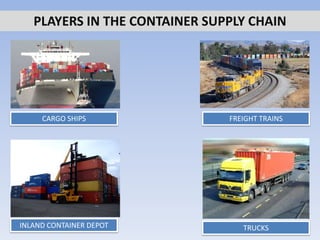
PLAYERS IN THE CONTAINER SUPPLY CHAIN


     CARGO SHIPS               FREIGHT TRAINS


INLAND CONTAINER DEPOT            TRUCKS
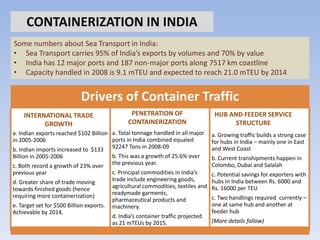
CONTAINERIZATION IN INDIA
Some numbers about Sea Transport in India:
• Sea Transport carries 95% of India’s exports by volumes and 70% by value
• India has 12 major ports and 187 non-major ports along 7517 km coastline
• Capacity handled in 2008 is 9.1 mTEU and expected to reach 21.0 mTEU by 2014


                            Drivers of Container Traffic
    INTERNATIONAL TRADE                          PENETRATION OF                     HUB AND FEEDER SERVICE
          GROWTH                                CONTAINERIZATION                         STRUCTURE
a. Indian exports reached $102 Billion a. Total tonnage handled in all major       a. Growing traffic builds a strong case
in 2005-2006                           ports in India combined equaled             for hubs in India – mainly one in East
b. Indian imports increased to $133 92247 Tons in 2008-09                          and West Coast
Billion in 2005-2006                      b. This was a growth of 25.6% over       b. Current transhipments happen in
c. Both record a growth of 23% over       the previous year.                       Colombo, Dubai and Salalah
previous year                             c. Principal commodities in India’s      c. Potential savings for exporters with
d. Greater share of trade moving          trade include engineering goods,         hubs in India between Rs. 6000 and
towards finished goods (hence             agricultural commodities, textiles and   Rs. 16000 per TEU
requiring more containerization)          readymade garments,
                                          pharmaceutical products and              c. Two handlings required currently –
e. Target set for $500 Billion exports.   machinery.                               one at same hub and another at
Achievable by 2014.                                                                feeder hub
                                          d. India’s container traffic projected
                                          as 21 mTEUs by 2015.                     (More details follow)
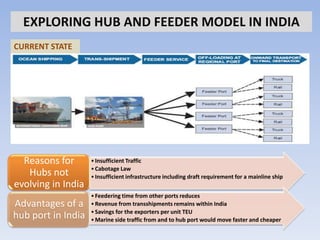
EXPLORING HUB AND FEEDER MODEL IN INDIA
CURRENT STATE


  Reasons for       • Insufficient Traffic
                    • Cabotage Law
   Hubs not         • Insufficient infrastructure including draft requirement for a mainline ship
evolving in India
                    • Feedering time from other ports reduces
Advantages of a     • Revenue from transshipments remains within India
                    • Savings for the exporters per unit TEU
hub port in India   • Marine side traffic from and to hub port would move faster and cheaper
IN FAVOR OF HUB AND FEEDER MODEL
IN INDIA
   Indian Sub-
    Continent     • Per World Bank Study, the western region (Mumbai and Gujarat)
                    can handle 66% container throughputs for the country, 27% can
    Peninsular      be handled in southern region and balance at eastern region

    Advantage
                  • The sizes of the large mother vessels are increasing from 6000-
                    8000 TEU to 12000-14000 TEU requiring fewer trips by present
Shipping Trends     4000 TEU ships as feeders
                  • Port infrastructure needs to be scaled up to handle the new
                    emerging standards of the vessels


                   • India is growing at 7-8% CAGR.
                   • The exports of finished groups are growing
Emerging India     • Government is realizing the need for more and more PPP
                     opportunities for an effective port management system
TOWARDS HUB AND FEEDER MODEL IN INDIA:
POTENTIAL HUB PORTS – KEY REQUIREMENTS
 STRATEGIC LOCATION


 POTENTIAL TO REDUCE TOTAL TRANSPORTATION COST


 COST SAVINGS OWING TO LAND VALUES


 LESSER DREDGING REQUIREMENTS


 FACILITY TO RECEIVE HIGHER CAPACITY VESSELS AND THUS REDUCE OVERALL FLEET COSTS
TOWARDS HUB AND FEEDER MODEL IN INDIA:
              Potential Hub Ports
A key requirement for an effective hub port is a deep draft so that large vessels can
navigate easily in the water and hence provide cheaper and higher quality service.

 The busiest port JNPT has a draft of 12.5 meters while Mundra has highest of 17.5 meters.
 The range of drafts in India are from 7.5 meters to 15 meters with an even spread on the east and
west coast.
 Colombo, the closest competitor, has a draft of 16 meters* and the proposal is to raise it to 23
meters*
 Based on the evacuation capabilities and the draft available criteria, the paper rightly points out
the following:
         Mundra is the best option purely based on the draft criteria
         JNPT is best fit with the hinterland connectivity initiatives that are on the anvil
         Vishakhapatnam is the best option for hub on the eastern side of the peninsula

 Further, the business plan of JNPT points out that the port is planning to intensify dredging so that
it can deepen channel up to 14 meters. There is also a growing competition among Indian ports with
the private players getting in the port management through PPPs.
* Port website
TOWARDS HUB AND FEEDER MODEL IN INDIA:
    Potential Hub Ports (Current State of JNPT)


Source: Business Plan, JNPT Port Website
TOWARDS HUB AND FEEDER MODEL IN INDIA:
     Potential Hub Ports (Hinterland Connectivity)
Hinterland Connectivity is required for smooth and well coordinated container traffic
inflow and outflow from the port. This is important for a port’s position as a hub.
Rail Evacuation
 JNPT enjoys a competitive advantage over the other ports as far as the hinterland connectivity is
concerned as is quoted in the paper. Containers bound to countries such as China and Japan also prefer JNPT
over others for this reason

 Gujarat ports despite better draft suffer from lack of sufficient hinterland connectivity leading to costlier
transports to and from these ports both time-wise and money-wise

 Congestion in the Tughlakabad-JNPT corridor is heavily congested and freight trains get a lower priority
over passenger trains. Suggestion is to explore double stack option in this corridor
        However, double stack option feasibility needs to be assessed as it increasing the overall height
           of the train.
        China faces a problem of lower electrical transmission lines in its railway network. A similar
           disadvantage is possible in Indian electrical transmission wiring. Also a review of the heights of
           road bridges over railway tracks needs to be studied before the double stack can be explore as a
           viable option.
        Some countries have adopted shorter containers for double stacking. Economic viability of this in
           JNPT and Indian context needs to be analyzed.

 PPP models have evolved with Kutch Railway Corp and Pipavav Railway Corp.
TOWARDS HUB AND FEEDER MODEL IN INDIA:
   Potential Hub Ports (Hinterland Connectivity)
Road Evacuation

 More maturity is required in the Indian context as far as the road connectivity goes. Some
projects on port connectivity have been shelved in recent past
 As mentioned in the paper, the future plans of NHDP are not covering port connectivity
 Movement of empty trailers, trailer parking around depots, maintenance, facilities for drivers etc
need astute traffic planning else situations of congestions are possible

JNPT advantage
 JNPT has a double line connectivity while Pipavav and
Mundra have single track diesel connectivity
 However, JNPT hinterland connectivity is reaching its
peak capacity
 JNPT is considering barges and double stacking to
remove capacity constraints
 JNPT has signed an MoU for partial funding of a road
expansion project
 Mundra and Pipavav are also persuading government
for additional focus on hinterland connectivity
TOWARDS HUB
AND FEEDER
MODEL IN INDIA:
Potential Hub
Ports (Hinterland
Connectivity)

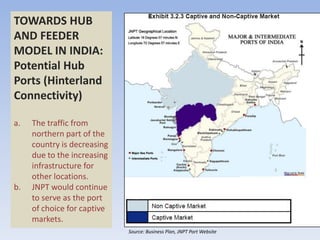
a.   The traffic from
     northern part of the
     country is decreasing
     due to the increasing
     infrastructure for
     other locations.
b.   JNPT would continue
     to serve as the port
     of choice for captive
     markets.
                             Source: Business Plan, JNPT Port Website
Potential Hub Ports (Hinterland Connectivity)
                 And Other Considerations
Other Considerations:
 Coastal Shipping
    and Inland
    Waterways
               Integration with
                coastal and inland
                water transport for
                evacuation needs
       ICD/CFS*
        Infrastructure
               Concepts of SEZ and
                FTWZ would gain
                more consideration
               Local connectivity
                with minimum
                traffic interference
               Customs and bond
                warehouses
               Rail connection to
                gateway ports
               Parking spaces
*(Container Freight Station)
                                       CAPACITY UTILIZATION OF RAILWAY SECTIONS
TOWARDS HUB AND FEEDER MODEL IN INDIA:
       Potential Hub Ports (Other Issues)
IT Infrastructure
 Standardization , network and information sharing and knowledge products requires policy and
governmental interference to build more robustness and effectiveness around the IT systems.
 Usage of GPS and RFID should be introduced

Domestic Traffic
  More focus needed towards the domestic traffic as well
  Opportunity for customized containerization possible with domestic traffic encouragement

Leasing and Manufacture
  More encouragement should be given to manufacturing of support elements for the marine
     supply chain through containerization. This would comprise of containers, wagons,
     tractors/trailers and cranes
  Leasing by non-shipping line owners is a beneficial business model as observed in other
     countries

Location of SEZs
  Government should be urged to build more and more SEZs near the ports to minimize
     connectivity requirements
TOWARDS HUB AND FEEDER MODEL IN INDIA:
      Potential Hub Ports (Other Issues)

Regulation – Following should be the focus areas for regulation

 Licensing
 Security
 Port Tariffs
 Shipping Line Conferences
 Customs
 Cabotage (laws that a govern trade or navigation in coastal waters of a
country to operate the air traffic within its territory)
 Environment and Conservation
 Safety
 QoS
 Dispute Resolution
TOWARDS HUB AND FEEDER MODEL IN INDIA:
  Potential Hub Ports (Closing Notes from paper)
Closing Issues – In line with the industry requirements
 More PPP models need to be adopted in the sector. Privately operated terminals are the way
forward
 Roles of landlord and operator should be clearly delineated (JNPT vs JNPCT)
 Port Authority should focus more on:
  Landlord Function
  Regulatory Function
  Coordination Function
  Facilitation/Promotion functions
 Scale needed to meet better economies
 Tendering and bidding should be more streamlined and transparent
 More global tendering should be encouraged
 Training needs in officials to build a supply chain and marketing mindset
 Technocrats rather than bureaucrats needed for port management
 Shipping Line Conferences

Conclusion: The group found the article very insightful and agree with most of the
proposals in it. However, we felt that port management trusts need to step-up and take a
solution-provider approach for their customers. We see next JNPT where many of the
suggestions of the paper have been put in practice.
TOWARDS HUB AND FEEDER MODEL IN INDIA:
   MORE ON JNPT VISION STATEMENT
TOWARDS HUB AND FEEDER MODEL IN INDIA:
    JNPT - IDENTIFICATION OF GOALS
THANK YOU

Containerization

  • 1.
    CONTAINERIZATION Building Global TradeCompetitiveness By: Amitesh Tyagi Aniruddha Ray Pervinder Singh Chawla Saurav Chaudhuri
  • 2.
    DISCUSSION POINTS What iscontainerization? Players in the container supply chain Containerization in India Hub and Feeder Possibility in India Additional focus on JNPT
  • 3.
    WHAT IS CONTAINERIZATION? Asper Wikipedia: ‘Containerization is a system of freight transport based on a range of steel intermodal containers (also 'shipping containers', 'ISO containers' etc). Containers are built to standardized dimensions, and can be loaded and unloaded, stacked, transported efficiently over long distances, and transferred from one mode of transport to another— container ships, rail and semi-trailer trucks—without being opened. The system was developed after World War II, led to greatly reduced transport costs, and supported a vast increase in international trade.’ ISO Standard for containers: a. Five common standard lengths: 20-ft, 40-ft, 45-ft, 48-ft and 53-ft b. Capacity is expressed in TEU – Twenty-feet Equivalent Units c. Height is not considered for expression d. Maximum gross mass for 20ft is 24000 kgs and for 40-ft is 30,480 kgs. Some big names in Container Transport: NYK Line, Evergreen Marine, CMA-CGM, Maersk Line, MSC, Hapag-Lloyd, APL, Hanjin, CSCL In India – Shipping Corporation of India
  • 4.
    PLAYERS IN THECONTAINER SUPPLY CHAIN CARGO SHIPS FREIGHT TRAINS INLAND CONTAINER DEPOT TRUCKS
  • 5.
    CONTAINERIZATION IN INDIA Somenumbers about Sea Transport in India: • Sea Transport carries 95% of India’s exports by volumes and 70% by value • India has 12 major ports and 187 non-major ports along 7517 km coastline • Capacity handled in 2008 is 9.1 mTEU and expected to reach 21.0 mTEU by 2014 Drivers of Container Traffic INTERNATIONAL TRADE PENETRATION OF HUB AND FEEDER SERVICE GROWTH CONTAINERIZATION STRUCTURE a. Indian exports reached $102 Billion a. Total tonnage handled in all major a. Growing traffic builds a strong case in 2005-2006 ports in India combined equaled for hubs in India – mainly one in East b. Indian imports increased to $133 92247 Tons in 2008-09 and West Coast Billion in 2005-2006 b. This was a growth of 25.6% over b. Current transhipments happen in c. Both record a growth of 23% over the previous year. Colombo, Dubai and Salalah previous year c. Principal commodities in India’s c. Potential savings for exporters with d. Greater share of trade moving trade include engineering goods, hubs in India between Rs. 6000 and towards finished goods (hence agricultural commodities, textiles and Rs. 16000 per TEU requiring more containerization) readymade garments, pharmaceutical products and c. Two handlings required currently – e. Target set for $500 Billion exports. machinery. one at same hub and another at Achievable by 2014. feeder hub d. India’s container traffic projected as 21 mTEUs by 2015. (More details follow)
  • 6.
    EXPLORING HUB ANDFEEDER MODEL IN INDIA CURRENT STATE Reasons for • Insufficient Traffic • Cabotage Law Hubs not • Insufficient infrastructure including draft requirement for a mainline ship evolving in India • Feedering time from other ports reduces Advantages of a • Revenue from transshipments remains within India • Savings for the exporters per unit TEU hub port in India • Marine side traffic from and to hub port would move faster and cheaper
  • 7.
    IN FAVOR OFHUB AND FEEDER MODEL IN INDIA Indian Sub- Continent • Per World Bank Study, the western region (Mumbai and Gujarat) can handle 66% container throughputs for the country, 27% can Peninsular be handled in southern region and balance at eastern region Advantage • The sizes of the large mother vessels are increasing from 6000- 8000 TEU to 12000-14000 TEU requiring fewer trips by present Shipping Trends 4000 TEU ships as feeders • Port infrastructure needs to be scaled up to handle the new emerging standards of the vessels • India is growing at 7-8% CAGR. • The exports of finished groups are growing Emerging India • Government is realizing the need for more and more PPP opportunities for an effective port management system
  • 8.
    TOWARDS HUB ANDFEEDER MODEL IN INDIA: POTENTIAL HUB PORTS – KEY REQUIREMENTS STRATEGIC LOCATION POTENTIAL TO REDUCE TOTAL TRANSPORTATION COST COST SAVINGS OWING TO LAND VALUES LESSER DREDGING REQUIREMENTS FACILITY TO RECEIVE HIGHER CAPACITY VESSELS AND THUS REDUCE OVERALL FLEET COSTS
  • 9.
    TOWARDS HUB ANDFEEDER MODEL IN INDIA: Potential Hub Ports A key requirement for an effective hub port is a deep draft so that large vessels can navigate easily in the water and hence provide cheaper and higher quality service.  The busiest port JNPT has a draft of 12.5 meters while Mundra has highest of 17.5 meters.  The range of drafts in India are from 7.5 meters to 15 meters with an even spread on the east and west coast.  Colombo, the closest competitor, has a draft of 16 meters* and the proposal is to raise it to 23 meters*  Based on the evacuation capabilities and the draft available criteria, the paper rightly points out the following:  Mundra is the best option purely based on the draft criteria  JNPT is best fit with the hinterland connectivity initiatives that are on the anvil  Vishakhapatnam is the best option for hub on the eastern side of the peninsula  Further, the business plan of JNPT points out that the port is planning to intensify dredging so that it can deepen channel up to 14 meters. There is also a growing competition among Indian ports with the private players getting in the port management through PPPs. * Port website
  • 10.
    TOWARDS HUB ANDFEEDER MODEL IN INDIA: Potential Hub Ports (Current State of JNPT) Source: Business Plan, JNPT Port Website
  • 11.
    TOWARDS HUB ANDFEEDER MODEL IN INDIA: Potential Hub Ports (Hinterland Connectivity) Hinterland Connectivity is required for smooth and well coordinated container traffic inflow and outflow from the port. This is important for a port’s position as a hub. Rail Evacuation  JNPT enjoys a competitive advantage over the other ports as far as the hinterland connectivity is concerned as is quoted in the paper. Containers bound to countries such as China and Japan also prefer JNPT over others for this reason  Gujarat ports despite better draft suffer from lack of sufficient hinterland connectivity leading to costlier transports to and from these ports both time-wise and money-wise  Congestion in the Tughlakabad-JNPT corridor is heavily congested and freight trains get a lower priority over passenger trains. Suggestion is to explore double stack option in this corridor  However, double stack option feasibility needs to be assessed as it increasing the overall height of the train.  China faces a problem of lower electrical transmission lines in its railway network. A similar disadvantage is possible in Indian electrical transmission wiring. Also a review of the heights of road bridges over railway tracks needs to be studied before the double stack can be explore as a viable option.  Some countries have adopted shorter containers for double stacking. Economic viability of this in JNPT and Indian context needs to be analyzed.  PPP models have evolved with Kutch Railway Corp and Pipavav Railway Corp.
  • 12.
    TOWARDS HUB ANDFEEDER MODEL IN INDIA: Potential Hub Ports (Hinterland Connectivity) Road Evacuation  More maturity is required in the Indian context as far as the road connectivity goes. Some projects on port connectivity have been shelved in recent past  As mentioned in the paper, the future plans of NHDP are not covering port connectivity  Movement of empty trailers, trailer parking around depots, maintenance, facilities for drivers etc need astute traffic planning else situations of congestions are possible JNPT advantage  JNPT has a double line connectivity while Pipavav and Mundra have single track diesel connectivity  However, JNPT hinterland connectivity is reaching its peak capacity  JNPT is considering barges and double stacking to remove capacity constraints  JNPT has signed an MoU for partial funding of a road expansion project  Mundra and Pipavav are also persuading government for additional focus on hinterland connectivity
  • 13.
    TOWARDS HUB AND FEEDER MODELIN INDIA: Potential Hub Ports (Hinterland Connectivity) a. The traffic from northern part of the country is decreasing due to the increasing infrastructure for other locations. b. JNPT would continue to serve as the port of choice for captive markets. Source: Business Plan, JNPT Port Website
  • 14.
    Potential Hub Ports(Hinterland Connectivity) And Other Considerations Other Considerations:  Coastal Shipping and Inland Waterways  Integration with coastal and inland water transport for evacuation needs  ICD/CFS* Infrastructure  Concepts of SEZ and FTWZ would gain more consideration  Local connectivity with minimum traffic interference  Customs and bond warehouses  Rail connection to gateway ports  Parking spaces *(Container Freight Station) CAPACITY UTILIZATION OF RAILWAY SECTIONS
  • 15.
    TOWARDS HUB ANDFEEDER MODEL IN INDIA: Potential Hub Ports (Other Issues) IT Infrastructure  Standardization , network and information sharing and knowledge products requires policy and governmental interference to build more robustness and effectiveness around the IT systems.  Usage of GPS and RFID should be introduced Domestic Traffic  More focus needed towards the domestic traffic as well  Opportunity for customized containerization possible with domestic traffic encouragement Leasing and Manufacture  More encouragement should be given to manufacturing of support elements for the marine supply chain through containerization. This would comprise of containers, wagons, tractors/trailers and cranes  Leasing by non-shipping line owners is a beneficial business model as observed in other countries Location of SEZs  Government should be urged to build more and more SEZs near the ports to minimize connectivity requirements
  • 16.
    TOWARDS HUB ANDFEEDER MODEL IN INDIA: Potential Hub Ports (Other Issues) Regulation – Following should be the focus areas for regulation  Licensing  Security  Port Tariffs  Shipping Line Conferences  Customs  Cabotage (laws that a govern trade or navigation in coastal waters of a country to operate the air traffic within its territory)  Environment and Conservation  Safety  QoS  Dispute Resolution
  • 17.
    TOWARDS HUB ANDFEEDER MODEL IN INDIA: Potential Hub Ports (Closing Notes from paper) Closing Issues – In line with the industry requirements  More PPP models need to be adopted in the sector. Privately operated terminals are the way forward  Roles of landlord and operator should be clearly delineated (JNPT vs JNPCT)  Port Authority should focus more on:  Landlord Function  Regulatory Function  Coordination Function  Facilitation/Promotion functions  Scale needed to meet better economies  Tendering and bidding should be more streamlined and transparent  More global tendering should be encouraged  Training needs in officials to build a supply chain and marketing mindset  Technocrats rather than bureaucrats needed for port management  Shipping Line Conferences Conclusion: The group found the article very insightful and agree with most of the proposals in it. However, we felt that port management trusts need to step-up and take a solution-provider approach for their customers. We see next JNPT where many of the suggestions of the paper have been put in practice.
  • 18.
    TOWARDS HUB ANDFEEDER MODEL IN INDIA: MORE ON JNPT VISION STATEMENT
  • 19.
    TOWARDS HUB ANDFEEDER MODEL IN INDIA: JNPT - IDENTIFICATION OF GOALS
  • 20.

Editor's Notes

  • #4 http://en.wikipedia.org/wiki/Containerization
  • #6 http://www.frost.com/prod/servlet/press-release.pag?Src=RSS&docid=176131850http://www.iimahd.ernet.in/~graghu/container.pdfhttp://articles.economictimes.indiatimes.com/2011-11-06/news/30366543_1_export-target-export-destinations-foreign-trade-policyhttp://www.indiastat.com/table/transport/30/trafficatmajorportsofindia/449979/55830/data.aspx
  • #7 http://www.google.co.in/imgres?q=hub+and+feeder&um=1&hl=en&safe=off&sa=N&rlz=1C1SNNT_enUS383US383&tbm=isch&tbnid=ZxLqHYVZ3uXXsM:&imgrefurl=http://www.tc.gc.ca/eng/policy/report-acf-tp14876-menu-1012.htm&docid=1ubzLYpKIdOPUM&imgurl=http://www.tc.gc.ca/media/images/policy/figure01.jpg&w=598&h=261&ei=VDfSTrsggsitB7Xa2L4M&zoom=1&iact=hc&vpx=743&vpy=269&dur=4190&hovh=148&hovw=340&tx=163&ty=76&sig=111437375350994547703&page=5&tbnh=69&tbnw=158&start=90&ndsp=22&ved=1t:429,r:4,s:90&biw=1366&bih=600
  • #8 http://www.google.co.in/imgres?q=hub+and+feeder&um=1&hl=en&safe=off&sa=N&rlz=1C1SNNT_enUS383US383&tbm=isch&tbnid=ZxLqHYVZ3uXXsM:&imgrefurl=http://www.tc.gc.ca/eng/policy/report-acf-tp14876-menu-1012.htm&docid=1ubzLYpKIdOPUM&imgurl=http://www.tc.gc.ca/media/images/policy/figure01.jpg&w=598&h=261&ei=VDfSTrsggsitB7Xa2L4M&zoom=1&iact=hc&vpx=743&vpy=269&dur=4190&hovh=148&hovw=340&tx=163&ty=76&sig=111437375350994547703&page=5&tbnh=69&tbnw=158&start=90&ndsp=22&ved=1t:429,r:4,s:90&biw=1366&bih=600
  • #9 http://www.google.co.in/imgres?q=hub+and+feeder&um=1&hl=en&safe=off&sa=N&rlz=1C1SNNT_enUS383US383&tbm=isch&tbnid=ZxLqHYVZ3uXXsM:&imgrefurl=http://www.tc.gc.ca/eng/policy/report-acf-tp14876-menu-1012.htm&docid=1ubzLYpKIdOPUM&imgurl=http://www.tc.gc.ca/media/images/policy/figure01.jpg&w=598&h=261&ei=VDfSTrsggsitB7Xa2L4M&zoom=1&iact=hc&vpx=743&vpy=269&dur=4190&hovh=148&hovw=340&tx=163&ty=76&sig=111437375350994547703&page=5&tbnh=69&tbnw=158&start=90&ndsp=22&ved=1t:429,r:4,s:90&biw=1366&bih=600
  • #10 http://jnport.gov.in/writereaddata/Downloads%5CJNPT_Final_Volume1v2.pdf
  • #11 http://jnport.gov.in/writereaddata/Downloads%5CJNPT_Final_Volume1v2.pdf
  • #12 http://jnport.gov.in/writereaddata/Downloads%5CJNPT_Final_Volume1v2.pdfhttp://en.wikipedia.org/wiki/Freight_rail_transport
  • #13 http://jnport.gov.in/writereaddata/Downloads%5CJNPT_Final_Volume1v2.pdfhttp://en.wikipedia.org/wiki/Freight_rail_transport
  • #14 http://jnport.gov.in/writereaddata/Downloads%5CJNPT_Final_Volume1v2.pdf
  • #15 http://jnport.gov.in/writereaddata/Downloads%5CJNPT_Final_Volume1v2.pdfhttp://en.wikipedia.org/wiki/Freight_rail_transport
  • #16 http://www.iimahd.ernet.in/~graghu/container.pdf
  • #17 http://www.iimahd.ernet.in/~graghu/container.pdf
  • #18 http://www.iimahd.ernet.in/~graghu/container.pdf
  • #19 http://jnport.gov.in/writereaddata/Downloads%5CJNPT_Final_Volume1v2.pdf
  • #20 http://jnport.gov.in/writereaddata/Downloads%5CJNPT_Final_Volume1v2.pdf
  • #21 http://jnport.gov.in/writereaddata/Downloads%5CJNPT_Final_Volume1v2.pdf