Fairness and Justice for all
Antony John Kunnan
California State University, Los Angeles
Introduction
As a concept, fairness is seemingly clear but quite complex.
The concept is an interdisciplinary one; not only based on the
psychometric view of tests and testing practice but also on
social, ethical, legal and philosophical views.
Code of Fair Testing Practices in Education (Code from now
on) prepared by the Joint Committee on Testing Practices
(1988) presents standards for educational test developers and
users in four areas: developing and selecting tests,
interpreting scores, striving for fairness and informing
test takers.
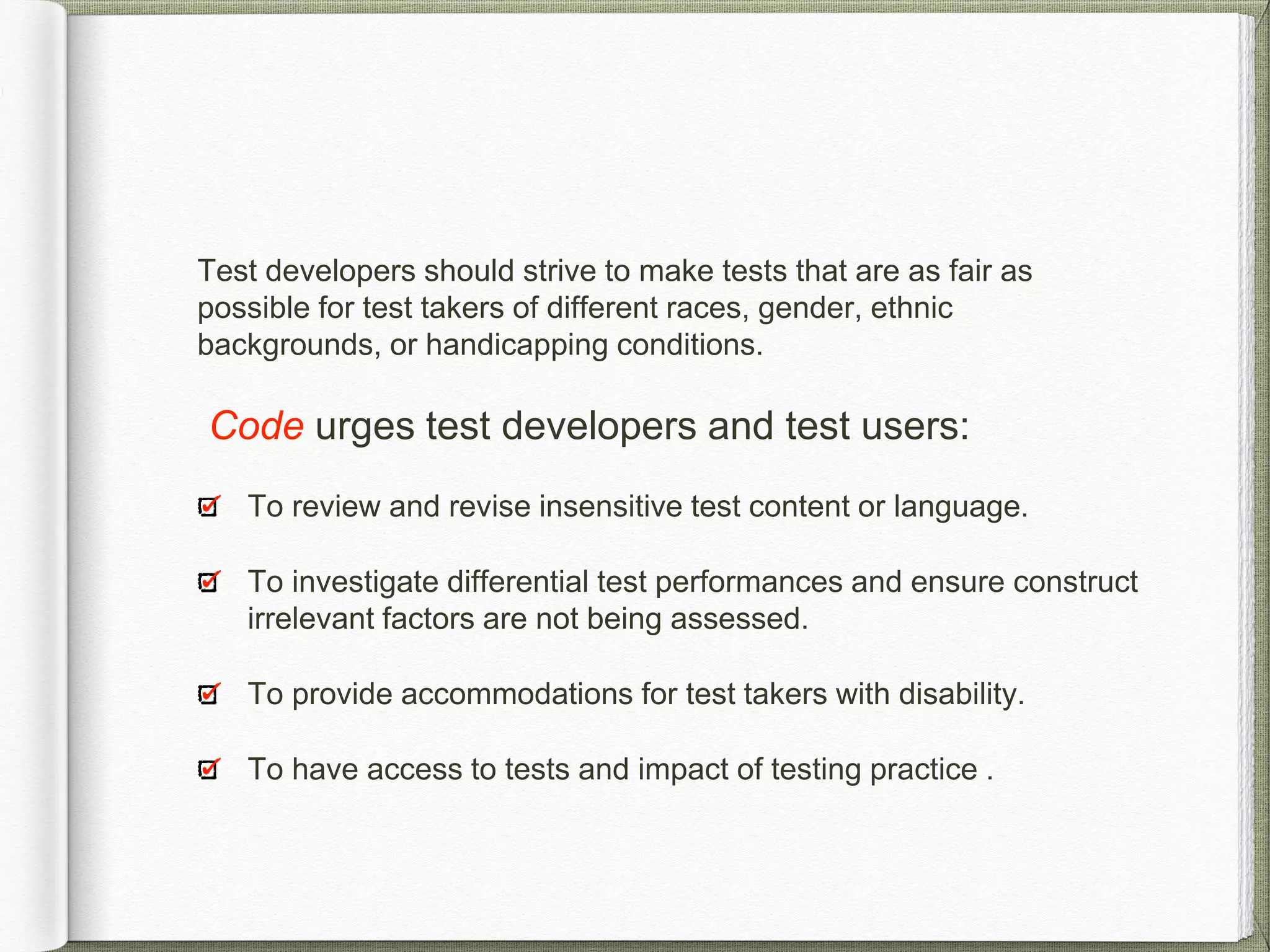
Test developers should strive to make tests that are as fair as
possible for test takers of different races, gender, ethnic
backgrounds, or handicapping conditions.
Code urges test developers and test users:
To review and revise insensitive test content or language.
To investigate differential test performances and ensure construct
irrelevant factors are not being assessed.
To provide accommodations for test takers with disability.
To have access to tests and impact of testing practice .
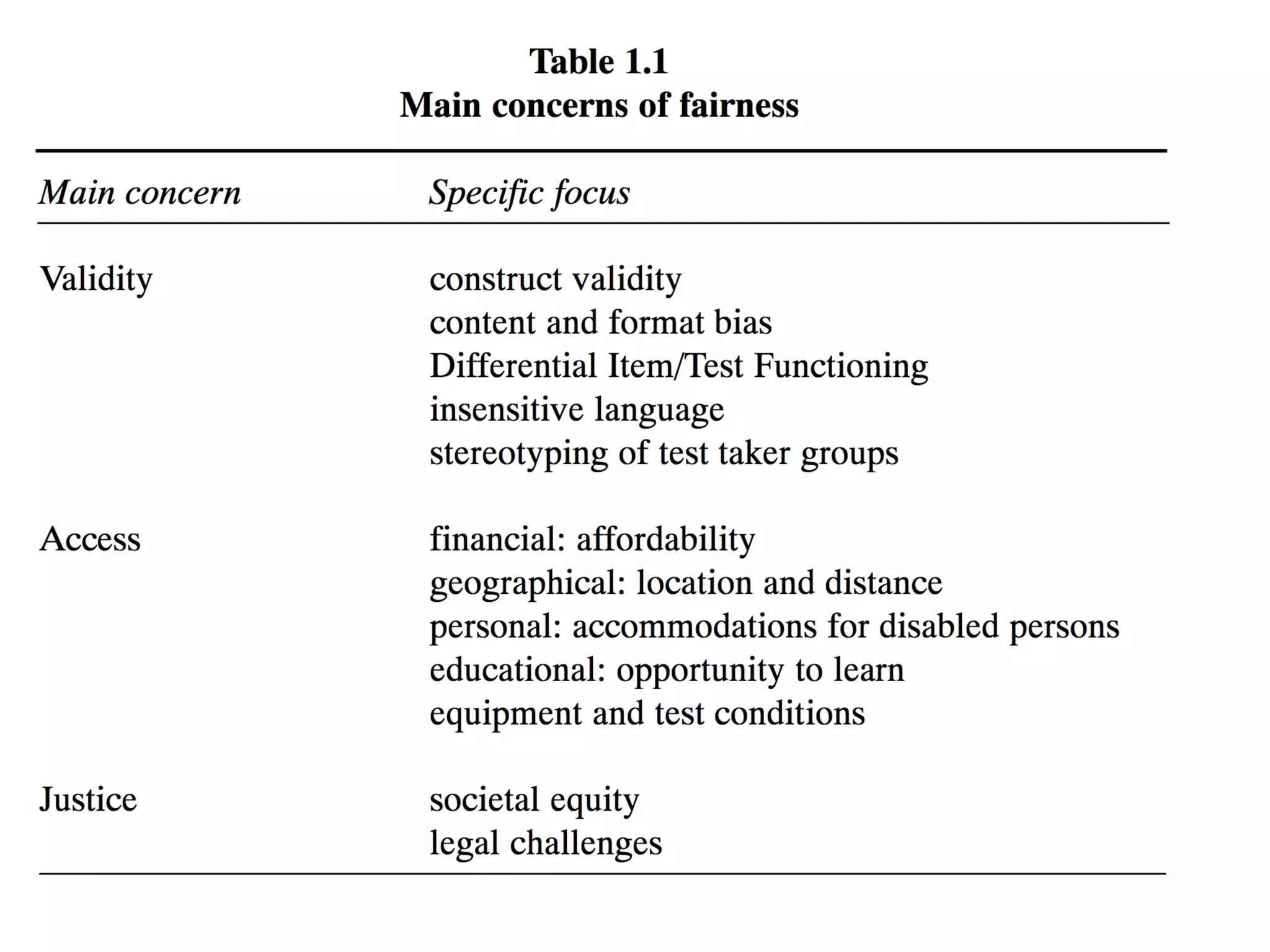
Validity
The focus is on :
Whether test-score interpretations have
equal construct validity (and reliability)
for different test-taker groups as defined
by salient test-taker characteristics such
as gender, race/ethnicity, field of
specialization and native language and
culture.
Content bias :Construct-irrelevant factors might
cause unfairness among groups include topical
knowledge and technical terminology, specific
cultural content and dialect variations.
Format bias :could include multiple-choice,
constructed response, computer-based
responses and multi-media materials.
Insensitive or offensive test materials and
materials that stereotype :Construct-irrelevant
factors that show certain test-taker groups in
unfavourable light.
Construct Irrelevant
Factors
Access
The focus :
Whether tests are accessible to test takers
from various aspects such as financial,
geographical, personal, and educational
access and familiarity of test conditions
and equipment.
Financial access :in terms of affordability is a key concern as the
consequences of unaffordable tests in all regions should be
known to test developers and test users.
Geographical access to test sites is critical and varies from
context to context.
Personal access : providing appropriate accommodations in test
administration procedures for test-takers with disability or
impairment.
Educational access : Opportunity to learn which plays a major
role in test-takers’ success on tests.
Access to test-taking equipment and test-taking conditions
:Being familiar with these conditions. ( use of computers in
computer-based tests and the use of multi-media in web-based
testing).
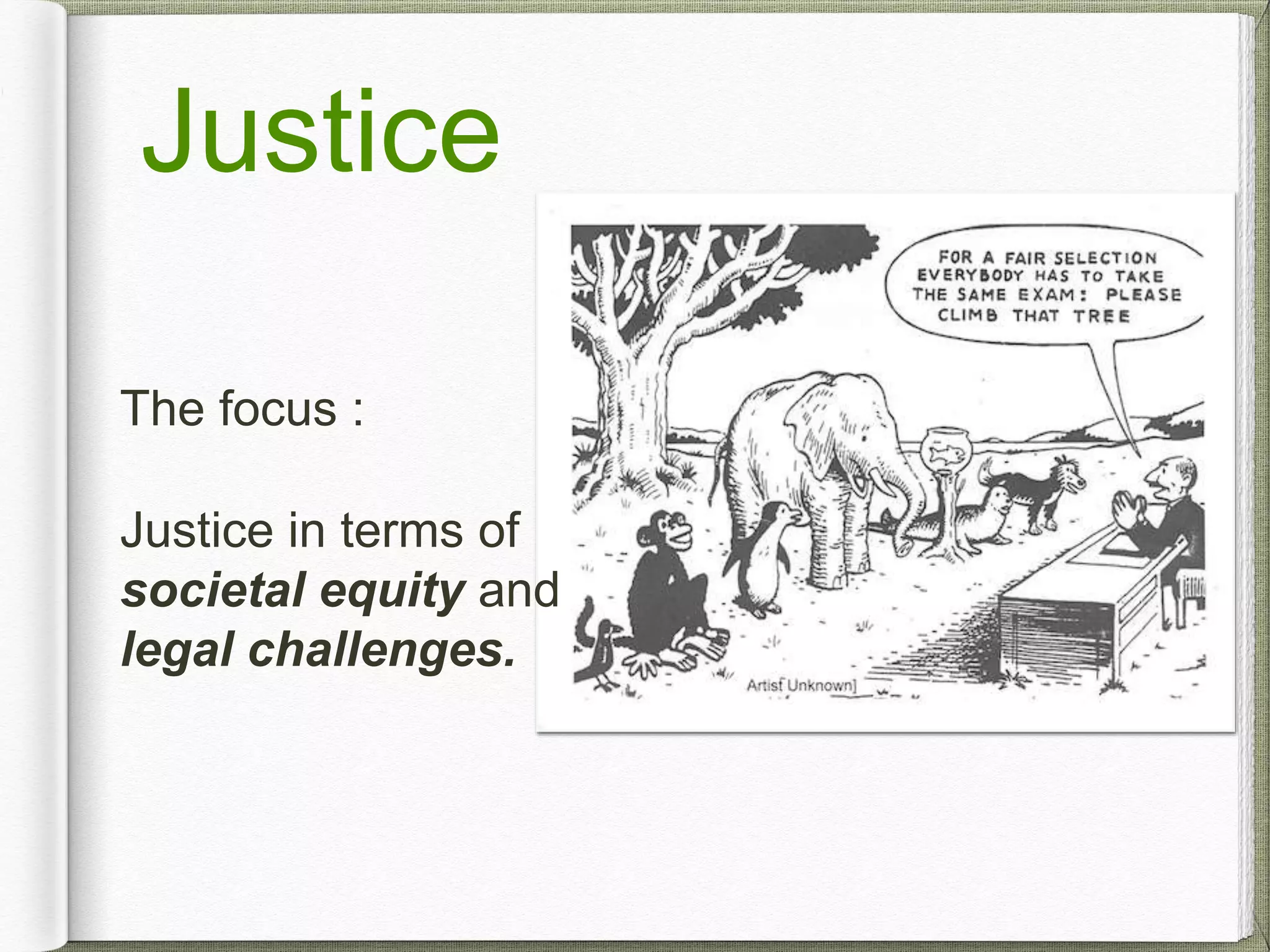
Justice
The focus :
Justice in terms of
societal equity and
legal challenges.
Societal equity focuses on the social
consequences of testing in terms of
whether testing programs contribute to
social equity or not.
Legal challenges Title VII of the Civil Rights
Act of 1964 (and subsequent related
legislation) provides remedies for persons
who feel they are discriminated against due
to their gender, race/ethnicity, native
language, national origin and so on.
Fairness and research
studies
Not many in number nor part of a coherent
research program either on fairness in
language assessment over the last 15
years (Kunnan 1998a).
Most of these studies are generally post-
hoc analyses and independent studies that
are not part of a coherent fairness research
program that is part of test development,
maintenance and research program.
Fairness and test
development
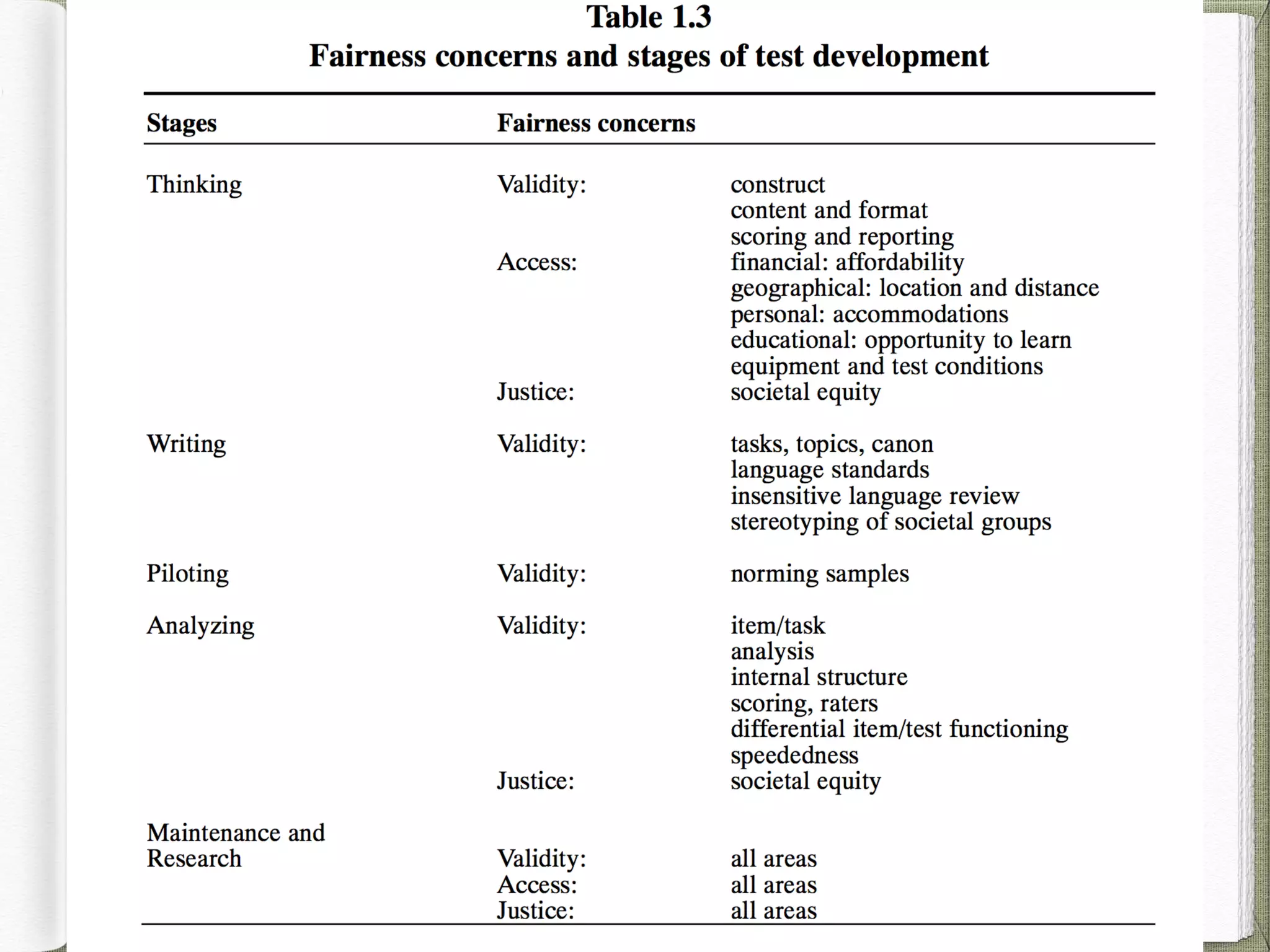
Table 1.3 presents the stages and the
fairness concerns that need to be focused
on for optimum administration of the
fairness agenda.
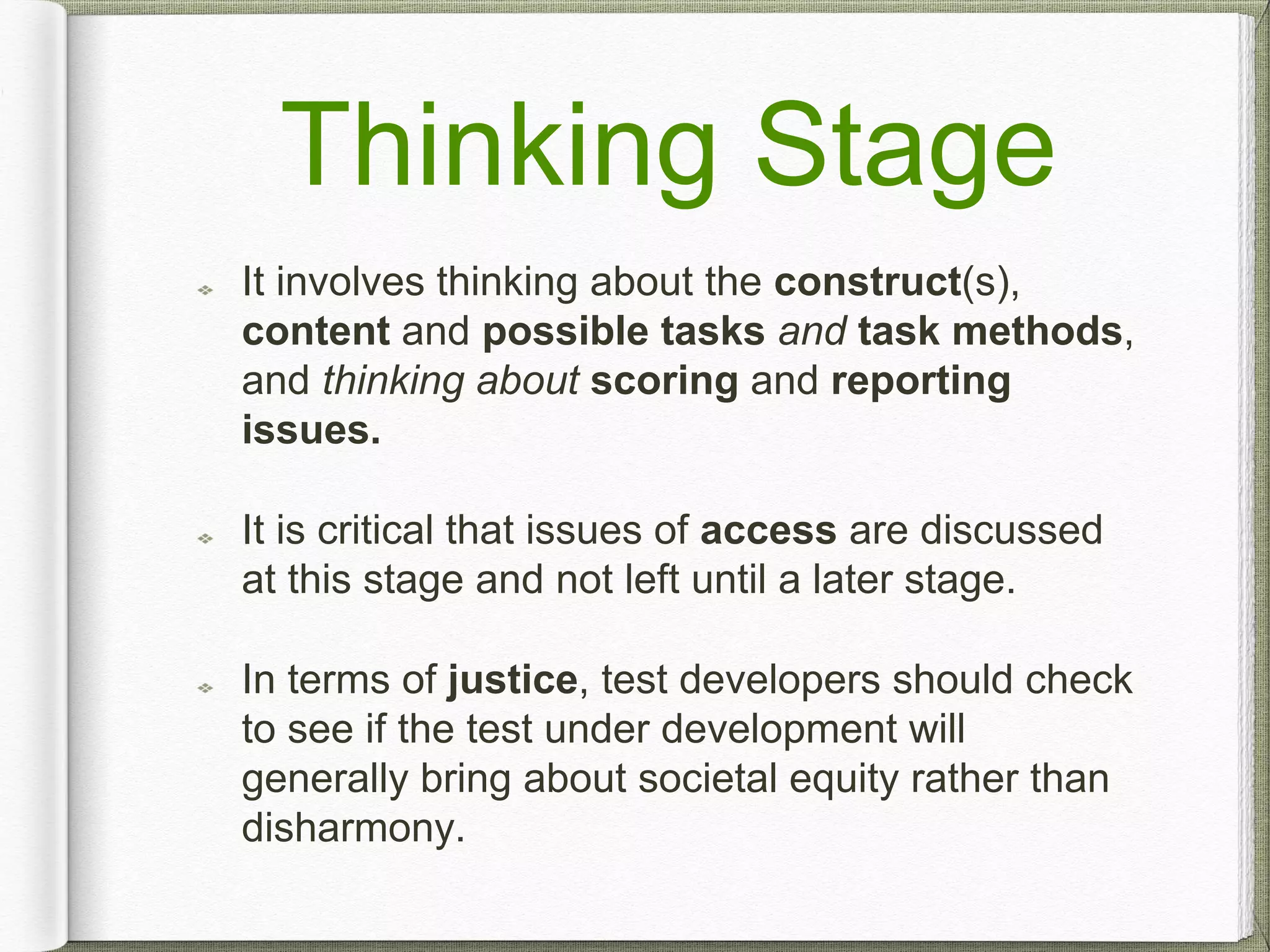
Thinking Stage
It involves thinking about the construct(s),
content and possible tasks and task methods,
and thinking about scoring and reporting
issues.
It is critical that issues of access are discussed
at this stage and not left until a later stage.
In terms of justice, test developers should check
to see if the test under development will
generally bring about societal equity rather than
disharmony.
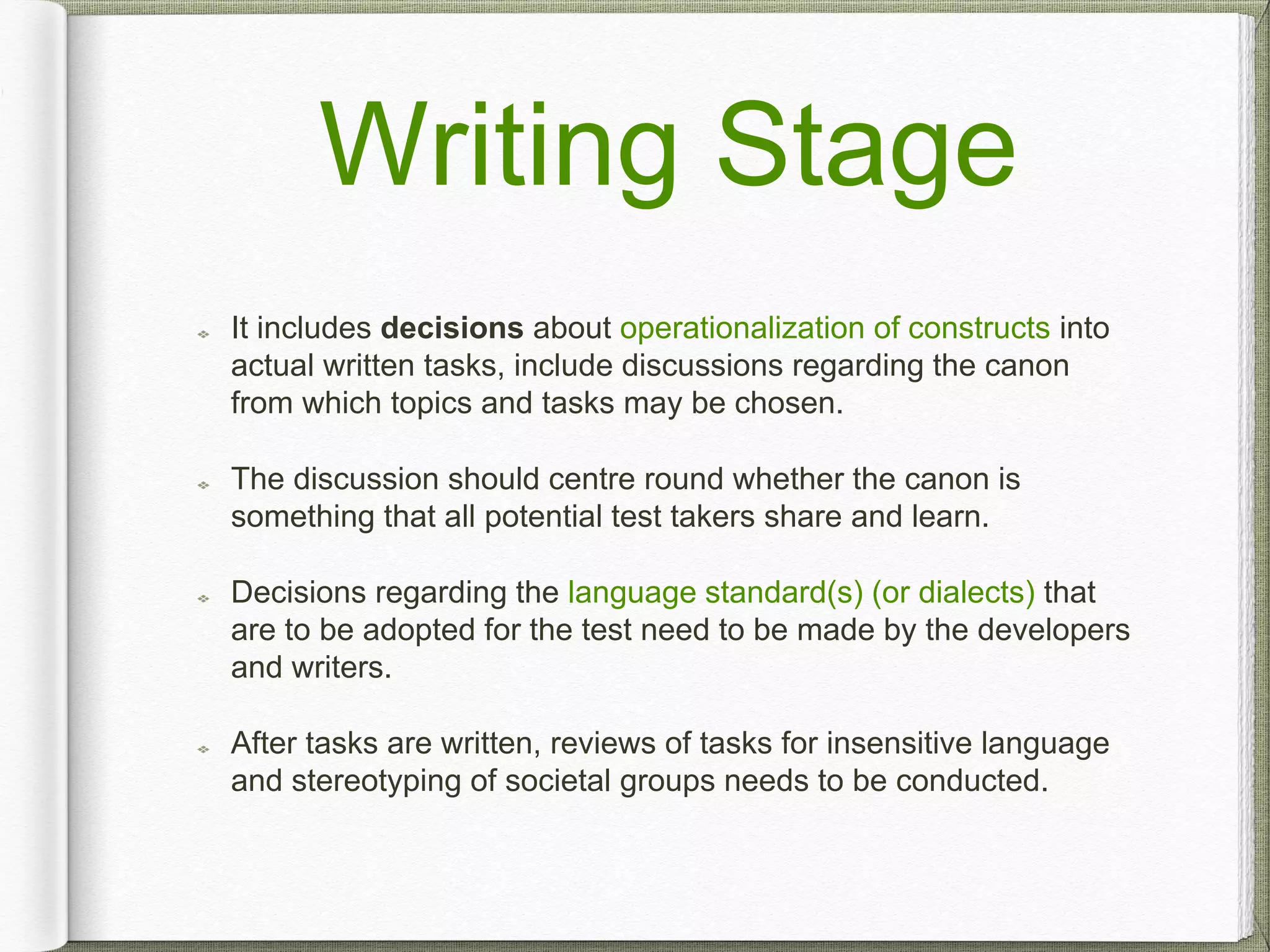
Writing Stage
It includes decisions about operationalization of constructs into
actual written tasks, include discussions regarding the canon
from which topics and tasks may be chosen.
The discussion should centre round whether the canon is
something that all potential test takers share and learn.
Decisions regarding the language standard(s) (or dialects) that
are to be adopted for the test need to be made by the developers
and writers.
After tasks are written, reviews of tasks for insensitive language
and stereotyping of societal groups needs to be conducted.
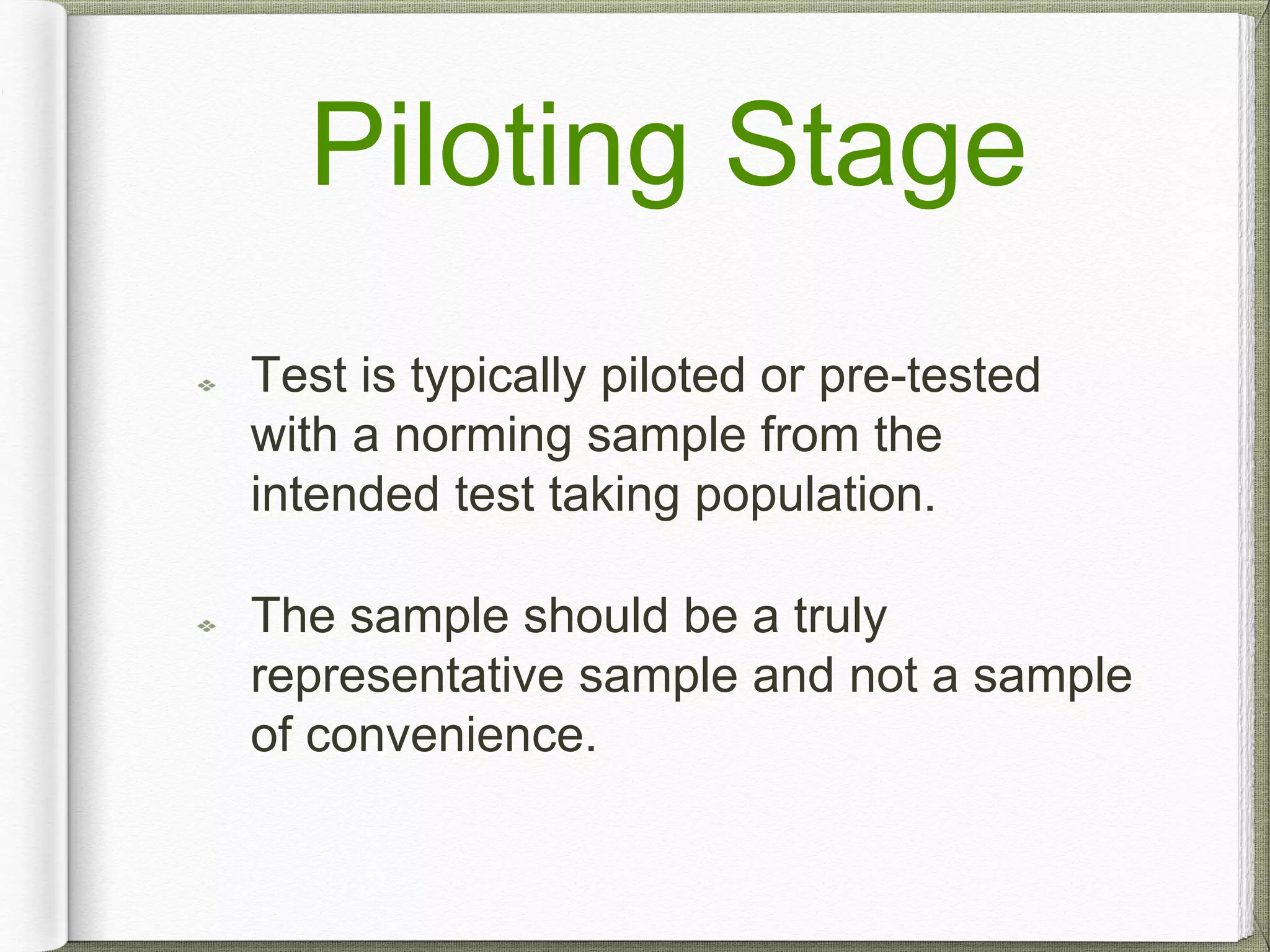
Piloting Stage
Test is typically piloted or pre-tested
with a norming sample from the
intended test taking population.
The sample should be a truly
representative sample and not a sample
of convenience.
Analyzing Stage
Data collected from test-takers is analyzed.
Traditional item analysis, internal structure analysis, rating reliability
and rater conduct should be conducted.
Investigations of differential item/task or testlet functioning should
be conducted in order to be able to state confidently that score
differences in performance on the test from different test taker
groups are due to relevant construct variance.
The issue of speededness needs to be investigated so that the
speed of the test is not felt differently by the various test-taker
groups(for example, non-native speakers as opposed to native
speakers).
The analyses should also include how the test might contribute to
societal equity.
Maintenance and Research
Stage
All fairness concerns itemized in Table 1.3
should be routinely investigated.
Fairness and legal
challenges
As an example, one ground for legal challenge has been
based on the perception that there is lack of societal equity
due to tests that track and classify students in schools.
Challenging a test is possible but until appropriate legislation
and a code of standards exists, test takers may have difficulty
seeking and obtaining remedies.
From the test developers’ perspective, a test can be
challenged because standards and legislation do not exist or
are somewhat poorly defined.
A few examples of US Court rulings have been briefly
presented in the article (see p.8).
Fairness and test
developersThe best ways to attain fairness in a test:
Test developers (such as thinkers, writers, raters, and researchers)
are from a diverse group (in terms of gender, race/ethnicity, native
language, etc.)
Test developers trained to examine all aspects of a test for its
fairness.
So that they can:
(i) obtain different viewpoints concerning the canon, topics, tasks,
format
(ii) examine tasks for the specific fairness concerns
(iii)Set a research agenda that can enhance fairness
Conclusion
This paper attempts to present :
Fairness in language assessment consists of validity, access
and justice.
Fairness is critically connected to research, test
development, legal challenges and test developers.
Fairness is a critical central component not just connecting
traditional components like validity and reliability (see
Kunnan 1997).
If a test is not fair there is little or no value in it being valid
and reliable or even authentic and interactive.
Thank You

Fairness in language testing

  • 1.
    Fairness and Justicefor all Antony John Kunnan California State University, Los Angeles
  • 2.
    Introduction As a concept,fairness is seemingly clear but quite complex. The concept is an interdisciplinary one; not only based on the psychometric view of tests and testing practice but also on social, ethical, legal and philosophical views. Code of Fair Testing Practices in Education (Code from now on) prepared by the Joint Committee on Testing Practices (1988) presents standards for educational test developers and users in four areas: developing and selecting tests, interpreting scores, striving for fairness and informing test takers.
  • 3.
    Test developers shouldstrive to make tests that are as fair as possible for test takers of different races, gender, ethnic backgrounds, or handicapping conditions. Code urges test developers and test users: To review and revise insensitive test content or language. To investigate differential test performances and ensure construct irrelevant factors are not being assessed. To provide accommodations for test takers with disability. To have access to tests and impact of testing practice .
  • 5.
    Validity The focus ison : Whether test-score interpretations have equal construct validity (and reliability) for different test-taker groups as defined by salient test-taker characteristics such as gender, race/ethnicity, field of specialization and native language and culture.
  • 6.
    Content bias :Construct-irrelevantfactors might cause unfairness among groups include topical knowledge and technical terminology, specific cultural content and dialect variations. Format bias :could include multiple-choice, constructed response, computer-based responses and multi-media materials. Insensitive or offensive test materials and materials that stereotype :Construct-irrelevant factors that show certain test-taker groups in unfavourable light. Construct Irrelevant Factors
  • 7.
    Access The focus : Whethertests are accessible to test takers from various aspects such as financial, geographical, personal, and educational access and familiarity of test conditions and equipment.
  • 8.
    Financial access :interms of affordability is a key concern as the consequences of unaffordable tests in all regions should be known to test developers and test users. Geographical access to test sites is critical and varies from context to context. Personal access : providing appropriate accommodations in test administration procedures for test-takers with disability or impairment. Educational access : Opportunity to learn which plays a major role in test-takers’ success on tests. Access to test-taking equipment and test-taking conditions :Being familiar with these conditions. ( use of computers in computer-based tests and the use of multi-media in web-based testing).
  • 9.
    Justice The focus : Justicein terms of societal equity and legal challenges.
  • 10.
    Societal equity focuseson the social consequences of testing in terms of whether testing programs contribute to social equity or not. Legal challenges Title VII of the Civil Rights Act of 1964 (and subsequent related legislation) provides remedies for persons who feel they are discriminated against due to their gender, race/ethnicity, native language, national origin and so on.
  • 11.
    Fairness and research studies Notmany in number nor part of a coherent research program either on fairness in language assessment over the last 15 years (Kunnan 1998a). Most of these studies are generally post- hoc analyses and independent studies that are not part of a coherent fairness research program that is part of test development, maintenance and research program.
  • 12.
    Fairness and test development Table1.3 presents the stages and the fairness concerns that need to be focused on for optimum administration of the fairness agenda.
  • 14.
    Thinking Stage It involvesthinking about the construct(s), content and possible tasks and task methods, and thinking about scoring and reporting issues. It is critical that issues of access are discussed at this stage and not left until a later stage. In terms of justice, test developers should check to see if the test under development will generally bring about societal equity rather than disharmony.
  • 15.
    Writing Stage It includesdecisions about operationalization of constructs into actual written tasks, include discussions regarding the canon from which topics and tasks may be chosen. The discussion should centre round whether the canon is something that all potential test takers share and learn. Decisions regarding the language standard(s) (or dialects) that are to be adopted for the test need to be made by the developers and writers. After tasks are written, reviews of tasks for insensitive language and stereotyping of societal groups needs to be conducted.
  • 16.
    Piloting Stage Test istypically piloted or pre-tested with a norming sample from the intended test taking population. The sample should be a truly representative sample and not a sample of convenience.
  • 17.
    Analyzing Stage Data collectedfrom test-takers is analyzed. Traditional item analysis, internal structure analysis, rating reliability and rater conduct should be conducted. Investigations of differential item/task or testlet functioning should be conducted in order to be able to state confidently that score differences in performance on the test from different test taker groups are due to relevant construct variance. The issue of speededness needs to be investigated so that the speed of the test is not felt differently by the various test-taker groups(for example, non-native speakers as opposed to native speakers). The analyses should also include how the test might contribute to societal equity.
  • 18.
    Maintenance and Research Stage Allfairness concerns itemized in Table 1.3 should be routinely investigated.
  • 19.
    Fairness and legal challenges Asan example, one ground for legal challenge has been based on the perception that there is lack of societal equity due to tests that track and classify students in schools. Challenging a test is possible but until appropriate legislation and a code of standards exists, test takers may have difficulty seeking and obtaining remedies. From the test developers’ perspective, a test can be challenged because standards and legislation do not exist or are somewhat poorly defined. A few examples of US Court rulings have been briefly presented in the article (see p.8).
  • 20.
    Fairness and test developersThebest ways to attain fairness in a test: Test developers (such as thinkers, writers, raters, and researchers) are from a diverse group (in terms of gender, race/ethnicity, native language, etc.) Test developers trained to examine all aspects of a test for its fairness. So that they can: (i) obtain different viewpoints concerning the canon, topics, tasks, format (ii) examine tasks for the specific fairness concerns (iii)Set a research agenda that can enhance fairness
  • 21.
    Conclusion This paper attemptsto present : Fairness in language assessment consists of validity, access and justice. Fairness is critically connected to research, test development, legal challenges and test developers. Fairness is a critical central component not just connecting traditional components like validity and reliability (see Kunnan 1997). If a test is not fair there is little or no value in it being valid and reliable or even authentic and interactive.
  • 22.