COMMUNICATIVE
COMPETENCE
Presented by :
1.SITI SARAH MUHAMMAD SHAFIE (GS32247)
2.NOR SHERINA MUSTAFFA (GS 39442 )
3.RASYIDAH YAHYA (GS 39443 ) )
Communicative competence
‘That aspect of our competence that enables us
to convey and interpret messages and to
negotiate meanings interpersonally within
specific contexts’
Hymes (1967)
Defining Communicative
Competence
• Pragmatic or sociolinguistic competence
• Knowledge necessary to use language in social
context.
• Coined by Dell Hymes (1967) In reaction to
Chomsky’s linguistic competence.
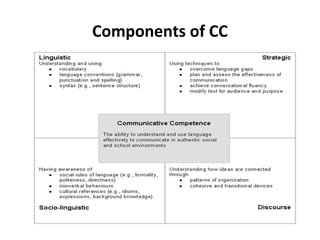
Components of CC
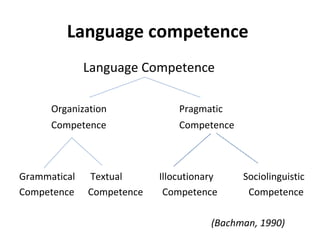
Language competence
Language Competence
Organization Pragmatic
Competence Competence
Grammatical Textual Illocutionary Sociolinguistic
Competence Competence Competence Competence
(Bachman, 1990)
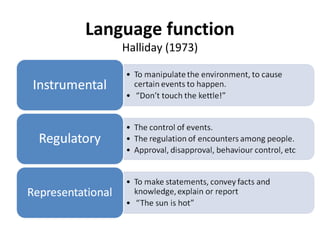
Language function
Halliday (1973)
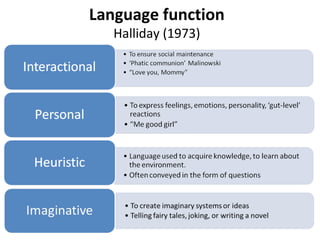
Language function
Halliday (1973)
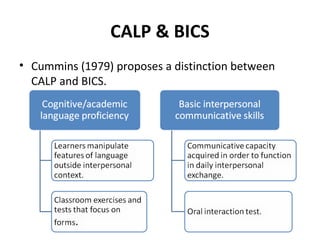
CALP & BICS
• Cummins (1979) proposes a distinction between
CALP and BICS.
DISCOURSE ANALYSIS
•The examination of the relationship between forms and functions
of language.
•It is the language beyond the sentence. A single sentence can
seldom be fully analyzed without considering its context.
•In most oral language, our discourse is marked by exchanges with
another person or several persons in which a few sentences spoken
by one participant are followed and built upon by sentences spoken
by another.
• Production and comprehension of language are a factor of our
ability to perceive and process stretches of discourse, to formulate
representations of meaning not just a from a single sentence but
from referents in both previous sentences and following sentences.
 Consider the following three different exchanges :
1. A : Got the time?
B : Ten-fifteen.
2. Waiter : More coffee?
Customer : I’m okay
3. Parent : Dinner!
Child : Just a minute!
 A single sentence sometimes contains certain presuppositions
or entailments that are not overtly manifested in surrounding
sentence-level surface structure, but that are clear from the
total context.
 All three of the above conversations contained such
presuppositions ( how to ask what time of day it is ; how to say
“no more coffee” ; how to announce that dinner is ready and
then indicate that one will be there in a minute)
 In written language, similar intersentential discourse relations
hold true as the writer builds a network of ideas or feelings and
the reader interprets them.
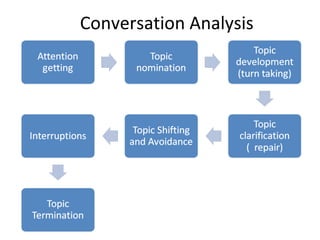
Conversation Analysis
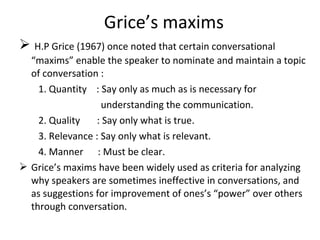
Grice’s maxims
 H.P Grice (1967) once noted that certain conversational
“maxims” enable the speaker to nominate and maintain a topic
of conversation :
1. Quantity : Say only as much as is necessary for
understanding the communication.
2. Quality : Say only what is true.
3. Relevance : Say only what is relevant.
4. Manner : Must be clear.
 Grice’s maxims have been widely used as criteria for analyzing
why speakers are sometimes ineffective in conversations, and
as suggestions for improvement of ones’s “power” over others
through conversation.
Pragmatics
Pragmatics constraints on language comprehension and
production may be loosely thought of as the effect of context on
strings of linguistics events. Consider the following conversation :
[Phone rings, a 10-year-old child picks up the phone]
Stefanie : Hello.
Voice : Hi, Stef,is your Mom there?
Stefanie : Just a minute. [Cups the phone and yells] Mom!Phone!
Mom : [from upstairs] I’m in the tub!
Stefanie : [returning to the phone] She can’t talk now. Wanna
leave a message?
Voice : Uh, [pause] I’ll call back later. Bye.
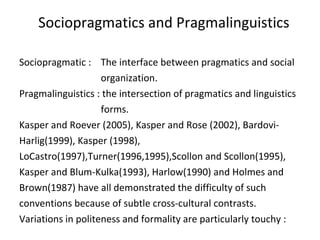
Sociopragmatics and Pragmalinguistics
Sociopragmatic : The interface between pragmatics and social
organization.
Pragmalinguistics : the intersection of pragmatics and linguistics
forms.
Kasper and Roever (2005), Kasper and Rose (2002), Bardovi-
Harlig(1999), Kasper (1998),
LoCastro(1997),Turner(1996,1995),Scollon and Scollon(1995),
Kasper and Blum-Kulka(1993), Harlow(1990) and Holmes and
Brown(1987) have all demonstrated the difficulty of such
conventions because of subtle cross-cultural contrasts.
Variations in politeness and formality are particularly touchy :
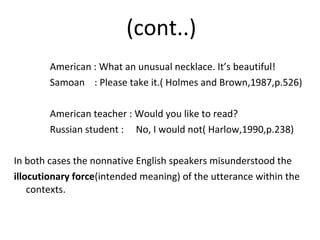
(cont..)
American : What an unusual necklace. It’s beautiful!
Samoan : Please take it.( Holmes and Brown,1987,p.526)
American teacher : Would you like to read?
Russian student : No, I would not( Harlow,1990,p.238)
In both cases the nonnative English speakers misunderstood the
illocutionary force(intended meaning) of the utterance within the
contexts.
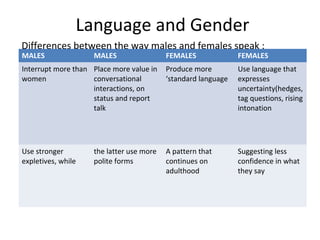
Language and Gender
Differences between the way males and females speak :
MALES MALES FEMALES FEMALES
Interrupt more than
women
Place more value in
conversational
interactions, on
status and report
talk
Produce more
‘standard language
Use language that
expresses
uncertainty(hedges,
tag questions, rising
intonation
Use stronger
expletives, while
the latter use more
polite forms
A pattern that
continues on
adulthood
Suggesting less
confidence in what
they say
Discourse Styles
 In describing Communicative Competence , the way we use
language in different styles depending on the context of a
communicative act in terms of subject matter, audience, occasion,
shared experience, and purpose of communication.
 Styles are not social or regional dialects, but sets of conventions
for selecting words, phrases, discourse and nonverbal language in
specificied contexts
 Martin Joos(1967) provided one most common speech styles
using the criterion of formality. There are five levels of formality:
1. Oratorical style : used in public speaking before a large
audience; wording is carefully planned in advance, intonation is
somewhat exaggerated, and numerous rhetorical devices are
appropriate.
2. Deliberative style : used in addressing audiences, usually too
large audiences to permit effective interchange between
speaker and hearers, although the forms are normally not as
polished as those in oratorical. A typical university classroom
lecture is often carried out in a deliberative style
3. Consultative style : typically a dialog, words are chosen with
some care. Business transactions, doctor-patient conversations,
and the like are usually consultative in nature
4. Casual style : Typical of conversations between friends or
colleagues sometimes members of a family ; in this context
words need not be guarded and social barriers are
moderately low.
5. Intimate style : One characterized by complete absence of
social inhibitions. Talk with family, loved ones, and very close
friends, where, the inner self is revealed, is usually in an
intimate style.
NONVERBAL COMMUNICATION
• Edward Hall (1959) called it as ‘silent
language’.
• Key importance: ‘it is not what you say, but
how you say it’.
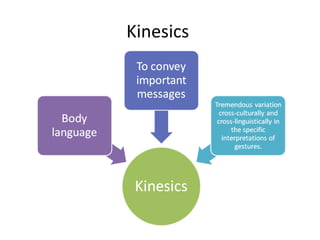
• To convey message with body language,
gestures, eye contact, physical distance, etc.
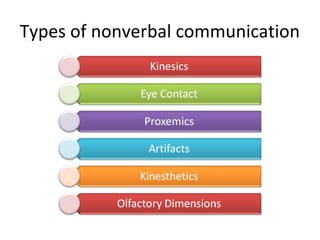
Types of nonverbal communication
Kinesics
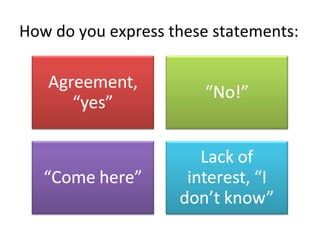
How do you express these statements:
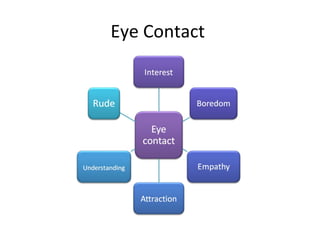
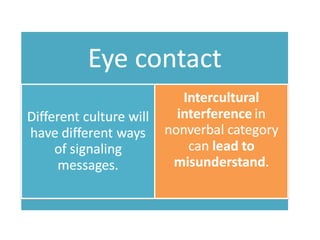
Eye Contact
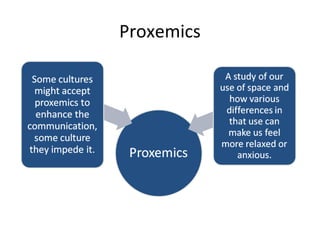
Proxemics
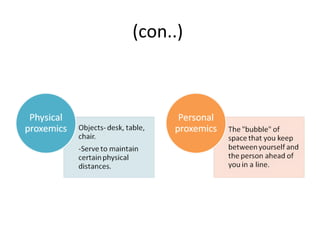
(con..)
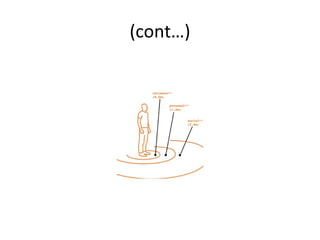
(cont…)
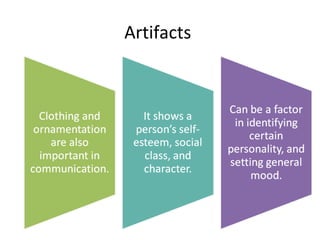
Artifacts
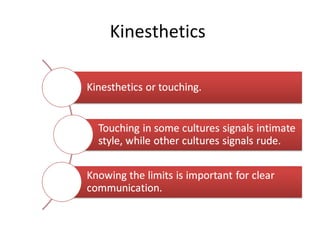
Kinesthetics
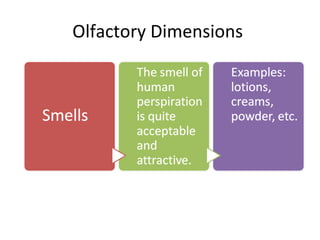
Olfactory Dimensions
CC IN THE CALSSROOM :CLT AND
TASK-BASED TEACHING
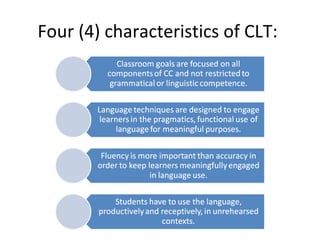
• CLT : Communicative Language Teaching
• CLT is an approach, rather than method
(Richards & Rodgers,2001).
• Based on the nature of language and of
language learning and teaching.
Four (4) characteristics of CLT:
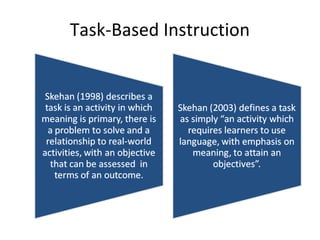
Task-Based Instruction
(cont…)
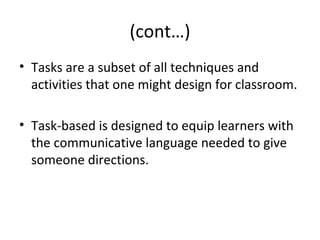
• Tasks are a subset of all techniques and
activities that one might design for classroom.
• Task-based is designed to equip learners with
the communicative language needed to give
someone directions.
(cont…)
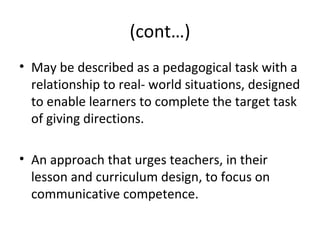
• May be described as a pedagogical task with a
relationship to real- world situations, designed
to enable learners to complete the target task
of giving directions.
• An approach that urges teachers, in their
lesson and curriculum design, to focus on
communicative competence.

Communicative competence

  • 1.
    COMMUNICATIVE COMPETENCE Presented by : 1.SITISARAH MUHAMMAD SHAFIE (GS32247) 2.NOR SHERINA MUSTAFFA (GS 39442 ) 3.RASYIDAH YAHYA (GS 39443 ) )
  • 2.
    Communicative competence ‘That aspectof our competence that enables us to convey and interpret messages and to negotiate meanings interpersonally within specific contexts’ Hymes (1967)
  • 3.
    Defining Communicative Competence • Pragmaticor sociolinguistic competence • Knowledge necessary to use language in social context. • Coined by Dell Hymes (1967) In reaction to Chomsky’s linguistic competence.
  • 4.
  • 5.
    Language competence Language Competence OrganizationPragmatic Competence Competence Grammatical Textual Illocutionary Sociolinguistic Competence Competence Competence Competence (Bachman, 1990)
  • 6.
  • 7.
  • 8.
    CALP & BICS •Cummins (1979) proposes a distinction between CALP and BICS.
  • 9.
    DISCOURSE ANALYSIS •The examinationof the relationship between forms and functions of language. •It is the language beyond the sentence. A single sentence can seldom be fully analyzed without considering its context. •In most oral language, our discourse is marked by exchanges with another person or several persons in which a few sentences spoken by one participant are followed and built upon by sentences spoken by another. • Production and comprehension of language are a factor of our ability to perceive and process stretches of discourse, to formulate representations of meaning not just a from a single sentence but from referents in both previous sentences and following sentences.
  • 10.
     Consider thefollowing three different exchanges : 1. A : Got the time? B : Ten-fifteen. 2. Waiter : More coffee? Customer : I’m okay 3. Parent : Dinner! Child : Just a minute!  A single sentence sometimes contains certain presuppositions or entailments that are not overtly manifested in surrounding sentence-level surface structure, but that are clear from the total context.
  • 11.
     All threeof the above conversations contained such presuppositions ( how to ask what time of day it is ; how to say “no more coffee” ; how to announce that dinner is ready and then indicate that one will be there in a minute)  In written language, similar intersentential discourse relations hold true as the writer builds a network of ideas or feelings and the reader interprets them.
  • 12.
  • 13.
    Grice’s maxims  H.PGrice (1967) once noted that certain conversational “maxims” enable the speaker to nominate and maintain a topic of conversation : 1. Quantity : Say only as much as is necessary for understanding the communication. 2. Quality : Say only what is true. 3. Relevance : Say only what is relevant. 4. Manner : Must be clear.  Grice’s maxims have been widely used as criteria for analyzing why speakers are sometimes ineffective in conversations, and as suggestions for improvement of ones’s “power” over others through conversation.
  • 14.
    Pragmatics Pragmatics constraints onlanguage comprehension and production may be loosely thought of as the effect of context on strings of linguistics events. Consider the following conversation : [Phone rings, a 10-year-old child picks up the phone] Stefanie : Hello. Voice : Hi, Stef,is your Mom there? Stefanie : Just a minute. [Cups the phone and yells] Mom!Phone! Mom : [from upstairs] I’m in the tub! Stefanie : [returning to the phone] She can’t talk now. Wanna leave a message? Voice : Uh, [pause] I’ll call back later. Bye.
  • 15.
    Sociopragmatics and Pragmalinguistics Sociopragmatic: The interface between pragmatics and social organization. Pragmalinguistics : the intersection of pragmatics and linguistics forms. Kasper and Roever (2005), Kasper and Rose (2002), Bardovi- Harlig(1999), Kasper (1998), LoCastro(1997),Turner(1996,1995),Scollon and Scollon(1995), Kasper and Blum-Kulka(1993), Harlow(1990) and Holmes and Brown(1987) have all demonstrated the difficulty of such conventions because of subtle cross-cultural contrasts. Variations in politeness and formality are particularly touchy :
  • 16.
    (cont..) American : Whatan unusual necklace. It’s beautiful! Samoan : Please take it.( Holmes and Brown,1987,p.526) American teacher : Would you like to read? Russian student : No, I would not( Harlow,1990,p.238) In both cases the nonnative English speakers misunderstood the illocutionary force(intended meaning) of the utterance within the contexts.
  • 17.
    Language and Gender Differencesbetween the way males and females speak : MALES MALES FEMALES FEMALES Interrupt more than women Place more value in conversational interactions, on status and report talk Produce more ‘standard language Use language that expresses uncertainty(hedges, tag questions, rising intonation Use stronger expletives, while the latter use more polite forms A pattern that continues on adulthood Suggesting less confidence in what they say
  • 18.
    Discourse Styles  Indescribing Communicative Competence , the way we use language in different styles depending on the context of a communicative act in terms of subject matter, audience, occasion, shared experience, and purpose of communication.  Styles are not social or regional dialects, but sets of conventions for selecting words, phrases, discourse and nonverbal language in specificied contexts  Martin Joos(1967) provided one most common speech styles using the criterion of formality. There are five levels of formality:
  • 19.
    1. Oratorical style: used in public speaking before a large audience; wording is carefully planned in advance, intonation is somewhat exaggerated, and numerous rhetorical devices are appropriate. 2. Deliberative style : used in addressing audiences, usually too large audiences to permit effective interchange between speaker and hearers, although the forms are normally not as polished as those in oratorical. A typical university classroom lecture is often carried out in a deliberative style 3. Consultative style : typically a dialog, words are chosen with some care. Business transactions, doctor-patient conversations, and the like are usually consultative in nature
  • 20.
    4. Casual style: Typical of conversations between friends or colleagues sometimes members of a family ; in this context words need not be guarded and social barriers are moderately low. 5. Intimate style : One characterized by complete absence of social inhibitions. Talk with family, loved ones, and very close friends, where, the inner self is revealed, is usually in an intimate style.
  • 21.
    NONVERBAL COMMUNICATION • EdwardHall (1959) called it as ‘silent language’. • Key importance: ‘it is not what you say, but how you say it’. • To convey message with body language, gestures, eye contact, physical distance, etc.
  • 22.
    Types of nonverbalcommunication
  • 23.
  • 24.
    How do youexpress these statements:
  • 25.
  • 27.
  • 28.
  • 29.
  • 30.
  • 31.
  • 32.
  • 33.
    CC IN THECALSSROOM :CLT AND TASK-BASED TEACHING • CLT : Communicative Language Teaching • CLT is an approach, rather than method (Richards & Rodgers,2001). • Based on the nature of language and of language learning and teaching.
  • 34.
  • 35.
  • 36.
    (cont…) • Tasks area subset of all techniques and activities that one might design for classroom. • Task-based is designed to equip learners with the communicative language needed to give someone directions.
  • 37.
    (cont…) • May bedescribed as a pedagogical task with a relationship to real- world situations, designed to enable learners to complete the target task of giving directions. • An approach that urges teachers, in their lesson and curriculum design, to focus on communicative competence.