HOLMES : CHAPTER 9
LANGUAGE CHANGE
By
SHARIFAH FATIN ATHIRA BT SYED
UZIR
1218106
SECTION 1 GROUP 3
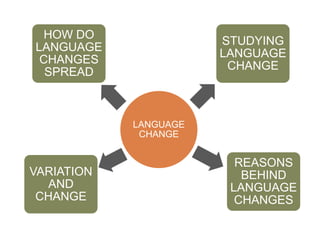
HOW DO
LANGUAGE
CHANGES
SPREAD

STUDYING
LANGUAGE
CHANGE

LANGUAGE
CHANGE

VARIATION
AND
CHANGE

REASONS
BEHIND
LANGUAGE
CHANGES



Language changes over time.
Changes occur in:
- Pronunciation
eg: knight, knit
- Meaning
eg: nice
- Vocabulary
eg: hie-hurry, stilly-softly
VARIATION AND CHANGE
Language varies in :- Time
- Physical space / setting
- Social context
 Speaker innovation : changes of language
are done by the speakers.

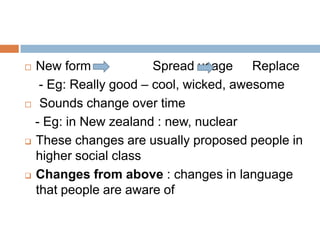
New form
Spread usage Replace
- Eg: Really good – cool, wicked, awesome
 Sounds change over time
- Eg: in New zealand : new, nuclear
 These changes are usually proposed people in
higher social class
 Changes from above : changes in language
that people are aware of

Changes from below: changes in language that
people are not aware of. Eg: changes in the
vowel pronunciation. (beer, bear)
 The spread of the vernacular forms
- Imitating the speech that are considered
prestigious
- Expression of solidarity

HOW DO LANGUAGE CHANGE
SPREAD?
1)
2)
3)

From group to group
From style to style
From word to word
STUDYING LANGUAGE
CHANGE
Apparent-time studies of language changes
- Comparing the speech of people of different
age;
younger speakers use more of the newer forms
- Looking at the frequency of the increase and
decrease of a form by age group

Language change in real time
- Observing the changes that occur over a
period
of time
- Known as real time studies
- A very reliable method
- Consider the social factors affecting the
language use

REASONS FOR LANGUAGE
CHANGE
Social status
- People of higher social status in the
community
introduce changes from other communities
which
are considered prestigious.
- Eg: Upper-class London
- Lower class people spread less-conscious
linguistic
changes.

Gender
- Differences in the speeches of men and
women
can cause linguistic change
- It can be either of the two who introduce the
change
- Women tend to introduce changes
associated with
both prestigious and vernacular forms
- Men introduce changes associated with
vernacular forms

Interaction
- Interaction among people is crucial in
channeling
linguistic change
- Linguistic change in communities with little
interaction with the outside world progress
slowly
- Isolation causes linguistic conservatism
- Eg: Iceland


Sociolinguistics : Language Change

  • 1.
    HOLMES : CHAPTER9 LANGUAGE CHANGE By SHARIFAH FATIN ATHIRA BT SYED UZIR 1218106 SECTION 1 GROUP 3
  • 2.
  • 3.
      Language changes overtime. Changes occur in: - Pronunciation eg: knight, knit - Meaning eg: nice - Vocabulary eg: hie-hurry, stilly-softly
  • 4.
    VARIATION AND CHANGE Languagevaries in :- Time - Physical space / setting - Social context  Speaker innovation : changes of language are done by the speakers. 
  • 5.
    New form Spread usageReplace - Eg: Really good – cool, wicked, awesome  Sounds change over time - Eg: in New zealand : new, nuclear  These changes are usually proposed people in higher social class  Changes from above : changes in language that people are aware of 
  • 6.
    Changes from below:changes in language that people are not aware of. Eg: changes in the vowel pronunciation. (beer, bear)  The spread of the vernacular forms - Imitating the speech that are considered prestigious - Expression of solidarity 
  • 7.
    HOW DO LANGUAGECHANGE SPREAD? 1) 2) 3) From group to group From style to style From word to word
  • 8.
    STUDYING LANGUAGE CHANGE Apparent-time studiesof language changes - Comparing the speech of people of different age; younger speakers use more of the newer forms - Looking at the frequency of the increase and decrease of a form by age group 
  • 9.
    Language change inreal time - Observing the changes that occur over a period of time - Known as real time studies - A very reliable method - Consider the social factors affecting the language use 
  • 10.
    REASONS FOR LANGUAGE CHANGE Socialstatus - People of higher social status in the community introduce changes from other communities which are considered prestigious. - Eg: Upper-class London - Lower class people spread less-conscious linguistic changes. 
  • 11.
    Gender - Differences inthe speeches of men and women can cause linguistic change - It can be either of the two who introduce the change - Women tend to introduce changes associated with both prestigious and vernacular forms - Men introduce changes associated with vernacular forms 
  • 12.
    Interaction - Interaction amongpeople is crucial in channeling linguistic change - Linguistic change in communities with little interaction with the outside world progress slowly - Isolation causes linguistic conservatism - Eg: Iceland 