Presented by: Maham Amjad Goraya
BS.English- University of Narowal
Instructors
Mam Mussart Naheed
Sir Ishaq Malik
*
*
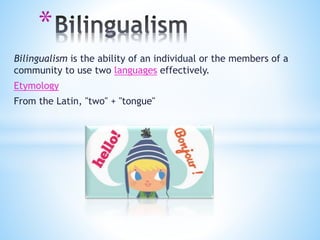
Bilingualism is the ability of an individual or the members of a
community to use two languages effectively.
Etymology
From the Latin, "two" + "tongue"
*
Bilingualism According to Webster's dictionary (1961) bilingual is
defined as 'having or using two languages especially as spoken with
the fluency characteristic of a native speaker; a person using two
languages especially habitually and with control like that of a
native speaker' and bilingualism as 'the constant oral use of two
languages'
*
• Additive bilingualism
• Subtractive bilingualism
• Receptive bilingualism
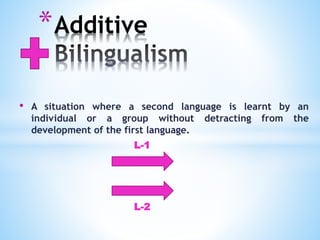
*Additive
• A situation where a second language is learnt by an
individual or a group without detracting from the
development of the first language.
L-1
L-2
*
• A situation where a second language is learnt by an
individual or a group on the risk of loosing the first
language.
L-1
L-2
*
• A situation in which one can understand but not speak a
language.
*
 compound bilingual
Coordinate bilingual
Subordinate bilingual
*
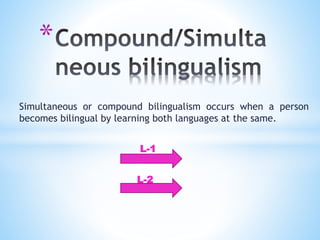
Simultaneous or compound bilingualism occurs when a person
becomes bilingual by learning both languages at the same.
L-1
L-2
*
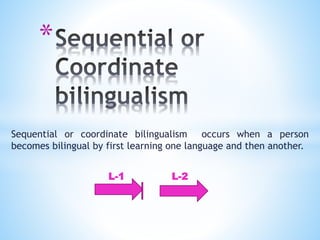
Sequential or coordinate bilingualism occurs when a person
becomes bilingual by first learning one language and then another.
L-1 L-2
*
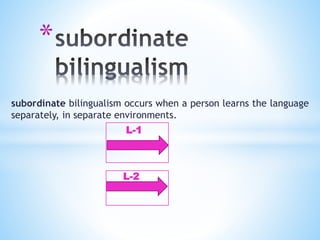
subordinate bilingualism occurs when a person learns the language
separately, in separate environments.
L-1
L-2
*
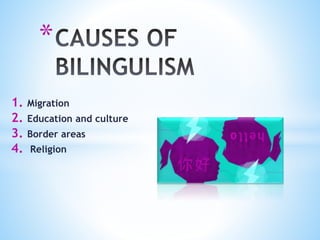
1. Migration
2. Education and culture
3. Border areas
4. Religion
*
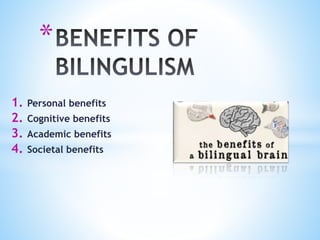
1. Personal benefits
2. Cognitive benefits
3. Academic benefits
4. Societal benefits
*
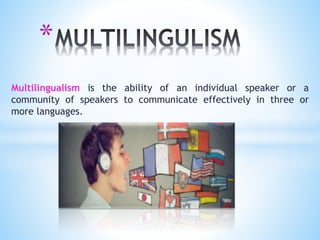
Multilingualism is the ability of an individual speaker or a
community of speakers to communicate effectively in three or
more languages.
*
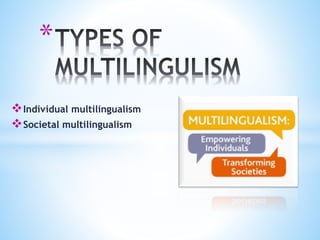
Individual multilingualism
Societal multilingualism
*
It is the ability of an individual to have competence in more
than two languages.
For example:
If a child has a Punjabi father and a Pushto mother and he is
raised by Seraiki maid and is living in a metropolitan city
Karachi, then the child will grow up acquiring individual
multilingualism.
*
It is defined as the linguistic diversity present in a society. In
societal multilingualism some issues such as role and status,
attitude towards, determinants of language choices, the
symbolic and practical use of languages and correlation between
language use and social factors as religion and class are
important.
*
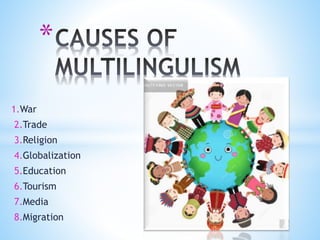
1.War
2.Trade
3.Religion
4.Globalization
5.Education
6.Tourism
7.Media
8.Migration
*
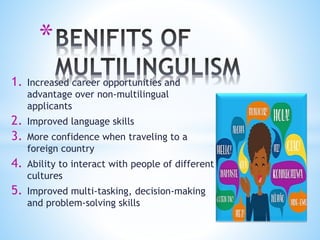
1. Increased career opportunities and
advantage over non-multilingual
applicants
2. Improved language skills
3. More confidence when traveling to a
foreign country
4. Ability to interact with people of different
cultures
5. Improved multi-tasking, decision-making
and problem-solving skills
*
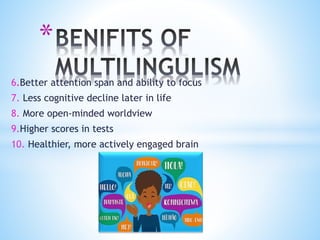
6.Better attention span and ability to focus
7. Less cognitive decline later in life
8. More open-minded worldview
9.Higher scores in tests
10. Healthier, more actively engaged brain
*1. https://www.time4learning.com/blog/experienced-
homeschooler/reap-the-benefits-of-being-multilingual-with-
time4languages/
2. https://www.quora.com/What-are-the-types-of-
multilingualism
3. https://www.quora.com/What-are-the-factors-that-
contribute-to-multilingualism
4. https://slideplayer.com/slide/6634119/
5. https://slideplayer.com/slide/15612941/
6. https://www.dreamstime.com/stock-illustration-
multicultural-children-holding-hand-around-world-vector-
illustration-image93483206
7. https://web.facebook.com/meits.owri/?_rdc=1&_rdr
8. http://www.meits.org/project/research-questions
*
Bilal Zulfiqar
Zohaib safdar
Faiza Abdul-Gaffar
*

Biliingulism and multilingulism