Key Issues in Teaching Young Learners
Professor: Dr. Hajmalek
Presented by: Mojgan Azimi
Classroom
management
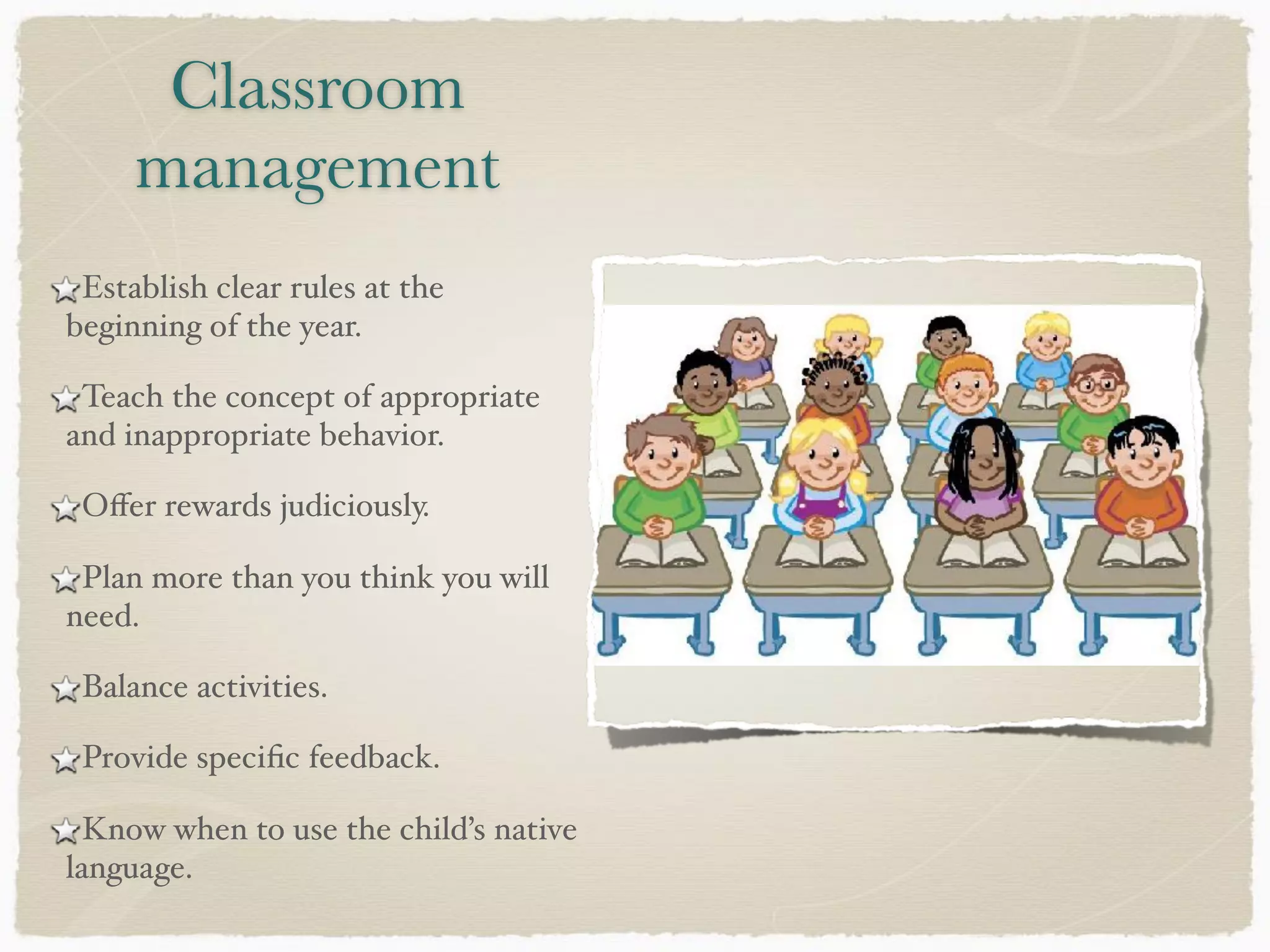
Establish clear rules at the
beginning of the year.
Teach the concept of appropriate
and inappropriate behavior.
Offer rewards judiciously.
Plan more than you think you will
need.
Balance activities.
Provide specific feedback.
Know when to use the child’s native
language.
Special Needs
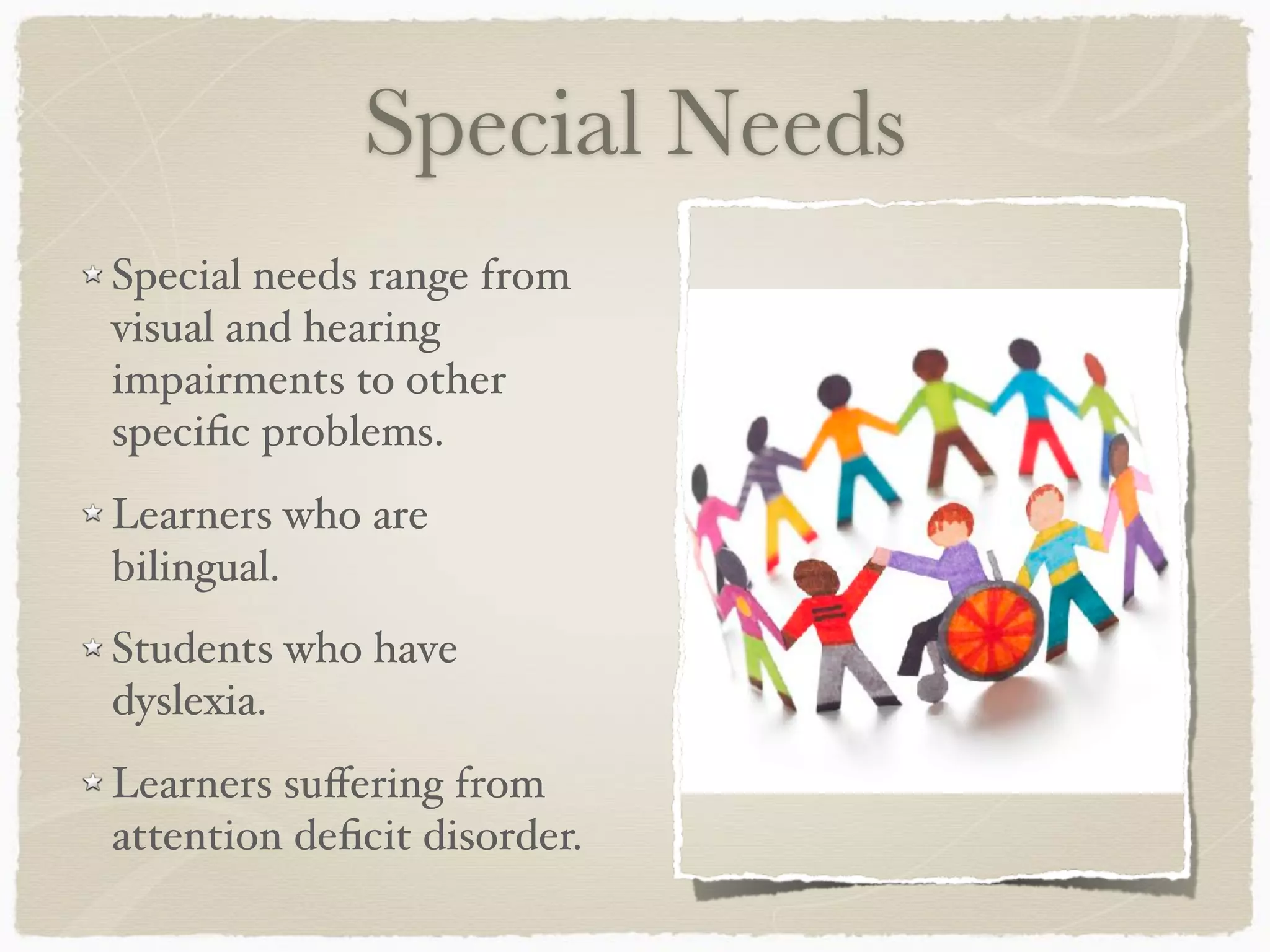
Special needs range from
visual and hearing
impairments to other
specific problems.
Learners who are
bilingual.
Students who have
dyslexia.
Learners suffering from
attention deficit disorder.
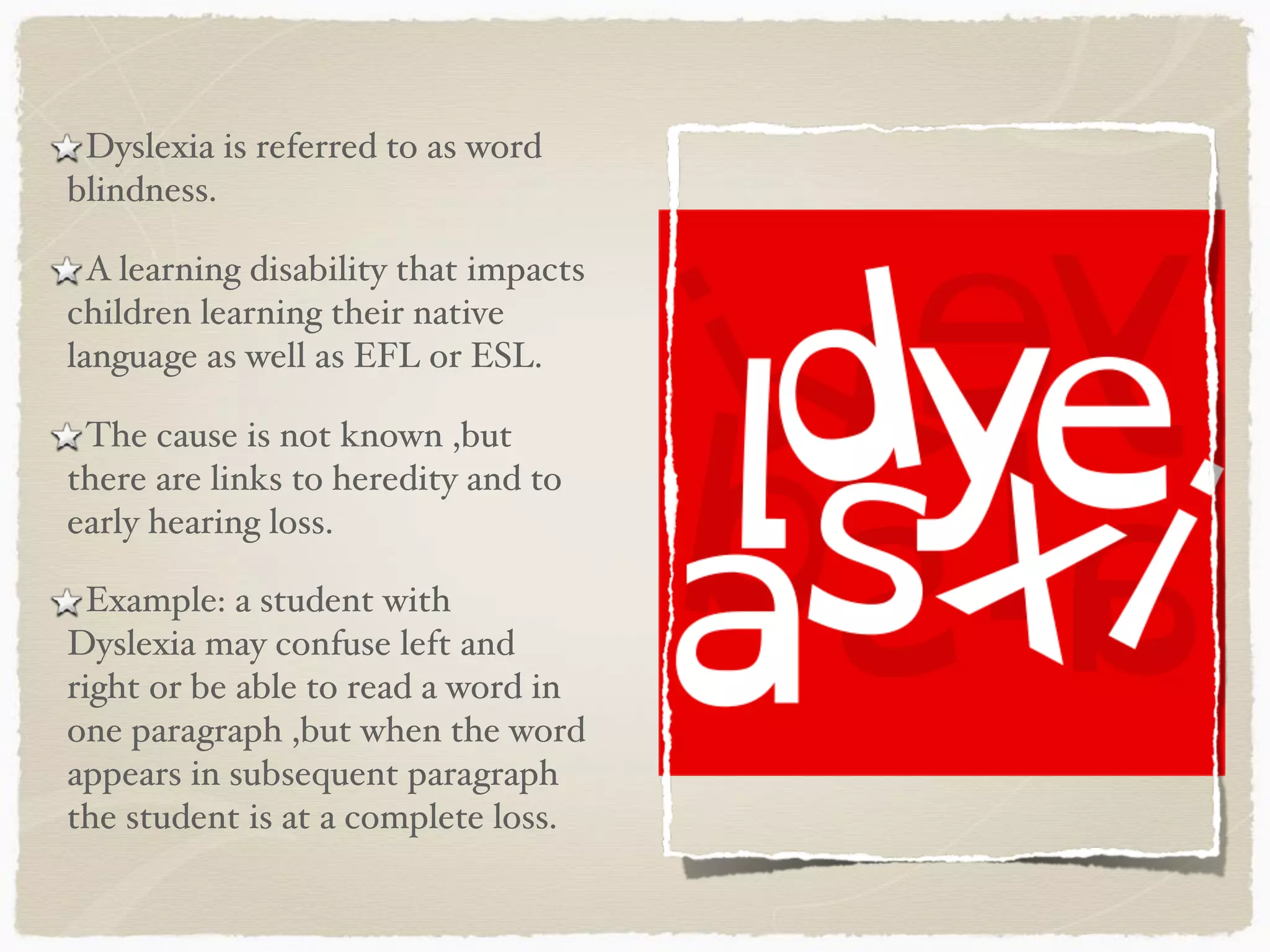
Dyslexia is referred to as word
blindness.
A learning disability that impacts
children learning their native
language as well as EFL or ESL.
The cause is not known ,but
there are links to heredity and to
early hearing loss.
Example: a student with
Dyslexia may confuse left and
right or be able to read a word in
one paragraph ,but when the word
appears in subsequent paragraph
the student is at a complete loss.
Teachers’ challenges
EFL teachers may find inappropriate to provide learners
suffering from this condition, English_language literacy
instruction until they have mastery in their native
language.
Many EFL teachers have little formal training to meet
the needs of dyslexic learners.
Sometimes there are no resources available to help such
learners.
British dyslexia association web site has provided a list
of indications that teachers can refer to.(see p. 194-5)
Attention Deficit Disorder (ADD)
Attention Deficit Hyperactivity Disorder
(ADHD)
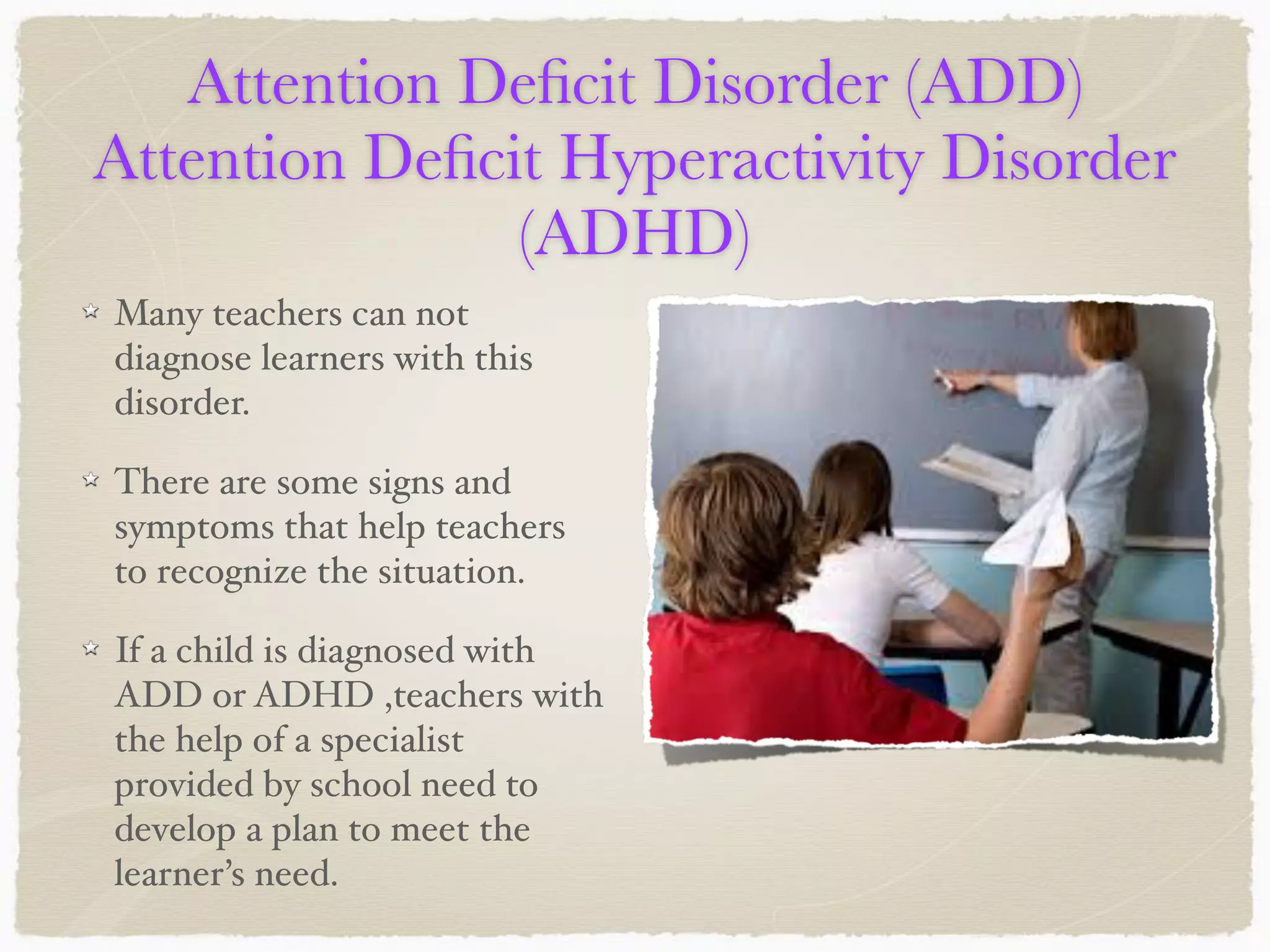
Many teachers can not
diagnose learners with this
disorder.
There are some signs and
symptoms that help teachers
to recognize the situation.
If a child is diagnosed with
ADD or ADHD ,teachers with
the help of a specialist
provided by school need to
develop a plan to meet the
learner’s need.
The Symptoms of
ADHD
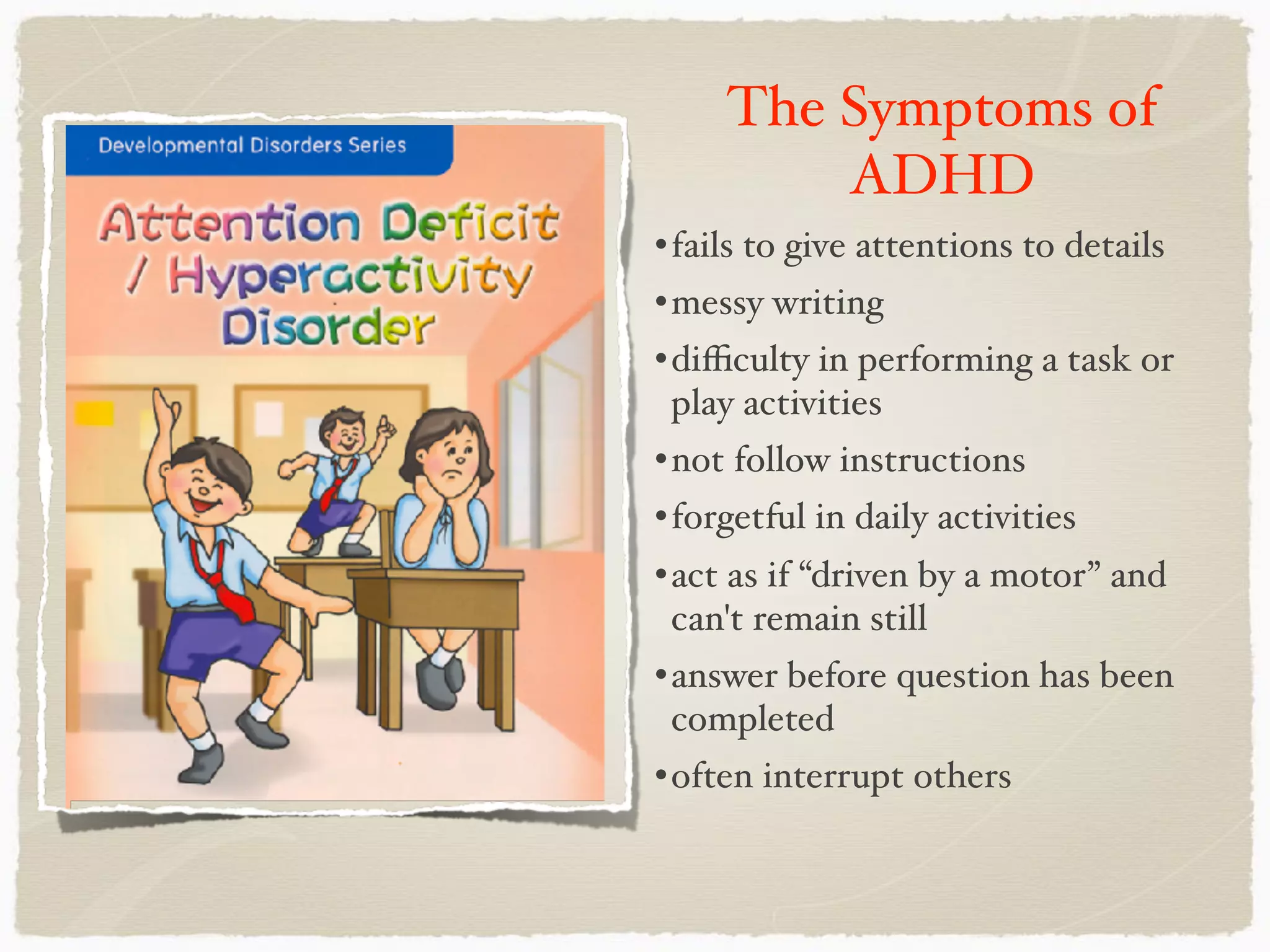
•fails to give attentions to details
•messy writing
•difficulty in performing a task or
play activities
•not follow instructions
•forgetful in daily activities
•act as if “driven by a motor” and
can't remain still
•answer before question has been
completed
•often interrupt others
Some Strategies for children
with ADHD
Allow a child to change work sites while completing homework
or studying.
Assign tasks involving movements (passing out papers, watering
plants).
Use music as a tool for transitioning from one activity to another.
Permit a child to do sth with hands while engaged in sustained
listening.
Provide opportunity for student to show creative thinking.
Vary tone of voice: loud, soft, whisper.
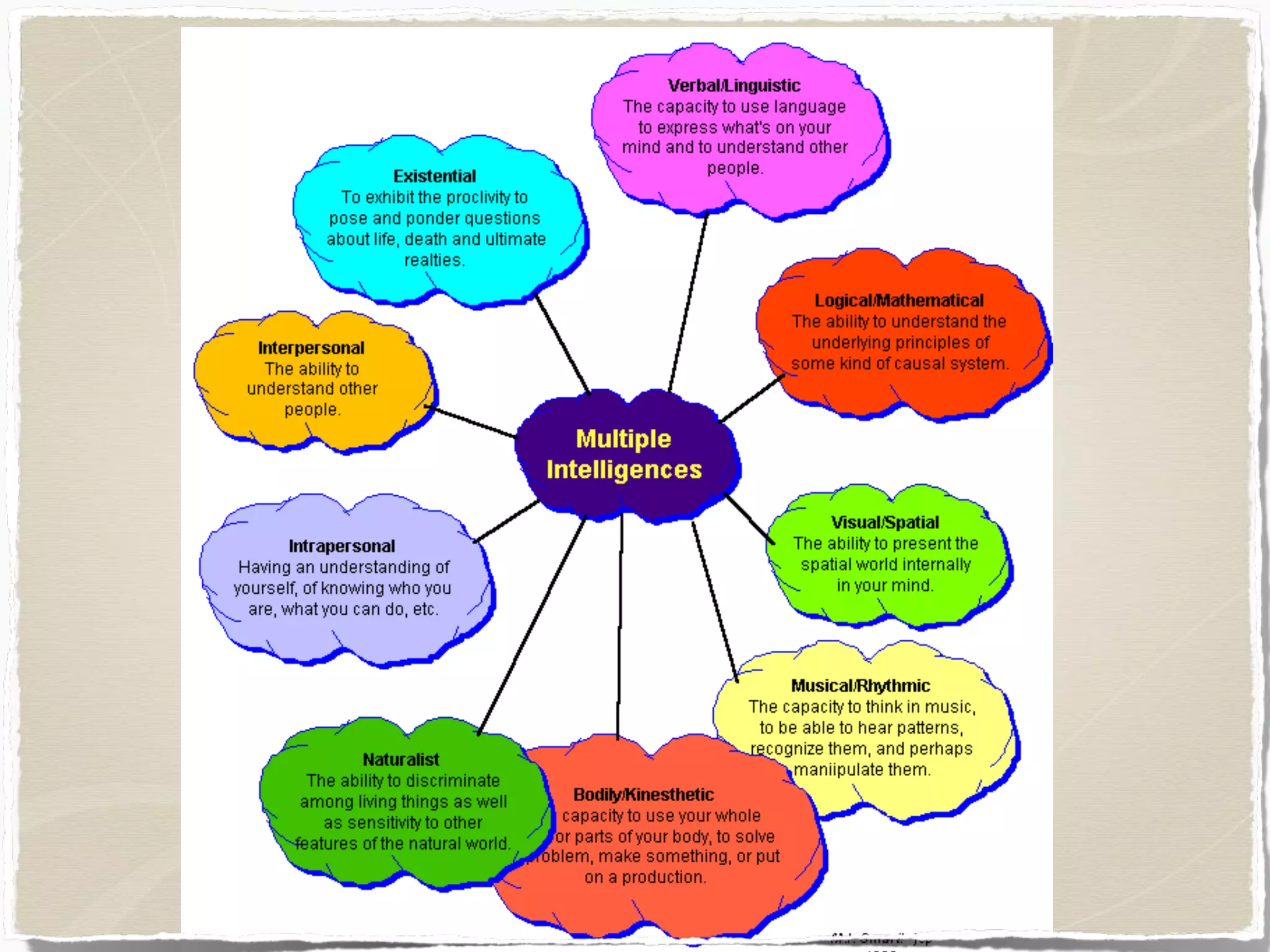
Multiple Intelligence
Howard Gardner
1. Mathematical_logical
2. Interpersonal (understanding others)
3. Intrapersonal (understanding one’s self)
4. Bodily kinesthetic
5. Verbal linguistic
6. Musical and Spatial
7. Naturalist (ability to discern patterns in nature)
Teachers’ awareness about Gardner’ s theory of multiple
intelligence will provide them a framework for looking
at children’s strength.
They can include in their instructions different types of
activities to meet each learner’ s type. For example:
For interpersonal students you can provide a situation to
work alone.
For bodily kinesthetic learners you can have them dance
to English song.
For learners with verbal linguistic intelligence you might
provide them with extra English books to read.
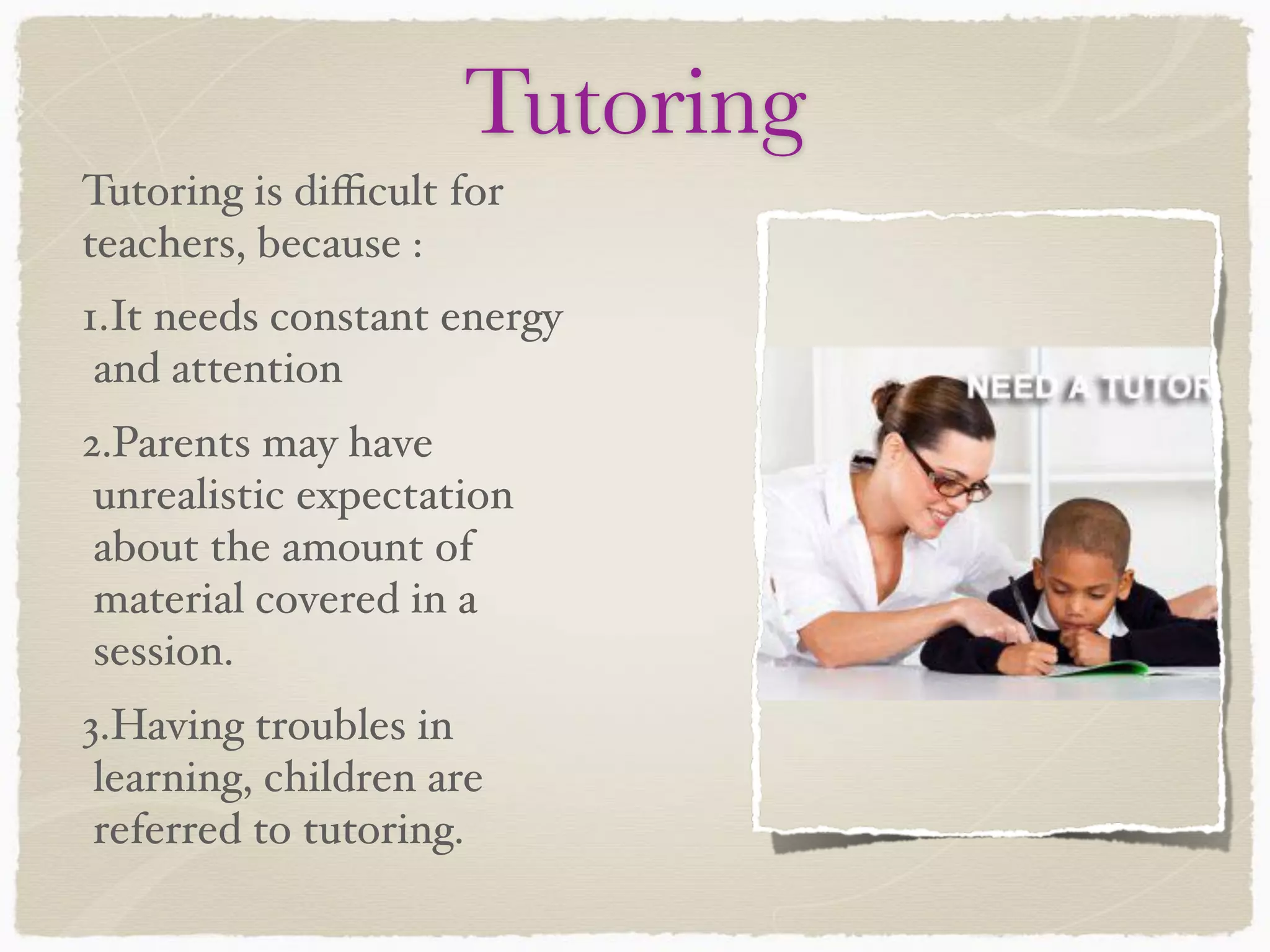
Tutoring
Tutoring is difficult for
teachers, because :
1.It needs constant energy
and attention
2.Parents may have
unrealistic expectation
about the amount of
material covered in a
session.
3.Having troubles in
learning, children are
referred to tutoring.
Before teaching, outline the background ,age and gender of
young learner.
Make a list of questions you would want answered before first
tutoring lesson.
Create a lesson plan.
Have a realistic expectations.
Match activities to the language cognitive level and
intelligence of the learner.
Pay attention to learner’s interest.
Consider learner’s ability to absorb the activities.
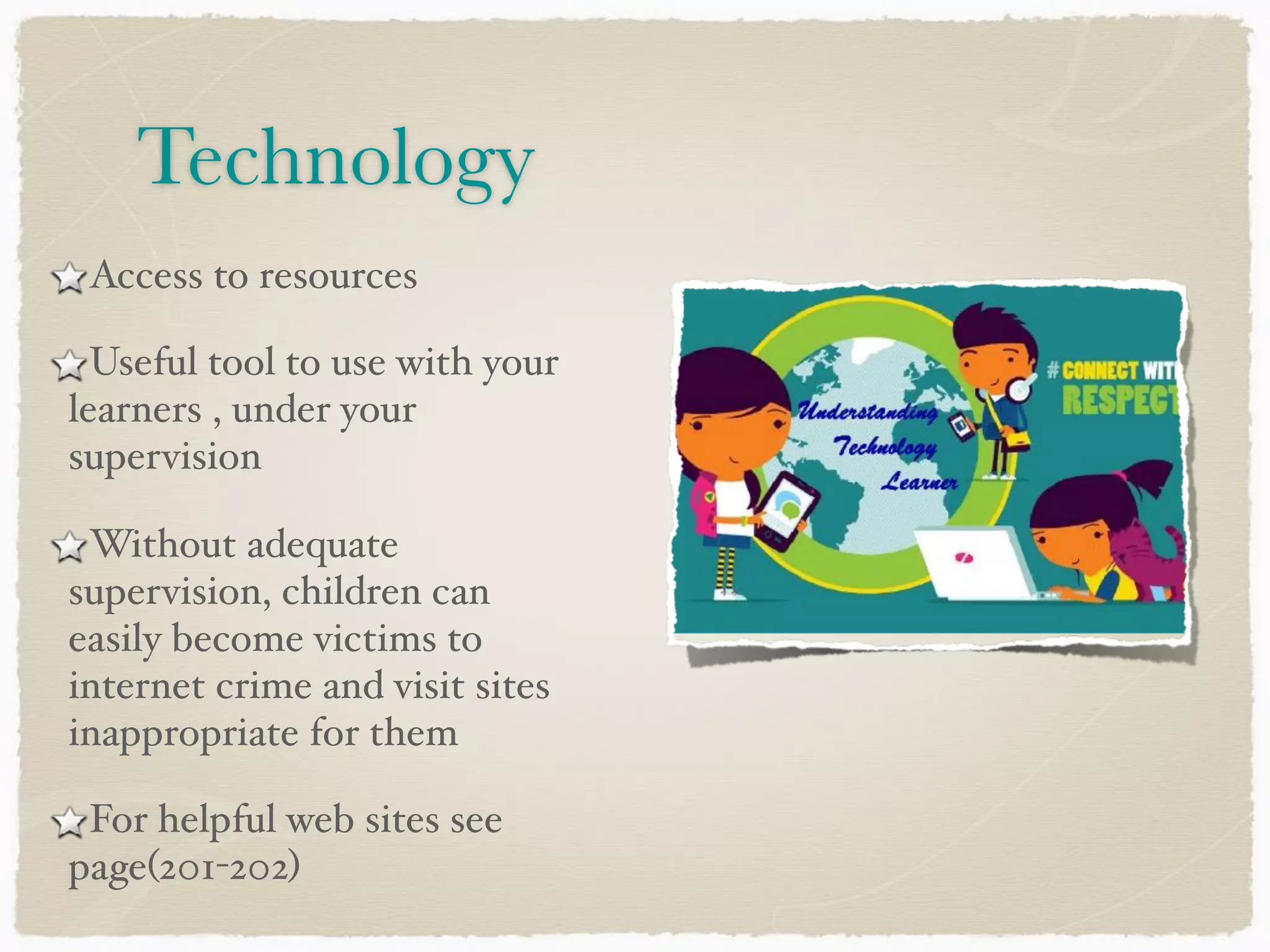
Technology
Access to resources
Useful tool to use with your
learners , under your
supervision
Without adequate
supervision, children can
easily become victims to
internet crime and visit sites
inappropriate for them
For helpful web sites see
page(201-202)
Professional Support
Two most well-known professional organizations
designed to support teachers are (TESOL) teachers of
English to speakers of other languages and (IATEFL)
international association of teachers of English as a foreign
language.
Association of supervision and curriculum development (ASCD)
support teachers by sending them articles on educational
developments from around the world.
It is recommended anyone teaching young learners ESL
or EFL join a professional organizer aiming at helping
teachers work with EFL or ESL learners.
Thank you

Teaching young learners

  • 1.
    Key Issues inTeaching Young Learners Professor: Dr. Hajmalek Presented by: Mojgan Azimi
  • 2.
    Classroom management Establish clear rulesat the beginning of the year. Teach the concept of appropriate and inappropriate behavior. Offer rewards judiciously. Plan more than you think you will need. Balance activities. Provide specific feedback. Know when to use the child’s native language.
  • 3.
    Special Needs Special needsrange from visual and hearing impairments to other specific problems. Learners who are bilingual. Students who have dyslexia. Learners suffering from attention deficit disorder.
  • 4.
    Dyslexia is referredto as word blindness. A learning disability that impacts children learning their native language as well as EFL or ESL. The cause is not known ,but there are links to heredity and to early hearing loss. Example: a student with Dyslexia may confuse left and right or be able to read a word in one paragraph ,but when the word appears in subsequent paragraph the student is at a complete loss.
  • 5.
    Teachers’ challenges EFL teachersmay find inappropriate to provide learners suffering from this condition, English_language literacy instruction until they have mastery in their native language. Many EFL teachers have little formal training to meet the needs of dyslexic learners. Sometimes there are no resources available to help such learners. British dyslexia association web site has provided a list of indications that teachers can refer to.(see p. 194-5)
  • 6.
    Attention Deficit Disorder(ADD) Attention Deficit Hyperactivity Disorder (ADHD) Many teachers can not diagnose learners with this disorder. There are some signs and symptoms that help teachers to recognize the situation. If a child is diagnosed with ADD or ADHD ,teachers with the help of a specialist provided by school need to develop a plan to meet the learner’s need.
  • 7.
    The Symptoms of ADHD •failsto give attentions to details •messy writing •difficulty in performing a task or play activities •not follow instructions •forgetful in daily activities •act as if “driven by a motor” and can't remain still •answer before question has been completed •often interrupt others
  • 8.
    Some Strategies forchildren with ADHD Allow a child to change work sites while completing homework or studying. Assign tasks involving movements (passing out papers, watering plants). Use music as a tool for transitioning from one activity to another. Permit a child to do sth with hands while engaged in sustained listening. Provide opportunity for student to show creative thinking. Vary tone of voice: loud, soft, whisper.
  • 10.
    Multiple Intelligence Howard Gardner 1.Mathematical_logical 2. Interpersonal (understanding others) 3. Intrapersonal (understanding one’s self) 4. Bodily kinesthetic 5. Verbal linguistic 6. Musical and Spatial 7. Naturalist (ability to discern patterns in nature)
  • 11.
    Teachers’ awareness aboutGardner’ s theory of multiple intelligence will provide them a framework for looking at children’s strength. They can include in their instructions different types of activities to meet each learner’ s type. For example: For interpersonal students you can provide a situation to work alone. For bodily kinesthetic learners you can have them dance to English song. For learners with verbal linguistic intelligence you might provide them with extra English books to read.
  • 12.
    Tutoring Tutoring is difficultfor teachers, because : 1.It needs constant energy and attention 2.Parents may have unrealistic expectation about the amount of material covered in a session. 3.Having troubles in learning, children are referred to tutoring.
  • 13.
    Before teaching, outlinethe background ,age and gender of young learner. Make a list of questions you would want answered before first tutoring lesson. Create a lesson plan. Have a realistic expectations. Match activities to the language cognitive level and intelligence of the learner. Pay attention to learner’s interest. Consider learner’s ability to absorb the activities.
  • 14.
    Technology Access to resources Usefultool to use with your learners , under your supervision Without adequate supervision, children can easily become victims to internet crime and visit sites inappropriate for them For helpful web sites see page(201-202)
  • 15.
    Professional Support Two mostwell-known professional organizations designed to support teachers are (TESOL) teachers of English to speakers of other languages and (IATEFL) international association of teachers of English as a foreign language. Association of supervision and curriculum development (ASCD) support teachers by sending them articles on educational developments from around the world. It is recommended anyone teaching young learners ESL or EFL join a professional organizer aiming at helping teachers work with EFL or ESL learners.
  • 16.