MMultiDDirectional Shoulder
IInstability (MDI)
Manos Antonogiannakis
Director 2nd
Orthopedic Dept.
IASO General Hospital
www.shoulder.gr
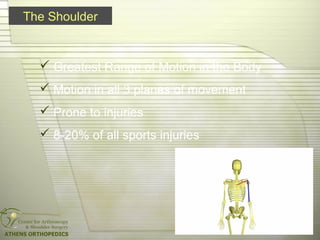
The Shoulder
 Greatest Range of Motion in the Body
 Motion in all 3 planes of movement
 Prone to injuries
 8-20% of all sports injuries
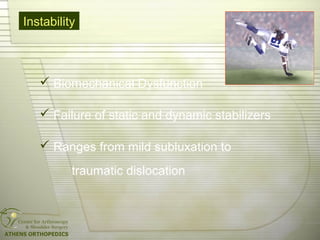
Instability
 Biomechanical Dysfunction
 Failure of static and dynamic stabilizers
 Ranges from mild subluxation to
traumatic dislocation
Mechanisms of Glenohumeral
Stability
• Static
• Dynamic
• Negative Intra- articular pressure
Labrum (50% of Glenoid depth)
Capsule
Ligaments-
Glenohumeral- Superior, Middle & Inferior
(stability & proprioception)
Rotator cuff tension-scapula stabilizers
Classification Schemes
• Mechanism
– Traumatic
– Atraumatic
– Congenital
– Neuromuscular
• Frequency
– Acute
– Chronic
– Recurrent
– Involuntary
– Voluntary
• Direction
– Anterior (and inferior)
– Posterior (and inferior)
– Superior?
– Multidirectional
• Extent
– Subluxation
– Dislocation
Types of instability
Not a black or white issue
WWW.SHOULDER.GR
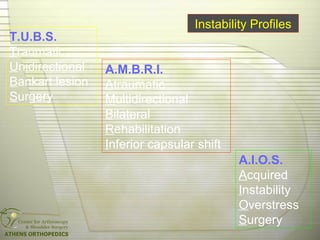
T.U.B.S.
Traumatic
Unidirectional
Bankart lesion
Surgery
A.M.B.R.I.
Atraumatic
Multidirectional
Bilateral
Rehabilitation
Inferior capsular shift
A.I.O.S.
Acquired
Instability
Overstress
Surgery
Instability Profiles
TUBS AIOS AMBRI
MDI Definition
The presence of inferior
instability in combination with
anterior and or posterior
instability
Definitions
• MDI implies subluxation or dislocations in
at least two directions either anteriorly,
posteriorly, or inferiorly
• Usually, the patient experiences
symptoms in one direction, but the
examination reveals more directions of
instability
www.shoulder.gr
MDI History
First described in detail
in 1980 by
Charles S. Neer
and
Craig R. Foster
www.shoulder.gr
MDI types
• Anterior-inferior dislocation with posterior
subluxation
• Posterior-inferior dislocation with anterior
subluxation
• Recurrent dislocation posterior and inferior
Neer and Foster
MDI Characteristics
• Relatively common
• Generally bilateral
• Atraumatic condition affecting
shoulder function
• Excessive translation in all
directions but with the
predominance of ONE direction,
typically anteroinferior or
posteroinferior.
www.shoulder.gr
MDI Characteristics
• Usually in overhead
active sports
• gymnastics, swimming,
throwing, racquet sports
www.shoulder.gr
MDI Characteristics
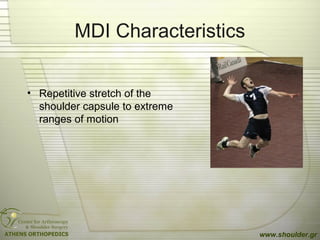
• Repetitive stretch of the
shoulder capsule to extreme
ranges of motion
www.shoulder.gr
MDI Characteristics
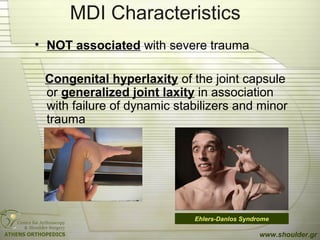
• NOT associated with severe trauma
Congenital hyperlaxity of the joint capsule
or generalized joint laxity in association
with failure of dynamic stabilizers and minor
trauma
www.shoulder.gr
Ehlers-Danlos Syndrome
MDI clinical presentation
• Frank dislocations with minimum violence
often reduced by the patient
• Subluxations and positive apprehension
sign in one or more directions in a loose
joint individual usually teenager
• Pain and functional impairment in a loose
joint individual, the patient mainly
complaining for pain and not for instability
Types of dislocation
• Voluntary dislocation
• Involuntary dislocation
should be recognized early
Voluntary dislocation
• Patients with good muscle control who can
dislocate and relocate their shoulder at will
from an early age that may lead to gradual
strain of the capsule and loss of control of
the dislocations
• True voluntary dislocators with psychiatric
problems
MDI Diagnostic Tools
Highly clinical diagnosis
• History
• Clinical examination
• Marginal help of imaging studies
(plain radiographs, MRI, MRI-arthrography)
• Highly supportive:
– Examination under anesthesia (EUA)
– Arthroscopic findings
www.shoulder.gr
MDI Clinical Examination
• Bilateral physical findings
• Usually, rotator cuff (dynamic stabilizers) weakness
• Drawer and load-shift tests (anterior and posterior)
reveal displacement with an elastic feeling
• Pathognomonic “sulcus sign”
• Apprehension test may be positive, usually in the
direction of the chief component of instability
www.shoulder.gr
Clinical examination
• Usually vague symptoms with activity
• Associated conditions: collagen disorders
• Look for generalized hyper-elasticity
(thumbs can be hyperextended to the distal radius, elbow
hyperextended ,knee recurvatum)
www.shoulder.gr
Clinical examination
SULCUS sign with the arm in adduction that
persists in external rotation or abduction is a
major clinical sign
Anterior and posterior load and sift tests
Examination Under Anesthesia
• To demonstrate increased
glenohumeral anterior,
posterior and inferior
translation
• Usually, symmetrical
www.shoulder.gr
MDI
Examination Under Anesthesia
Treatment Options
• Conservative
• Intensive RC strengthening (dynamic stabilizers)
• Scapular Stabilizers strengthening
• Dynamic Upper Limb Propioception
• Surgical
• Open Surgery
– Inferior Capsular Shift
• Arthroscopy
www.shoulder.gr
Treatment: Address all factors
• Dynamic stabilizers: rotator cuff and
scapula muscles
• Static stabilizers: plication of
capsuloligamentus stactures
treatment
• Open treatment first described by Neer as
the glenoid inferior capsular sift based
laterally on the humeral head
• Arthroscopic management was pioneered
by Gaspari using a transglenoid technique
Contraindications
for Surgical Treatment
• Voluntary shoulder instability
• Collagen disorders
(eg, Ehlers-Danlos syndrome, Marfan syndrome)
• Noncompliance with a supervised
rehabilitation program
www.shoulder.gr
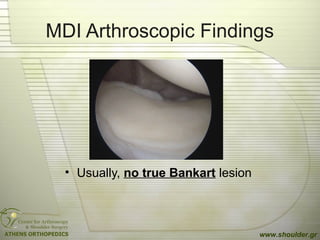
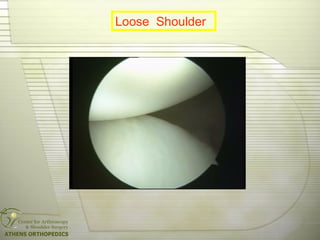
MDI Arthroscopic Findings
• Usually, no true Bankart lesion
www.shoulder.gr
Loose Shoulder
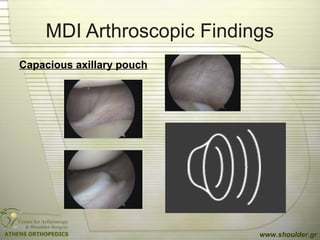
MDI Arthroscopic Findings
Capacious axillary pouch
www.shoulder.gr
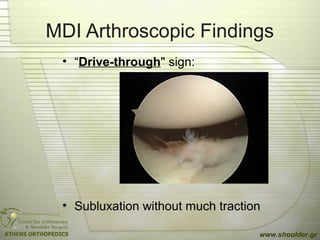
MDI Arthroscopic Findings
• “Drive-through" sign:
• Subluxation without much traction
www.shoulder.gr
MDI Arthroscopic Findings
MDI Surgical Treatment
The goal is "addressing the capsular
laxity and redundancy to restore
anatomic capsuloligamentous tension
without overconstraining the shoulder."
[Caprise and Sekiya, 2006]
www.shoulder.gr
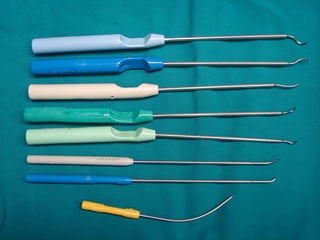
Arthroscopic Treatment Options
• Thermical Shrinkage
• Capsular plication
www.shoulder.gr
MDI Arthroscopic Treatment
Possible problems
• Axillary nerve injury
• Loose repair
• Healing problems
(collagen diseases: Ehlers-Danlos, Marfan)
• Postoperative noncompliance
• Overtensioning
is not a common problem
www.shoulder.gr
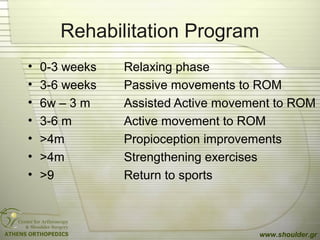
Rehabilitation Program
• 0-3 weeks Relaxing phase
• 3-6 weeks Passive movements to ROM
• 6w – 3 m Assisted Active movement to ROM
• 3-6 m Active movement to ROM
• >4m Propioception improvements
• >4m Strengthening exercises
• >9 Return to sports
www.shoulder.gr
What to expect
• Painless shoulder
• Full ROM
• No atrophies
• Return to the same sport level
Rowe scores:
78% excellent / good [Snyder, 2001]
75% excellent / good [Wolf, 1999]
88% excellent / good [Treacy, 2002]
www.shoulder.gr
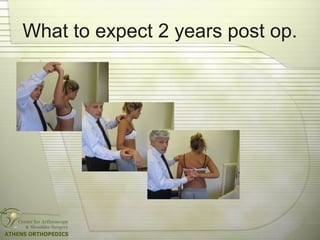
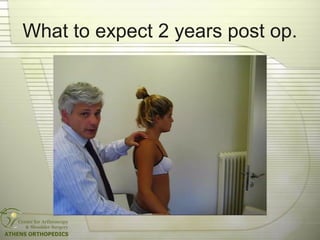
What to expect 2 years post op.
Conclusions
• Most patients present in their late teens
• Complaints of pain during athletic activities
or ADL
• Uncountable dislocations and subluxations
even at sleep reduced by the patient in a
tall thin loose joint individual
• Excessive ROM in more joints
www.shoulder.gr
Conclusions
• Excesive translation of the joint anterior
posterior and inferior at clinical
examination with aprehension in one or
more directions
• At arthroscopy a patulous thin capsule
with few other findings.
Conclusion
• Treatment should address all factors of
instability mainly the dynamic stabilizers
with an aggressive rehabilitation program
and if this fails arthoscopic or open
capsulorraphy in order to reduce the
volume of the capsule
Thank you
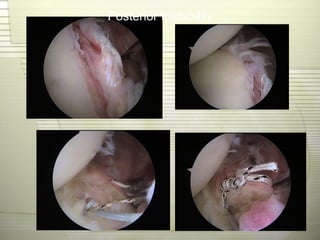
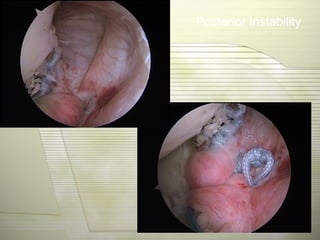
Posterior Instability
Natural History Of MDI
After 8 years:
• 48.7% pain 46.1% instability
• Mod. Rowe/Zarris:
• 13.8% excellent
• 33% good
• 52.7% poor
[Misamore, JSES 2005]
www.shoulder.gr

Multidirectional shoulder instability

  • 1.
    MMultiDDirectional Shoulder IInstability (MDI) ManosAntonogiannakis Director 2nd Orthopedic Dept. IASO General Hospital www.shoulder.gr
  • 2.
    The Shoulder  GreatestRange of Motion in the Body  Motion in all 3 planes of movement  Prone to injuries  8-20% of all sports injuries
  • 3.
    Instability  Biomechanical Dysfunction Failure of static and dynamic stabilizers  Ranges from mild subluxation to traumatic dislocation
  • 4.
    Mechanisms of Glenohumeral Stability •Static • Dynamic • Negative Intra- articular pressure Labrum (50% of Glenoid depth) Capsule Ligaments- Glenohumeral- Superior, Middle & Inferior (stability & proprioception) Rotator cuff tension-scapula stabilizers
  • 5.
    Classification Schemes • Mechanism –Traumatic – Atraumatic – Congenital – Neuromuscular • Frequency – Acute – Chronic – Recurrent – Involuntary – Voluntary • Direction – Anterior (and inferior) – Posterior (and inferior) – Superior? – Multidirectional • Extent – Subluxation – Dislocation
  • 6.
    Types of instability Nota black or white issue WWW.SHOULDER.GR
  • 7.
  • 8.
  • 9.
    MDI Definition The presenceof inferior instability in combination with anterior and or posterior instability
  • 10.
    Definitions • MDI impliessubluxation or dislocations in at least two directions either anteriorly, posteriorly, or inferiorly • Usually, the patient experiences symptoms in one direction, but the examination reveals more directions of instability www.shoulder.gr
  • 11.
    MDI History First describedin detail in 1980 by Charles S. Neer and Craig R. Foster www.shoulder.gr
  • 12.
    MDI types • Anterior-inferiordislocation with posterior subluxation • Posterior-inferior dislocation with anterior subluxation • Recurrent dislocation posterior and inferior Neer and Foster
  • 13.
    MDI Characteristics • Relativelycommon • Generally bilateral • Atraumatic condition affecting shoulder function • Excessive translation in all directions but with the predominance of ONE direction, typically anteroinferior or posteroinferior. www.shoulder.gr
  • 14.
    MDI Characteristics • Usuallyin overhead active sports • gymnastics, swimming, throwing, racquet sports www.shoulder.gr
  • 15.
    MDI Characteristics • Repetitivestretch of the shoulder capsule to extreme ranges of motion www.shoulder.gr
  • 16.
    MDI Characteristics • NOTassociated with severe trauma Congenital hyperlaxity of the joint capsule or generalized joint laxity in association with failure of dynamic stabilizers and minor trauma www.shoulder.gr Ehlers-Danlos Syndrome
  • 17.
    MDI clinical presentation •Frank dislocations with minimum violence often reduced by the patient • Subluxations and positive apprehension sign in one or more directions in a loose joint individual usually teenager • Pain and functional impairment in a loose joint individual, the patient mainly complaining for pain and not for instability
  • 18.
    Types of dislocation •Voluntary dislocation • Involuntary dislocation should be recognized early
  • 19.
    Voluntary dislocation • Patientswith good muscle control who can dislocate and relocate their shoulder at will from an early age that may lead to gradual strain of the capsule and loss of control of the dislocations • True voluntary dislocators with psychiatric problems
  • 20.
    MDI Diagnostic Tools Highlyclinical diagnosis • History • Clinical examination • Marginal help of imaging studies (plain radiographs, MRI, MRI-arthrography) • Highly supportive: – Examination under anesthesia (EUA) – Arthroscopic findings www.shoulder.gr
  • 21.
    MDI Clinical Examination •Bilateral physical findings • Usually, rotator cuff (dynamic stabilizers) weakness • Drawer and load-shift tests (anterior and posterior) reveal displacement with an elastic feeling • Pathognomonic “sulcus sign” • Apprehension test may be positive, usually in the direction of the chief component of instability www.shoulder.gr
  • 22.
    Clinical examination • Usuallyvague symptoms with activity • Associated conditions: collagen disorders • Look for generalized hyper-elasticity (thumbs can be hyperextended to the distal radius, elbow hyperextended ,knee recurvatum) www.shoulder.gr
  • 23.
    Clinical examination SULCUS signwith the arm in adduction that persists in external rotation or abduction is a major clinical sign Anterior and posterior load and sift tests
  • 24.
    Examination Under Anesthesia •To demonstrate increased glenohumeral anterior, posterior and inferior translation • Usually, symmetrical www.shoulder.gr
  • 25.
  • 26.
    Treatment Options • Conservative •Intensive RC strengthening (dynamic stabilizers) • Scapular Stabilizers strengthening • Dynamic Upper Limb Propioception • Surgical • Open Surgery – Inferior Capsular Shift • Arthroscopy www.shoulder.gr
  • 27.
    Treatment: Address allfactors • Dynamic stabilizers: rotator cuff and scapula muscles • Static stabilizers: plication of capsuloligamentus stactures
  • 28.
    treatment • Open treatmentfirst described by Neer as the glenoid inferior capsular sift based laterally on the humeral head • Arthroscopic management was pioneered by Gaspari using a transglenoid technique
  • 29.
    Contraindications for Surgical Treatment •Voluntary shoulder instability • Collagen disorders (eg, Ehlers-Danlos syndrome, Marfan syndrome) • Noncompliance with a supervised rehabilitation program www.shoulder.gr
  • 30.
    MDI Arthroscopic Findings •Usually, no true Bankart lesion www.shoulder.gr
  • 31.
  • 32.
    MDI Arthroscopic Findings Capaciousaxillary pouch www.shoulder.gr
  • 33.
    MDI Arthroscopic Findings •“Drive-through" sign: • Subluxation without much traction www.shoulder.gr
  • 34.
  • 35.
    MDI Surgical Treatment Thegoal is "addressing the capsular laxity and redundancy to restore anatomic capsuloligamentous tension without overconstraining the shoulder." [Caprise and Sekiya, 2006] www.shoulder.gr
  • 36.
    Arthroscopic Treatment Options •Thermical Shrinkage • Capsular plication www.shoulder.gr
  • 38.
  • 39.
    Possible problems • Axillarynerve injury • Loose repair • Healing problems (collagen diseases: Ehlers-Danlos, Marfan) • Postoperative noncompliance • Overtensioning is not a common problem www.shoulder.gr
  • 40.
    Rehabilitation Program • 0-3weeks Relaxing phase • 3-6 weeks Passive movements to ROM • 6w – 3 m Assisted Active movement to ROM • 3-6 m Active movement to ROM • >4m Propioception improvements • >4m Strengthening exercises • >9 Return to sports www.shoulder.gr
  • 41.
    What to expect •Painless shoulder • Full ROM • No atrophies • Return to the same sport level Rowe scores: 78% excellent / good [Snyder, 2001] 75% excellent / good [Wolf, 1999] 88% excellent / good [Treacy, 2002] www.shoulder.gr
  • 42.
    What to expect2 years post op.
  • 43.
    What to expect2 years post op.
  • 44.
    Conclusions • Most patientspresent in their late teens • Complaints of pain during athletic activities or ADL • Uncountable dislocations and subluxations even at sleep reduced by the patient in a tall thin loose joint individual • Excessive ROM in more joints www.shoulder.gr
  • 45.
    Conclusions • Excesive translationof the joint anterior posterior and inferior at clinical examination with aprehension in one or more directions • At arthroscopy a patulous thin capsule with few other findings.
  • 46.
    Conclusion • Treatment shouldaddress all factors of instability mainly the dynamic stabilizers with an aggressive rehabilitation program and if this fails arthoscopic or open capsulorraphy in order to reduce the volume of the capsule
  • 47.
  • 48.
  • 49.
  • 50.
    Natural History OfMDI After 8 years: • 48.7% pain 46.1% instability • Mod. Rowe/Zarris: • 13.8% excellent • 33% good • 52.7% poor [Misamore, JSES 2005] www.shoulder.gr