Zonal CME
conducted at GSLMC
DR.S.JAGANMOHAN
M.S,D.N.B. ORTHO, FELLOW ARTHROPLASTY
ASSISTANT PROFESSOR , DEPT. OF ORTHOPAEDICS
GSL MEDICAL COLLEGE AND HOSPITAL
 Introduction
 Definition
 Related anatomy
 Pathoanatomy
 Investigations
 Treatment options
 Conclusion
 Ganz and Noesberger 1975 -The Floating
Shoulder - the ipsilateral glenoid surgical
neck and midshaft clavicle fracture
 Goss 1993 introduced the concept Superior
shoulder suspensory complex
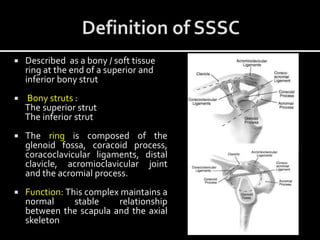
 Described as a bony / soft tissue
ring at the end of a superior and
inferior bony strut
 Bony struts :
The superior strut
The inferior strut
 The ring is composed of the
glenoid fossa, coracoid process,
coracoclavicular ligaments, distal
clavicle, acromioclavicular joint
and the acromial process.
 Function: This complex maintains a
normal stable relationship
between the scapula and the axial
skeleton
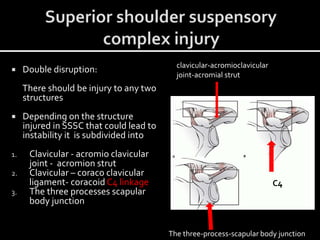
 Double disruption:
There should be injury to any two
structures
 Depending on the structure
injured in SSSC that could lead to
instability it is subdivided into
1. Clavicular - acromio clavicular
joint - acromion strut
2. Clavicular – coraco clavicular
ligament- coracoid C4 linkage
3. The three processes scapular
body junction
clavicular-acromioclavicular
joint-acromial strut
C4
The three-process-scapular body junction
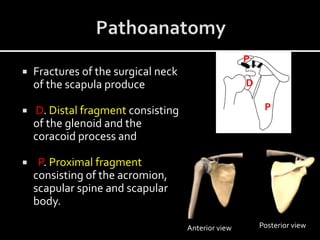
 Fractures of the surgical neck
of the scapula produce
 D. Distal fragment consisting
of the glenoid and the
coracoid process and
 P. Proximal fragment
consisting of the acromion,
scapular spine and scapular
body.
D
P
P
Anterior view Posterior view
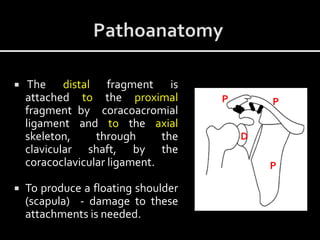
 The distal fragment is
attached to the proximal
fragment by coracoacromial
ligament and to the axial
skeleton, through the
clavicular shaft, by the
coracoclavicular ligament.
 To produce a floating shoulder
(scapula) - damage to these
attachments is needed.
D
P
P
P
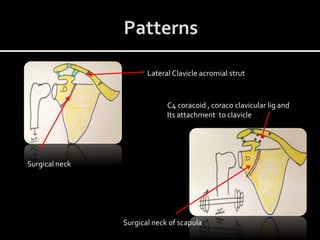
Surgical neck
Lateral Clavicle acromial strut
C4 coracoid , coraco clavicular lig and
Its attachment to clavicle
Surgical neck of scapula
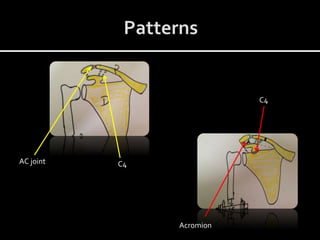
AC joint C4
Acromion
C4
 The scapular neck fracture is displaced inferiorly
as well as anteromedially by the altered muscle
forces and the weight of the upper extremity.
 And If significant displacement occurs at either
or both sites, there may be problems with
healing, such as delayed union, malunion and
nonunion
 Malunion is common
 Drooping of shoulder- deformity
 Brachial plexus pressure
 Relationship of the glenohumeral joint
with the acromion is altered, creating
a functional imbalance
 Decreased range of motion
 Loss of normal lever arm of the rotator
cuff (length)
 Results in weakness on abduction and
subacromial pain are common
Drooping of shoulder
 Most are following Road traffic injuries
 High energy injuries
 Polytrauma associated with chest injuries
pneumo/ haemo thorax, rib fractures
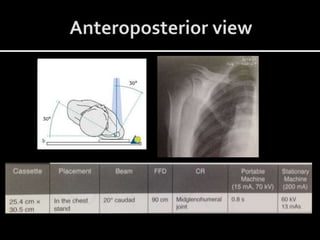
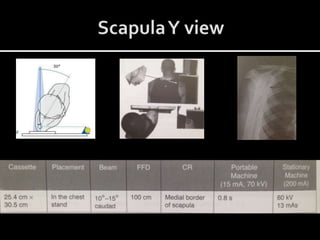
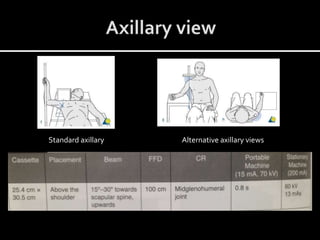
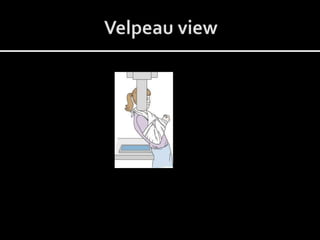
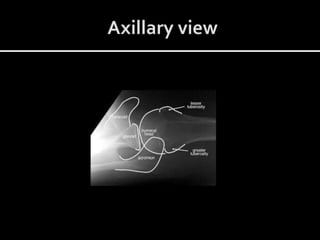
 Recommended views of shoulder
1. Anteroposterior view ( weight bearing)
2. Lateral view
3. Axillary view or trauma axillary view
Standard axillary Alternative axillary views
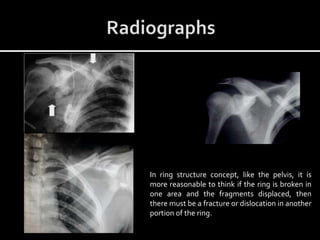
In ring structure concept, like the pelvis, it is
more reasonable to think if the ring is broken in
one area and the fragments displaced, then
there must be a fracture or dislocation in another
portion of the ring.
 Conservative treatment : supported by recent papers
 Edwards (jbjs2000) : Reported excellent results in 20 treated
nonoperatively by a shoulder immobilizer.They recommend
conservative treatment, especially in patients with less than 5-mm
displacement.
 Van Noort et al ( injury and octa ortopaedica 2005, 2006) In a
retrospective study, reported fair to good results in 28 patients treated
conservatively with a well-aligned glenoid.
The authors concluded conservative treatment leads to a good functional
outcome in the absence of caudal displacement of the glenoid.
Caudal displacement was defined as an inferior angulation of the glenoid
of at least 20 degrees
 Surgical management:
 Goss 1993, recommended stabilisation of both sides and stated that
conservative treatment causes drooping of the shoulder
 Ada and Miller reported a high incidence of rotator cuff dysfunction in
patients with displaced clavicular and scapular fractures resulting in loss
of the normal lever arm of the rotator cuff, and they recommended that
the fractures be treated by open reduction
 Romeo et al. reported a poor outcome after scapular neck fractures with
malalignment; they measured the glenopolar angle to assess the
rotational malalignment of fractures involving the glenoid . In their
series patients with scapular fractures, which were displaced by more
than 1 cm, had poorer results than those with undisplaced fractures.
 B.D.Owens &T.P. Goss jbjs2006 Surgical
stabilisation of the clavicle alone could reduce
the scapular fracture indirectly, and fixation
of the scapular fracture was only required
with displaced fractures
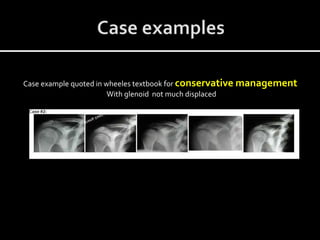
Case example quoted in wheeles textbook for conservative management
With glenoid not much displaced
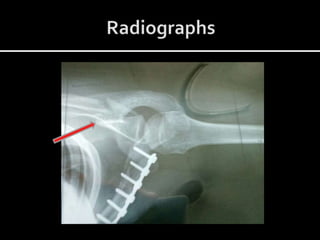
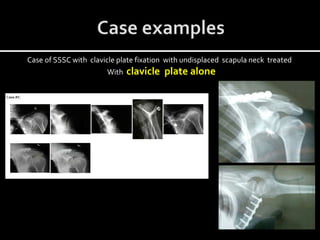
Case of SSSC with clavicle plate fixation with undisplaced scapula neck treated
With clavicle plate alone
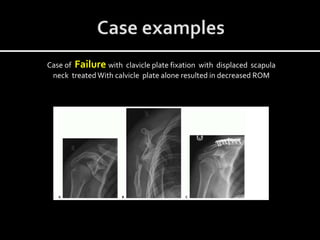
Case of Failure with clavicle plate fixation with displaced scapula
neck treated With calvicle plate alone resulted in decreased ROM
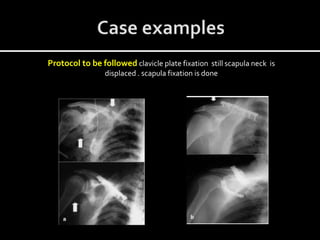
Protocol to be followed clavicle plate fixation still scapula neck is
displaced . scapula fixation is done
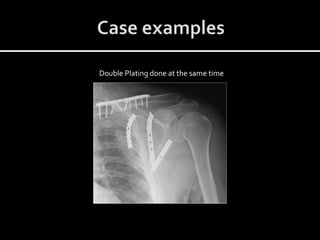
Double Plating done at the same time
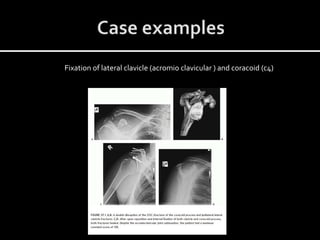
Fixation of lateral clavicle (acromio clavicular ) and coracoid (c4)
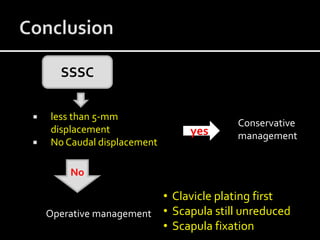
 less than 5-mm
displacement
 No Caudal displacement
Conservative
management
• Clavicle plating first
• Scapula still unreduced
• Scapula fixation
SSSC
yes
No
Operative management
Superior Shoulder Suspensory Complex injuries (SSSC)

Superior Shoulder Suspensory Complex injuries (SSSC)

  • 1.
    Zonal CME conducted atGSLMC DR.S.JAGANMOHAN M.S,D.N.B. ORTHO, FELLOW ARTHROPLASTY ASSISTANT PROFESSOR , DEPT. OF ORTHOPAEDICS GSL MEDICAL COLLEGE AND HOSPITAL
  • 2.
     Introduction  Definition Related anatomy  Pathoanatomy  Investigations  Treatment options  Conclusion
  • 3.
     Ganz andNoesberger 1975 -The Floating Shoulder - the ipsilateral glenoid surgical neck and midshaft clavicle fracture  Goss 1993 introduced the concept Superior shoulder suspensory complex
  • 4.
     Described asa bony / soft tissue ring at the end of a superior and inferior bony strut  Bony struts : The superior strut The inferior strut  The ring is composed of the glenoid fossa, coracoid process, coracoclavicular ligaments, distal clavicle, acromioclavicular joint and the acromial process.  Function: This complex maintains a normal stable relationship between the scapula and the axial skeleton
  • 5.
     Double disruption: Thereshould be injury to any two structures  Depending on the structure injured in SSSC that could lead to instability it is subdivided into 1. Clavicular - acromio clavicular joint - acromion strut 2. Clavicular – coraco clavicular ligament- coracoid C4 linkage 3. The three processes scapular body junction clavicular-acromioclavicular joint-acromial strut C4 The three-process-scapular body junction
  • 6.
     Fractures ofthe surgical neck of the scapula produce  D. Distal fragment consisting of the glenoid and the coracoid process and  P. Proximal fragment consisting of the acromion, scapular spine and scapular body. D P P Anterior view Posterior view
  • 7.
     The distalfragment is attached to the proximal fragment by coracoacromial ligament and to the axial skeleton, through the clavicular shaft, by the coracoclavicular ligament.  To produce a floating shoulder (scapula) - damage to these attachments is needed. D P P P
  • 8.
    Surgical neck Lateral Clavicleacromial strut C4 coracoid , coraco clavicular lig and Its attachment to clavicle Surgical neck of scapula
  • 9.
  • 10.
     The scapularneck fracture is displaced inferiorly as well as anteromedially by the altered muscle forces and the weight of the upper extremity.  And If significant displacement occurs at either or both sites, there may be problems with healing, such as delayed union, malunion and nonunion  Malunion is common
  • 11.
     Drooping ofshoulder- deformity  Brachial plexus pressure  Relationship of the glenohumeral joint with the acromion is altered, creating a functional imbalance  Decreased range of motion  Loss of normal lever arm of the rotator cuff (length)  Results in weakness on abduction and subacromial pain are common Drooping of shoulder
  • 12.
     Most arefollowing Road traffic injuries  High energy injuries  Polytrauma associated with chest injuries pneumo/ haemo thorax, rib fractures
  • 13.
     Recommended viewsof shoulder 1. Anteroposterior view ( weight bearing) 2. Lateral view 3. Axillary view or trauma axillary view
  • 16.
  • 19.
    In ring structureconcept, like the pelvis, it is more reasonable to think if the ring is broken in one area and the fragments displaced, then there must be a fracture or dislocation in another portion of the ring.
  • 21.
     Conservative treatment: supported by recent papers  Edwards (jbjs2000) : Reported excellent results in 20 treated nonoperatively by a shoulder immobilizer.They recommend conservative treatment, especially in patients with less than 5-mm displacement.  Van Noort et al ( injury and octa ortopaedica 2005, 2006) In a retrospective study, reported fair to good results in 28 patients treated conservatively with a well-aligned glenoid. The authors concluded conservative treatment leads to a good functional outcome in the absence of caudal displacement of the glenoid. Caudal displacement was defined as an inferior angulation of the glenoid of at least 20 degrees
  • 22.
     Surgical management: Goss 1993, recommended stabilisation of both sides and stated that conservative treatment causes drooping of the shoulder  Ada and Miller reported a high incidence of rotator cuff dysfunction in patients with displaced clavicular and scapular fractures resulting in loss of the normal lever arm of the rotator cuff, and they recommended that the fractures be treated by open reduction  Romeo et al. reported a poor outcome after scapular neck fractures with malalignment; they measured the glenopolar angle to assess the rotational malalignment of fractures involving the glenoid . In their series patients with scapular fractures, which were displaced by more than 1 cm, had poorer results than those with undisplaced fractures.
  • 23.
     B.D.Owens &T.P.Goss jbjs2006 Surgical stabilisation of the clavicle alone could reduce the scapular fracture indirectly, and fixation of the scapular fracture was only required with displaced fractures
  • 24.
    Case example quotedin wheeles textbook for conservative management With glenoid not much displaced
  • 25.
    Case of SSSCwith clavicle plate fixation with undisplaced scapula neck treated With clavicle plate alone
  • 26.
    Case of Failurewith clavicle plate fixation with displaced scapula neck treated With calvicle plate alone resulted in decreased ROM
  • 27.
    Protocol to befollowed clavicle plate fixation still scapula neck is displaced . scapula fixation is done
  • 28.
    Double Plating doneat the same time
  • 29.
    Fixation of lateralclavicle (acromio clavicular ) and coracoid (c4)
  • 30.
     less than5-mm displacement  No Caudal displacement Conservative management • Clavicle plating first • Scapula still unreduced • Scapula fixation SSSC yes No Operative management

Editor's Notes

  • #5  The scapula is ‘hung’ or suspended from the clavicle by the coracoclavicular ligaments and the acromioclavicular joint
  • #6 The complex can be subdivided into three units: 1) the clavicular-acromioclavicular joint-acromial strut; 2) the three-process-scapular body junction; and 3) the clavicular-coracoclavicular ligamentous- coracoid (C-4) linkage Secondary support is provided by the coracoacromial ligament.
  • #7 Clavicle is the only bony connection between the upper extremity and the axial skeleton The scapula is ‘hung’ or suspended from the clavicle by the coracoclavicular ligaments and the acromioclavicular joint
  • #8 Clavicle is the only bony connection between the upper extremity and the axial skeleton The scapula is ‘hung’ or suspended from the clavicle by the coracoclavicular ligaments and the acromioclavicular joint