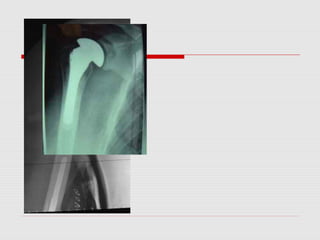
Shoulder Arthroplasty
Daniel Penello
Upper Extremity Rounds
April 26, 2006
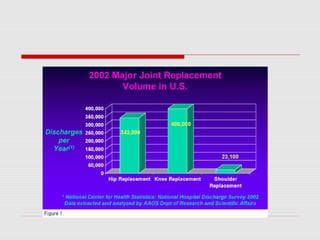
 Lesions of the shoulder requiring
arthroplasty are much less common
than lesions involving the weight-
bearing joints of the body, such as
the hip and knee.
The Shoulder
 Greatest ROM
 No inherent bony
stability
 Relies on soft tissues
for stability
 Many injuries involve
the soft tissues
(rotator cuff, labrum)
 Little glenoid bone
stock
Indications for Shoulder
Arthroplasty
 Osteoarthritis
 Rheumatoid arthritis
 Rotator cuff tear arthropathy
 Avascular necrosis
 Post-traumatic arthritis
 Severe proximal humeral fractures
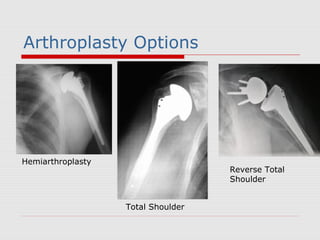
Hemiarthroplasty
Total Shoulder
Reverse Total
Shoulder
Arthroplasty Options
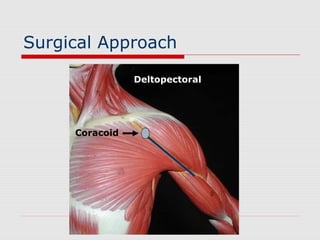
Surgical Approach
Deltopectoral
Coracoid
A little history
 1893- French surgeon Pean inserted
platinum and rubber components to
replace a shoulder joint destroyed by
tuberculosis.
 1951- Neer I, Vitallium
Hemiarthroplasty prosthesis which
resulted in pain relief and good
function compared to previous
options.
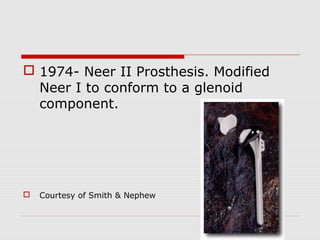
 1974- Neer II Prosthesis. Modified
Neer I to conform to a glenoid
component.
 Courtesy of Smith & Nephew
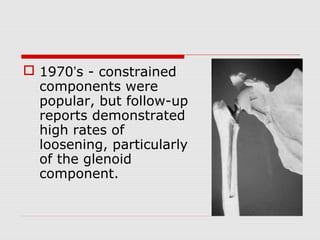
 1970’s - constrained
components were
popular, but follow-up
reports demonstrated
high rates of
loosening, particularly
of the glenoid
component.
 1980’s – Modular humeral
components were developed, along
with cementless glenoid fixation using
polyethylene on a metal backing.
Cemented polyethylene versus uncemented metal-
backed glenoid components in total shoulder
arthroplasty: a prospective, double-blind, randomized
study.
Boileau P, Avidor C, J Shoulder Elbow Surg. 2002 Jul-
Aug;11(4):351-9.
40 Shoulders with 3 year follow up.
 Metal-backed – 2% radiolucent lines, 100%
progressive, 25% loose in 3 years. Associated with
shift and osteolysis.
 Cemented – 80% radiolucent lines, 25%
progressive. None loose in 3 years.
Other Problems with Metal-Backed
Glenoid Components
 Metal-backing increased the thickness of
the component and often lead to over-
stuffing of the joint.
 To avoid over-stuffing the joint, the
polyethylene thickness had to be reduced,
resulting in accelerated poly wear & failure
 Poly-metal disassociation occurred with
unacceptable frequency.
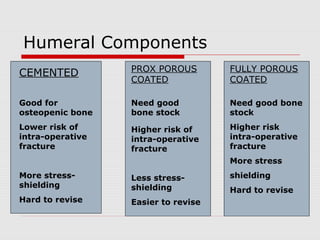
Humeral Components
CEMENTED PROX POROUS
COATED
FULLY POROUS
COATED
Good for
osteopenic bone
Lower risk of
intra-operative
fracture
More stress-
shielding
Hard to revise
Higher risk of
intra-operative
fracture
Less stress-
shielding
Easier to revise
Need good
bone stock
Need good bone
stock
Higher risk
intra-operative
fracture
More stress
shielding
Hard to revise
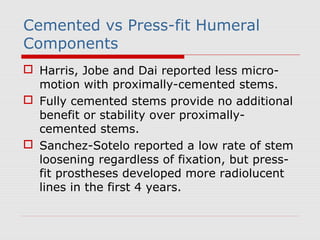
Cemented vs Press-fit Humeral
Components
 Harris, Jobe and Dai reported less micro-
motion with proximally-cemented stems.
 Fully cemented stems provide no additional
benefit or stability over proximally-
cemented stems.
 Sanchez-Sotelo reported a low rate of stem
loosening regardless of fixation, but press-
fit prostheses developed more radiolucent
lines in the first 4 years.
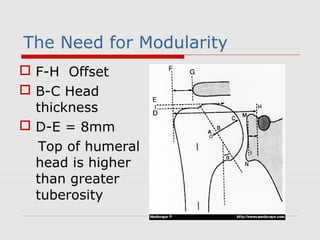
The Need for Modularity
 F-H Offset
 B-C Head
thickness
 D-E = 8mm
Top of humeral
head is higher
than greater
tuberosity
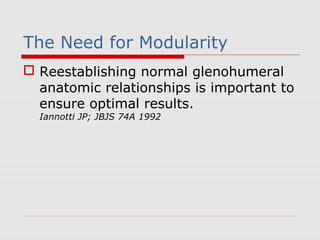
The Need for Modularity
 Reestablishing normal glenohumeral
anatomic relationships is important to
ensure optimal results.
Iannotti JP; JBJS 74A 1992
Other Anatomic Variables to
Consider
 Glenoid : 2° anteversion to
7° retroversion
 Humeral Head: 20° - 40° retroversion
 Axial CT of the glenohumeral joint is
a valuable pre-op planning tool.
Contraindications to Shoulder
Arthroplasty
 Active or recent shoulder joint
infection
 Paralysis with complete loss of rotator
cuff and deltoid function
 A neuropathic arthropathy
 Irreparable rotator cuff tear is a
contraindication to glenoid
resurfacing.
Osteoarthritis
 In addition to the universal features of
osteoarthritic joints (joint space narrowing, cyts,
osteophytes…), the shoulder can also
demonstrate
 Posterior glenoid erosion
 Flattening of the humeral head
 Enlargement of the humeral head
 Rotator cuff tears are uncommon in OA
Hemi vs Total Shoulder
 Easy procedure
 Short Operating time
 Less risk of instability
 Can be revised to TSA
 Less reliable pain relief
 Progressive Glenoid
erosion may cause
results to deteriorate
over time
 Need concentric
glenoid
 More consistent pain
relief
 Better fulcrum for
active motion
 Difficult procedure
 Longer OR time
 Poly wear can cause
loosening of both
components
 More Glenoid bone loss
Recommendation based on
Experience
 Neer, 1998
“When the articular surface of the
glenoid is good, the results of
hemiarthroplasty are similar to those
of TSA. Wear on the glenoid has not
been a problem if the articular
surface was good at the time of
surgery and glenohumeral motion
was re-established”
Recommendations based on
Evidence
Kirkley et al, 2000
 42 pts, 3 surgeons (stratified)
 One year follow-up
 No significant difference in WOSI,
ASES, DASH Constant Score or ROM.
 Trend towards better pain relief with
TSA.
 2 Hemi patients crossed over to TSA
after 1 year follow-up.
Recommendations based on
Evidence
Gartsman, 2000
 51 shoulders
 Average f/u of 35 months
 No difference in ASES or UCLA
scores.
 Significantly better pain relief with
TSA
 3 pts crossed over to TSA by 35
months
A comparison of pain, strength, range of motion, and
functional outcomes after hemiarthroplasty and total
shoulder arthroplasty in patients with osteoarthritis of the
shoulder. A systematic review and meta-analysis.
Bryant D, Litchfield R; J Bone Joint Surg Am. 2005 Sep;87(9):1947-56.
Included 4 RCT’s
Average 2 year follow-up.
TSA resulted in significantly improved UCLA scores, pain relief and
increased forward elevation (by 13°).
This meta-analysis concluded that at 2 years of follow-p, TSA provided
a better functional outcome, however the problems of glenoid
component loosening in the TSA group and progressive glenoid
erosion in the hemi group may affect the eventual long-term
outcome.
Longer follow-up is necessary
Recommendations based on
Evidence
 The results of arthroplasty in osteoarthritis of the
shoulder. Haines JF et al. J Bone Joint Surg Br. 2006 Apr;88(4):496-501
 Prospective study of 124 shoulder arthroplasties for OA
(Hemi and TSA)
 Similar improvement in pain and function in both groups
if rotator cuff was intact . Better results with Hemi if +
rotator cuff tear
 Hemi  Revision at mean of 1.5 years for glenoid
pain
 TSA  Revision at mean of 4.5 years for glenoid
loosening
Technical Issues to Consider
 OA tends to result in posterior glenoid
wear/erosion, which, if accepted, will
lead to a retroverted glenoid
component.
 Compensate by anterior reaming or
placing the humeral component in
LESS retroversion.
 Failure to do so will result in Posterior
Instability
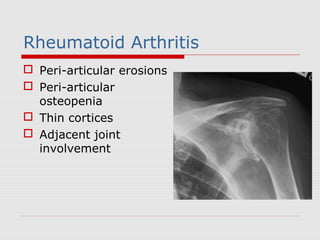
Rheumatoid Arthritis
 Peri-articular erosions
 Peri-articular
osteopenia
 Thin cortices
 Adjacent joint
involvement
Rheumatoid Arthritis
 Cemented short-stemmed prosthesis
 Gill, Cofield et al recommend at least
60mm between the cement mantles
of ipsilateral shoulder and elbow
arthroplasties.
 If this cannot be achieved, join both
cement mantles together.
Rheumatoid Arthritis
 Generally, TSA performed due to
destruction of the glenoid articular
surface by the disease.
 Glenoid erosion may require bone
grafting, however, if glenoid is eroded
to the level of the coracoid process,
glenoid resurfacing is contraindicated
Rotator Cuff Arthropathy
 Described by Neer, Craig and Fukada
in 1983.
 A distinct form of osteoarthritis
associated with a massive chronic
rotator cuff tear.
 Generally, rotator cuff tears occur in
less than 10% of shoulders with OA
Rotator Cuff Arthropathy
 A function of the rotator cuff is to depress
the humeral head and keep it centered on
the glenoid fossa.
 Massive rotator cuff tears result in proximal
migration of the humeral head.
 This is a contraindication to glenoid
resurfacing as it results in eccentric
(superior) glenoid loading and early
component loosening.
Surgical Options
 Hemiarthroplasty with a large head
 Repair of rotator cuff and TSA
 Reverse TSA
 “Clayton Spacer”
Outcomes of Hemiarthroplasty
 Rockwood: 86% satisfactory results
after 4 years
 Zuckerman: 93% adequate pain
relief and 90% had improved function
for ADL’s.
 Sanches-Sotelo: 75% modest
improvements in ROM and strength
for ADL’s. Good pain relief.
Outcomes of Hemiarthroplasty
 Field et al, and Sanchez-Sotelo
reported that impaired deltoid
function and previous subacromial
decompression (loss of
coracoacromial ligament) were
significantly associated with clinical
shoulder instability post
hemiarthroplasty.
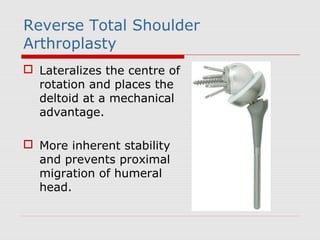
Reverse Total Shoulder
Arthroplasty
 Lateralizes the centre of
rotation and places the
deltoid at a mechanical
advantage.
 More inherent stability
and prevents proximal
migration of humeral
head.
Outcomes of the Reverse Total
Shoulder
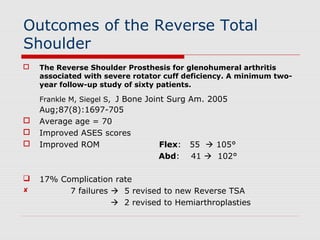
 The Reverse Shoulder Prosthesis for glenohumeral arthritis
associated with severe rotator cuff deficiency. A minimum two-
year follow-up study of sixty patients.
Frankle M, Siegel S, J Bone Joint Surg Am. 2005
Aug;87(8):1697-705
 Average age = 70
 Improved ASES scores
 Improved ROM Flex: 55  105°
Abd: 41  102°
 17% Complication rate
 7 failures  5 revised to new Reverse TSA
 2 revised to Hemiarthroplasties
Outcomes of the Reverse TSA
(Delta III prosthesis)
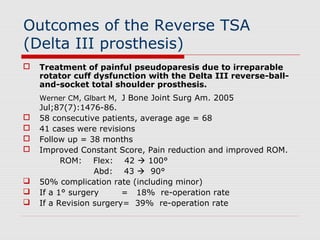
 Treatment of painful pseudoparesis due to irreparable
rotator cuff dysfunction with the Delta III reverse-ball-
and-socket total shoulder prosthesis.
Werner CM, Glbart M, J Bone Joint Surg Am. 2005
Jul;87(7):1476-86.
 58 consecutive patients, average age = 68
 41 cases were revisions
 Follow up = 38 months
 Improved Constant Score, Pain reduction and improved ROM.
ROM: Flex: 42  100°
Abd: 43  90°
 50% complication rate (including minor)
 If a 1° surgery = 18% re-operation rate
 If a Revision surgery= 39% re-operation rate
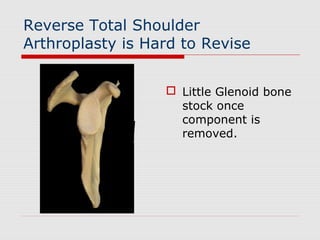
Reverse Total Shoulder
Arthroplasty is Hard to Revise
 Little Glenoid bone
stock once
component is
removed.
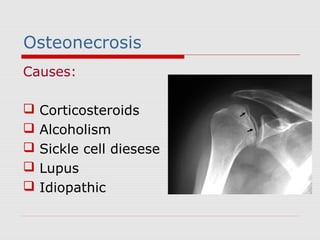
Osteonecrosis
Causes:
 Corticosteroids
 Alcoholism
 Sickle cell diesese
 Lupus
 Idiopathic
Osteonecrosis
 Usually young patients with adequate
bone stock.
 Prefer proximally porous-coated,
press-fit humeral prosthesis.
 less stress-shielding
 easier to revise if necessary
 Only resurface glenoid in stage V
osteonecrosis (glenoid erosion).
Post-Traumatic Arthritis
 Due to fractures treated
conservatively
 May have mal-union of tuberosities,
distorting normal anatomic landmarks
 12% of patients have axillary nerve
palsies (Neer).
 Many have soft-tissue contractures
and muscle weakness
Choice of Prosthesis
Consider
 Patient age
 Condition of glenoid surface and bone
stock
 Axillary nerve palsy is a relative
contraindication to arthroplasty
Complications
 Instability 1.2%
 Excessive Retro/Anteversion
 Head too small
 Head too low (post fracture)
 Subscap rupture
Complications
 Rotator Cuff Tear 2%
 Results in superior migration of
humerus and glenoid loosening
 Glenoid loosening
Complications
 Infection 0.5%
 Staph Aureus
 More common after revision surgery
Complications
 Heterotopic Ossification 10 -45%
 Males
 Dx = osteoarthitis
 Low grade
 Non-progressive
 Does not affect outcome
Sperling, Cofield et al
Complications
 Stiffness
 Depends on indication for
arthroplasty
 Subscap shortening
 Oversized components
 Inappropriate rehab
Complications
 Periprosthetic Fracture
 Intra-op 1%
 Post-op 0.5 - 2%
 Most common in RA
 85% women
 Glenoid fractures are rare
Complications
 Axillary nerve injury
 Rare
 Higher risk during revision surgery
 Usually a neuropraxia
Ultimate Bail -Outs
 Excision Arthroplasty
 Shoulder Arthrodesis
Thank You