





Atraumatic Shoulder
Instability
Mr Mike Walton BMedSci BMBS MSc FRCS(T&O) MFSEM(UK)
Consultant Shoulder Surgeon
Natural Selection
• The ability to throw / hunt
revolutionised our survival
Armed And Deadly: Shoulder,Weapons Key
To Hunt by Christopher Joyce Charles Darwin
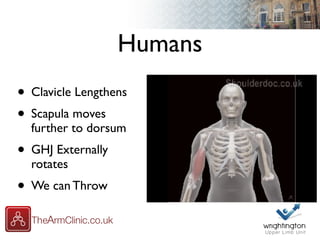
Humans
• Clavicle Lengthens
• Scapula moves
further to dorsum
• GHJ Externally
rotates
• We can Throw
Not Evolved Enough!!!
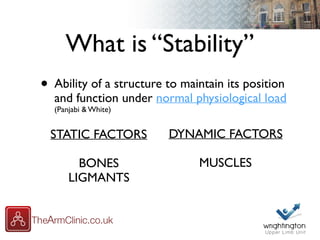
What is “Stability”
What is “Stability”
• Ability of a structure to maintain its position
and function under normal physiological load
(Panjabi & White)
What is “Stability”
• Ability of a structure to maintain its position
and function under normal physiological load
(Panjabi & White)
STATIC FACTORS
BONES
LIGMANTS
DYNAMIC FACTORS
MUSCLES
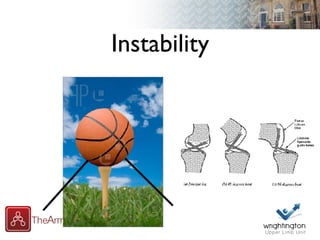
Instability
Instability
Instability
Instability
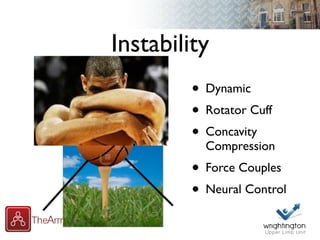
• Dynamic
• Rotator Cuff
• Concavity
Compression
• Force Couples
• Neural Control
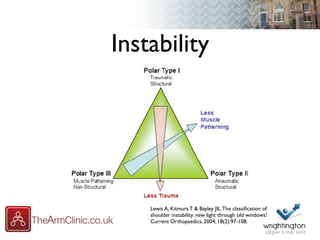
Instability
Lewis A, Kitmura T & Bayley JIL.The classification of
shoulder instability: new light through old windows!
Current Orthopaedics, 2004; 18(2):97-108.
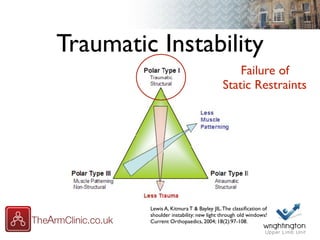
Traumatic Instability
Lewis A, Kitmura T & Bayley JIL.The classification of
shoulder instability: new light through old windows!
Current Orthopaedics, 2004; 18(2):97-108.
Failure of
Static Restraints
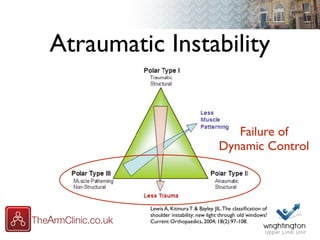
Atraumatic Instability
Lewis A, Kitmura T & Bayley JIL.The classification of
shoulder instability: new light through old windows!
Current Orthopaedics, 2004; 18(2):97-108.
Failure of
Dynamic Control
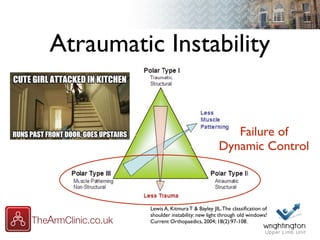
Atraumatic Instability
Lewis A, Kitmura T & Bayley JIL.The classification of
shoulder instability: new light through old windows!
Current Orthopaedics, 2004; 18(2):97-108.
Failure of
Dynamic Control
MDI
• Definition “MultiDirectional Instability”
• Shoulder instability in patients who have
generalised ligamentous laxity [Web Dictionary]
• Abnormal exclusion of the humeral head
on the glenoid in ALL directions [Neer]
• Instability in TWO directions [1,2,3,4]
• Instability in THREE directions [5,6,7]
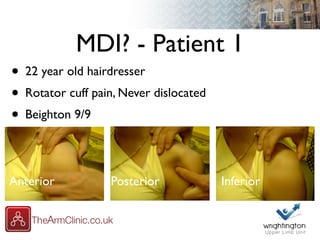
MDI? - Patient 1
• 22 year old hairdresser
• Rotator cuff pain, Never dislocated
• Beighton 9/9
Anterior InferiorPosterior
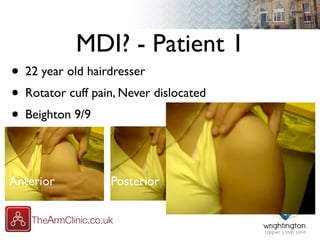
MDI? - Patient 1
• 22 year old hairdresser
• Rotator cuff pain, Never dislocated
• Beighton 9/9
Anterior InferiorPosterior
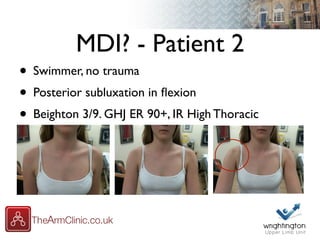
MDI? - Patient 2
• Swimmer, no trauma
• Posterior subluxation in flexion
• Beighton 3/9. GHJ ER 90+, IR High Thoracic
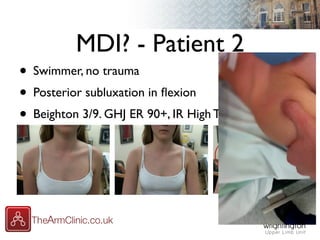
MDI? - Patient 2
• Swimmer, no trauma
• Posterior subluxation in flexion
• Beighton 3/9. GHJ ER 90+, IR High Thoracic
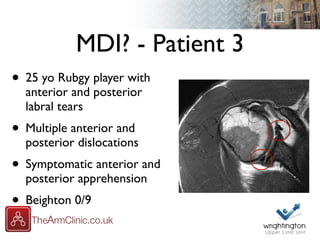
MDI? - Patient 3
• 25 yo Rubgy player with
anterior and posterior
labral tears
• Multiple anterior and
posterior dislocations
• Symptomatic anterior and
posterior apprehension
• Beighton 0/9
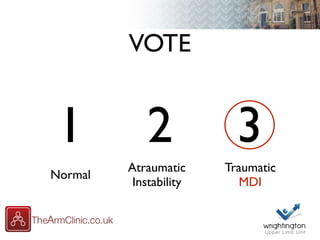
VOTE
1 2 3
VOTE
1 2 3
Atraumatic
Instability
Normal
Traumatic
MDI
Atraumatic Instability
•Symptomatic instability
• usually in one direction
• Absence of significant trauma
• laxity (in multiple directions) a common
finding
MDI
• The use of laxity testing tends to result in an overestimation of the
number of patients with this condition.
• This observation is important because the results of studies may vary if
patients with traumatic instability are considered to have
multidirectional instability on the basis of laxity testing.
• Investigators studying patients with multidirectional instability should
carefully define the inclusion criteria that they used.
Biomechanics
• Absence of static ligament restraint (laxity)
• Failure of cuff control
• Failure of proprioception
• Recruitment of “power muscles’ as
stabilisers
• Imbalance of force couples
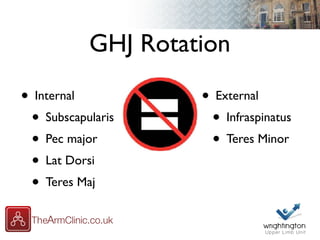
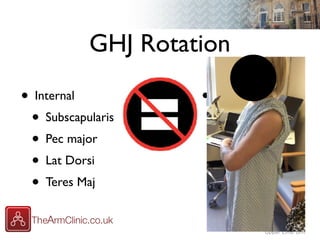
GHJ Rotation
• Internal
• Subscapularis
• Pec major
• Lat Dorsi
• Teres Maj
• External
• Infraspinatus
• Teres Minor
GHJ Rotation
• Internal
• Subscapularis
• Pec major
• Lat Dorsi
• Teres Maj
• External
• Infraspinatus
• Teres Minor
GHJ Rotation
• Internal
• Subscapularis
• Pec major
• Lat Dorsi
• Teres Maj
• External
• Infraspinatus
• Teres Minor
GHJ Rotation
• Internal
• Subscapularis
• Pec major
• Lat Dorsi
• Teres Maj
• External
• Infraspinatus
• Teres Minor
GHJ Rotation
• Internal
• Subscapularis
• Pec major
• Lat Dorsi
• Teres Maj
• External
• Infraspinatus
• Teres Minor
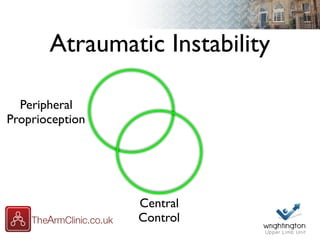
Atraumatic Instability
Peripheral
Proprioception
Central
Control
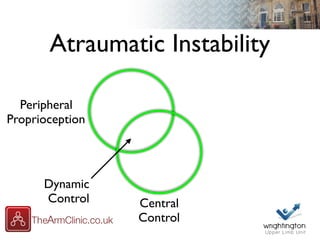
Atraumatic Instability
Peripheral
Proprioception
Central
Control
Dynamic
Control
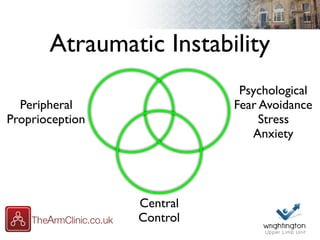
Atraumatic Instability
Peripheral
Proprioception
Central
Control
Psychological
Fear Avoidance
Stress
Anxiety
Assessment (Surgeon)
• Assessment of patient
• Understanding
• Anxiety
• Secondary gain
• Assessment of
dynamic control
• Core stability - hip
control
• Scapula dyskinesis
• Cuff control
HISTORY, HISTORY, HISTORY
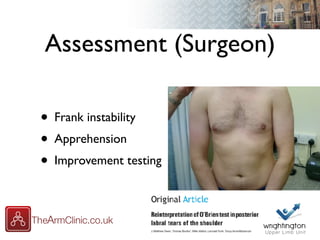
Assessment (Surgeon)
• Frank instability
• Apprehension
• Improvement testing
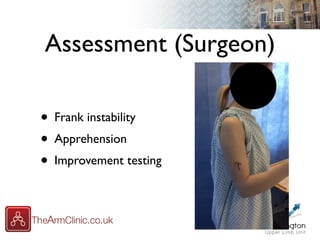
Assessment (Surgeon)
• Frank instability
• Apprehension
• Improvement testing
Management
Management
PHYSIO
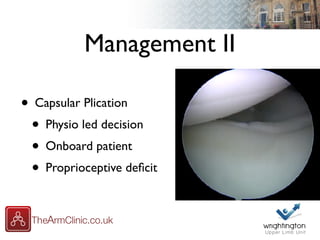
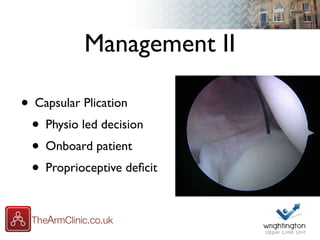
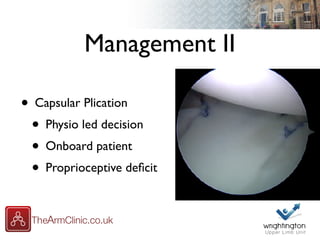
Management II
• Capsular Plication
• Physio led decision
• Onboard patient
• Proprioceptive deficit
Management II
• Capsular Plication
• Physio led decision
• Onboard patient
• Proprioceptive deficit
Management II
• Capsular Plication
• Physio led decision
• Onboard patient
• Proprioceptive deficit
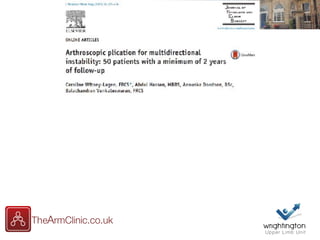
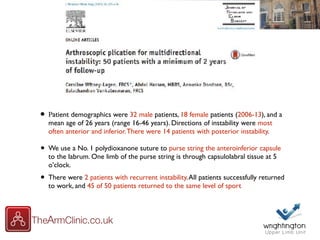
• Patient demographics were 32 male patients, 18 female patients (2006-13), and a
mean age of 26 years (range 16-46 years). Directions of instability were most
often anterior and inferior.There were 14 patients with posterior instability.
• We use a No. 1 polydioxanone suture to purse string the anteroinferior capsule
to the labrum. One limb of the purse string is through capsulolabral tissue at 5
o’clock.
• There were 2 patients with recurrent instability.All patients successfully returned
to work, and 45 of 50 patients returned to the same level of sport
Defining Groups
• Spectrum of pathology and patients
• Well motivated
• Infrequent subluxations
• Labral tears
• Normal tone
Defining Groups
• Hypertonia
• Inability to know in joint
• Preferring out over in
• Secondary gain
• Failure of previous
treatment
• Spectrum of pathology and patients
• Well motivated
• Infrequent subluxations
• Labral tears
• Normal tone
References
1. Altchek DW,Warren RF, Skyhar MJ, Ortiz G.T-plasty modification of the Bankart procedure for multidirectional instability of the
anterior and inferior types. J Bone Joint Surg Am . 1991;73: 105-12.Abstract/FREE Full Text
2. Bak K, Spring BJ, Henderson JP. Inferior capsular shift procedure in athletes with multidirectional instability based on isolated
capsular and ligamentous redundancy.Am J Sports Med . 2000;28: 466-71.Abstract/FREE Full Text
3. Flatow EL, Miniaci A, Evans PJ, Simonian PT,Warren RF. Instability of the shoulder: complex problems and failed repairs: Part II.
Failed repairs. Instr Course Lect . 1998;47: 113-25.Medline
4. Gerber C. Observations on the classification of instability. In:Warner JJP, Iannotti JP, Gerber C, editors. Complex and revision
problems in shoulder surgery . Philadelphia: Lippincott-Raven; 1996. p 9-18.
5. Pagnani MJ,Warren RF,Altchek DW,Wickiewicz TL,Anderson AF.Arthroscopic shoulder stabilization using transglenoid sutures.
A four-year minimum followup.Am J Sports Med . 1996;24: 459-67.
6. Jobe FW,Tibone JE, Pink MM, Jobe CM, Kvitne RS.The shoulder in sports. In: Rockwood CA Jr, Matsen FA 3rd, editors.The
shoulder . 2nd ed. Philadelphia:WB Saunders; 1996. p 1214-38.
7. Neer CS 2nd. Involuntary inferior and multidirectional instability of the shoulder: etiology, recognition, and treatment. Instr
Course Lect . 1985;34: 232-8
8. Pollock RG, Owens JM, Flatow EL, Bigliani LU. Operative results of the inferior capsular shift procedure for multidirectional
instability of the shoulder. J Bone Joint Surg Am . 2000;82: 919-2

Atraumatic Shoulder Instability

  • 1.
    Atraumatic Shoulder Instability Mr MikeWalton BMedSci BMBS MSc FRCS(T&O) MFSEM(UK) Consultant Shoulder Surgeon
  • 2.
    Natural Selection • Theability to throw / hunt revolutionised our survival Armed And Deadly: Shoulder,Weapons Key To Hunt by Christopher Joyce Charles Darwin
  • 3.
    Humans • Clavicle Lengthens •Scapula moves further to dorsum • GHJ Externally rotates • We can Throw
  • 4.
  • 5.
  • 6.
    What is “Stability” •Ability of a structure to maintain its position and function under normal physiological load (Panjabi & White)
  • 7.
    What is “Stability” •Ability of a structure to maintain its position and function under normal physiological load (Panjabi & White) STATIC FACTORS BONES LIGMANTS DYNAMIC FACTORS MUSCLES
  • 8.
  • 9.
  • 10.
  • 11.
    Instability • Dynamic • RotatorCuff • Concavity Compression • Force Couples • Neural Control
  • 12.
    Instability Lewis A, KitmuraT & Bayley JIL.The classification of shoulder instability: new light through old windows! Current Orthopaedics, 2004; 18(2):97-108.
  • 13.
    Traumatic Instability Lewis A,Kitmura T & Bayley JIL.The classification of shoulder instability: new light through old windows! Current Orthopaedics, 2004; 18(2):97-108. Failure of Static Restraints
  • 14.
    Atraumatic Instability Lewis A,Kitmura T & Bayley JIL.The classification of shoulder instability: new light through old windows! Current Orthopaedics, 2004; 18(2):97-108. Failure of Dynamic Control
  • 15.
    Atraumatic Instability Lewis A,Kitmura T & Bayley JIL.The classification of shoulder instability: new light through old windows! Current Orthopaedics, 2004; 18(2):97-108. Failure of Dynamic Control
  • 16.
    MDI • Definition “MultiDirectionalInstability” • Shoulder instability in patients who have generalised ligamentous laxity [Web Dictionary] • Abnormal exclusion of the humeral head on the glenoid in ALL directions [Neer] • Instability in TWO directions [1,2,3,4] • Instability in THREE directions [5,6,7]
  • 17.
    MDI? - Patient1 • 22 year old hairdresser • Rotator cuff pain, Never dislocated • Beighton 9/9 Anterior InferiorPosterior
  • 18.
    MDI? - Patient1 • 22 year old hairdresser • Rotator cuff pain, Never dislocated • Beighton 9/9 Anterior InferiorPosterior
  • 19.
    MDI? - Patient2 • Swimmer, no trauma • Posterior subluxation in flexion • Beighton 3/9. GHJ ER 90+, IR High Thoracic
  • 20.
    MDI? - Patient2 • Swimmer, no trauma • Posterior subluxation in flexion • Beighton 3/9. GHJ ER 90+, IR High Thoracic
  • 21.
    MDI? - Patient3 • 25 yo Rubgy player with anterior and posterior labral tears • Multiple anterior and posterior dislocations • Symptomatic anterior and posterior apprehension • Beighton 0/9
  • 22.
  • 23.
  • 24.
    Atraumatic Instability •Symptomatic instability •usually in one direction • Absence of significant trauma • laxity (in multiple directions) a common finding MDI
  • 25.
    • The useof laxity testing tends to result in an overestimation of the number of patients with this condition. • This observation is important because the results of studies may vary if patients with traumatic instability are considered to have multidirectional instability on the basis of laxity testing. • Investigators studying patients with multidirectional instability should carefully define the inclusion criteria that they used.
  • 26.
    Biomechanics • Absence ofstatic ligament restraint (laxity) • Failure of cuff control • Failure of proprioception • Recruitment of “power muscles’ as stabilisers • Imbalance of force couples
  • 27.
    GHJ Rotation • Internal •Subscapularis • Pec major • Lat Dorsi • Teres Maj • External • Infraspinatus • Teres Minor
  • 28.
    GHJ Rotation • Internal •Subscapularis • Pec major • Lat Dorsi • Teres Maj • External • Infraspinatus • Teres Minor
  • 29.
    GHJ Rotation • Internal •Subscapularis • Pec major • Lat Dorsi • Teres Maj • External • Infraspinatus • Teres Minor
  • 30.
    GHJ Rotation • Internal •Subscapularis • Pec major • Lat Dorsi • Teres Maj • External • Infraspinatus • Teres Minor
  • 31.
    GHJ Rotation • Internal •Subscapularis • Pec major • Lat Dorsi • Teres Maj • External • Infraspinatus • Teres Minor
  • 32.
  • 33.
  • 34.
  • 35.
    Assessment (Surgeon) • Assessmentof patient • Understanding • Anxiety • Secondary gain • Assessment of dynamic control • Core stability - hip control • Scapula dyskinesis • Cuff control HISTORY, HISTORY, HISTORY
  • 36.
    Assessment (Surgeon) • Frankinstability • Apprehension • Improvement testing
  • 37.
    Assessment (Surgeon) • Frankinstability • Apprehension • Improvement testing
  • 38.
  • 39.
  • 40.
    Management II • CapsularPlication • Physio led decision • Onboard patient • Proprioceptive deficit
  • 41.
    Management II • CapsularPlication • Physio led decision • Onboard patient • Proprioceptive deficit
  • 42.
    Management II • CapsularPlication • Physio led decision • Onboard patient • Proprioceptive deficit
  • 44.
    • Patient demographicswere 32 male patients, 18 female patients (2006-13), and a mean age of 26 years (range 16-46 years). Directions of instability were most often anterior and inferior.There were 14 patients with posterior instability. • We use a No. 1 polydioxanone suture to purse string the anteroinferior capsule to the labrum. One limb of the purse string is through capsulolabral tissue at 5 o’clock. • There were 2 patients with recurrent instability.All patients successfully returned to work, and 45 of 50 patients returned to the same level of sport
  • 45.
    Defining Groups • Spectrumof pathology and patients • Well motivated • Infrequent subluxations • Labral tears • Normal tone
  • 46.
    Defining Groups • Hypertonia •Inability to know in joint • Preferring out over in • Secondary gain • Failure of previous treatment • Spectrum of pathology and patients • Well motivated • Infrequent subluxations • Labral tears • Normal tone
  • 48.
    References 1. Altchek DW,WarrenRF, Skyhar MJ, Ortiz G.T-plasty modification of the Bankart procedure for multidirectional instability of the anterior and inferior types. J Bone Joint Surg Am . 1991;73: 105-12.Abstract/FREE Full Text 2. Bak K, Spring BJ, Henderson JP. Inferior capsular shift procedure in athletes with multidirectional instability based on isolated capsular and ligamentous redundancy.Am J Sports Med . 2000;28: 466-71.Abstract/FREE Full Text 3. Flatow EL, Miniaci A, Evans PJ, Simonian PT,Warren RF. Instability of the shoulder: complex problems and failed repairs: Part II. Failed repairs. Instr Course Lect . 1998;47: 113-25.Medline 4. Gerber C. Observations on the classification of instability. In:Warner JJP, Iannotti JP, Gerber C, editors. Complex and revision problems in shoulder surgery . Philadelphia: Lippincott-Raven; 1996. p 9-18. 5. Pagnani MJ,Warren RF,Altchek DW,Wickiewicz TL,Anderson AF.Arthroscopic shoulder stabilization using transglenoid sutures. A four-year minimum followup.Am J Sports Med . 1996;24: 459-67. 6. Jobe FW,Tibone JE, Pink MM, Jobe CM, Kvitne RS.The shoulder in sports. In: Rockwood CA Jr, Matsen FA 3rd, editors.The shoulder . 2nd ed. Philadelphia:WB Saunders; 1996. p 1214-38. 7. Neer CS 2nd. Involuntary inferior and multidirectional instability of the shoulder: etiology, recognition, and treatment. Instr Course Lect . 1985;34: 232-8 8. Pollock RG, Owens JM, Flatow EL, Bigliani LU. Operative results of the inferior capsular shift procedure for multidirectional instability of the shoulder. J Bone Joint Surg Am . 2000;82: 919-2