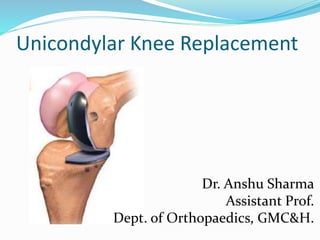
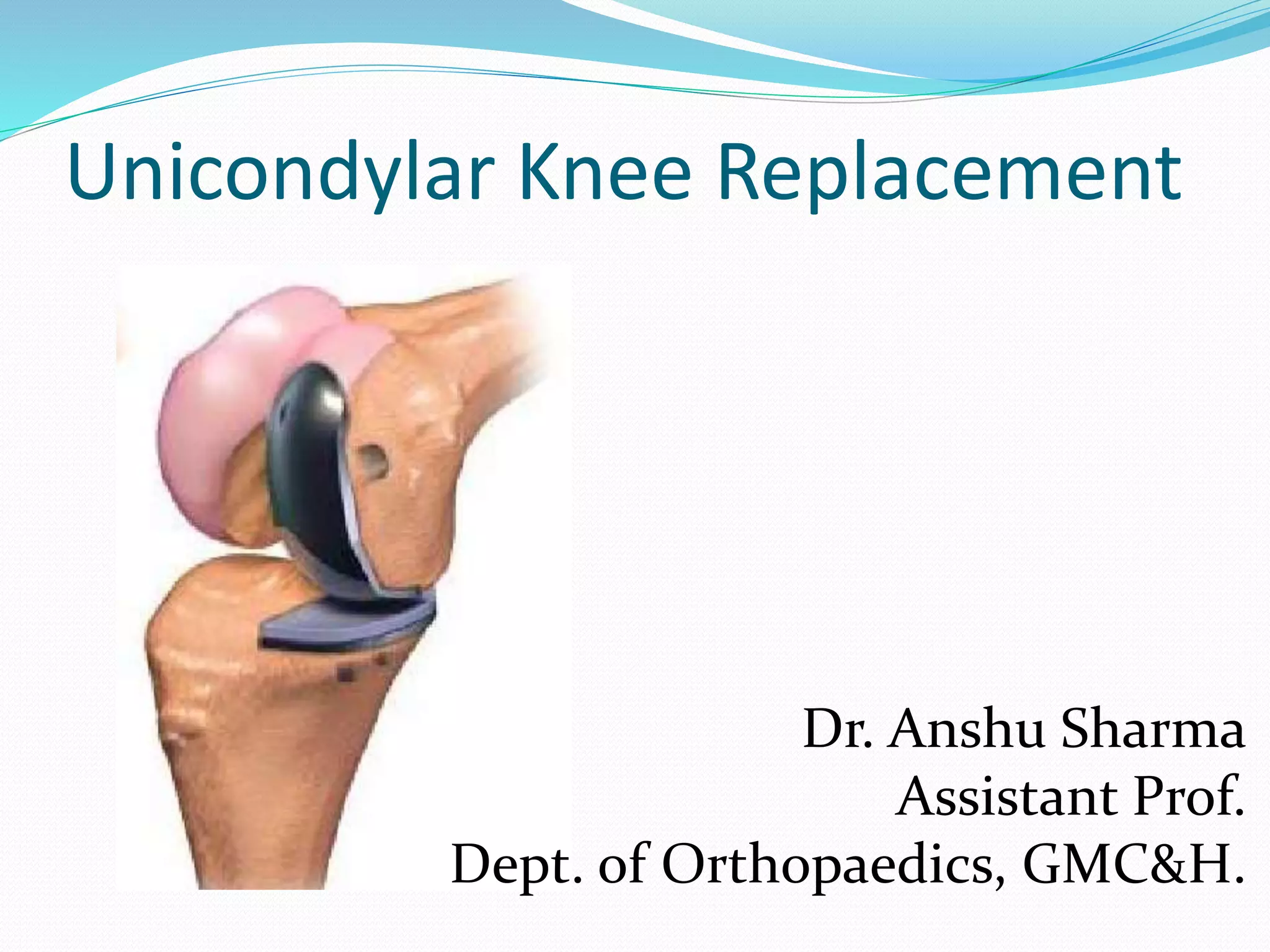
Unicondylar Knee Replacement
Dr. Anshu Sharma
Assistant Prof.
Dept. of Orthopaedics, GMC&H.
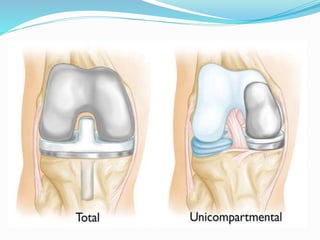
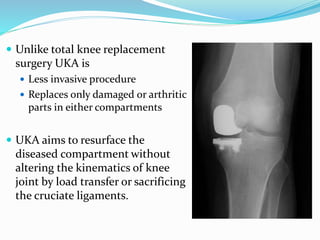
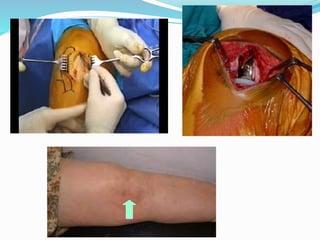
 Unlike total knee replacement
surgery UKA is
 Less invasive procedure
 Replaces only damaged or arthritic
parts in either compartments
 UKA aims to resurface the
diseased compartment without
altering the kinematics of knee
joint by load transfer or sacrificing
the cruciate ligaments.
Indications of UKA
 Clinically:-
-Pain and tenderness localized to one side of joint line,
-Flexion Arc greater than 90*,
-FFD less than 10*,
-Passively correctable deformity,
-Intact ACL.
 Radiologically:-
-Isolated Uni-compartmental OA,
-Varus deformity <10* or Valgus deformity<5*,
-Insignificant degenerative changes in opposite compartment.
Contraindications of UKA
 OA involving both compartments ,
 Absence of an intact ACL,
 Inflammatory Arthritis,
 Crystal deposition induced Arthritis,
 Full thickness patellar cartilage loss,
 Previous HTO,
 Previous Patellectomy,
 BMI >30 kg/m2.
Procedural tips:
 Avoid overcorrections
 undercorrect the mechanical axis by 2-3 degrees
 overcorrection places excess load on unresurfaced
compartment.
 Remove osteophytes (peripheral and notch)
 Resect minimal bone
 Avoid extensive soft tissue releases
 Avoid edge loading
 Prevent tibial spine impingement with proper
mediolateral placement.
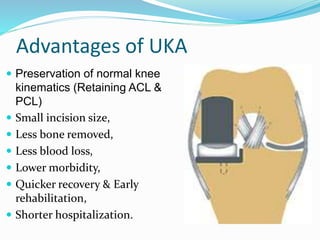
Advantages of UKA
 Preservation of normal knee
kinematics (Retaining ACL &
PCL)
 Small incision size,
 Less bone removed,
 Less blood loss,
 Lower morbidity,
 Quicker recovery & Early
rehabilitation,
 Shorter hospitalization.
Disadvantages of UKA
 Inferior survivorship,
 Secondary degeneration of opposite compartment,
 Patella impingement on femoral component (patella
pain),
 Stress fracture almost always involving Tibia,
 Tibial component collapse due to poor mechanical
properties of bone,
 Component loosening,
 Polyethylene wear.
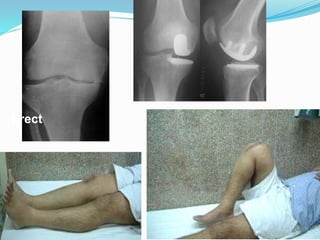
Erect
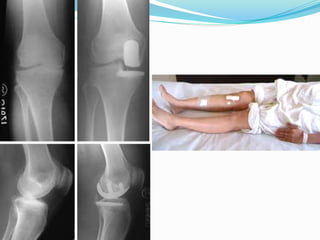
Postop xrays
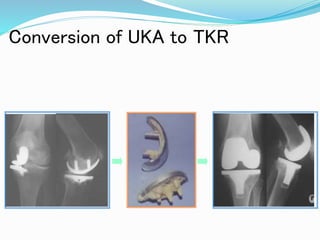
Conversion of UKA to TKR
THANK YOU……!!!!

Unicondylar knee replacement

  • 1.
    Unicondylar Knee Replacement Dr.Anshu Sharma Assistant Prof. Dept. of Orthopaedics, GMC&H.
  • 3.
     Unlike totalknee replacement surgery UKA is  Less invasive procedure  Replaces only damaged or arthritic parts in either compartments  UKA aims to resurface the diseased compartment without altering the kinematics of knee joint by load transfer or sacrificing the cruciate ligaments.
  • 4.
    Indications of UKA Clinically:- -Pain and tenderness localized to one side of joint line, -Flexion Arc greater than 90*, -FFD less than 10*, -Passively correctable deformity, -Intact ACL.  Radiologically:- -Isolated Uni-compartmental OA, -Varus deformity <10* or Valgus deformity<5*, -Insignificant degenerative changes in opposite compartment.
  • 5.
    Contraindications of UKA OA involving both compartments ,  Absence of an intact ACL,  Inflammatory Arthritis,  Crystal deposition induced Arthritis,  Full thickness patellar cartilage loss,  Previous HTO,  Previous Patellectomy,  BMI >30 kg/m2.
  • 7.
    Procedural tips:  Avoidovercorrections  undercorrect the mechanical axis by 2-3 degrees  overcorrection places excess load on unresurfaced compartment.  Remove osteophytes (peripheral and notch)  Resect minimal bone  Avoid extensive soft tissue releases  Avoid edge loading  Prevent tibial spine impingement with proper mediolateral placement.
  • 8.
    Advantages of UKA Preservation of normal knee kinematics (Retaining ACL & PCL)  Small incision size,  Less bone removed,  Less blood loss,  Lower morbidity,  Quicker recovery & Early rehabilitation,  Shorter hospitalization.
  • 9.
    Disadvantages of UKA Inferior survivorship,  Secondary degeneration of opposite compartment,  Patella impingement on femoral component (patella pain),  Stress fracture almost always involving Tibia,  Tibial component collapse due to poor mechanical properties of bone,  Component loosening,  Polyethylene wear.
  • 11.
  • 12.
  • 13.

Editor's Notes

  • #2 Unicondylar> replaces only half of the knee joint when damage is limited to one side of the knee,