MDI 
What is it? 
Should we Operate? 
Lennard Funk 
@theshoulderdoc 
lenfunk@shoulderdoc.co.uk
www.wrightington.com 
2
? MDI 
www.wrightington.com 
3 
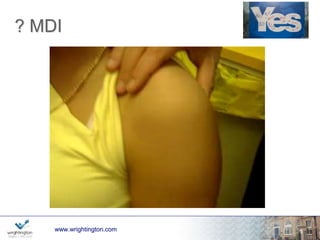
22yr secretary, asymptomatic 
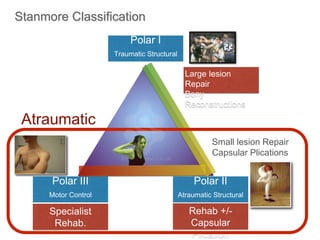
Hyperlax in all directions 
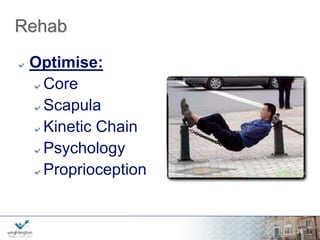
ANTERIOR 
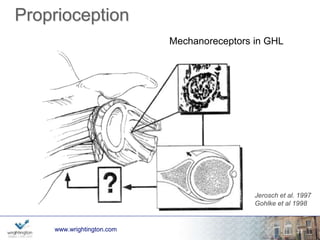
POSTERIOR INFERIOR
?MDI 
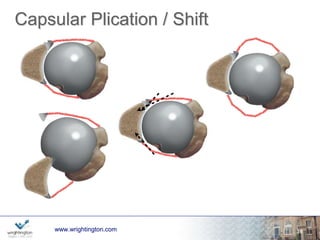
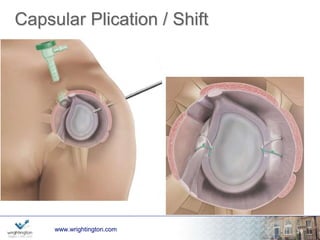
www.wrightington.com 
4 
17yr old swimmer - overstretch in pool 
Subluxing posterior in flexion and painful
?MDI 
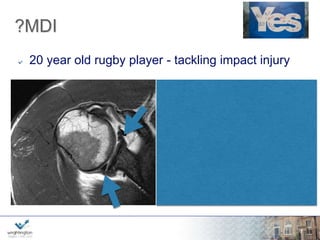
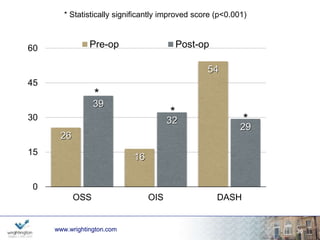
20 year old rugby player - tackling impact injury 
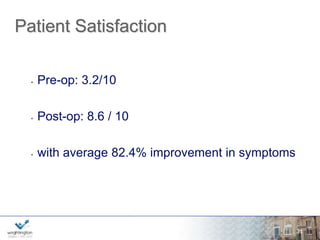
Pain & dead arm; feels unstable 
Large anterior and posterior labral tears 
wwwwww.w.wrigrhigtinhgttionng.ctoomn.com 
5
MDI - Definitions? 
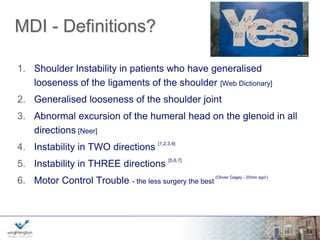
1. Shoulder Instability in patients who have generalised 
looseness of the ligaments of the shoulder [Web Dictionary] 
2. Generalised looseness of the shoulder joint 
3. Abnormal excursion of the humeral head on the glenoid in all 
directions [Neer] 
4. Instability in TWO directions [1,2,3,4] 
5. Instability in THREE directions [5,6,7] 
6. Motor Control Trouble - the less surgery the best 
wwwwww.w.wrigrhigtinhgttionng.ctoomn.com 
(Olivier Gagey - 20min ago!) 
6
wwwwww.w.wrigrhigtinhgttionng.ctoomn.com 
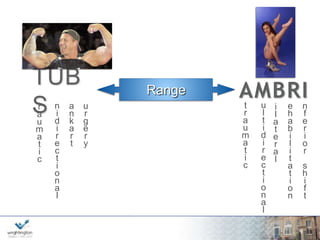
nferior 
shift 
eh 
abilitation 
ilateral 
ultidirection 
al 
traumatic 
Range AMBRI 
TUBS 
7 
urgery 
ankart 
nidirectional 
umatic 
ra
The use of laxity testing tends to result in an overestimation of the 
number of patients with this condition. 
This observation is important because the results of studies may vary 
if patients with traumatic instability are considered to have 
multidirectional instability on the basis of laxity testing. 
Investigators studying patients with multidirectional instability should 
carefully define the inclusion criteria that they used. 
wwwwww.w.wrigrhigtinhgttionng.ctoomn.com 
8
Uncontrollable, involuntary inferior subluxation 
or dislocation, associated with both anterior and 
posterior dislocations or subluxations of the 
shoulder. 
wwwwww.w.wrigrhigtinhgttionng.ctoomn.com 
9
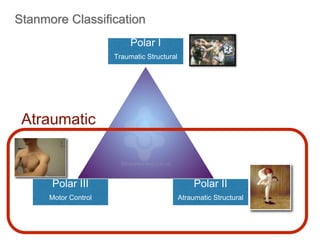
Stanmore Classification 
Atraumatic 
wwwwww.w.wrigrhigtinhgttionng.ctoomn.com 
11 
Polar I 
Traumatic Structural 
Polar II 
Atraumatic Structural 
Polar III 
Motor Control
What is it? 
www.wrightington.com 
12 
• Shoulder Instability in patients who have generalised 
looseness of the ligaments of the shoulder [Web Dictionary] 
• Atraumatic 
• Multidirectional laxity 
• Uni/Multidirectional Instability
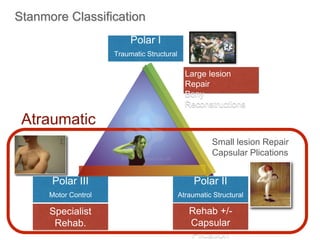
Stanmore Classification 
Atraumatic 
wwwwww.w.wrigrhigtinhgttionng.ctoomn.com 
13 
Small lesion Repair 
Capsular Plications 
Polar I 
Traumatic Structural 
Polar II 
Atraumatic Structural 
Polar III 
Motor Control 
Large lesion Repair 
Bony Reconstructions 
Rehab +/- 
Capsular Plication 
Specialist 
Rehab.
Rehab 
Optimise: 
Core 
Scapula 
Kinetic Chain 
Psychology 
Proprioception 
wwwwww.w.wrigrhigtinhgttionng.ctoomn.com 
14
Proprioception 
www.wrightington.com 
15 
Mechanoreceptors in GHL 
Jerosch et al. 1997 
Gohlke et al 1998
www.wrightington.com 
16 
Capsular Plication / Shift
Capsular Plication / Shift 
www.wrightington.com 
17
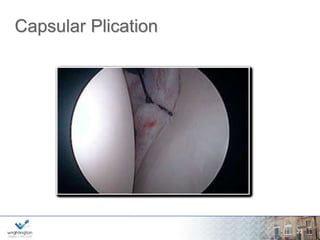
Capsular Plication 
wwwwww.w.wrigrhigtinhgttionng.ctoomn.com 
20
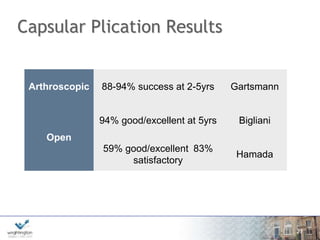
Capsular Plication Results 
Arthroscopic 88-94% success at 2-5yrs Gartsmann 
Open 
94% good/excellent at 5yrs Bigliani 
59% good/excellent 
83% satisfactory 
Hamada 
wwwwww.w.wrigrhigtinhgttionng.ctoomn.com 25
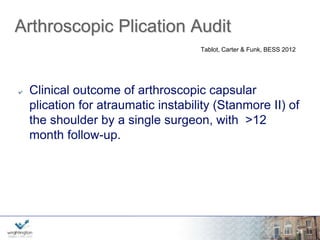
Arthroscopic Plication Audit 
Clinical outcome of arthroscopic capsular 
plication for atraumatic instability (Stanmore II) 
of the shoulder by a single surgeon, with >12 
month follow-up. 
wwwwww.w.wrigrhigtinhgttionng.ctoomn.com 
26 
Tablot, Carter & Funk, BESS 2012
Patients 
• 23 patients (16 ) 
• Average age 27 (19 – 41 years) 
• Follow-up – 15.6 months (range 4 - 40 months) 
• Previous Thermal Capsular Shrinkage: 6 
• Average Pre-Op Specialist Physio: 5.4 months 
wwwwww.w.wrigrhigtinhgttionng.ctoomn.com 
27
Pre-op Post-op 
* 
www.wrightington.com 
28 
* Statistically significantly improved score (p<0.001) 
26 
16 
54 
39 
* 
32 
* 
29 
60. 
45. 
30. 
15. 
0. 
OSS OIS DASH
Patient Satisfaction 
• Pre-op: 3.2/10 
• Post-op: 8.6 / 10 
• with average 82.4% improvement in symptoms 
wwwwww.w.wrigrhigtinhgttionng.ctoomn.com 
29
Stanmore Classification 
Atraumatic 
wwwwww.w.wrigrhigtinhgttionng.ctoomn.com 
30 
Small lesion Repair 
Capsular Plications 
Polar I 
Traumatic Structural 
Polar II 
Atraumatic Structural 
Polar III 
Motor Control 
Large lesion Repair 
Bony 
Reconstructions 
Rehab +/- 
Capsular Plication 
Specialist 
Rehab.
Atraumatic shoulder instability 
Randomized Controlled Trial 
Does stabilisation surgery followed by 
physiotherapy improve short & long term 
outcomes compared with physiotherapy alone? 
Associate Professor Karen Ginn 
Ms Anju Jaggi 
Dr Susan Alexander 
Professor Len Funk 
Professor Rob Herbert 
Associate Professor Karen Ginn
Karen Ginn 
Rob Herbert 
Anju Jaggi 
Susan Alexander 
Len Funk
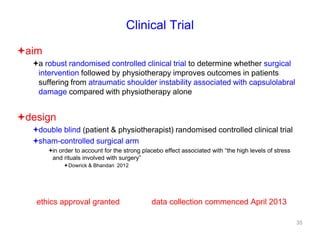
Clinical Trial 
 aim 
a robust randomised controlled clinical trial to determine whether surgical 
intervention followed by physiotherapy improves outcomes in patients 
suffering from atraumatic shoulder instability associated with capsulolabral 
damage compared with physiotherapy alone 
 design 
double blind (patient & physiotherapist) randomised controlled clinical trial 
sham-controlled surgical arm 
in order to account for the strong placebo effect associated with “the high levels of stress and 
rituals involved with surgery” 
Dowrick & Bhandari 2012 
33 
ethics approval granted data collection commenced April 2013
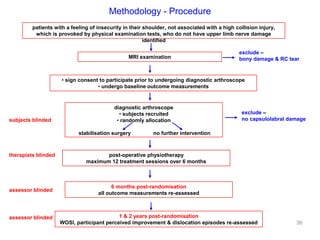
Methodology - Procedure 
exclude – 
bony damage & RC tear 
subjects blinded no capsulolabral damage 
34 
patients with a feeling of insecurity in their shoulder, not associated with a high collision injury, 
which is provoked by physical examination tests, who do not have upper limb nerve damage 
identified 
MRI examination 
• sign consent to participate prior to undergoing diagnostic arthroscope 
• undergo baseline outcome measurements 
diagnostic arthroscope 
• subjects recruited 
• randomly allocation 
stabilisation surgery no further intervention 
post-operative physiotherapy 
maximum 12 treatment sessions over 6 months 
6 months post-randomisation 
all outcome measurements re-assessed 
1 & 2 years post-randomisation 
exclude – 
WOSI, participant perceived improvement & dislocation episodes re-assessed 
therapists blinded 
assessor blinded 
assessor blinded
Thank You 
www.wrightington.com 
39 
lenfunk@shoulderdoc.co.uk
http://www.salford.ac.uk/spd/coursede 
www.wrightington.com 
40 
tails?courseid=THESCAfQ7Q
References: 
1.Altchek DW, Warren RF, Skyhar MJ, Ortiz G. T-plasty modification of the Bankart procedure for multidirectional 
instability of the anterior and inferior types. J Bone Joint Surg Am . 1991;73: 105-12.Abstract/FREE Full Text 
2. Bak K, Spring BJ, Henderson JP. Inferior capsular shift procedure in athletes with multidirectional instability based on 
isolated capsular and ligamentous redundancy. Am J Sports Med . 2000;28: 466-71.Abstract/FREE Full Text 
3. Flatow EL, Miniaci A, Evans PJ, Simonian PT, Warren RF. Instability of the shoulder: complex problems and failed 
repairs: Part II. Failed repairs. Instr Course Lect . 1998;47: 113-25.Medline 
4.Gerber C. Observations on the classification of instability. In: Warner JJP, Iannotti JP, Gerber C, editors. Complex and 
revision problems in shoulder surgery . Philadelphia: Lippincott-Raven; 1996. p 9-18. 
5.Pagnani MJ, Warren RF, Altchek DW, Wickiewicz TL, Anderson AF. Arthroscopic shoulder stabilization using 
transglenoid sutures. A four-year minimum followup. Am J Sports Med . 1996;24: 459-67. 
6. Jobe FW, Tibone JE, Pink MM, Jobe CM, Kvitne RS. The shoulder in sports. In: Rockwood CA Jr, Matsen FA 3rd, 
editors. The shoulder . 2nd ed. Philadelphia: WB Saunders; 1996. p 1214-38. 
7. Neer CS 2nd. Involuntary inferior and multidirectional instability of the shoulder: etiology, recognition, and treatment. 
Instr Course Lect . 1985;34: 232-8 
8.Pollock RG, Owens JM, Flatow EL, Bigliani LU. Operative results of the inferior capsular shift procedure for 
multidirectional instability of the shoulder. J Bone Joint Surg Am . 2000;82: 919-28 
wwwwww.w.wrigrhigtinhgttionng.ctoomn.com 
41

Multidirectional instability of the shoulder 2014

  • 1.
    MDI What isit? Should we Operate? Lennard Funk @theshoulderdoc lenfunk@shoulderdoc.co.uk
  • 2.
  • 3.
    ? MDI www.wrightington.com 3 22yr secretary, asymptomatic Hyperlax in all directions ANTERIOR POSTERIOR INFERIOR
  • 4.
    ?MDI www.wrightington.com 4 17yr old swimmer - overstretch in pool Subluxing posterior in flexion and painful
  • 5.
    ?MDI 20 yearold rugby player - tackling impact injury Pain & dead arm; feels unstable Large anterior and posterior labral tears wwwwww.w.wrigrhigtinhgttionng.ctoomn.com 5
  • 6.
    MDI - Definitions? 1. Shoulder Instability in patients who have generalised looseness of the ligaments of the shoulder [Web Dictionary] 2. Generalised looseness of the shoulder joint 3. Abnormal excursion of the humeral head on the glenoid in all directions [Neer] 4. Instability in TWO directions [1,2,3,4] 5. Instability in THREE directions [5,6,7] 6. Motor Control Trouble - the less surgery the best wwwwww.w.wrigrhigtinhgttionng.ctoomn.com (Olivier Gagey - 20min ago!) 6
  • 7.
    wwwwww.w.wrigrhigtinhgttionng.ctoomn.com nferior shift eh abilitation ilateral ultidirection al traumatic Range AMBRI TUBS 7 urgery ankart nidirectional umatic ra
  • 8.
    The use oflaxity testing tends to result in an overestimation of the number of patients with this condition. This observation is important because the results of studies may vary if patients with traumatic instability are considered to have multidirectional instability on the basis of laxity testing. Investigators studying patients with multidirectional instability should carefully define the inclusion criteria that they used. wwwwww.w.wrigrhigtinhgttionng.ctoomn.com 8
  • 9.
    Uncontrollable, involuntary inferiorsubluxation or dislocation, associated with both anterior and posterior dislocations or subluxations of the shoulder. wwwwww.w.wrigrhigtinhgttionng.ctoomn.com 9
  • 10.
    Stanmore Classification Atraumatic wwwwww.w.wrigrhigtinhgttionng.ctoomn.com 11 Polar I Traumatic Structural Polar II Atraumatic Structural Polar III Motor Control
  • 11.
    What is it? www.wrightington.com 12 • Shoulder Instability in patients who have generalised looseness of the ligaments of the shoulder [Web Dictionary] • Atraumatic • Multidirectional laxity • Uni/Multidirectional Instability
  • 12.
    Stanmore Classification Atraumatic wwwwww.w.wrigrhigtinhgttionng.ctoomn.com 13 Small lesion Repair Capsular Plications Polar I Traumatic Structural Polar II Atraumatic Structural Polar III Motor Control Large lesion Repair Bony Reconstructions Rehab +/- Capsular Plication Specialist Rehab.
  • 13.
    Rehab Optimise: Core Scapula Kinetic Chain Psychology Proprioception wwwwww.w.wrigrhigtinhgttionng.ctoomn.com 14
  • 14.
    Proprioception www.wrightington.com 15 Mechanoreceptors in GHL Jerosch et al. 1997 Gohlke et al 1998
  • 15.
  • 16.
    Capsular Plication /Shift www.wrightington.com 17
  • 17.
  • 18.
    Capsular Plication Results Arthroscopic 88-94% success at 2-5yrs Gartsmann Open 94% good/excellent at 5yrs Bigliani 59% good/excellent 83% satisfactory Hamada wwwwww.w.wrigrhigtinhgttionng.ctoomn.com 25
  • 19.
    Arthroscopic Plication Audit Clinical outcome of arthroscopic capsular plication for atraumatic instability (Stanmore II) of the shoulder by a single surgeon, with >12 month follow-up. wwwwww.w.wrigrhigtinhgttionng.ctoomn.com 26 Tablot, Carter & Funk, BESS 2012
  • 20.
    Patients • 23patients (16 ) • Average age 27 (19 – 41 years) • Follow-up – 15.6 months (range 4 - 40 months) • Previous Thermal Capsular Shrinkage: 6 • Average Pre-Op Specialist Physio: 5.4 months wwwwww.w.wrigrhigtinhgttionng.ctoomn.com 27
  • 21.
    Pre-op Post-op * www.wrightington.com 28 * Statistically significantly improved score (p<0.001) 26 16 54 39 * 32 * 29 60. 45. 30. 15. 0. OSS OIS DASH
  • 22.
    Patient Satisfaction •Pre-op: 3.2/10 • Post-op: 8.6 / 10 • with average 82.4% improvement in symptoms wwwwww.w.wrigrhigtinhgttionng.ctoomn.com 29
  • 23.
    Stanmore Classification Atraumatic wwwwww.w.wrigrhigtinhgttionng.ctoomn.com 30 Small lesion Repair Capsular Plications Polar I Traumatic Structural Polar II Atraumatic Structural Polar III Motor Control Large lesion Repair Bony Reconstructions Rehab +/- Capsular Plication Specialist Rehab.
  • 24.
    Atraumatic shoulder instability Randomized Controlled Trial Does stabilisation surgery followed by physiotherapy improve short & long term outcomes compared with physiotherapy alone? Associate Professor Karen Ginn Ms Anju Jaggi Dr Susan Alexander Professor Len Funk Professor Rob Herbert Associate Professor Karen Ginn
  • 25.
    Karen Ginn RobHerbert Anju Jaggi Susan Alexander Len Funk
  • 26.
    Clinical Trial aim a robust randomised controlled clinical trial to determine whether surgical intervention followed by physiotherapy improves outcomes in patients suffering from atraumatic shoulder instability associated with capsulolabral damage compared with physiotherapy alone  design double blind (patient & physiotherapist) randomised controlled clinical trial sham-controlled surgical arm in order to account for the strong placebo effect associated with “the high levels of stress and rituals involved with surgery” Dowrick & Bhandari 2012 33 ethics approval granted data collection commenced April 2013
  • 27.
    Methodology - Procedure exclude – bony damage & RC tear subjects blinded no capsulolabral damage 34 patients with a feeling of insecurity in their shoulder, not associated with a high collision injury, which is provoked by physical examination tests, who do not have upper limb nerve damage identified MRI examination • sign consent to participate prior to undergoing diagnostic arthroscope • undergo baseline outcome measurements diagnostic arthroscope • subjects recruited • randomly allocation stabilisation surgery no further intervention post-operative physiotherapy maximum 12 treatment sessions over 6 months 6 months post-randomisation all outcome measurements re-assessed 1 & 2 years post-randomisation exclude – WOSI, participant perceived improvement & dislocation episodes re-assessed therapists blinded assessor blinded assessor blinded
  • 28.
    Thank You www.wrightington.com 39 lenfunk@shoulderdoc.co.uk
  • 29.
  • 30.
    References: 1.Altchek DW,Warren RF, Skyhar MJ, Ortiz G. T-plasty modification of the Bankart procedure for multidirectional instability of the anterior and inferior types. J Bone Joint Surg Am . 1991;73: 105-12.Abstract/FREE Full Text 2. Bak K, Spring BJ, Henderson JP. Inferior capsular shift procedure in athletes with multidirectional instability based on isolated capsular and ligamentous redundancy. Am J Sports Med . 2000;28: 466-71.Abstract/FREE Full Text 3. Flatow EL, Miniaci A, Evans PJ, Simonian PT, Warren RF. Instability of the shoulder: complex problems and failed repairs: Part II. Failed repairs. Instr Course Lect . 1998;47: 113-25.Medline 4.Gerber C. Observations on the classification of instability. In: Warner JJP, Iannotti JP, Gerber C, editors. Complex and revision problems in shoulder surgery . Philadelphia: Lippincott-Raven; 1996. p 9-18. 5.Pagnani MJ, Warren RF, Altchek DW, Wickiewicz TL, Anderson AF. Arthroscopic shoulder stabilization using transglenoid sutures. A four-year minimum followup. Am J Sports Med . 1996;24: 459-67. 6. Jobe FW, Tibone JE, Pink MM, Jobe CM, Kvitne RS. The shoulder in sports. In: Rockwood CA Jr, Matsen FA 3rd, editors. The shoulder . 2nd ed. Philadelphia: WB Saunders; 1996. p 1214-38. 7. Neer CS 2nd. Involuntary inferior and multidirectional instability of the shoulder: etiology, recognition, and treatment. Instr Course Lect . 1985;34: 232-8 8.Pollock RG, Owens JM, Flatow EL, Bigliani LU. Operative results of the inferior capsular shift procedure for multidirectional instability of the shoulder. J Bone Joint Surg Am . 2000;82: 919-28 wwwwww.w.wrigrhigtinhgttionng.ctoomn.com 41

Editor's Notes

  • #2 ST4-6 am session 'Instability' 11.00am - Instability - Arthroscopic Techniques for Repair, Indications for Open Surgery, Dealing with Glenoid Deficiency
  • #11 Background: There currently is a wide variation in the definition of multidirectional instability of the shoulder in the literature. The purpose of this study was to determine if these variations influence the distribution of the diagnoses in a cohort of patients with shoulder instability. Methods: A cohort of 168 patients who underwent shoulder surgery for instability of any type was studied. Statistical analysis was performed in two steps. First, the instability of the shoulder in each patient was classified with the use of four existing systems, and the number of patients classified as having multidirectional instability was compared among the classification systems. Second, the definition of multidirectional instability was modified so that the result of laxity testing was the criterion for making the diagnosis, and the changes in the distribution of patients with a diagnosis of multidirectional instability were analyzed. Results: Classification with the four existing systems resulted in significant differences in the number of patients diagnosed as having multidirectional instability, with two (1.2%), seven (4.2%), thirteen (7.7%), and fourteen patients (8.3%) so diagnosed (p < 0.05). Modification of the definition of multidirectional instability so that it was based on laxity testing resulted in a wide variation in the number of patients diagnosed as having multidirectional instability; these numbers ranged from fourteen (8.3%) to 139 (82.7%) (p < 0.05). Conclusions: This study demonstrated that variations in the criteria used for the diagnosis of multidirectional instability significantly affect the distribution of patients with that diagnosis. The use of laxity testing tends to result in an overestimation of the number of patients with this condition. This observation is important because the results of studies may vary if patients with traumatic instability are considered to have multidirectional instability on the basis of laxity testing. Investigators studying patients with multidirectional instability should carefully define the inclusion criteria that they used.
  • #12 In thirty-six patients (forty shoulders) with involuntary inferior and multidirectional subluxation and dislocation, there had been failure of standard operations or uncertainty regarding diagnosis or treatment. Clinical evaluation of these patients stressed meticulous psychiatric appraisal, conservative treatment, and repeated examination of the shoulder. All patients were treated by an inferior capsular shift, a procedure in which a flap of the capsule reinforced by overlying tendon is shifted to reduce capsular and ligamentous redundancy on all three sides. This technique offers the advantage of correcting multidirectional instability through one incision without damage to the articular surface. One shoulder began subluxating again within seven months after operation, but there have been no other unsatisfactory results to date. Seventeen shoulders were followed for more than two years.
  • #28 As a result suture plication techniques have more widely applied, both open and arthroscopically…..
  • #29 The aim of the study was to assess the surgical role in the management of patients with atraumatic instability of the shoulder who remained unstable despite assessment and treatment by specialist shoulder physiotherapy.
  • #30 As above Many had previous episodes of physiotherapy elsewhere but all patients were seen pre-op for a mean of 5.4 months by one of 2 specialist shoulder therapists in our unit
  • #31 This table shows pre and post op scores with ranges in brackets. Statistically significantly improved scores were noted in the OS, OI and quick DASH scores