Effectiveness of Conservative
     Treatment for MDI 


          Gregory Sabo
Objectives

  •Define the current clinical scenario and question
  •Identify search methods for the best available evidence
for successful treatment of MDI
  •Describe the findings of these key studies
  •Address the weaknesses of these key studies
  •Summarize the implications for practitioners
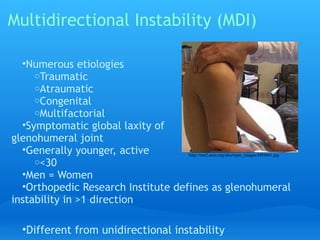
Multidirectional Instability (MDI)

  •Numerous etiologies
     oTraumatic
     oAtraumatic
     oCongenital
     oMultifactorial 
  •Symptomatic global laxity of
glenohumeral joint
  •Generally younger, active        http://test2.aaos.org/oko/topic_images/SPO041.jpg
     o<30
  •Men = Women
  •Orthopedic Research Institute defines as glenohumeral
instability in >1 direction

   •Different from unidirectional instability
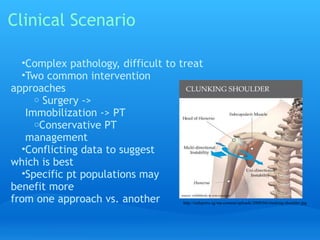
Clinical Scenario

  •Complex pathology, difficult to treat
  •Two common intervention
approaches
     o Surgery ->
   Immobilization -> PT
     oConservative PT
   management  
  •Conflicting data to suggest
which is best
  •Specific pt populations may
benefit more
from one approach vs. another       http://redsports.sg/wp-content/uploads/2008/04/clunking-shoulder.jpg
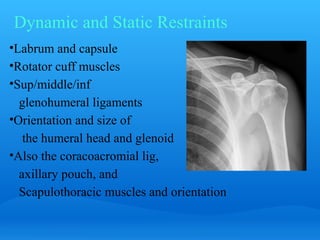
Dynamic and Static Restraints
•Labrum and capsule
•Rotator cuff muscles
•Sup/middle/inf
  glenohumeral ligaments
•Orientation and size of
   the humeral head and glenoid
•Also the coracoacromial lig,
  axillary pouch, and
  Scapulothoracic muscles and orientation
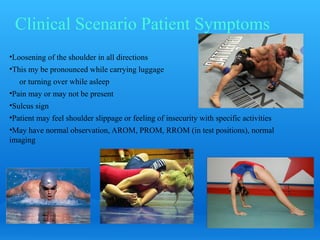
Clinical Scenario Patient Symptoms
•Loosening of the shoulder in all directions
•This my be pronounced while carrying luggage
   or turning over while asleep
•Pain may or may not be present
•Sulcus sign
•Patient may feel shoulder slippage or feeling of insecurity with specific activities
•May have normal observation, AROM, PROM, RROM (in test positions), normal
imaging
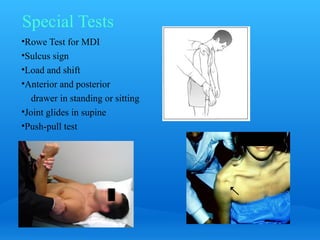
Special Tests
•Rowe Test for MDI
•Sulcus sign
•Load and shift
•Anterior and posterior
   drawer in standing or sitting
•Joint glides in supine
•Push-pull test
Grades of Humeral Head Translation


  Normal laxity- mild amount of translation up to
  25%
  Grade 1- A feeling of the humeral head riding up to
  the glenoid rim 25-50%
  Grade 2- A feeling of the humeral head over riding
  the rim, but spontaneously reduces >50%
  Grade 3- A feeling of the humeral head over the
  rim, but remains dislocated
Focused Clinical Question

Is conservative rehabilitation alone an effective intervention
in the treatment of multidirectional shoulder instability?
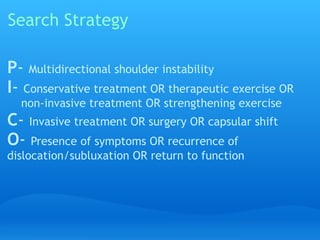
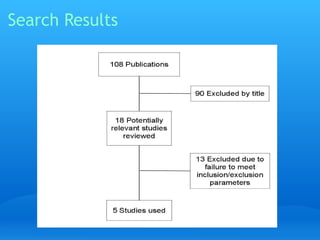
Search Strategy

P- Multidirectional shoulder instability
I- Conservative treatment OR therapeutic exercise OR  
    non-invasive treatment OR strengthening exercise
C- Invasive treatment OR surgery OR capsular shift
O- Presence of symptoms OR recurrence of
dislocation/subluxation OR return to function
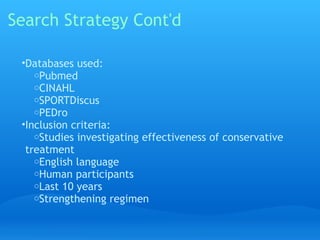
Search Strategy Cont'd

 •Databases used:
    oPubmed
    oCINAHL
    oSPORTDiscus
    oPEDro
 •Inclusion criteria:
    oStudies investigating effectiveness of conservative
  treatment
    oEnglish language
    oHuman participants
    oLast 10 years
    oStrengthening regimen 
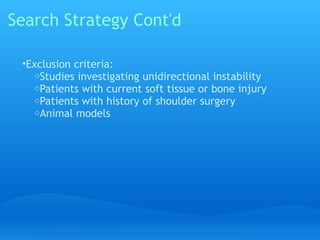
Search Strategy Cont'd

 •Exclusion criteria:
    oStudies investigating unidirectional instability
    oPatients with current soft tissue or bone injury
    oPatients with history of shoulder surgery
    oAnimal models 
Search Results

         
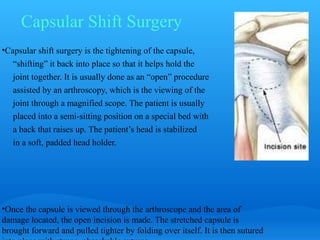
Capsular Shift Surgery
•Capsular shift surgery is the tightening of the capsule,
   “shifting” it back into place so that it helps hold the
   joint together. It is usually done as an “open” procedure
   assisted by an arthroscopy, which is the viewing of the
   joint through a magnified scope. The patient is usually
   placed into a semi-sitting position on a special bed with
   a back that raises up. The patient’s head is stabilized
   in a soft, padded head holder.


•Once the capsule is viewed through the arthroscope and the area of
damage located, the open incision is made. The stretched capsule is
brought forward and pulled tighter by folding over itself. It is then sutured
Illyés et al (2009)
Study Prospective Cohort
Design
Particip 101 subjects
ants
         Control Group: 32 males, 18 females,
         average age in mid 20’s

        PT Group: 17 males, 15 females, average
        age 18

        Surgery + PT Group: 7 males, 12 females,
        average age in low 30’s

IntervenConservative Group: Education, Mirrors,
tion    PNF, biofeedback, strengthening exercises,
        closed chain exercises, stamina training

        Surgical Group: Open capsular shift,
        immobilized in sling for 6 weeks, rehab on
        day 1:
        aarom elevation to 90, ER to 10 degrees.
        After 3 weeks: max ROM without pain.
        After 6 weeks: Begin same intervention as
        conservative group


Outcom EMG data from pec major, infraspinatus,
e      deltoid, upper
Measur trapezius, bicep, tricep, during pull, forward
es     punch, elevation, slow/fast overhead throw

        Time between first muscle reaching max
        activity and last (time broadness)

        Normalized maximum amplitudes
Main Only surgical + rehab returned muscles
Finding activity to normal
s
        Motion patterns on muscles around joint
        with MDI are changed.

        Conservative treatment improved time
        broadness
        to normal, but not for level of muscle
        activations (decreased accelerators,
        increased
        stabilizers).
Kiss et al (2010)
Study Non-Randomized Control Trial
Design
Participa 90 subjects
nts
          Control Group: 16 males, 9 females,
          average age 27

         PT Group: 18 males, 16 females, average
         age 28

          Surgery + PT Group: 12 males, 19 females,
          average age 30
Intervent Program consisted of proprioceptive input
ion       to improve the sense of joint position, and
          on relearning correct movement patterns
          with the development of strength and
          endurance in the scapulothoracic and
          glenohumeral muscles. Mirrors, PNF,
          biofeedback were used to retrain patterns of
          ST and GH movement. Strength exercises,
          closed chain exercises, stamina training
          were used to increase stability of muscle
          balance and proprioception.

        Surgery group had a capsular shift using the
        “beach chair” position through an anterior
        approach. Surgery was then followed with
        postoperative physiotherapy.
Outcom Kinematic characteristics of movement
e       measured using the Zebris CMS-HS
Measure movement analysis system.
s
        Changes in the electrical potential of the
        ant/middle/post parts of the deltoid,
        supraspinatus with trapezius, infraspinatus,
        biceps brachii, triceps brachii were
        recorded.

         Maximum muscle contraction was specified
         by taking the highest muscle contraction
         achieved during various forms of motion.

         Bilinear regression line of rhythm was
         calculated using 5 parameters of motion
         pattern.
Main     Patients with MDI had significant
Findings alterations in shoulder kinematics and in
         muscle activity compared to controls.
Misamore et al (2005)
Study Uncontrolled, Retrospective,
Design Noncomparative Review
Particip 64 patients with atraumatic MDI
ants
         21 males, 43 females, average age 18.6

        All but 9 participated in sport
IntervenEnrolled in physical therapy program and
tion    were placed on home exercise program.

        Phase 1 consisted of relative rest from
        provocative activities, analgesics, and gentle
        ROM exercises.        Phase 2 consisted of
        rotator cuff and parascapular muscle
        strengthening exercises. Slow progressive
        strengthening programs were performed
        daily at home (15 to 20 min 3x daily).
                      Phase 3 involved sport specific
        exercises if appropriate. Phase 4 involved
        returning to sport or work.
Outcom Modified Rowe score (Max of 100 points).
e       Includes function, pain, stability, motion.
Measur
es
Main At 2 years surgery had been performed on 20
Finding of the patients to stabilize their shoulder. Of
s       the 39 patients not receiving surgery 20 had
        good or excellent results regarding pain
        relief, 21 had good or excellent results with
        stability, 28 reported that the shoulder
        condition was better or much better.

        At 8 years 1 addition patient received
        surgery. Of the 36 non-surgical patients 29
        reported no further treatment for their
        shoulder instability, none of the patients
        were still performing shoulder therapy
        exercises. 28 reported persistent problems
        with their shoulders, 8 reported no residual
        symptoms.
Level   2B
of
Evidenc
e
Conclus At the 8 year follow up 40 of 57 patients
ion     (70%) had been treated surgically or had fair
        or poor ratings for their shoulders. Only
        30% had a good or excellent result based on
Ide et al (2003)
Study Prospective Cohort
Design
Particip 46 patients with MDI
ants
         12 males, 34 females, average age 20
Interve Prescribed exercise daily for 8 weeks.
ntion Performed exercise in novel shoulder
         orthosis to increase scapular inclination and
         to stabilize the scapula. Strengthening the
         rotator muscles and scapular stabilizers
         (serratus anterior, and rhomboids). Isometric
         exercises included IR, ER, and isotonic
         shoulder strengthening exercises with thera-
         band. Wall pushup exercises to strengthen
         scapular stabilizers and synchrony training of
         the scapulothoracic muscles.
Outco Before and after 8 week program patients
me       were evaluated for; shoulder function, pain,
Measur numbness, stability, ROM on a modified
es       Rowe grading system. There was then a
         follow up at 7 years.
Main Before the rehab program 59 shoulders were
Finding in fair condition and 14 were in poor
s        condition. After the rehab program 24
         shoulders were in fair condition and 1 was in
         poor.

       Muscle strength increased by more than 20%
       in 22 of 36 shoulders, in 20 of 22 shoulders
       good or excellent results were achieved.
Level 2B
of
Eviden
ce
Conclu The aim of rehabilitation should be a gain of
sion 20% in the peak torque of internal and
       external rotation and the achievement of
       normal muscle balance. Shoulder orthotic
       prevents a decrease in scapular inclination;
       rather, it increases scapular inclination by
       pushing the inferior angle of the scapula and
       straightening the thoracic spine. Patients can
       achieve stabilization of the glenohumeral
       joint and scapula by using the orthosis
       correctly. They are permitted to remove the
       orthosis after achieving strengthening of the
       shoulder muscles upon completion of the
       exercise program.
Gibson et al (2004)
Study Systematic Review
Design
Particip Adults 16-55 with history of shoulder
ants     instability

        Excluded stroke, hemiplegia, prior surgery
IntervenNon-operative management including but
tion    not limited to immobilization and PT
        methods like stretching, strengthening or
        stabilization exercises, biofeedback, other
        modalities
Outcom Recurrence of instability (redislocation or
e       resubluxation)
Measur
es      Return to
        premorbid function

        Alleviation of symptoms
Main Many different intervention protocols, but
Finding mostly based on physiological rationale
s       and biological evidence

        Paucity of quality trials in this area

        Review
        limited to qualitative analysis due to poor
        reporting in many papers

        Current available studies are weak
        foundation

        Weak but positive trend for conservative
        management

        Most cohorts found worse outcome with
        conservative management, particularly in
        those under 30.
Level   1A
of
Evidenc
e
Conclus Weak evidence to support surgery over
ion     conservative management.
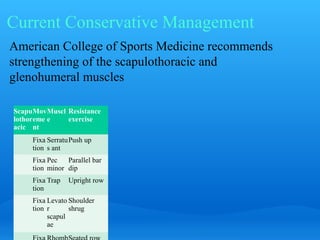
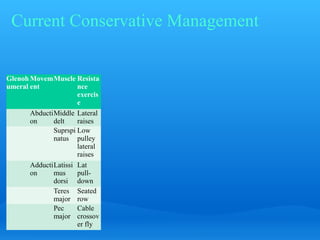
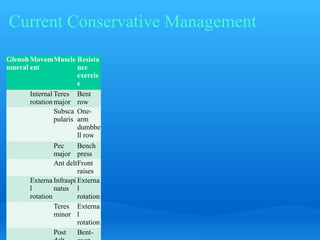
Current Conservative Management
American College of Sports Medicine recommends
strengthening of the scapulothoracic and
glenohumeral muscles

Scapu Mov Muscl Resistance
lothor eme e    exercise
acic nt
     Fixa Serratu Push up
     tion s ant
     Fixa Pec   Parallel bar
     tion minor dip
     Fixa Trap   Upright row
     tion
     Fixa Levato Shoulder
     tion r      shrug
          scapul
          ae
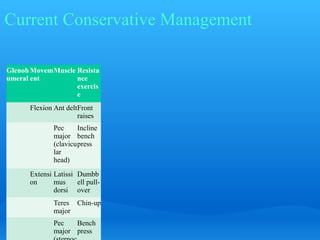
Current Conservative Management

Glenoh Movem Muscle Resista
umeral ent          nce
                    exercis
                    e
      Flexion Ant deltFront
                      raises
              Pec      Incline
              major bench
              (clavicu press
              lar
              head)
      Extensi Latissi Dumbb
      on      mus     ell pull-
              dorsi over
              Teres Chin-up
              major
              Pec   Bench
              major press
Current Conservative Management


Glenoh Movem Muscle Resista
umeral ent             nce
                       exercis
                       e
       Abducti Middle Lateral
       on      delt    raises
               Suprspi Low
               natus pulley
                       lateral
                       raises
       Adducti Latissi Lat
       on      mus     pull-
               dorsi down
               Teres Seated
               major row
               Pec     Cable
               major crossov
                       er fly
Current Conservative Management
Glenoh Movem Muscle Resista
umeral ent              nce
                        exercis
                        e
       Internal Teres Bent
       rotation major row
                Subsca One-
                pularis arm
                        dumbbe
                        ll row
                Pec     Bench
                major press
                Ant deltFront
                        raises
       Externa Infraspi Externa
       l        natus l
       rotation         rotation
                Teres Externa
                minor l
                        rotation
                Post    Bent-
Study findings affecting conservative
               management

Study 1   Patients with
          MDI have
          altered motion
          patterns on
          muscles around
          joint

Study 2   Patients with
          MDI had
          significant
          alterations in
          shoulder
          kinematics and
          in muscle
          activation

Study 3   Most patients
          who improve
          with ther ex
          program do so
          fairly quickly,
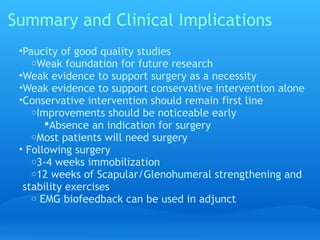
Summary and Clinical Implications
 •Paucity of good quality studies
    oWeak foundation for future research
 •Weak evidence to support surgery as a necessity
 •Weak evidence to support conservative intervention alone
 •Conservative intervention should remain first line
    oImprovements should be noticeable early
       Absence an indication for surgery
    oMost patients will need surgery
 • Following surgery
    o3-4 weeks immobilization
    o12 weeks of Scapular/Glenohumeral strengthening and
  stability exercises
    o EMG biofeedback can be used in adjunct
Gibson, K., A. Growse, L. Korda, E. Wray, and JC MacDermid. "The Effectiveness of Rehabilitation for Nonoperative
Management of Shoulder Instability: a Systematic Review." Journal of Hand Therapy 17.2 (2004): 229-42.


Ide, J., S. Maeda, M. Yamaga, K. Morisawa, and K. Takagi. "Shoulder-strengthening Exercise with an Orthosis for
Multidirectional Shoulder Instability: Quantitative Evaluation of Rotational Shoulder Strength before and after the
Exercise Program." Journal of Shoulder and Elbow Surgery 12.4 (2003): 342-45.


Illyes, A., J. Kiss, and R. Kiss. "Electromyographic Analysis during Pull, Forward Punch, Elevation and Overhead
Throw after Conservative Treatment or Capsular Shift at Patient with Multidirectional Shoulder Joint Instability."
Journal of Electromyography and Kinesiology (2008).


Kiss, Rita M., Árpád Illyés, and Jenő Kiss. "Physiotherapy vs. Capsular Shift and Physiotherapy in Multidirectional
Shoulder Joint Instability." Journal of Electromyography and Kinesiology (2009).


Misamore, G., P. Sallay, and W. Didelot. "A Longitudinal Study of Patients with Multidirectional Instability of the
Shoulder with Seven- to Ten-year Follow-up." Journal of Shoulder and Elbow Surgery 14.5 (2005): 466-70.


American College of Sports Medicine. ACSM’s Resource Manual for Guidelines for Exercise Testing and
Perscription. 6th ed. Wolters Kluwer; 2010: 1-868.


David J. Magee. Orthopedic Physical Assessment. 5th ed. Saunders Elsevier; 2008: 231-360.
Questions?

MDIfinal

  • 1.
    Effectiveness of Conservative Treatment for MDI  Gregory Sabo
  • 2.
    Objectives •Definethe current clinical scenario and question •Identify search methods for the best available evidence for successful treatment of MDI •Describe the findings of these key studies •Address the weaknesses of these key studies •Summarize the implications for practitioners
  • 3.
    Multidirectional Instability (MDI) •Numerous etiologies oTraumatic oAtraumatic oCongenital oMultifactorial  •Symptomatic global laxity of glenohumeral joint •Generally younger, active http://test2.aaos.org/oko/topic_images/SPO041.jpg o<30 •Men = Women •Orthopedic Research Institute defines as glenohumeral instability in >1 direction •Different from unidirectional instability
  • 4.
    Clinical Scenario •Complex pathology, difficult to treat •Two common intervention approaches o Surgery -> Immobilization -> PT oConservative PT management   •Conflicting data to suggest which is best •Specific pt populations may benefit more from one approach vs. another http://redsports.sg/wp-content/uploads/2008/04/clunking-shoulder.jpg
  • 5.
    Dynamic and StaticRestraints •Labrum and capsule •Rotator cuff muscles •Sup/middle/inf glenohumeral ligaments •Orientation and size of the humeral head and glenoid •Also the coracoacromial lig, axillary pouch, and Scapulothoracic muscles and orientation
  • 6.
    Clinical Scenario PatientSymptoms •Loosening of the shoulder in all directions •This my be pronounced while carrying luggage or turning over while asleep •Pain may or may not be present •Sulcus sign •Patient may feel shoulder slippage or feeling of insecurity with specific activities •May have normal observation, AROM, PROM, RROM (in test positions), normal imaging
  • 7.
    Special Tests •Rowe Testfor MDI •Sulcus sign •Load and shift •Anterior and posterior drawer in standing or sitting •Joint glides in supine •Push-pull test
  • 8.
    Grades of HumeralHead Translation Normal laxity- mild amount of translation up to 25% Grade 1- A feeling of the humeral head riding up to the glenoid rim 25-50% Grade 2- A feeling of the humeral head over riding the rim, but spontaneously reduces >50% Grade 3- A feeling of the humeral head over the rim, but remains dislocated
  • 9.
    Focused Clinical Question Isconservative rehabilitation alone an effective intervention in the treatment of multidirectional shoulder instability?
  • 10.
    Search Strategy P- Multidirectionalshoulder instability I- Conservative treatment OR therapeutic exercise OR       non-invasive treatment OR strengthening exercise C- Invasive treatment OR surgery OR capsular shift O- Presence of symptoms OR recurrence of dislocation/subluxation OR return to function
  • 11.
    Search Strategy Cont'd •Databases used: oPubmed oCINAHL oSPORTDiscus oPEDro •Inclusion criteria: oStudies investigating effectiveness of conservative treatment oEnglish language oHuman participants oLast 10 years oStrengthening regimen 
  • 12.
    Search Strategy Cont'd •Exclusion criteria: oStudies investigating unidirectional instability oPatients with current soft tissue or bone injury oPatients with history of shoulder surgery oAnimal models 
  • 13.
  • 14.
    Capsular Shift Surgery •Capsularshift surgery is the tightening of the capsule, “shifting” it back into place so that it helps hold the joint together. It is usually done as an “open” procedure assisted by an arthroscopy, which is the viewing of the joint through a magnified scope. The patient is usually placed into a semi-sitting position on a special bed with a back that raises up. The patient’s head is stabilized in a soft, padded head holder. •Once the capsule is viewed through the arthroscope and the area of damage located, the open incision is made. The stretched capsule is brought forward and pulled tighter by folding over itself. It is then sutured
  • 15.
    Illyés et al(2009) Study Prospective Cohort Design Particip 101 subjects ants Control Group: 32 males, 18 females, average age in mid 20’s PT Group: 17 males, 15 females, average age 18 Surgery + PT Group: 7 males, 12 females, average age in low 30’s IntervenConservative Group: Education, Mirrors, tion PNF, biofeedback, strengthening exercises, closed chain exercises, stamina training Surgical Group: Open capsular shift, immobilized in sling for 6 weeks, rehab on day 1: aarom elevation to 90, ER to 10 degrees. After 3 weeks: max ROM without pain. After 6 weeks: Begin same intervention as conservative group Outcom EMG data from pec major, infraspinatus, e deltoid, upper Measur trapezius, bicep, tricep, during pull, forward es punch, elevation, slow/fast overhead throw Time between first muscle reaching max activity and last (time broadness) Normalized maximum amplitudes Main Only surgical + rehab returned muscles Finding activity to normal s Motion patterns on muscles around joint with MDI are changed. Conservative treatment improved time broadness to normal, but not for level of muscle activations (decreased accelerators, increased stabilizers).
  • 16.
    Kiss et al(2010) Study Non-Randomized Control Trial Design Participa 90 subjects nts Control Group: 16 males, 9 females, average age 27 PT Group: 18 males, 16 females, average age 28 Surgery + PT Group: 12 males, 19 females, average age 30 Intervent Program consisted of proprioceptive input ion to improve the sense of joint position, and on relearning correct movement patterns with the development of strength and endurance in the scapulothoracic and glenohumeral muscles. Mirrors, PNF, biofeedback were used to retrain patterns of ST and GH movement. Strength exercises, closed chain exercises, stamina training were used to increase stability of muscle balance and proprioception. Surgery group had a capsular shift using the “beach chair” position through an anterior approach. Surgery was then followed with postoperative physiotherapy. Outcom Kinematic characteristics of movement e measured using the Zebris CMS-HS Measure movement analysis system. s Changes in the electrical potential of the ant/middle/post parts of the deltoid, supraspinatus with trapezius, infraspinatus, biceps brachii, triceps brachii were recorded. Maximum muscle contraction was specified by taking the highest muscle contraction achieved during various forms of motion. Bilinear regression line of rhythm was calculated using 5 parameters of motion pattern. Main Patients with MDI had significant Findings alterations in shoulder kinematics and in muscle activity compared to controls.
  • 17.
    Misamore et al(2005) Study Uncontrolled, Retrospective, Design Noncomparative Review Particip 64 patients with atraumatic MDI ants 21 males, 43 females, average age 18.6 All but 9 participated in sport IntervenEnrolled in physical therapy program and tion were placed on home exercise program. Phase 1 consisted of relative rest from provocative activities, analgesics, and gentle ROM exercises. Phase 2 consisted of rotator cuff and parascapular muscle strengthening exercises. Slow progressive strengthening programs were performed daily at home (15 to 20 min 3x daily). Phase 3 involved sport specific exercises if appropriate. Phase 4 involved returning to sport or work. Outcom Modified Rowe score (Max of 100 points). e Includes function, pain, stability, motion. Measur es Main At 2 years surgery had been performed on 20 Finding of the patients to stabilize their shoulder. Of s the 39 patients not receiving surgery 20 had good or excellent results regarding pain relief, 21 had good or excellent results with stability, 28 reported that the shoulder condition was better or much better. At 8 years 1 addition patient received surgery. Of the 36 non-surgical patients 29 reported no further treatment for their shoulder instability, none of the patients were still performing shoulder therapy exercises. 28 reported persistent problems with their shoulders, 8 reported no residual symptoms. Level 2B of Evidenc e Conclus At the 8 year follow up 40 of 57 patients ion (70%) had been treated surgically or had fair or poor ratings for their shoulders. Only 30% had a good or excellent result based on
  • 18.
    Ide et al(2003) Study Prospective Cohort Design Particip 46 patients with MDI ants 12 males, 34 females, average age 20 Interve Prescribed exercise daily for 8 weeks. ntion Performed exercise in novel shoulder orthosis to increase scapular inclination and to stabilize the scapula. Strengthening the rotator muscles and scapular stabilizers (serratus anterior, and rhomboids). Isometric exercises included IR, ER, and isotonic shoulder strengthening exercises with thera- band. Wall pushup exercises to strengthen scapular stabilizers and synchrony training of the scapulothoracic muscles. Outco Before and after 8 week program patients me were evaluated for; shoulder function, pain, Measur numbness, stability, ROM on a modified es Rowe grading system. There was then a follow up at 7 years. Main Before the rehab program 59 shoulders were Finding in fair condition and 14 were in poor s condition. After the rehab program 24 shoulders were in fair condition and 1 was in poor. Muscle strength increased by more than 20% in 22 of 36 shoulders, in 20 of 22 shoulders good or excellent results were achieved. Level 2B of Eviden ce Conclu The aim of rehabilitation should be a gain of sion 20% in the peak torque of internal and external rotation and the achievement of normal muscle balance. Shoulder orthotic prevents a decrease in scapular inclination; rather, it increases scapular inclination by pushing the inferior angle of the scapula and straightening the thoracic spine. Patients can achieve stabilization of the glenohumeral joint and scapula by using the orthosis correctly. They are permitted to remove the orthosis after achieving strengthening of the shoulder muscles upon completion of the exercise program.
  • 19.
    Gibson et al(2004) Study Systematic Review Design Particip Adults 16-55 with history of shoulder ants instability Excluded stroke, hemiplegia, prior surgery IntervenNon-operative management including but tion not limited to immobilization and PT methods like stretching, strengthening or stabilization exercises, biofeedback, other modalities Outcom Recurrence of instability (redislocation or e resubluxation) Measur es Return to premorbid function Alleviation of symptoms Main Many different intervention protocols, but Finding mostly based on physiological rationale s and biological evidence Paucity of quality trials in this area Review limited to qualitative analysis due to poor reporting in many papers Current available studies are weak foundation Weak but positive trend for conservative management Most cohorts found worse outcome with conservative management, particularly in those under 30. Level 1A of Evidenc e Conclus Weak evidence to support surgery over ion conservative management.
  • 20.
    Current Conservative Management AmericanCollege of Sports Medicine recommends strengthening of the scapulothoracic and glenohumeral muscles Scapu Mov Muscl Resistance lothor eme e exercise acic nt Fixa Serratu Push up tion s ant Fixa Pec Parallel bar tion minor dip Fixa Trap Upright row tion Fixa Levato Shoulder tion r shrug scapul ae
  • 21.
    Current Conservative Management GlenohMovem Muscle Resista umeral ent nce exercis e Flexion Ant deltFront raises Pec Incline major bench (clavicu press lar head) Extensi Latissi Dumbb on mus ell pull- dorsi over Teres Chin-up major Pec Bench major press
  • 22.
    Current Conservative Management GlenohMovem Muscle Resista umeral ent nce exercis e Abducti Middle Lateral on delt raises Suprspi Low natus pulley lateral raises Adducti Latissi Lat on mus pull- dorsi down Teres Seated major row Pec Cable major crossov er fly
  • 23.
    Current Conservative Management GlenohMovem Muscle Resista umeral ent nce exercis e Internal Teres Bent rotation major row Subsca One- pularis arm dumbbe ll row Pec Bench major press Ant deltFront raises Externa Infraspi Externa l natus l rotation rotation Teres Externa minor l rotation Post Bent-
  • 24.
    Study findings affectingconservative management Study 1 Patients with MDI have altered motion patterns on muscles around joint Study 2 Patients with MDI had significant alterations in shoulder kinematics and in muscle activation Study 3 Most patients who improve with ther ex program do so fairly quickly,
  • 25.
    Summary and ClinicalImplications •Paucity of good quality studies oWeak foundation for future research •Weak evidence to support surgery as a necessity •Weak evidence to support conservative intervention alone •Conservative intervention should remain first line oImprovements should be noticeable early Absence an indication for surgery oMost patients will need surgery • Following surgery o3-4 weeks immobilization o12 weeks of Scapular/Glenohumeral strengthening and stability exercises o EMG biofeedback can be used in adjunct
  • 26.
    Gibson, K., A.Growse, L. Korda, E. Wray, and JC MacDermid. "The Effectiveness of Rehabilitation for Nonoperative Management of Shoulder Instability: a Systematic Review." Journal of Hand Therapy 17.2 (2004): 229-42. Ide, J., S. Maeda, M. Yamaga, K. Morisawa, and K. Takagi. "Shoulder-strengthening Exercise with an Orthosis for Multidirectional Shoulder Instability: Quantitative Evaluation of Rotational Shoulder Strength before and after the Exercise Program." Journal of Shoulder and Elbow Surgery 12.4 (2003): 342-45. Illyes, A., J. Kiss, and R. Kiss. "Electromyographic Analysis during Pull, Forward Punch, Elevation and Overhead Throw after Conservative Treatment or Capsular Shift at Patient with Multidirectional Shoulder Joint Instability." Journal of Electromyography and Kinesiology (2008). Kiss, Rita M., Árpád Illyés, and Jenő Kiss. "Physiotherapy vs. Capsular Shift and Physiotherapy in Multidirectional Shoulder Joint Instability." Journal of Electromyography and Kinesiology (2009). Misamore, G., P. Sallay, and W. Didelot. "A Longitudinal Study of Patients with Multidirectional Instability of the Shoulder with Seven- to Ten-year Follow-up." Journal of Shoulder and Elbow Surgery 14.5 (2005): 466-70. American College of Sports Medicine. ACSM’s Resource Manual for Guidelines for Exercise Testing and Perscription. 6th ed. Wolters Kluwer; 2010: 1-868. David J. Magee. Orthopedic Physical Assessment. 5th ed. Saunders Elsevier; 2008: 231-360.
  • 27.