CURRENT REVIEW OF
ROTATOR CUFF TEARS
Dr. Sushil Paudel
INTRODUCTION
 In 1834, Smith - first description of a rupture of the
rotator cuff tendon
 Among most common causes of shoulder pain and
instability.
 Disease severity range from inflammation and
edema to irreparable ruptures
 Incidence 5-40% with increasing with advancing
age
 Normal senescence process
ANATOMY
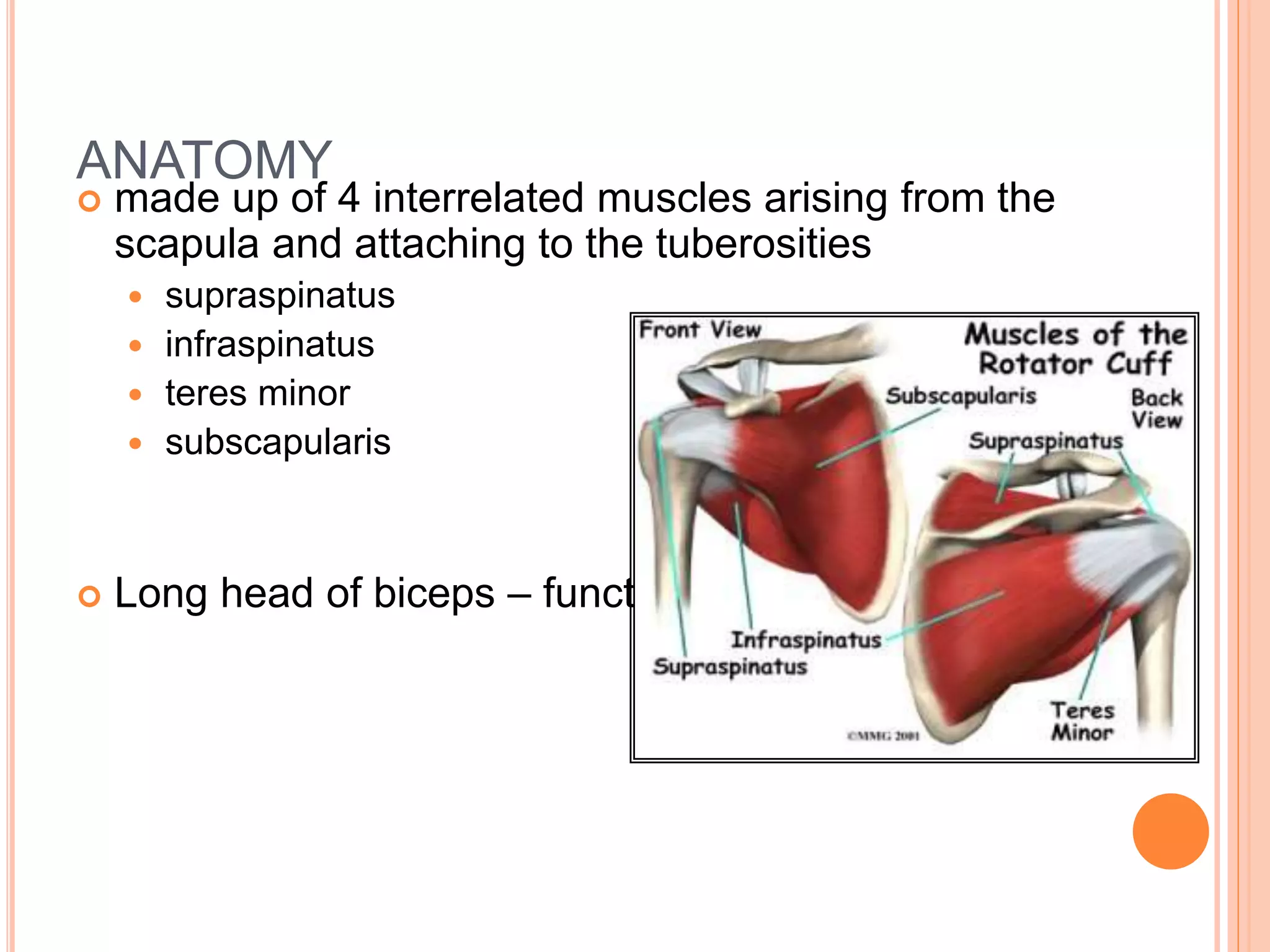
 made up of 4 interrelated muscles arising from the
scapula and attaching to the tuberosities
 supraspinatus
 infraspinatus
 teres minor
 subscapularis
 Long head of biceps – functional part
FUNCTION
 Stabilisers of shoulder mainly anterior and posterior
cuff providing fixed fulcrum for concentric rotation
of the humeral head.
 Neutralises shearing forces of deltoid in early
abduction.
 Initiation of abduction.
 Rotation of shoulder.
PATHOPHYSIOLOGY
The extrinsic hypothesis :
 repeated impingement of rotator cuff tendon against
different structures of the glenohumeral joint .
 Three distinct impingement syndromes
 Anterosuperior impingement syndrome
 Posterosuperior impingement syndrome
 Anterointernal impingement syndrome
ANTEROSUPERIOR IMPINGEMENT
SYNDROME
 Impingement beneath the coracoacromial
arch
 In 1972, Neer - term “impingement
syndrome”
 Supraspinatus tendon insertion to the
greater tuberosity and the bicipital groove
must pass beneath the arch with forward
flexion of the shoulder, especially if
internally rotated, causing an impingement
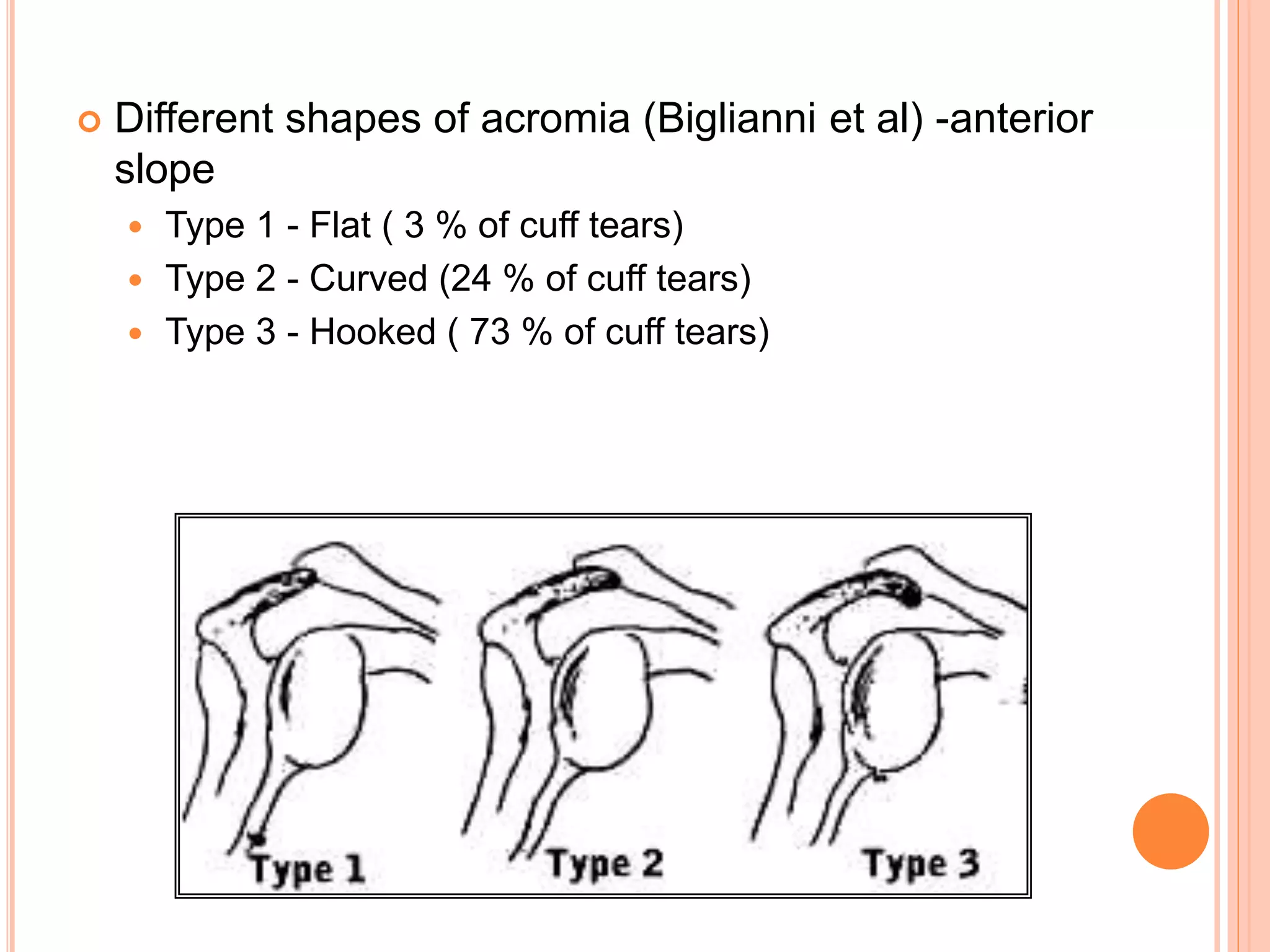
 Different shapes of acromia (Biglianni et al) -anterior
slope
 Type 1 - Flat ( 3 % of cuff tears)
 Type 2 - Curved (24 % of cuff tears)
 Type 3 - Hooked ( 73 % of cuff tears)
 Pt with cuff tear are more likely to have
curved or hooked acromion (Toivonen DA et
al 1995,Tuite et al1995)
 Flatow et al (1994)-stereophotogrammetry-
type 3 acromia had increased contact
 Ozaki's study on cadavers showed that the
undersurface of the acromion was normal
when the incomplete tear was on the
articular side
 Neer‘s stages:
 Stage 1-
 edema and hemorrhage
 excessive overhead use
 patients < 25 years.
 Stage 2-
 fibrosis and tendinitis
 following repeated episodes of mechanical inflammation
 patients - 25-40 years.
 Stage 3-
 bone spurs
 incomplete and complete tears of the rotator cuff and long head
of the biceps tendon
 patients > 40 years.
POSTEROSUPERIOR IMPINGEMENT
SYNDROME
 Impingement between the articular side of the
supraspinatus tendon and the posterosuperior edge
of the glenoid cavity
 Walch in 1991
 May explain some of the articular side tears,
especially in overhead sport athletes
POSTEROSUPERIOR IMPINGEMENT
SYNDROME(CONTD)
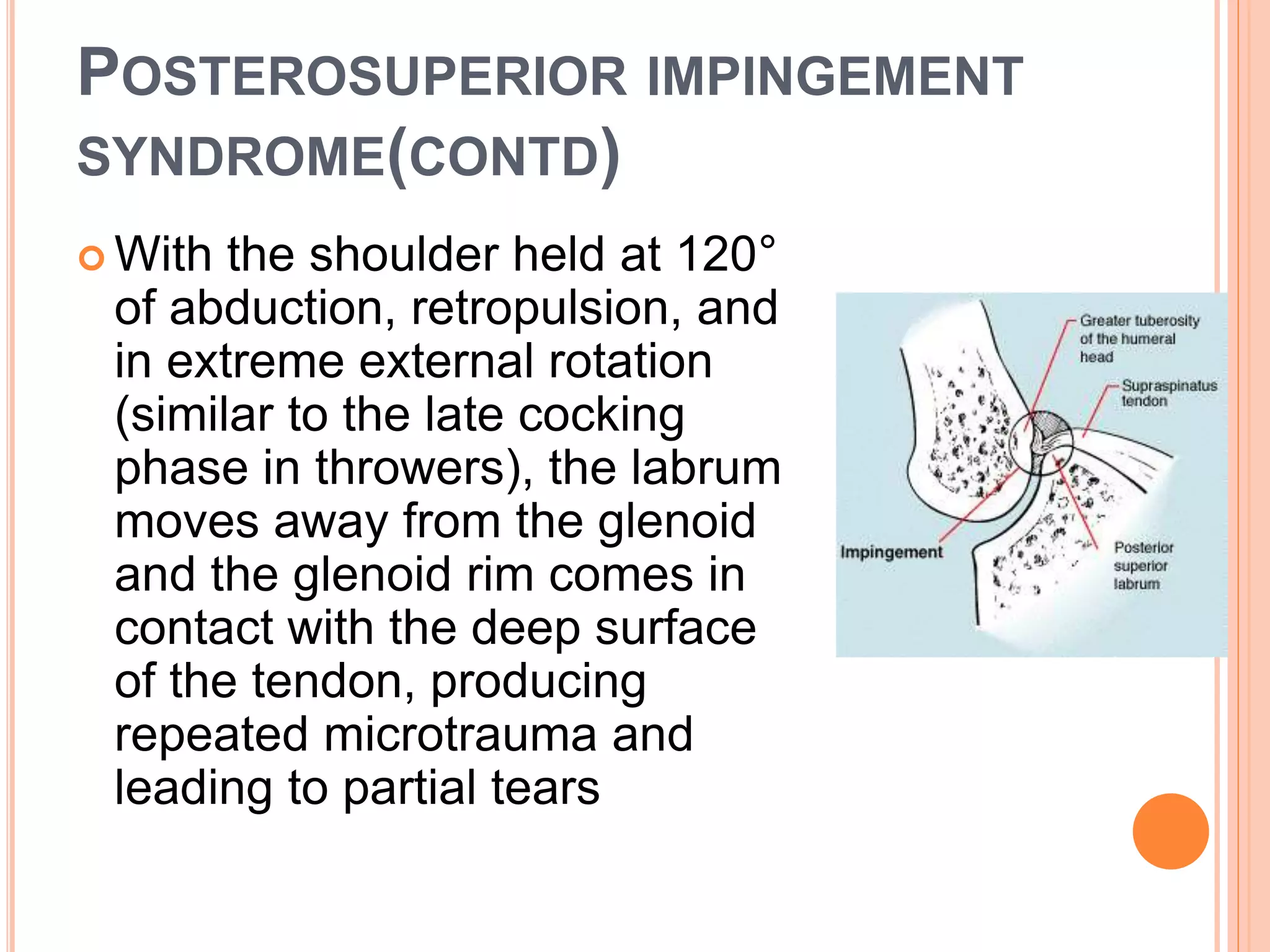
 With the shoulder held at 120°
of abduction, retropulsion, and
in extreme external rotation
(similar to the late cocking
phase in throwers), the labrum
moves away from the glenoid
and the glenoid rim comes in
contact with the deep surface
of the tendon, producing
repeated microtrauma and
leading to partial tears
ANTEROINTERNAL IMPINGEMENT
SYNDROME
 Gerber (1985) - impingement of the cuff in
the coracohumeral interval
 When the shoulder is held in flexion and
internal rotation, the coracohumeral
distance is reduced from 8.6 mm when the
arm is at the side to 6.7 mm
 Subcoracoid impingement can be idiopathic
(eg, large coracoid tip), iatrogenic or
following a fracture (eg, humeral head or
neck fracture)
THE INTRINSIC HYPOTHESIS
 Progressive age-related degeneration of the tendon
 Von Meyer -first to introduce the concept that
degeneration of the tendon plays a major role in the
production of cuff lesions
 Many histologic studies show the age-related
degeneration of the cuff tendon
THE INTRINSIC HYPOTHESIS (CONT)
 “The critical zone” (Codman) -articular surface of
the tendon, near its insertion on the greater
tuberosity
 ? hypovascularity in critical zone
 Recent studies using laser doppler (Swiontkowski &
associates) - normal flow in this zone of normal
tendon
 Rathbun et al -relative avascularity of the cuff is
position-dependent and observed a poor filling only
when the shoulder is in adduction
 Normal degenerative process associated
with aging, then, is the main factor to explain the
lesions of the articular side of the cuff
CLINICAL PRESENTATION
Stiffness-more common with partial tears.
 Stiffness can be demonstrated as limitations of
 Internal rotation with arm in abduction
 Reach up the back
 Cross-body adduction
 Flexion
 External rotation
CLINICAL PRESENTATION (CONTD)
 Pain or weakness
 Located anterolaterally and superior
 Aggravated by use of arm in overhead position or
flexion
 Weakness
 Associated crepitus, clicking, clunking or grinding
sensation
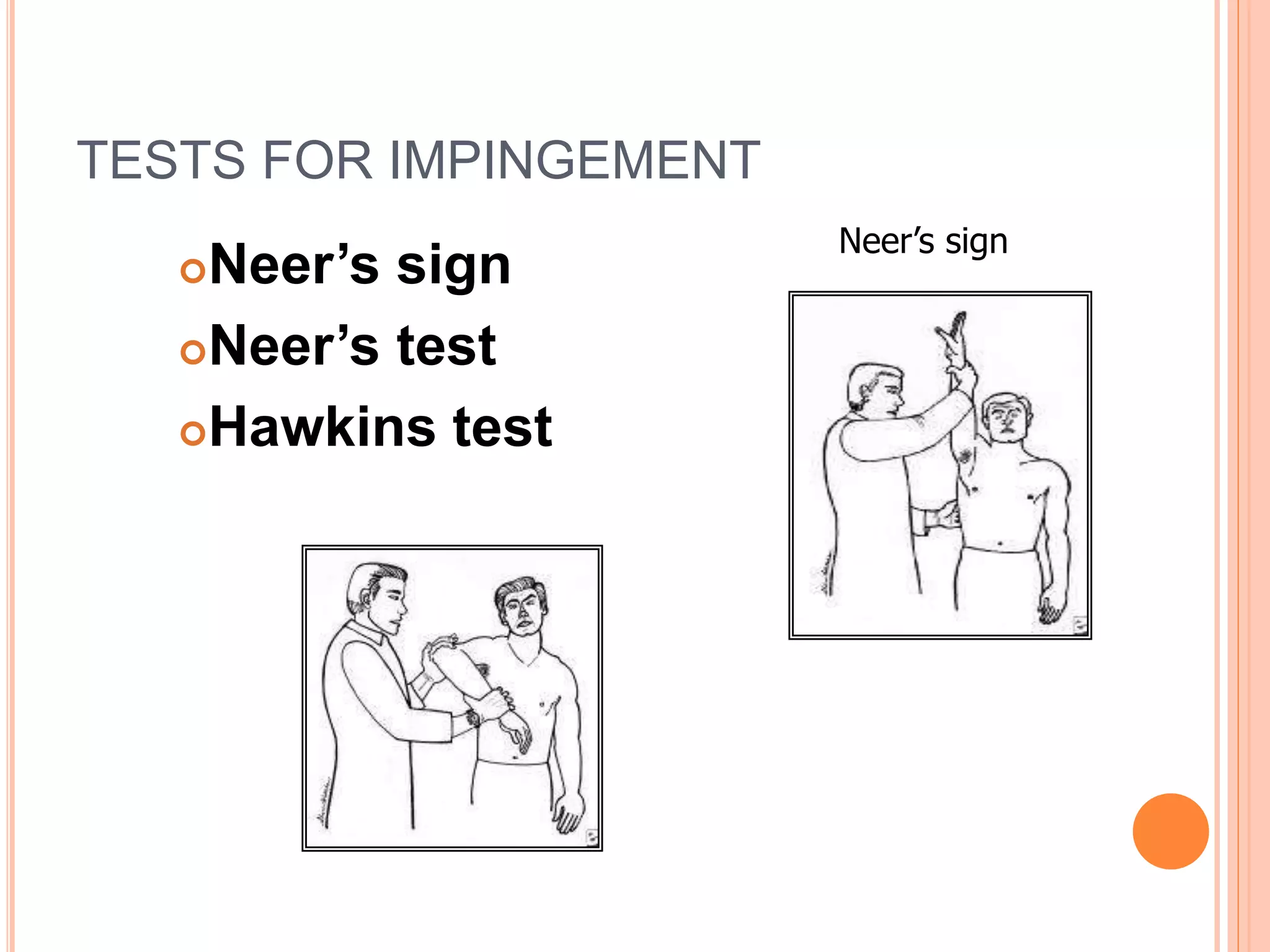
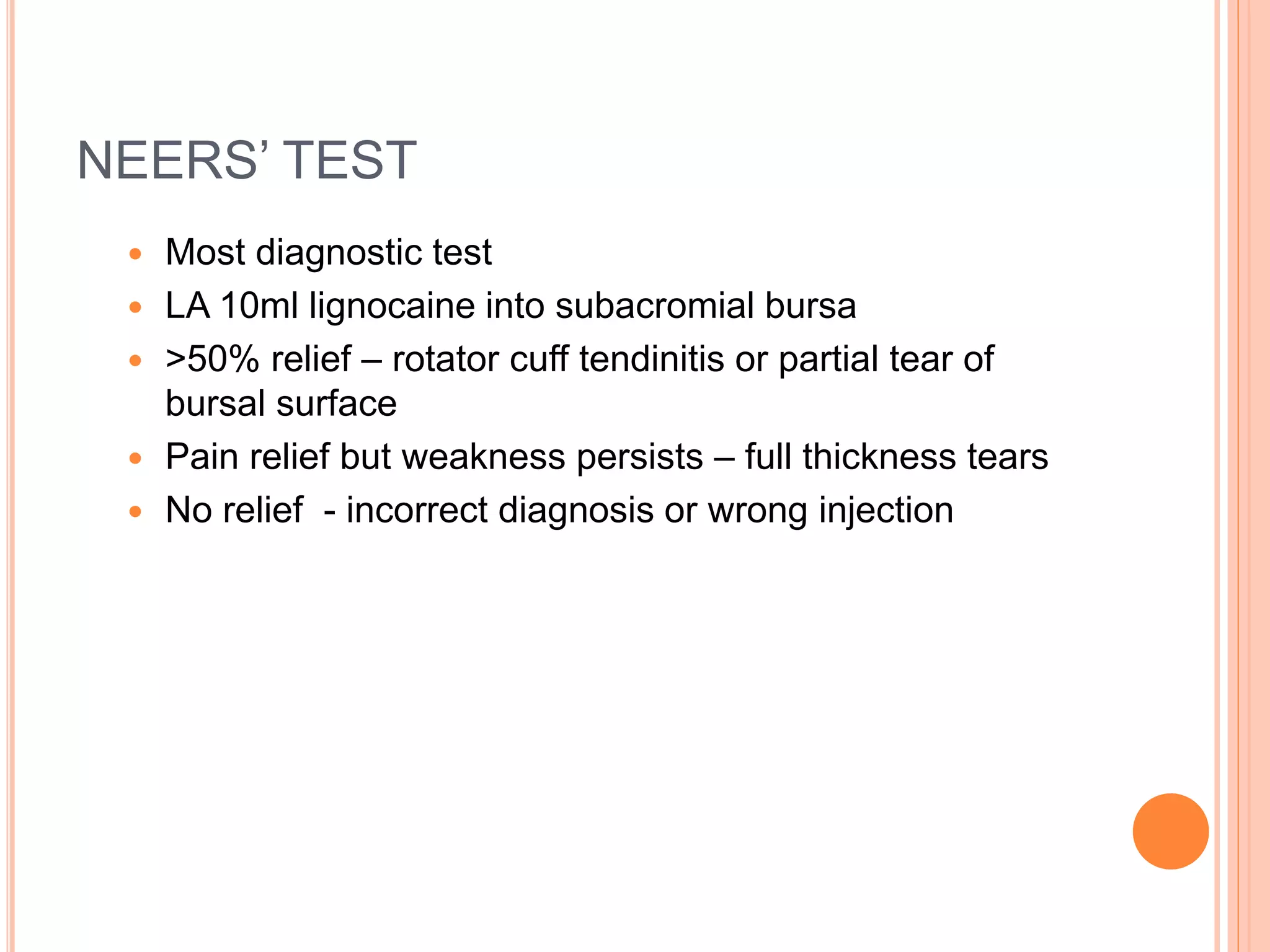
TESTS FOR IMPINGEMENT
Neer’s sign
Neer’s test
Hawkins test
Neer’s sign
NEERS’ TEST
 Most diagnostic test
 LA 10ml lignocaine into subacromial bursa
 >50% relief – rotator cuff tendinitis or partial tear of
bursal surface
 Pain relief but weakness persists – full thickness tears
 No relief - incorrect diagnosis or wrong injection
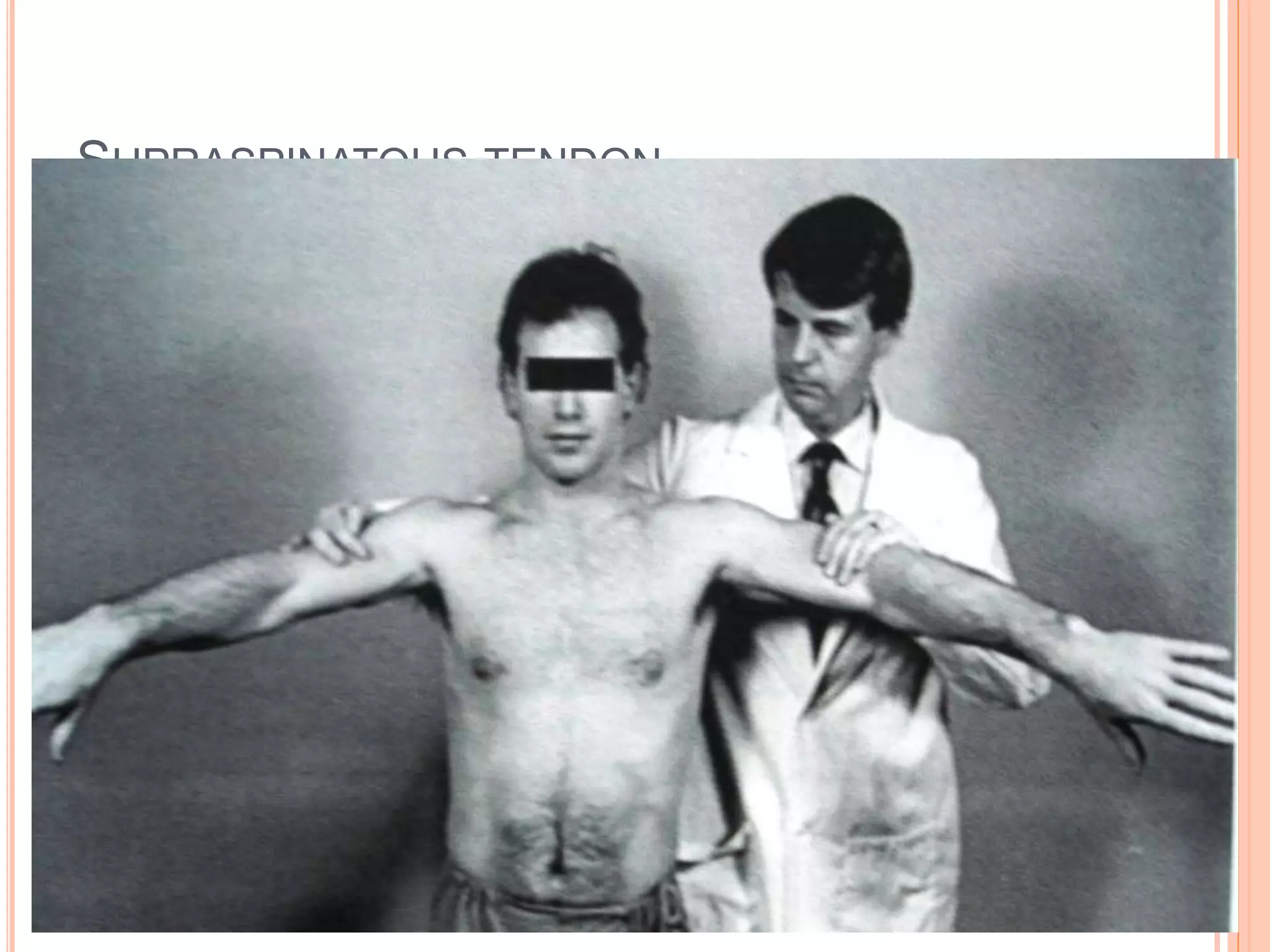
TOPOGRAPHIC TESTS
 supraspinatus tendon
 The Jobe test
 Shoulder is placed at 90° of abduction and 30° of flexion.
 Shoulder elevation is resisted.
 Test is positive if pain is noted.
SUPRASPINATOUS TENDON
 The Full Can test
 Shoulder is placed at 90° of flexion and 45° of external
humeral rotation (thumb pointing upward, like someone
holding a full can, right-side-up).
 Shoulder elevation is resisted.
 Test is positive if it produces pain.
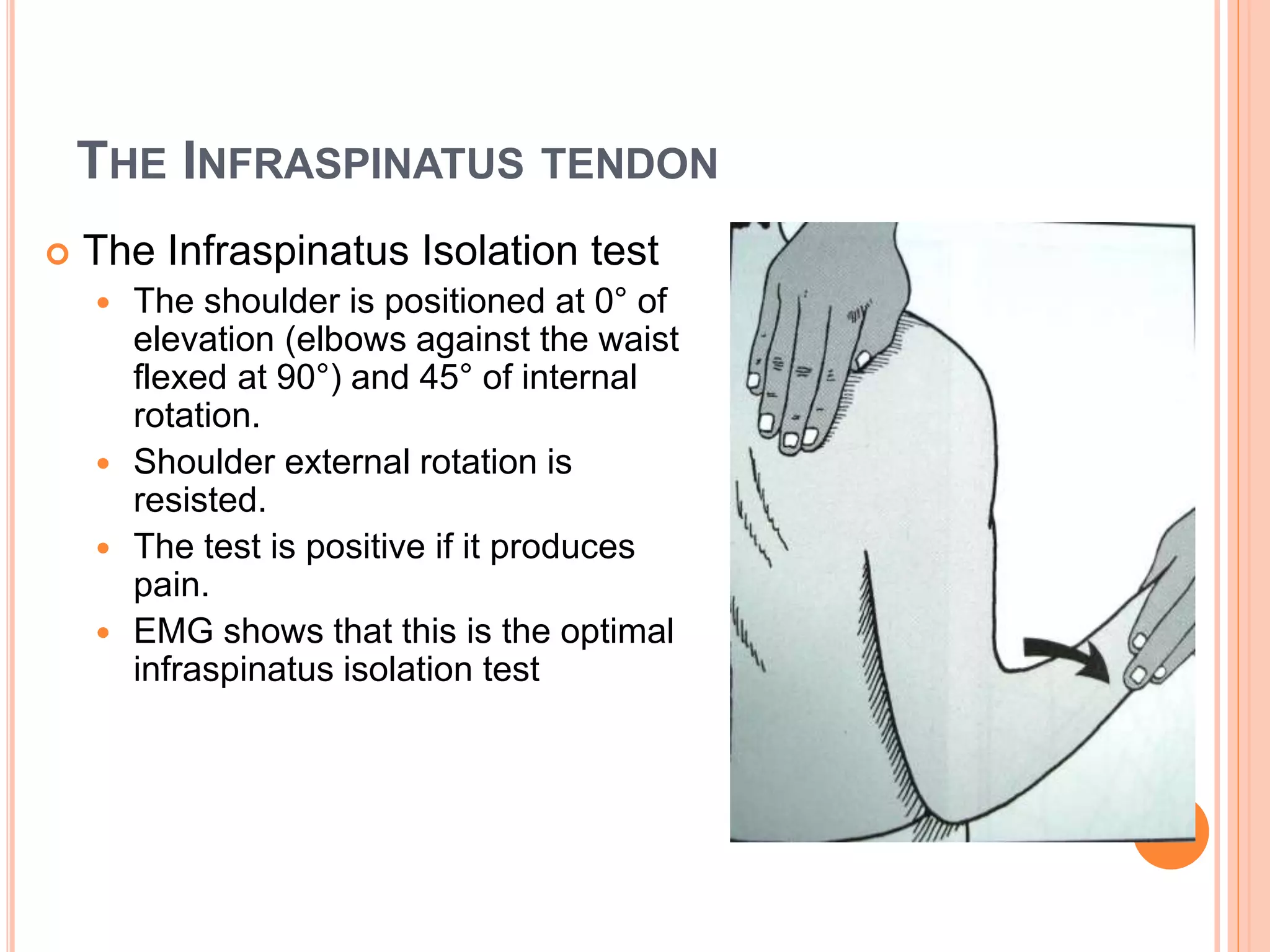
THE INFRASPINATUS TENDON
 The Infraspinatus Isolation test
 The shoulder is positioned at 0° of
elevation (elbows against the waist
flexed at 90°) and 45° of internal
rotation.
 Shoulder external rotation is
resisted.
 The test is positive if it produces
pain.
 EMG shows that this is the optimal
infraspinatus isolation test
 The Patte test
 The shoulder is placed at 90° of abduction, neutral
rotation, and in the plane of the scapula.
 The examiner holds the elbow of the patient and the
external rotation is resisted.
 The test is positive if it produces pain.
THE SUBSCAPULAR TENDON
 The Gerber lift-off test
 The shoulder is placed passively in internal rotation and
slight extension by placing the hand 5-10 cm from the
back with the palm facing outward and the elbow flexed
at 90°.
 The test is positive when the patient cannot hold this
position, with the back of the hand hitting the patient's
back.
 The Gerber push with
force test
 The shoulder is placed
in the same position as
the lift-off test; however,
the patient has to keep
his hand away from the
back and resists a push
in the palm of the hand.
DIFFERENTIAL DIAGNOSIS
 Adhesive Capsulitis
 Bicipital Tendinitis
 Cervival Disc Disease
 Cervical Myofascial Pain
 Cervical Spondylosis
 Fibromyalgia
 Osteoarthritis
 Rheumatoid Arthritis
 Thoracic Outlet Syndrome
X-RAY
 AP for AHI (Normal >7 mms)
<5mms - poor prognosis.
 Y-lateral for shape of acromion
 Axillary for os acromiale
 AP of ACJ for osteophytes
 AP in Abd for rotator cuff dysfunction
RADIOGRAPHIC FEATURES
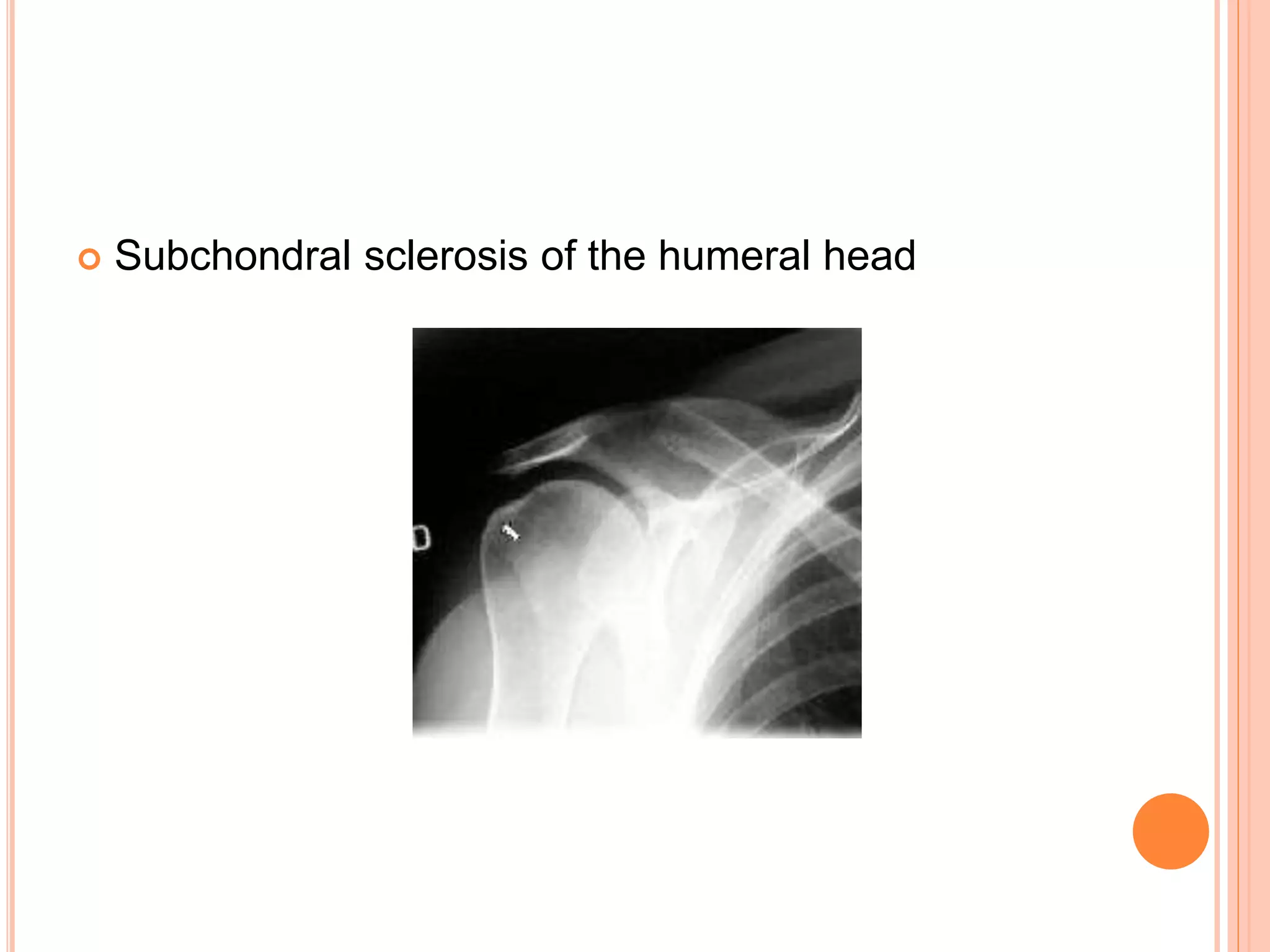
 subchondral sclerosis of humeral head
 flattening of the greater tuberosity
 sclerosis of the acromion-sourcil sign
 calcifications located in the presumed area of
rotator cuff tendon
 acromion spurs
 acromion type 2 and 3.
 Subchondral sclerosis of the humeral head
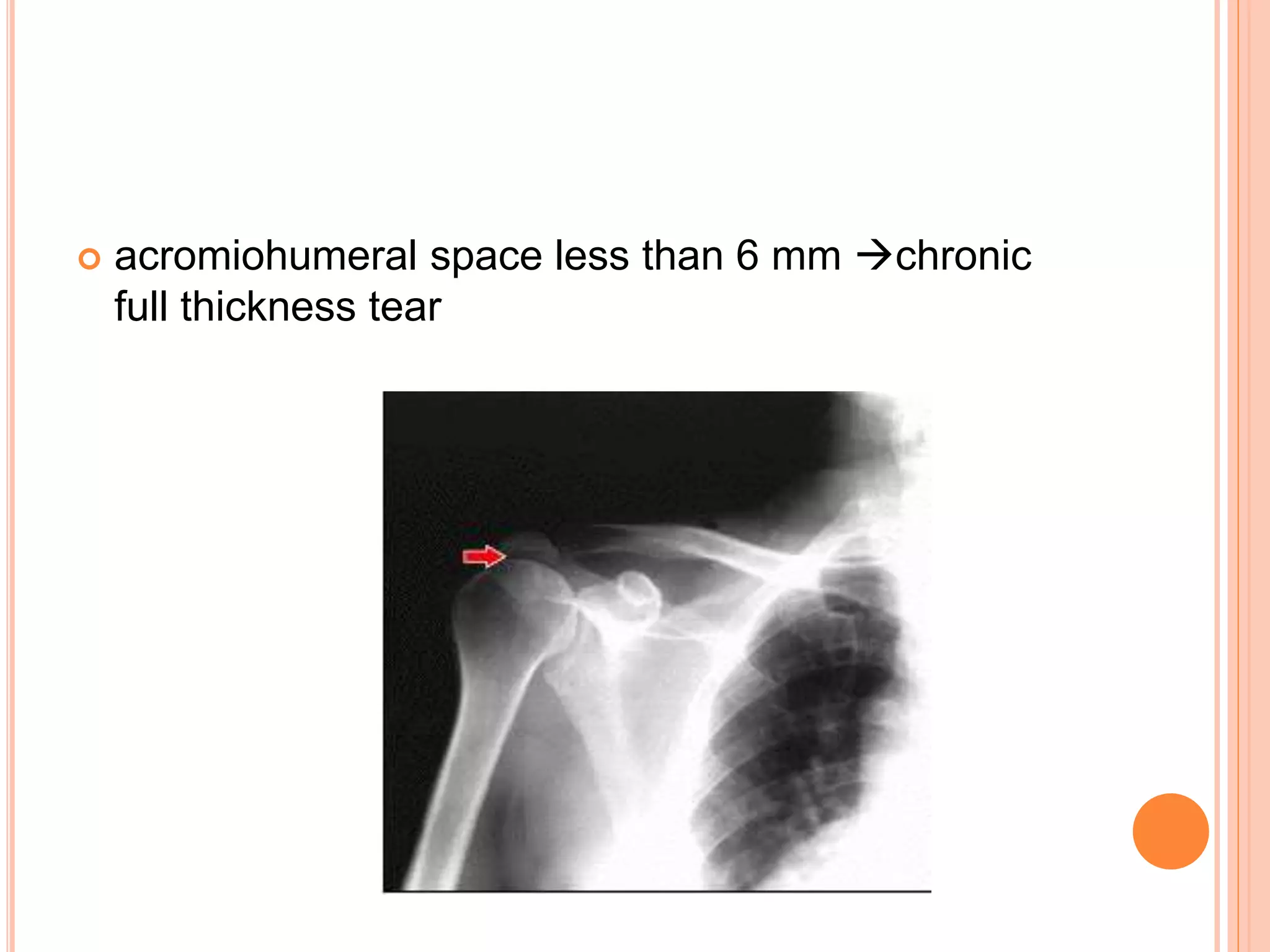
 acromiohumeral space less than 6 mm chronic
full thickness tear
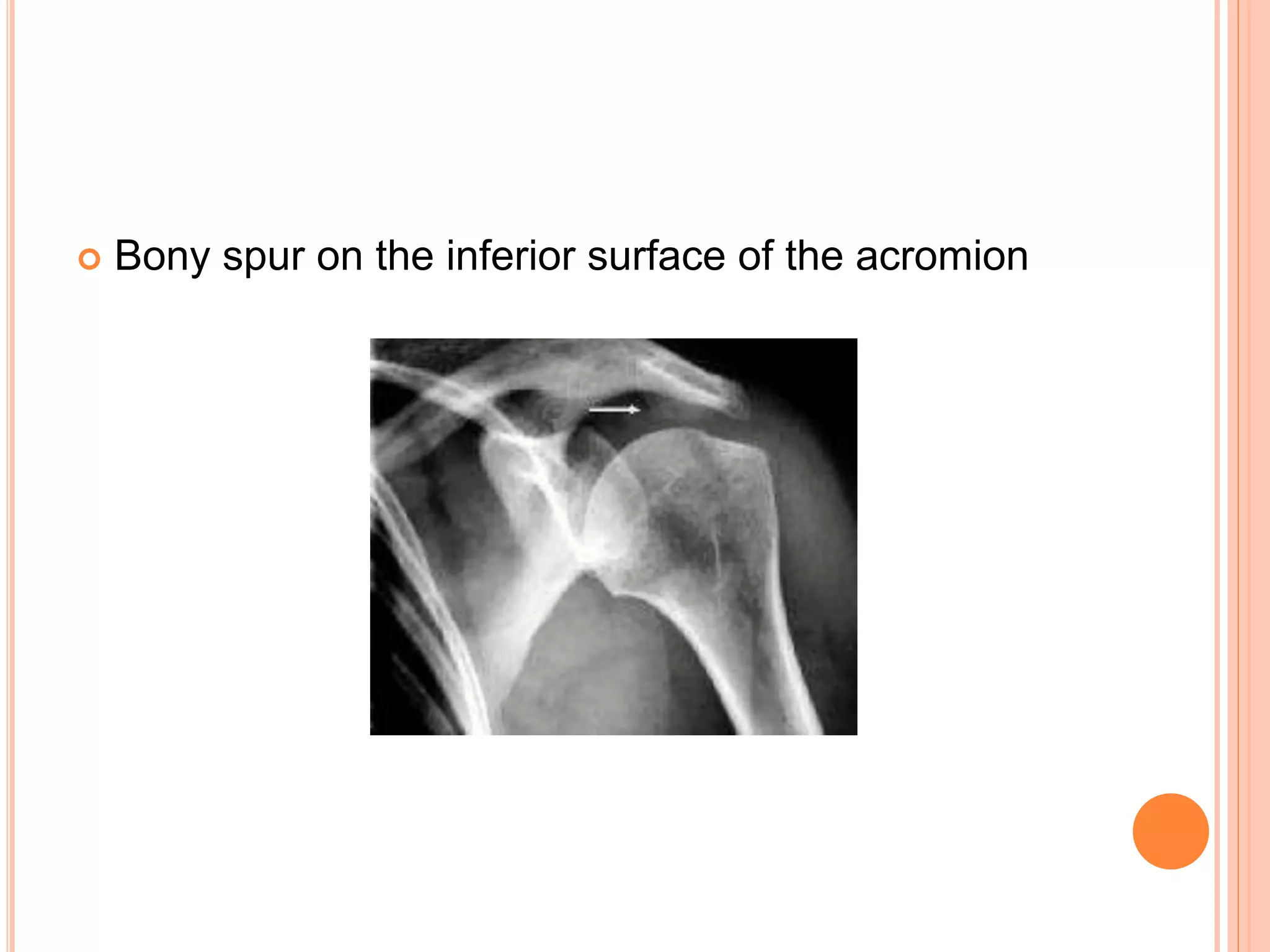
 Bony spur on the inferior surface of the acromion
ARTHROGRAM
 Good for diagnosis of complete rotator cuff tear.
 Cost effective.
 Invasive
 Does not give information about size of tear.
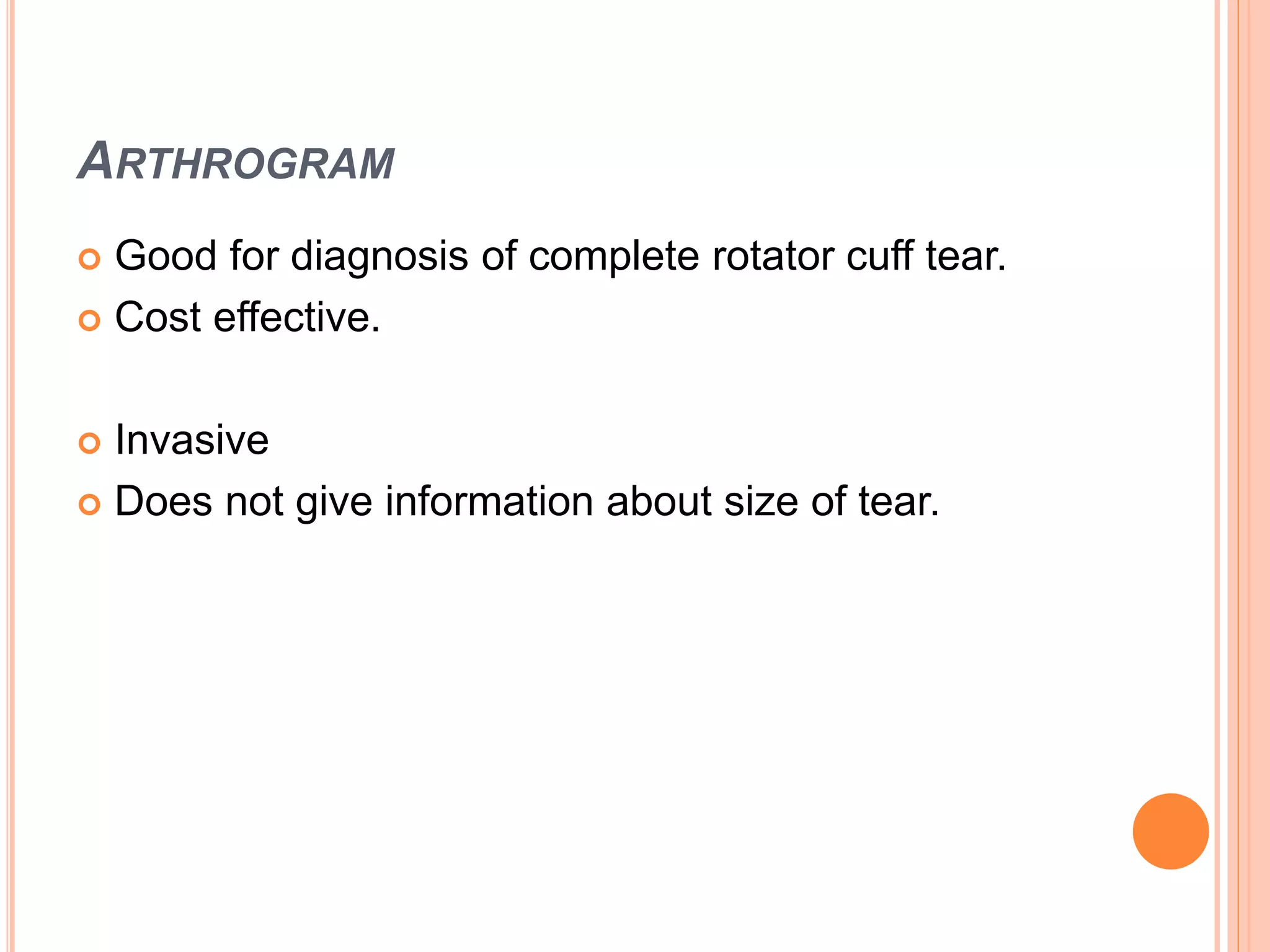
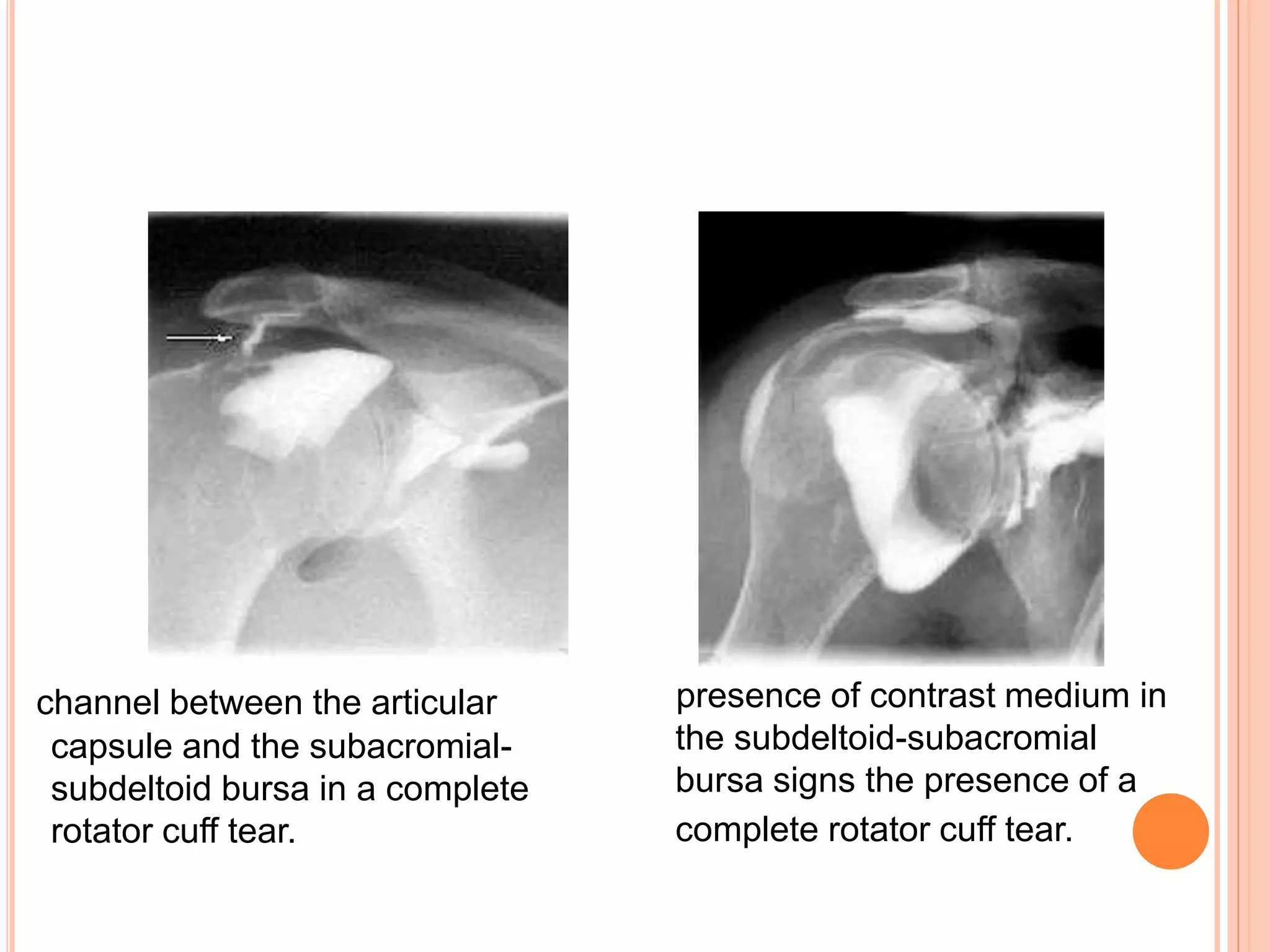
presence of contrast medium in
the subdeltoid-subacromial
bursa signs the presence of a
complete rotator cuff tear.
channel between the articular
capsule and the subacromial-
subdeltoid bursa in a complete
rotator cuff tear.
ULTRASOUND
 Cheap and quick to perform.
 Good definition of rotator cuff.
 Allows dynamic examination.
 Operator dependant.
 Findings:
 Nonvisualization of cuff
 Localized absence
 Discontinuity
 Focal abnormal echogenicity
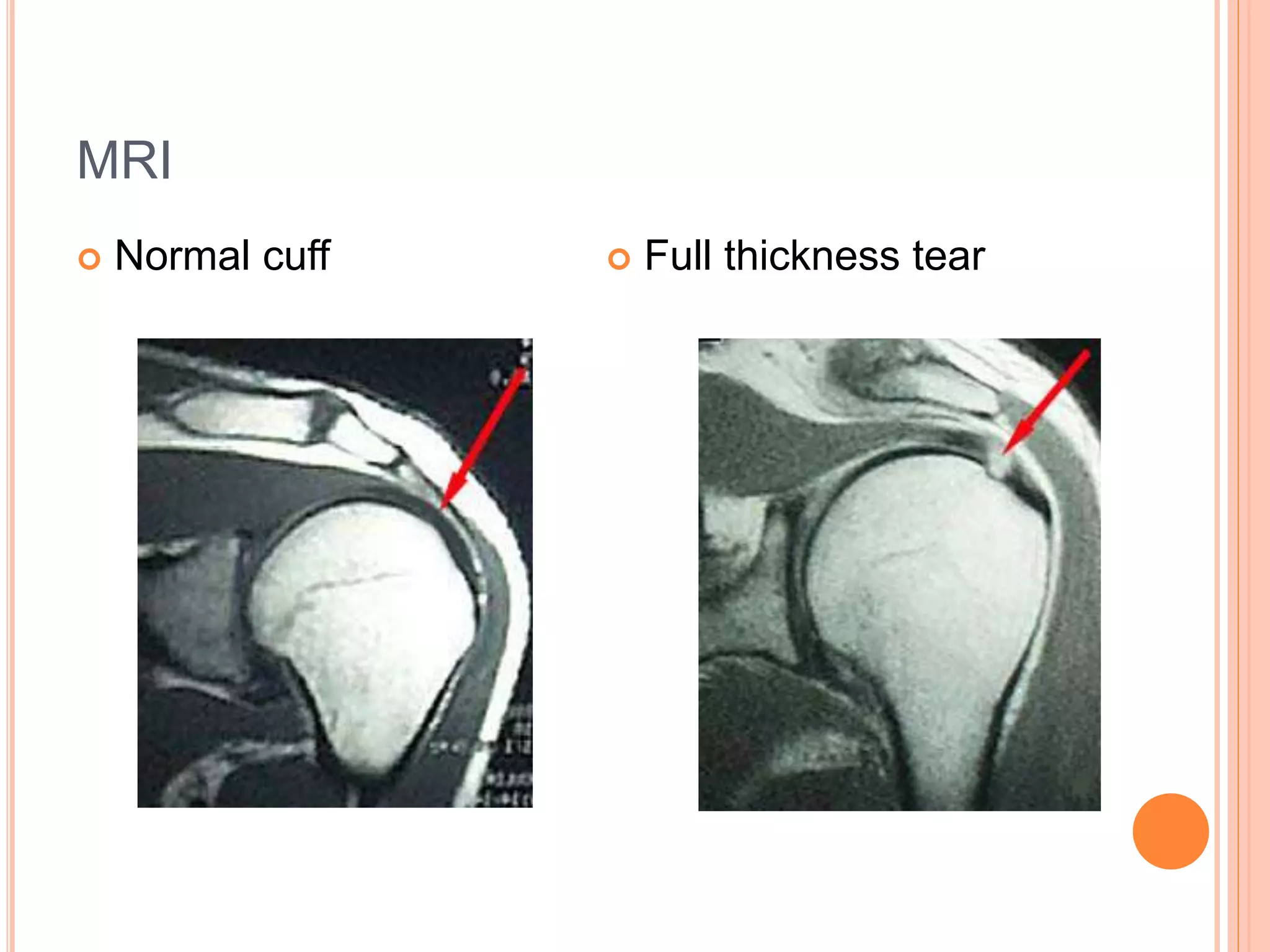
MRI
 Best diagnostic aid.
 Defines site of cuff damage.
 Demonstrates fatty changes in muscle
-poor quality cuff.
 Exact size, shape and location of tear
 Non-invasive
MRI
 Normal cuff  Full thickness tear
CONSERVATIVE MANAGEMENT
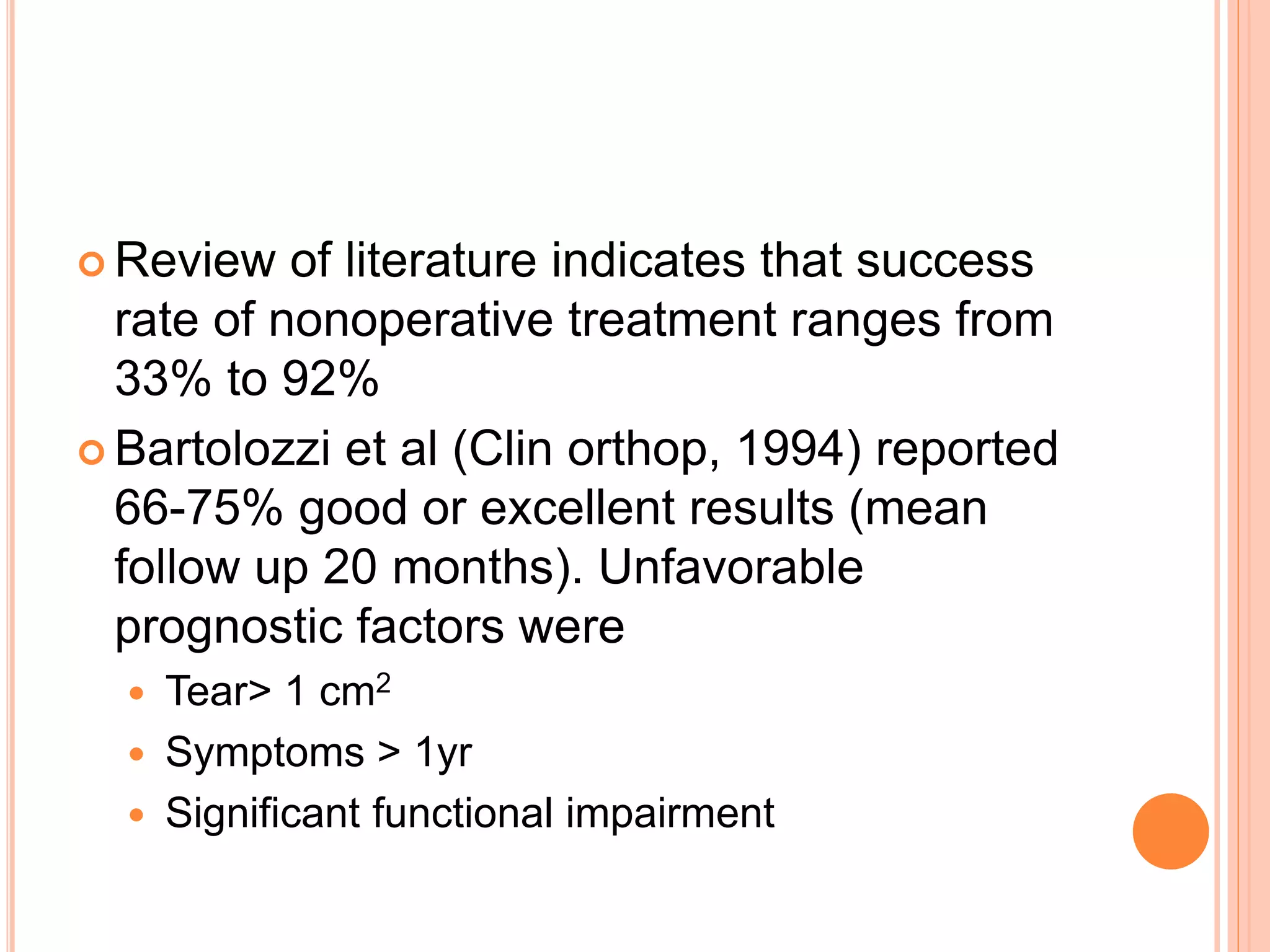
 McLaughlin in 1962 advanced reasons to avoid
early repair
 25 % of cadavers had torn cuff -most of them were
asymptomatic
 50 % of patients would recover comfortably
 Results of early and late repair are similar
 Repair did not always permit anatomic restoration
 Early diagnosis is difficult
 Review of literature indicates that success
rate of nonoperative treatment ranges from
33% to 92%
 Bartolozzi et al (Clin orthop, 1994) reported
66-75% good or excellent results (mean
follow up 20 months). Unfavorable
prognostic factors were
 Tear> 1 cm2
 Symptoms > 1yr
 Significant functional impairment
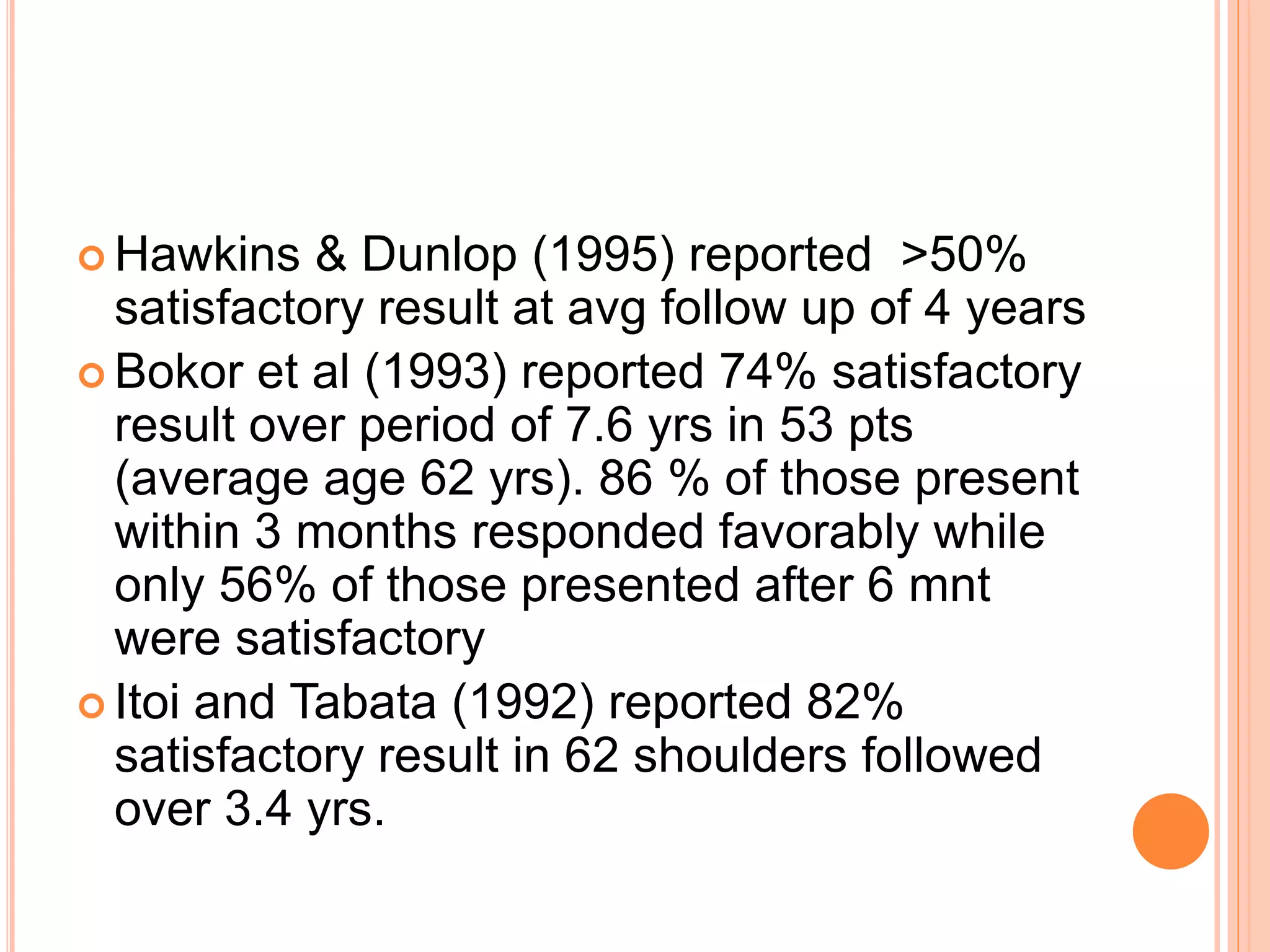
 Hawkins & Dunlop (1995) reported >50%
satisfactory result at avg follow up of 4 years
 Bokor et al (1993) reported 74% satisfactory
result over period of 7.6 yrs in 53 pts
(average age 62 yrs). 86 % of those present
within 3 months responded favorably while
only 56% of those presented after 6 mnt
were satisfactory
 Itoi and Tabata (1992) reported 82%
satisfactory result in 62 shoulders followed
over 3.4 yrs.
ORTHOTHERAPY
 Term used by Michael Wirth (OCNA 1997)
 Interactive exchange between patient and
orthopedic surgeon directed at creating exercise
regimen that gradually improves motion and
strength in shoulder girdle.
 Three phases:
 Phase 1- restore full, painless range of motion. Codman
pendulum exercise followed by passive movements in all
direction
 Phase 2- designed to strengthened remaining muscles of
rotator cuff, deltoid & scapular muscles
 Phase 3- gradual reinstitution of normal activities including
work, hobby and sport.
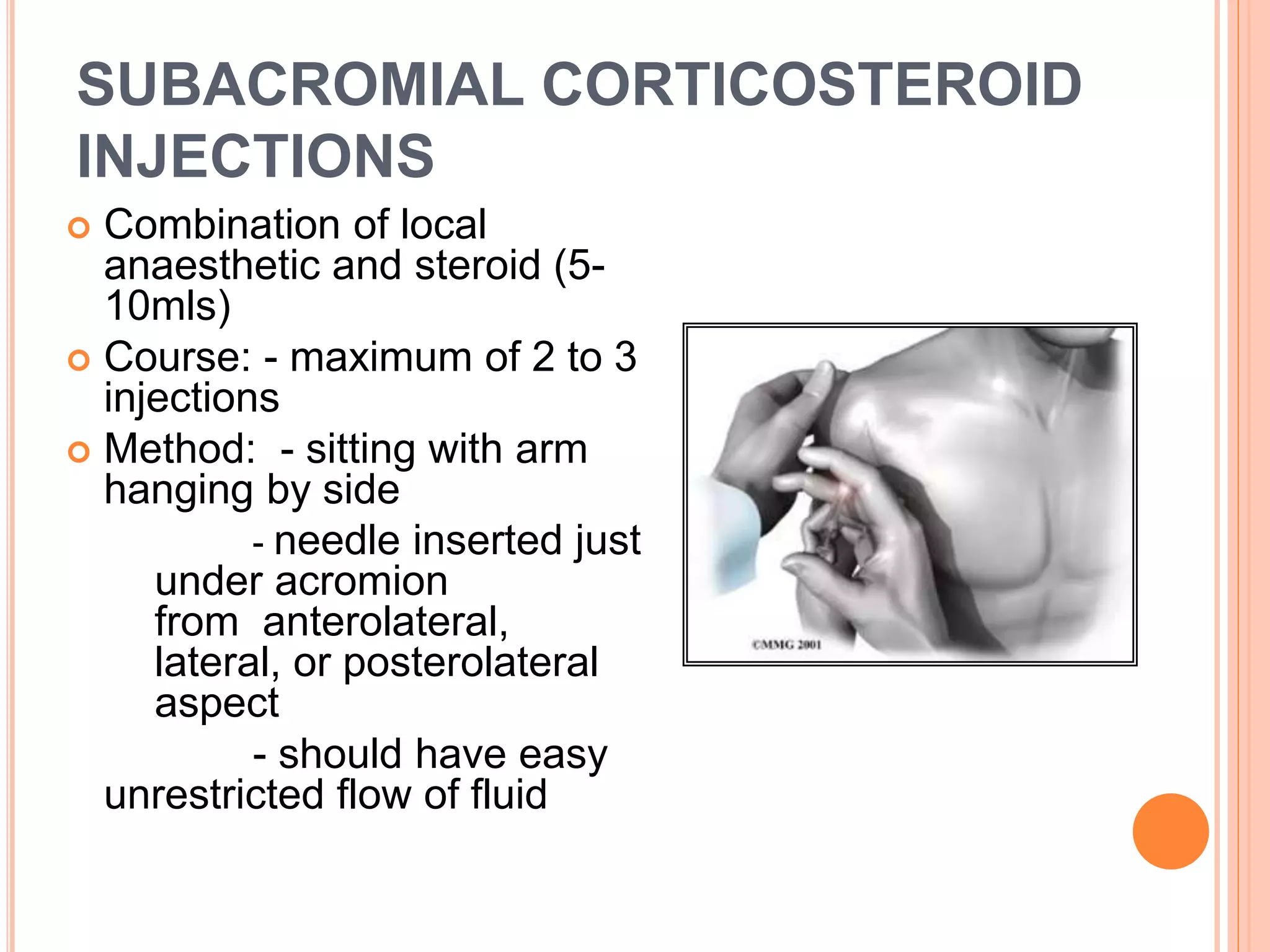
SUBACROMIAL CORTICOSTEROID
INJECTIONS
 Combination of local
anaesthetic and steroid (5-
10mls)
 Course: - maximum of 2 to 3
injections
 Method: - sitting with arm
hanging by side
- needle inserted just
under acromion
from anterolateral,
lateral, or posterolateral
aspect
- should have easy
unrestricted flow of fluid
SUBACROMIAL CORTICOSTEROID
INJECTIONS
 Benefits: - short-term benefit in reducing pain and
increasing ROM
 Risks:
- decreased tendon strength and risk of rupture
if into tendon
- subcutaneous atrophy
- effects on articular cartilage
- may have detrimental effects on results of
subsequent repair
OPERATIVE TREATMENT
 Patient selection:
 Samilson & Binder :
 Patient physiologically younger than 60 yrs
 Clinically or arthrographically demonstrable full
thickness cuff tear.
 Failure to improve on nonoperative management
for minimum of 6 weeks
 Need to use shoulder in overhead elevation
 Full passive range of motion
 Ability & willingness to cooperate
POOR PROGNOSTIC FACTORS
 Old age group
 Long history
 No history of trauma
 Smoker
 Multiple steroid injection
 Diffuse osteopenia
 Rotator cuff tear are classified on basis of size by
Gartsman:
 Small < 1 cm
 Medium-1 to 3 cm
 Large-3 to 5 cm
 Massive > 5 cm
PROCEDURES
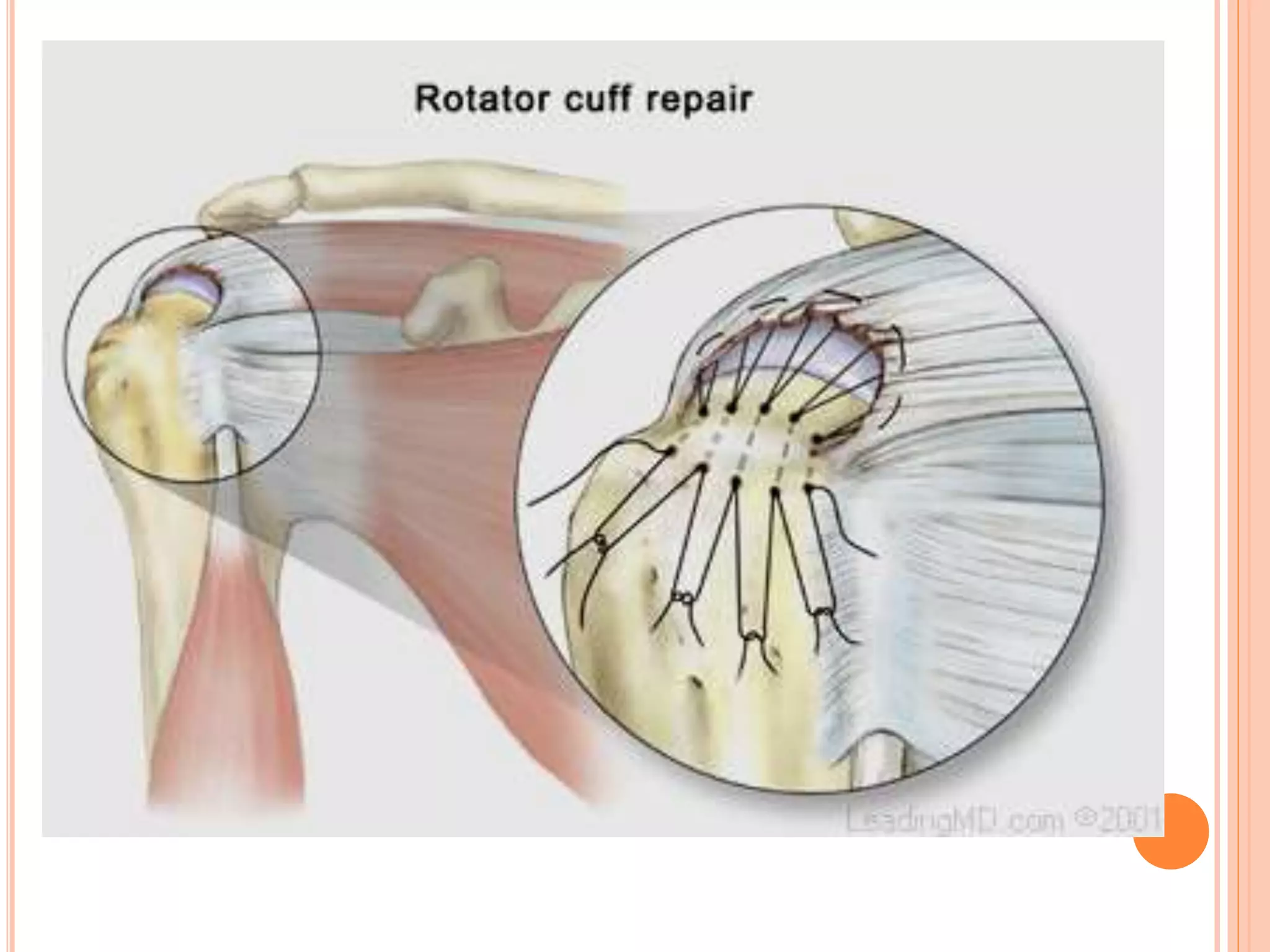
 Repair of tear
 open or arthroscopic
 Tendon to tendon or tendon to bone
 Arthroscopic debridement and acromioplasty with mini-
open repair
 Neer described four major objectives
 Closure of cuff defect
 Elimination of impingement lesions of coracoacromial
arch
 Preservation of origin of deltoid
 Rehabilitation to prevent postop stiffness
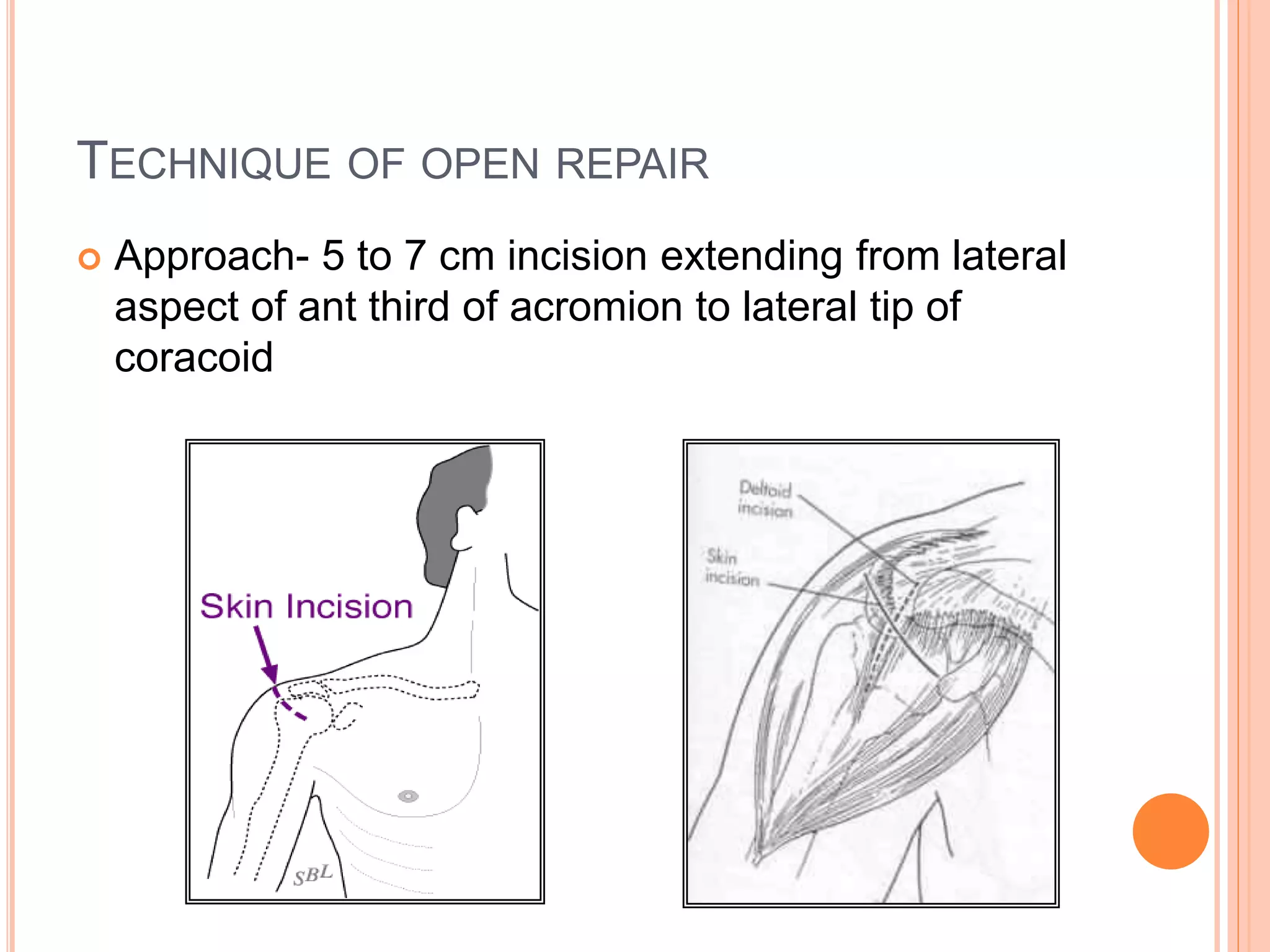
TECHNIQUE OF OPEN REPAIR
 Approach- 5 to 7 cm incision extending from lateral
aspect of ant third of acromion to lateral tip of
coracoid
 Subacromial decompression-
 Coracoacromial ligament release
 Anterior acromioplasty
 Modified acromioclavicular arthroplasty
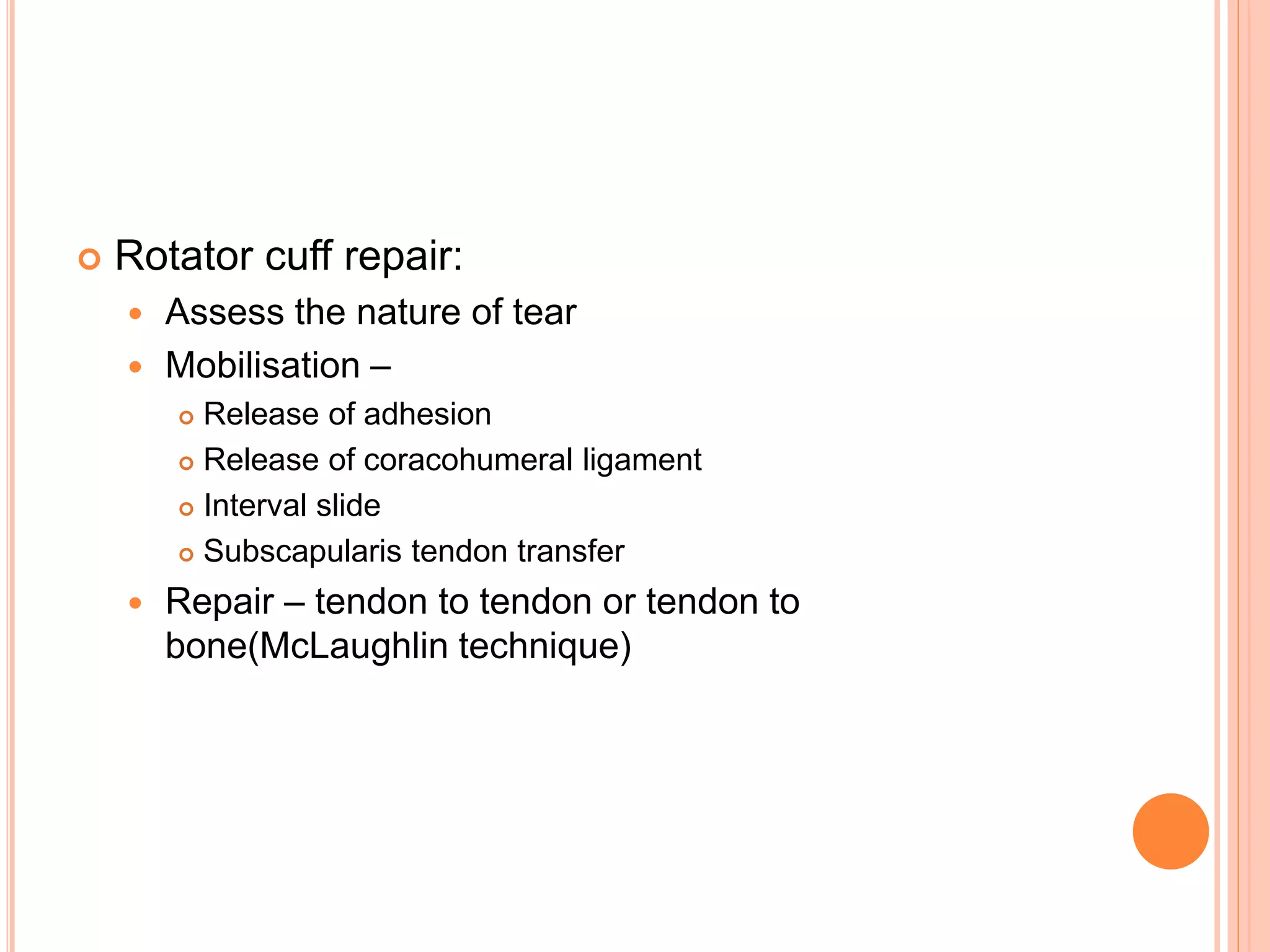
 Rotator cuff repair:
 Assess the nature of tear
 Mobilisation –
 Release of adhesion
 Release of coracohumeral ligament
 Interval slide
 Subscapularis tendon transfer
 Repair – tendon to tendon or tendon to
bone(McLaughlin technique)
MOBILISATION
 Release of capsule
from labrum
 Release of cuff tendons from
coracoid
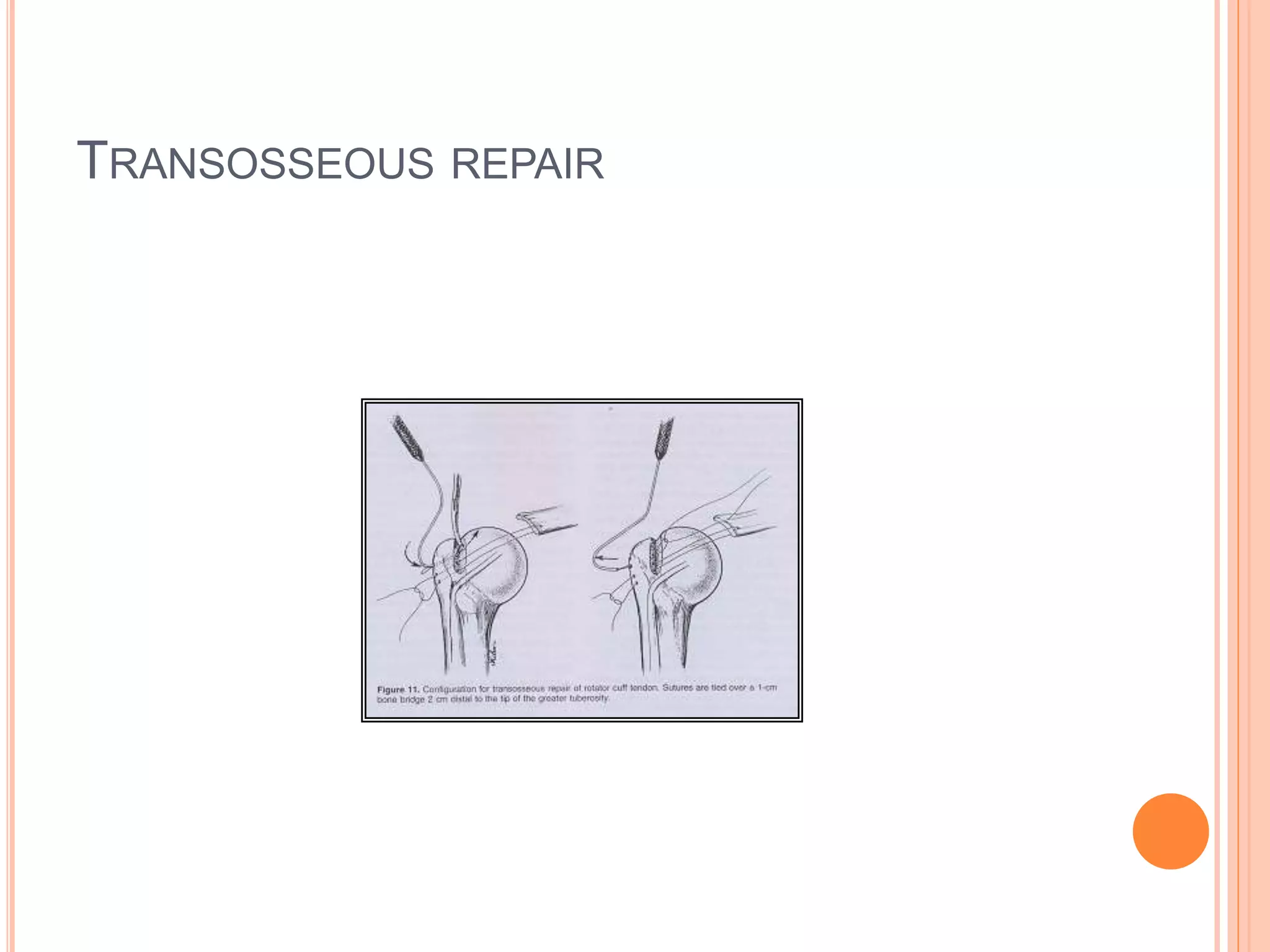
TRANSOSSEOUS REPAIR
ADVANTAGES OF OPEN REPAIR
 Easy to do
 No special equipment required
 Allows direct visualization of cuff repair and
acromioplasty
 Good long term follow-up
DISADVANTAGES
 Deltoid detachment required
 False positive studies (arthrogram 2%, MRI 10%)
will lead to unnecessary open exploration
 Unrepairable tear will be opened.
 Significant intraarticular pathology will be missed
ARTHROSCOPIC REPAIR OF ROTATOR CUFF
 Advantages :
 Lesser morbidity
 Ability to identify and treat other pathology
 Truly outpatient
 Allows to address small undetected tears
 Patient acceptance
 Disadvantages :
 Technically difficult
 Implant cost-needs anchor
 Increased OR time
 High failure rate during learning curve
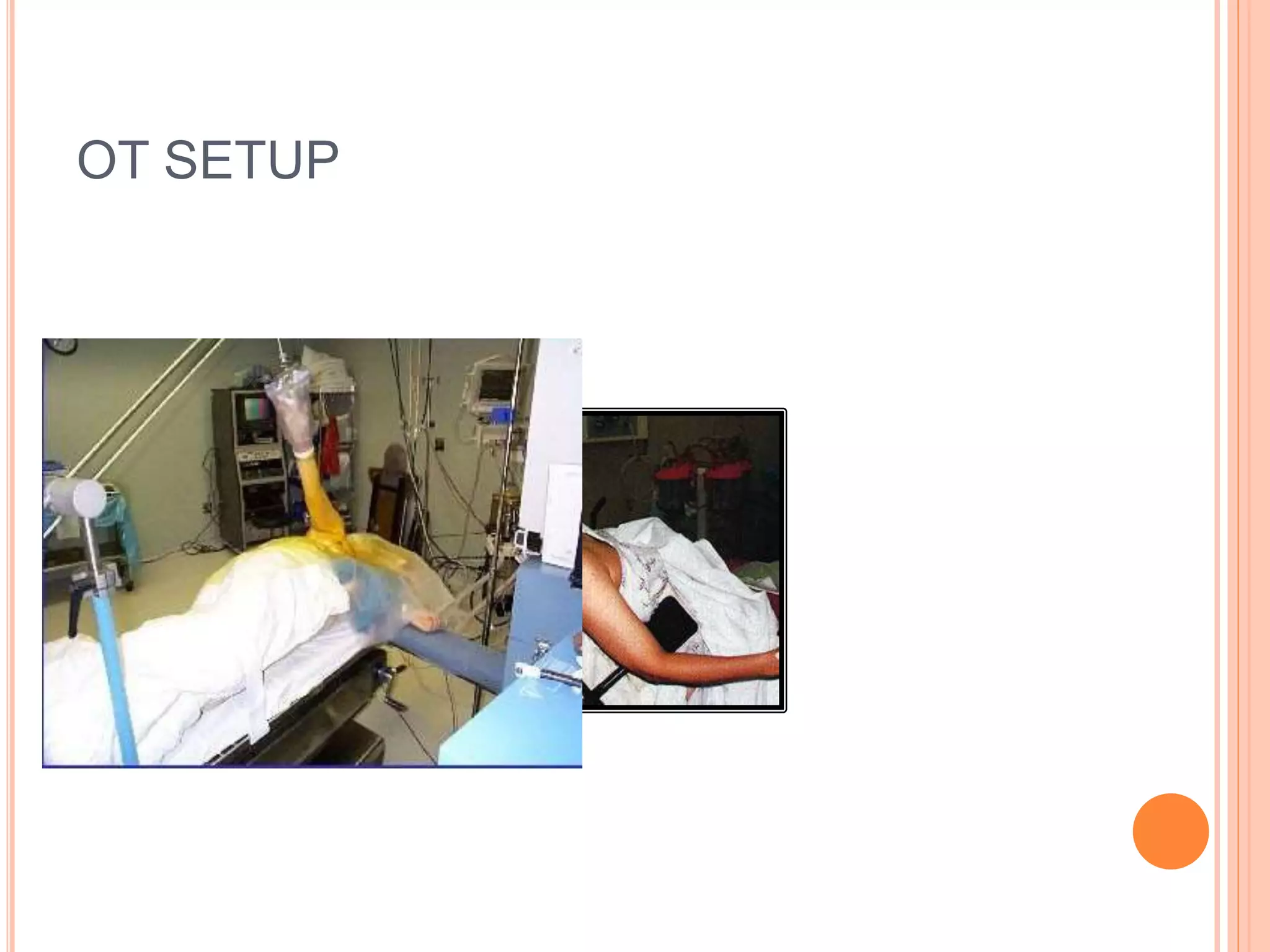
OT SETUP
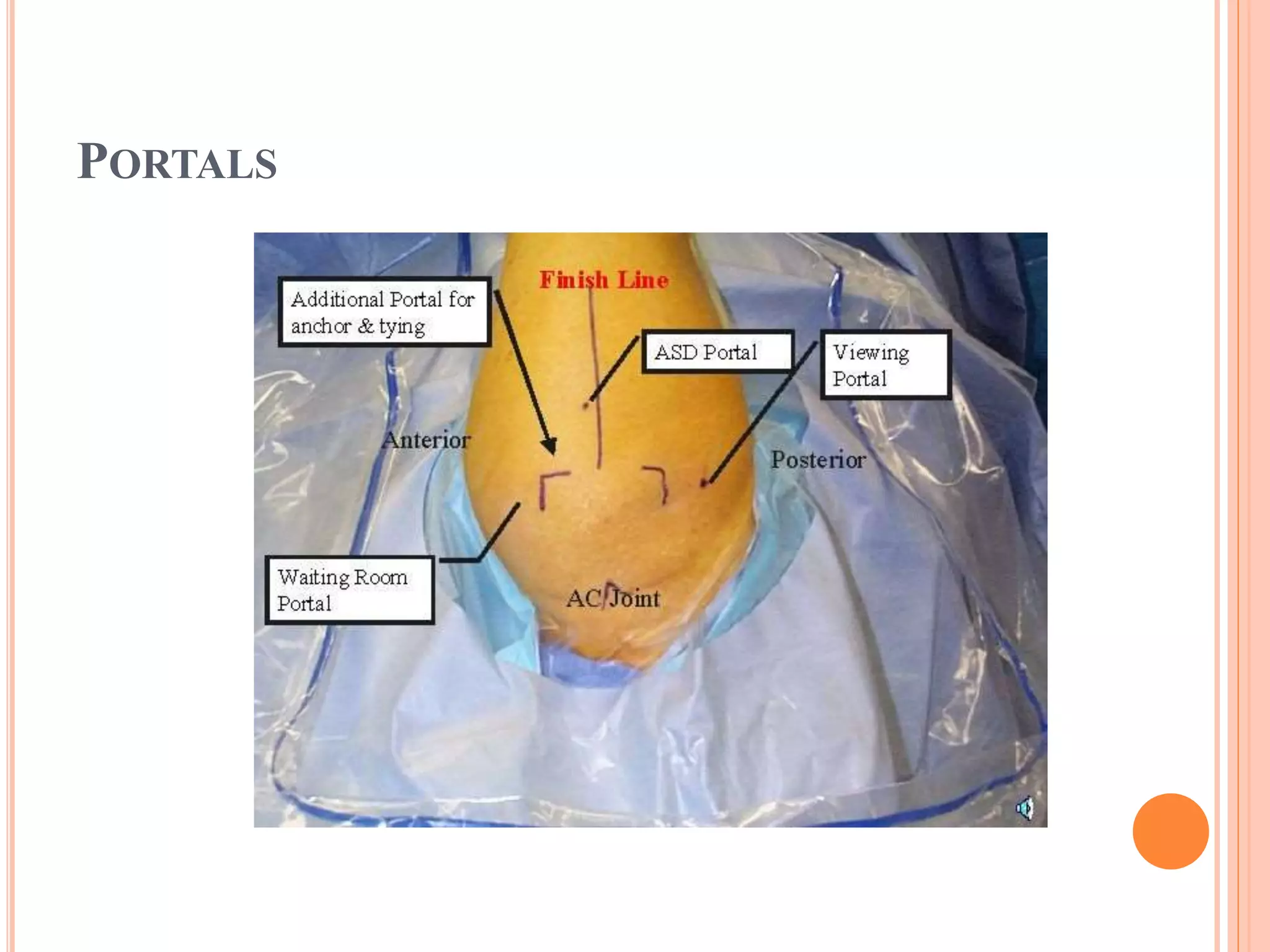
PORTALS
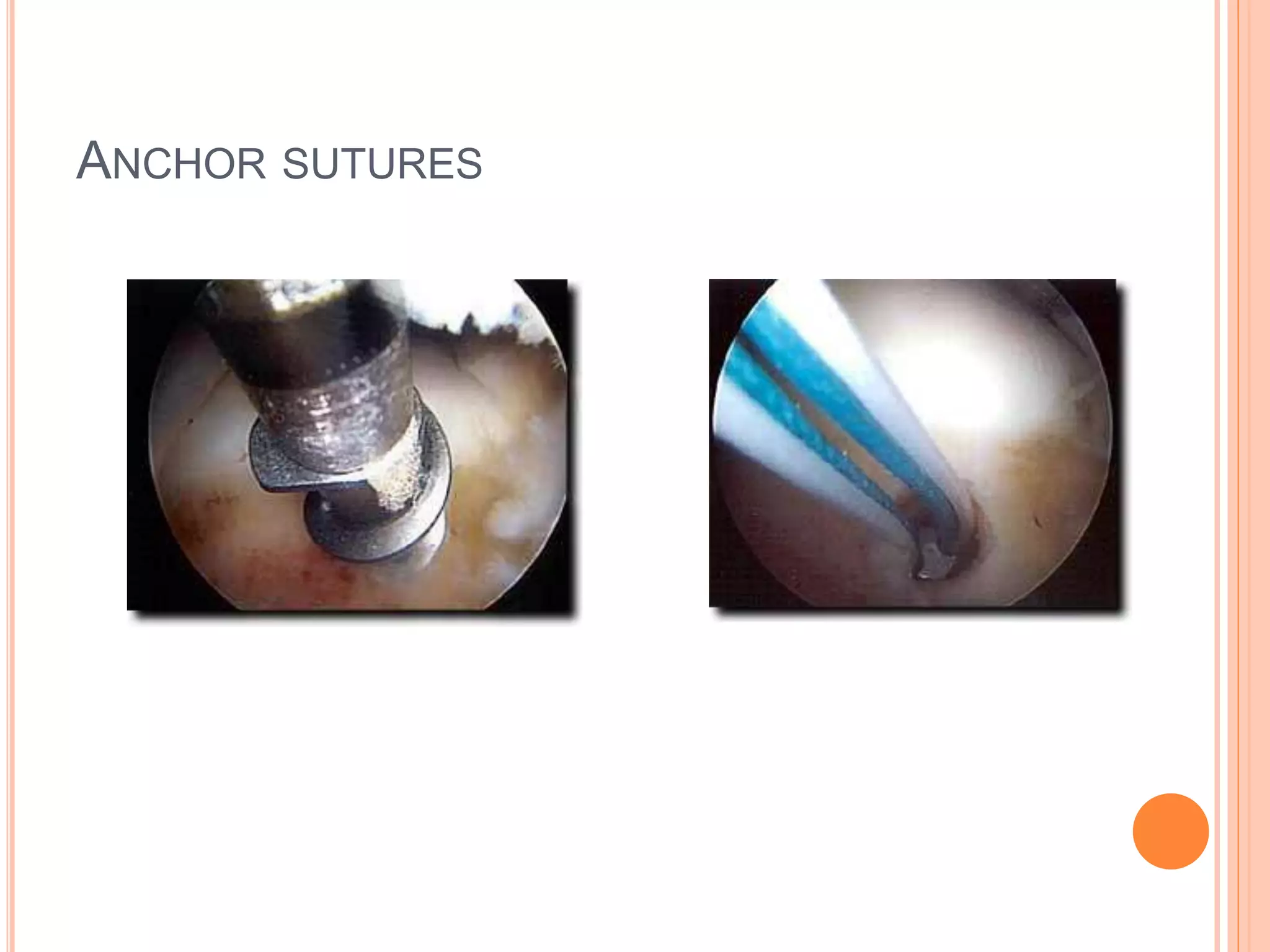
ANCHOR SUTURES
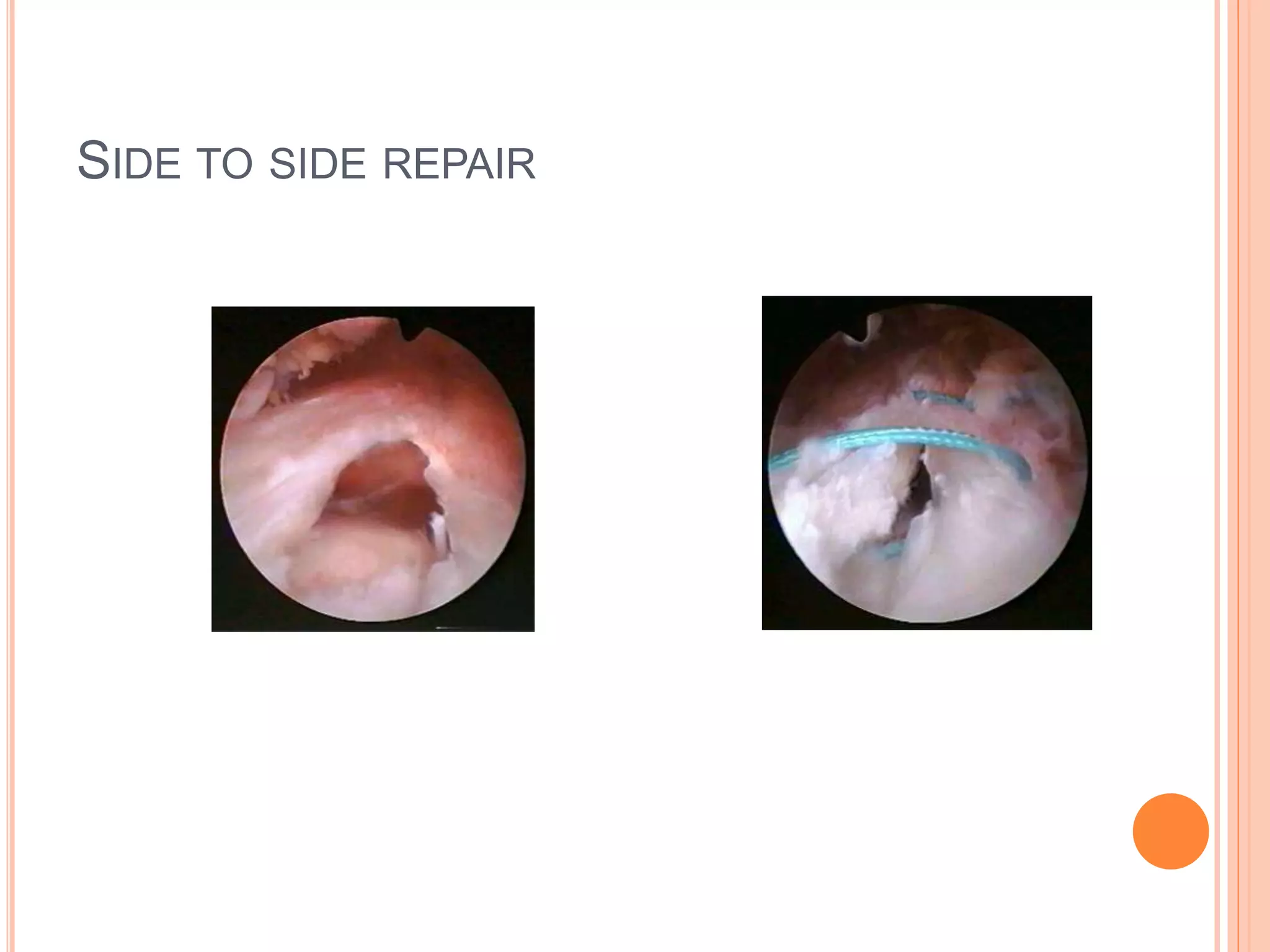
SIDE TO SIDE REPAIR
ARTHROSCOPIC ASSISTED MINI
OPEN REPAIR
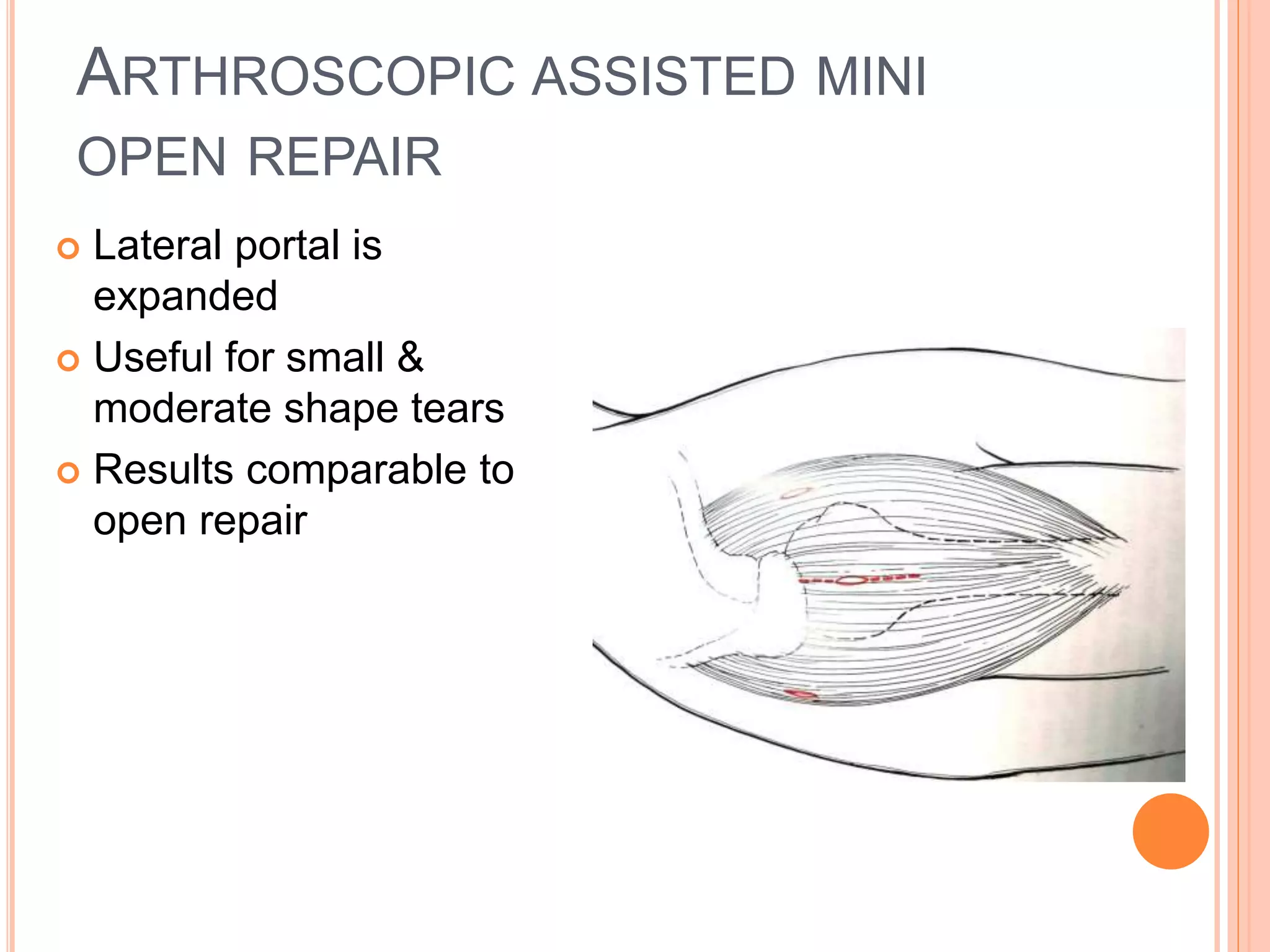
 Lateral portal is
expanded
 Useful for small &
moderate shape tears
 Results comparable to
open repair
ARTHROSCOPIC ASSISTED MINI
OPEN REPAIR
 Combined advantage
 easy to do with modest arthroscopic skills
 allows for arthroscopic correction of intraarticular
pathology
 well established improvement in perioperative
morbidity
 in two large studies with no increase in
complication or compromise in outcome
 cost effective
 easy to “bail out” to full open procedure if desired
 avoid opening patients with false positive studies
 avoid opening patients with unrepairable defects
POST OPERATIVE PLAN
 Depends on
1. Size of tear
2. Type of repair
3. Degree of retraction
4. Intraoperative motion limits
5. Age of patient
POST OPERATIVE PLAN (CONTD)
 Arthroscopic
 Immd active and passive ROM
 Avoid active abduction >60 degree for 3-4 wks
 Then electrical stimulation, resisting exercises
for 3-4 mths
 High demand activities within 4-6 mths
 Open
 Proceed slowly (deltoid detached)
 Avoid active flexion or abduction for 4 wks
 Requires 1-2 additional months
POST OPERATIVE PLAN (CONTD)
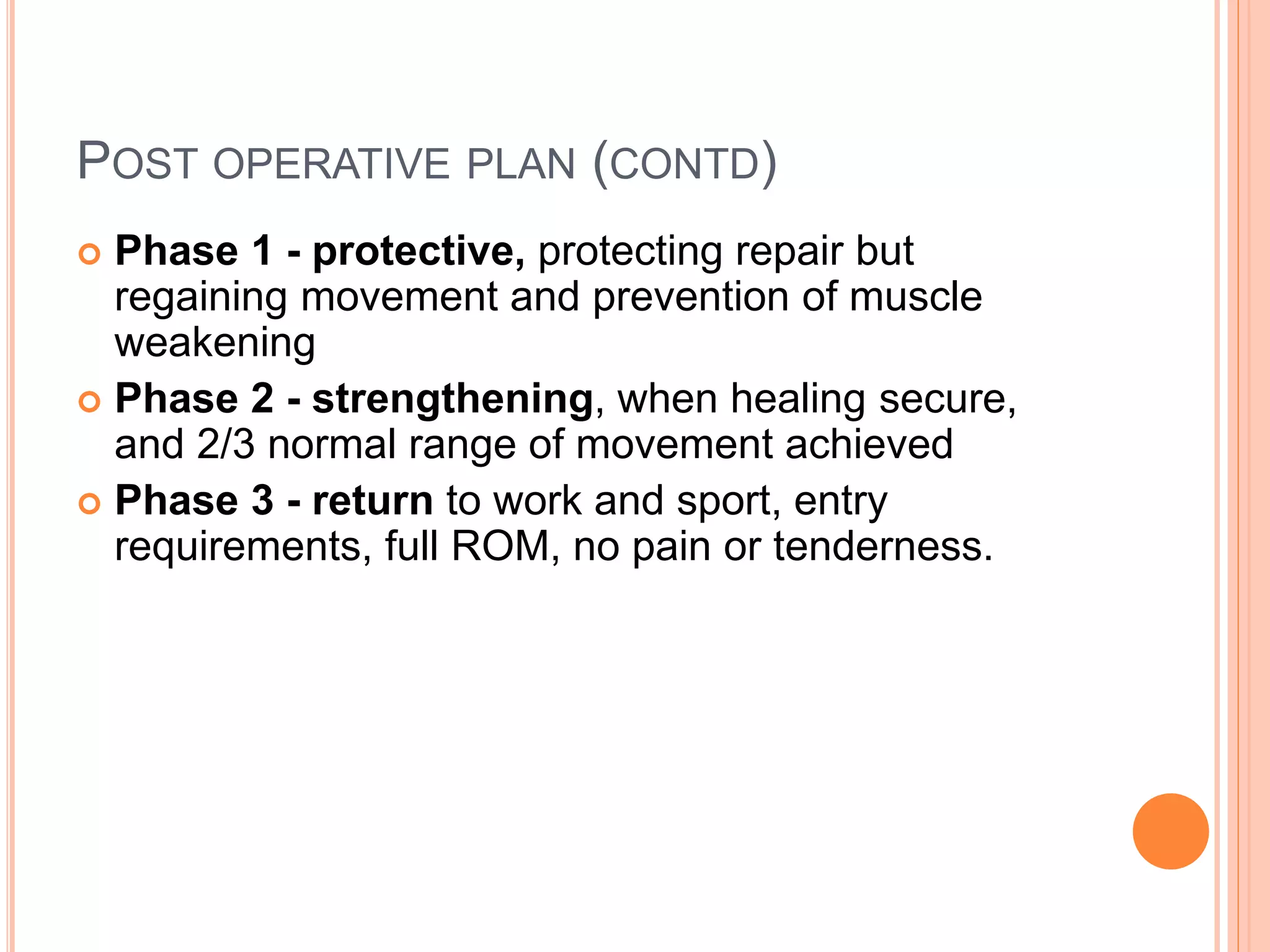
 Phase 1 - protective, protecting repair but
regaining movement and prevention of muscle
weakening
 Phase 2 - strengthening, when healing secure,
and 2/3 normal range of movement achieved
 Phase 3 - return to work and sport, entry
requirements, full ROM, no pain or tenderness.
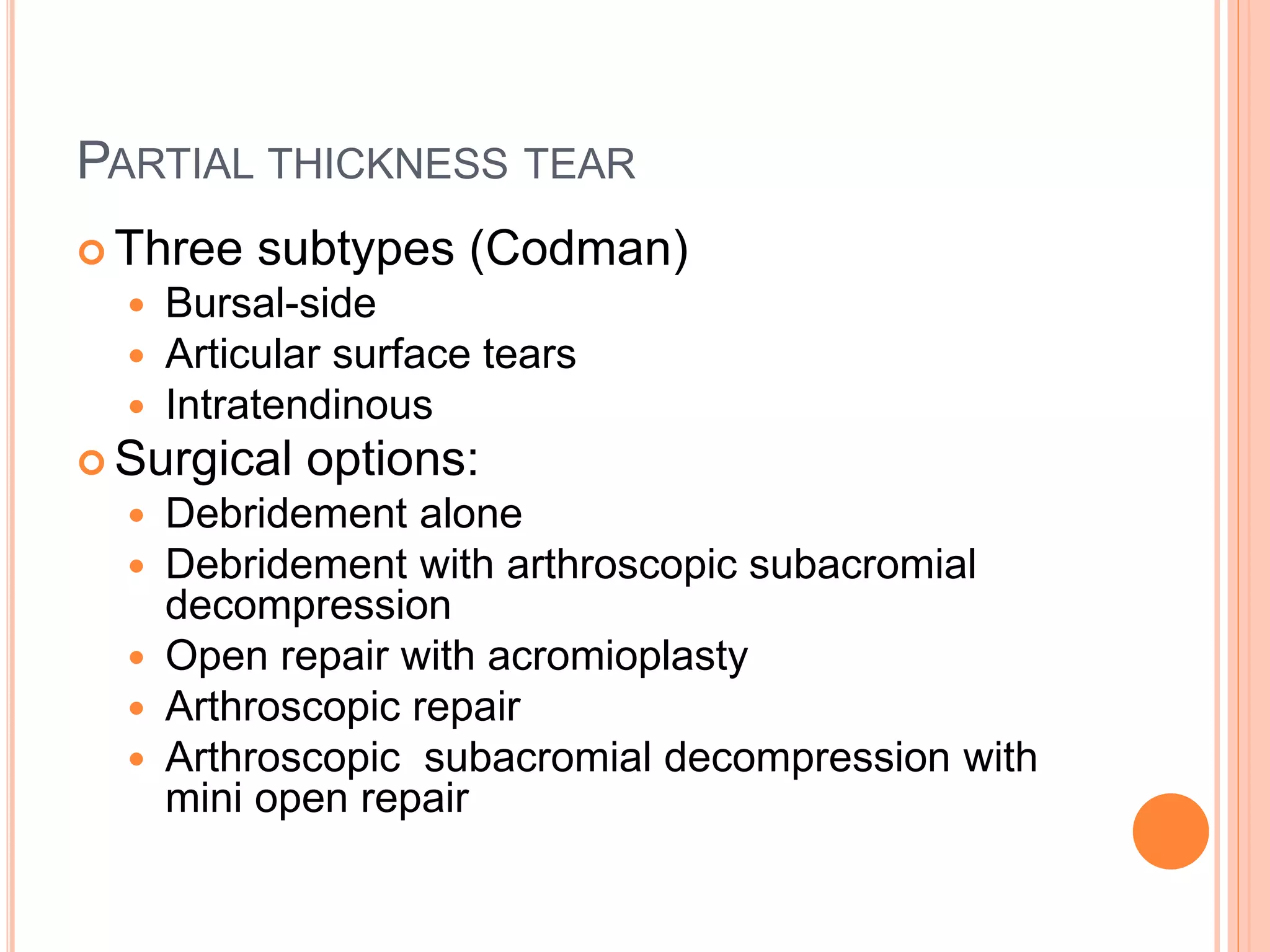
PARTIAL THICKNESS TEAR
 Three subtypes (Codman)
 Bursal-side
 Articular surface tears
 Intratendinous
 Surgical options:
 Debridement alone
 Debridement with arthroscopic subacromial
decompression
 Open repair with acromioplasty
 Arthroscopic repair
 Arthroscopic subacromial decompression with
mini open repair
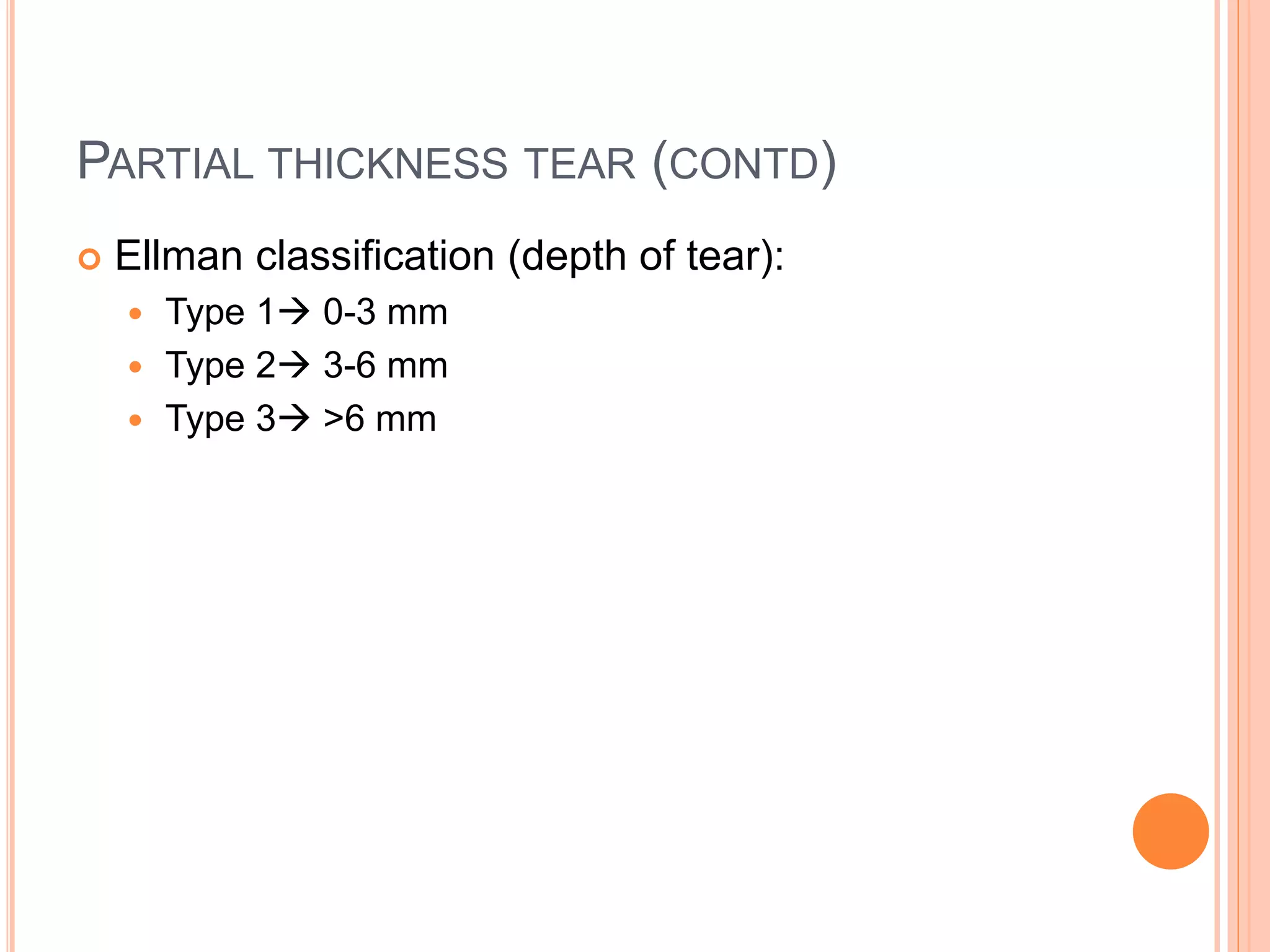
PARTIAL THICKNESS TEAR (CONTD)
 Ellman classification (depth of tear):
 Type 1 0-3 mm
 Type 2 3-6 mm
 Type 3 >6 mm
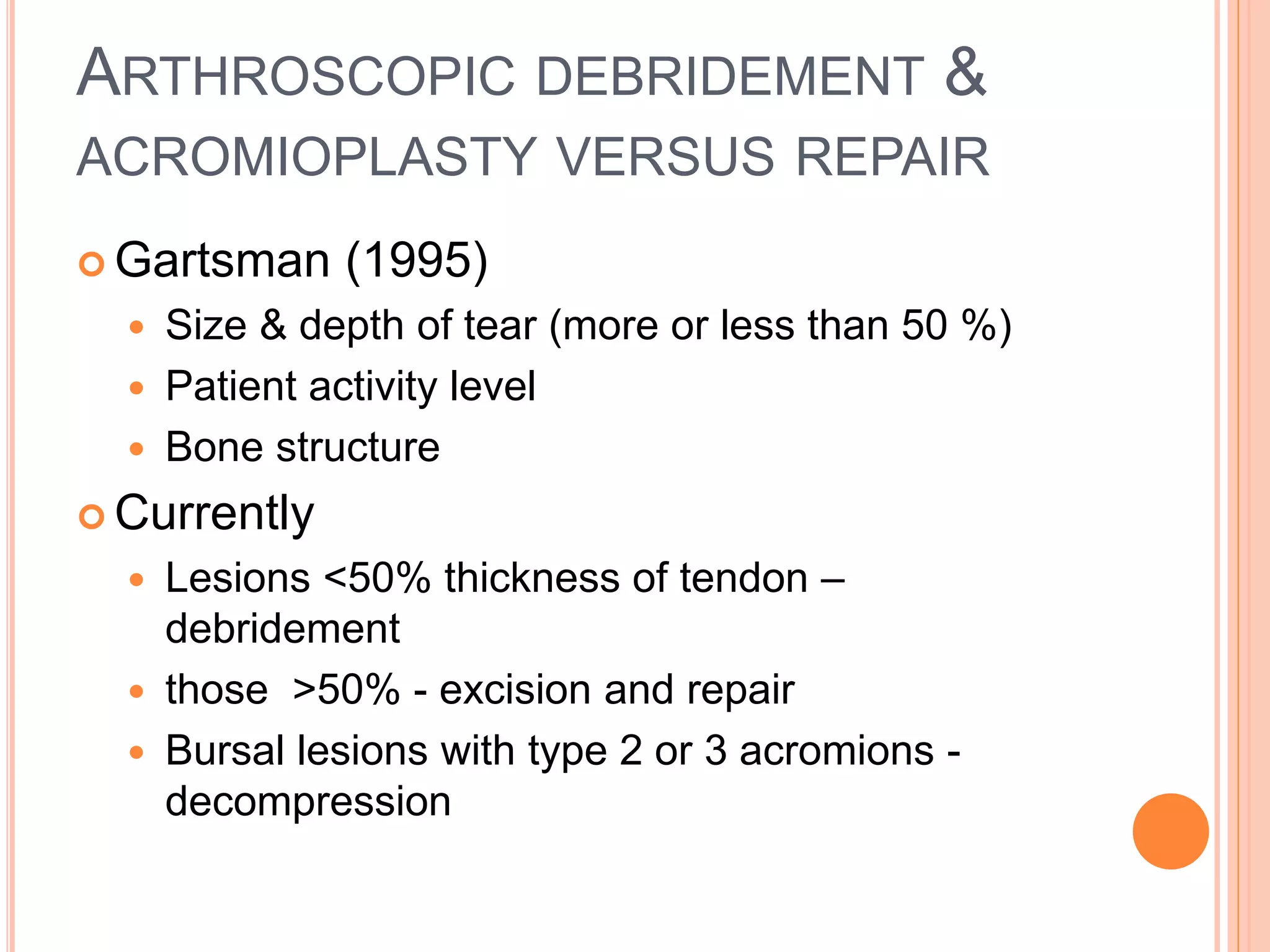
ARTHROSCOPIC DEBRIDEMENT &
ACROMIOPLASTY VERSUS REPAIR
 Gartsman (1995)
 Size & depth of tear (more or less than 50 %)
 Patient activity level
 Bone structure
 Currently
 Lesions <50% thickness of tendon –
debridement
 those >50% - excision and repair
 Bursal lesions with type 2 or 3 acromions -
decompression
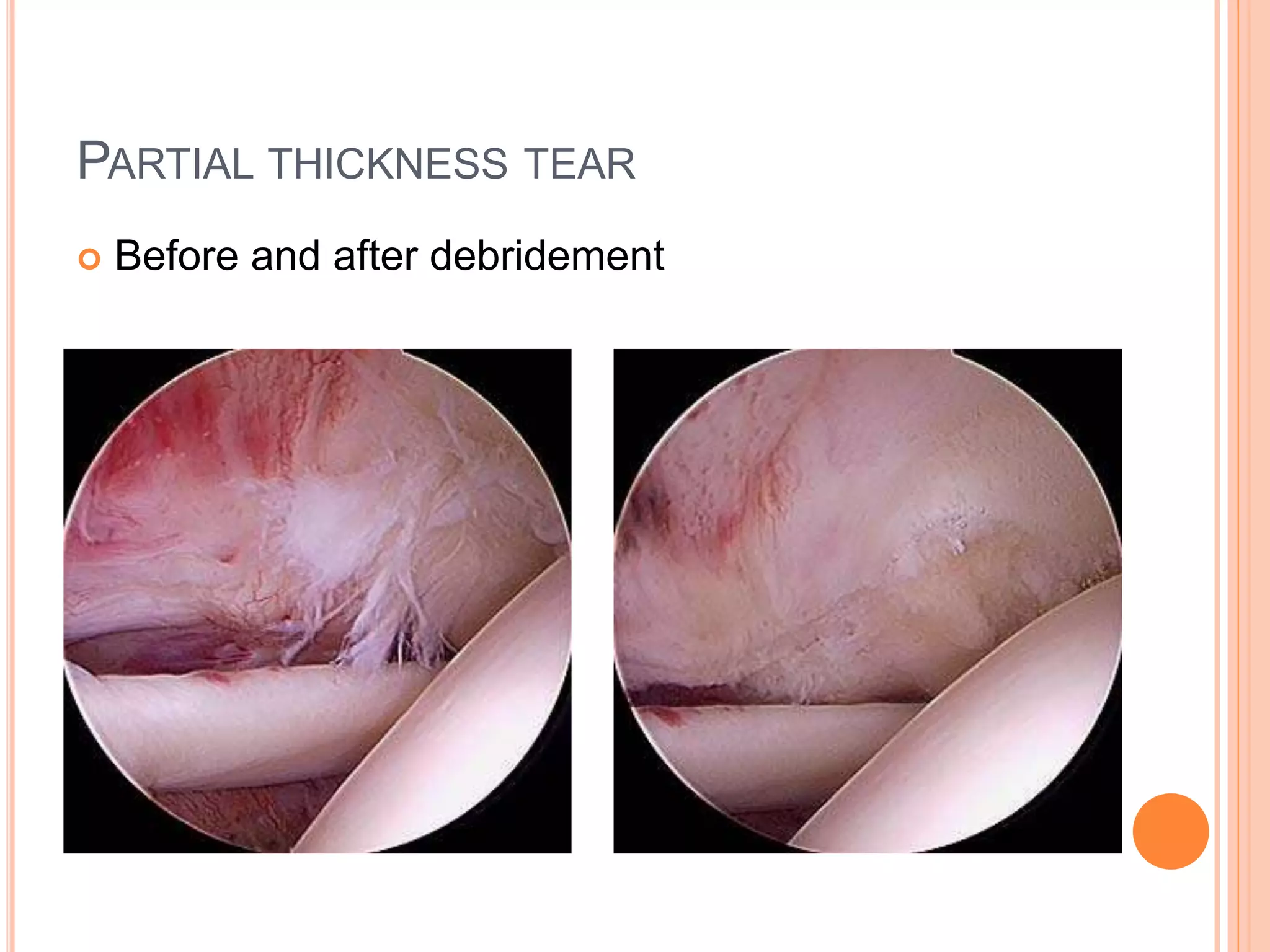
PARTIAL THICKNESS TEAR
 Before and after debridement
IRREPARABLE TEARS
 Pre operative diagnosis
 AHI <3 mms
 Profound loss of external rotation
 MRI-fatty degeneration of muscle
TREATMENT OPTIONS
 Debridement
 Tendon transposition
 Subscapularis
 Infraspinatus
 Muscle transfer
 Partial repair
 Allograft substitution
DEBRIDEMENT
 Indication
 >60 years
 good external rotation
 good flexion
 good relief with subacromial LA injection
DEBRIDEMENT
 Excise all frayed margin and tissue.
 Do not excise coraco-acromial ligament.
 antero- superior translation of humeral head.
 Minimal debridement of acromion.
TENDON TRANSPOSITION
 Transfer part of subscapularis or infraspinatus
superiorly.
 ? Disrupts coupling force of subscapularis and
infraspinatus.
PARTIAL REPAIR OF MASSIVE
ROTATOR CUFF TEAR
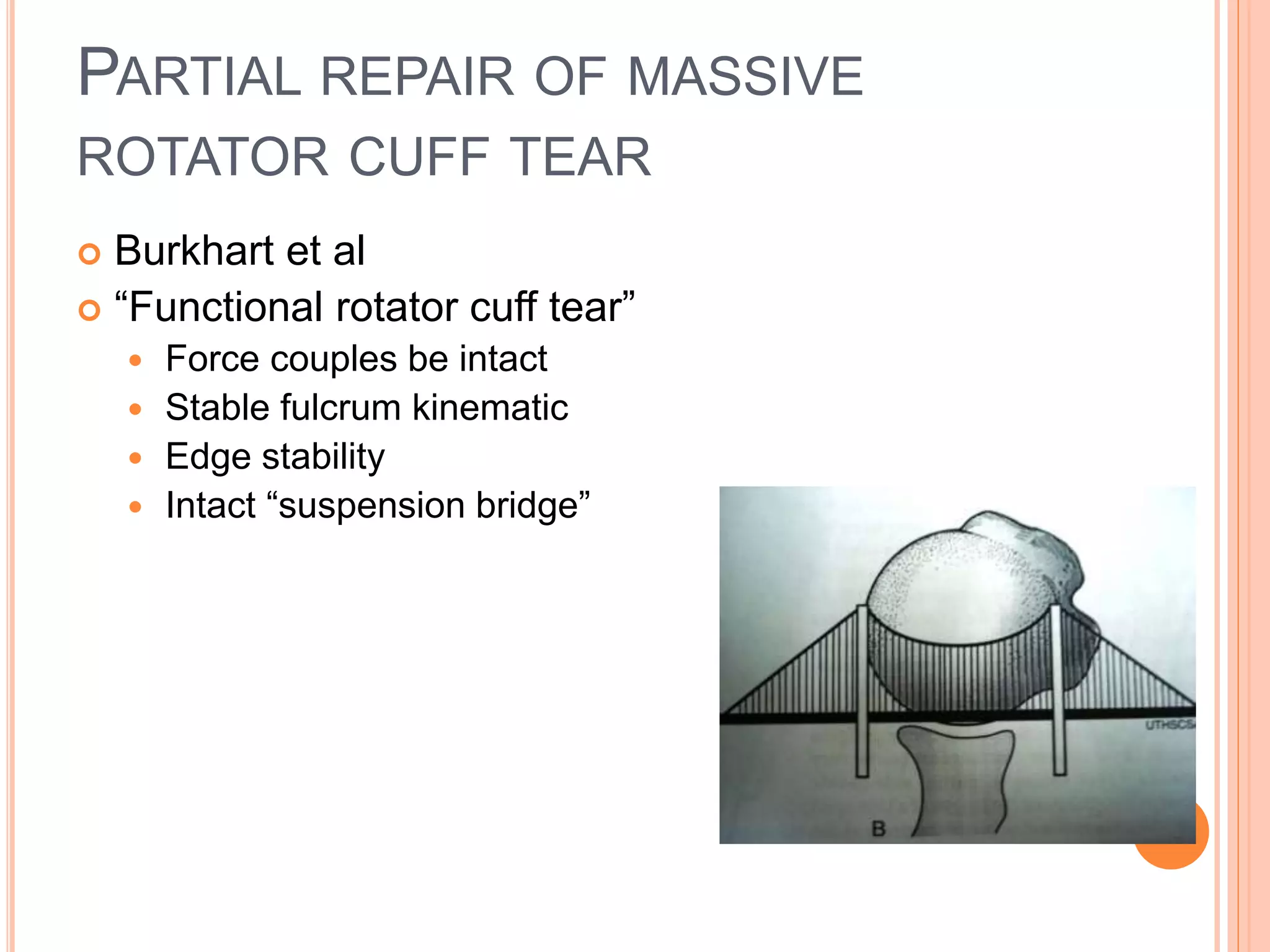
 Burkhart et al
 “Functional rotator cuff tear”
 Force couples be intact
 Stable fulcrum kinematic
 Edge stability
 Intact “suspension bridge”
PARTIAL REPAIR OF MASSIVE
ROTATOR CUFF TEAR (CONTD)
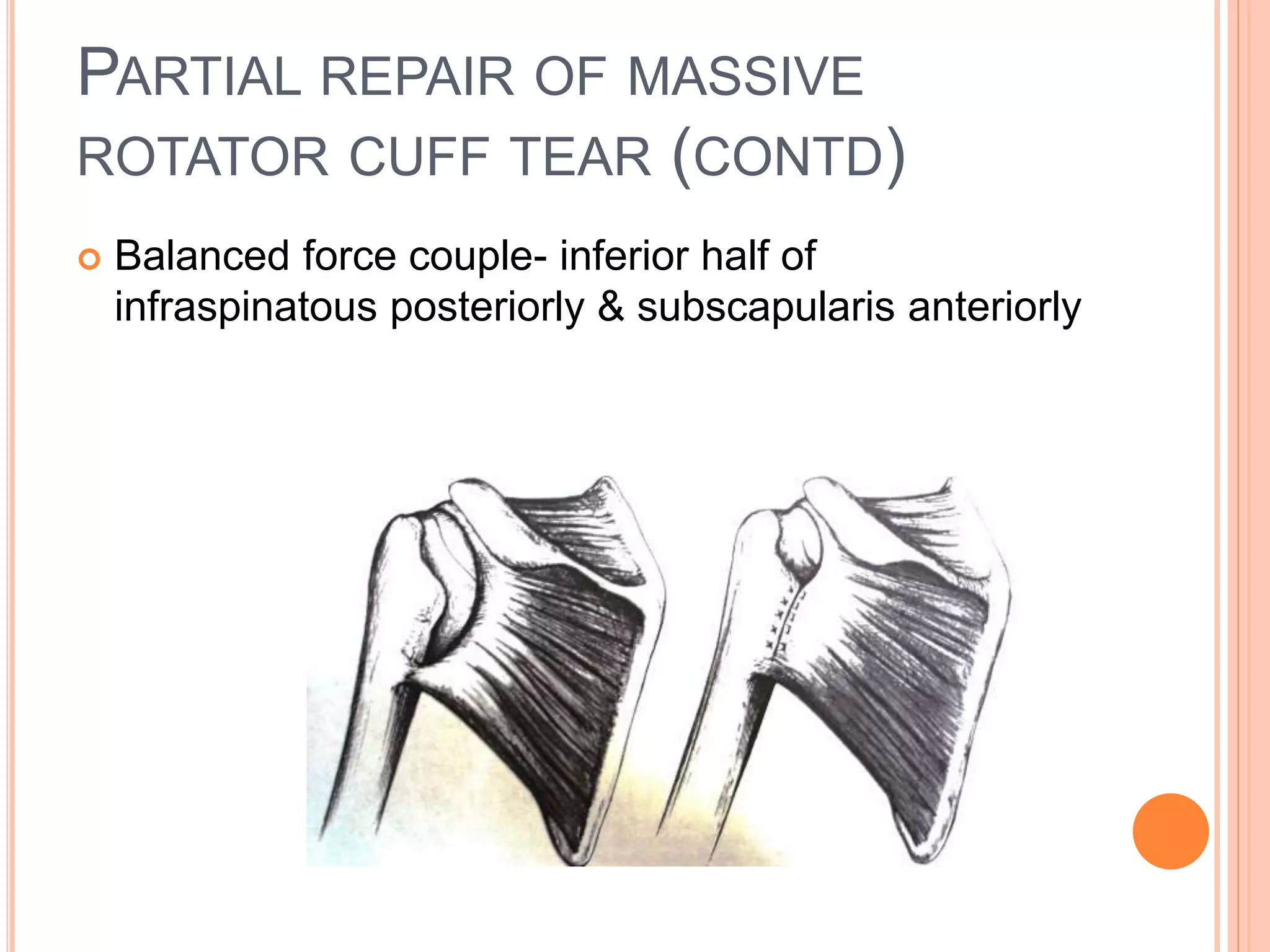
 Balanced force couple- inferior half of
infraspinatous posteriorly & subscapularis anteriorly
PARTIAL REPAIR OF MASSIVE
ROTATOR CUFF TEAR (CONTD)
 Burkhart et al- partial rotator cuff repair in
irreperable cuff- 2 excellent, 6 good, 5 fair & 1 poor
result
 Preserves normal mechanics as compared to
tendon transfer
MUSCLE TRANSFERS
 Main indication- symptomatic rotator cuff
defect that has low probability of repair
 Two parameters are used
 Static subluxation of humeral head
 Degree of degeneration and atrophy of rotator
cuff muscles
 Transfers for substitution of individual
muscle
 Subscapularis -Trapezius (acromial portion),
pectoralis major, pectoralis minor
 Supraspinatus – Trapezius (acromial portion),
Deltoid
 Infraspinatus – Latissimus dorsi, Teres major
LATISSIMUS DORSI TRANSFER
 Described by Gerber in 1992
 Indication
 Irreparable rotator cuff tear involving
 Supraspinatus
 Infraspinatus
 Functioning subscapularis and deltoid.
REVIEW OF 16 CASES OVER 33
MONTHS
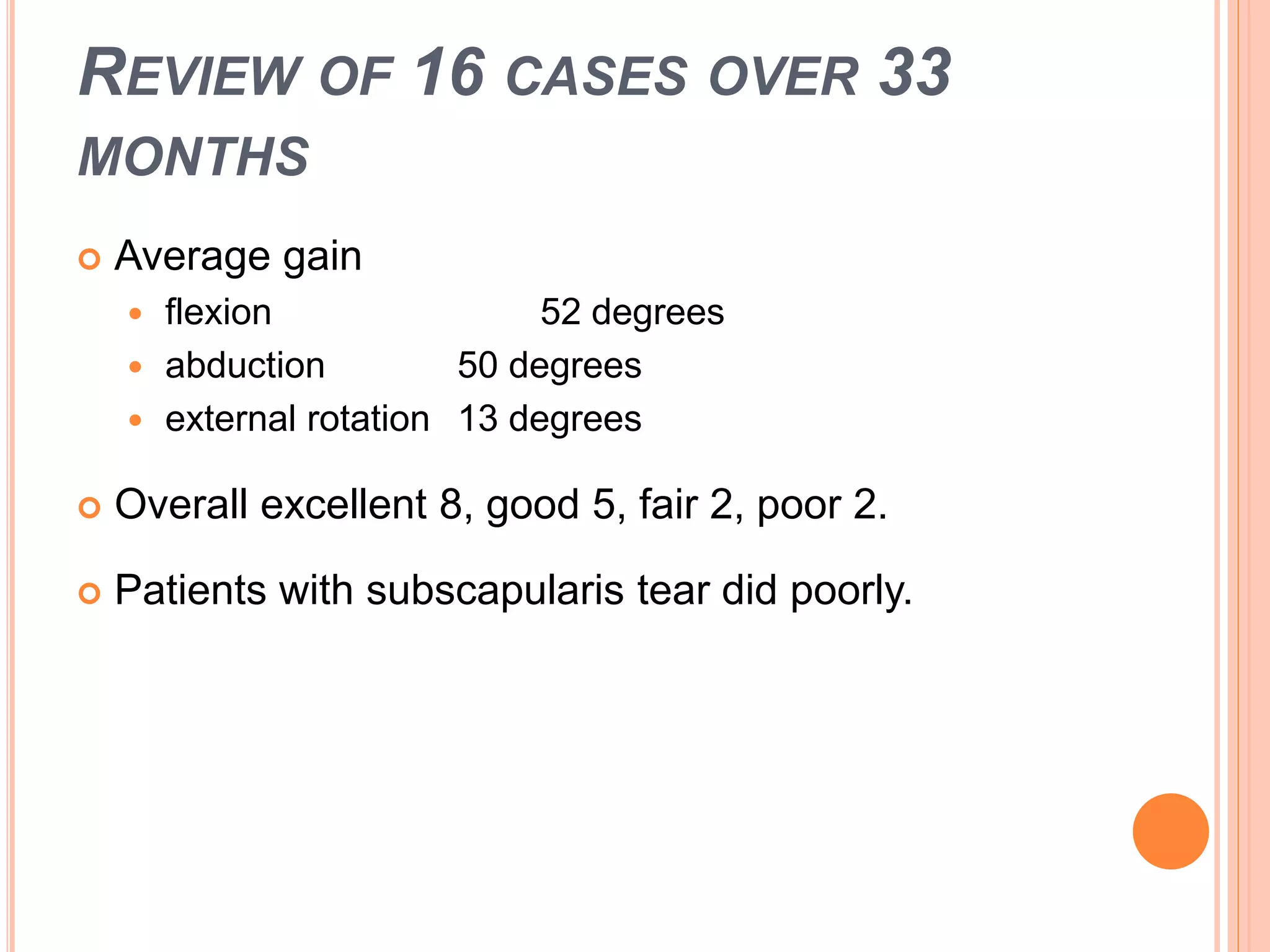
 Average gain
 flexion 52 degrees
 abduction 50 degrees
 external rotation 13 degrees
 Overall excellent 8, good 5, fair 2, poor 2.
 Patients with subscapularis tear did poorly.
TERES MAJOR TRANSFER
 Described by Celli in 1998
 Indication
 Isolated infraspinatus tear
 Functional supraspinatus
 Reported 6 cases with good results
COMPLICATIONS OF ROTATOR CUFF REPAIR
 Retear or failure of repair
 Infection
 Adhesions
 Fracture of acromion
 Denervation of deltoid
 Injury to suprascapular nerve
 Greater tuberosity fracture
 Stiffness – frozen shoulder
 Reflex sympathetic dystrophy
CUFF TEAR ARTHROPATHY
 End stage rotator cuff disease (4%)
 Age 70-80 yrs
 Severe shoulder pain
 Active elevation 40-60 degrees
 Severe wasting of supraspinatus and infraspinatus
 Effusion anteriorly
 Superior subluxation of humerus
CUFF TEAR ARTHROPATHY
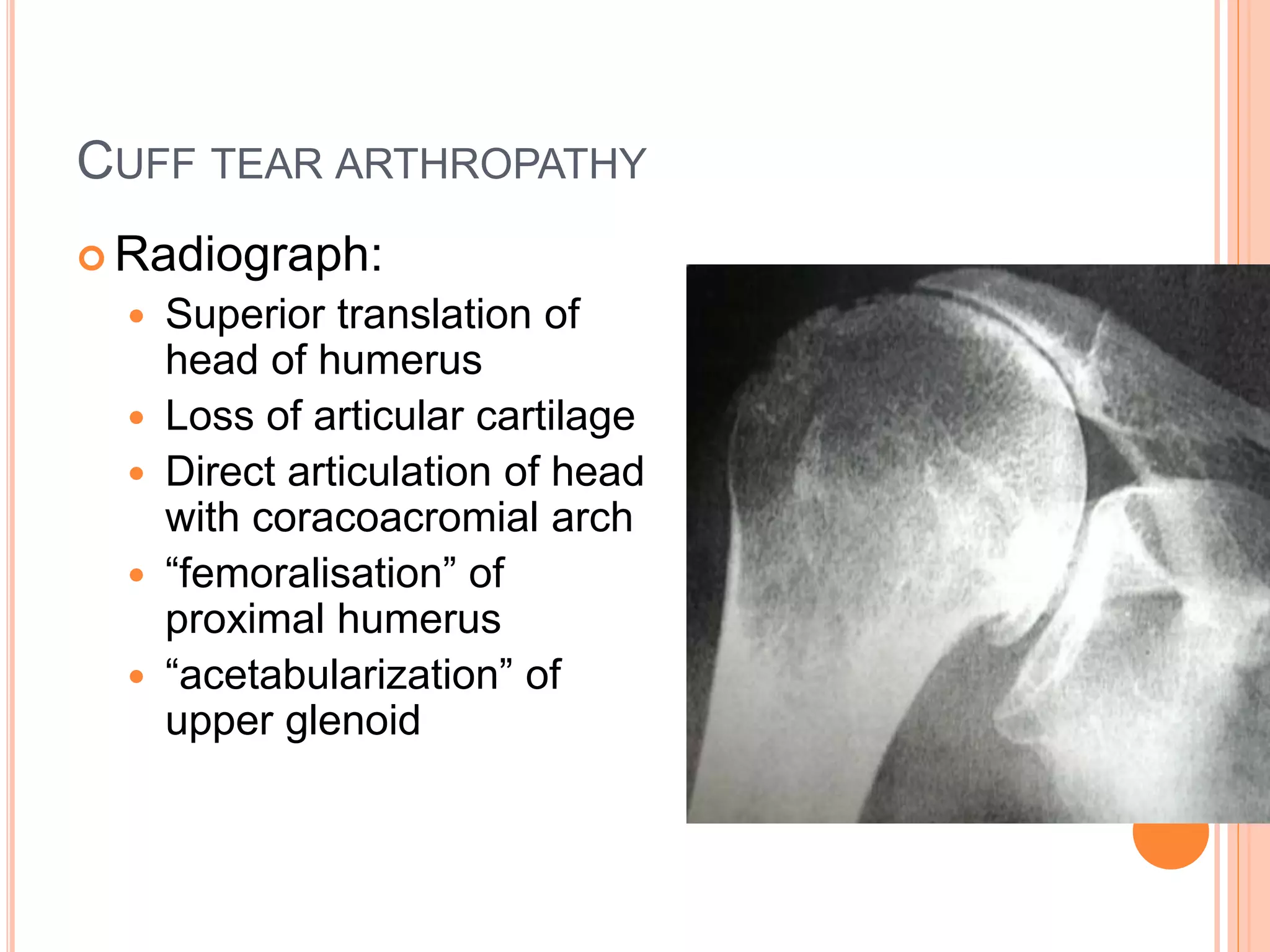
 Radiograph:
 Superior translation of
head of humerus
 Loss of articular cartilage
 Direct articulation of head
with coracoacromial arch
 “femoralisation” of
proximal humerus
 “acetabularization” of
upper glenoid
TREATMENT
 Intractable pain unresponsive to conservative
treatment is the strongest indication for surgery
 Options :
 Shoulder arthrodesis
 Hemi replacement arthroplasty
 Total shoulder replacement
TREATMENT (CONTD)
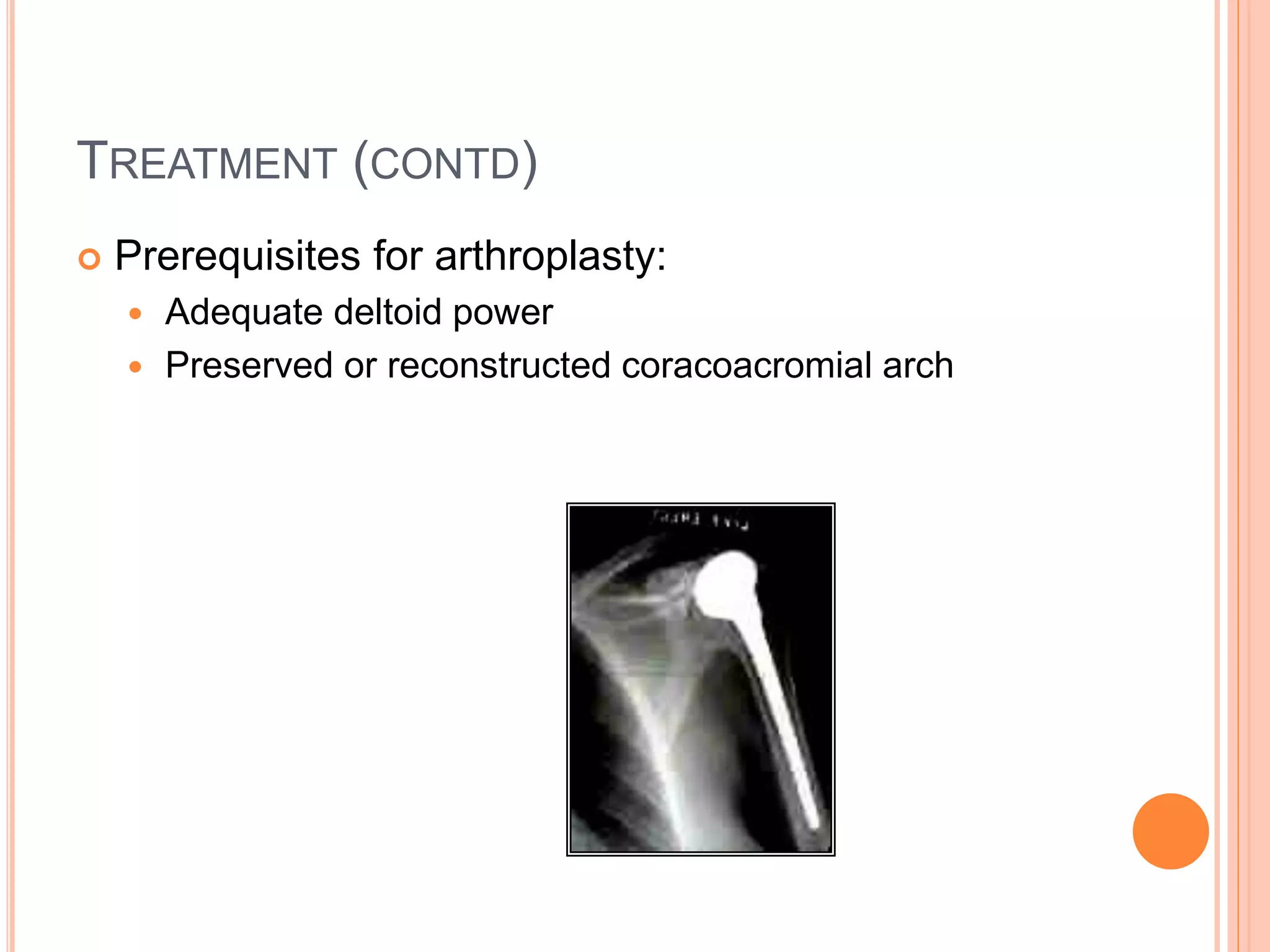
 Prerequisites for arthroplasty:
 Adequate deltoid power
 Preserved or reconstructed coracoacromial arch
CONCLUSION
 Diagnosis is usually by good history and
examination
 Non operative management remains the standard
initial care
 Surgery in selective active individuals
 Arthroscopy - early mobilization and decreased
morbidity
 Treatment according to patients functional needs
REFERENCES
 The Orthopedic Clinics Of North America, Volume
28, April 1997
 The Orthopedic Clinics Of North America, Volume
27, January 1997
 The Shoulder, 2nd Edition, Rockwood and Matson-
WB Saunders
 Pubmed online
HANK YOU

Rotator cuff tears

  • 1.
    CURRENT REVIEW OF ROTATORCUFF TEARS Dr. Sushil Paudel
  • 2.
    INTRODUCTION  In 1834,Smith - first description of a rupture of the rotator cuff tendon  Among most common causes of shoulder pain and instability.  Disease severity range from inflammation and edema to irreparable ruptures  Incidence 5-40% with increasing with advancing age  Normal senescence process
  • 3.
    ANATOMY  made upof 4 interrelated muscles arising from the scapula and attaching to the tuberosities  supraspinatus  infraspinatus  teres minor  subscapularis  Long head of biceps – functional part
  • 4.
    FUNCTION  Stabilisers ofshoulder mainly anterior and posterior cuff providing fixed fulcrum for concentric rotation of the humeral head.  Neutralises shearing forces of deltoid in early abduction.  Initiation of abduction.  Rotation of shoulder.
  • 5.
    PATHOPHYSIOLOGY The extrinsic hypothesis:  repeated impingement of rotator cuff tendon against different structures of the glenohumeral joint .  Three distinct impingement syndromes  Anterosuperior impingement syndrome  Posterosuperior impingement syndrome  Anterointernal impingement syndrome
  • 6.
    ANTEROSUPERIOR IMPINGEMENT SYNDROME  Impingementbeneath the coracoacromial arch  In 1972, Neer - term “impingement syndrome”  Supraspinatus tendon insertion to the greater tuberosity and the bicipital groove must pass beneath the arch with forward flexion of the shoulder, especially if internally rotated, causing an impingement
  • 7.
     Different shapesof acromia (Biglianni et al) -anterior slope  Type 1 - Flat ( 3 % of cuff tears)  Type 2 - Curved (24 % of cuff tears)  Type 3 - Hooked ( 73 % of cuff tears)
  • 8.
     Pt withcuff tear are more likely to have curved or hooked acromion (Toivonen DA et al 1995,Tuite et al1995)  Flatow et al (1994)-stereophotogrammetry- type 3 acromia had increased contact  Ozaki's study on cadavers showed that the undersurface of the acromion was normal when the incomplete tear was on the articular side
  • 9.
     Neer‘s stages: Stage 1-  edema and hemorrhage  excessive overhead use  patients < 25 years.  Stage 2-  fibrosis and tendinitis  following repeated episodes of mechanical inflammation  patients - 25-40 years.  Stage 3-  bone spurs  incomplete and complete tears of the rotator cuff and long head of the biceps tendon  patients > 40 years.
  • 10.
    POSTEROSUPERIOR IMPINGEMENT SYNDROME  Impingementbetween the articular side of the supraspinatus tendon and the posterosuperior edge of the glenoid cavity  Walch in 1991  May explain some of the articular side tears, especially in overhead sport athletes
  • 11.
    POSTEROSUPERIOR IMPINGEMENT SYNDROME(CONTD)  Withthe shoulder held at 120° of abduction, retropulsion, and in extreme external rotation (similar to the late cocking phase in throwers), the labrum moves away from the glenoid and the glenoid rim comes in contact with the deep surface of the tendon, producing repeated microtrauma and leading to partial tears
  • 12.
    ANTEROINTERNAL IMPINGEMENT SYNDROME  Gerber(1985) - impingement of the cuff in the coracohumeral interval  When the shoulder is held in flexion and internal rotation, the coracohumeral distance is reduced from 8.6 mm when the arm is at the side to 6.7 mm  Subcoracoid impingement can be idiopathic (eg, large coracoid tip), iatrogenic or following a fracture (eg, humeral head or neck fracture)
  • 13.
    THE INTRINSIC HYPOTHESIS Progressive age-related degeneration of the tendon  Von Meyer -first to introduce the concept that degeneration of the tendon plays a major role in the production of cuff lesions  Many histologic studies show the age-related degeneration of the cuff tendon
  • 14.
    THE INTRINSIC HYPOTHESIS(CONT)  “The critical zone” (Codman) -articular surface of the tendon, near its insertion on the greater tuberosity  ? hypovascularity in critical zone  Recent studies using laser doppler (Swiontkowski & associates) - normal flow in this zone of normal tendon  Rathbun et al -relative avascularity of the cuff is position-dependent and observed a poor filling only when the shoulder is in adduction  Normal degenerative process associated with aging, then, is the main factor to explain the lesions of the articular side of the cuff
  • 15.
    CLINICAL PRESENTATION Stiffness-more commonwith partial tears.  Stiffness can be demonstrated as limitations of  Internal rotation with arm in abduction  Reach up the back  Cross-body adduction  Flexion  External rotation
  • 16.
    CLINICAL PRESENTATION (CONTD) Pain or weakness  Located anterolaterally and superior  Aggravated by use of arm in overhead position or flexion  Weakness  Associated crepitus, clicking, clunking or grinding sensation
  • 17.
    TESTS FOR IMPINGEMENT Neer’ssign Neer’s test Hawkins test Neer’s sign
  • 18.
    NEERS’ TEST  Mostdiagnostic test  LA 10ml lignocaine into subacromial bursa  >50% relief – rotator cuff tendinitis or partial tear of bursal surface  Pain relief but weakness persists – full thickness tears  No relief - incorrect diagnosis or wrong injection
  • 19.
    TOPOGRAPHIC TESTS  supraspinatustendon  The Jobe test  Shoulder is placed at 90° of abduction and 30° of flexion.  Shoulder elevation is resisted.  Test is positive if pain is noted.
  • 20.
  • 21.
     The FullCan test  Shoulder is placed at 90° of flexion and 45° of external humeral rotation (thumb pointing upward, like someone holding a full can, right-side-up).  Shoulder elevation is resisted.  Test is positive if it produces pain.
  • 22.
    THE INFRASPINATUS TENDON The Infraspinatus Isolation test  The shoulder is positioned at 0° of elevation (elbows against the waist flexed at 90°) and 45° of internal rotation.  Shoulder external rotation is resisted.  The test is positive if it produces pain.  EMG shows that this is the optimal infraspinatus isolation test
  • 23.
     The Pattetest  The shoulder is placed at 90° of abduction, neutral rotation, and in the plane of the scapula.  The examiner holds the elbow of the patient and the external rotation is resisted.  The test is positive if it produces pain.
  • 24.
    THE SUBSCAPULAR TENDON The Gerber lift-off test  The shoulder is placed passively in internal rotation and slight extension by placing the hand 5-10 cm from the back with the palm facing outward and the elbow flexed at 90°.  The test is positive when the patient cannot hold this position, with the back of the hand hitting the patient's back.
  • 25.
     The Gerberpush with force test  The shoulder is placed in the same position as the lift-off test; however, the patient has to keep his hand away from the back and resists a push in the palm of the hand.
  • 26.
    DIFFERENTIAL DIAGNOSIS  AdhesiveCapsulitis  Bicipital Tendinitis  Cervival Disc Disease  Cervical Myofascial Pain  Cervical Spondylosis  Fibromyalgia  Osteoarthritis  Rheumatoid Arthritis  Thoracic Outlet Syndrome
  • 27.
    X-RAY  AP forAHI (Normal >7 mms) <5mms - poor prognosis.  Y-lateral for shape of acromion  Axillary for os acromiale  AP of ACJ for osteophytes  AP in Abd for rotator cuff dysfunction
  • 28.
    RADIOGRAPHIC FEATURES  subchondralsclerosis of humeral head  flattening of the greater tuberosity  sclerosis of the acromion-sourcil sign  calcifications located in the presumed area of rotator cuff tendon  acromion spurs  acromion type 2 and 3.
  • 29.
     Subchondral sclerosisof the humeral head
  • 30.
     acromiohumeral spaceless than 6 mm chronic full thickness tear
  • 31.
     Bony spuron the inferior surface of the acromion
  • 32.
    ARTHROGRAM  Good fordiagnosis of complete rotator cuff tear.  Cost effective.  Invasive  Does not give information about size of tear.
  • 33.
    presence of contrastmedium in the subdeltoid-subacromial bursa signs the presence of a complete rotator cuff tear. channel between the articular capsule and the subacromial- subdeltoid bursa in a complete rotator cuff tear.
  • 34.
    ULTRASOUND  Cheap andquick to perform.  Good definition of rotator cuff.  Allows dynamic examination.  Operator dependant.  Findings:  Nonvisualization of cuff  Localized absence  Discontinuity  Focal abnormal echogenicity
  • 35.
    MRI  Best diagnosticaid.  Defines site of cuff damage.  Demonstrates fatty changes in muscle -poor quality cuff.  Exact size, shape and location of tear  Non-invasive
  • 36.
    MRI  Normal cuff Full thickness tear
  • 37.
    CONSERVATIVE MANAGEMENT  McLaughlinin 1962 advanced reasons to avoid early repair  25 % of cadavers had torn cuff -most of them were asymptomatic  50 % of patients would recover comfortably  Results of early and late repair are similar  Repair did not always permit anatomic restoration  Early diagnosis is difficult
  • 38.
     Review ofliterature indicates that success rate of nonoperative treatment ranges from 33% to 92%  Bartolozzi et al (Clin orthop, 1994) reported 66-75% good or excellent results (mean follow up 20 months). Unfavorable prognostic factors were  Tear> 1 cm2  Symptoms > 1yr  Significant functional impairment
  • 39.
     Hawkins &Dunlop (1995) reported >50% satisfactory result at avg follow up of 4 years  Bokor et al (1993) reported 74% satisfactory result over period of 7.6 yrs in 53 pts (average age 62 yrs). 86 % of those present within 3 months responded favorably while only 56% of those presented after 6 mnt were satisfactory  Itoi and Tabata (1992) reported 82% satisfactory result in 62 shoulders followed over 3.4 yrs.
  • 40.
    ORTHOTHERAPY  Term usedby Michael Wirth (OCNA 1997)  Interactive exchange between patient and orthopedic surgeon directed at creating exercise regimen that gradually improves motion and strength in shoulder girdle.  Three phases:  Phase 1- restore full, painless range of motion. Codman pendulum exercise followed by passive movements in all direction  Phase 2- designed to strengthened remaining muscles of rotator cuff, deltoid & scapular muscles  Phase 3- gradual reinstitution of normal activities including work, hobby and sport.
  • 41.
    SUBACROMIAL CORTICOSTEROID INJECTIONS  Combinationof local anaesthetic and steroid (5- 10mls)  Course: - maximum of 2 to 3 injections  Method: - sitting with arm hanging by side - needle inserted just under acromion from anterolateral, lateral, or posterolateral aspect - should have easy unrestricted flow of fluid
  • 42.
    SUBACROMIAL CORTICOSTEROID INJECTIONS  Benefits:- short-term benefit in reducing pain and increasing ROM  Risks: - decreased tendon strength and risk of rupture if into tendon - subcutaneous atrophy - effects on articular cartilage - may have detrimental effects on results of subsequent repair
  • 43.
    OPERATIVE TREATMENT  Patientselection:  Samilson & Binder :  Patient physiologically younger than 60 yrs  Clinically or arthrographically demonstrable full thickness cuff tear.  Failure to improve on nonoperative management for minimum of 6 weeks  Need to use shoulder in overhead elevation  Full passive range of motion  Ability & willingness to cooperate
  • 44.
    POOR PROGNOSTIC FACTORS Old age group  Long history  No history of trauma  Smoker  Multiple steroid injection  Diffuse osteopenia
  • 45.
     Rotator cufftear are classified on basis of size by Gartsman:  Small < 1 cm  Medium-1 to 3 cm  Large-3 to 5 cm  Massive > 5 cm
  • 46.
    PROCEDURES  Repair oftear  open or arthroscopic  Tendon to tendon or tendon to bone  Arthroscopic debridement and acromioplasty with mini- open repair
  • 47.
     Neer describedfour major objectives  Closure of cuff defect  Elimination of impingement lesions of coracoacromial arch  Preservation of origin of deltoid  Rehabilitation to prevent postop stiffness
  • 48.
    TECHNIQUE OF OPENREPAIR  Approach- 5 to 7 cm incision extending from lateral aspect of ant third of acromion to lateral tip of coracoid
  • 49.
     Subacromial decompression- Coracoacromial ligament release  Anterior acromioplasty  Modified acromioclavicular arthroplasty
  • 50.
     Rotator cuffrepair:  Assess the nature of tear  Mobilisation –  Release of adhesion  Release of coracohumeral ligament  Interval slide  Subscapularis tendon transfer  Repair – tendon to tendon or tendon to bone(McLaughlin technique)
  • 51.
    MOBILISATION  Release ofcapsule from labrum  Release of cuff tendons from coracoid
  • 53.
  • 54.
    ADVANTAGES OF OPENREPAIR  Easy to do  No special equipment required  Allows direct visualization of cuff repair and acromioplasty  Good long term follow-up
  • 55.
    DISADVANTAGES  Deltoid detachmentrequired  False positive studies (arthrogram 2%, MRI 10%) will lead to unnecessary open exploration  Unrepairable tear will be opened.  Significant intraarticular pathology will be missed
  • 56.
    ARTHROSCOPIC REPAIR OFROTATOR CUFF  Advantages :  Lesser morbidity  Ability to identify and treat other pathology  Truly outpatient  Allows to address small undetected tears  Patient acceptance
  • 57.
     Disadvantages : Technically difficult  Implant cost-needs anchor  Increased OR time  High failure rate during learning curve
  • 58.
  • 59.
  • 60.
  • 61.
  • 62.
    ARTHROSCOPIC ASSISTED MINI OPENREPAIR  Lateral portal is expanded  Useful for small & moderate shape tears  Results comparable to open repair
  • 63.
    ARTHROSCOPIC ASSISTED MINI OPENREPAIR  Combined advantage  easy to do with modest arthroscopic skills  allows for arthroscopic correction of intraarticular pathology  well established improvement in perioperative morbidity  in two large studies with no increase in complication or compromise in outcome  cost effective  easy to “bail out” to full open procedure if desired  avoid opening patients with false positive studies  avoid opening patients with unrepairable defects
  • 64.
    POST OPERATIVE PLAN Depends on 1. Size of tear 2. Type of repair 3. Degree of retraction 4. Intraoperative motion limits 5. Age of patient
  • 65.
    POST OPERATIVE PLAN(CONTD)  Arthroscopic  Immd active and passive ROM  Avoid active abduction >60 degree for 3-4 wks  Then electrical stimulation, resisting exercises for 3-4 mths  High demand activities within 4-6 mths  Open  Proceed slowly (deltoid detached)  Avoid active flexion or abduction for 4 wks  Requires 1-2 additional months
  • 66.
    POST OPERATIVE PLAN(CONTD)  Phase 1 - protective, protecting repair but regaining movement and prevention of muscle weakening  Phase 2 - strengthening, when healing secure, and 2/3 normal range of movement achieved  Phase 3 - return to work and sport, entry requirements, full ROM, no pain or tenderness.
  • 67.
    PARTIAL THICKNESS TEAR Three subtypes (Codman)  Bursal-side  Articular surface tears  Intratendinous  Surgical options:  Debridement alone  Debridement with arthroscopic subacromial decompression  Open repair with acromioplasty  Arthroscopic repair  Arthroscopic subacromial decompression with mini open repair
  • 68.
    PARTIAL THICKNESS TEAR(CONTD)  Ellman classification (depth of tear):  Type 1 0-3 mm  Type 2 3-6 mm  Type 3 >6 mm
  • 69.
    ARTHROSCOPIC DEBRIDEMENT & ACROMIOPLASTYVERSUS REPAIR  Gartsman (1995)  Size & depth of tear (more or less than 50 %)  Patient activity level  Bone structure  Currently  Lesions <50% thickness of tendon – debridement  those >50% - excision and repair  Bursal lesions with type 2 or 3 acromions - decompression
  • 70.
    PARTIAL THICKNESS TEAR Before and after debridement
  • 71.
    IRREPARABLE TEARS  Preoperative diagnosis  AHI <3 mms  Profound loss of external rotation  MRI-fatty degeneration of muscle
  • 72.
    TREATMENT OPTIONS  Debridement Tendon transposition  Subscapularis  Infraspinatus  Muscle transfer  Partial repair  Allograft substitution
  • 73.
    DEBRIDEMENT  Indication  >60years  good external rotation  good flexion  good relief with subacromial LA injection
  • 74.
    DEBRIDEMENT  Excise allfrayed margin and tissue.  Do not excise coraco-acromial ligament.  antero- superior translation of humeral head.  Minimal debridement of acromion.
  • 75.
    TENDON TRANSPOSITION  Transferpart of subscapularis or infraspinatus superiorly.  ? Disrupts coupling force of subscapularis and infraspinatus.
  • 76.
    PARTIAL REPAIR OFMASSIVE ROTATOR CUFF TEAR  Burkhart et al  “Functional rotator cuff tear”  Force couples be intact  Stable fulcrum kinematic  Edge stability  Intact “suspension bridge”
  • 77.
    PARTIAL REPAIR OFMASSIVE ROTATOR CUFF TEAR (CONTD)  Balanced force couple- inferior half of infraspinatous posteriorly & subscapularis anteriorly
  • 78.
    PARTIAL REPAIR OFMASSIVE ROTATOR CUFF TEAR (CONTD)  Burkhart et al- partial rotator cuff repair in irreperable cuff- 2 excellent, 6 good, 5 fair & 1 poor result  Preserves normal mechanics as compared to tendon transfer
  • 79.
    MUSCLE TRANSFERS  Mainindication- symptomatic rotator cuff defect that has low probability of repair  Two parameters are used  Static subluxation of humeral head  Degree of degeneration and atrophy of rotator cuff muscles  Transfers for substitution of individual muscle  Subscapularis -Trapezius (acromial portion), pectoralis major, pectoralis minor  Supraspinatus – Trapezius (acromial portion), Deltoid  Infraspinatus – Latissimus dorsi, Teres major
  • 80.
    LATISSIMUS DORSI TRANSFER Described by Gerber in 1992  Indication  Irreparable rotator cuff tear involving  Supraspinatus  Infraspinatus  Functioning subscapularis and deltoid.
  • 81.
    REVIEW OF 16CASES OVER 33 MONTHS  Average gain  flexion 52 degrees  abduction 50 degrees  external rotation 13 degrees  Overall excellent 8, good 5, fair 2, poor 2.  Patients with subscapularis tear did poorly.
  • 82.
    TERES MAJOR TRANSFER Described by Celli in 1998  Indication  Isolated infraspinatus tear  Functional supraspinatus  Reported 6 cases with good results
  • 83.
    COMPLICATIONS OF ROTATORCUFF REPAIR  Retear or failure of repair  Infection  Adhesions  Fracture of acromion  Denervation of deltoid  Injury to suprascapular nerve  Greater tuberosity fracture  Stiffness – frozen shoulder  Reflex sympathetic dystrophy
  • 84.
    CUFF TEAR ARTHROPATHY End stage rotator cuff disease (4%)  Age 70-80 yrs  Severe shoulder pain  Active elevation 40-60 degrees  Severe wasting of supraspinatus and infraspinatus  Effusion anteriorly  Superior subluxation of humerus
  • 85.
    CUFF TEAR ARTHROPATHY Radiograph:  Superior translation of head of humerus  Loss of articular cartilage  Direct articulation of head with coracoacromial arch  “femoralisation” of proximal humerus  “acetabularization” of upper glenoid
  • 86.
    TREATMENT  Intractable painunresponsive to conservative treatment is the strongest indication for surgery  Options :  Shoulder arthrodesis  Hemi replacement arthroplasty  Total shoulder replacement
  • 87.
    TREATMENT (CONTD)  Prerequisitesfor arthroplasty:  Adequate deltoid power  Preserved or reconstructed coracoacromial arch
  • 88.
    CONCLUSION  Diagnosis isusually by good history and examination  Non operative management remains the standard initial care  Surgery in selective active individuals  Arthroscopy - early mobilization and decreased morbidity  Treatment according to patients functional needs
  • 89.
    REFERENCES  The OrthopedicClinics Of North America, Volume 28, April 1997  The Orthopedic Clinics Of North America, Volume 27, January 1997  The Shoulder, 2nd Edition, Rockwood and Matson- WB Saunders  Pubmed online
  • 90.