MULE HDFS CONNECTOR
BY – ANKUSH SHARMA
WHAT IS HDFS CONNECTOR?
• The Anypoint Connector for the Hadoop Distributed File System
(HDFS) is used as a bi-directional gateway between
applications. Its source is stored at the HDFS Connector GitHub
site.
PRE-REQUISITES
• To use the HDFS connector, you must have the following:
• A working Apache Hadoop Server.
• Anypoint Studio Community edition.
MULE HDFS CONNECTOR –
CONFIGURATION WIZARD (GENERAL TAB)
(CONT.)
MULE HDFS CONNECTOR –
CONFIGURATION WIZARD (GENERAL TAB)
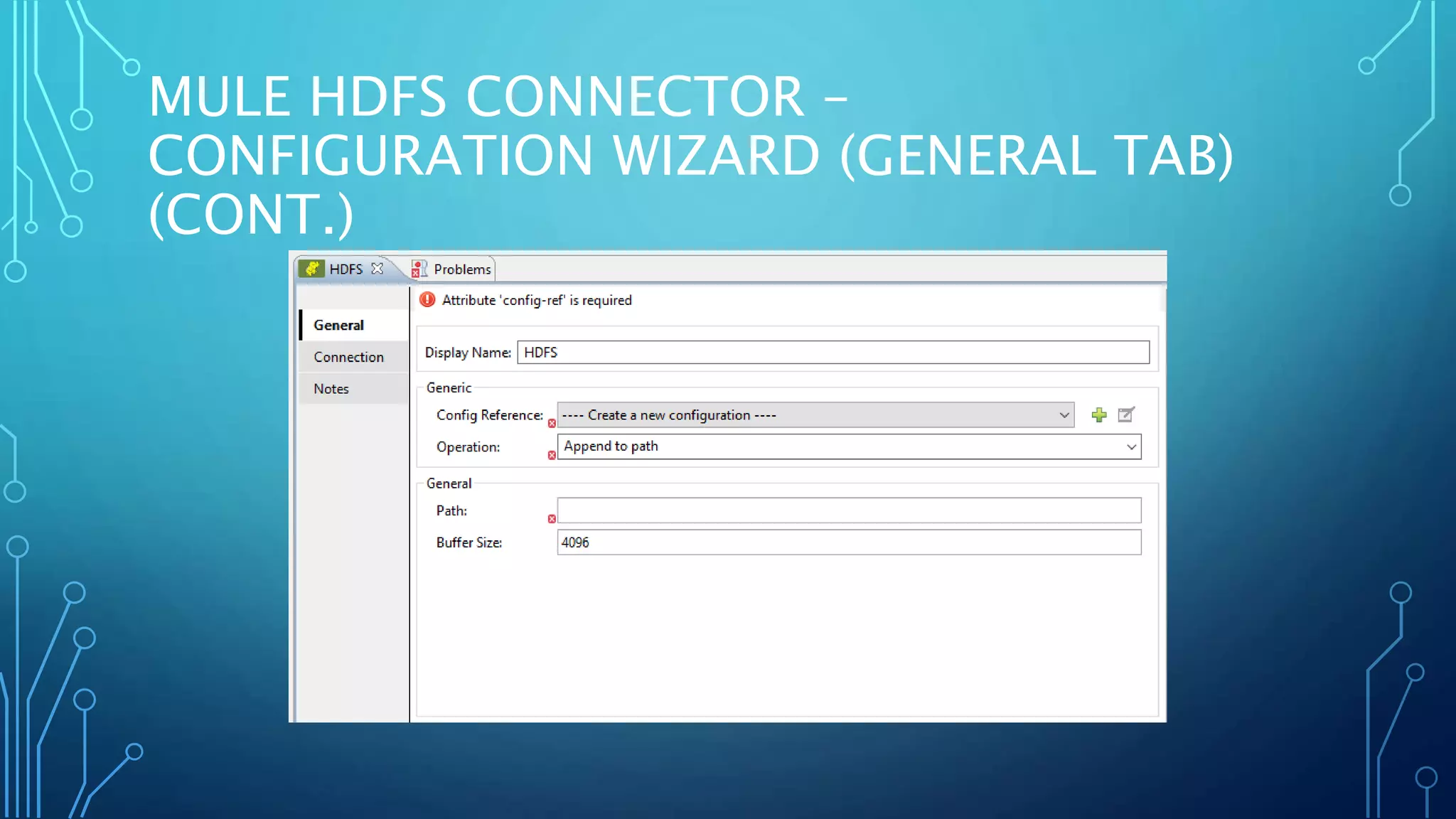
• Following are the options on general tab –
• Display Name – The name of the component to be displayed in Mule
flow.
• Config Reference – Reference to the global configuration.
• Operation – The operation to be performed on server.
• Path – The path of the file to write to.
• Buffer Size – The buffer size to use for appending content in file.
MULE HDFS CONNECTOR –
CONFIGURATION WIZARD (CONNECTION
TAB) (CONT.)
MULE HDFS CONNECTOR –
CONFIGURATION WIZARD (CONNECTION
TAB)
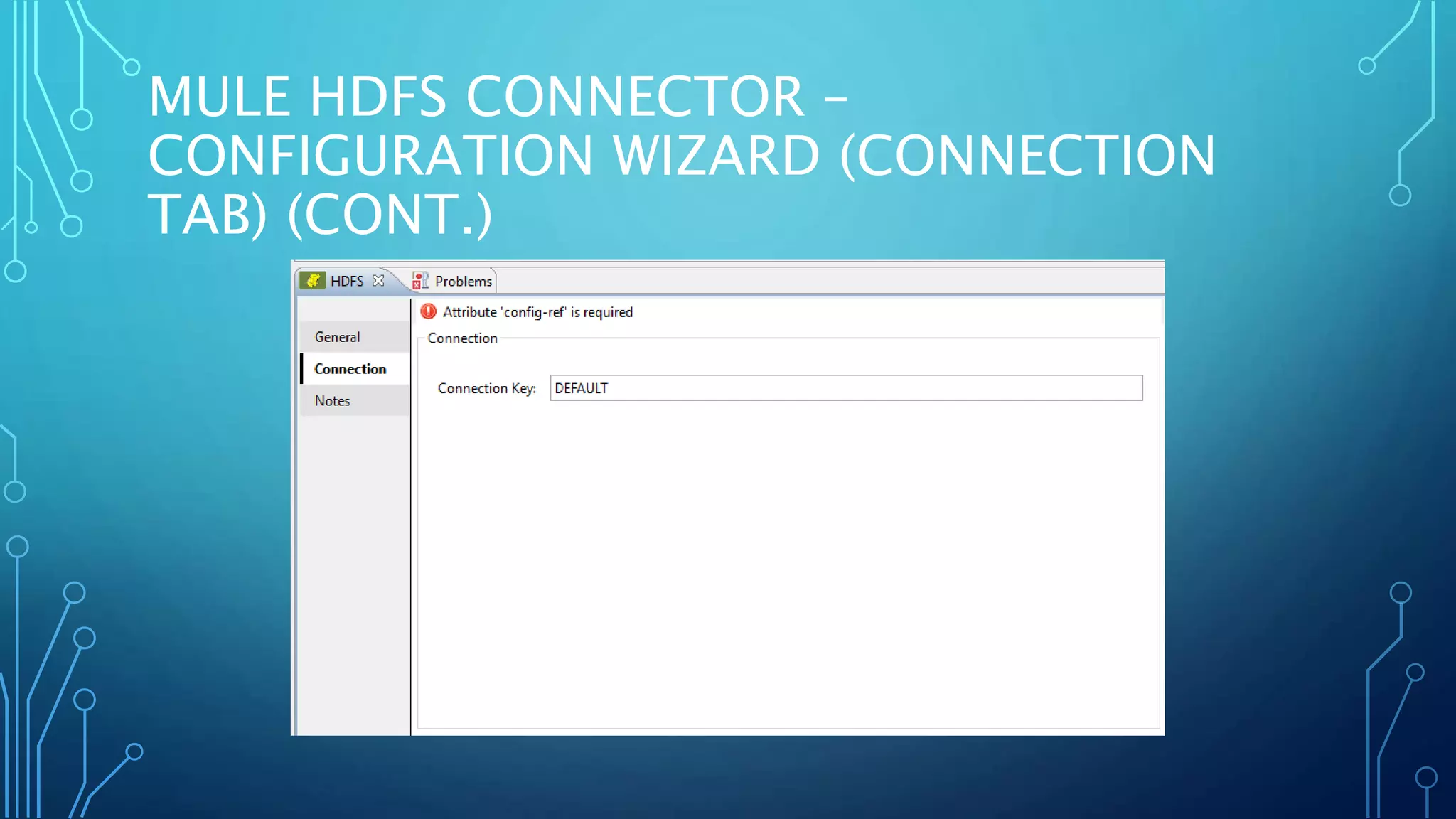
• This tab is used to add a connection key.
• By default the connection key is ‘DEFAULT’.
MULE HDFS CONNECTOR – CONFIG
REFERENCE CONFIGURATION WIZARD
(GENERAL TAB) (CONT.)
MULE HDFS CONNECTOR – CONFIG
REFERENCE CONFIGURATION WIZARD
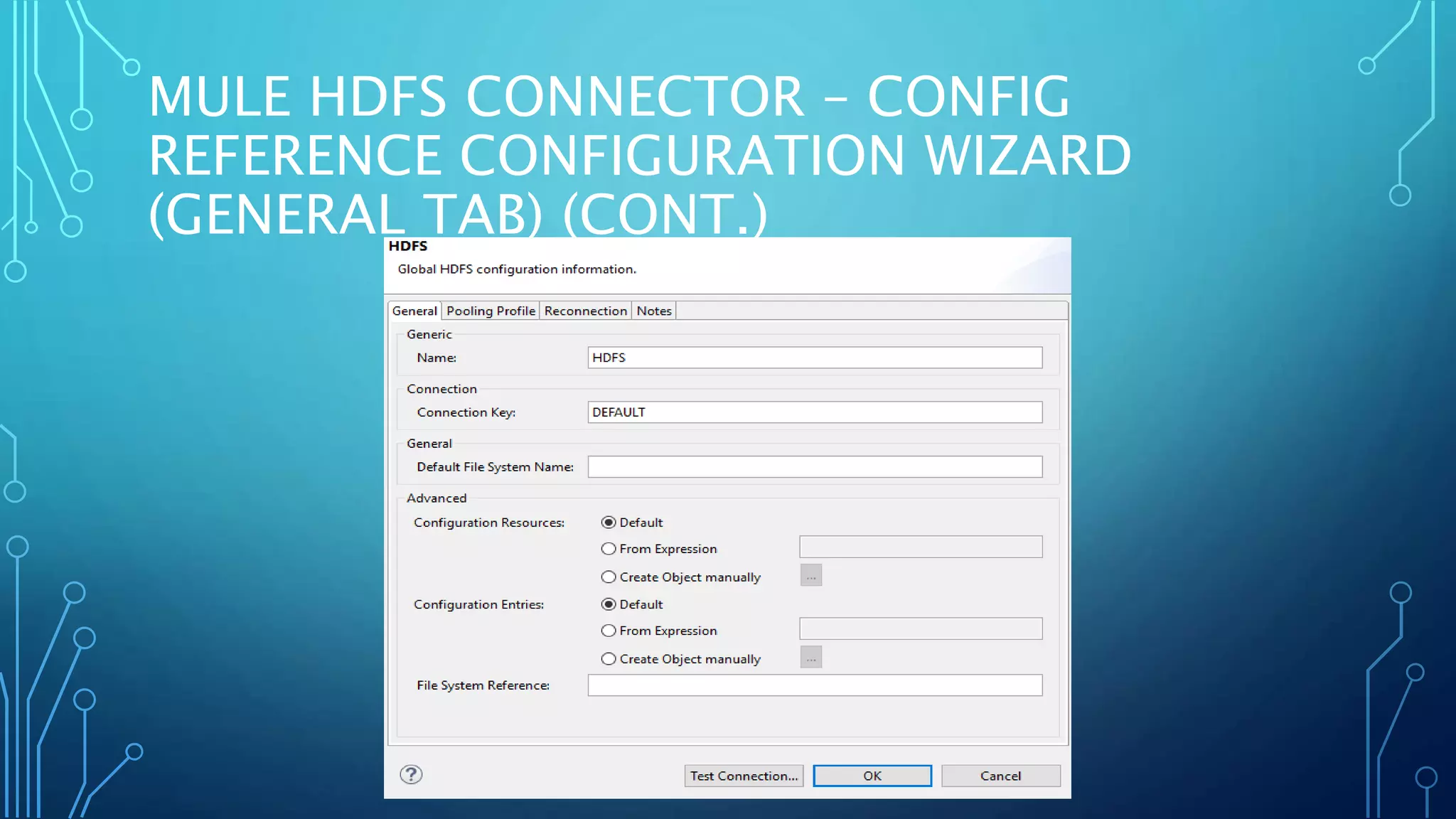
(GENERAL TAB)
• Following are the options in general tab –
• Name – The name of the configuration.
• Connection Key – The key used in connection.
• Default File System Name – The name of the file system to connect to.
• Configuration Resources – Use this radio button to configure various
resources.
• Configuration Enteries – Use this radio button to configure various
enteries.
• File System Reference – A readily configured to used to connect to HDFS.
MULE HDFS CONNECTOR – CONFIG REFERENCE
CONFIGURATION WIZARD (POOLING PROFILE
TAB) (CONT.)
MULE HDFS CONNECTOR – CONFIG
REFERENCE CONFIGURATION WIZARD
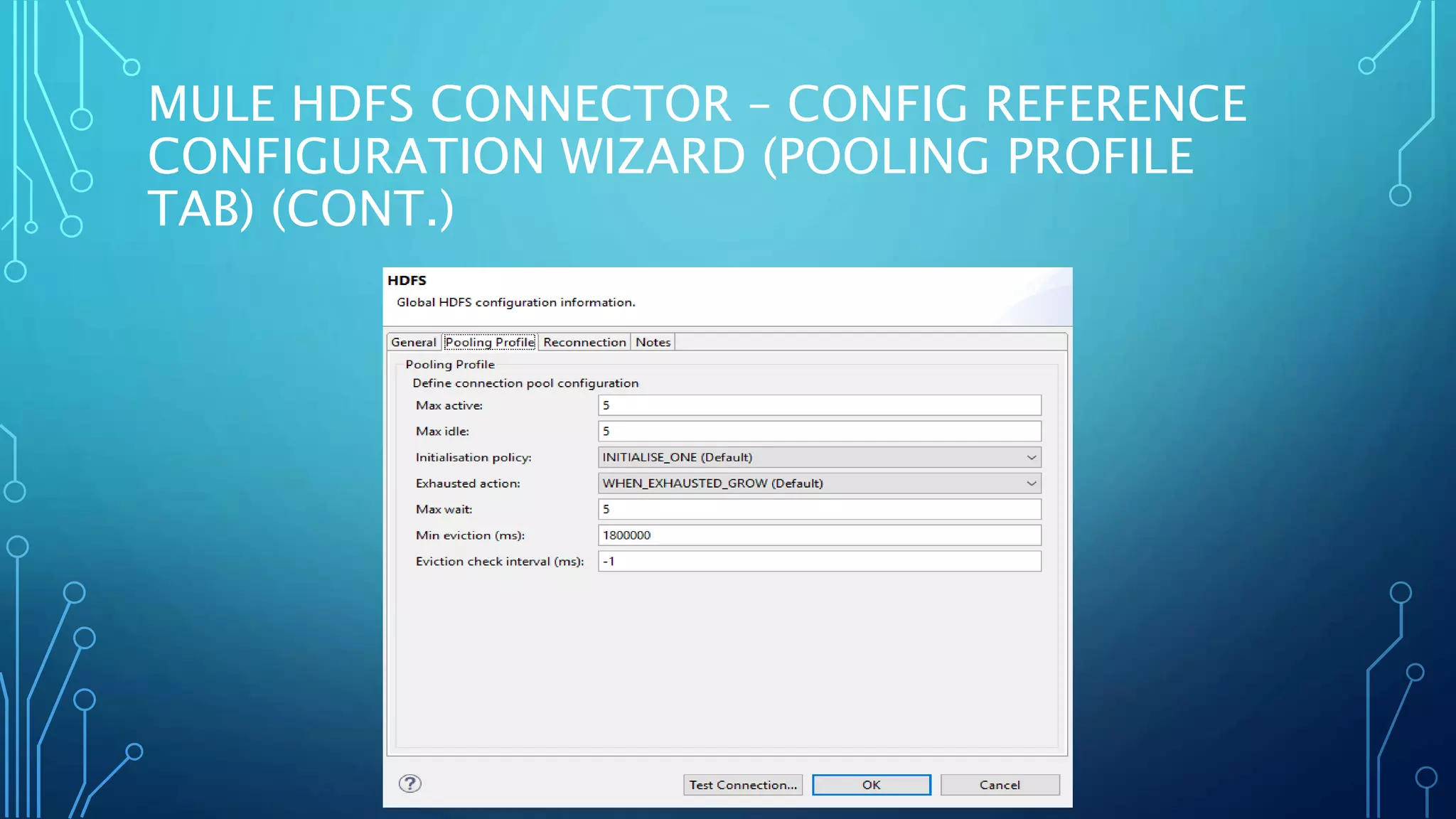
(POOLING PROFILE TAB)
• Mule HDFS connector configuration’s pooling profile tab
contains following properties –
• Max active – Property which define how many connections can be
there in connection pool.
• Max idle – Defines maximum number of connections that can be idle.
• Initialization policy – Defines how to initialize new connections.
• Exhausted action – Defines how to release a connection after usage.
• Max wait – Maximum time to wait for a new connection to be available.
• Min eviction time – Minimum amount of time a connection can sit idle
for.
MULE HDFS CONNECTOR – CONFIG REFERENCE
CONFIGURATION WIZARD (RECONNECTION TAB)
(CONT.)
MULE HDFS CONNECTOR – CONFIG
REFERENCE CONFIGURATION WIZARD
(RECONNECTION TAB)
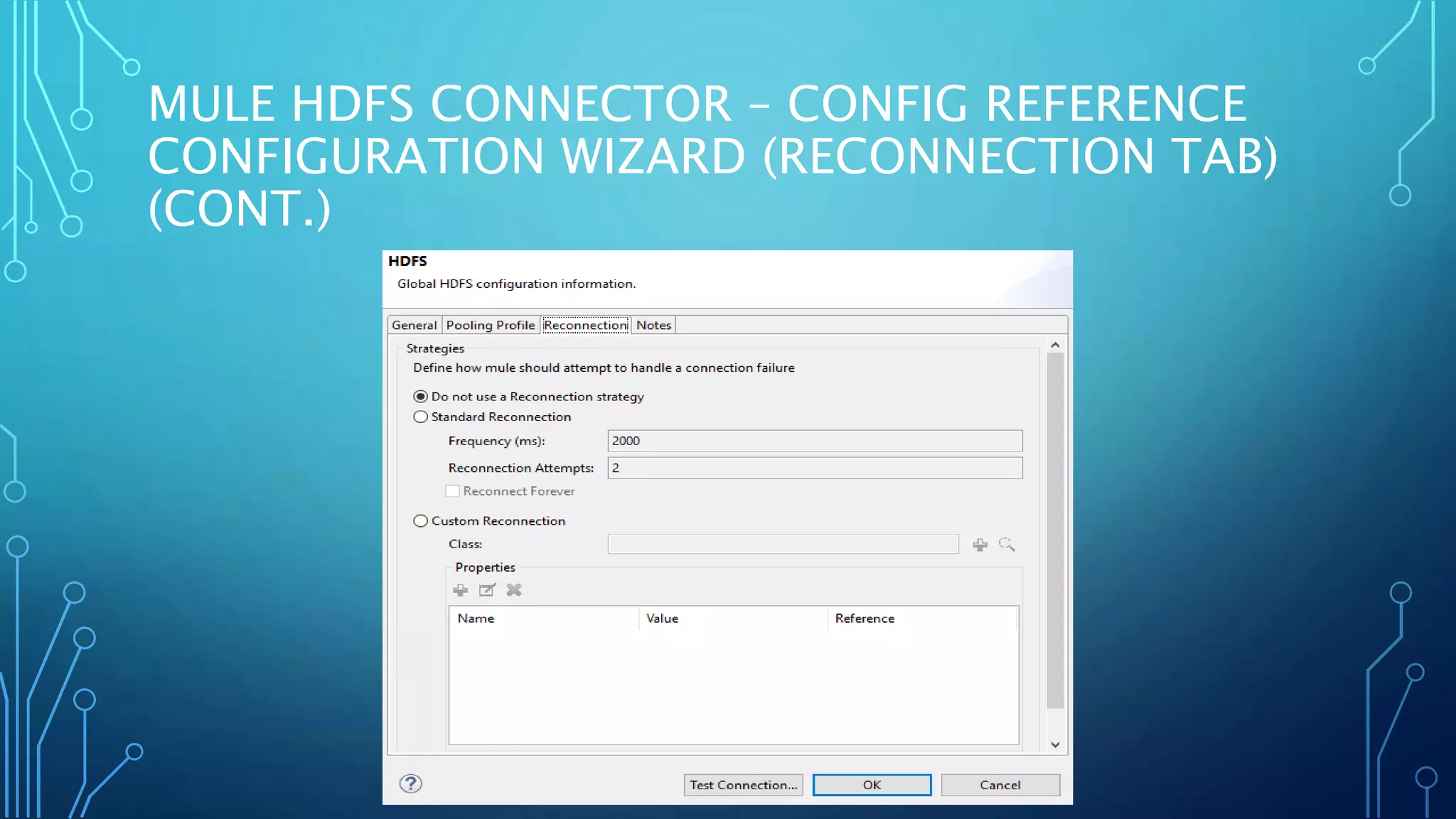
• The Reconnection tab contains following properties –
• Do not use a Reconnection Strategy – This is the default radio button which
specifies do not try to reconnect if there is error connecting to the web
address URL.
• Standard Reconnection – Use this radio button to enable a standard
reconnection strategy.
• Frequency (ms) – The frequency time in milliseconds after which the HDFS
connector will try to access the web address URL.
• Reconnect Attempts – This tells how many times the HDFS connector will try to
connect to web address URL.
• Reconnector Forever – Check this box if there is need to make HDFS connector
connect to web address URL until there is a successful connection with it.
• Custom Reconnection – Use this radio button to create a custom
Reconnection strategy.
• Class – The java class which will come in action after a failed connection attempt.
MULE HDFS CONNECTOR –
CONFIGURATION WIZARD (NOTES TAB)
• Notes Tab is used to add special notes for Mule HDFS
Connector.
THANK YOU!

Mule HDFS Connector

  • 1.
    MULE HDFS CONNECTOR BY– ANKUSH SHARMA
  • 2.
    WHAT IS HDFSCONNECTOR? • The Anypoint Connector for the Hadoop Distributed File System (HDFS) is used as a bi-directional gateway between applications. Its source is stored at the HDFS Connector GitHub site.
  • 3.
    PRE-REQUISITES • To usethe HDFS connector, you must have the following: • A working Apache Hadoop Server. • Anypoint Studio Community edition.
  • 4.
    MULE HDFS CONNECTOR– CONFIGURATION WIZARD (GENERAL TAB) (CONT.)
  • 5.
    MULE HDFS CONNECTOR– CONFIGURATION WIZARD (GENERAL TAB) • Following are the options on general tab – • Display Name – The name of the component to be displayed in Mule flow. • Config Reference – Reference to the global configuration. • Operation – The operation to be performed on server. • Path – The path of the file to write to. • Buffer Size – The buffer size to use for appending content in file.
  • 6.
    MULE HDFS CONNECTOR– CONFIGURATION WIZARD (CONNECTION TAB) (CONT.)
  • 7.
    MULE HDFS CONNECTOR– CONFIGURATION WIZARD (CONNECTION TAB) • This tab is used to add a connection key. • By default the connection key is ‘DEFAULT’.
  • 8.
    MULE HDFS CONNECTOR– CONFIG REFERENCE CONFIGURATION WIZARD (GENERAL TAB) (CONT.)
  • 9.
    MULE HDFS CONNECTOR– CONFIG REFERENCE CONFIGURATION WIZARD (GENERAL TAB) • Following are the options in general tab – • Name – The name of the configuration. • Connection Key – The key used in connection. • Default File System Name – The name of the file system to connect to. • Configuration Resources – Use this radio button to configure various resources. • Configuration Enteries – Use this radio button to configure various enteries. • File System Reference – A readily configured to used to connect to HDFS.
  • 10.
    MULE HDFS CONNECTOR– CONFIG REFERENCE CONFIGURATION WIZARD (POOLING PROFILE TAB) (CONT.)
  • 11.
    MULE HDFS CONNECTOR– CONFIG REFERENCE CONFIGURATION WIZARD (POOLING PROFILE TAB) • Mule HDFS connector configuration’s pooling profile tab contains following properties – • Max active – Property which define how many connections can be there in connection pool. • Max idle – Defines maximum number of connections that can be idle. • Initialization policy – Defines how to initialize new connections. • Exhausted action – Defines how to release a connection after usage. • Max wait – Maximum time to wait for a new connection to be available. • Min eviction time – Minimum amount of time a connection can sit idle for.
  • 12.
    MULE HDFS CONNECTOR– CONFIG REFERENCE CONFIGURATION WIZARD (RECONNECTION TAB) (CONT.)
  • 13.
    MULE HDFS CONNECTOR– CONFIG REFERENCE CONFIGURATION WIZARD (RECONNECTION TAB) • The Reconnection tab contains following properties – • Do not use a Reconnection Strategy – This is the default radio button which specifies do not try to reconnect if there is error connecting to the web address URL. • Standard Reconnection – Use this radio button to enable a standard reconnection strategy. • Frequency (ms) – The frequency time in milliseconds after which the HDFS connector will try to access the web address URL. • Reconnect Attempts – This tells how many times the HDFS connector will try to connect to web address URL. • Reconnector Forever – Check this box if there is need to make HDFS connector connect to web address URL until there is a successful connection with it. • Custom Reconnection – Use this radio button to create a custom Reconnection strategy. • Class – The java class which will come in action after a failed connection attempt.
  • 14.
    MULE HDFS CONNECTOR– CONFIGURATION WIZARD (NOTES TAB) • Notes Tab is used to add special notes for Mule HDFS Connector.
  • 15.