By – Ankush Sharma
User Datagram Protocol (UDP) is part of the Internet Protocol suite used by
programs running on different computers on a network. UDP is used to send short
messages called datagrams but overall, it is an unreliable, connectionless
protocol.UDP is officially defined in RFC 768 and was formulated by David P. Reed.
Universal Datagram Protocol, or UDP, is a stateless protocol for sending or
receiving large amounts of messages (datagrams) quickly. The UDP transport in
Mule allows sending messages to or receiving messages with Mule using UDP
sockets.
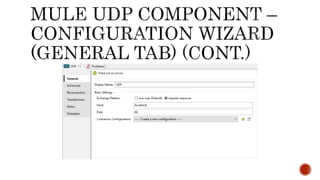
 Following are the options on general tab –
 Display Name – The display name to be displayed in Mule flow.
 Exchange Pattern – The type of exchange pattern to be used with this component.
 Host – The host for this component.
 Port – The port for this component.
 Connector Configuration – Reference to the global connector configuration.
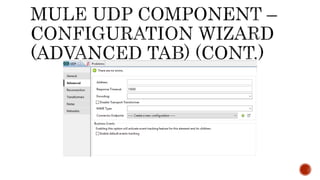
 Following are the options on advanced tab –
 Address – The address to this component.
 Response Timeout – Response timeout time in milliseconds.
 Encoding – Encoding standard to be applied on message data.
 MIME Type – MIME type of the message data.
 Connector Endpoint – Reference to the global connector endpoint configuration.
 Following are properties on reconnection tab –
 Do not use a Reconnection Strategy – This is the default radio button which specifies do
not try to reconnect if there is error connecting to the web address URL.
 Standard Reconnection – Use this radio button to enable a standard reconnection
strategy.
 Frequency (ms) – The frequency time in milliseconds after which the File connector will try to
access the web address URL.
 Reconnect Attempts – This tells how many times the File connector will try to connect to web
address URL.
 Reconnector Forever – Check this box if there is need to make File connector connect to web
address URL until there is a successful connection with it.
 Custom Reconnection – Use this radio button to create a custom Reconnection strategy.
 Class – The java class which will come in action after a failed connection attempt.
 Run the connection in a separated thread – Check this box if there is need to use this custom
reconnection operation in separate thread.
 Following are properties on Transformers tab –
 Global transformers – Enter a list of synchronous transformers that are applied to the
request before it is sent to the FTP transport.
 Transformers to be applied - Enter a list of synchronous transformers that are applied to
the response before it is dispatched from the FTP transport.
 Notes tab - This tab is used to add special notes for the UDP transport.
 Metadata tab – This tab is used to add any metadata entry for UDP transport.
Mule UDP Transport

Mule UDP Transport

  • 1.
  • 2.
    User Datagram Protocol(UDP) is part of the Internet Protocol suite used by programs running on different computers on a network. UDP is used to send short messages called datagrams but overall, it is an unreliable, connectionless protocol.UDP is officially defined in RFC 768 and was formulated by David P. Reed.
  • 3.
    Universal Datagram Protocol,or UDP, is a stateless protocol for sending or receiving large amounts of messages (datagrams) quickly. The UDP transport in Mule allows sending messages to or receiving messages with Mule using UDP sockets.
  • 5.
     Following arethe options on general tab –  Display Name – The display name to be displayed in Mule flow.  Exchange Pattern – The type of exchange pattern to be used with this component.  Host – The host for this component.  Port – The port for this component.  Connector Configuration – Reference to the global connector configuration.
  • 7.
     Following arethe options on advanced tab –  Address – The address to this component.  Response Timeout – Response timeout time in milliseconds.  Encoding – Encoding standard to be applied on message data.  MIME Type – MIME type of the message data.  Connector Endpoint – Reference to the global connector endpoint configuration.
  • 9.
     Following areproperties on reconnection tab –  Do not use a Reconnection Strategy – This is the default radio button which specifies do not try to reconnect if there is error connecting to the web address URL.  Standard Reconnection – Use this radio button to enable a standard reconnection strategy.  Frequency (ms) – The frequency time in milliseconds after which the File connector will try to access the web address URL.  Reconnect Attempts – This tells how many times the File connector will try to connect to web address URL.  Reconnector Forever – Check this box if there is need to make File connector connect to web address URL until there is a successful connection with it.  Custom Reconnection – Use this radio button to create a custom Reconnection strategy.  Class – The java class which will come in action after a failed connection attempt.  Run the connection in a separated thread – Check this box if there is need to use this custom reconnection operation in separate thread.
  • 11.
     Following areproperties on Transformers tab –  Global transformers – Enter a list of synchronous transformers that are applied to the request before it is sent to the FTP transport.  Transformers to be applied - Enter a list of synchronous transformers that are applied to the response before it is dispatched from the FTP transport.
  • 12.
     Notes tab- This tab is used to add special notes for the UDP transport.  Metadata tab – This tab is used to add any metadata entry for UDP transport.