Control of Doubly Fed Induction
Generator connected to Variable Speed
Wind Turbine
IEEE International Conference on Technological
Advancements in Power and Energy-2015.
7/26/2016 TAP ENERGY-2015,Paper ID-270 1
Paper ID-270
Authors: Presented By
1. Anjana Jain B.Janardhan Reddy
Asst Professor, ASE, Bangalore
2. B.Janardhan Reddy TAP ENERGY-2015
PG student, ASE, Bangalore
Overview:
• Objective
• Introduction
• Block Diagram
• Proposed Control Algorithm
• Simulation Results
• Conclusion
• References
7/26/2016 TAP ENERGY-2015,Paper ID-270 2
Objective
• Derived the closed loop control scheme of DFIG.
• To maintain the terminal voltage and frequency constant.
• To maintain the slip power as negative in super synchronous mode of
operation and as positive in sub synchronous mode of operation.
By using bidirectional back-to-back SPWM converters connected to
rotor terminals.
7/26/2016 TAP ENERGY-2015,Paper ID-270 3
Introduction
• Wind Energy is a source of renewable power.
• Wind turbines harvest this kinetic energy and convert it into usable
power.
• In earlier period the technology used in WECS was based on SCIG
running at constant speed, directly connected to the grid.so wind
power is not utilized completely.
• Presently the technology moves towards the variable speed WECS and
hence influencing the system dynamics.
• But unbalances in wind energy are highly impacting the energy
conversion.
• Doubly fed induction generators (DFIG) are commonly used in wind
turbines to generate large amounts of electric power.
7/26/2016 TAP ENERGY-2015,Paper ID-270 4
Wind turbine:
• The maximum power extractable from the wind turbine is defined as
𝑃𝑚𝑎𝑥=
1
2
𝜌𝐴𝑉∞
3 𝐶 𝑝
=
1
2
∗ 1.225 ∗ 3.14 ∗ 153
∗ 0.46
=2985.84 𝑊
Parameters of Wind turbine
Radius = 1m
Pitch angle 𝛽 = 0 𝑑𝑒𝑔𝑟𝑒𝑒𝑠 for small wind turbines.
Wind velocity=15m/s for super synchronous mode and 5m/s for sub
synchronous mode of operation.
7/26/2016 TAP ENERGY-2015,Paper ID-270 5
Block diagram:
7/26/2016 TAP ENERGY-2015,Paper ID-270 6
For Pm=Ps+Pr
Ps=sPr
supersynchronous
speed operation
Pm=(1+s)Pr, s=-ve
For Pm=Ps+Pr
Ps=-sPr
subsynchronous
speed operation
Pm=(1-s)Pr, s=+ve
Fig:1 Structure of DFIG wind generation system
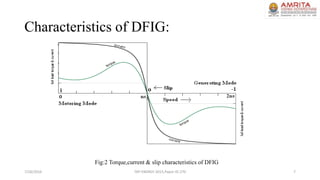
Characteristics of DFIG:
7/26/2016 TAP ENERGY-2015,Paper ID-270 7
Fig:2 Torque,current & slip characteristics of DFIG
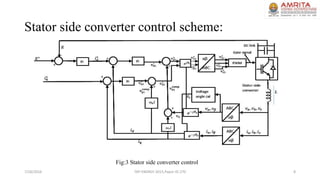
Stator side converter control scheme:
7/26/2016 TAP ENERGY-2015,Paper ID-270 8
Fig:3 Stator side converter control
Proposed control algorithm for Rotor side converter:
7/26/2016 TAP ENERGY-2015,Paper ID-270 9
Fig:4 Proposed control algorithm for rotor side converter
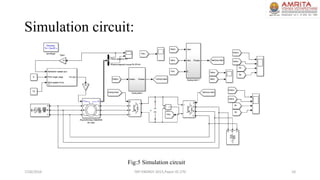
Simulation circuit:
7/26/2016 TAP ENERGY-2015,Paper ID-270 10
Fig:5 Simulation circuit
Rotor speed Electromagnetic Torque
7/26/2016 TAP ENERGY-2015,Paper ID-270 11
Mechanical Torque Stator active power
SIMULATION RESULTS
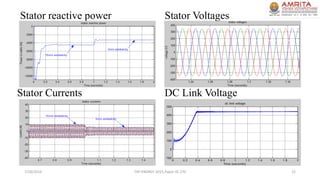
Stator reactive power Stator Voltages
7/26/2016 TAP ENERGY-2015,Paper ID-270 12
Stator Currents DC Link Voltage
Rotor active power Rotor reactive power
7/26/2016 TAP ENERGY-2015,Paper ID-270 13
Rotor Voltages Rotor Currents
Grid Voltages Grid Currents
7/26/2016 TAP ENERGY-2015,Paper ID-270 14
Grid Synchronization THD for o/p Voltage Waveform
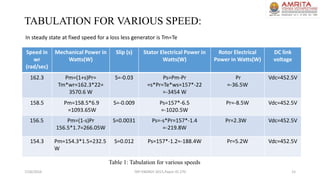
TABULATION FOR VARIOUS SPEED:
Speed in
wr
(rad/sec)
Mechanical Power in
Watts(W)
Slip (s) Stator Electrical Power in
Watts(W)
Rotor Electrical
Power in Watts(W)
DC link
voltage
162.3 Pm=(1+s)Pr=
Tm*wr=162.3*22=
3570.6 W
S=-0.03 Ps=Pm-Pr
=s*Pr=Te*ws=157*-22
=-3454 W
Pr
=-36.5W
Vdc=452.5V
158.5 Pm=158.5*6.9
=1093.65W
S=-0.009 Ps=157*-6.5
=-1020.5W
Pr=-8.5W Vdc=452.5V
156.5 Pm=(1-s)Pr
156.5*1.7=266.05W
S=0.0031 Ps=-s*Pr=157*-1.4
=-219.8W
Pr=2.3W Vdc=452.5V
154.3 Pm=154.3*1.5=232.5
W
S=0.012 Ps=157*-1.2=-188.4W Pr=5.2W Vdc=452.5V
7/26/2016 TAP ENERGY-2015,Paper ID-270 15
In steady state at fixed speed for a loss less generator is Tm=Te
Table 1: Tabulation for various speeds
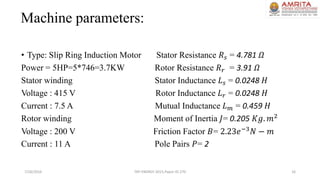
Machine parameters:
• Type: Slip Ring Induction Motor Stator Resistance 𝑅 𝑠 = 4.781 𝛺
Power = 5HP=5*746=3.7KW Rotor Resistance 𝑅 𝑟 = 3.91 𝛺
Stator winding Stator Inductance 𝐿 𝑠 = 0.0248 𝐻
Voltage : 415 V Rotor Inductance 𝐿 𝑟 = 0.0248 𝐻
Current : 7.5 A Mutual Inductance 𝐿 𝑚 = 0.459 𝐻
Rotor winding Moment of Inertia 𝐽= 0.205 𝐾𝑔. 𝑚2
Voltage : 200 V Friction Factor 𝐵= 2.23𝑒−3
𝑁 − 𝑚
Current : 11 A Pole Pairs 𝑃= 2
7/26/2016 TAP ENERGY-2015,Paper ID-270 16
Conclusion:
• The complexity of the rotor-side converter control is reduced by
applying the proposed rotor control algorithm.
• Improvements in the grid-synchronization technique can be achieved
by applying the control technique using fuzzy logic to obtain
negligible oscillations in the various system parameters.
7/26/2016 TAP ENERGY-2015,Paper ID-270 17
References:
[1] R. Pena, J. C. Clare and G. M. Asher, “Doubly-Fed Induction Generator using back-to-back PWM converters and its application to
Variable-speed wind energy generation” IEEE Proceedings on Electrical Power Applications, Vol.143, No.3, pp. 231-241, May 1996.
[2] R. Pena, J. C. Clare and G. M. Asher, “Doubly-Fed Induction Generator using back-to-back PWM converters supplying an isolated
load from a Variable-speed wind turbine” IEEE Proceedings on Electrical Power Applications, Vol.143, No.5, pp. 380-387, Sep 1996.
[3] A.Jayalaxmi and Yerra Sreenivasa Rao “Direct Torque Control of Doubly Fed Induction Generator based wind turbine under
Voltage Dips” International Journal of Advances of Engineering & Technology, may 2012.
[4] Gilsung Byeon*, In Kwon Park** and Gilsoo Jang, “Modelling and Control of a Doubly-Fed Induction Generator (DFIG) Wind
Power Generation System for Real-time Simulations.
[5] S. Muller, M. Deicke, and R. W. De Doncker, “Doubly-Fed Induction Generator Systems for Wind Turbines,” IEEE Ind. Appl.Mag.,
Vol.8,n0. 3,pp. 26-33, May/Jun. 2002.
[6] R. Pena, J. C. Clare and G. M. Asher, “Doubly-Fed Induction Generator using back-to-back PWM converters and its application to
Variable-speed wind energy generation” IEEE Proceedings on Electrical Power Applications, Vol.143, No.3, pp. 231-241 May 1996.
[7] Srinath Vanukuru & Sateesh Sukhavasi “Active and reactive power control of a Doubly Fed Induction Generator driven by a Wind
Turbine.
[8] Rishabh Dev Shukla & Ramesh Kumar Tripathi “A novel Voltage and Frequency controller for standalone DFIG based Wind
Energy Conversion system.
[9] Iwanski G, Koczara W. “Sensorless direct voltage control method for standalone slip-ring induction generator.” In:Proceedings of
11th EPE, Dresden, Germany, CD-ROM; 2005.
[10] Bhim Singh, Fellow, IEEE, & N. K. Swami Naidu, “Direct Power Control of single VSC based DFIG without rotor position
sensor”, IEEE transaction on industry applications, vol. 50, no. 6, November/December 2014.
7/26/2016 TAP ENERGY-2015,Paper ID-270 18
THANK YOU
For Further Queries please
Contact @
thrishul007@gmail.com
7/26/2016 TAP ENERGY-2015,Paper ID-270 19

Mtech IEEE Conference Presentation

  • 1.
    Control of DoublyFed Induction Generator connected to Variable Speed Wind Turbine IEEE International Conference on Technological Advancements in Power and Energy-2015. 7/26/2016 TAP ENERGY-2015,Paper ID-270 1 Paper ID-270 Authors: Presented By 1. Anjana Jain B.Janardhan Reddy Asst Professor, ASE, Bangalore 2. B.Janardhan Reddy TAP ENERGY-2015 PG student, ASE, Bangalore
  • 2.
    Overview: • Objective • Introduction •Block Diagram • Proposed Control Algorithm • Simulation Results • Conclusion • References 7/26/2016 TAP ENERGY-2015,Paper ID-270 2
  • 3.
    Objective • Derived theclosed loop control scheme of DFIG. • To maintain the terminal voltage and frequency constant. • To maintain the slip power as negative in super synchronous mode of operation and as positive in sub synchronous mode of operation. By using bidirectional back-to-back SPWM converters connected to rotor terminals. 7/26/2016 TAP ENERGY-2015,Paper ID-270 3
  • 4.
    Introduction • Wind Energyis a source of renewable power. • Wind turbines harvest this kinetic energy and convert it into usable power. • In earlier period the technology used in WECS was based on SCIG running at constant speed, directly connected to the grid.so wind power is not utilized completely. • Presently the technology moves towards the variable speed WECS and hence influencing the system dynamics. • But unbalances in wind energy are highly impacting the energy conversion. • Doubly fed induction generators (DFIG) are commonly used in wind turbines to generate large amounts of electric power. 7/26/2016 TAP ENERGY-2015,Paper ID-270 4
  • 5.
    Wind turbine: • Themaximum power extractable from the wind turbine is defined as 𝑃𝑚𝑎𝑥= 1 2 𝜌𝐴𝑉∞ 3 𝐶 𝑝 = 1 2 ∗ 1.225 ∗ 3.14 ∗ 153 ∗ 0.46 =2985.84 𝑊 Parameters of Wind turbine Radius = 1m Pitch angle 𝛽 = 0 𝑑𝑒𝑔𝑟𝑒𝑒𝑠 for small wind turbines. Wind velocity=15m/s for super synchronous mode and 5m/s for sub synchronous mode of operation. 7/26/2016 TAP ENERGY-2015,Paper ID-270 5
  • 6.
    Block diagram: 7/26/2016 TAPENERGY-2015,Paper ID-270 6 For Pm=Ps+Pr Ps=sPr supersynchronous speed operation Pm=(1+s)Pr, s=-ve For Pm=Ps+Pr Ps=-sPr subsynchronous speed operation Pm=(1-s)Pr, s=+ve Fig:1 Structure of DFIG wind generation system
  • 7.
    Characteristics of DFIG: 7/26/2016TAP ENERGY-2015,Paper ID-270 7 Fig:2 Torque,current & slip characteristics of DFIG
  • 8.
    Stator side convertercontrol scheme: 7/26/2016 TAP ENERGY-2015,Paper ID-270 8 Fig:3 Stator side converter control
  • 9.
    Proposed control algorithmfor Rotor side converter: 7/26/2016 TAP ENERGY-2015,Paper ID-270 9 Fig:4 Proposed control algorithm for rotor side converter
  • 10.
    Simulation circuit: 7/26/2016 TAPENERGY-2015,Paper ID-270 10 Fig:5 Simulation circuit
  • 11.
    Rotor speed ElectromagneticTorque 7/26/2016 TAP ENERGY-2015,Paper ID-270 11 Mechanical Torque Stator active power SIMULATION RESULTS
  • 12.
    Stator reactive powerStator Voltages 7/26/2016 TAP ENERGY-2015,Paper ID-270 12 Stator Currents DC Link Voltage
  • 13.
    Rotor active powerRotor reactive power 7/26/2016 TAP ENERGY-2015,Paper ID-270 13 Rotor Voltages Rotor Currents
  • 14.
    Grid Voltages GridCurrents 7/26/2016 TAP ENERGY-2015,Paper ID-270 14 Grid Synchronization THD for o/p Voltage Waveform
  • 15.
    TABULATION FOR VARIOUSSPEED: Speed in wr (rad/sec) Mechanical Power in Watts(W) Slip (s) Stator Electrical Power in Watts(W) Rotor Electrical Power in Watts(W) DC link voltage 162.3 Pm=(1+s)Pr= Tm*wr=162.3*22= 3570.6 W S=-0.03 Ps=Pm-Pr =s*Pr=Te*ws=157*-22 =-3454 W Pr =-36.5W Vdc=452.5V 158.5 Pm=158.5*6.9 =1093.65W S=-0.009 Ps=157*-6.5 =-1020.5W Pr=-8.5W Vdc=452.5V 156.5 Pm=(1-s)Pr 156.5*1.7=266.05W S=0.0031 Ps=-s*Pr=157*-1.4 =-219.8W Pr=2.3W Vdc=452.5V 154.3 Pm=154.3*1.5=232.5 W S=0.012 Ps=157*-1.2=-188.4W Pr=5.2W Vdc=452.5V 7/26/2016 TAP ENERGY-2015,Paper ID-270 15 In steady state at fixed speed for a loss less generator is Tm=Te Table 1: Tabulation for various speeds
  • 16.
    Machine parameters: • Type:Slip Ring Induction Motor Stator Resistance 𝑅 𝑠 = 4.781 𝛺 Power = 5HP=5*746=3.7KW Rotor Resistance 𝑅 𝑟 = 3.91 𝛺 Stator winding Stator Inductance 𝐿 𝑠 = 0.0248 𝐻 Voltage : 415 V Rotor Inductance 𝐿 𝑟 = 0.0248 𝐻 Current : 7.5 A Mutual Inductance 𝐿 𝑚 = 0.459 𝐻 Rotor winding Moment of Inertia 𝐽= 0.205 𝐾𝑔. 𝑚2 Voltage : 200 V Friction Factor 𝐵= 2.23𝑒−3 𝑁 − 𝑚 Current : 11 A Pole Pairs 𝑃= 2 7/26/2016 TAP ENERGY-2015,Paper ID-270 16
  • 17.
    Conclusion: • The complexityof the rotor-side converter control is reduced by applying the proposed rotor control algorithm. • Improvements in the grid-synchronization technique can be achieved by applying the control technique using fuzzy logic to obtain negligible oscillations in the various system parameters. 7/26/2016 TAP ENERGY-2015,Paper ID-270 17
  • 18.
    References: [1] R. Pena,J. C. Clare and G. M. Asher, “Doubly-Fed Induction Generator using back-to-back PWM converters and its application to Variable-speed wind energy generation” IEEE Proceedings on Electrical Power Applications, Vol.143, No.3, pp. 231-241, May 1996. [2] R. Pena, J. C. Clare and G. M. Asher, “Doubly-Fed Induction Generator using back-to-back PWM converters supplying an isolated load from a Variable-speed wind turbine” IEEE Proceedings on Electrical Power Applications, Vol.143, No.5, pp. 380-387, Sep 1996. [3] A.Jayalaxmi and Yerra Sreenivasa Rao “Direct Torque Control of Doubly Fed Induction Generator based wind turbine under Voltage Dips” International Journal of Advances of Engineering & Technology, may 2012. [4] Gilsung Byeon*, In Kwon Park** and Gilsoo Jang, “Modelling and Control of a Doubly-Fed Induction Generator (DFIG) Wind Power Generation System for Real-time Simulations. [5] S. Muller, M. Deicke, and R. W. De Doncker, “Doubly-Fed Induction Generator Systems for Wind Turbines,” IEEE Ind. Appl.Mag., Vol.8,n0. 3,pp. 26-33, May/Jun. 2002. [6] R. Pena, J. C. Clare and G. M. Asher, “Doubly-Fed Induction Generator using back-to-back PWM converters and its application to Variable-speed wind energy generation” IEEE Proceedings on Electrical Power Applications, Vol.143, No.3, pp. 231-241 May 1996. [7] Srinath Vanukuru & Sateesh Sukhavasi “Active and reactive power control of a Doubly Fed Induction Generator driven by a Wind Turbine. [8] Rishabh Dev Shukla & Ramesh Kumar Tripathi “A novel Voltage and Frequency controller for standalone DFIG based Wind Energy Conversion system. [9] Iwanski G, Koczara W. “Sensorless direct voltage control method for standalone slip-ring induction generator.” In:Proceedings of 11th EPE, Dresden, Germany, CD-ROM; 2005. [10] Bhim Singh, Fellow, IEEE, & N. K. Swami Naidu, “Direct Power Control of single VSC based DFIG without rotor position sensor”, IEEE transaction on industry applications, vol. 50, no. 6, November/December 2014. 7/26/2016 TAP ENERGY-2015,Paper ID-270 18
  • 19.
    THANK YOU For FurtherQueries please Contact @ thrishul007@gmail.com 7/26/2016 TAP ENERGY-2015,Paper ID-270 19