IEEE Student Professional
       Awareness

 Rob Vice (vice@ieee.org)
 Past-Region 1 SPAC Coordinator


 2012 R1 Training Workshop
 Downtown Marriott, Hartford, CT
 10 March 2012
Agenda


 Professional Awareness
 S-PAC & S-PAVe
 Student Benefits and Involvement
What is Professional Awareness?

As defined within IEEE
  “Professional awareness is the emphasizing of
  the importance of the non-technical aspects of
  engineering to engineers and future engineers.”


                        3
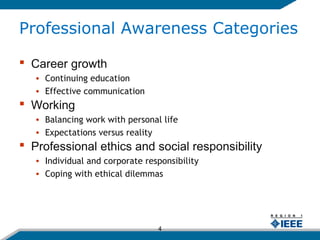
Professional Awareness Categories

ď‚§ Career growth
   • Continuing education
   • Effective communication
ď‚§ Working
   • Balancing work with personal life
   • Expectations versus reality
ď‚§ Professional ethics and social responsibility
   • Individual and corporate responsibility
   • Coping with ethical dilemmas


                                 4
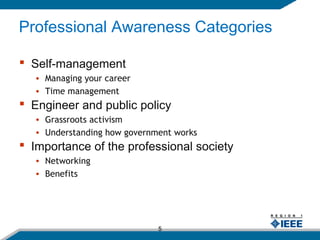
Professional Awareness Categories

ď‚§ Self-management
  • Managing your career
  • Time management
ď‚§ Engineer and public policy
  • Grassroots activism
  • Understanding how government works
ď‚§ Importance of the professional society
  • Networking
  • Benefits


                             5
6
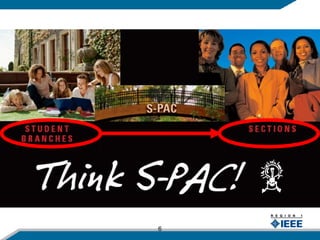
What Are S-PACs?

ď‚§ Student Professional Awareness Conferences (S-PAC)
ď‚§ Students plan and run the event with consultation from
  SPAC Regional Coordinators
ď‚§ The students do all project management
ď‚§ Presentation or panel format related to the professional
  awareness categories
ď‚§ Topics are selected by students in consultation with SPAC
  Regional Coordinators (Regions 1-6) who will advise on
  finding speakers


                            7
Student Benefits for S-PACs

ď‚§ Organizers of S-PACs gain project management
  experience (impressive on resumes)
ď‚§ Attendees leave with a continuous consciousness of
  a non-technical aspect that will be useful for the rest
  of their lives
ď‚§ Initial networking with someone in industry
ď‚§ Successful S-PACs at a branch makes it easier for
  that branch to institute the event on a regular basis


                          8
What Are S-PAVes?

ď‚§ Student Professional Awareness Ventures
ď‚§ Venture can take on any form except presentation format
ď‚§ Student branch submits proposal based on the
  professional awareness categories with budget and
  schedule
ď‚§ The students do all project management
ď‚§ Start-up funds are available to initiate venture
 “Free flowing” format enables creativity


                            9
S-PAVe Formats

ď‚§ Suggested formats
  •   Service
  •   CDs, videos
  •   Workshop
  •   Simulations
  •   Resource materials


ď‚§ Can span days, weeks, months, within
  one semester/quarter


                           10
Student Benefits for S-PAVes

ď‚§ Develop activities / materials to enhance
  professional awareness and provide service to
  members
ď‚§ Enable student branches to gain experience in
  project conception, planning, and organization
ď‚§ Increase student membership (freshmen,
  sophomores, juniors, seniors, graduate students)


                         11
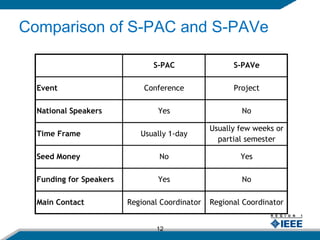
Comparison of S-PAC and S-PAVe

                                S-PAC                 S-PAVe

  Event                      Conference               Project

  National Speakers              Yes                    No

                                                Usually few weeks or
  Time Frame                Usually 1-day
                                                  partial semester

  Seed Money                     No                     Yes

  Funding for Speakers           Yes                    No

  Main Contact           Regional Coordinator   Regional Coordinator


                                12
Steps for Organizing a
 Student Professional
Awareness Conference


          13
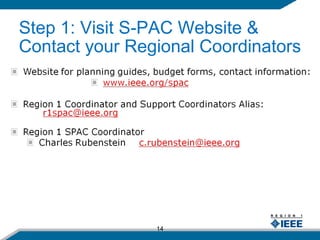
Step 1: Visit S-PAC Website &
Contact your Regional Coordinators


                14
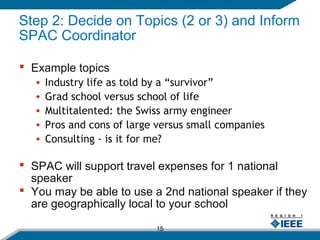
Step 2: Decide on Topics (2 or 3) and Inform
SPAC Coordinator

ď‚§ Example topics
   •   Industry life as told by a “survivor”
   •   Grad school versus school of life
   •   Multitalented: the Swiss army engineer
   •   Pros and cons of large versus small companies
   •   Consulting - is it for me?

ď‚§ SPAC will support travel expenses for 1 national
  speaker
ď‚§ You may be able to use a 2nd national speaker if they
  are geographically local to your school

                             15
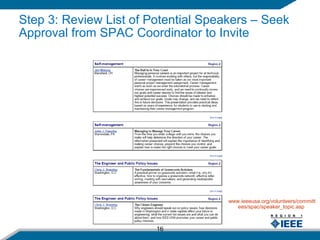
Step 3: Review List of Potential Speakers – Seek
Approval from SPAC Coordinator to Invite


                                     www.ieeeusa.org/volunteers/committ
                                        ees/spac/speaker_topic.asp


                        16
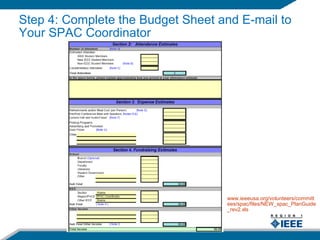
Step 4: Complete the Budget Sheet and E-mail to
Your SPAC Coordinator


                                   www.ieeeusa.org/volunteers/committ
                                   ees/spac/files/NEW_spac_PlanGuide
                                   _rev2.xls


                       17
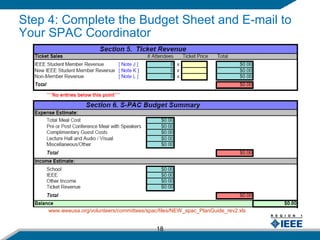
Step 4: Complete the Budget Sheet and E-mail to
Your SPAC Coordinator


     www.ieeeusa.org/volunteers/committees/spac/files/NEW_spac_PlanGuide_rev2.xls


                                              18
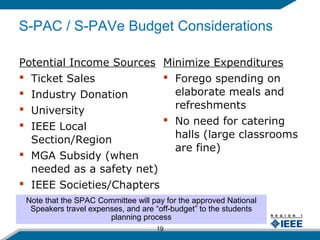
S-PAC / S-PAVe Budget Considerations

Potential Income Sources Minimize Expenditures
ď‚§ Ticket Sales            ď‚§ Forego spending on
ď‚§ Industry Donation         elaborate meals and
ď‚§ University                refreshments
ď‚§ IEEE Local              ď‚§ No need for catering
                            halls (large classrooms
  Section/Region
                            are fine)
ď‚§ MGA Subsidy (when
  needed as a safety net)
ď‚§ IEEE Societies/Chapters
 Note that the SPAC Committee will pay for the approved National
  Speakers travel expenses, and are “off-budget” to the students
                       planning process
                                    19
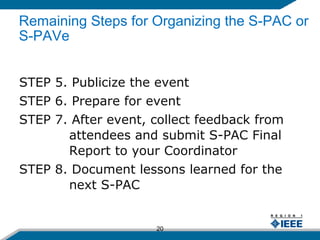
Remaining Steps for Organizing the S-PAC or
S-PAVe


STEP 5. Publicize the event
STEP 6. Prepare for event
STEP 7. After event, collect feedback from
       attendees and submit S-PAC Final
       Report to your Coordinator
STEP 8. Document lessons learned for the
       next S-PAC


                     20
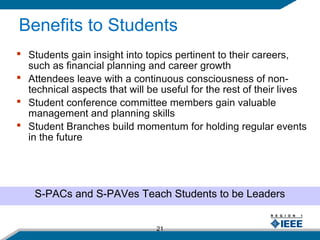
Benefits to Students
ď‚§ Students gain insight into topics pertinent to their careers,
  such as financial planning and career growth
ď‚§ Attendees leave with a continuous consciousness of non-
  technical aspects that will be useful for the rest of their lives
ď‚§ Student conference committee members gain valuable
  management and planning skills
ď‚§ Student Branches build momentum for holding regular events
  in the future


    S-PACs and S-PAVes Teach Students to be Leaders


                                21
Get Started


Visit the IEEE USA SPAC Web site at:
         www.ieee.org/SPAC


                 22
23
Questions???


     24
For additional information
           please contact:

                 r1spac@ieee.org

Charles Rubenstein (c.rubenstein@ieee.org)

Support Coordinators:
Rob Vice (rvice@ieee.org) (Past R1 SPAC Coordinator)
Krenar Komoni (krenar_k@yahoo.com)

SPAC Planning Guide & Resources for Students and Coordinators
   http://www.ieee.org/SPAC


  25

Ieee slide format

  • 1.
    IEEE Student Professional Awareness Rob Vice (vice@ieee.org) Past-Region 1 SPAC Coordinator 2012 R1 Training Workshop Downtown Marriott, Hartford, CT 10 March 2012
  • 2.
    Agenda Professional Awareness S-PAC & S-PAVe Student Benefits and Involvement
  • 3.
    What is ProfessionalAwareness? As defined within IEEE “Professional awareness is the emphasizing of the importance of the non-technical aspects of engineering to engineers and future engineers.” 3
  • 4.
    Professional Awareness Categories Career growth • Continuing education • Effective communication  Working • Balancing work with personal life • Expectations versus reality  Professional ethics and social responsibility • Individual and corporate responsibility • Coping with ethical dilemmas 4
  • 5.
    Professional Awareness Categories Self-management • Managing your career • Time management  Engineer and public policy • Grassroots activism • Understanding how government works  Importance of the professional society • Networking • Benefits 5
  • 6.
  • 7.
    What Are S-PACs? ď‚§Student Professional Awareness Conferences (S-PAC) ď‚§ Students plan and run the event with consultation from SPAC Regional Coordinators ď‚§ The students do all project management ď‚§ Presentation or panel format related to the professional awareness categories ď‚§ Topics are selected by students in consultation with SPAC Regional Coordinators (Regions 1-6) who will advise on finding speakers 7
  • 8.
    Student Benefits forS-PACs ď‚§ Organizers of S-PACs gain project management experience (impressive on resumes) ď‚§ Attendees leave with a continuous consciousness of a non-technical aspect that will be useful for the rest of their lives ď‚§ Initial networking with someone in industry ď‚§ Successful S-PACs at a branch makes it easier for that branch to institute the event on a regular basis 8
  • 9.
    What Are S-PAVes? Student Professional Awareness Ventures  Venture can take on any form except presentation format  Student branch submits proposal based on the professional awareness categories with budget and schedule  The students do all project management  Start-up funds are available to initiate venture  “Free flowing” format enables creativity 9
  • 10.
    S-PAVe Formats  Suggestedformats • Service • CDs, videos • Workshop • Simulations • Resource materials  Can span days, weeks, months, within one semester/quarter 10
  • 11.
    Student Benefits forS-PAVes ď‚§ Develop activities / materials to enhance professional awareness and provide service to members ď‚§ Enable student branches to gain experience in project conception, planning, and organization ď‚§ Increase student membership (freshmen, sophomores, juniors, seniors, graduate students) 11
  • 12.
    Comparison of S-PACand S-PAVe S-PAC S-PAVe Event Conference Project National Speakers Yes No Usually few weeks or Time Frame Usually 1-day partial semester Seed Money No Yes Funding for Speakers Yes No Main Contact Regional Coordinator Regional Coordinator 12
  • 13.
    Steps for Organizinga Student Professional Awareness Conference 13
  • 14.
    Step 1: VisitS-PAC Website & Contact your Regional Coordinators 14
  • 15.
    Step 2: Decideon Topics (2 or 3) and Inform SPAC Coordinator  Example topics • Industry life as told by a “survivor” • Grad school versus school of life • Multitalented: the Swiss army engineer • Pros and cons of large versus small companies • Consulting - is it for me?  SPAC will support travel expenses for 1 national speaker  You may be able to use a 2nd national speaker if they are geographically local to your school 15
  • 16.
    Step 3: ReviewList of Potential Speakers – Seek Approval from SPAC Coordinator to Invite www.ieeeusa.org/volunteers/committ ees/spac/speaker_topic.asp 16
  • 17.
    Step 4: Completethe Budget Sheet and E-mail to Your SPAC Coordinator www.ieeeusa.org/volunteers/committ ees/spac/files/NEW_spac_PlanGuide _rev2.xls 17
  • 18.
    Step 4: Completethe Budget Sheet and E-mail to Your SPAC Coordinator www.ieeeusa.org/volunteers/committees/spac/files/NEW_spac_PlanGuide_rev2.xls 18
  • 19.
    S-PAC / S-PAVeBudget Considerations Potential Income Sources Minimize Expenditures  Ticket Sales  Forego spending on  Industry Donation elaborate meals and  University refreshments  IEEE Local  No need for catering halls (large classrooms Section/Region are fine)  MGA Subsidy (when needed as a safety net)  IEEE Societies/Chapters Note that the SPAC Committee will pay for the approved National Speakers travel expenses, and are “off-budget” to the students planning process 19
  • 20.
    Remaining Steps forOrganizing the S-PAC or S-PAVe STEP 5. Publicize the event STEP 6. Prepare for event STEP 7. After event, collect feedback from attendees and submit S-PAC Final Report to your Coordinator STEP 8. Document lessons learned for the next S-PAC 20
  • 21.
    Benefits to Students ď‚§Students gain insight into topics pertinent to their careers, such as financial planning and career growth ď‚§ Attendees leave with a continuous consciousness of non- technical aspects that will be useful for the rest of their lives ď‚§ Student conference committee members gain valuable management and planning skills ď‚§ Student Branches build momentum for holding regular events in the future S-PACs and S-PAVes Teach Students to be Leaders 21
  • 22.
    Get Started Visit theIEEE USA SPAC Web site at: www.ieee.org/SPAC 22
  • 23.
  • 24.
  • 25.
    For additional information please contact: r1spac@ieee.org Charles Rubenstein (c.rubenstein@ieee.org) Support Coordinators: Rob Vice (rvice@ieee.org) (Past R1 SPAC Coordinator) Krenar Komoni (krenar_k@yahoo.com) SPAC Planning Guide & Resources for Students and Coordinators http://www.ieee.org/SPAC 25