ELECTRICAL MACHINES AND DRIVES
REPORT ON
Dynamic Behavior of the Doubly Fed
Induction Generator during Three-
Phase Voltage Dips
2015
SUBMITTED BY:
EBBIN DANIEL
U80380223
1
ABSTRACT
The use of doubly fed induction generators (DFIGs) in large wind turbines
has become quite common over the last few years. These machines
provide variable speed and are driven with a power converter which is
sized for a small percentage of the turbine-rated power.
A drawback of the DFIG is that it is very sensitive to grid disturbances,
especially to voltage dips. However, the operation of the machine in these
situations has only been studied in the literature by means of simulations.
This paper develops a theoretical analysis of the dynamic behavior of the
induction machine during three-phase voltage dips.
The proposed analysis contributes to understanding the causes of the
problem and represents a very useful tool to improve the existing solutions
and propose new alternatives. Experimental results are in good agreement
with those obtained theoretically and validate the proposed analysis.
2
CONTENTS
CHAPTER NO: TITLE PAGE NO
1 INTRODUCTION
1.1 Introduction 3
1.2 Proposed system 4
2 PROJECT DESCRIPTION
2.1 System description
2.1.1 Doubly fed induction generator 5
2.1.1.1 Wind Turbine 6
2.1.1.2 Asynchronous machine 7
2.1.2 Rotor Side Control 9
2.1.3 Stator Side Control 11
2.2 Model description 13
2.3 Output 15
3 CONCLUSION 16
4 REFERENCES 17
3
CHAPTER-1
INTRODUCTION
WIND energy is now considered as an actual alternative to the conventional and
pollutant energy sources such as oil, gas, and coal. Global wind power reached
47GWin 2004 with a 20% growth in this year. Due to their advantageous
characteristics, most of the grid-connected wind turbines operate at a variable
speed. Among the different alternatives to obtain variable speed, the doubly fed
induction generator (DFIG) is the most used.
The control of the machine can be carried out with a converter that is sized for a
power around 25%–35% of the rated power of the turbine. In addition to the
common advantages in cost, size, and weight associated with a small converter,
losses are also smaller compared to the system with a full power converter
connected to the stator.
However, wind turbines based on the DFIG are very sensitive to grid disturbances,
especially to voltage dips. The abrupt drop of the grid voltage causes overvoltage
and overcurrent in the rotor windings that could even destroy the converter if no
protection elements are included.
This paper tries to help understand the dynamic behavior of the DFIG in the typical
case of three-phase voltage dips.
In this paper, simulation tests and experiments are proposed on a small machine.
The objective is to provide a qualitative analysis of the system behavior during
voltage dips.
4
PROPOSED SYSTEM
Doubly fed induction generators are electric generators that have windings on
both stationary and rotating parts, where both windings transfer significant active
power between shaft and electrical system.
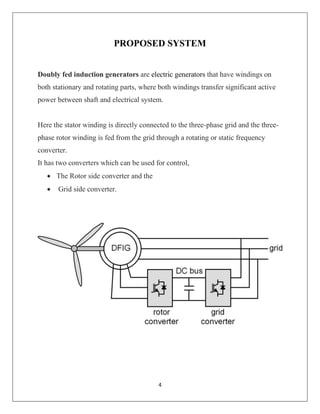
Here the stator winding is directly connected to the three-phase grid and the three-
phase rotor winding is fed from the grid through a rotating or static frequency
converter.
It has two converters which can be used for control,
ď‚· The Rotor side converter and the
ď‚· Grid side converter.
5
CHAPTER 2
PROJECT DESCRIPTION
2.1 SYSTEM DESCRIPTION
2.1.1 DOUBLY FED INDUCTION GENERATOR
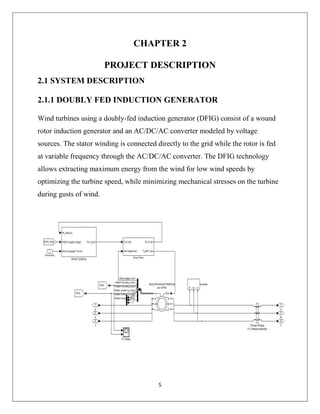
Wind turbines using a doubly-fed induction generator (DFIG) consist of a wound
rotor induction generator and an AC/DC/AC converter modeled by voltage
sources. The stator winding is connected directly to the grid while the rotor is fed
at variable frequency through the AC/DC/AC converter. The DFIG technology
allows extracting maximum energy from the wind for low wind speeds by
optimizing the turbine speed, while minimizing mechanical stresses on the turbine
during gusts of wind.
6
2.1.1.1 WIND TURBINE
The model is based on the steady-state power characteristics of the turbine. The
stiffness of the drive train is infinite and the friction factor and the inertia of the
turbine must be combined with those of the generator coupled to the turbine. The
output power of the turbine is given by the following equation.
Inputs and Outputs
Generator speed (pu)
Simulink input of the generator speed in pu based on the nominal speed of the
Generator.
Pitch angle (deg)
Simulink input of the pitch angle.
Wind speed (m/s)
Simulink input of the wind speed in m/s.
Tm (pu)
Simulink output of the mechanical torque of the wind turbine, in pu of the nominal
generator torque. The nominal torque of the generator is based on the nominal
generator power and speed.
7
2.1.1.2 ASYNCHRONOUS MACHINE
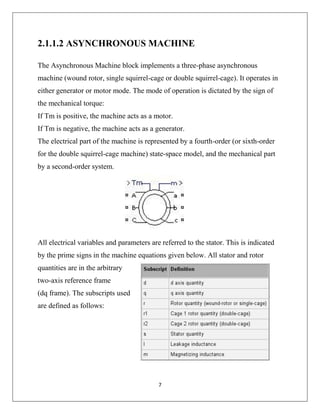
The Asynchronous Machine block implements a three-phase asynchronous
machine (wound rotor, single squirrel-cage or double squirrel-cage). It operates in
either generator or motor mode. The mode of operation is dictated by the sign of
the mechanical torque:
If Tm is positive, the machine acts as a motor.
If Tm is negative, the machine acts as a generator.
The electrical part of the machine is represented by a fourth-order (or sixth-order
for the double squirrel-cage machine) state-space model, and the mechanical part
by a second-order system.
All electrical variables and parameters are referred to the stator. This is indicated
by the prime signs in the machine equations given below. All stator and rotor
quantities are in the arbitrary
two-axis reference frame
(dq frame). The subscripts used
are defined as follows:
8
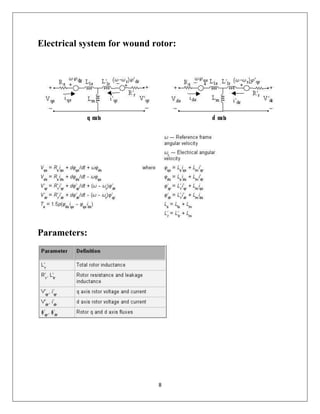
Electrical system for wound rotor:
Parameters:
9
2.1.2 ROTOR SIDE CONTROL
During nonsevere fault conditions, the crowbar protection is not activated and the
rotor windings of a doubly fed induction generator (DFIG) are still excited by the
ac/dc/ac converter.
In these cases, the dynamic response of a rotor-side converter (RSC) has a large
influence on the fault current characteristics of the DFIG.
The synchronous dq reference frame is chosen to model the DFIG based on the
fifth-order two-axis representation, and the model of DFIG is commonly known as
“Park model”.
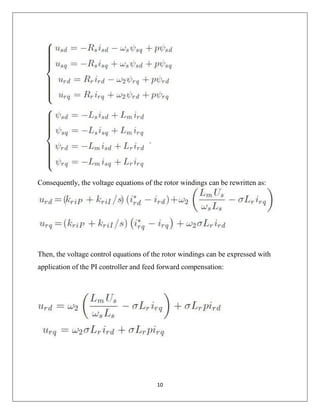
Using generator convention for the stator windings and motor convention for the
rotor windings, the voltage equations and flux linkage equations are expressed as:
10
Consequently, the voltage equations of the rotor windings can be rewritten as:
Then, the voltage control equations of the rotor windings can be expressed with
application of the PI controller and feed forward compensation:
11
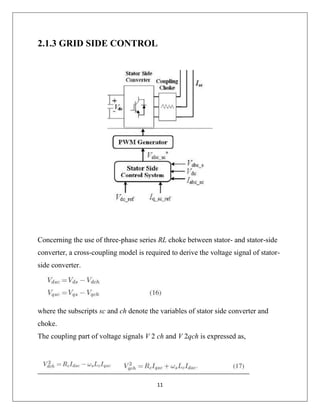
2.1.3 GRID SIDE CONTROL
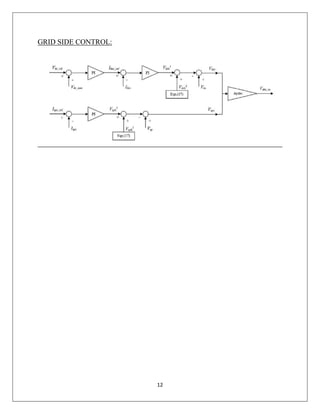
Concerning the use of three-phase series RL choke between stator- and stator-side
converter, a cross-coupling model is required to derive the voltage signal of stator-
side converter.
where the subscripts sc and ch denote the variables of stator side converter and
choke.
The coupling part of voltage signals V 2 ch and V 2qch is expressed as,
12
GRID SIDE CONTROL:
13
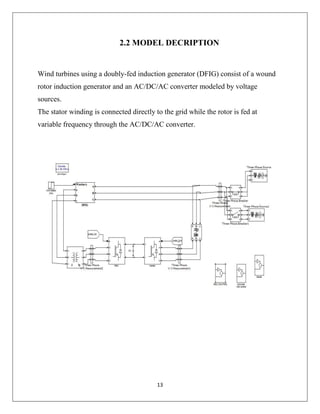
2.2 MODEL DECRIPTION
Wind turbines using a doubly-fed induction generator (DFIG) consist of a wound
rotor induction generator and an AC/DC/AC converter modeled by voltage
sources.
The stator winding is connected directly to the grid while the rotor is fed at
variable frequency through the AC/DC/AC converter.
14
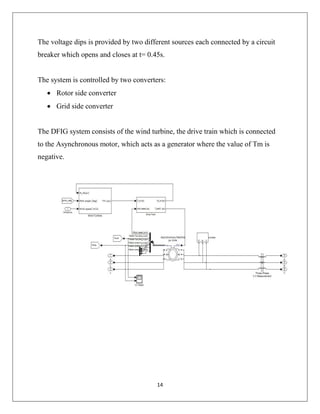
The voltage dips is provided by two different sources each connected by a circuit
breaker which opens and closes at t= 0.45s.
The system is controlled by two converters:
ď‚· Rotor side converter
ď‚· Grid side converter
The DFIG system consists of the wind turbine, the drive train which is connected
to the Asynchronous motor, which acts as a generator where the value of Tm is
negative.
15
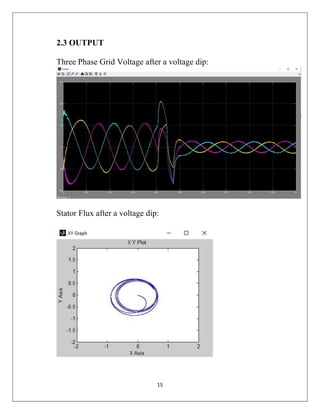
2.3 OUTPUT
Three Phase Grid Voltage after a voltage dip:
Stator Flux after a voltage dip:
16
CHAPTER 3
CONCLUSION
A theoretical analysis of the behavior of the DFIG during full- or partial-
voltage dips has been proposed.
The paper proposes a rigorous approach to these complex transient
phenomena in order to analyze the dynamic behavior of a doubly fed
induction machine during a voltage dip.
The analysis is, in particular, for an instantaneous voltage dip, which is
representative of the abrupt voltage dips that usually appear in real
situations.
It opens interesting prospects toward the search of hardware and
software solutions allowing to face the grid interactions of DFIG-based
wind power systems.
17
4. REFERENCE
Dynamic Behavior of the Doubly Fed Induction
Generator During Three-Phase Voltage Dips
Jes´us L´opez, Member, IEEE, Pablo Sanchis, Member, IEEE, Xavier Roboam, Member, IEEE,
and Luis Marroyo, Member, IEEE
Simulation Comparisons and Implementation of
Induction Generator Wind Power Systems
Yu Zou, Malik E. Elbuluk, Senior Member, IEEE, and Yilmaz Sozer, Member, IEEE
Study of Fault Current Characteristics of the DFIG :
Considering Dynamic Response of the RSC
Xiangping Kong, Zhe Zhang, Xianggen Yin, Member, IEEE, and Minghao Wen

DFIG_report

  • 1.
    ELECTRICAL MACHINES ANDDRIVES REPORT ON Dynamic Behavior of the Doubly Fed Induction Generator during Three- Phase Voltage Dips 2015 SUBMITTED BY: EBBIN DANIEL U80380223
  • 2.
    1 ABSTRACT The use ofdoubly fed induction generators (DFIGs) in large wind turbines has become quite common over the last few years. These machines provide variable speed and are driven with a power converter which is sized for a small percentage of the turbine-rated power. A drawback of the DFIG is that it is very sensitive to grid disturbances, especially to voltage dips. However, the operation of the machine in these situations has only been studied in the literature by means of simulations. This paper develops a theoretical analysis of the dynamic behavior of the induction machine during three-phase voltage dips. The proposed analysis contributes to understanding the causes of the problem and represents a very useful tool to improve the existing solutions and propose new alternatives. Experimental results are in good agreement with those obtained theoretically and validate the proposed analysis.
  • 3.
    2 CONTENTS CHAPTER NO: TITLEPAGE NO 1 INTRODUCTION 1.1 Introduction 3 1.2 Proposed system 4 2 PROJECT DESCRIPTION 2.1 System description 2.1.1 Doubly fed induction generator 5 2.1.1.1 Wind Turbine 6 2.1.1.2 Asynchronous machine 7 2.1.2 Rotor Side Control 9 2.1.3 Stator Side Control 11 2.2 Model description 13 2.3 Output 15 3 CONCLUSION 16 4 REFERENCES 17
  • 4.
    3 CHAPTER-1 INTRODUCTION WIND energy isnow considered as an actual alternative to the conventional and pollutant energy sources such as oil, gas, and coal. Global wind power reached 47GWin 2004 with a 20% growth in this year. Due to their advantageous characteristics, most of the grid-connected wind turbines operate at a variable speed. Among the different alternatives to obtain variable speed, the doubly fed induction generator (DFIG) is the most used. The control of the machine can be carried out with a converter that is sized for a power around 25%–35% of the rated power of the turbine. In addition to the common advantages in cost, size, and weight associated with a small converter, losses are also smaller compared to the system with a full power converter connected to the stator. However, wind turbines based on the DFIG are very sensitive to grid disturbances, especially to voltage dips. The abrupt drop of the grid voltage causes overvoltage and overcurrent in the rotor windings that could even destroy the converter if no protection elements are included. This paper tries to help understand the dynamic behavior of the DFIG in the typical case of three-phase voltage dips. In this paper, simulation tests and experiments are proposed on a small machine. The objective is to provide a qualitative analysis of the system behavior during voltage dips.
  • 5.
    4 PROPOSED SYSTEM Doubly fedinduction generators are electric generators that have windings on both stationary and rotating parts, where both windings transfer significant active power between shaft and electrical system. Here the stator winding is directly connected to the three-phase grid and the three- phase rotor winding is fed from the grid through a rotating or static frequency converter. It has two converters which can be used for control, ď‚· The Rotor side converter and the ď‚· Grid side converter.
  • 6.
    5 CHAPTER 2 PROJECT DESCRIPTION 2.1SYSTEM DESCRIPTION 2.1.1 DOUBLY FED INDUCTION GENERATOR Wind turbines using a doubly-fed induction generator (DFIG) consist of a wound rotor induction generator and an AC/DC/AC converter modeled by voltage sources. The stator winding is connected directly to the grid while the rotor is fed at variable frequency through the AC/DC/AC converter. The DFIG technology allows extracting maximum energy from the wind for low wind speeds by optimizing the turbine speed, while minimizing mechanical stresses on the turbine during gusts of wind.
  • 7.
    6 2.1.1.1 WIND TURBINE Themodel is based on the steady-state power characteristics of the turbine. The stiffness of the drive train is infinite and the friction factor and the inertia of the turbine must be combined with those of the generator coupled to the turbine. The output power of the turbine is given by the following equation. Inputs and Outputs Generator speed (pu) Simulink input of the generator speed in pu based on the nominal speed of the Generator. Pitch angle (deg) Simulink input of the pitch angle. Wind speed (m/s) Simulink input of the wind speed in m/s. Tm (pu) Simulink output of the mechanical torque of the wind turbine, in pu of the nominal generator torque. The nominal torque of the generator is based on the nominal generator power and speed.
  • 8.
    7 2.1.1.2 ASYNCHRONOUS MACHINE TheAsynchronous Machine block implements a three-phase asynchronous machine (wound rotor, single squirrel-cage or double squirrel-cage). It operates in either generator or motor mode. The mode of operation is dictated by the sign of the mechanical torque: If Tm is positive, the machine acts as a motor. If Tm is negative, the machine acts as a generator. The electrical part of the machine is represented by a fourth-order (or sixth-order for the double squirrel-cage machine) state-space model, and the mechanical part by a second-order system. All electrical variables and parameters are referred to the stator. This is indicated by the prime signs in the machine equations given below. All stator and rotor quantities are in the arbitrary two-axis reference frame (dq frame). The subscripts used are defined as follows:
  • 9.
    8 Electrical system forwound rotor: Parameters:
  • 10.
    9 2.1.2 ROTOR SIDECONTROL During nonsevere fault conditions, the crowbar protection is not activated and the rotor windings of a doubly fed induction generator (DFIG) are still excited by the ac/dc/ac converter. In these cases, the dynamic response of a rotor-side converter (RSC) has a large influence on the fault current characteristics of the DFIG. The synchronous dq reference frame is chosen to model the DFIG based on the fifth-order two-axis representation, and the model of DFIG is commonly known as “Park model”. Using generator convention for the stator windings and motor convention for the rotor windings, the voltage equations and flux linkage equations are expressed as:
  • 11.
    10 Consequently, the voltageequations of the rotor windings can be rewritten as: Then, the voltage control equations of the rotor windings can be expressed with application of the PI controller and feed forward compensation:
  • 12.
    11 2.1.3 GRID SIDECONTROL Concerning the use of three-phase series RL choke between stator- and stator-side converter, a cross-coupling model is required to derive the voltage signal of stator- side converter. where the subscripts sc and ch denote the variables of stator side converter and choke. The coupling part of voltage signals V 2 ch and V 2qch is expressed as,
  • 13.
  • 14.
    13 2.2 MODEL DECRIPTION Windturbines using a doubly-fed induction generator (DFIG) consist of a wound rotor induction generator and an AC/DC/AC converter modeled by voltage sources. The stator winding is connected directly to the grid while the rotor is fed at variable frequency through the AC/DC/AC converter.
  • 15.
    14 The voltage dipsis provided by two different sources each connected by a circuit breaker which opens and closes at t= 0.45s. The system is controlled by two converters: ď‚· Rotor side converter ď‚· Grid side converter The DFIG system consists of the wind turbine, the drive train which is connected to the Asynchronous motor, which acts as a generator where the value of Tm is negative.
  • 16.
    15 2.3 OUTPUT Three PhaseGrid Voltage after a voltage dip: Stator Flux after a voltage dip:
  • 17.
    16 CHAPTER 3 CONCLUSION A theoreticalanalysis of the behavior of the DFIG during full- or partial- voltage dips has been proposed. The paper proposes a rigorous approach to these complex transient phenomena in order to analyze the dynamic behavior of a doubly fed induction machine during a voltage dip. The analysis is, in particular, for an instantaneous voltage dip, which is representative of the abrupt voltage dips that usually appear in real situations. It opens interesting prospects toward the search of hardware and software solutions allowing to face the grid interactions of DFIG-based wind power systems.
  • 18.
    17 4. REFERENCE Dynamic Behaviorof the Doubly Fed Induction Generator During Three-Phase Voltage Dips Jes´us L´opez, Member, IEEE, Pablo Sanchis, Member, IEEE, Xavier Roboam, Member, IEEE, and Luis Marroyo, Member, IEEE Simulation Comparisons and Implementation of Induction Generator Wind Power Systems Yu Zou, Malik E. Elbuluk, Senior Member, IEEE, and Yilmaz Sozer, Member, IEEE Study of Fault Current Characteristics of the DFIG : Considering Dynamic Response of the RSC Xiangping Kong, Zhe Zhang, Xianggen Yin, Member, IEEE, and Minghao Wen