, Natural History Museum, London, U.K. iczn@nhm.ac.uk  www.iczn.org Ellinor Michel   International Commission  on Zoological Nomenclature(ICZN) Zoological Nomenclature
The   International Commission  on Zoological Nomenclature Present Role: To revise and publish the  International Code of Zoological Nomenclature To consider and rule on specific cases of nomenclatural uncertainty  in zoology Mandate: ‘Sense & Stability in Animal Names’ Support Convention on Biological Diversity,  Decisions adopted by the 4th meeting  of the Conference of the Parties   (Bratislava, 4-15 May 1998)
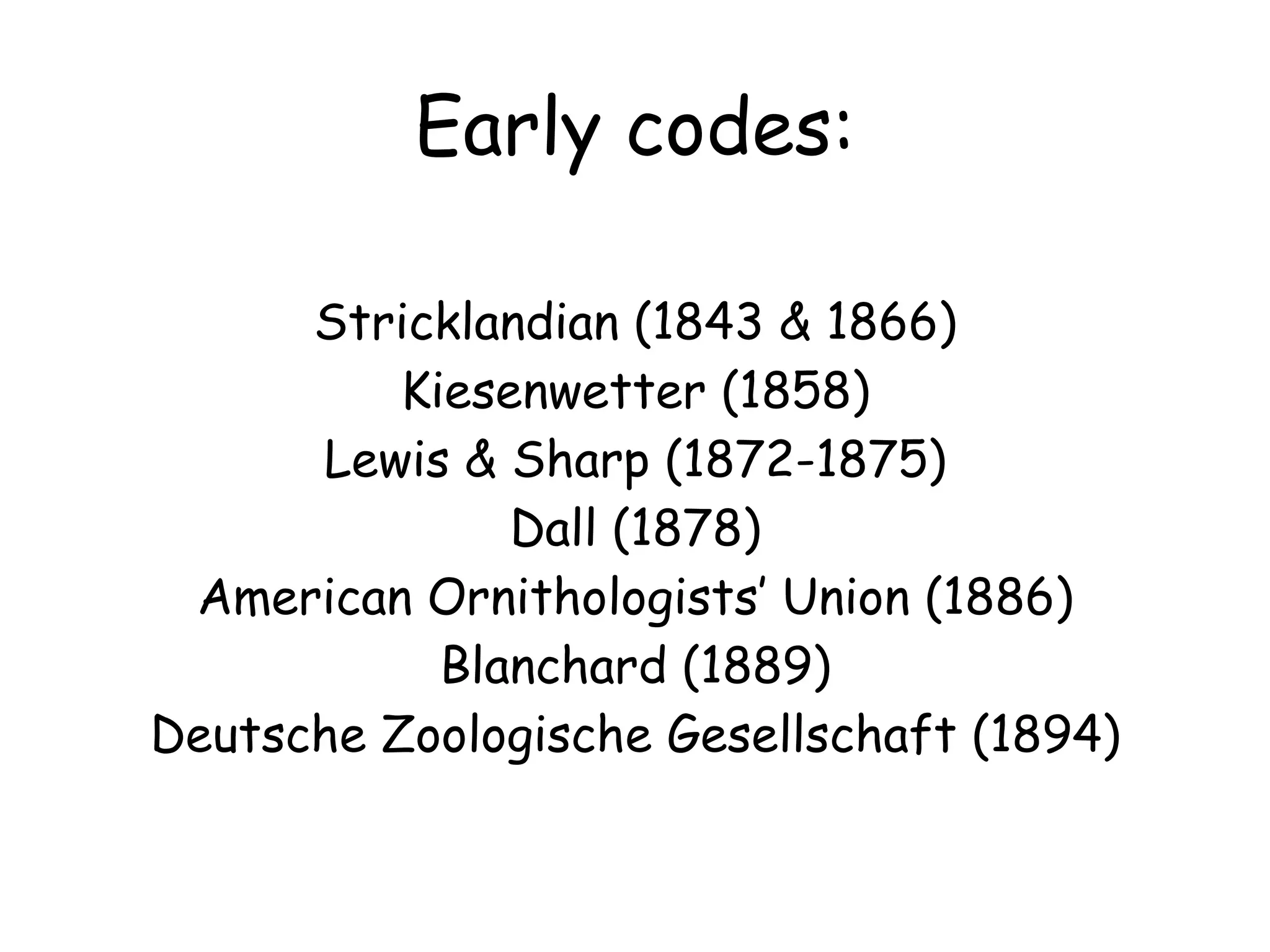
Early codes: Stricklandian (1843 & 1866) Kiesenwetter (1858) Lewis & Sharp (1872-1875) Dall (1878) American Ornithologists’ Union (1886) Blanchard (1889) Deutsche Zoologische Gesellschaft (1894)
A universal code for all animals: Commission established: 1895 Publication of the “R è gles”: 1905 1 st  International Code:  1961 2 nd : 1964; 3 rd : 1985; 4 th : 1999 5: in the works for 2012
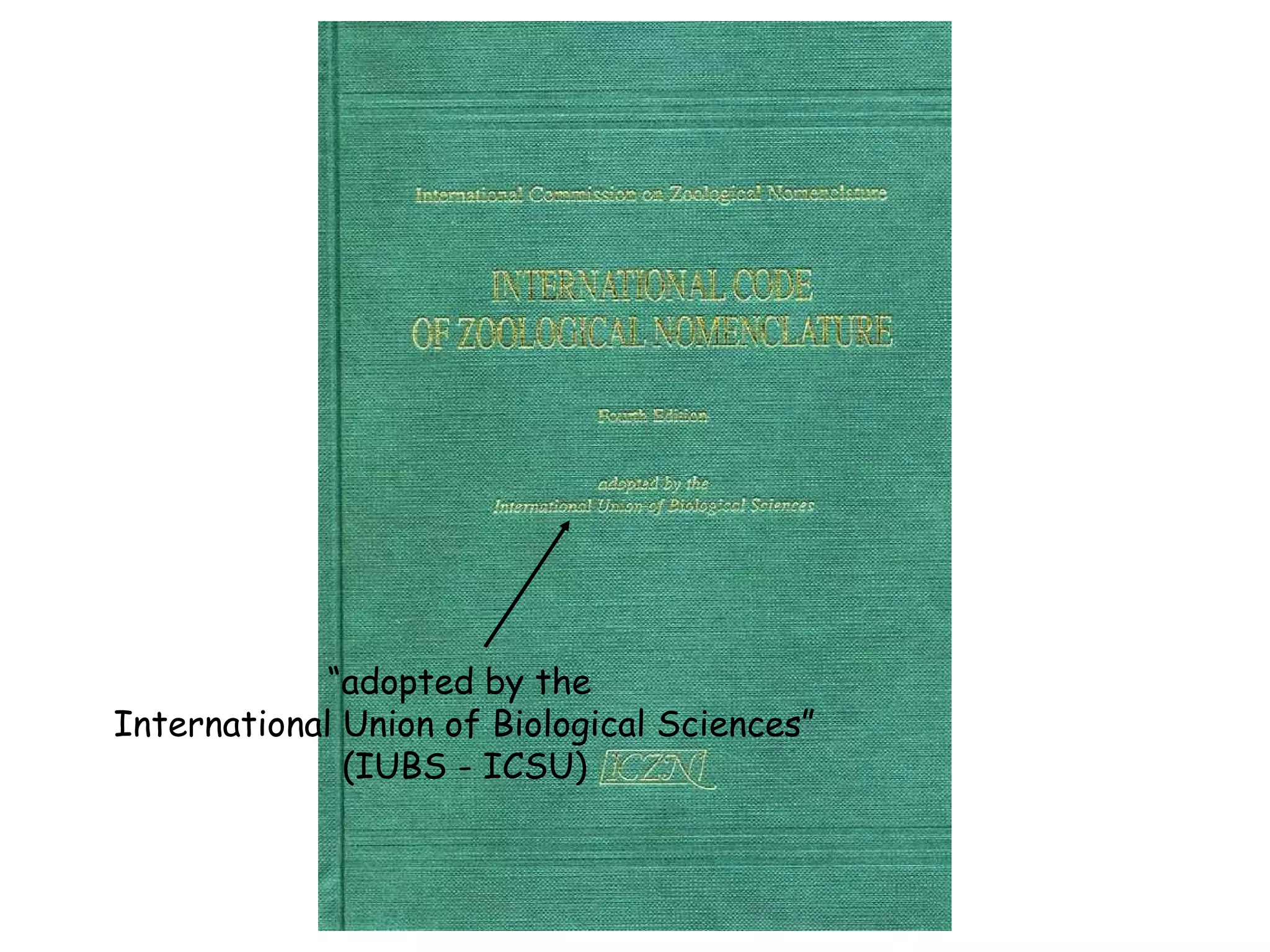
“ adopted by the  International Union of Biological Sciences” (IUBS - ICSU)
Legal? Semi-legal? Who decides?
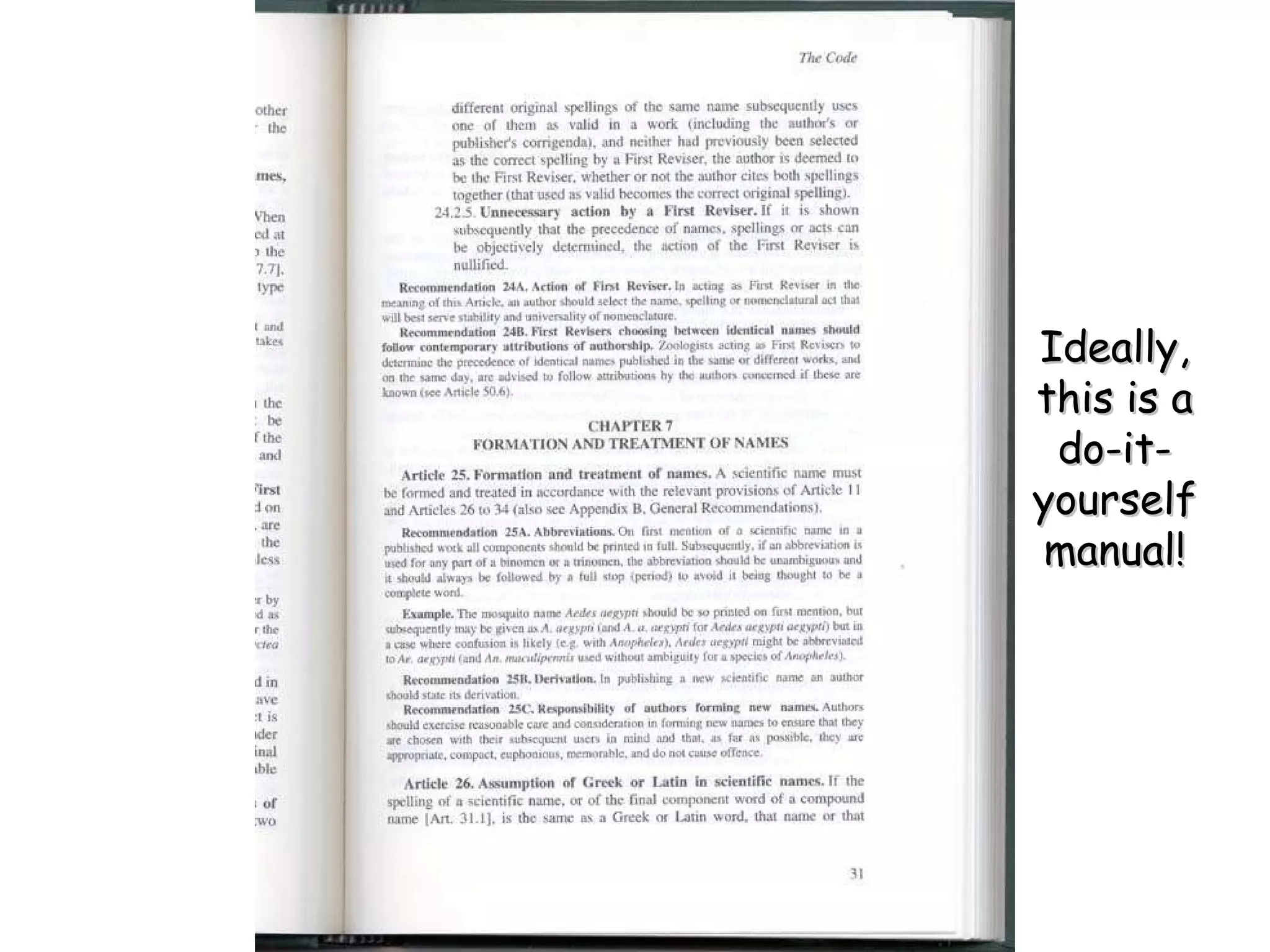
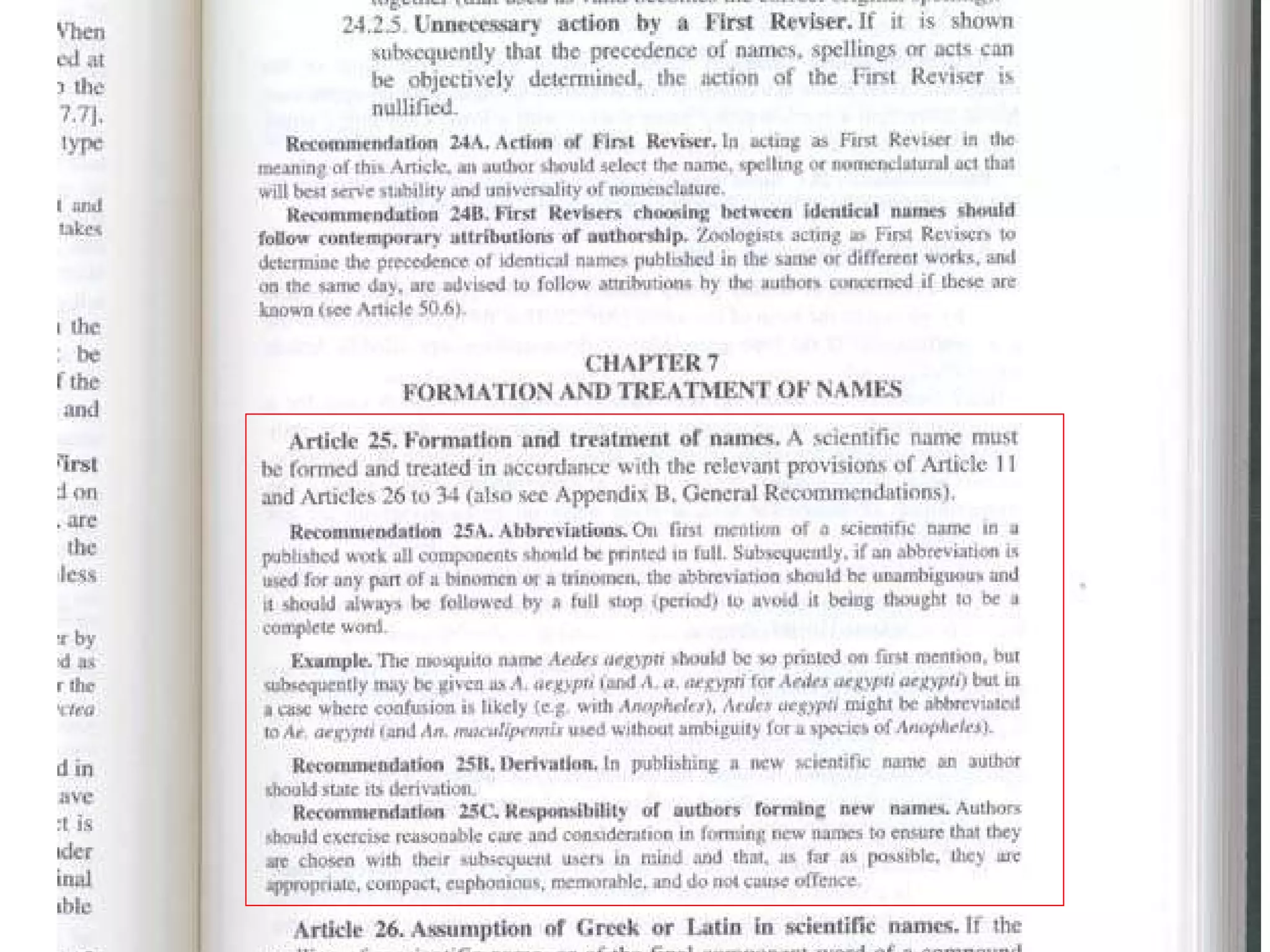
Ideally, this is a do-it-yourself manual!


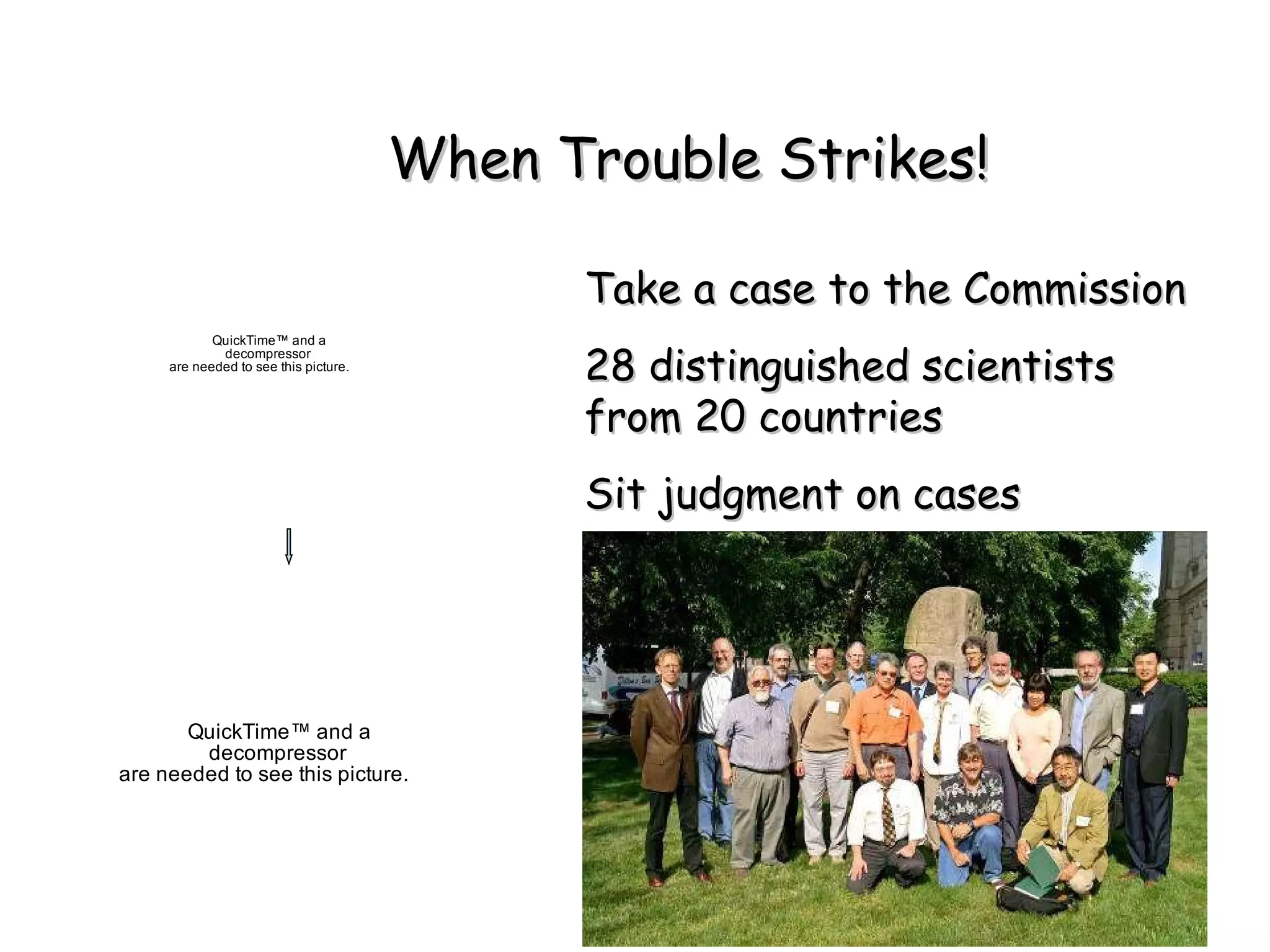
When Trouble Strikes! Take a case to the Commission 28 distinguished scientists from 20 countries Sit judgment on cases
 
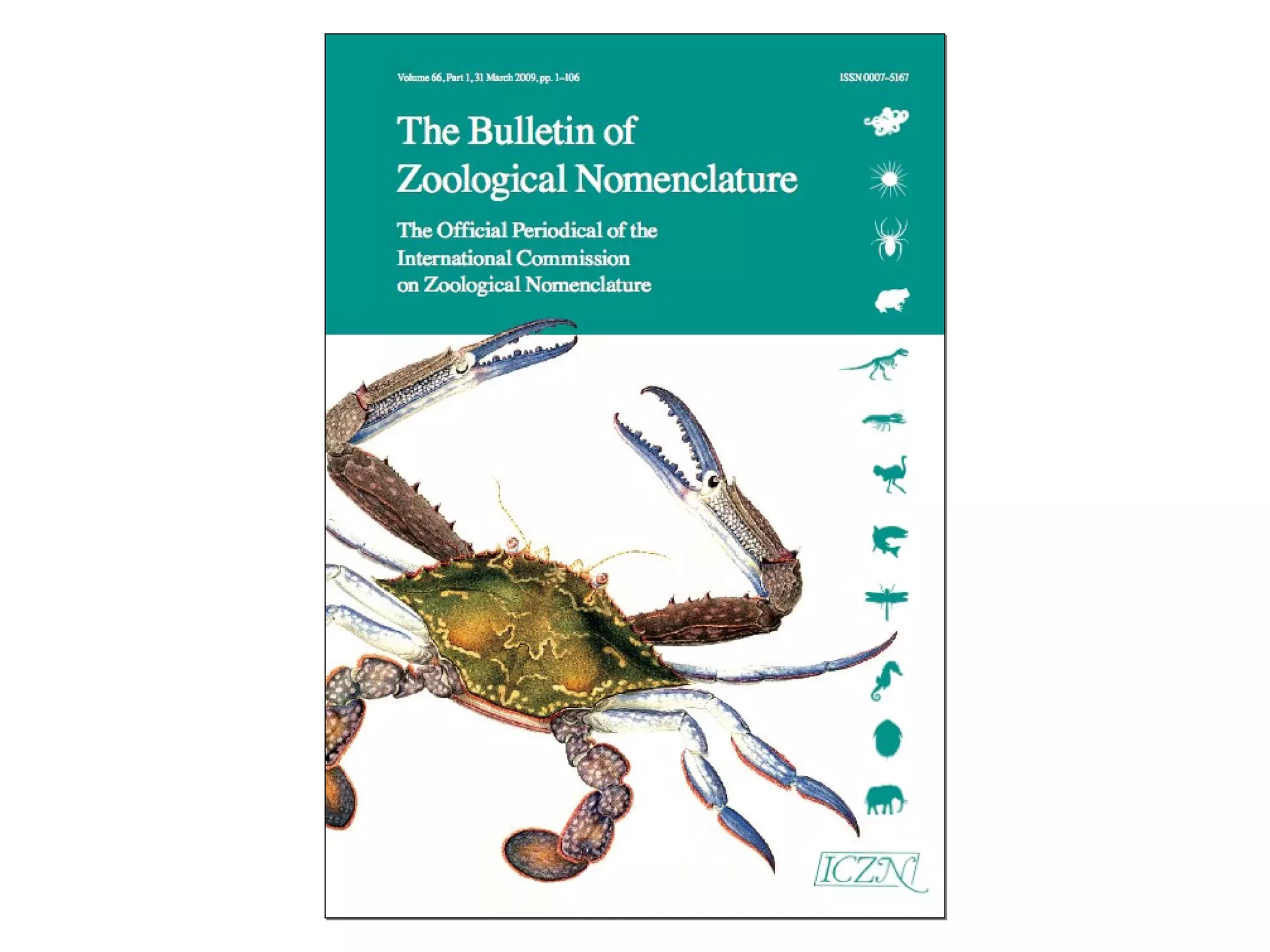
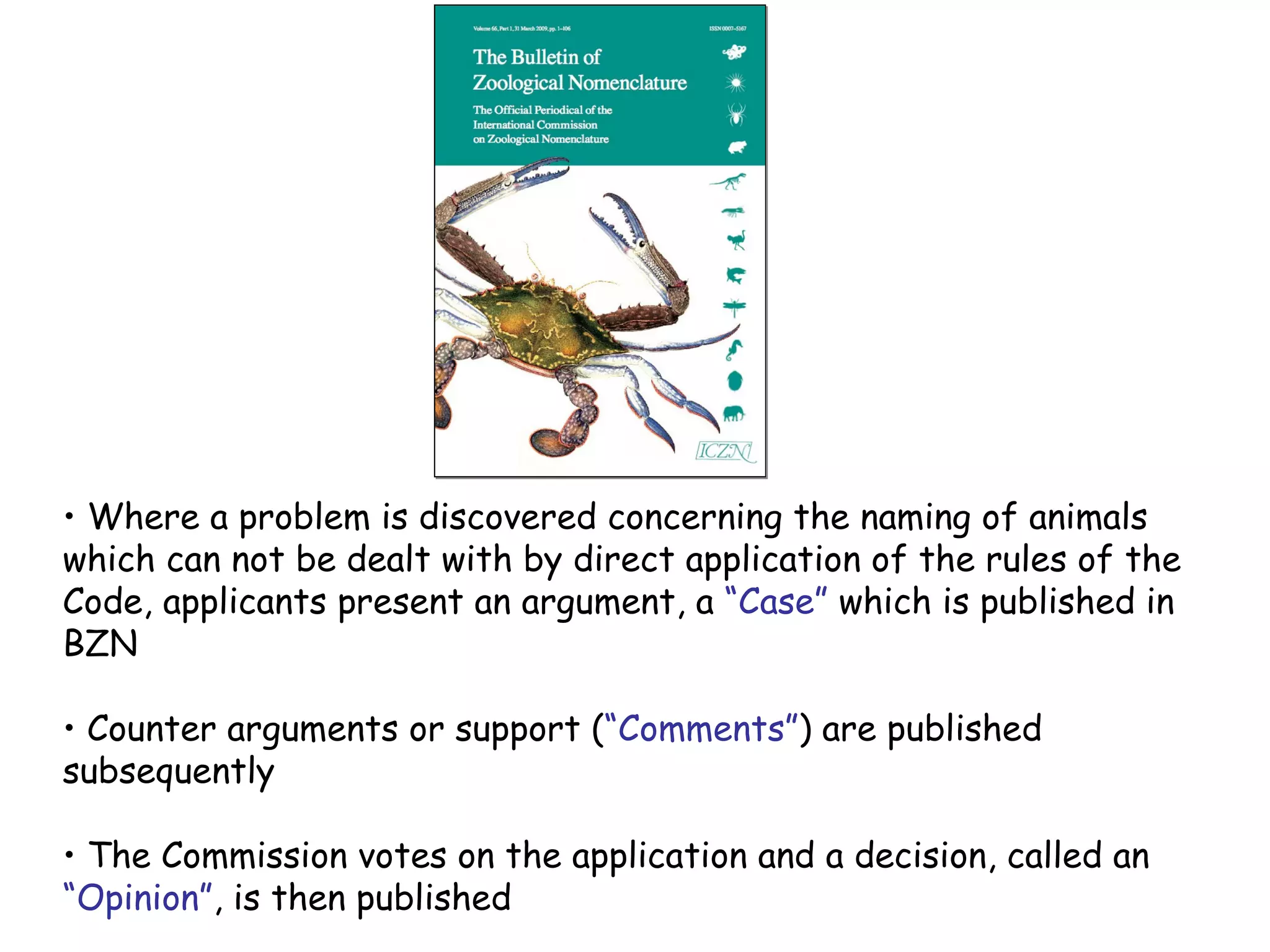
Where a problem is discovered concerning the naming of animals which can not be dealt with by direct application of the rules of the Code, applicants present an argument , a  “Case”  which is published in BZN Counter arguments or support ( “Comments” ) are published subsequently The Commission votes on the application and a decision, called an  “Opinion” ,  is then published
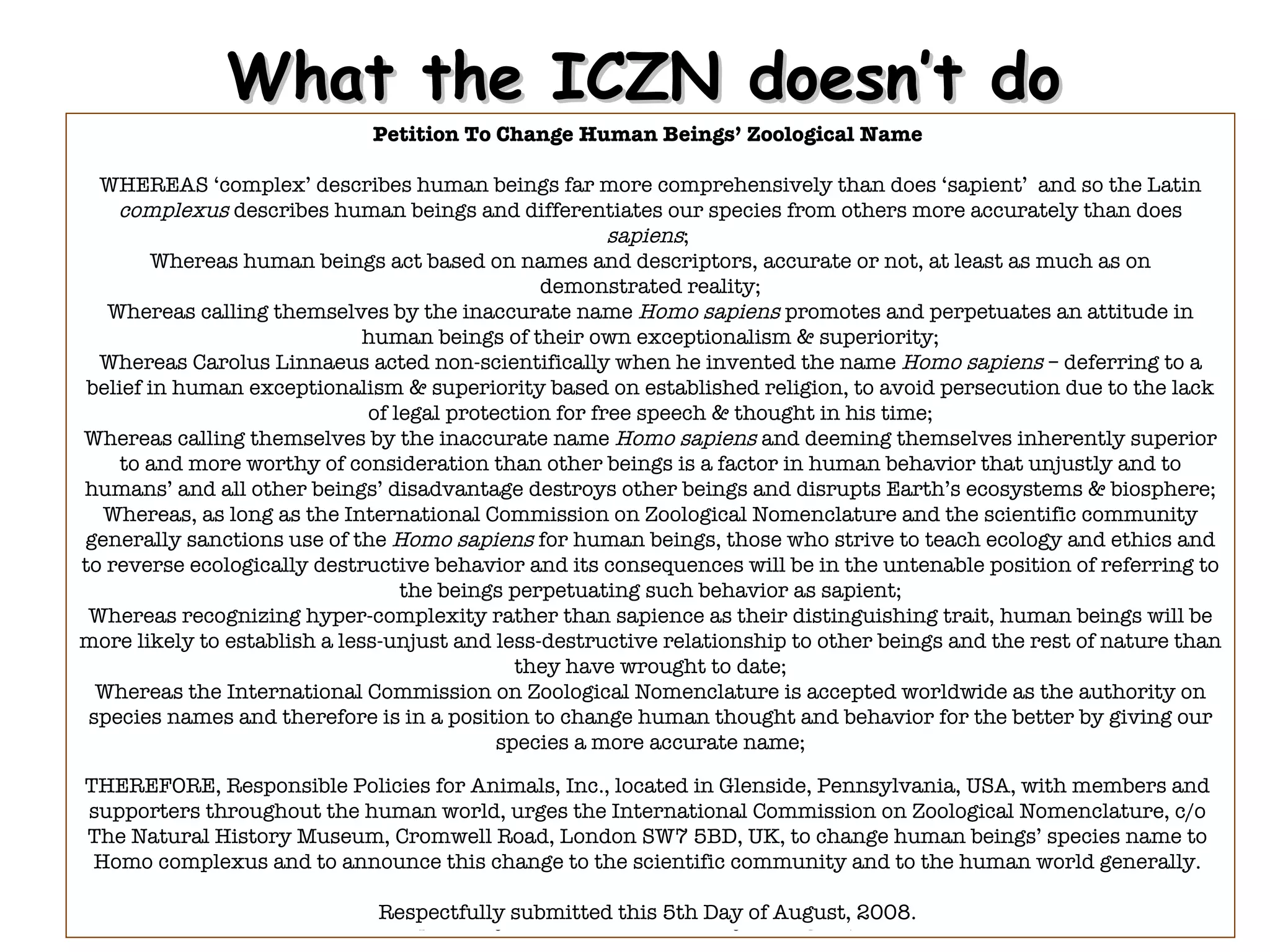
What the ICZN doesn’t do Make taxonomic decisions Give names to organisms Enforce correct use of names Change names (we make decisions between existing alternatives)
What the ICZN doesn’t do Petition To Change Human Beings’ Zoological Name  WHEREAS ‘ c o mplex’ describes human beings far more comprehensively than does ‘ s a pient’  and so the Latin  complexus  describes human beings and differentiates our species from others more accurately than does  sapiens ;  Whereas human beings act based on names and descriptors, accurate or not, at least as much as on demonstrated reality; Whereas calling themselves by the inaccurate name  Homo sapiens  promotes and perpetuates an attitude in human beings of their own exceptionalism & superiority; Whereas Carolus Linnaeus acted non-scientifically when he invented the name  Homo sapiens  – deferring to a belief in human exceptionalism & superiority based on established religion, to avoid persecution due to the lack of legal protection for free speech & thought in his time; Whereas calling themselves by the inaccurate name  Homo sapiens  and deeming themselves inherently superior to and more worthy of consideration than other beings is a factor in human behavior that unjustly and to humans’ and all other beings’ disadvantage destroys other beings and disrupts Earth’s ecosystems & biosphere; Whereas, as long as the International Commission on Zoological Nomenclature and the scientific community generally sanctions use of the  Homo sapiens  for human beings, those who strive to teach ecology and ethics and to reverse ecologically destructive behavior and its consequences will be in the untenable position of referring to the beings perpetuating such behavior as sapient; Whereas recognizing hyper-complexity rather than sapience as their distinguishing trait, human beings will be more likely to establish a less-unjust and less-destructive relationship to other beings and the rest of nature than they have wrought to date; Whereas the International Commission on Zoological Nomenclature is accepted worldwide as the authority on species names and therefore is in a position to change human thought and behavior for the better by giving our species a more accurate name; THEREFORE, Responsible Policies for Animals, Inc., located in Glenside, Pennsylvania, USA, with members and supporters throughout the human world, urges the International Commission on Zoological Nomenclature, c/o The Natural History Museum, Cromwell Road, London SW7 5BD, UK, to change human beings’ species name to  Homo complexus  and to announce this change to the scientific community and to the human world generally. Respectfully submitted this 5th Day of August, 2008. THEREFORE, Responsible Policies for Animals, Inc., located in Glenside, Pennsylvania, USA, with members and supporters throughout the human world, urges the International Commission on Zoological Nomenclature, c/o The Natural History Museum, Cromwell Road, London SW7 5BD, UK, to change human beings’ species name to Homo complexus and to announce this change to the scientific community and to the human world generally. Respectfully submitted this 5th Day of August, 2008.
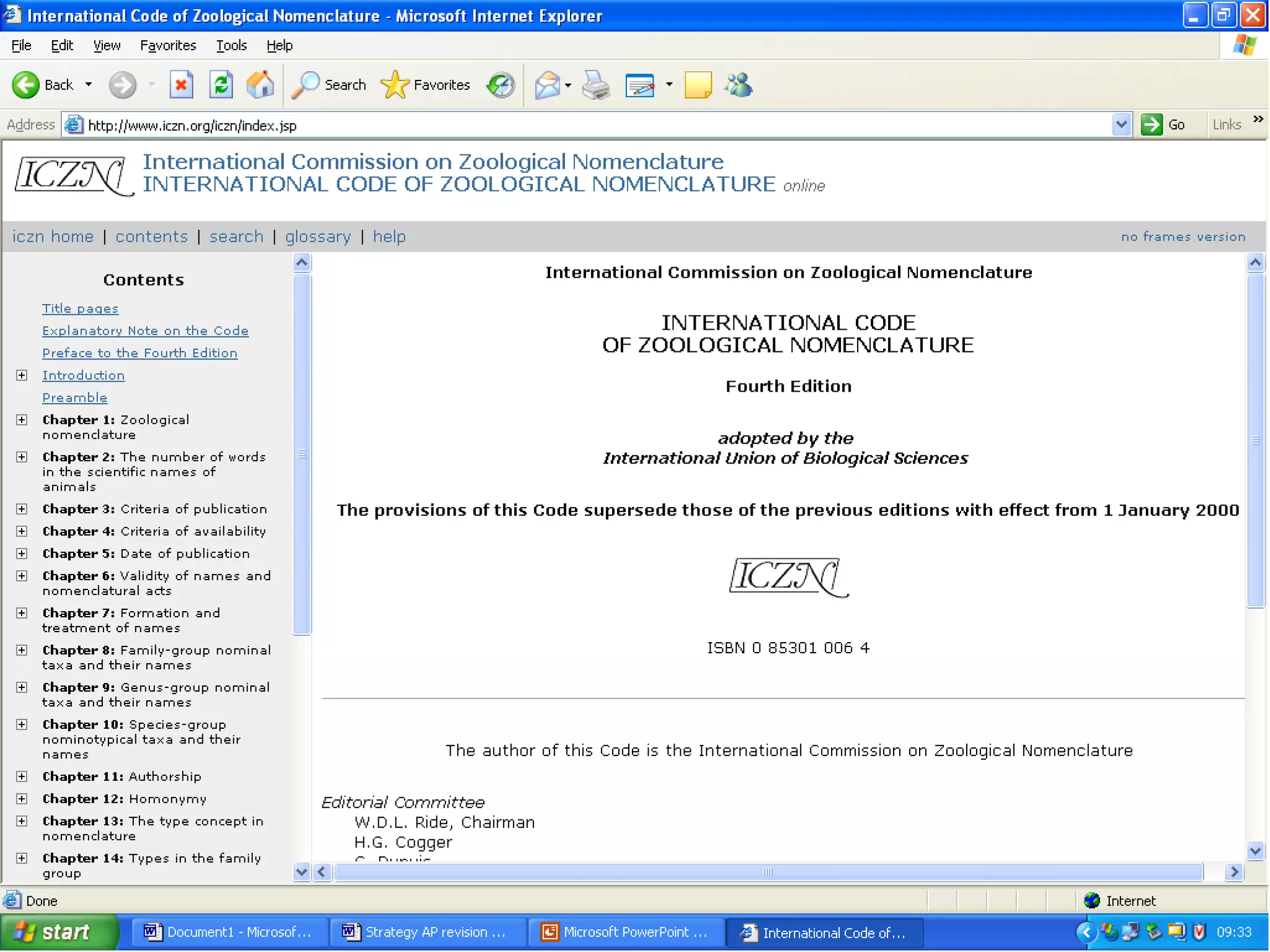
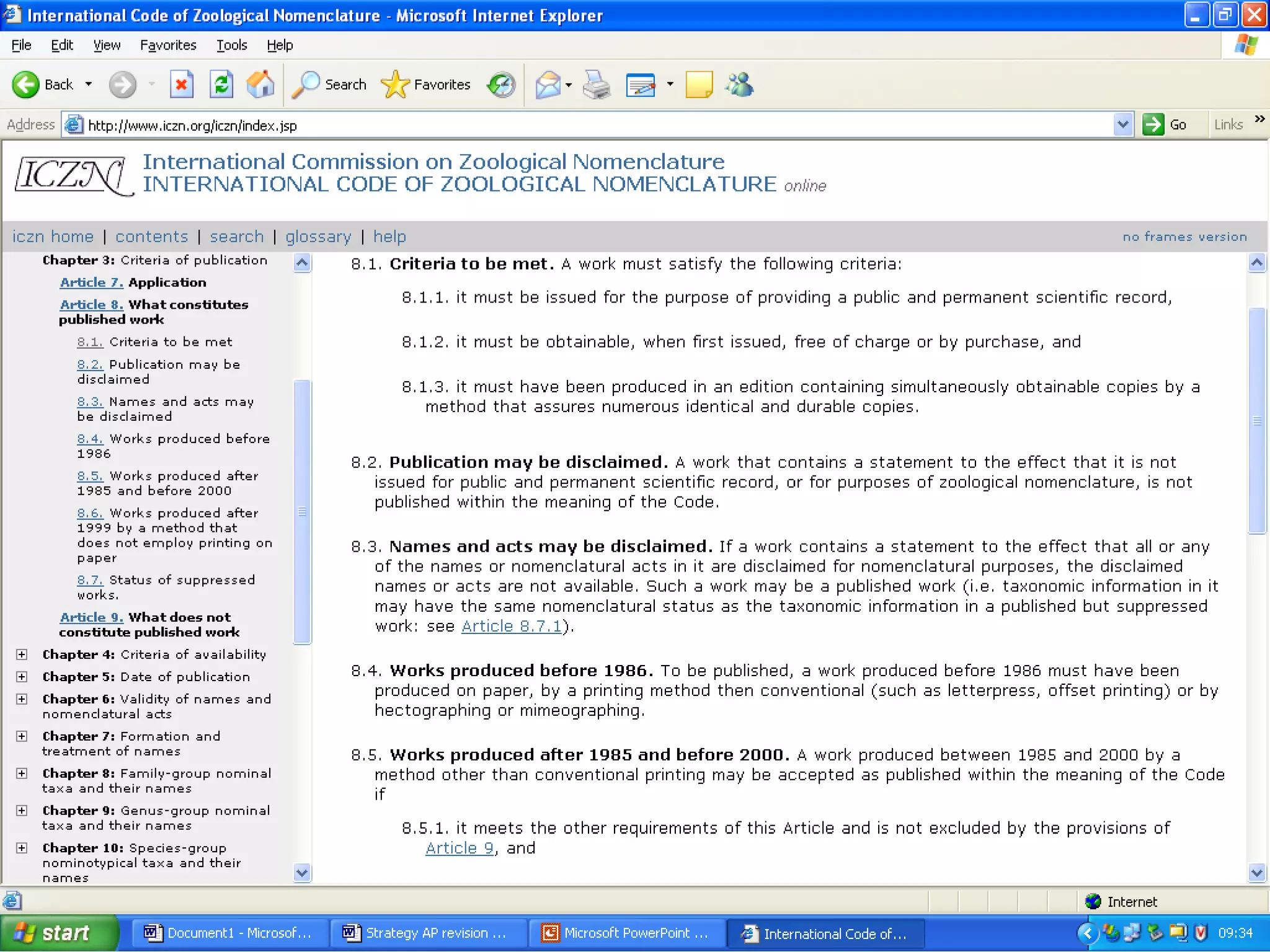
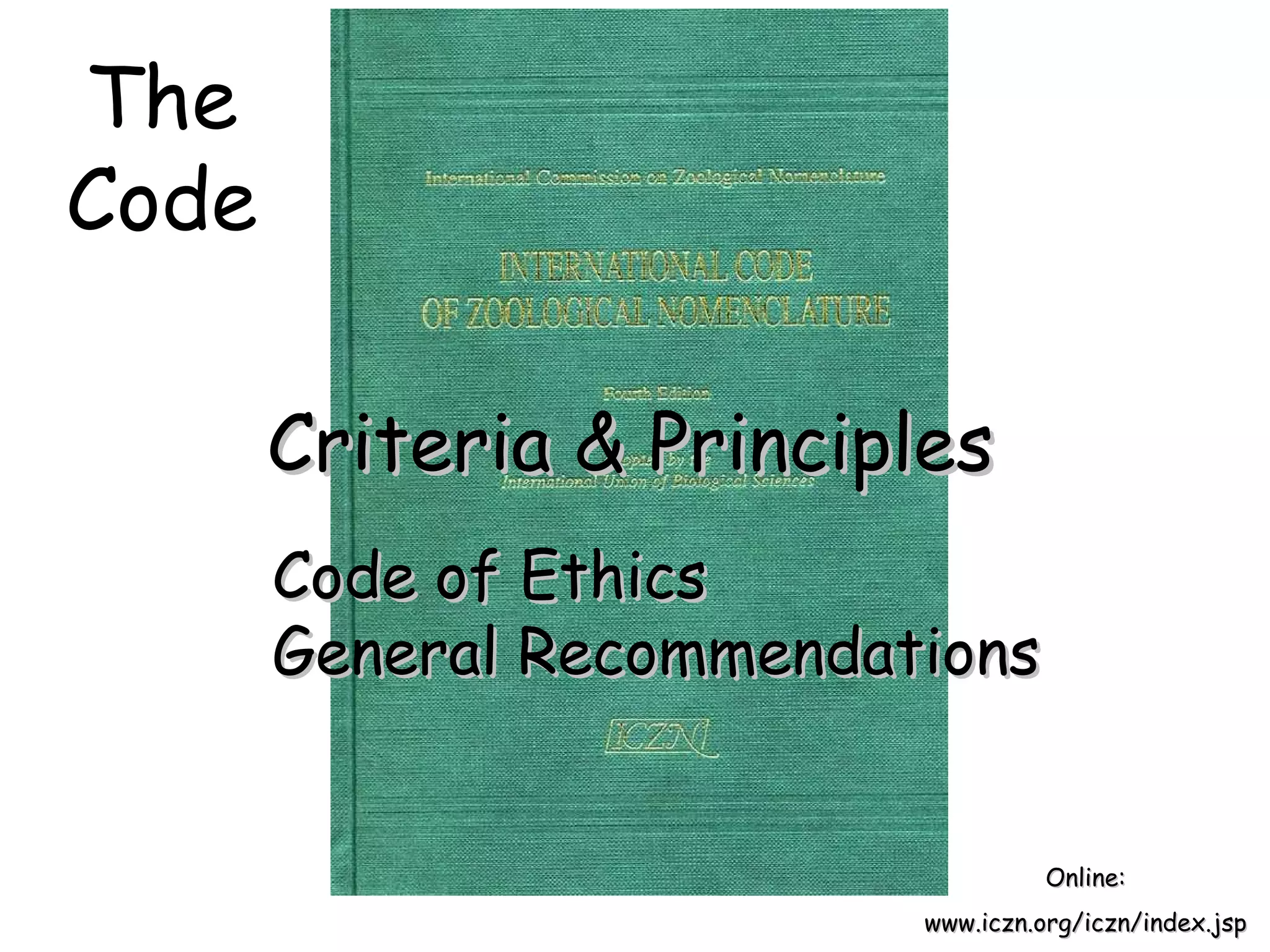
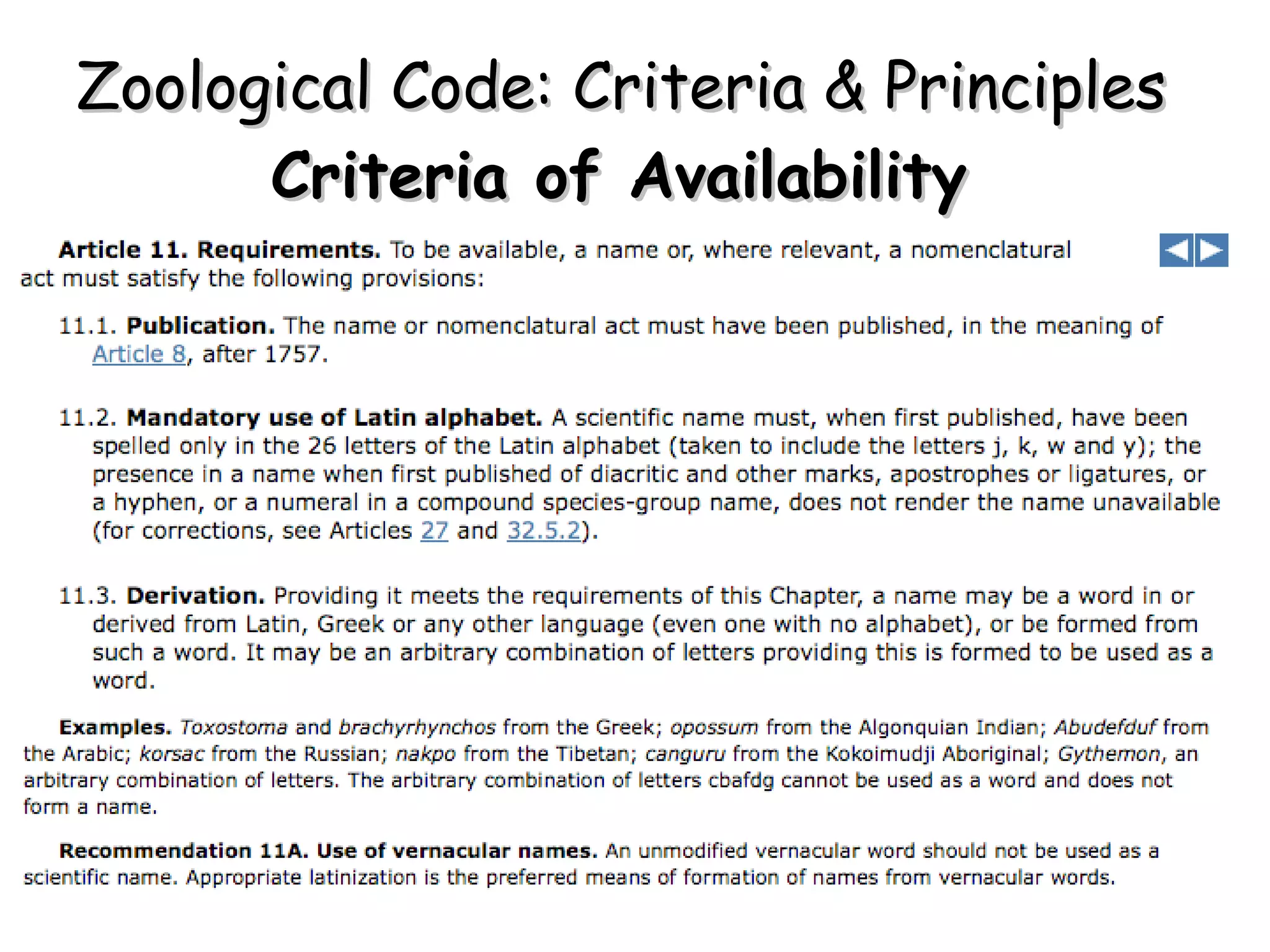
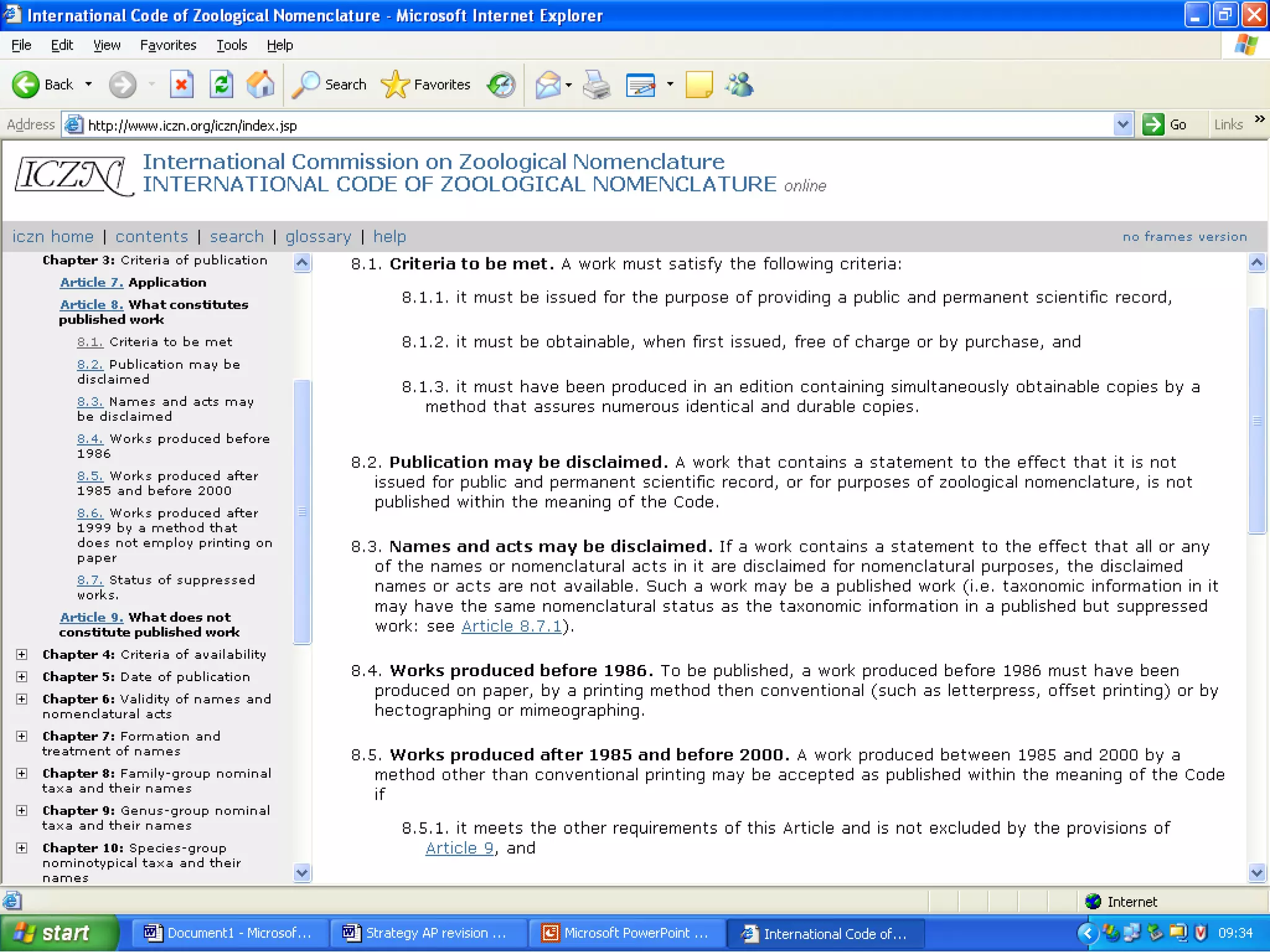
The Code Criteria & Principles Online: www.iczn.org/iczn/index.jsp Code of Ethics General Recommendations
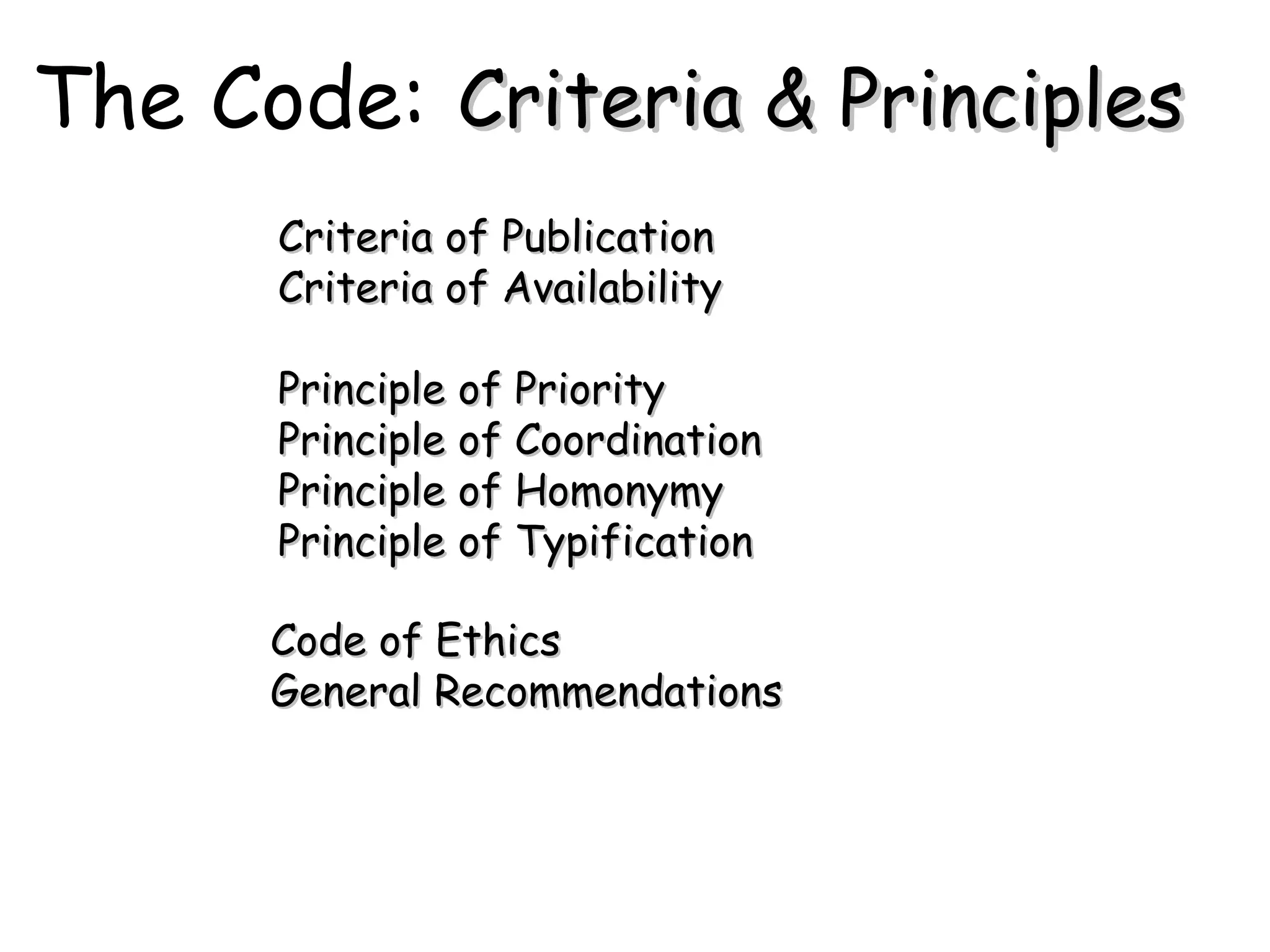
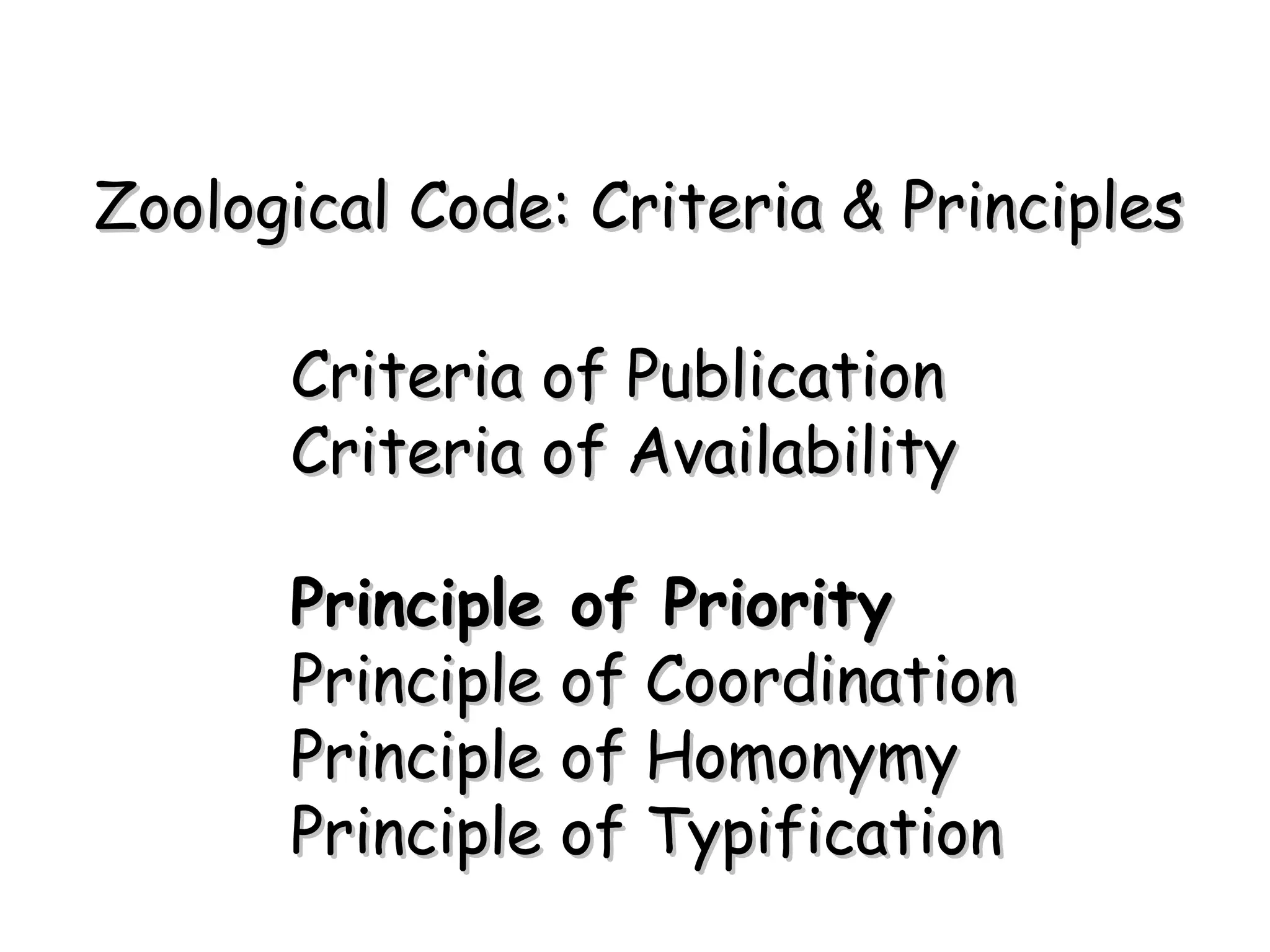
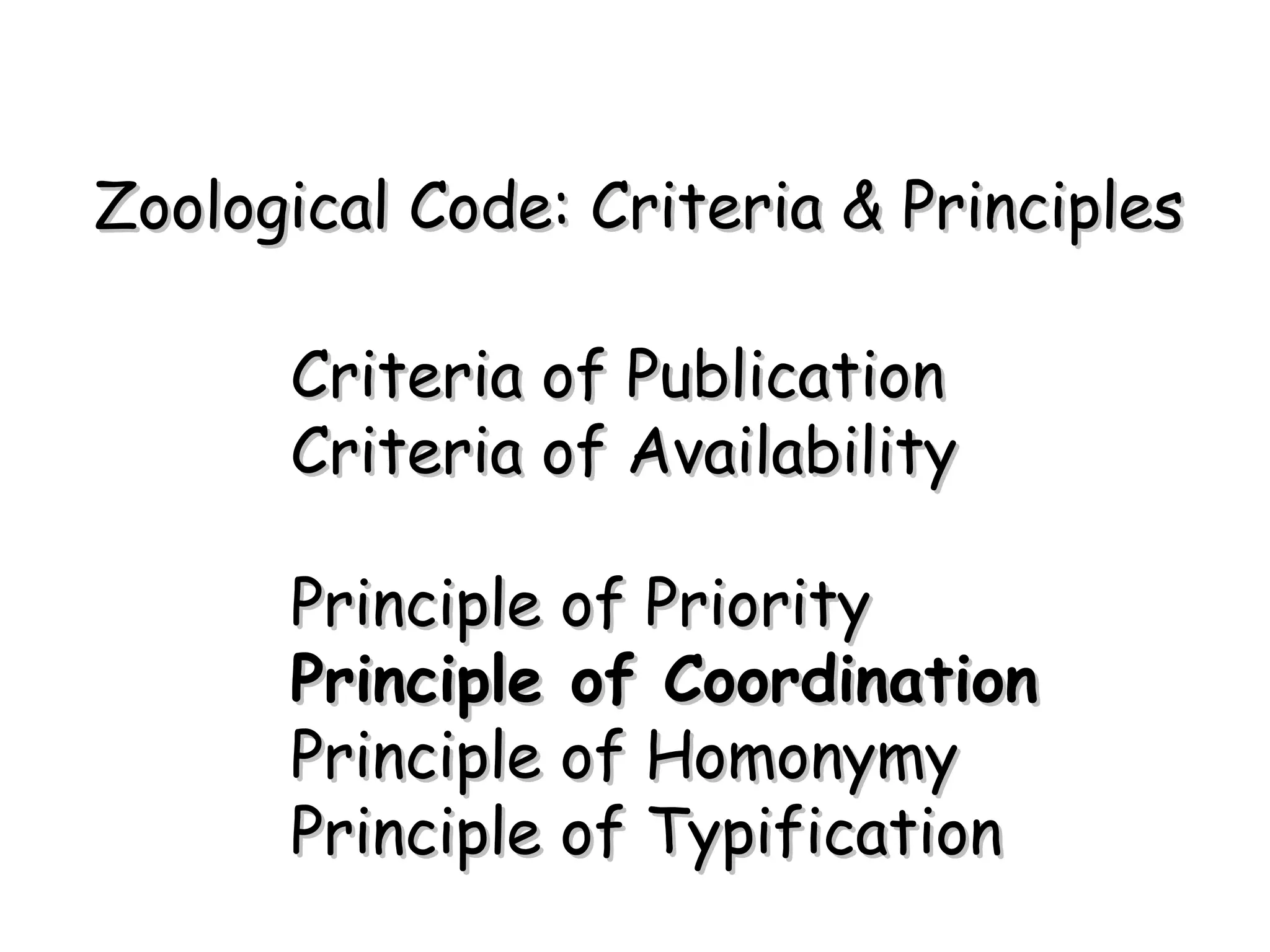
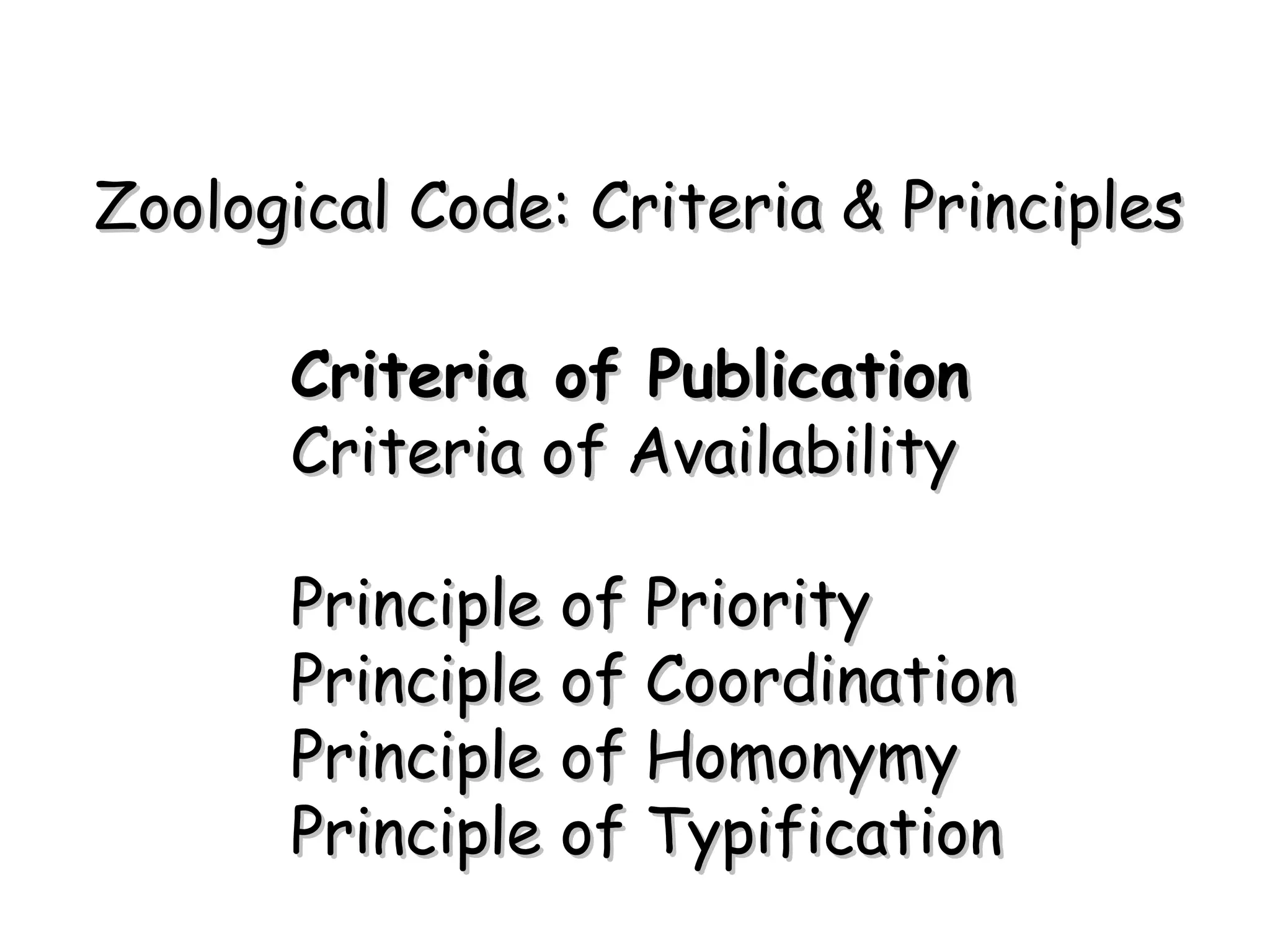
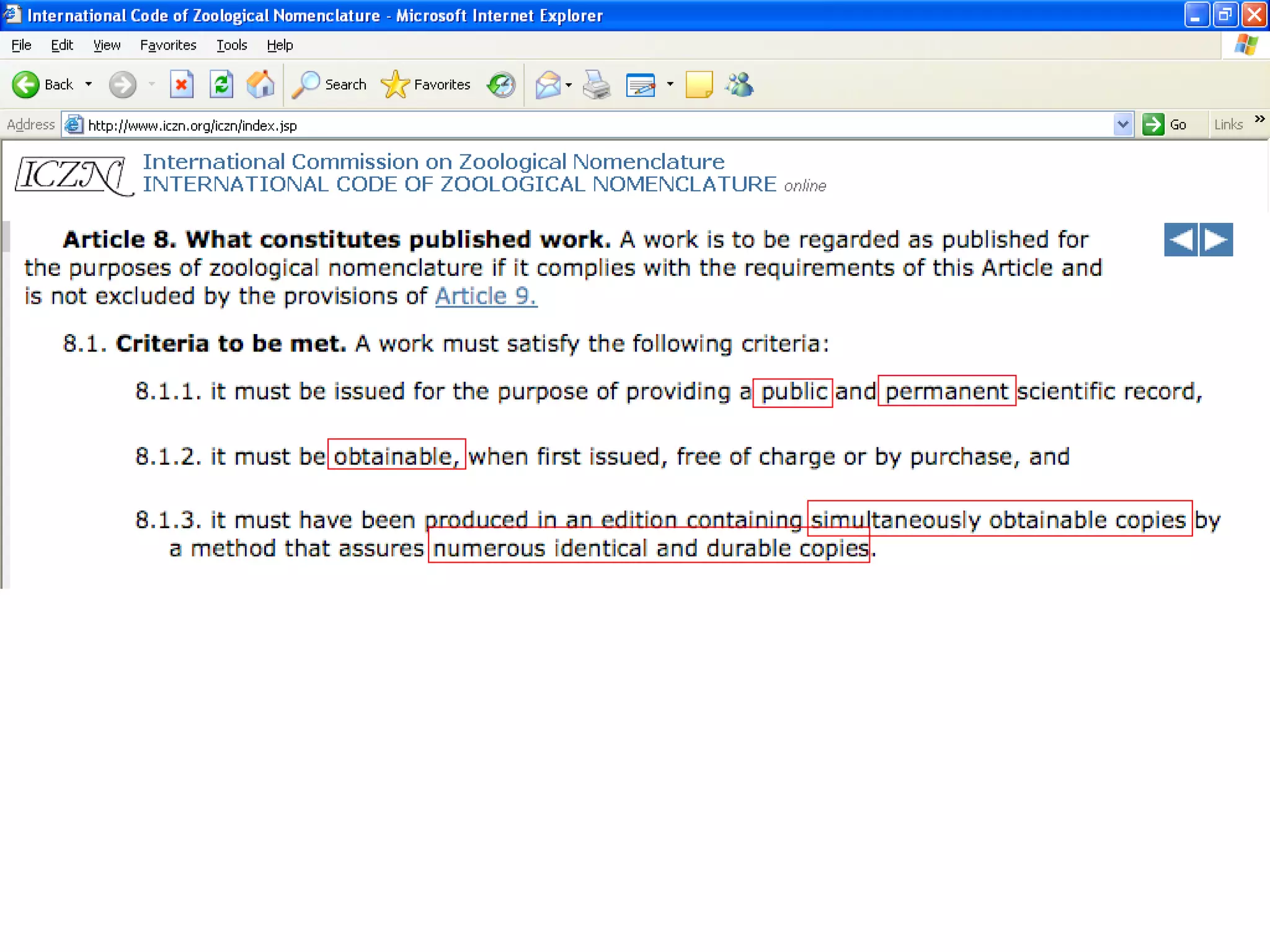
The Code: Criteria & Principles Criteria of Publication Criteria of Availability Principle of Priority Principle of Coordination Principle of Homonymy Principle of Typification Code of Ethics General Recommendations
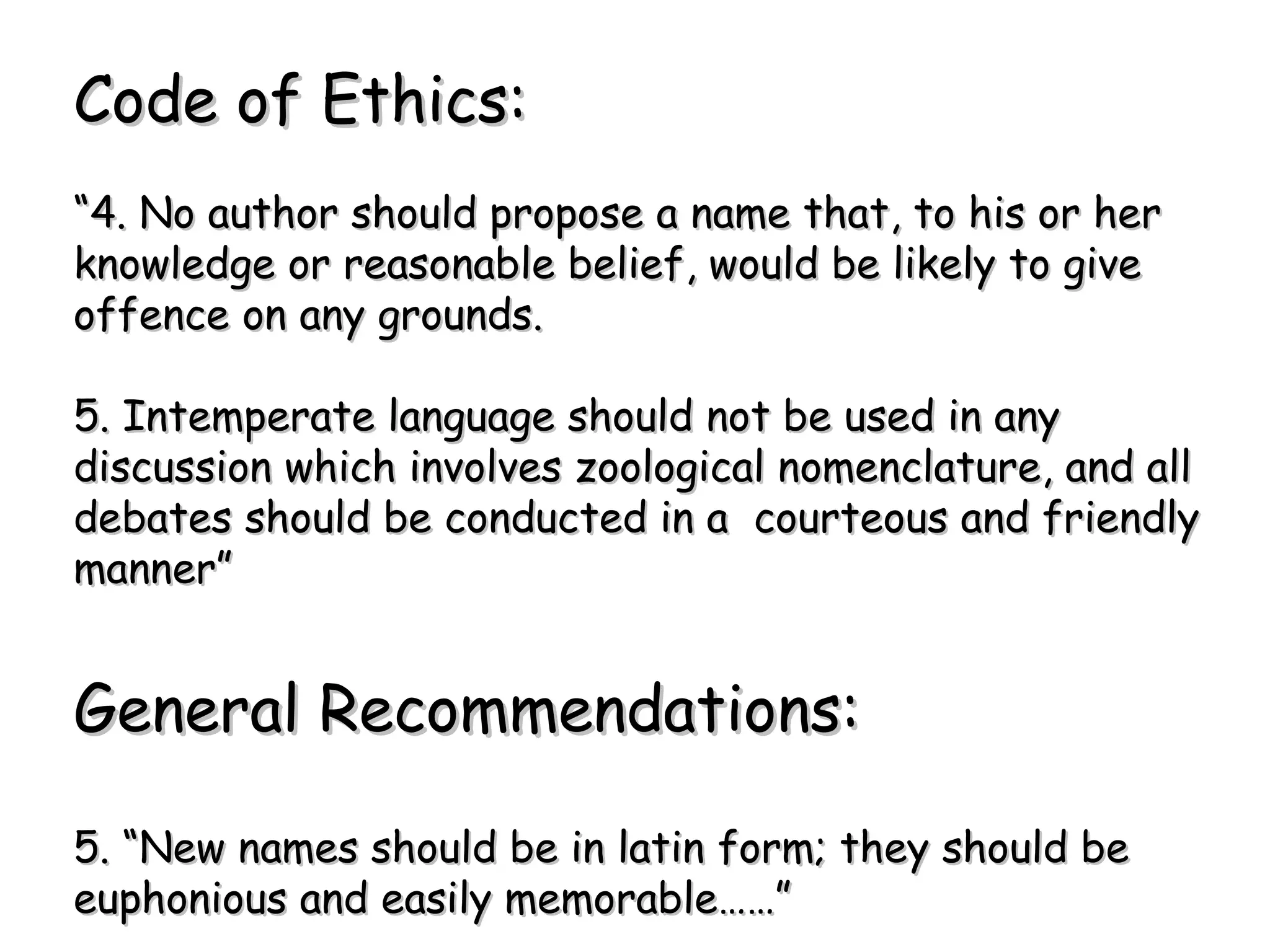
Code of Ethics: “ 4. No author should propose a name that, to his or her knowledge or reasonable belief, would be likely to give offence on any grounds. 5. Intemperate language should not be used in any discussion which involves zoological nomenclature, and all debates should be conducted in a  courteous and friendly manner” General Recommendations: 5. “New names should be in latin form; they should be euphonious and easily memorable……”
The Code: Namewise – anything goes
The Code: Namewise – anything goes (almost)
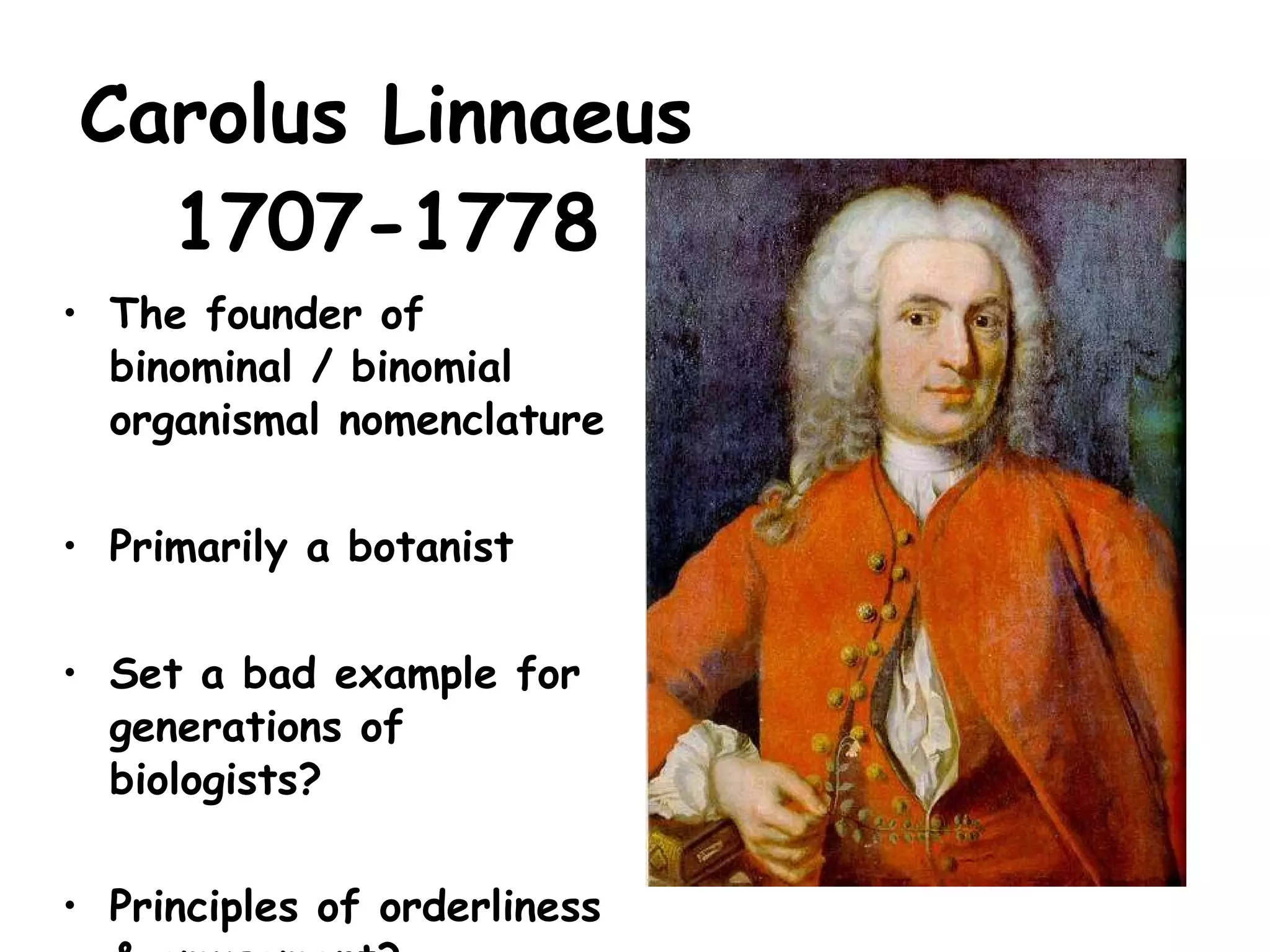
Carolus Linnaeus 1707-1778 The founder of binominal / binomial organismal nomenclature Primarily a botanist Set a bad example for generations of biologists? Principles of orderliness & amusement?
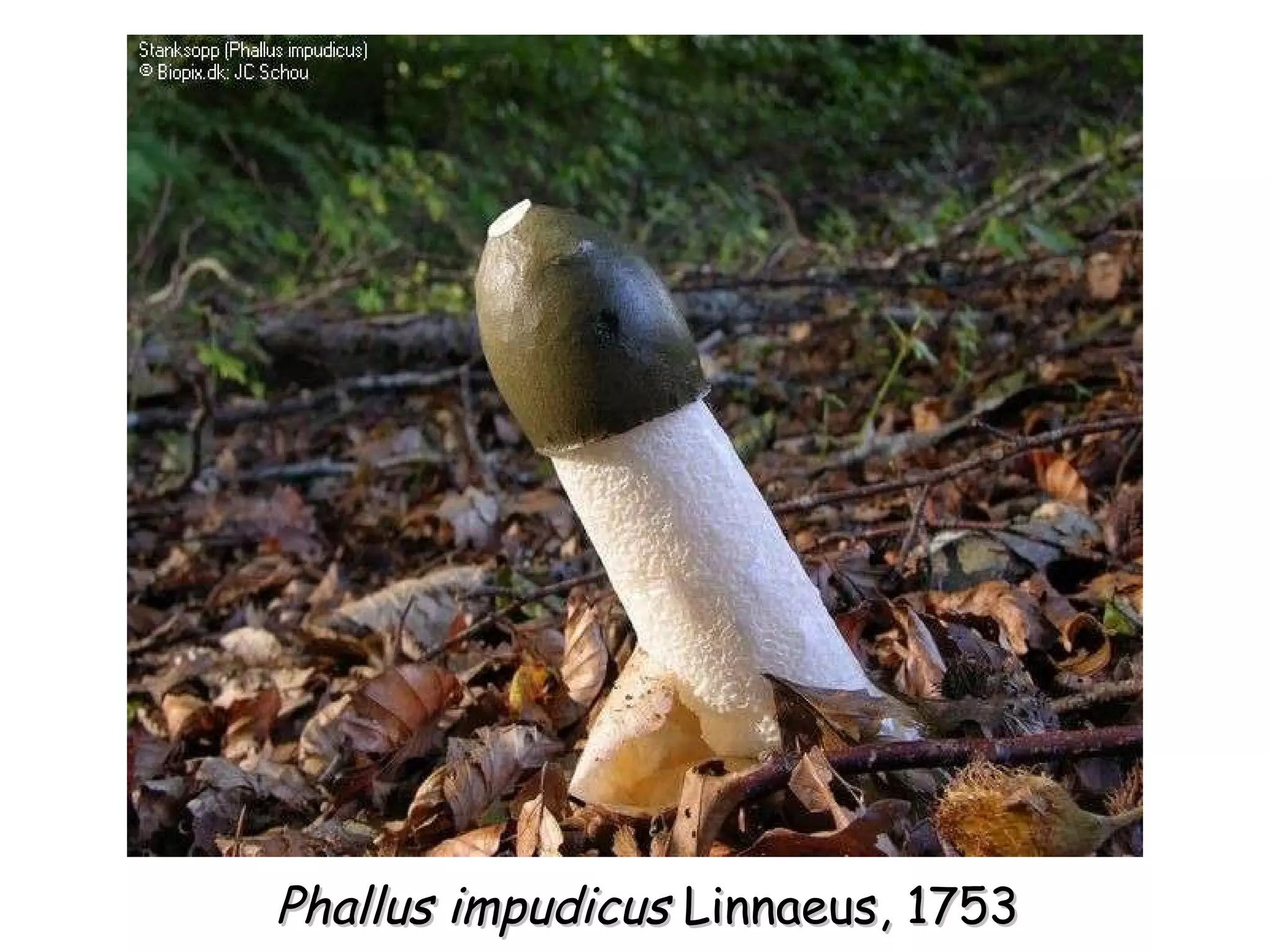
Phallus impudicus  Linnaeus, 1753
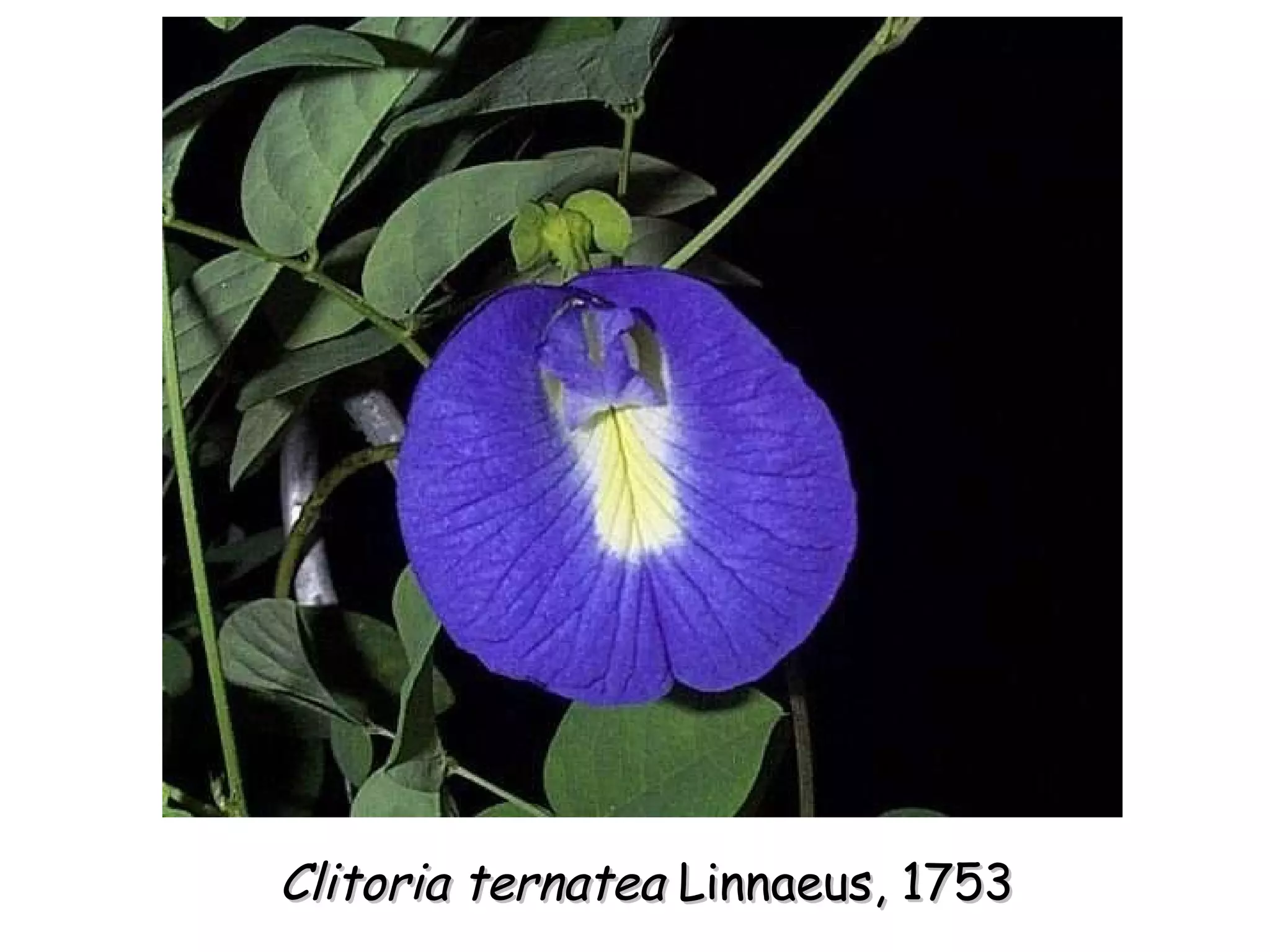
Clitoria ternatea  Linnaeus, 1753
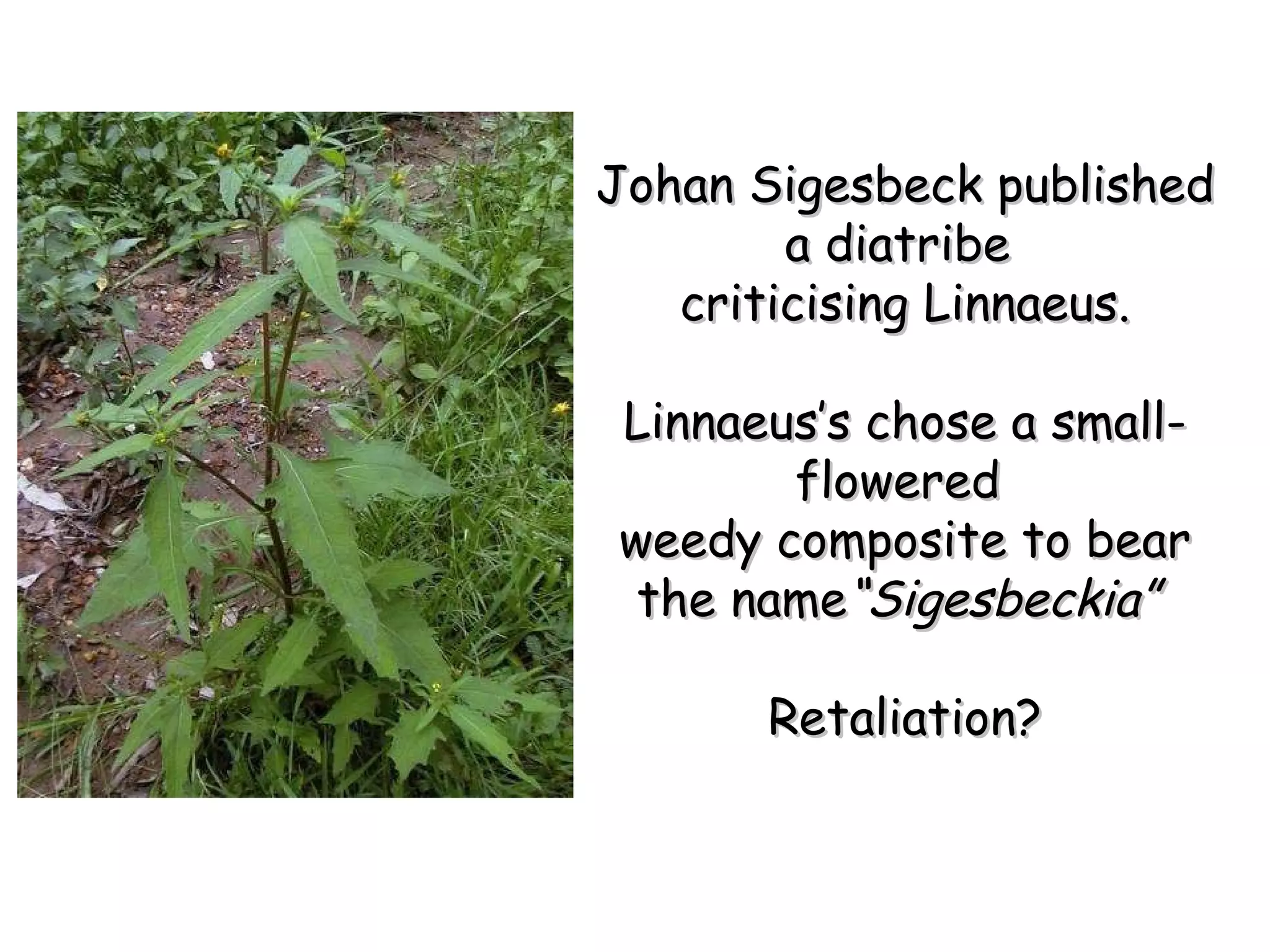
Johan Sigesbeck published a diatribe  criticising Linnaeus. Linnaeus’s chose a small-flowered  weedy composite to bear the name “Sigesbeckia”   Retaliation?
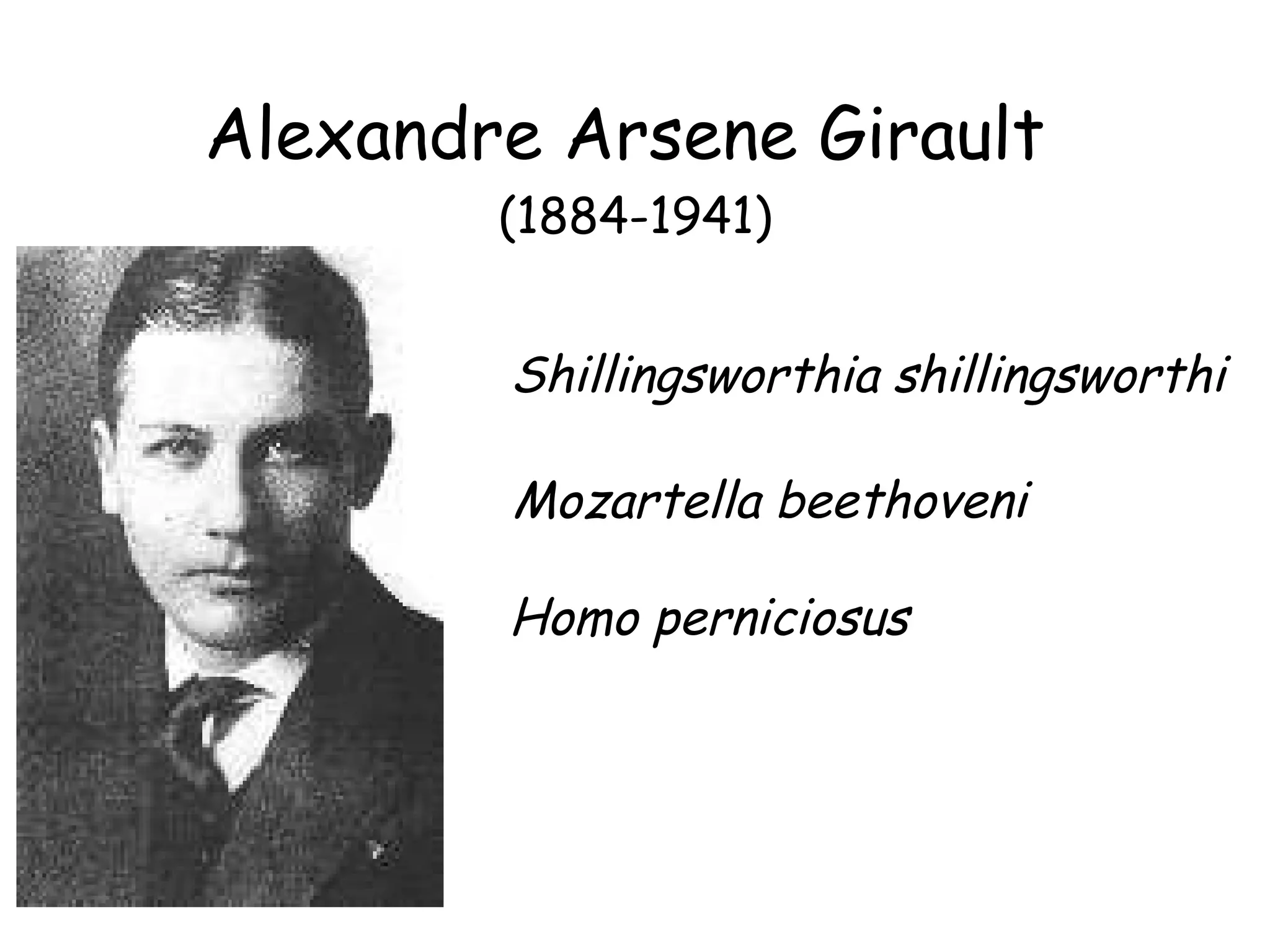
Alexandre Arsene Girault  (1884-1941) Shillingsworthia shillingsworthi Mozartella beethoveni Homo perniciosus
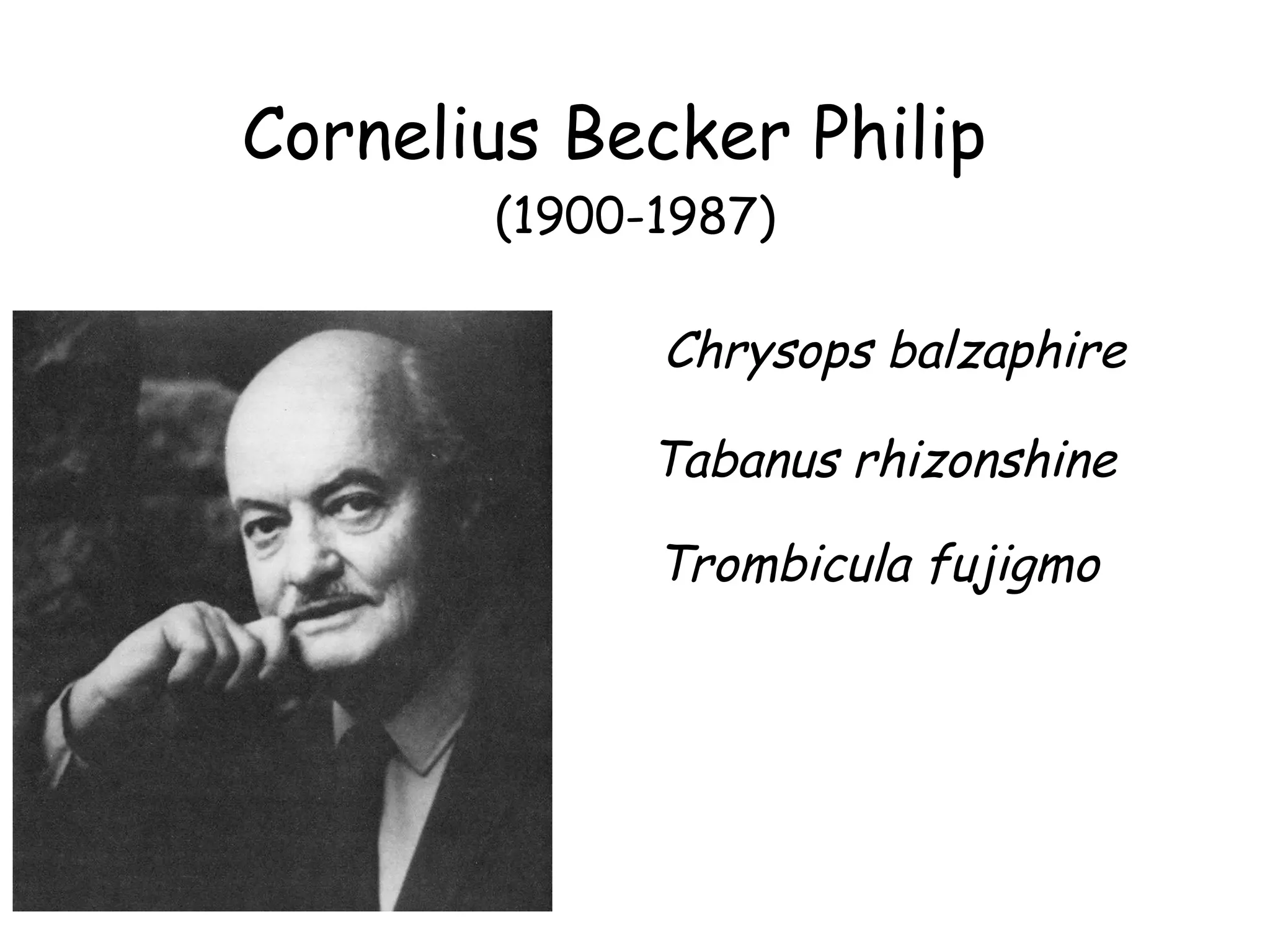
Cornelius Becker Philip  (1900-1987) Chrysops balzaphire Tabanus rhizonshine Trombicula fujigmo
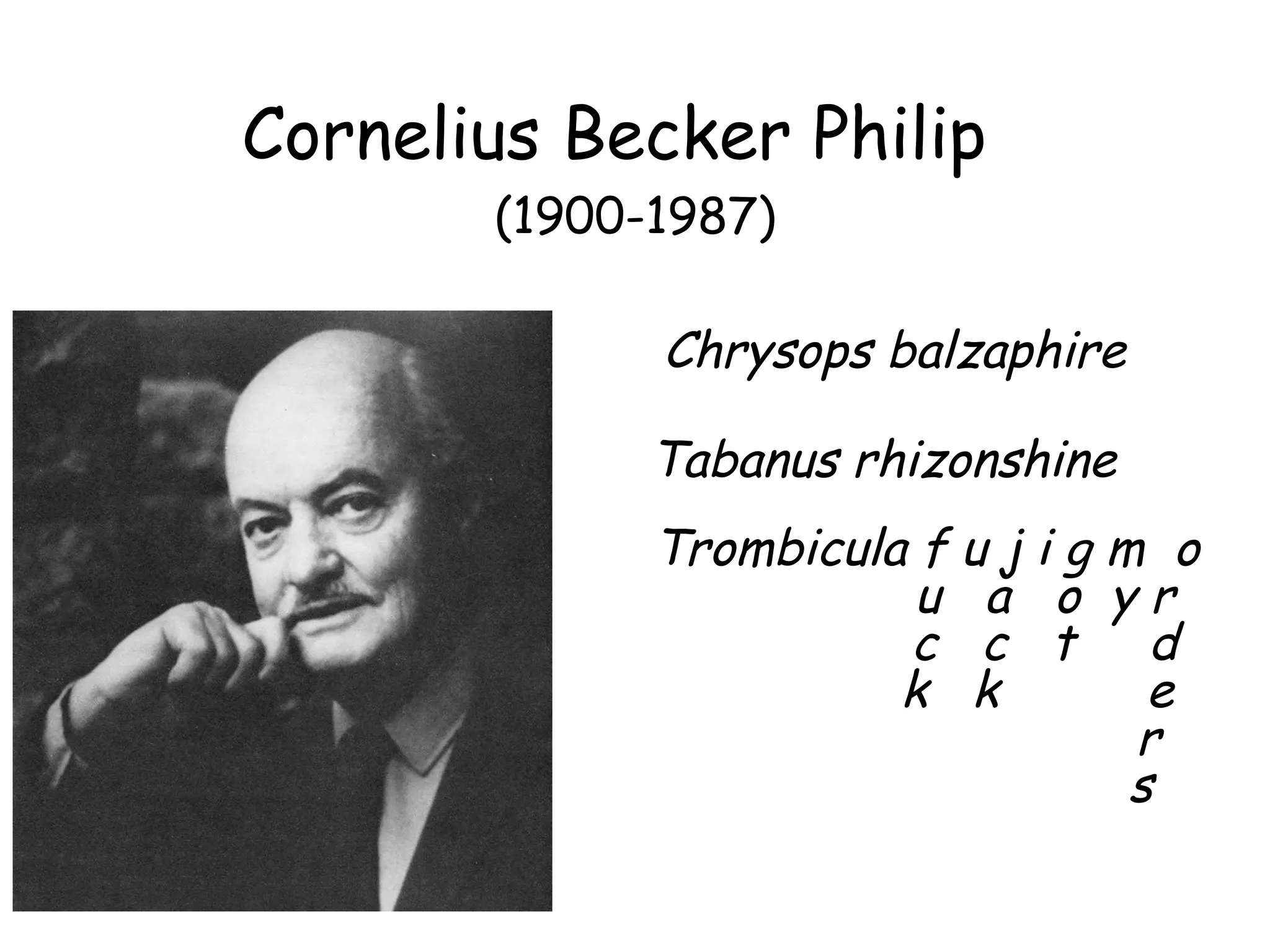
Cornelius Becker Philip  (1900-1987) Chrysops balzaphire Tabanus rhizonshine Trombicula f u j i g m  o u  a  o  y r  c  c  t  d k  k  e r s
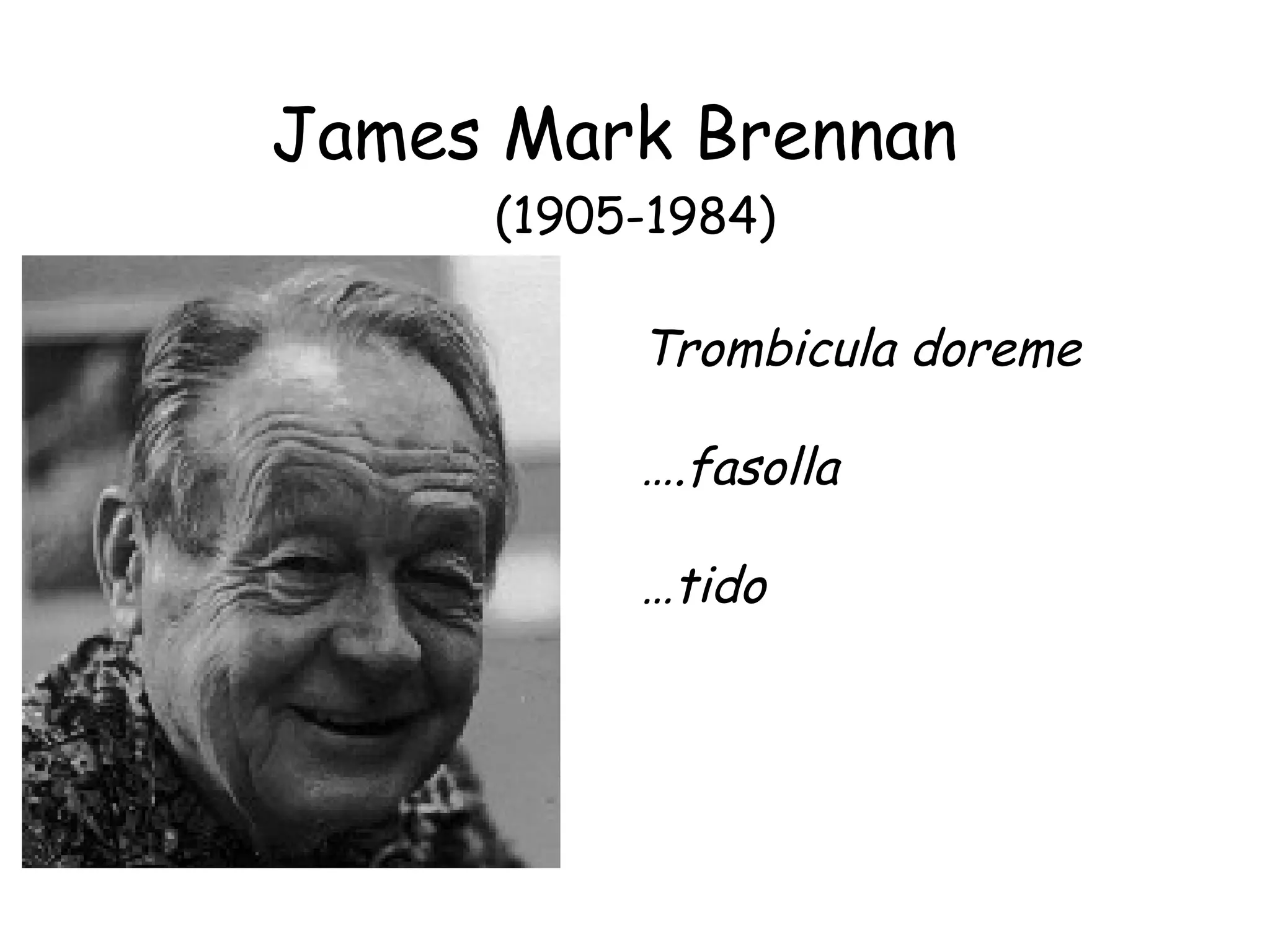
James Mark Brennan  (1905-1984) Trombicula doreme … .fasolla … tido
Orsonwelles  Hormiga (a fat spider) Pinocchio  Pagliano & Scaramozzino (a wasp) Lucifer  Doderlein (a fish) Satan  Hubbs & Bailey (a catfish)
Abra cadabra  Eames & Wilkins (a bivalve) Agra phobia  Irwin (a beetle) Ohmyia omya  Thompson (a fly)
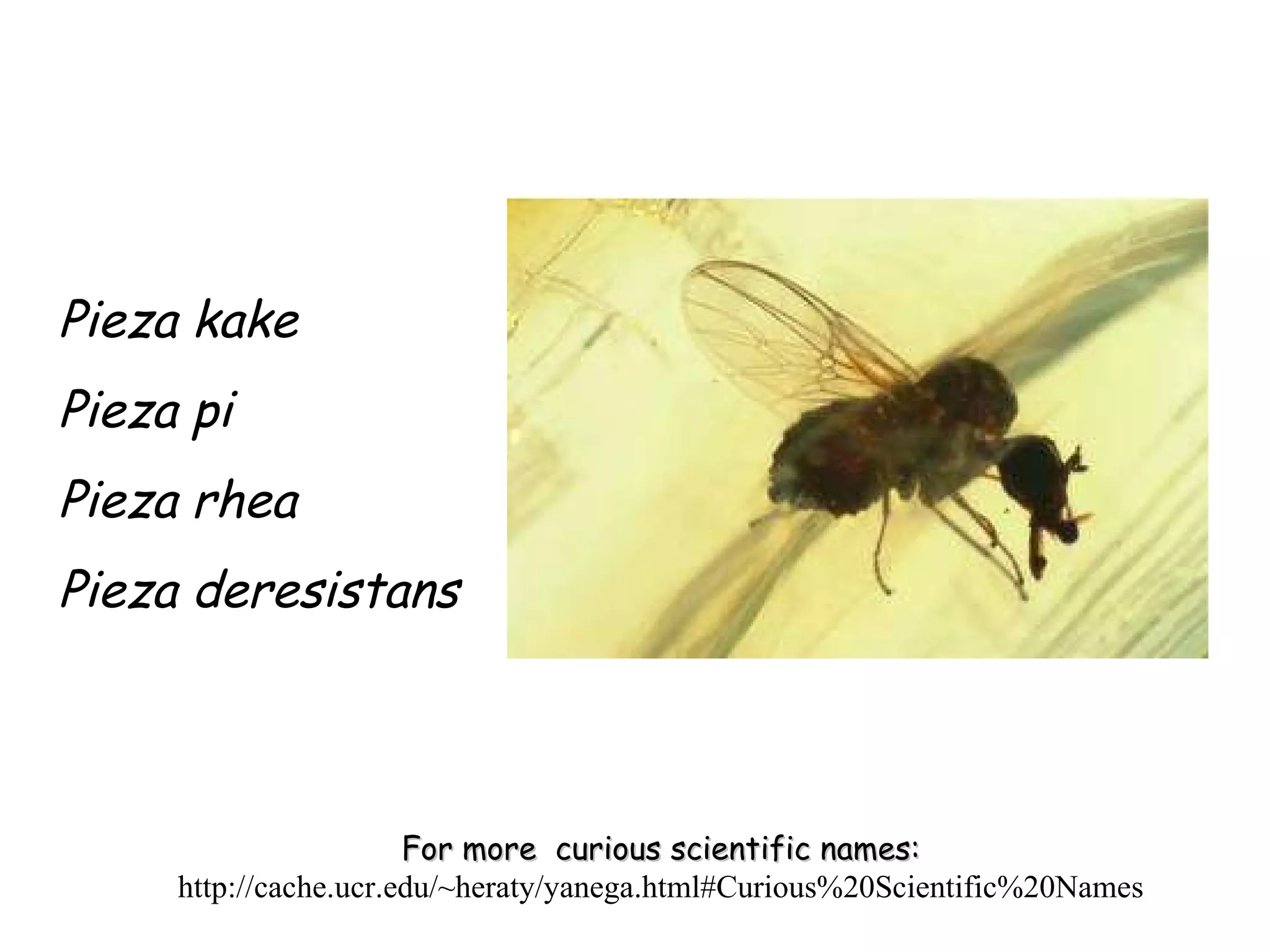
Pieza kake Pieza pi Pieza rhea Pieza deresistans For more  curious scientific names:  http://cache.ucr.edu/~heraty/yanega.html#Curious%20Scientific%20Names
Record Setters Longest Genus Name Gammaracanthuskytodermogammarus  Dybowski (an amphipod) Longest Genus and Species Name Brachyta interrogationis interrogationis   var.  nigrohumeralisscutellohumeroconjuncta  Plavilstshikov  (a cerambycid beetle) Shortest Genus and Species Combination Ia io  Thomas (a bat)
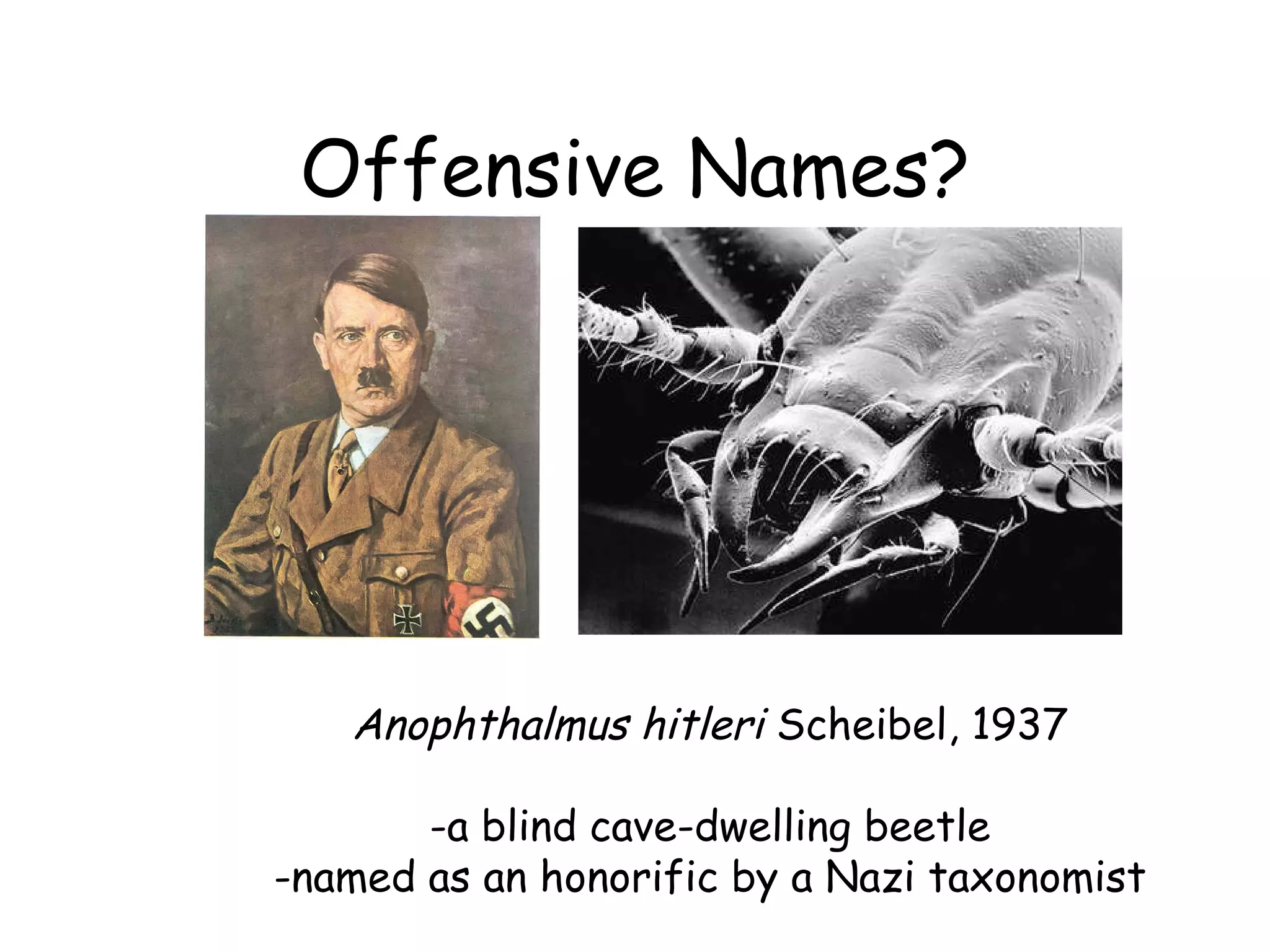
Offensive Names? Anophthalmus hitleri  Scheibel, 1937 a blind cave-dwelling beetle named as an honorific by a Nazi taxonomist
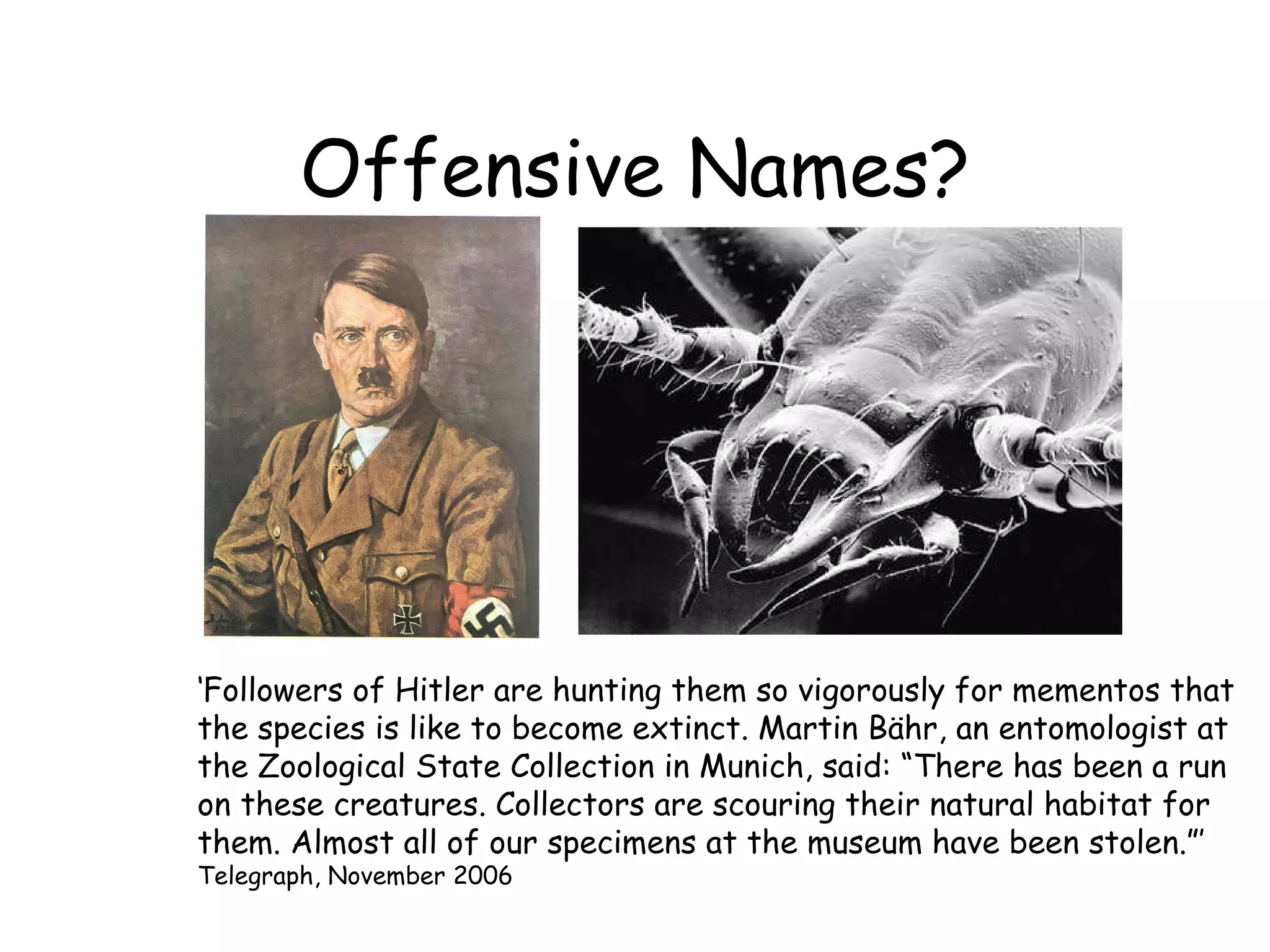
Offensive Names? ‘ Followers of Hitler are hunting them so vigorously for mementos that the species is like to become extinct. Martin Bähr, an entomologist at the Zoological State Collection in Munich, said: “There has been a run on these creatures. Collectors are scouring their natural habitat for them. Almost all of our specimens at the museum have been stolen.”’ Telegraph, November 2006
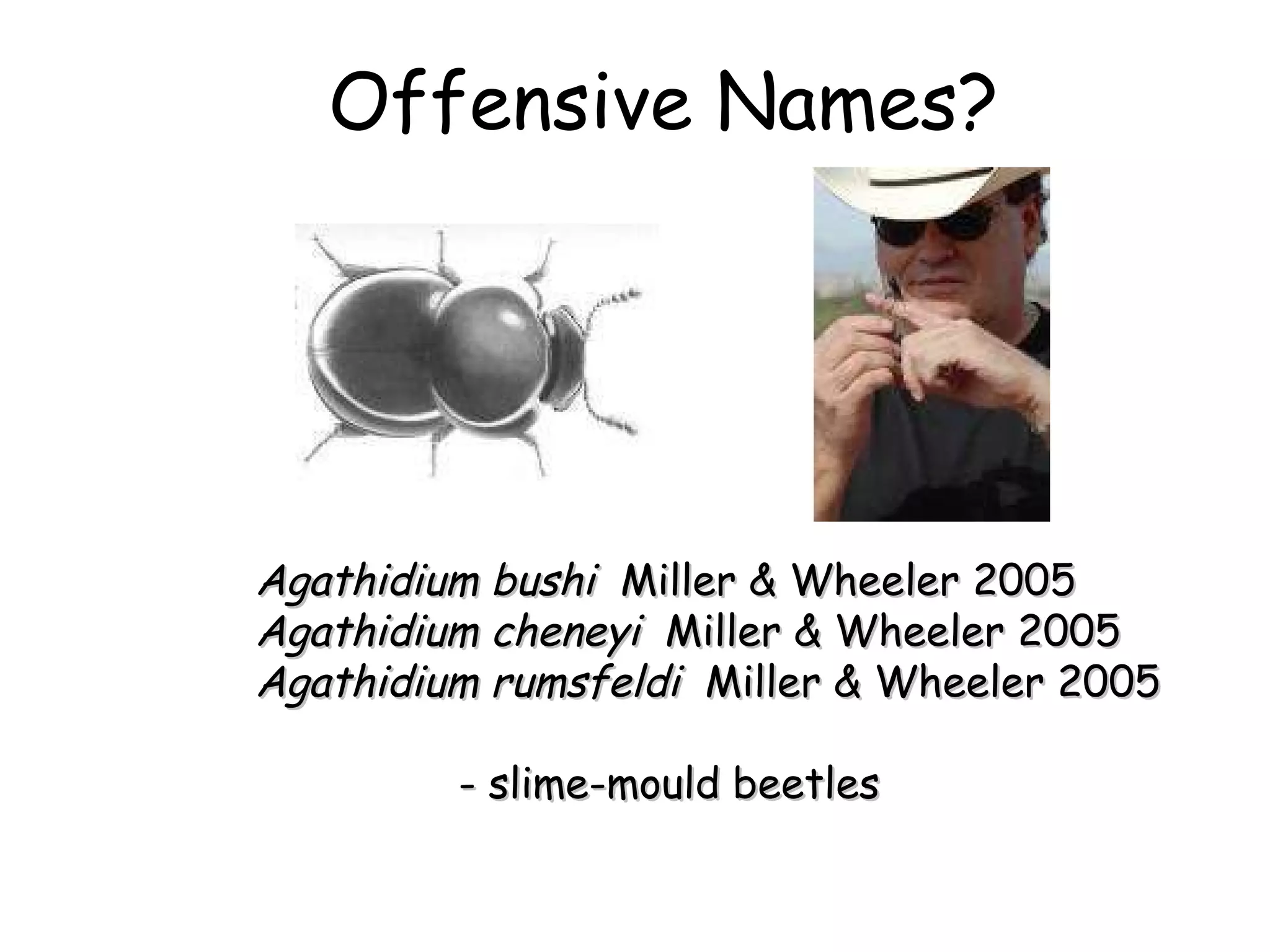
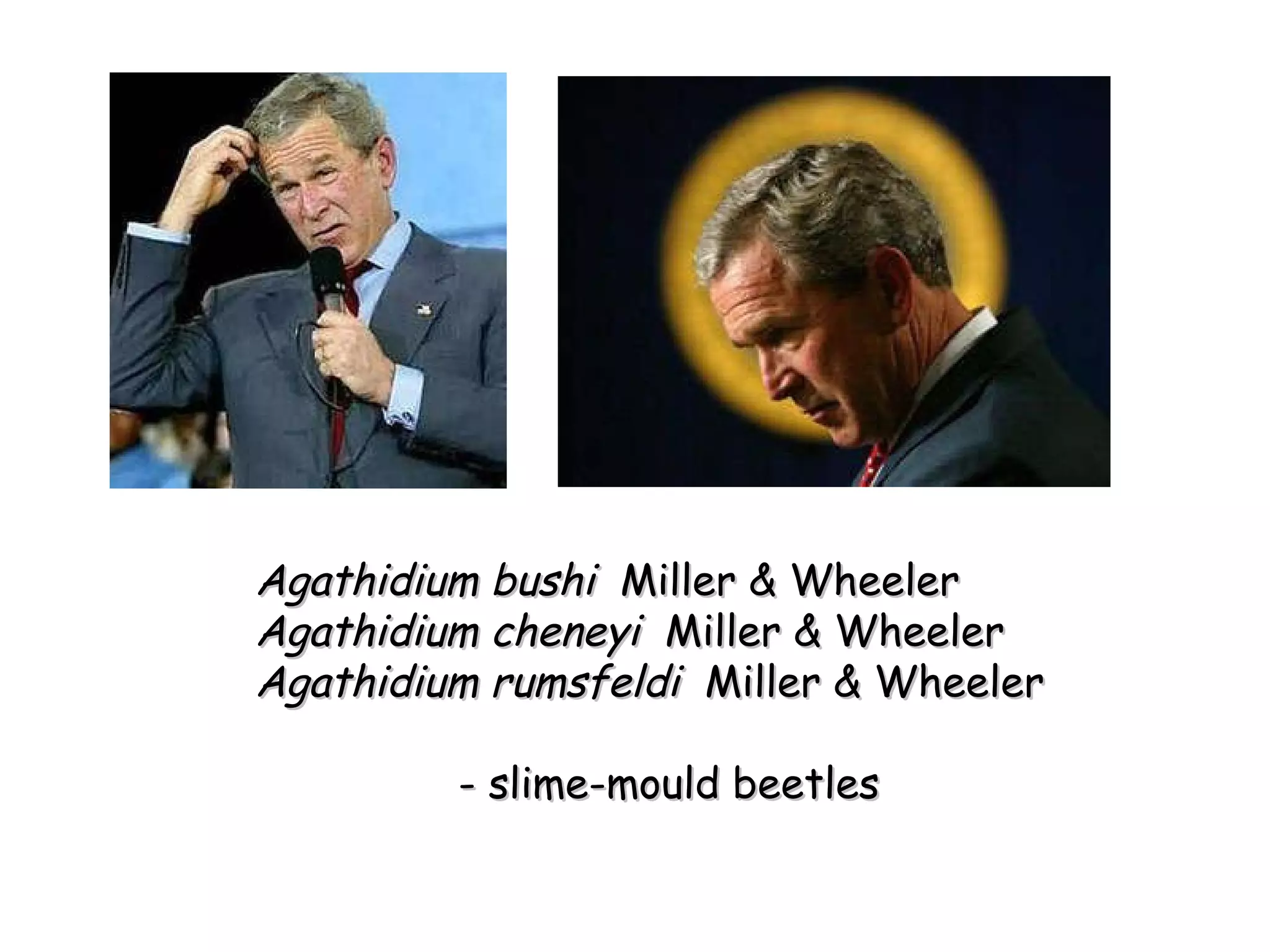
Offensive Names? Agathidium bushi  Miller & Wheeler 2005 Agathidium cheneyi  Miller & Wheeler 2005 Agathidium rumsfeldi  Miller & Wheeler 2005 - slime-mould beetles
Agathidium bushi  Miller & Wheeler Agathidium cheneyi  Miller & Wheeler Agathidium rumsfeldi  Miller & Wheeler - slime-mould beetles
Criteria of Publication Criteria of Availability Principle of Priority Principle of Coordination Principle of Homonymy Principle of Typification Zoological Code: Criteria & Principles


Criteria of Publication Criteria of Availability Principle of Priority Principle of Coordination Principle of Homonymy Principle of Typification Zoological Code: Criteria & Principles
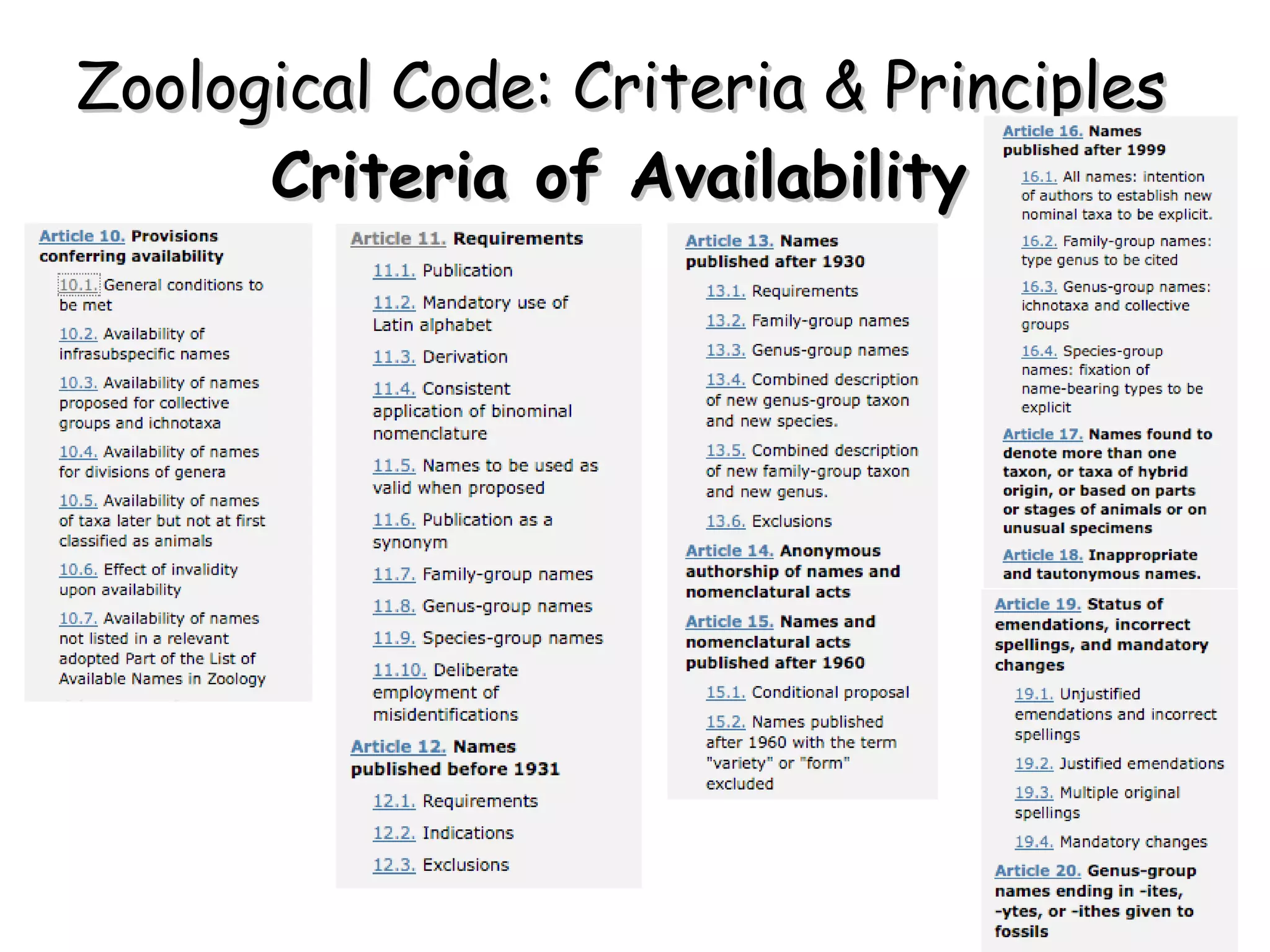
Criteria of Availability Zoological Code: Criteria & Principles
Criteria of Publication Criteria of Availability Principle of Priority Principle of Coordination Principle of Homonymy Principle of Typification Zoological Code: Criteria & Principles
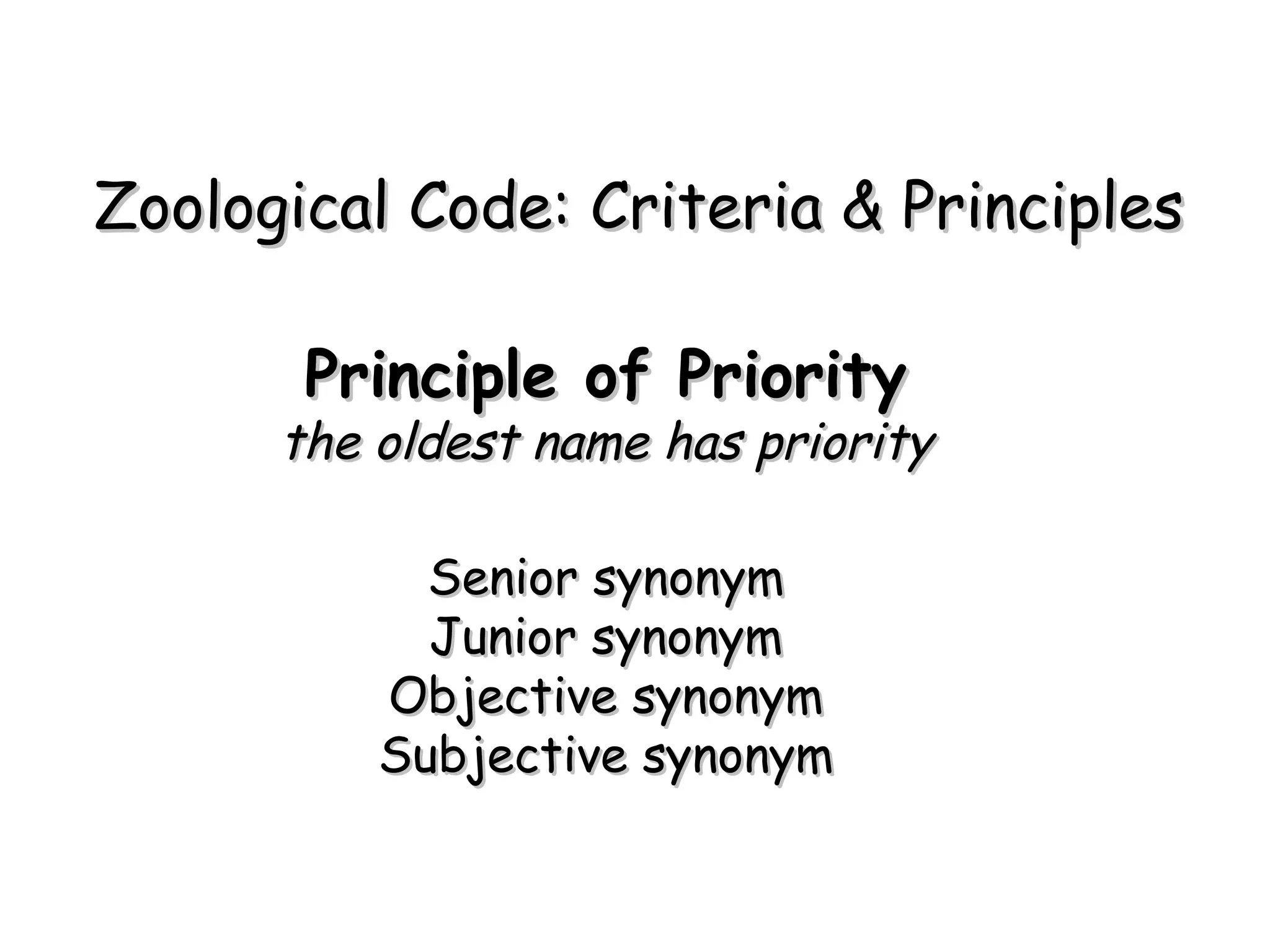
Principle of Priority the oldest name has priority Senior synonym Junior synonym Objective synonym Subjective synonym Zoological Code: Criteria & Principles
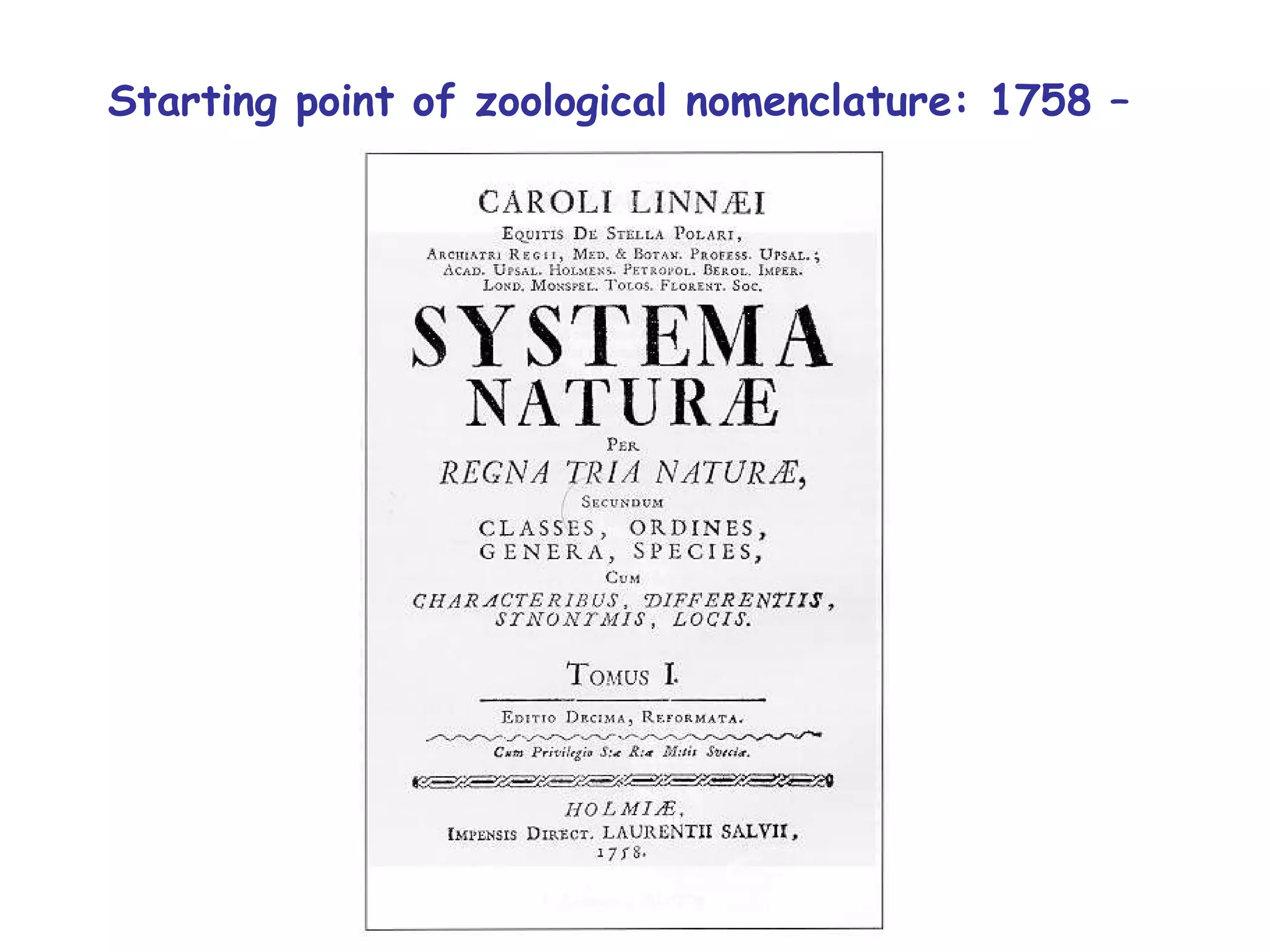
Starting point of zoological nomenclature: 1758 –
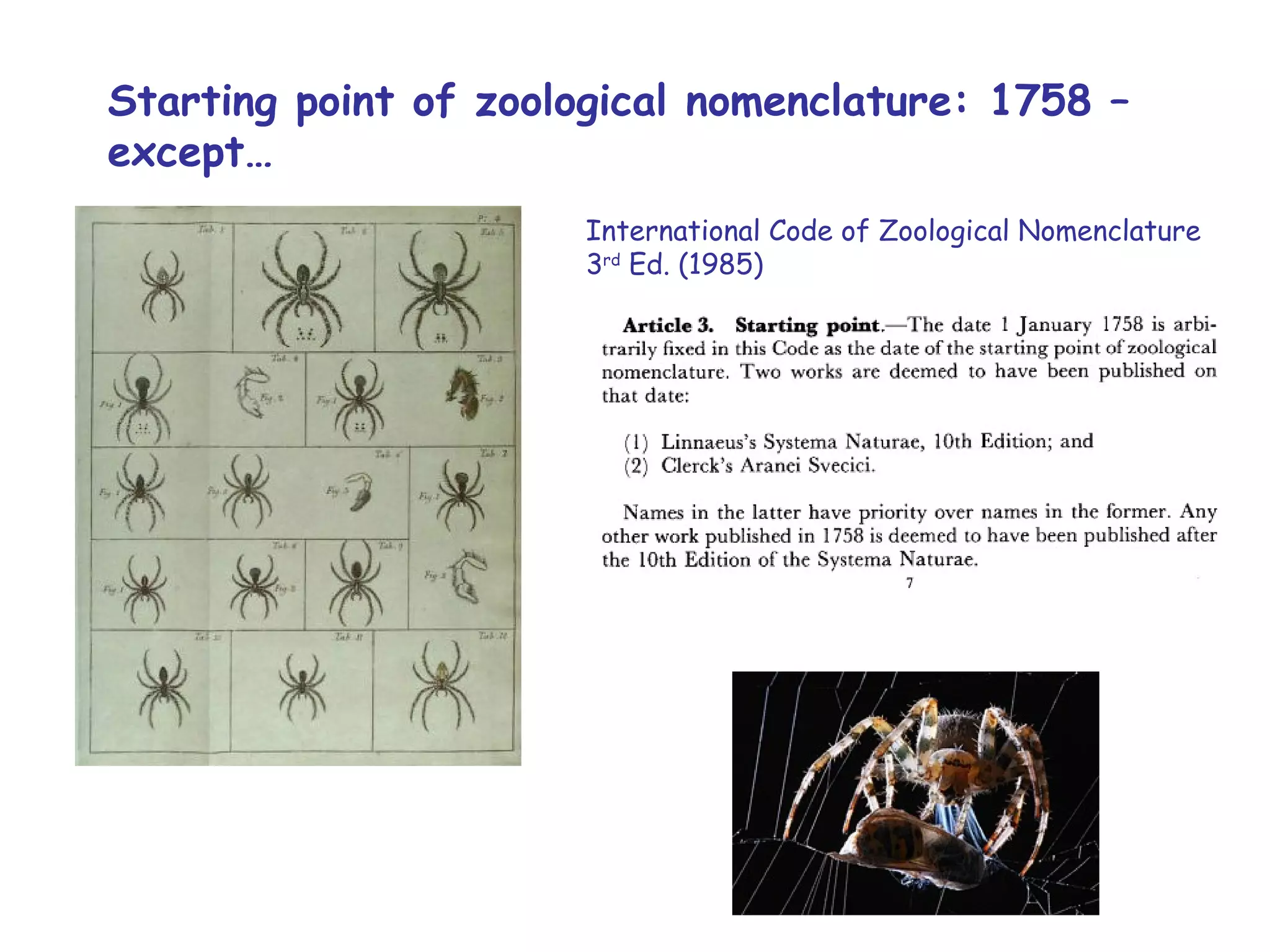
International Code of Zoological Nomenclature 3 rd  Ed. (1985) Starting point of zoological nomenclature: 1758 – except…
Principle of Priority Principle of the First Reviser If two or more items have the same date of publication, the first subsequent author who deals with the matter, makes a choice and publishes the decision in the required manner, the First Reviser, is to be followed. [Art. 24.2]. Zoological Code: Criteria & Principles
Criteria of Publication Criteria of Availability Principle of Priority Principle of Coordination Principle of Homonymy Principle of Typification Zoological Code: Criteria & Principles
Principle of Coordination the act of publishing a new zoological name thereby automatically and simultaneously establishes all the corresponding names in the relevant other ranks, with the same type Zoological Code: Criteria & Principles
Challenges in the present Code: Principle of Typification DEAD or ALIVE?
Principle of Typification Article 16.4.2:  authors of new taxa must publish a statement of intent that extant types will be deposited in a collection Article 73.1.4 “Designation of an illustration of a single specimen as a holotype is to be treated as designation of the specimen illustrated; the fact that the specimen no longer exists or cannot be traced does not of itself invalidate the designation.” Challenges in the present Code:
Principle of Typification The Article, as formulated, thereby permits the description of threatened animals or those for whom the collection of specimens is otherwise impractical, impossible, or unethical. Challenges in the present Code:
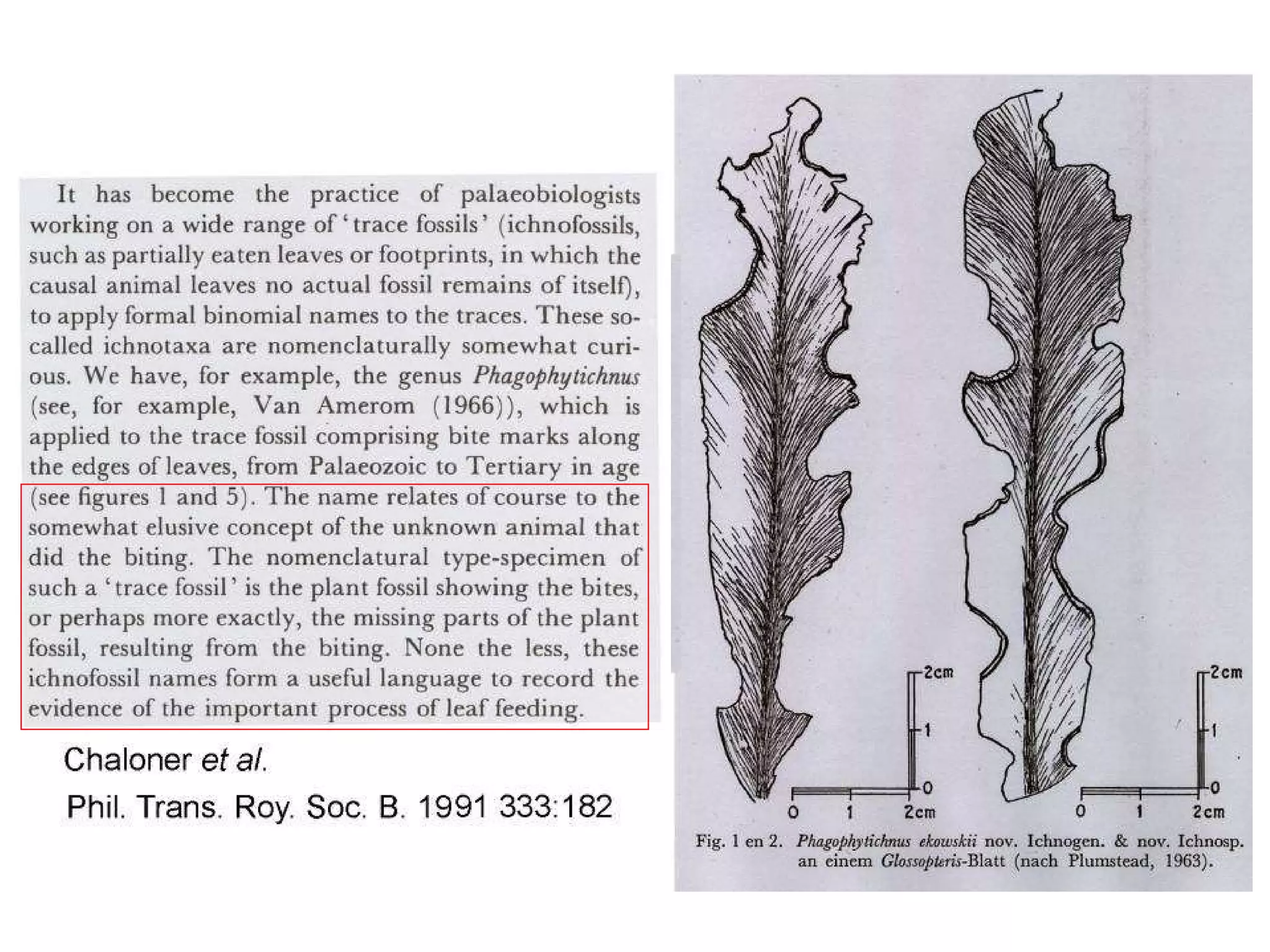
Ichnotaxa Challenges in the present Code:
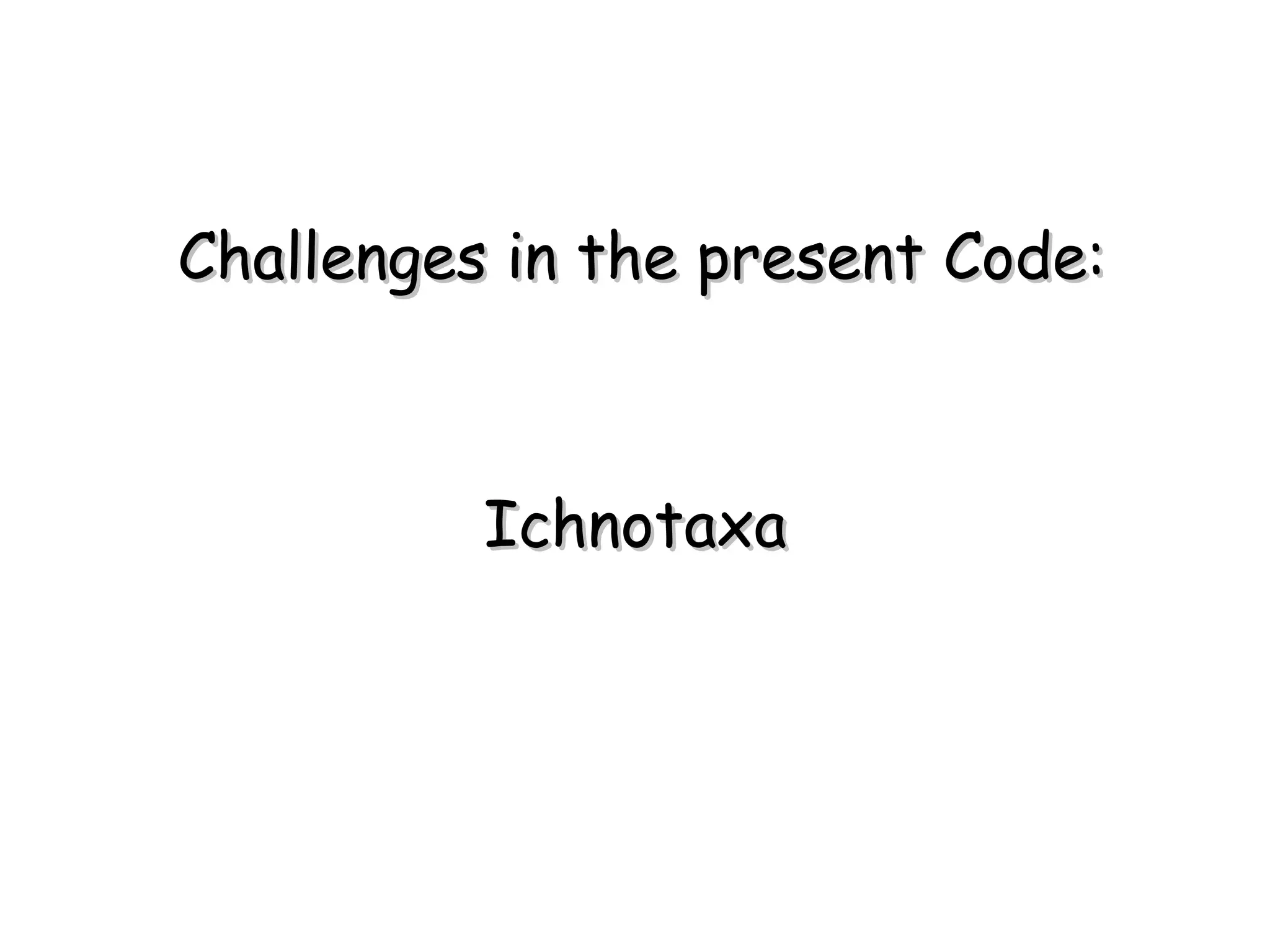
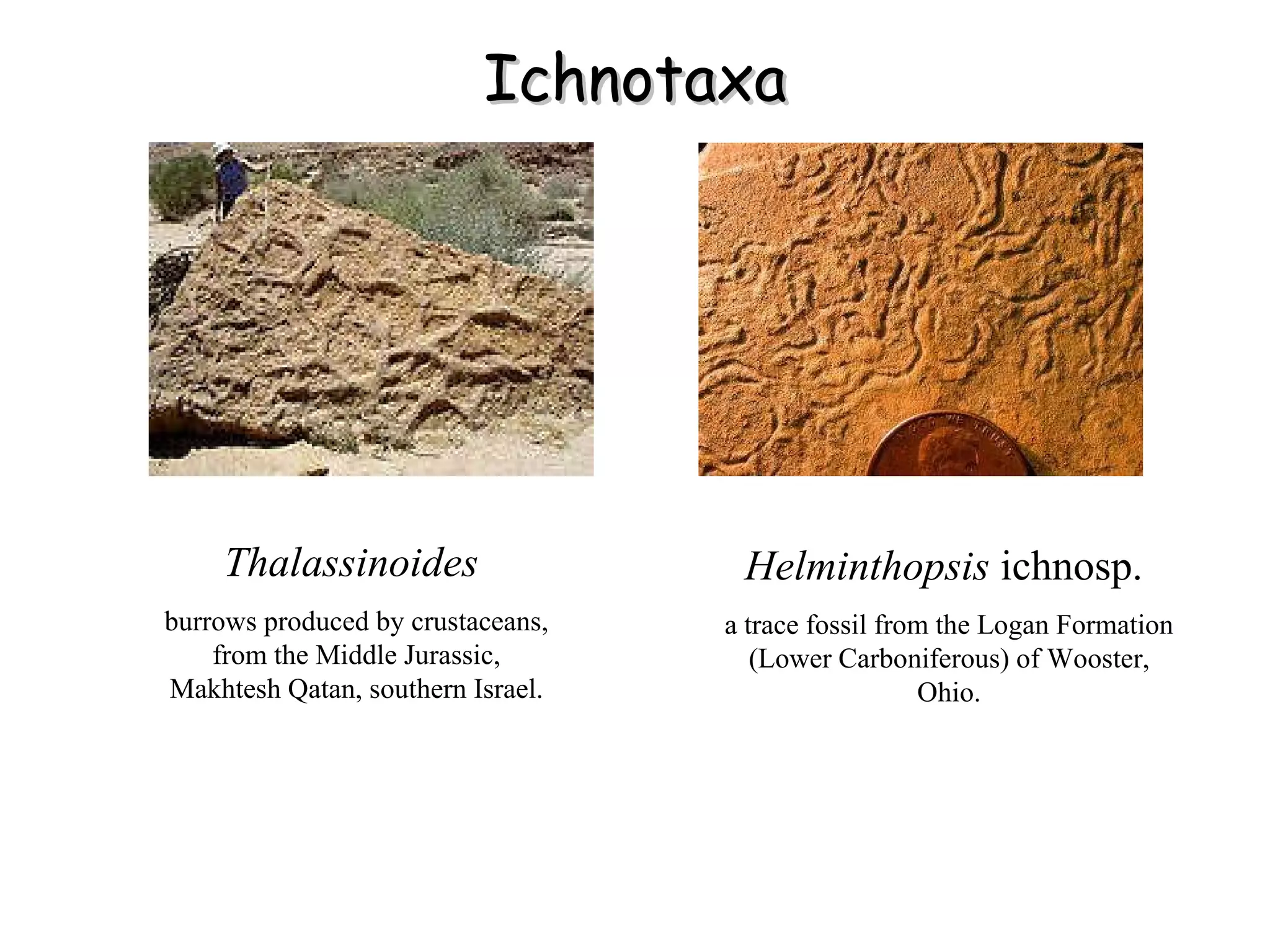
Thalassinoides   burrows produced by crustaceans, from the Middle Jurassic, Makhtesh Qatan, southern Israel. Helminthopsis  ichnosp.  a trace fossil from the Logan Formation (Lower Carboniferous) of Wooster, Ohio. Ichnotaxa
 
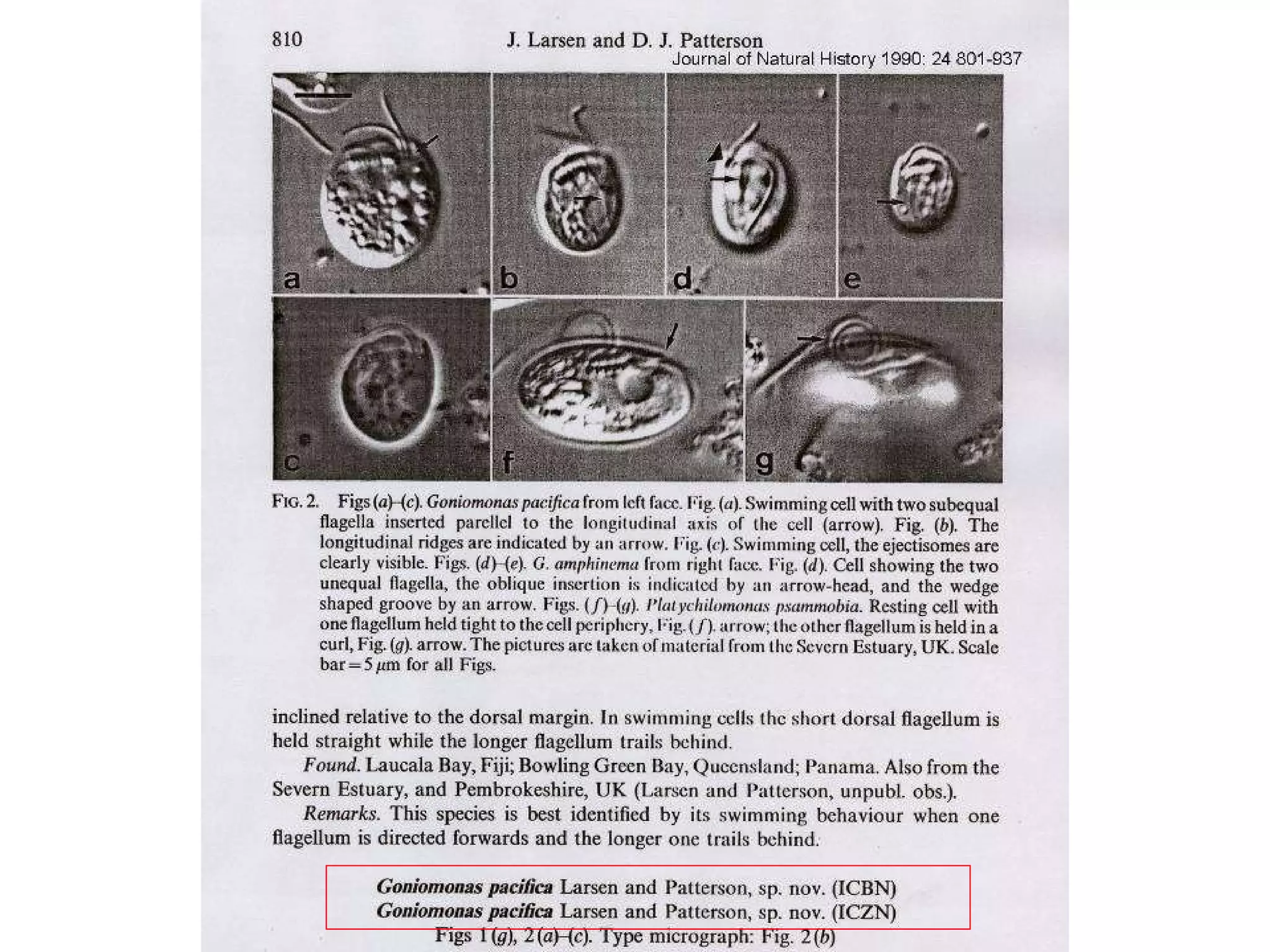
Ambiregnal organisms photosynthesizing = plant non-photosynthesizing = animal Challenges in the present Code:
 
 
Ambiregnal organisms (+ Principle of Typification) Challenges in the present Code:
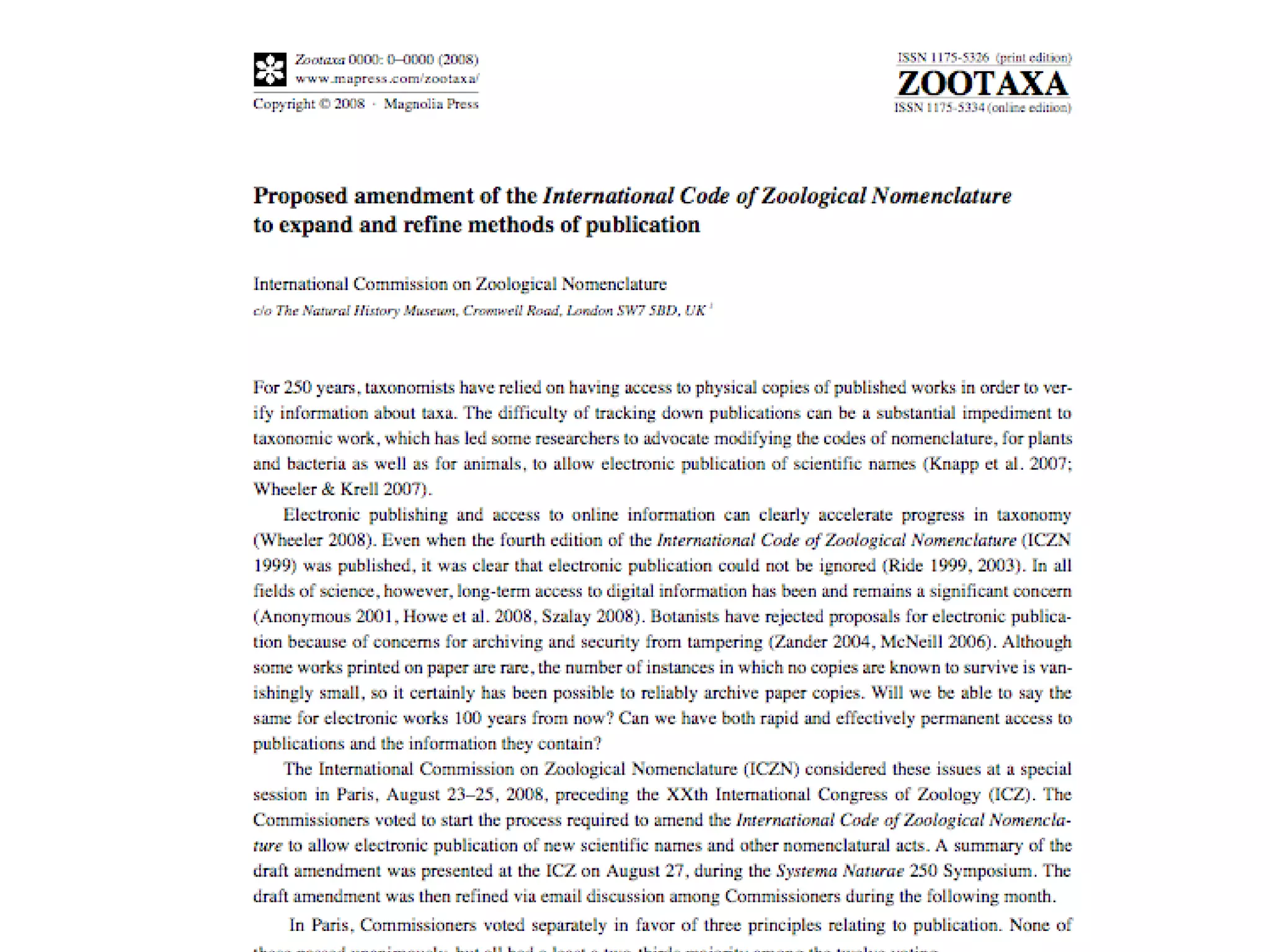
Criteria of publication electronic-only publication Challenges in the present Code:
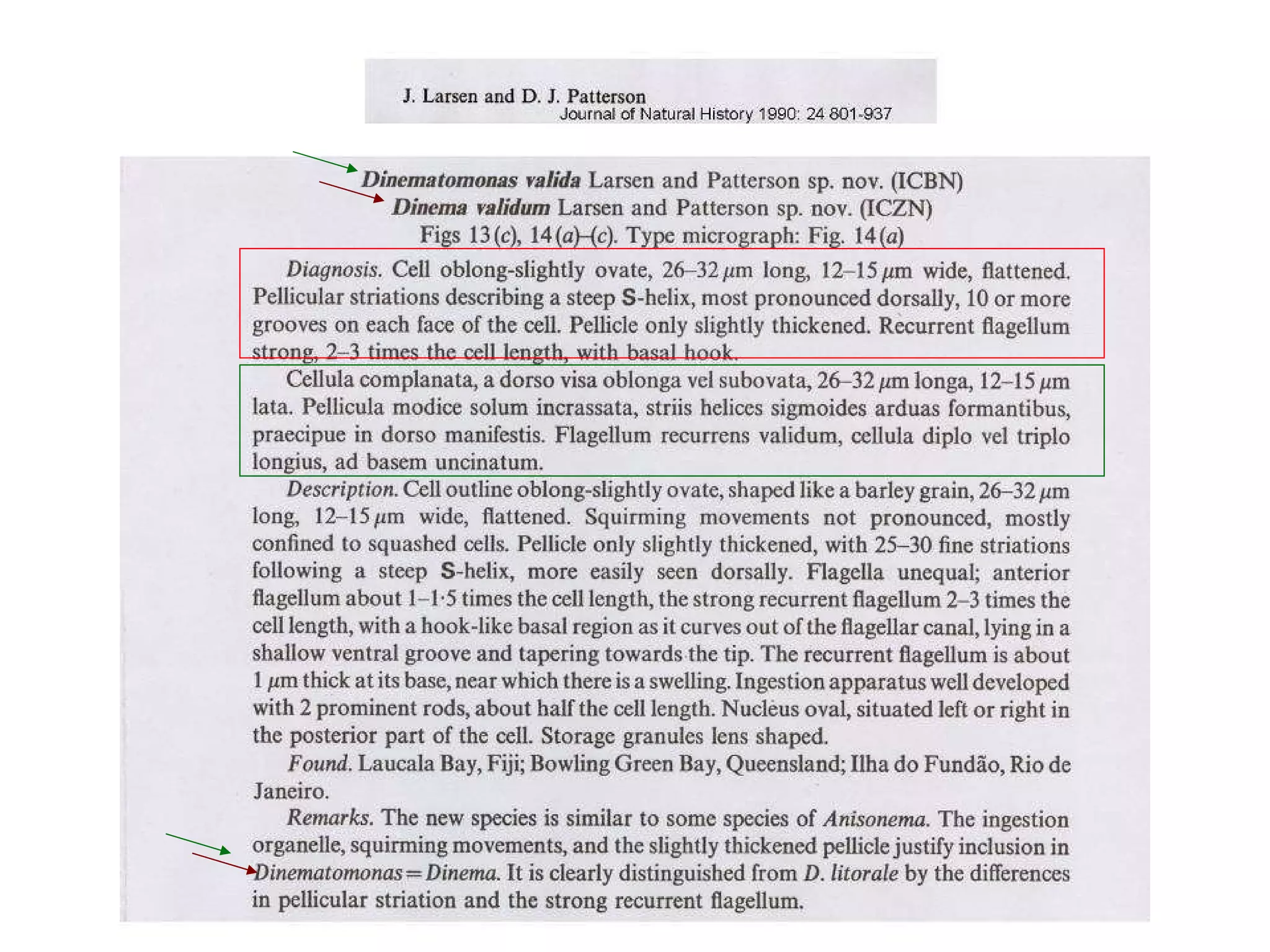
Other problems with the present Code: Alternative Languages
The Code is an evolving document New edition under construction now  for publication in 2012  (ah, right, lets get busy!)
Homonyms & Synonyms Article 53.2.  Homonyms in the genus group. In the genus group, two or more available names established with the same spelling are homonyms. Article 60.2.  Junior homonyms with synonyms. If the rejected junior homonym has one or more available and potentially valid synonyms, the oldest of these becomes the valid name of the taxon with its own authorship and date.
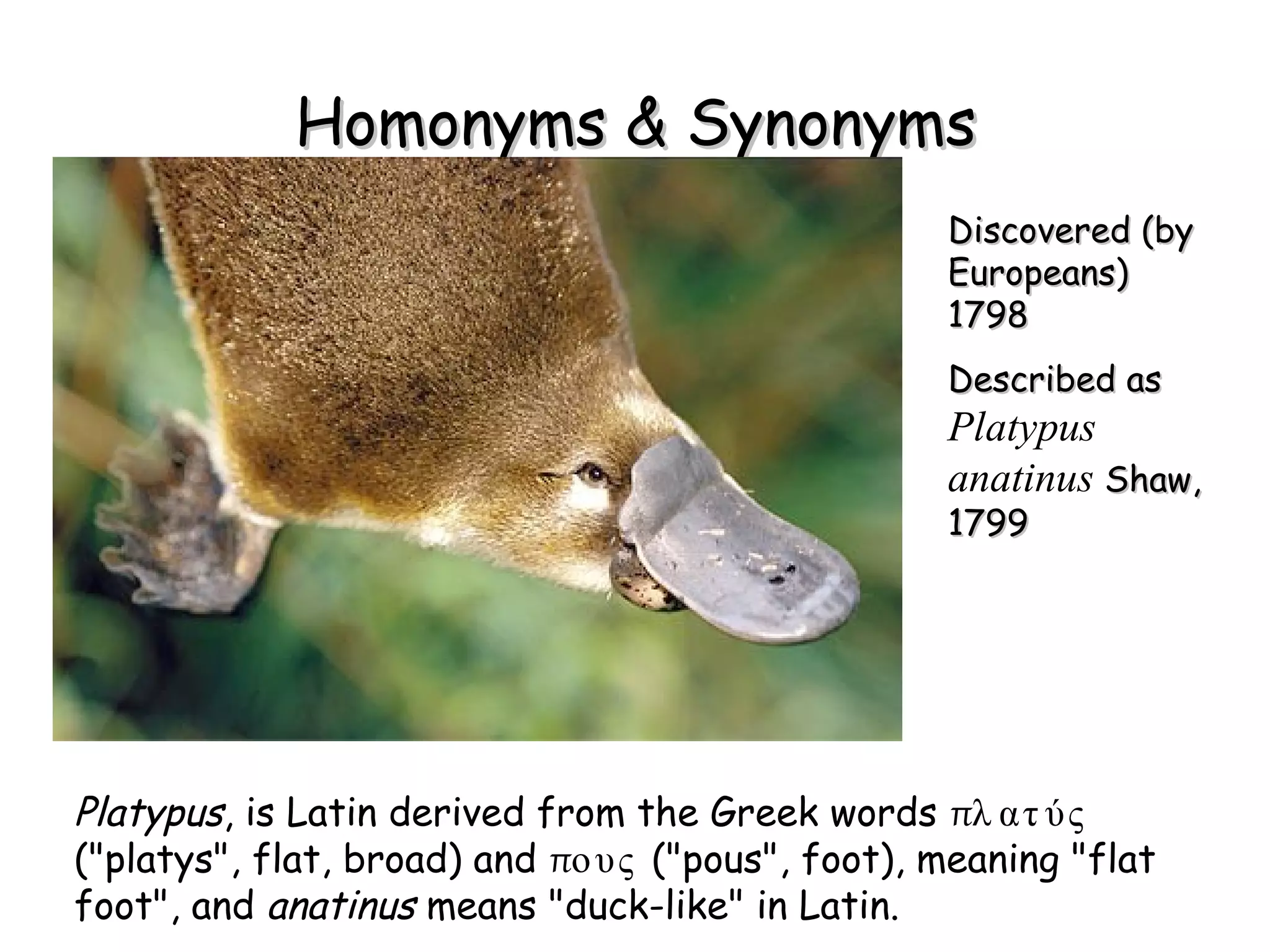
Homonyms & Synonyms Discovered (by Europeans) 1798 Described as  Platypus   anatinus   Shaw, 1799  Platypus , is Latin derived from the Greek words  π λατύς  ("platys", flat, broad) and  π ους  ("pous", foot), meaning "flat foot", and  anatinus  means "duck-like" in Latin.
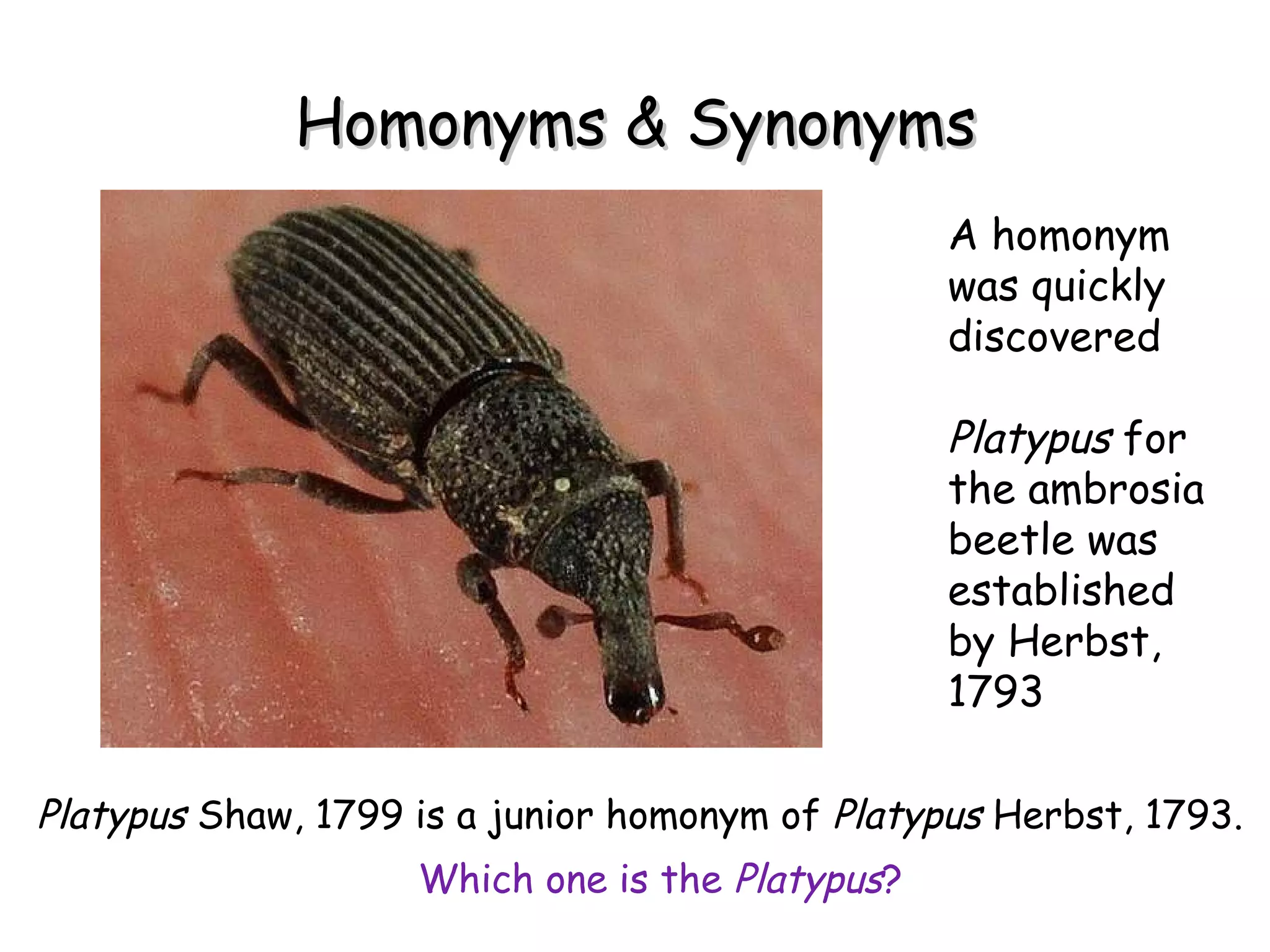
Homonyms & Synonyms A homonym was quickly discovered Platypus  for the ambrosia beetle was established by Herbst, 1793 Platypus  Shaw, 1799 is a junior homonym of  Platypus  Herbst, 1793. Which one is the  Platypus ?
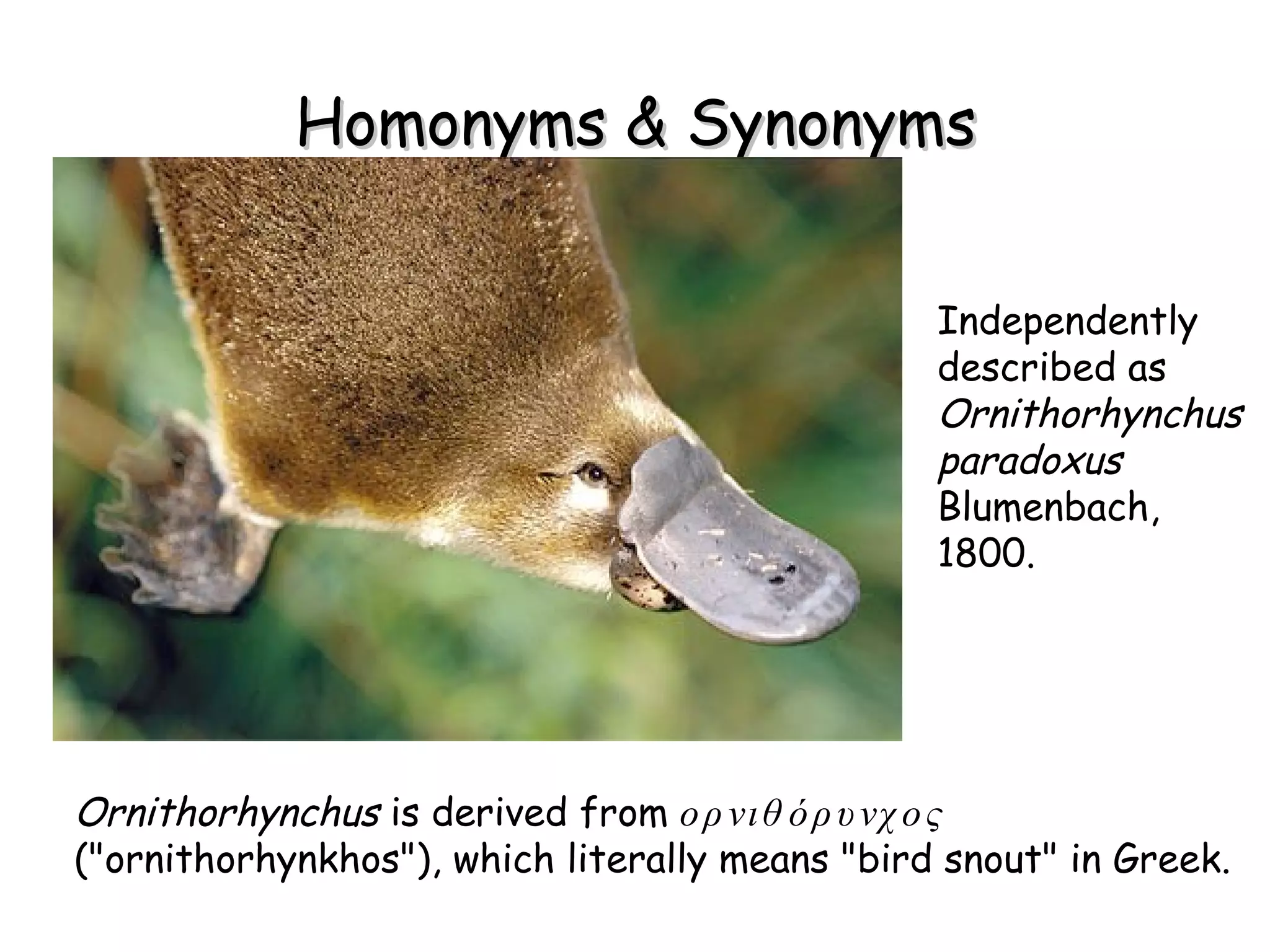
Homonyms & Synonyms Independently described as  Ornithorhynchus paradoxus  Blumenbach, 1800.  Ornithorhynchus  is derived from  ορνιθόρυνχος  ("ornithorhynkhos"), which literally means "bird snout" in Greek.
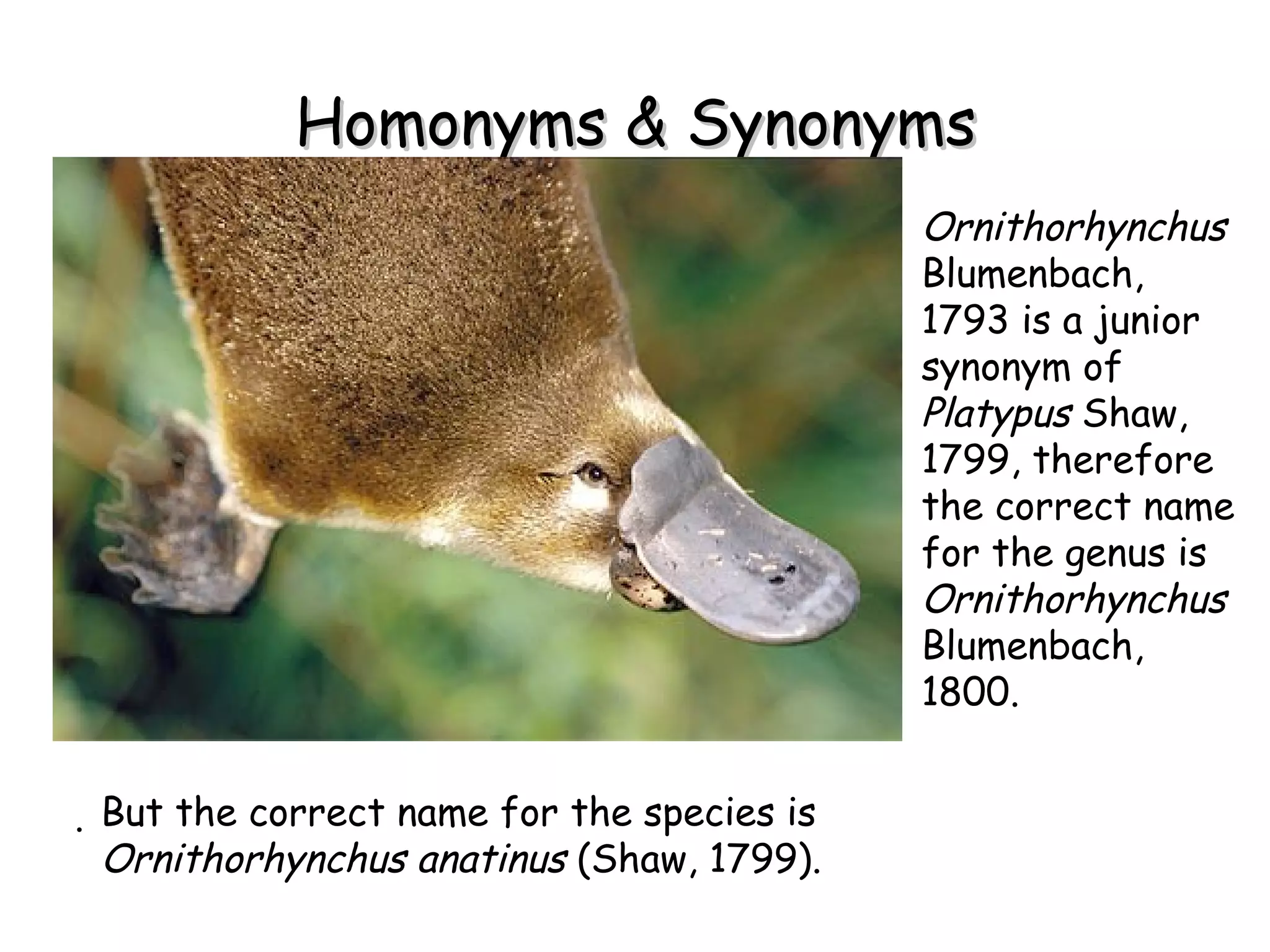
Homonyms & Synonyms Ornithorhynchus  Blumenbach, 1793 is a junior synonym of  Platypus  Shaw, 1799, therefore the correct name for the genus is  Ornithorhynchus  Blumenbach, 1800. . But the correct name for the species is  Ornithorhynchus anatinus  (Shaw, 1799).
Homonyms & Synonyms Article 53.2.  Homonyms in the genus group. In the genus group, two or more available names established with the same spelling are homonyms. Platypus  Shaw, 1799 is a junior homonym of  Platypus  Herbst, 1793, so is rejected. Article 60.2.  Junior homonyms with synonyms. If the rejected junior homonym has one or more available and potentially valid synonyms, the oldest of these becomes the valid name of the taxon with its own authorship and date. Ornithorhynchus  Blumenbach, 1800 is a junior synonym of  Platypus  Shaw, 1799, so steps in to fill the gap.  (and the species name from Shaw, 1799, stays alive)
Homonyms Article 52.1. Statement of the Principle of Homonymy:   When two or more taxa are distinguished from each other they must not be denoted by the same name. Article 52.2. Operation of the Principle of Homonymy.  When two or more names are homonyms, only the senior, as determined by the Principle of Priority  may be used as a valid name.
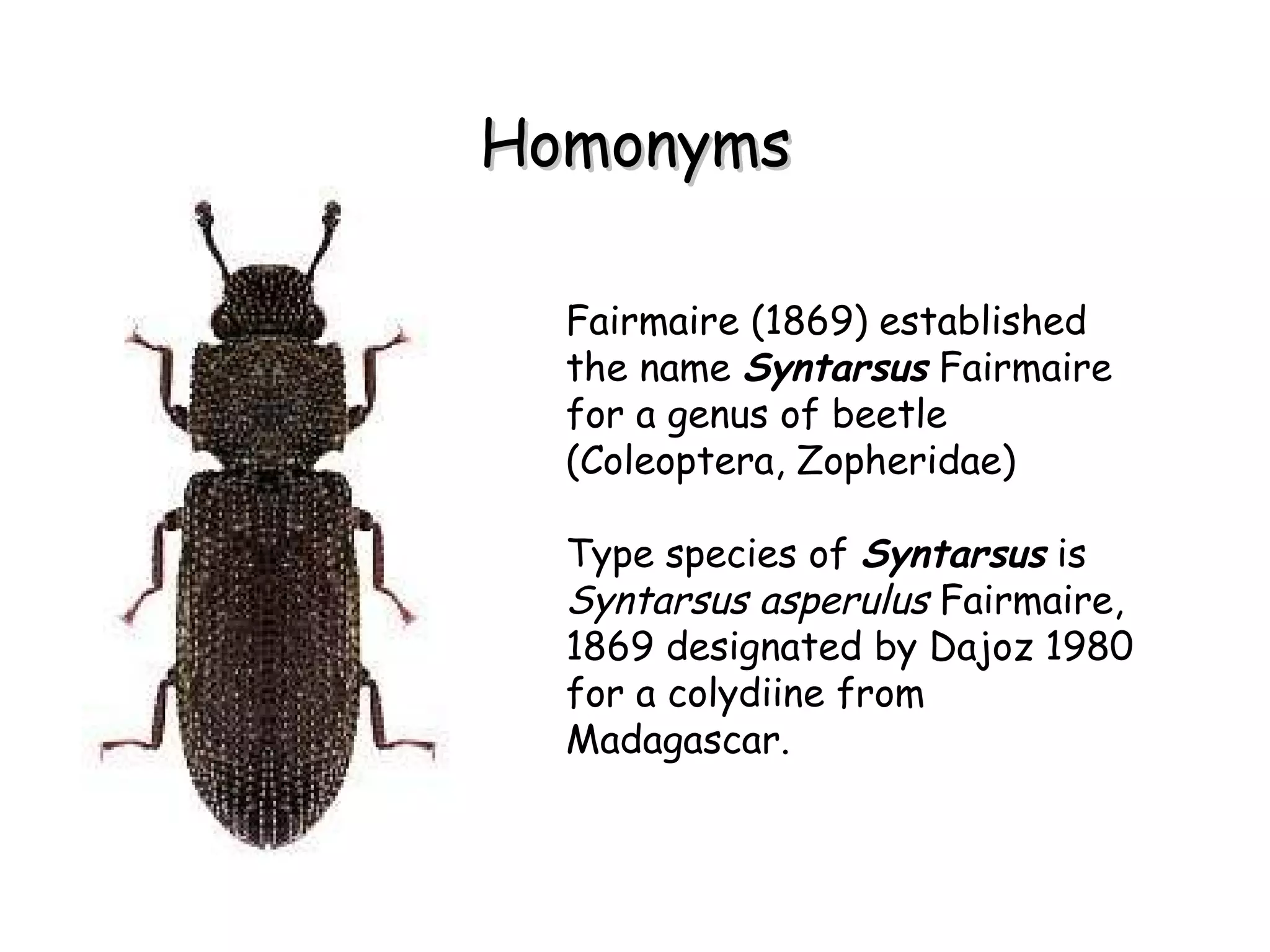
Homonyms Fairmaire (1869) established the name  Syntarsus  Fairmaire for a genus of beetle (Coleoptera, Zopheridae) Type species of  Syntarsus  is  Syntarsus asperulus  Fairmaire, 1869 designated by Dajoz 1980 for a colydiine from Madagascar.
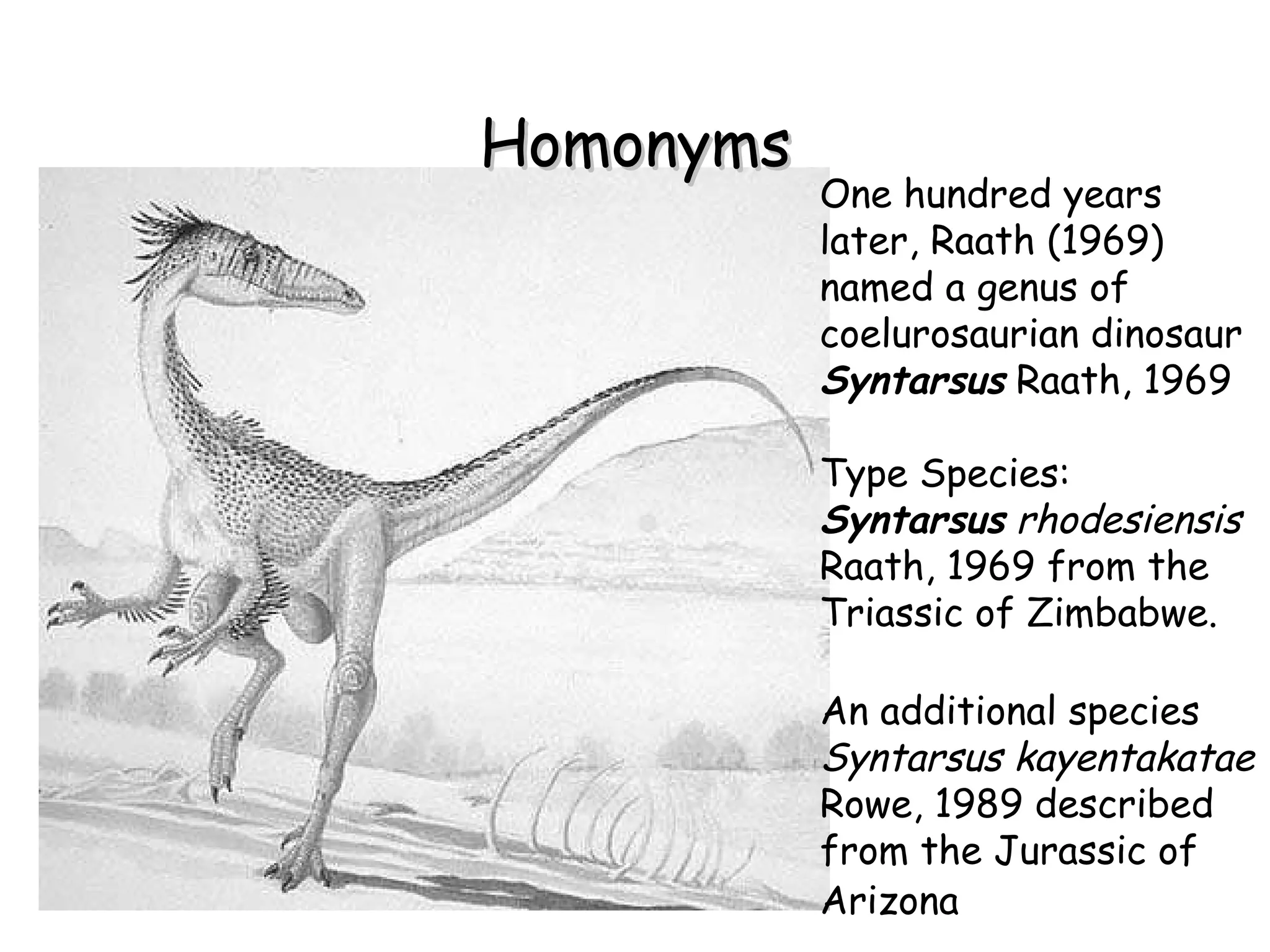
Homonyms One hundred years later, Raath (1969) named a genus of coelurosaurian dinosaur  Syntarsus  Raath, 1969 Type Species:  Syntarsus   rhodesiensis  Raath, 1969 from the Triassic of Zimbabwe.  An additional species  Syntarsus kayentakatae  Rowe, 1989 described from the Jurassic of Arizona
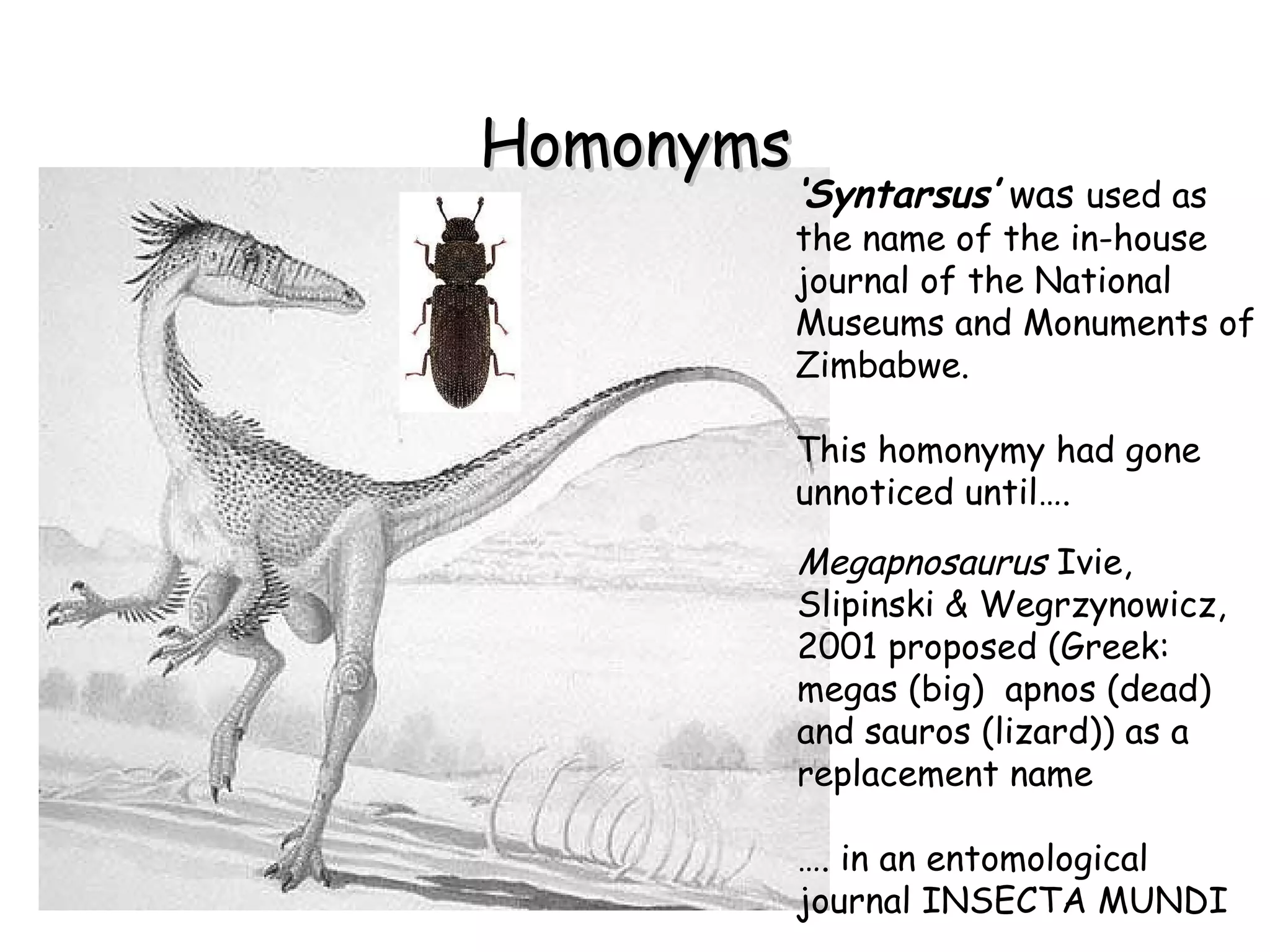
Homonyms ‘ Syntarsus’  was  used as the name of the in-house journal of the National Museums and Monuments of Zimbabwe. This homonymy had gone unnoticed until…. Megapnosaurus  Ivie, Slipinski & Wegrzynowicz, 2001 proposed (Greek: megas (big)  apnos (dead) and sauros (lizard)) as a replacement name … . in an entomological journal INSECTA MUNDI
Name changes can be contentious “ 'Big dead lizard' is named and shamed Entomologist Michael Ivie says that his new name for the dinosaur formerly known as  Syntarsus  was meant as a joke. But his choice of  Megapnosaurus , which means 'big dead lizard', has not amused palaeontologists. Ivie, based at Montana State University in Bozeman, renamed  Syntarsus  after realizing that a beetle discovered in 1869 already had the same name. Following recognized taxonomy guidelines, Ivie issued a correction and attempted to inform the discoverer of  Syntarsus , Mike Raath of the University of the Witwatersrand in Johannesburg. But palaeontologists were not impressed. Some pointed out that the name is inaccurate, as  Syntarsus  was not big by dinosaur standards, and others have disputed Ivie's right to rename it. The controversy highlights problems with duplicate names. Thousands of biological species are thought to share the same names, and a recent paper (J. Alroy,  Proceedings of the National Academy of Sciences ; 10.1073/pnas.062691099; 2002) suggests that this and other taxonomy problems may have led to overestimates of global diversity. Nature 416, 21 March 21, 2002
Name changes can be contentious MEDIA COVERAGE “ Entomogist's name change bugs paleontologists “ - USA Today”, March 11, 2002 “ Beetle beats Jurassic dinosaur” – CSIRO media release, 12 May, 2002 Big dead lizard' is named and shamed – Nature 416, 21 March 21, 2002
Name changes can be difficult to enforce Inexplicably, the name  Syntarsus  is still commonly in use for the dinosaur  e.g. on the website site of the Natural History Museum  www.nhm.ac.uk /.../ detail.dsml?Genus = Syntarsus which says: “ Taxonomy:   Dinosauria, Saurischia, Theropoda, Neotherapoda, Ceratosauria, Coelophysoidea, Coelophysidae,  Syntarsus  Named by:  Raath (1969) Type species:  rhodesiensis Other names used:  Megapnosaurus Ivie, Slipinsky & Wegrzynowicz (2001), Syntarsus colberti Hunt & Lucas 1991= Coelophysis bauri Other species:  S. kayentakatae Rowe 1989 ”
Challenging taxa Article 1.2. Scope   Article 1.2.1.  The scientific names of extant or extinct animals include names based on   domesticated animals , names based on fossils that are substitutions (replacements, impressions, moulds and casts) for the actual remains of animals, names based on the fossilized work of organisms (ichnotaxa), and names established for collective groups.
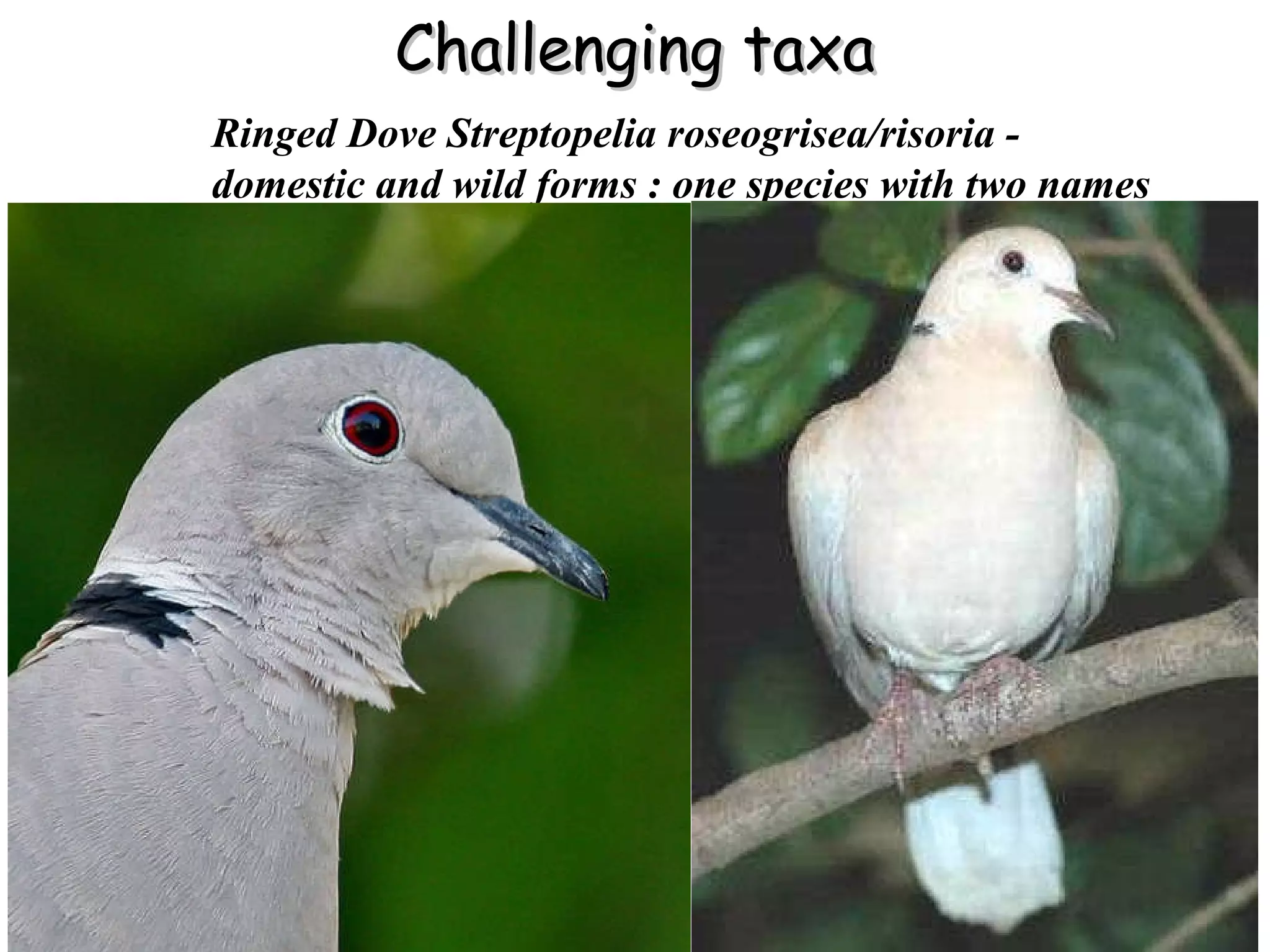
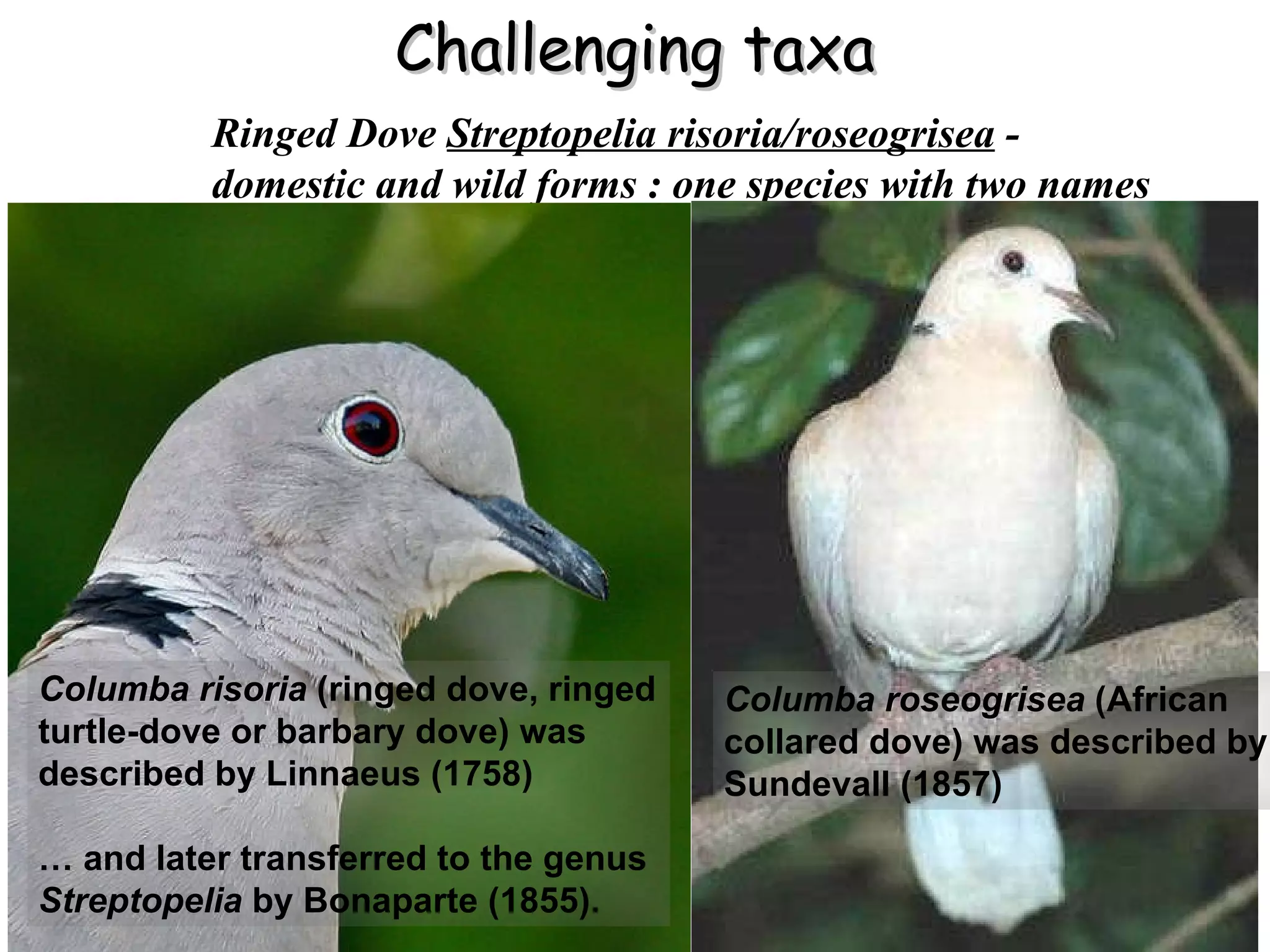
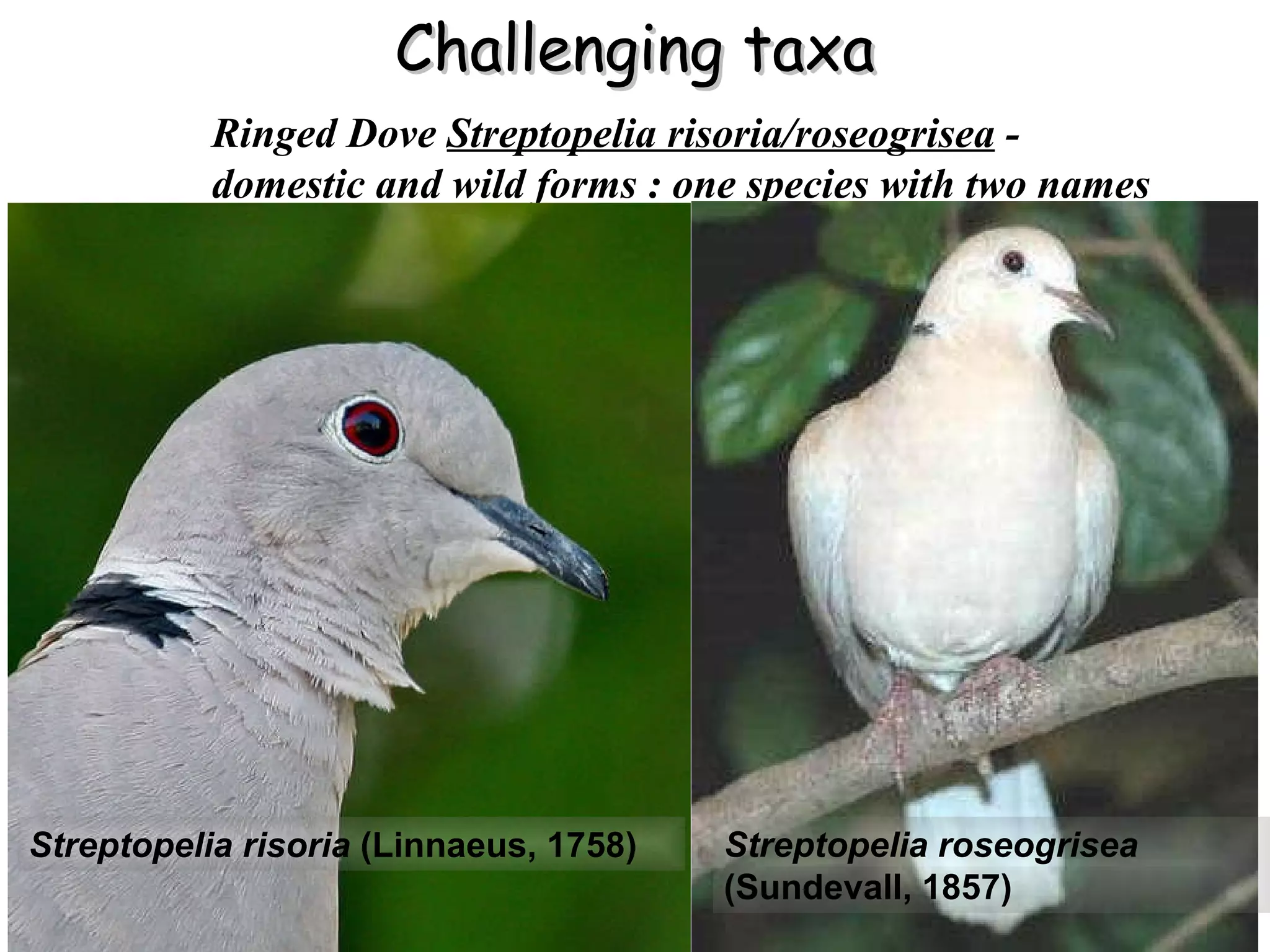
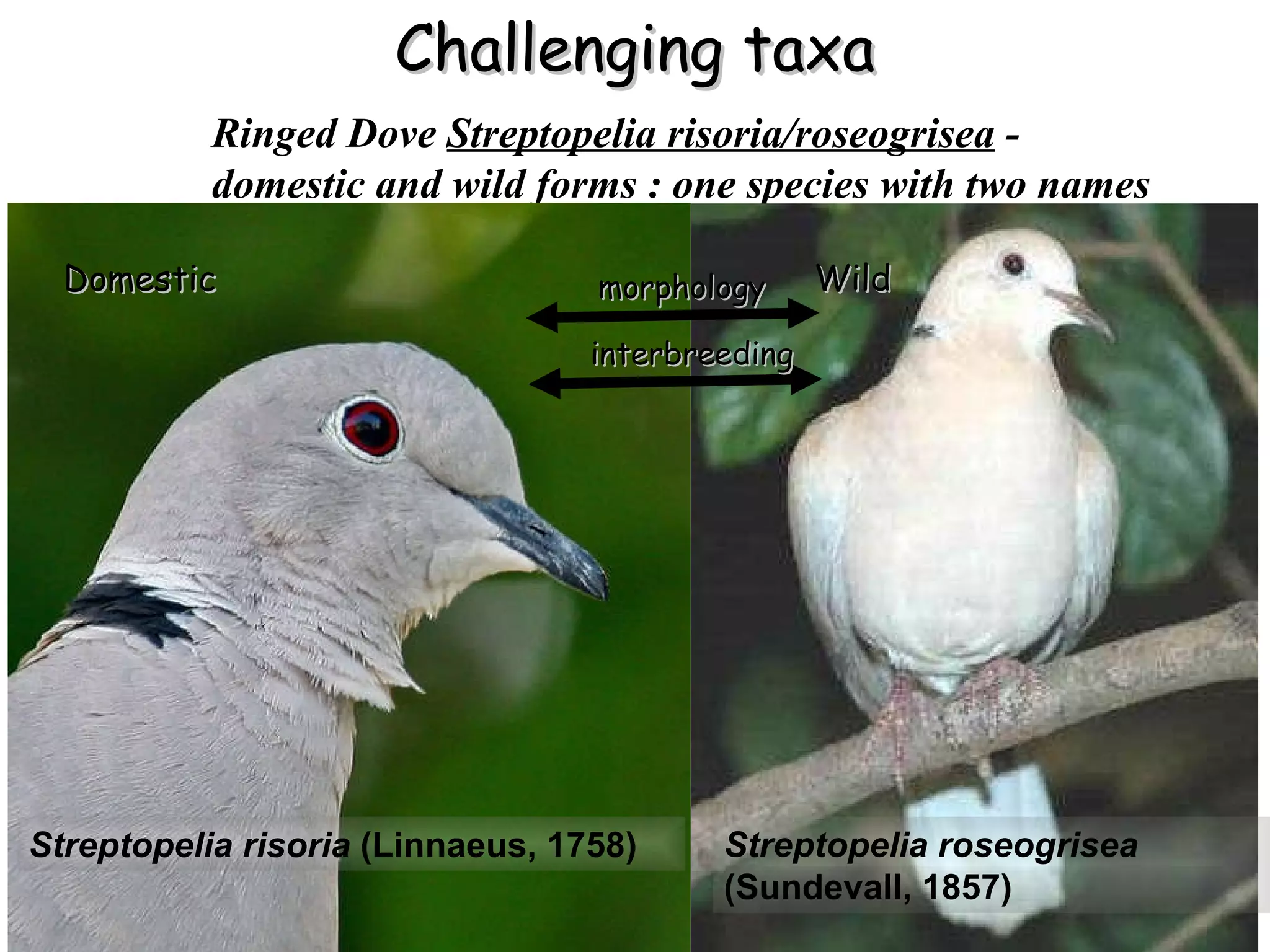
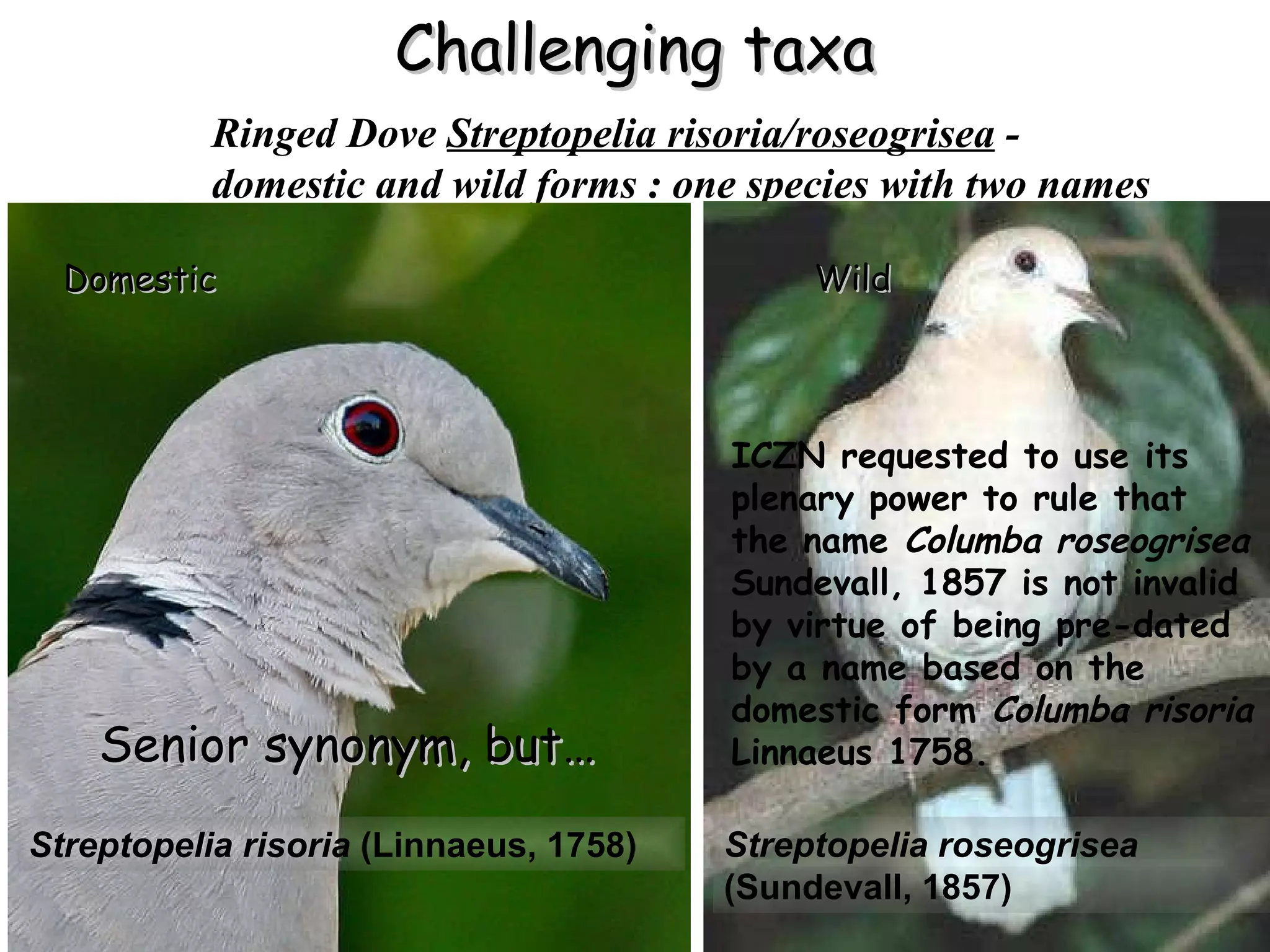
Challenging taxa Ringed Dove Streptopelia roseogrisea/risoria   -  domestic and wild forms : one species with two names
Challenging taxa Ringed Dove  Streptopelia risoria/roseogrisea   -  domestic and wild forms : one species with two names Columba risoria  (ringed dove, ringed turtle-dove or barbary dove) was described by Linnaeus (1758) …  and later transferred to the genus  Streptopelia  by Bonaparte (1855).  Columba roseogrisea  (African collared dove) was described by Sundevall (1857)
Challenging taxa Ringed Dove  Streptopelia risoria/roseogrisea   -  domestic and wild forms : one species with two names Streptopelia risoria  (Linnaeus, 1758) Streptopelia roseogrisea  (Sundevall, 1857)
Challenging taxa Ringed Dove  Streptopelia risoria/roseogrisea   -  domestic and wild forms : one species with two names Streptopelia risoria  (Linnaeus, 1758) Streptopelia roseogrisea  (Sundevall, 1857)  Domestic Wild morphology interbreeding
Challenging taxa Ringed Dove  Streptopelia risoria/roseogrisea   -  domestic and wild forms : one species with two names Streptopelia risoria  (Linnaeus, 1758) Streptopelia roseogrisea  (Sundevall, 1857)  Domestic Wild Senior synonym, but… ICZN requested to use its plenary power to rule that the name  Columba roseogrisea  Sundevall, 1857 is not invalid by virtue of being pre-dated by a name based on the domestic form  Columba risoria  Linnaeus 1758.
Challenging taxa Article 1.2. Scope   Article 1.2.1.  The scientific names of extant or extinct animals include names based on   domesticated animals , names based on fossils that are substitutions (replacements, impressions, moulds and casts) for the actual remains of animals, names based on the fossilized work of organisms (ichnotaxa), and names established for collective groups. Columba roseogrisea  Sundevall, 1857 could be made invalid by  Columba risoria  Linnaeus 1758 - commission intervention sought This is the situation for many domestic-wild comparisons - cats, dogs, camels, llamas, cattle, etc.  Loss of information if these names are synonyomized.
Homonyms Article 52.1. Statement of the Principle of Homonymy:   When two or more taxa are distinguished from each other they must not be denoted by the same name. Article 52.2. Operation of the Principle of Homonymy.  When two or more names are homonyms, only the senior, as determined by the Principle of Priority  may be used as a valid name. Syntarsus  Raath, 1969, the dinosaur, must give way to  Syntarsus  Fairmaire, 1869, the beetle.
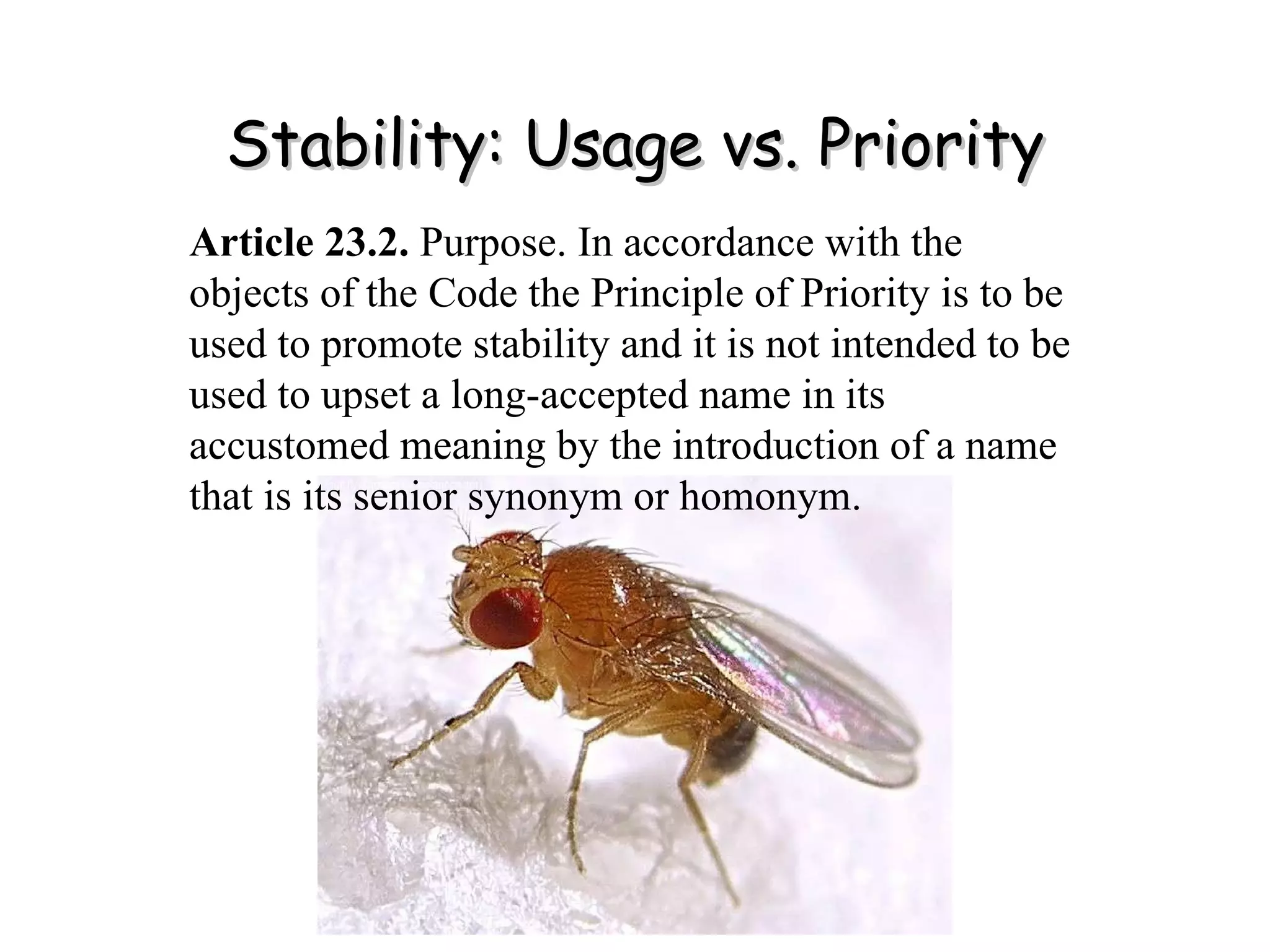
Stability: Usage vs. Priority Article 23.2.  Purpose. In accordance with the objects of the Code the Principle of Priority is to be used to promote stability and it is not intended to be used to upset a long-accepted name in its accustomed meaning by the introduction of a name that is its senior synonym or homonym.
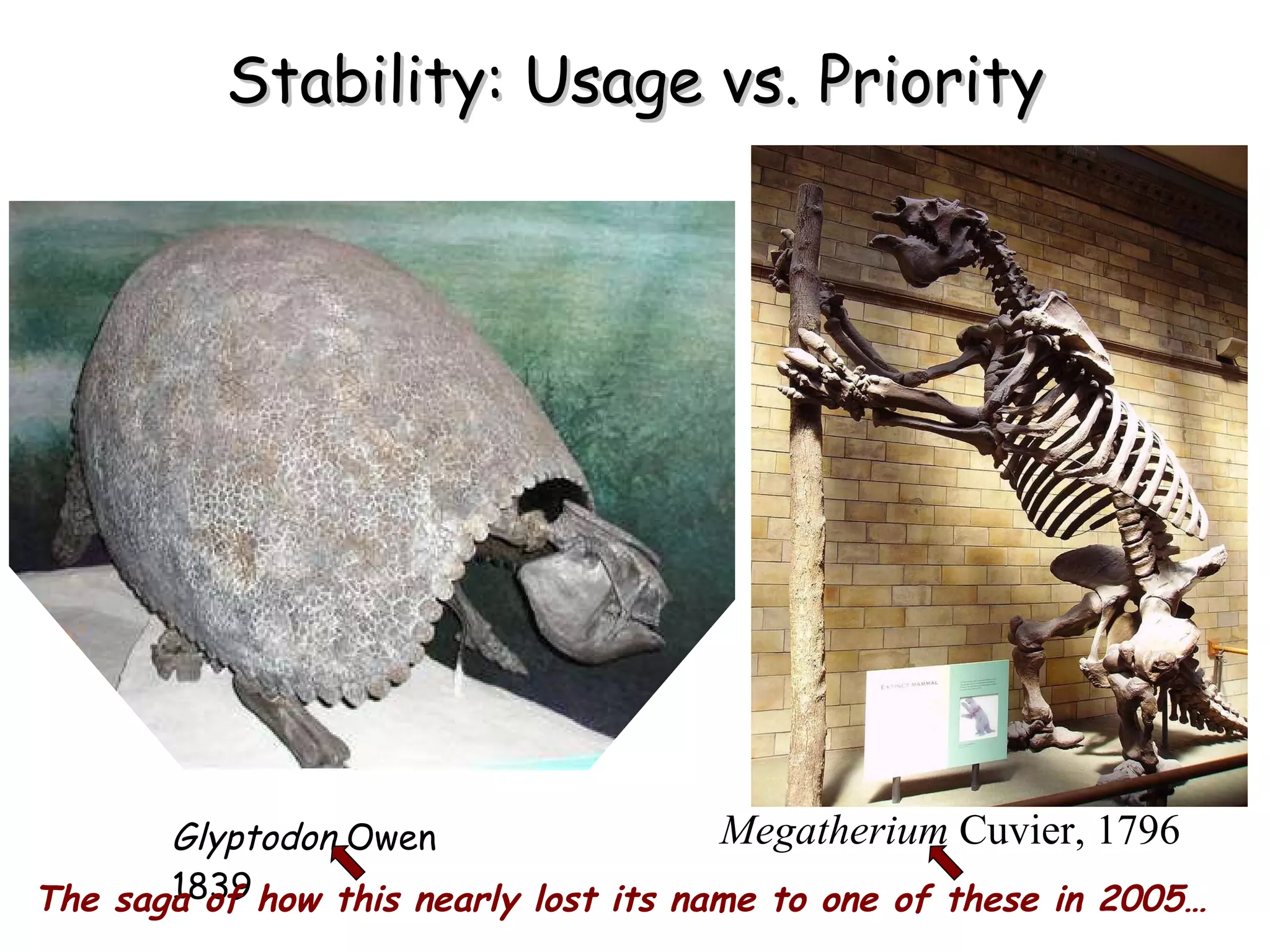
Glyptodon  Owen 1839 Megatherium  Cuvier, 1796 Stability: Usage vs. Priority The saga of how this nearly lost its name to one of these in 2005…
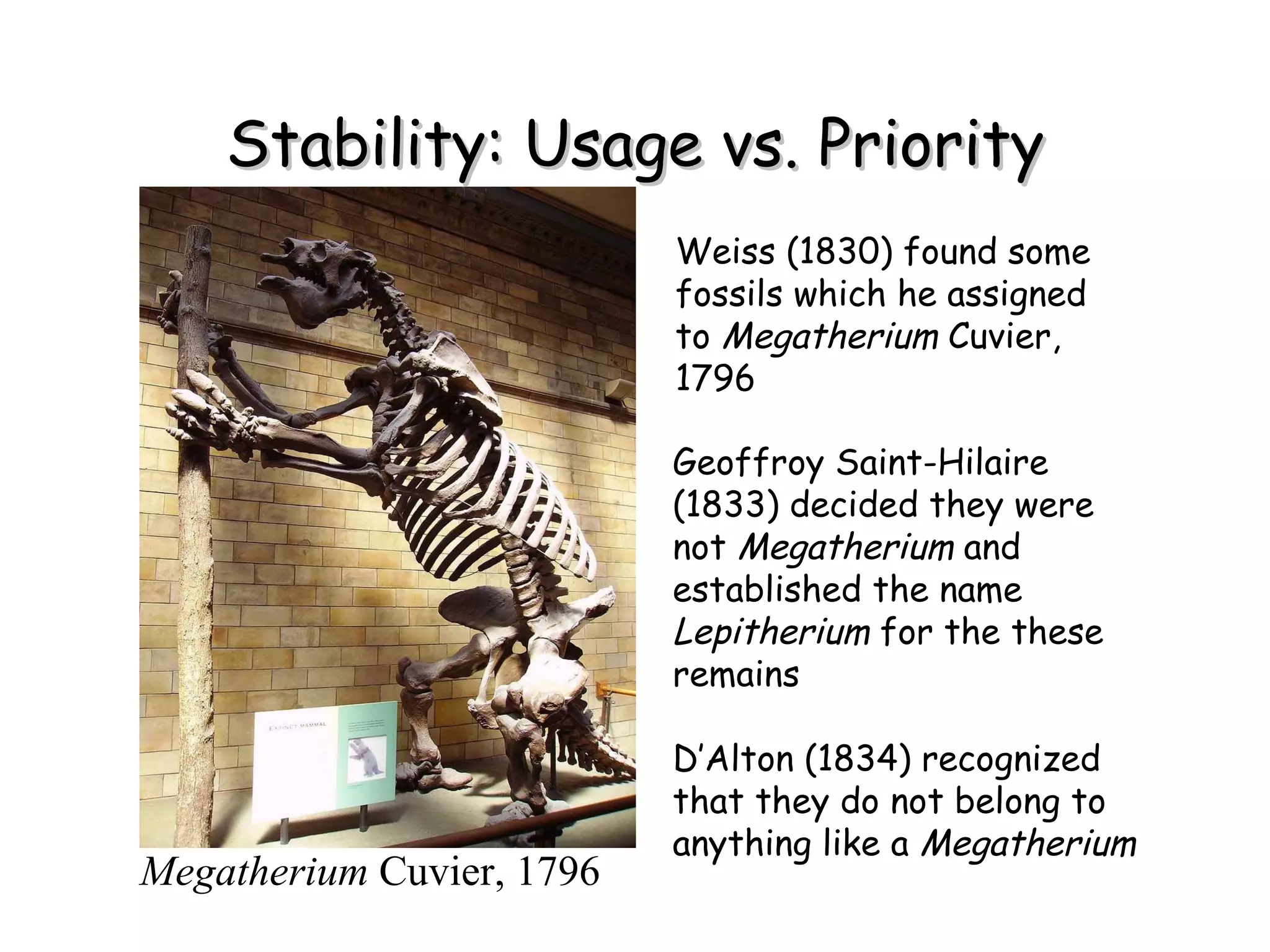
Stability: Usage vs. Priority Megatherium  Cuvier, 1796 Weiss (1830) found some fossils which he assigned to  Megatherium  Cuvier, 1796 Geoffroy Saint-Hilaire (1833) decided they were not  Megatherium  and established the name  Lepitherium  for the these remains D’Alton (1834) recognized that they do not belong to anything like a  Megatherium
Stability: Usage vs. Priority meanwhile Glyptondon was getting off to a rough start…. Owen in Parish (1838) gave the name  Glyptodon  to a genus primarily based on an isolated indeterminable tooth.  As the tooth has been lost this name is generally considered as a  nomen dubium  ( impossible to determine whether a specimen belongs to that group or not) . (In fact, this tooth probably belonged to what is currently known as  Panochthus  Burmeister, 1866, so not a glyptodon at all.) ? ? ? ? ? ?
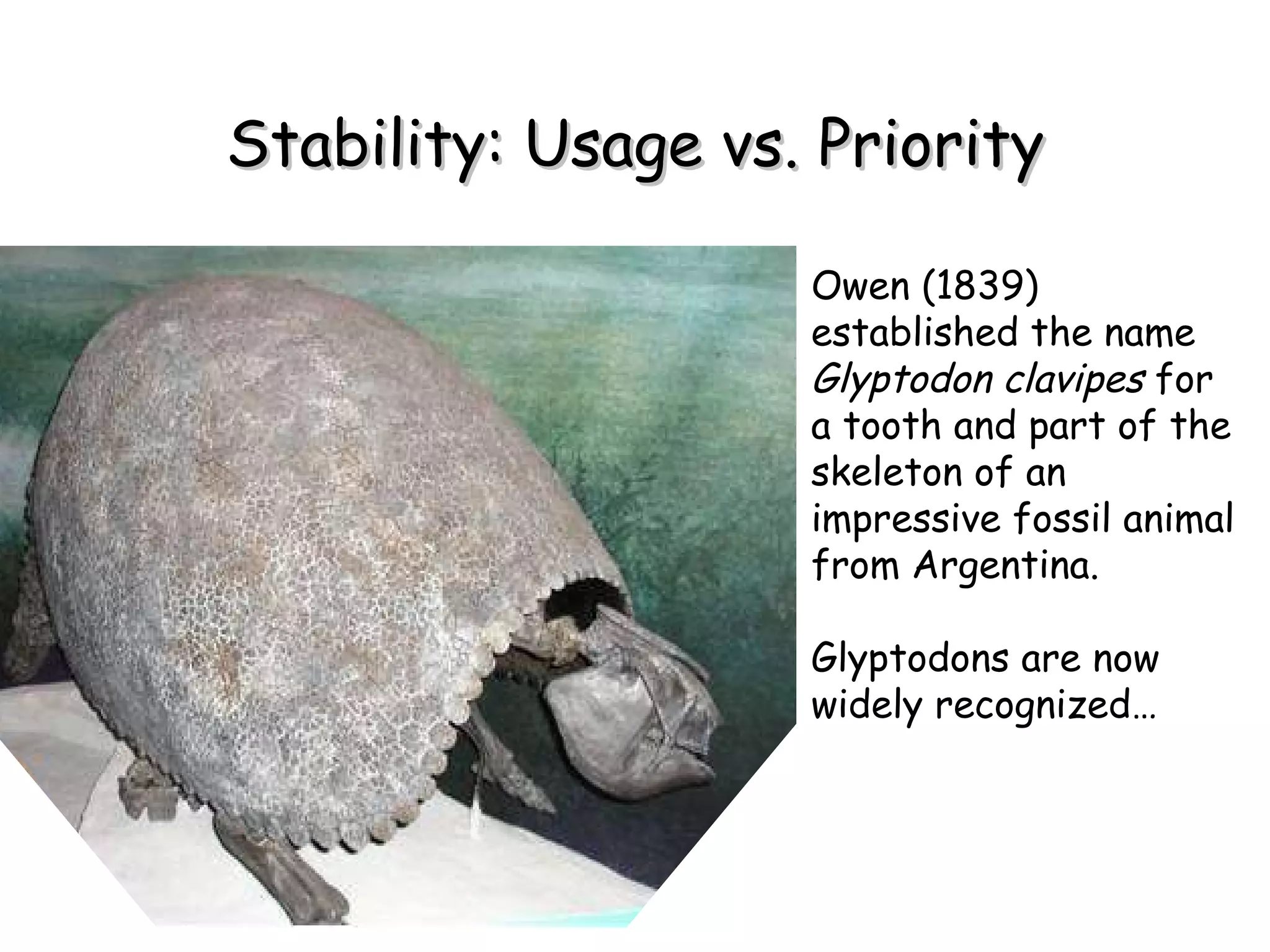
Stability: Usage vs. Priority Owen (1839) established the name  Glyptodon clavipes  for a tooth and part of the skeleton of an impressive fossil animal from Argentina. Glyptodons are now widely recognized…
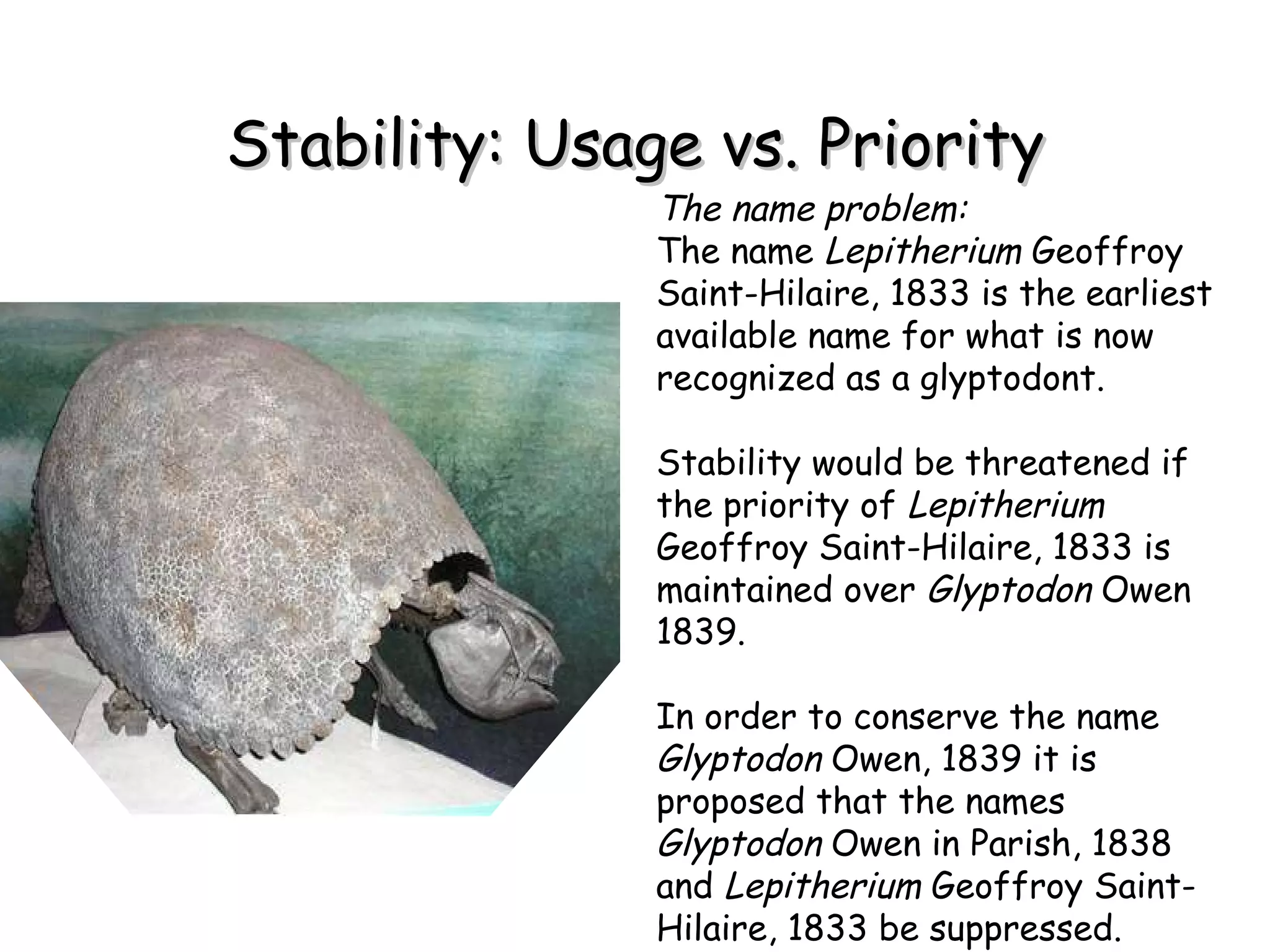
Stability: Usage vs. Priority The name problem: The name  Lepitherium  Geoffroy Saint-Hilaire, 1833 is the earliest available name for what is now recognized as a glyptodont.  Stability would be threatened if the priority of  Lepitherium  Geoffroy Saint-Hilaire, 1833 is maintained over  Glyptodon  Owen 1839. In order to conserve the name  Glyptodon  Owen, 1839 it is proposed that the names  Glyptodon  Owen in Parish, 1838 and  Lepitherium  Geoffroy Saint-Hilaire, 1833 be suppressed.
Stability: Usage vs. Priority Article 23.2.  Purpose. In accordance with the objects of the Code the Principle of Priority is to be used to promote stability and it is not intended to be used to upset a long-accepted name in its accustomed meaning by the introduction of a name that is its senior synonym or homonym. Lepitherium  Geoffroy Saint-Hilaire, 1833 is suppressed so  Glyptodon  Owen in Parish, 1838, can continue to be used
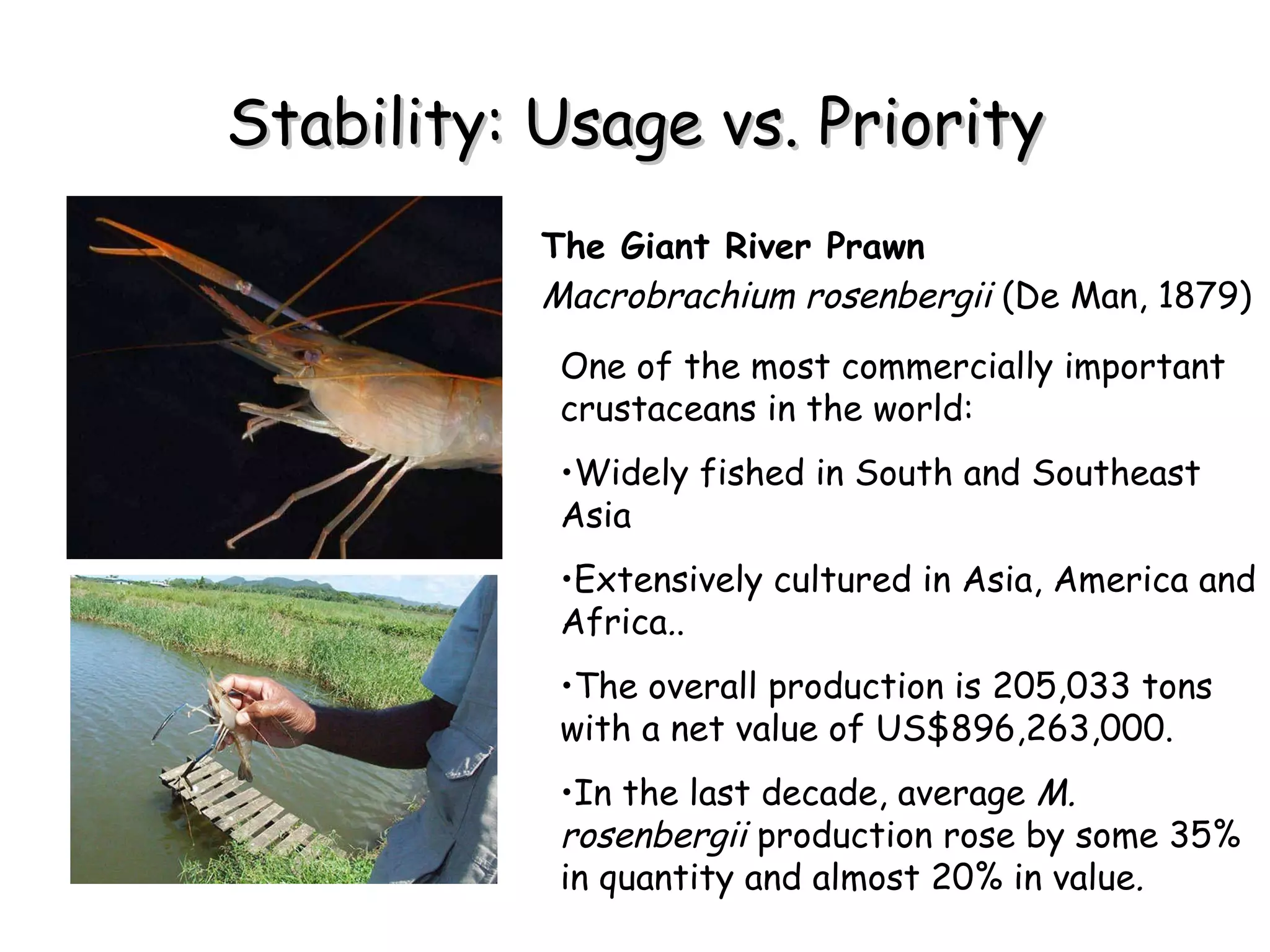
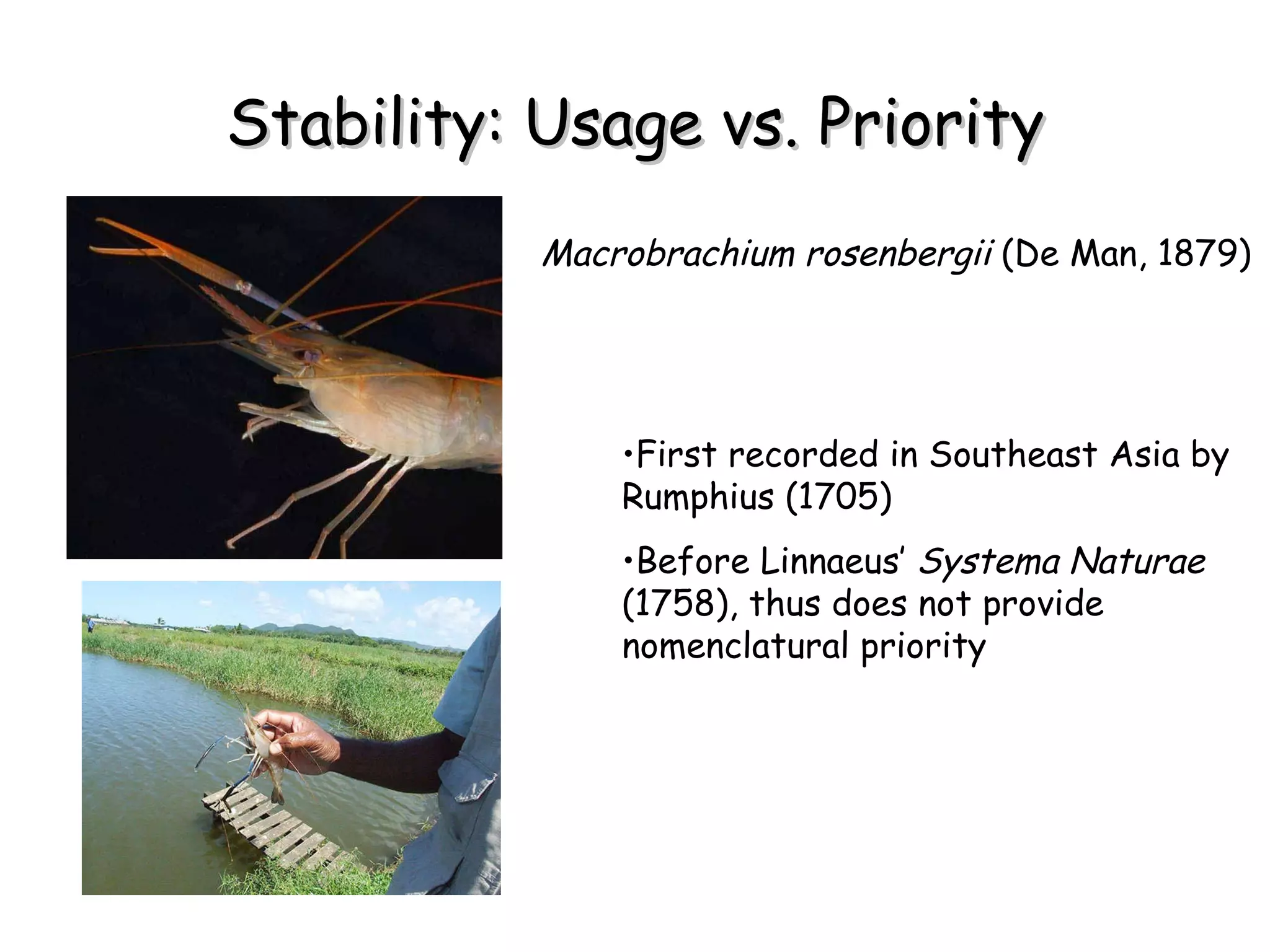
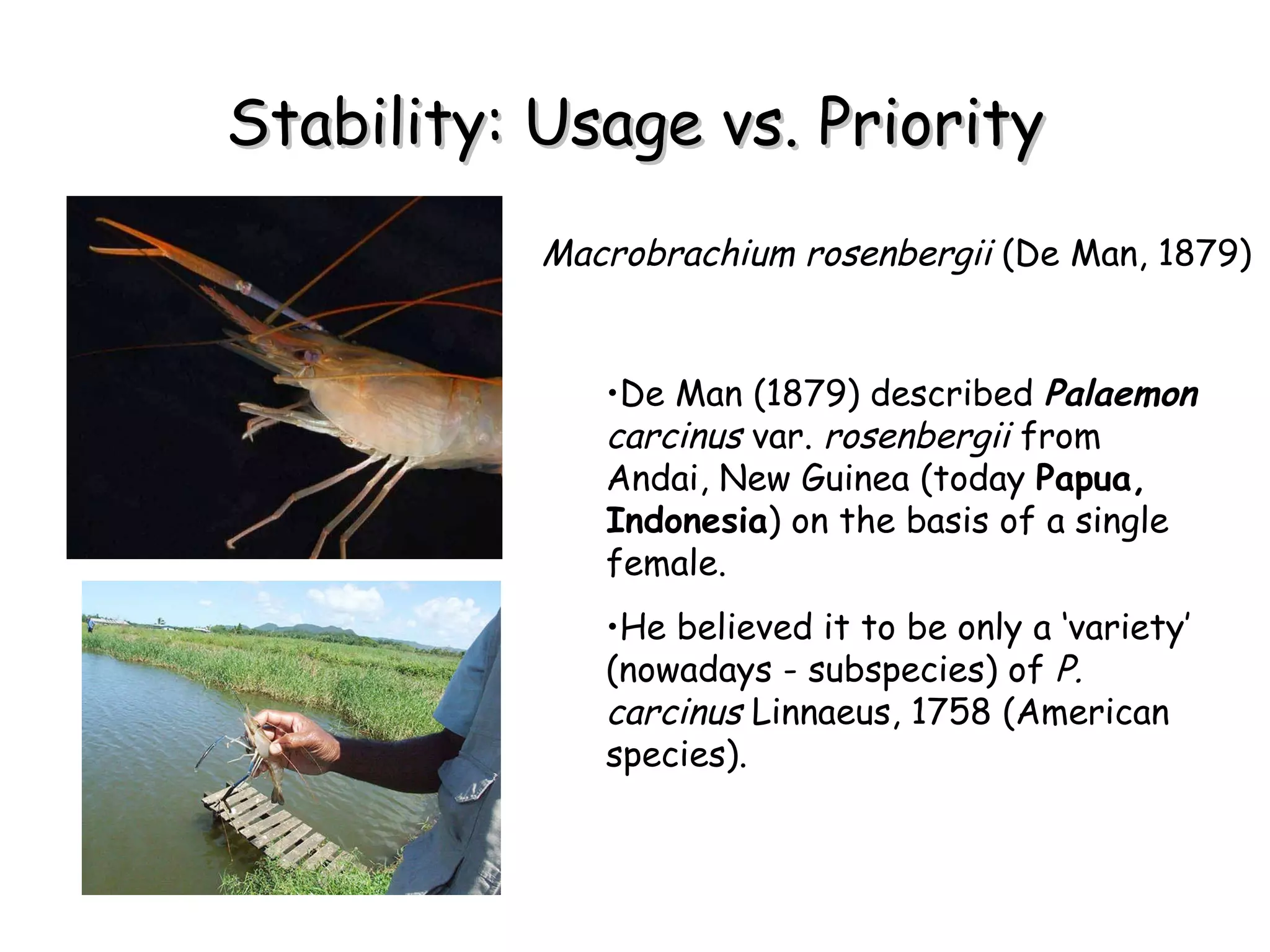
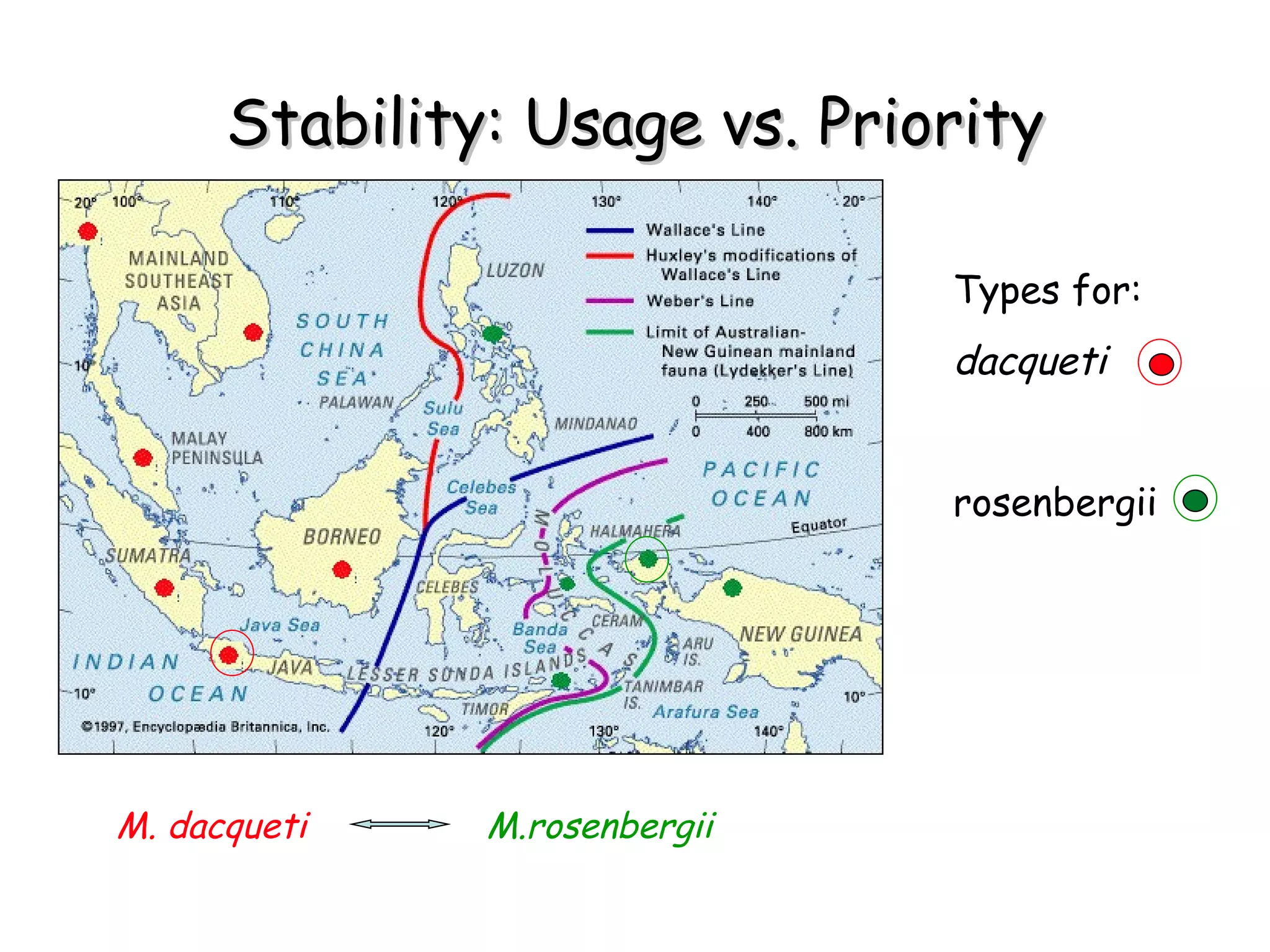
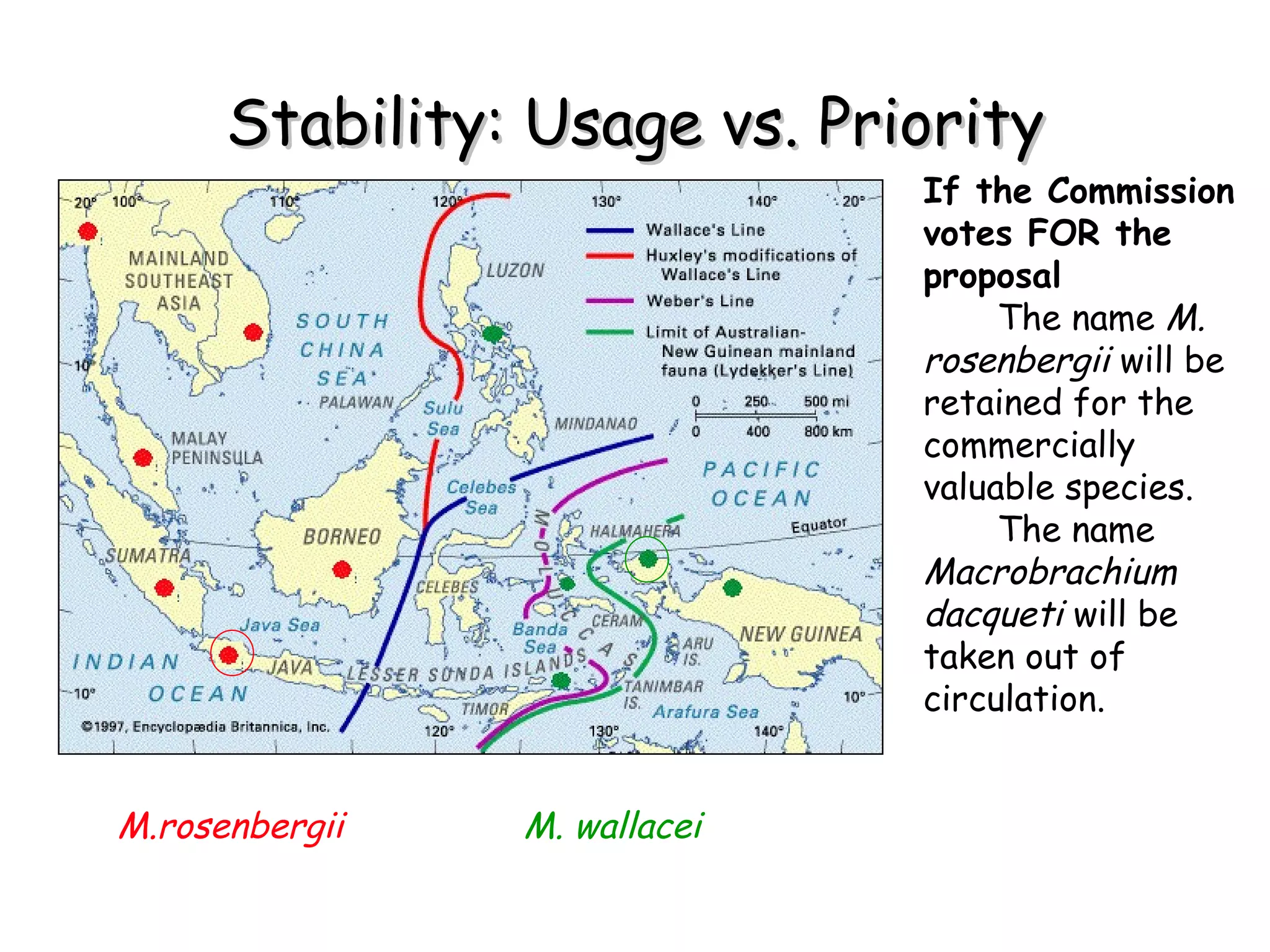
Stability: Usage vs. Priority The Giant River Prawn   Macrobrachium rosenbergii  (De Man, 1879)   One of the most commercially important crustaceans in the world: Widely fished in South and Southeast Asia Extensively cultured in Asia, America and Africa . .  The overall production is 205,033 tons with a net value of US$896,263,000. In the last decade, average  M. rosenbergii  production rose by some 35% in quantity and almost 20% in value .
Stability: Usage vs. Priority First recorded in Southeast Asia by Rumphius (1705)  Before Linnaeus’  Systema Naturae  (1758), thus does not provide nomenclatural priority Macrobrachium rosenbergii  (De Man, 1879)
Stability: Usage vs. Priority De Man (1879) described  Palaemon  carcinus  var.  rosenbergii  from Andai, New Guinea (today  Papua, Indonesia ) on the basis of a single female.  He believed it to be only a ‘variety’ (nowadays - subspecies) of  P. carcinus  Linnaeus, 1758 (American species). Macrobrachium rosenbergii  (De Man, 1879)
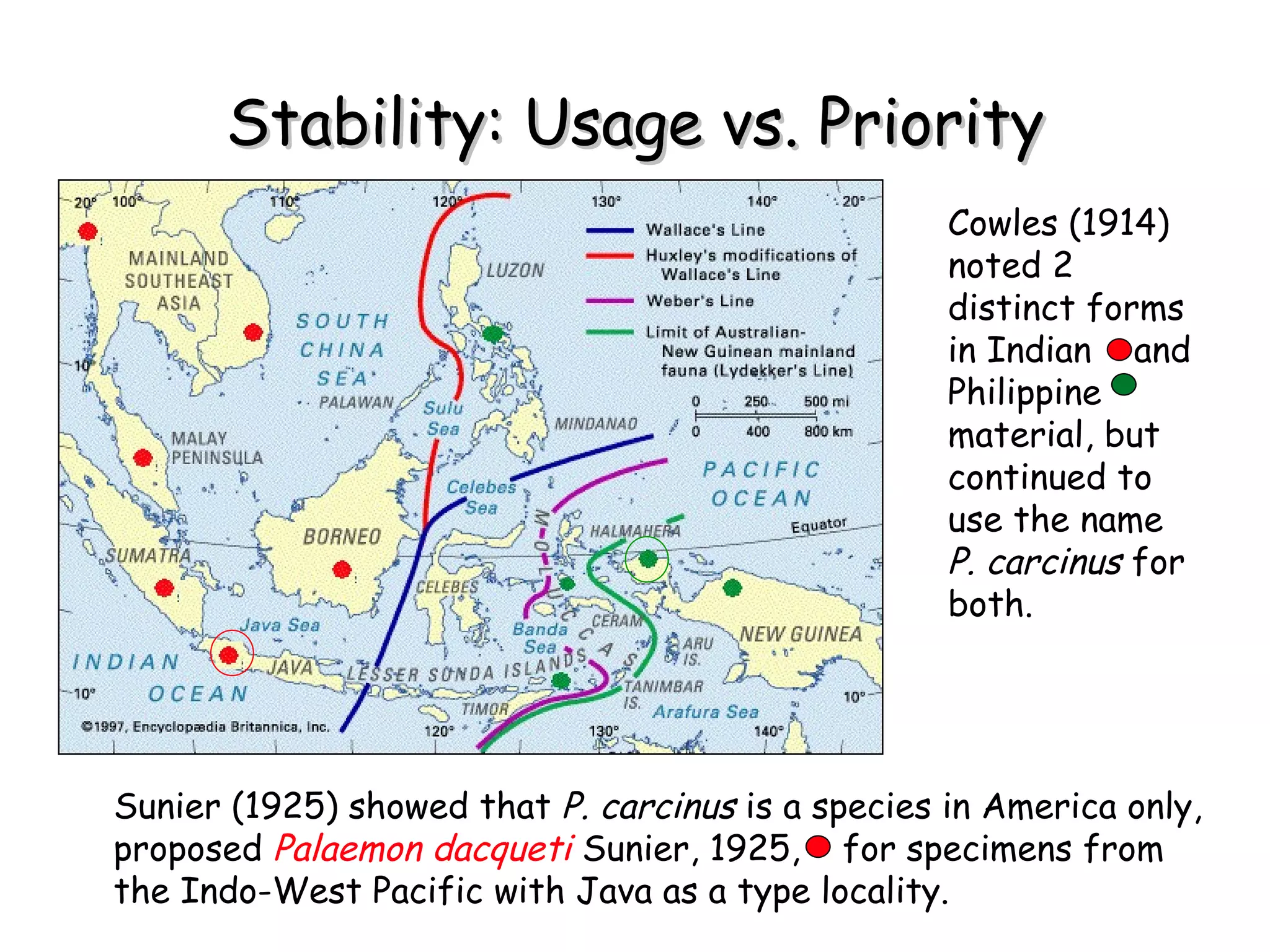
Stability: Usage vs. Priority Sunier (1925) showed that  P. carcinus  is a species in America only, proposed  Palaemon   dacqueti   Sunier, 1925,  for specimens from the Indo-West Pacific with Java as a type locality. Cowles (1914) noted 2 distinct forms in Indian  and Philippine material, but continued to use the name  P. carcinus  for both.
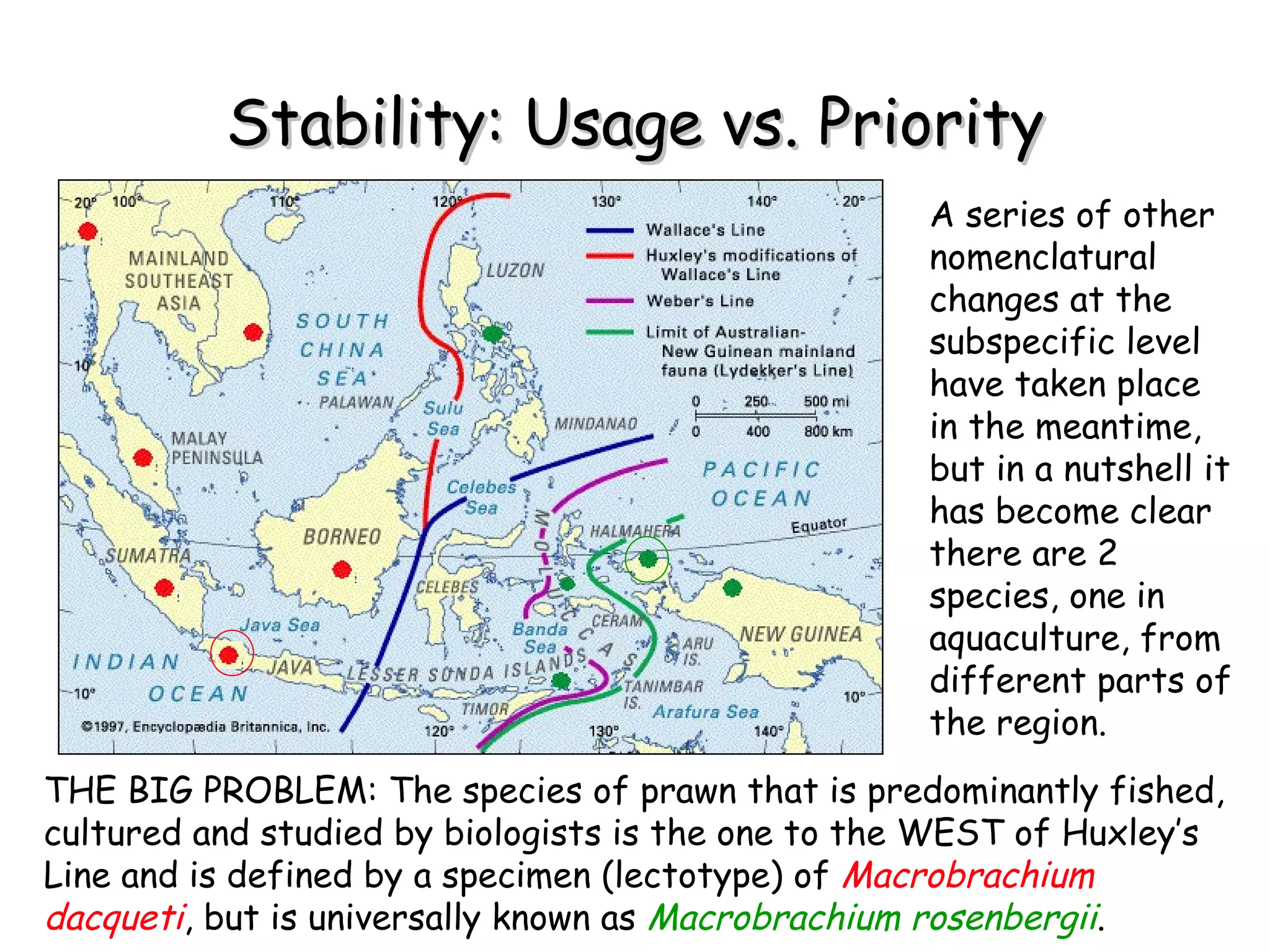
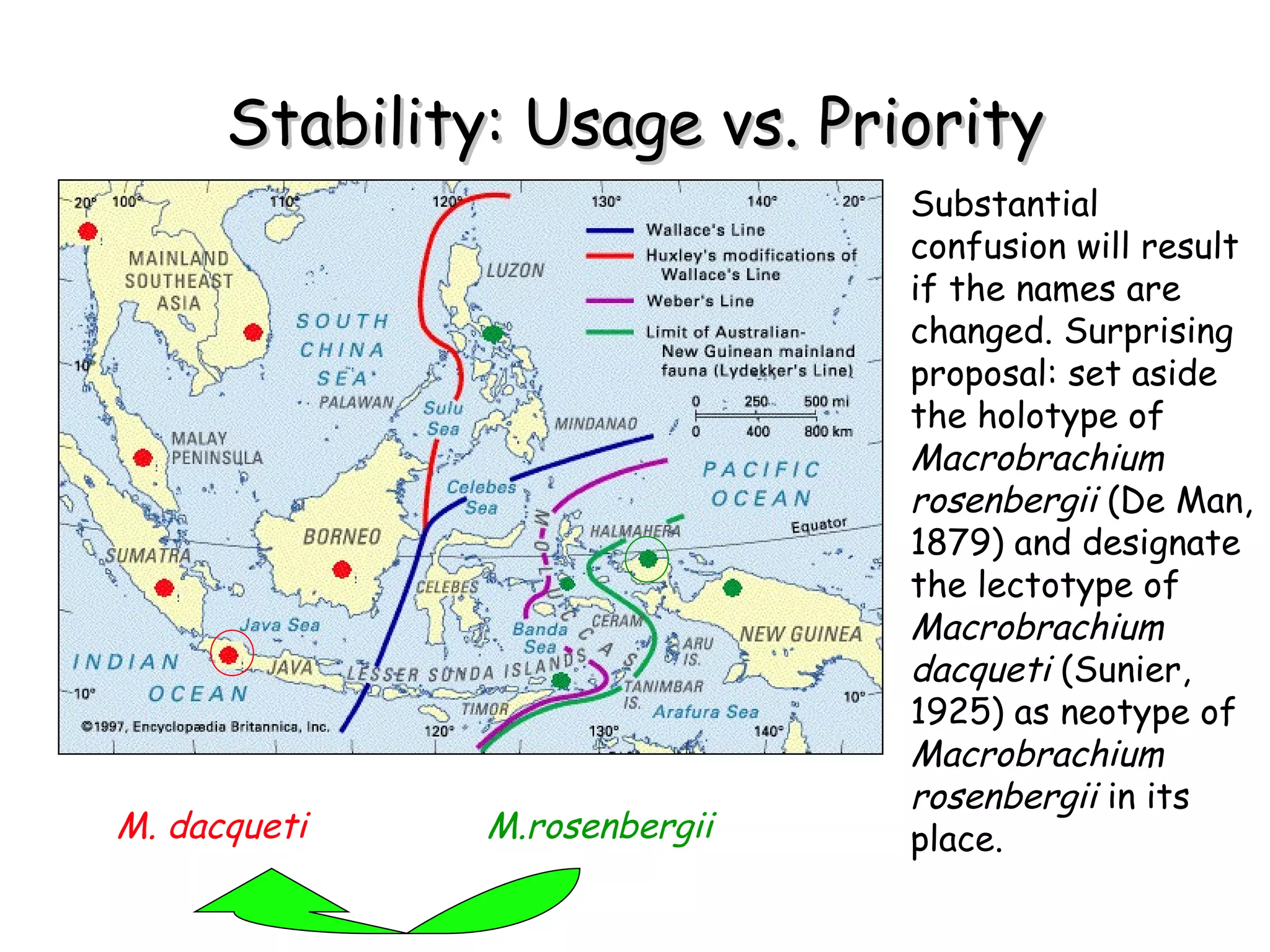
Stability: Usage vs. Priority Types for: dacqueti rosenbergii  M. dacqueti   M.rosenbergii
Stability: Usage vs. Priority THE BIG PROBLEM: The species of prawn that is predominantly fished, cultured and studied by biologists is the one to the WEST of Huxley’s Line and is defined by a specimen (lectotype) of  Macrobrachium dacqueti , but is universally known as  Macrobrachium rosenbergii . A series of other nomenclatural changes at the subspecific level have taken place in the meantime, but in a nutshell it has become clear there are 2 species, one in aquaculture, from different parts of the region.
Stability: Usage vs. Priority Substantial confusion will result if the names are changed. Surprising proposal: set aside the holotype of  Macrobrachium rosenbergii  (De Man, 1879) and designate the lectotype of  Macrobrachium dacqueti  (Sunier, 1925) as neotype of  Macrobrachium rosenbergii  in its place. M. dacqueti   M.rosenbergii
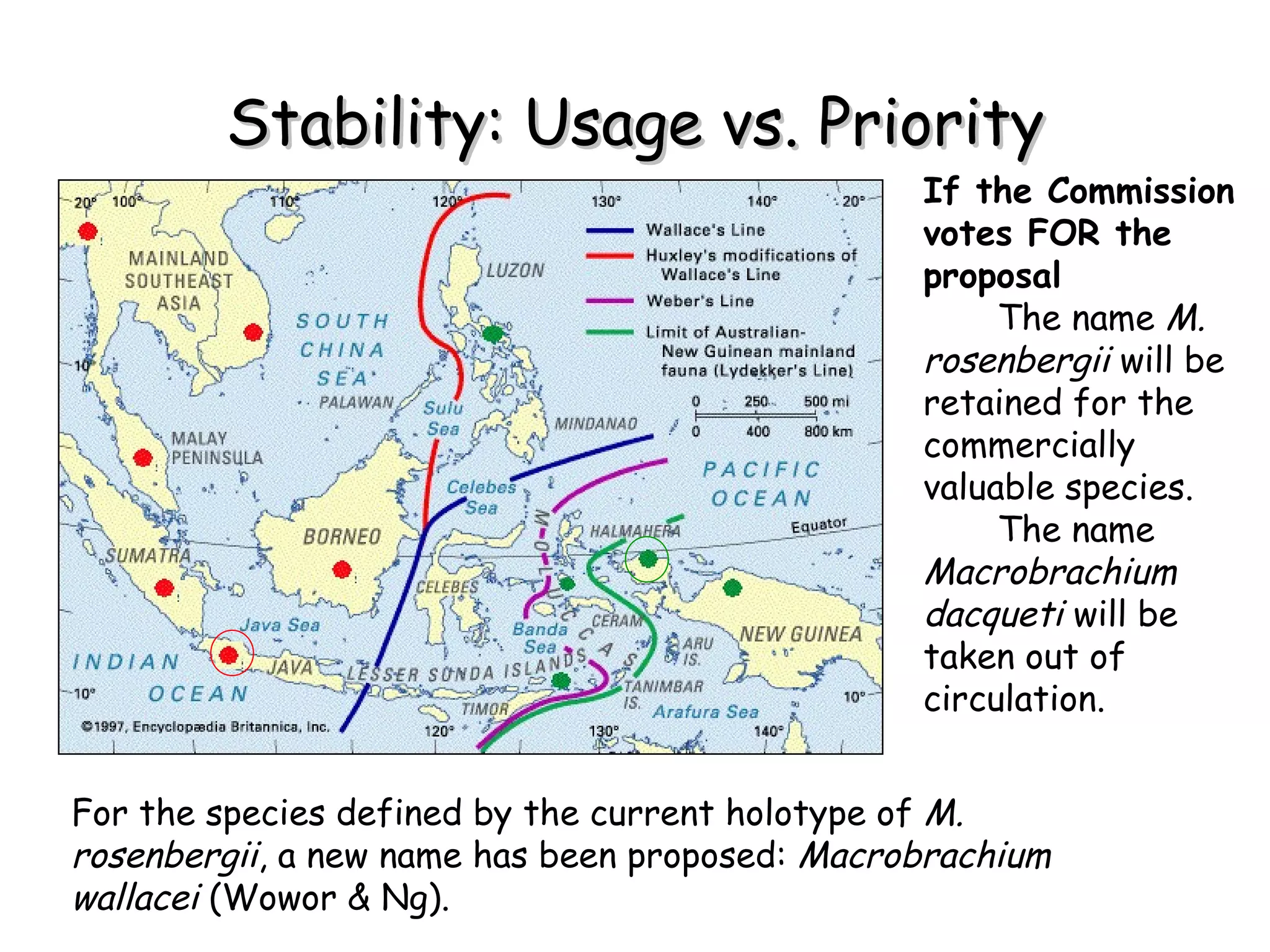
Stability: Usage vs. Priority If the Commission votes FOR the proposal The name  M. rosenbergii  will be retained for the commercially valuable species. The name  Macrobrachium dacqueti  will be taken out of circulation. For the species defined by the current holotype of  M. rosenbergii , a new name has been proposed:  Macrobrachium wallacei  (Wowor & Ng).
Stability: Usage vs. Priority M.rosenbergii   M. wallacei  If the Commission votes FOR the proposal The name  M. rosenbergii  will be retained for the commercially valuable species. The name  Macrobrachium dacqueti  will be taken out of circulation.
Stability: Usage vs. Priority Article 23.2.  Purpose. In accordance with the objects of the Code the Principle of Priority is to be used to promote stability and it is not intended to be used to upset a long-accepted name in its accustomed meaning by the introduction of a name that is its senior synonym or homonym.
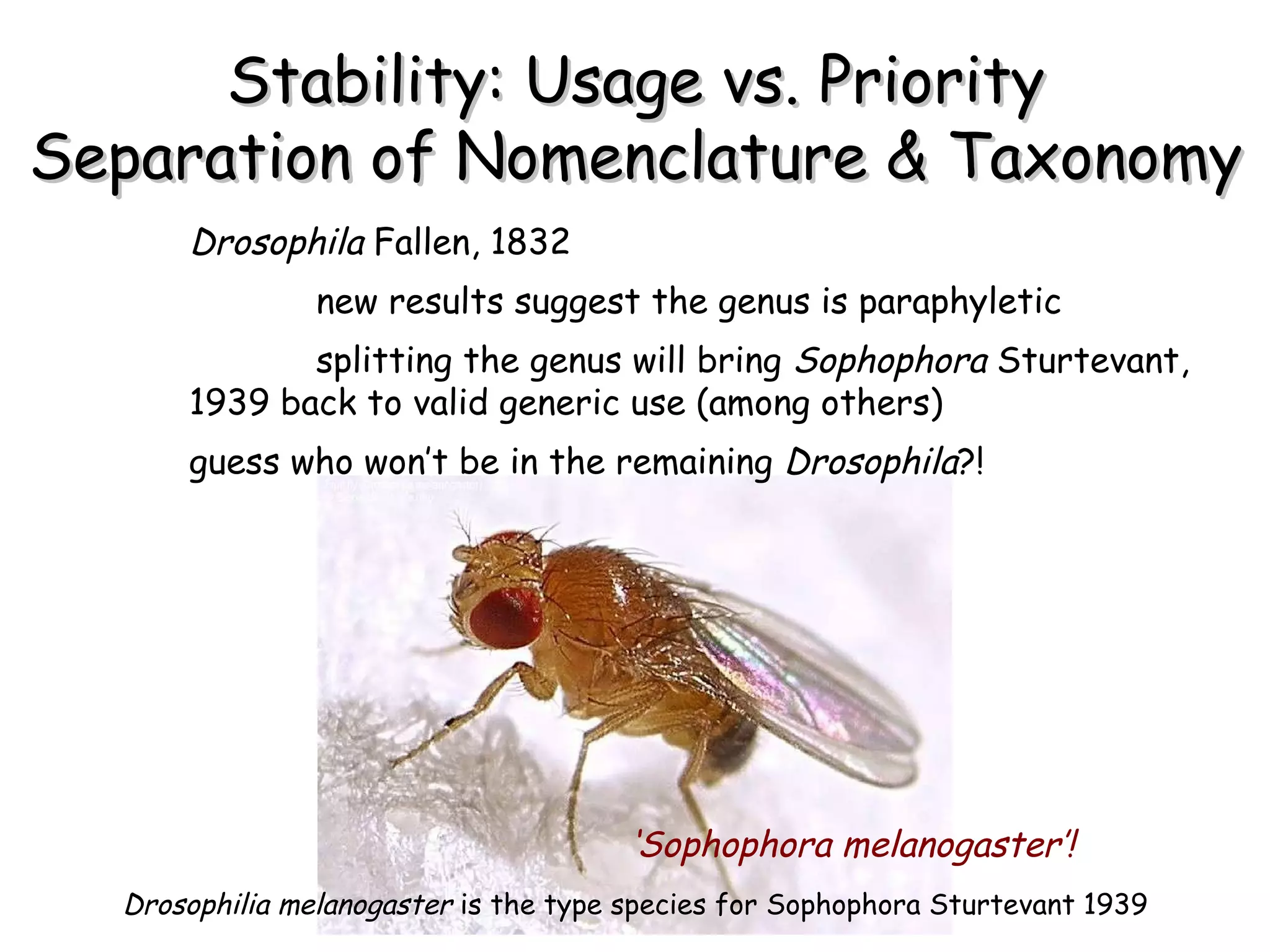
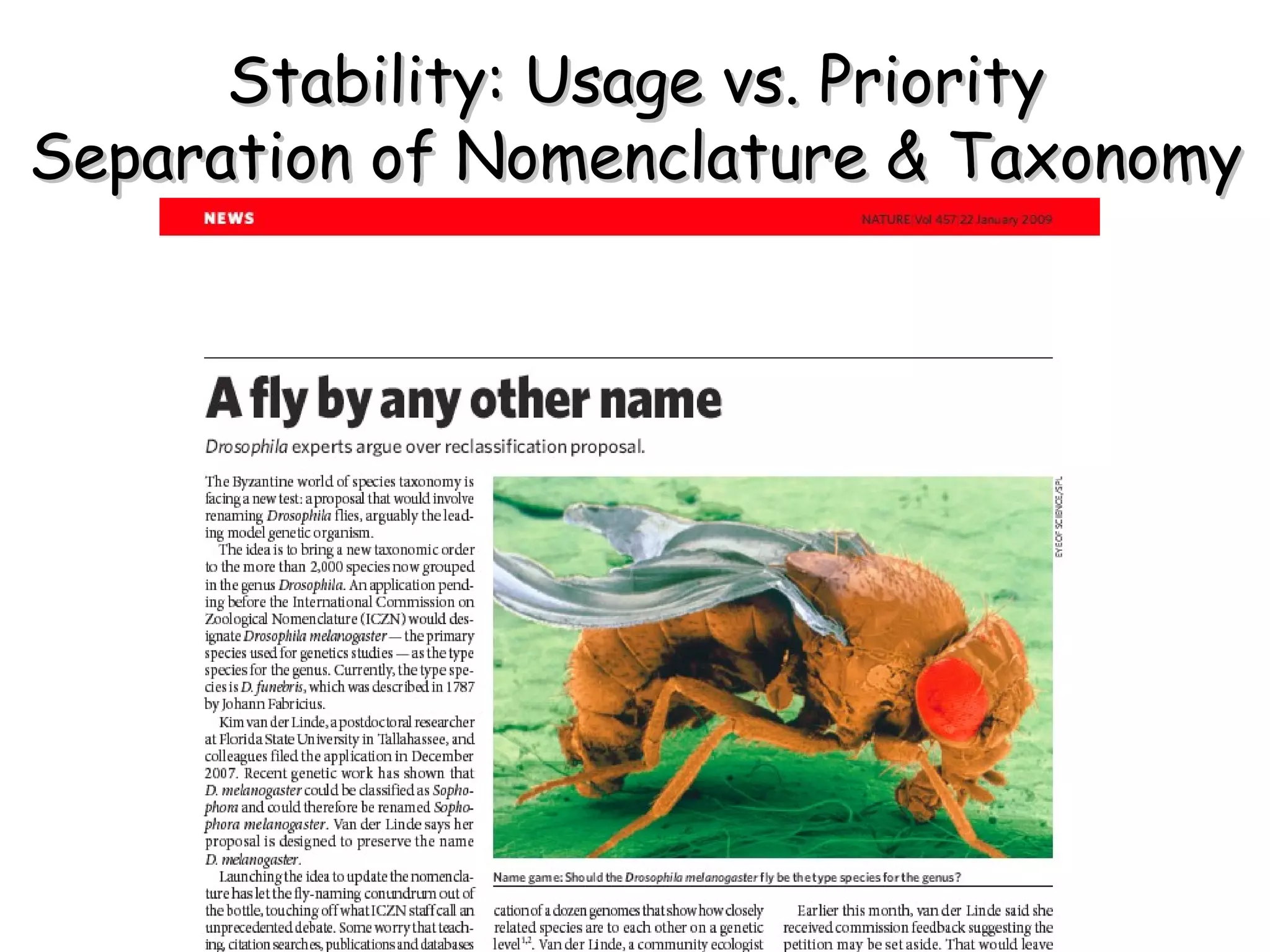
Stability: Usage vs. Priority Separation of Nomenclature & Taxonomy Drosophila  Fallen, 1832 new results suggest the genus is paraphyletic splitting the genus will bring  Sophophora  Sturtevant, 1939 back to valid generic use (among others) guess who won’t be in the remaining  Drosophila ?!  ‘ Sophophora melanogaster’!   Drosophilia melanogaster  is the type species for Sophophora Sturtevant 1939
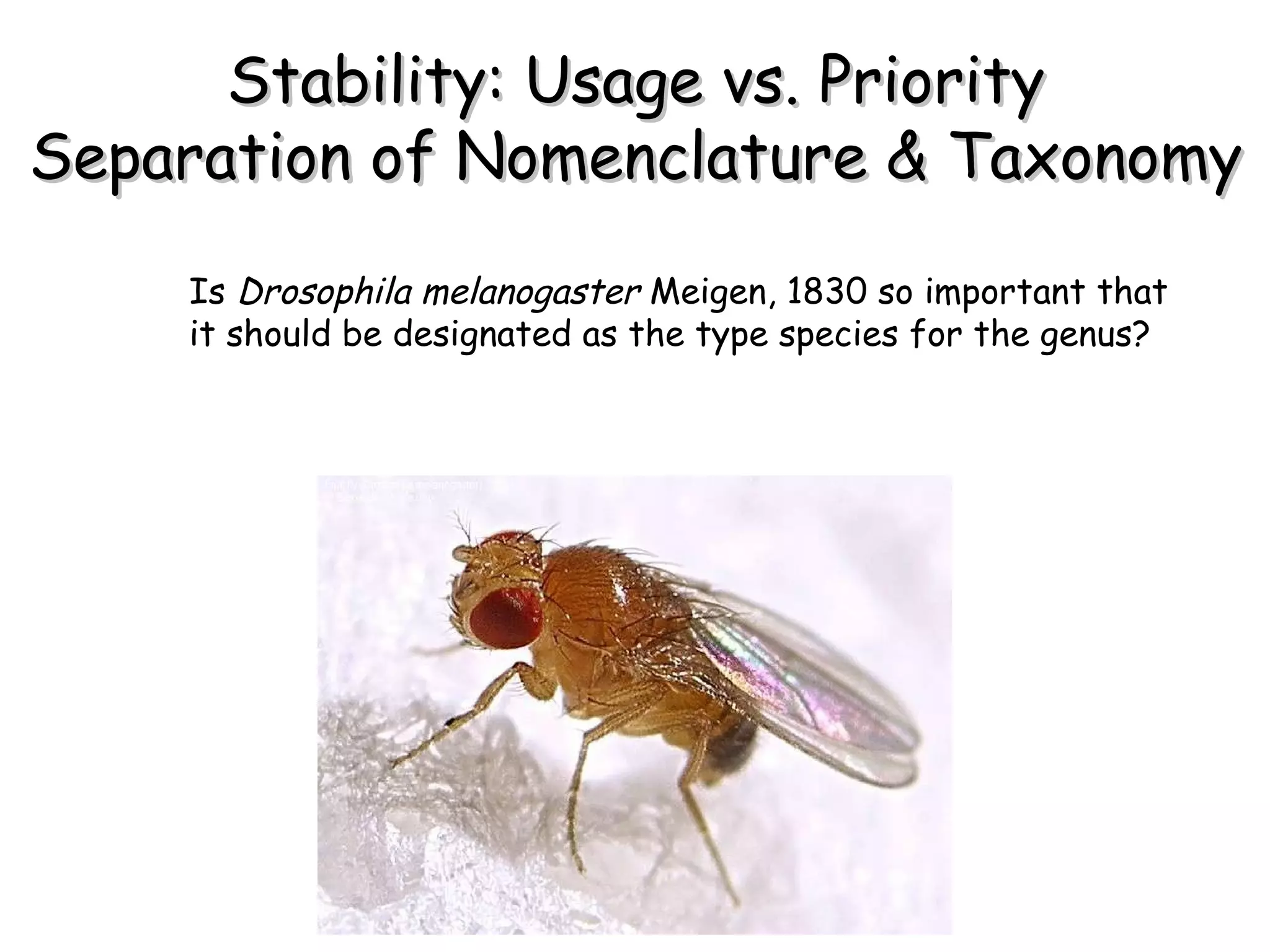
Stability: Usage vs. Priority Separation of Nomenclature & Taxonomy Is  Drosophila   melanogaster  Meigen, 1830 so important that it should be designated as the type species for the genus?
Stability: Usage vs. Priority Separation of Nomenclature & Taxonomy
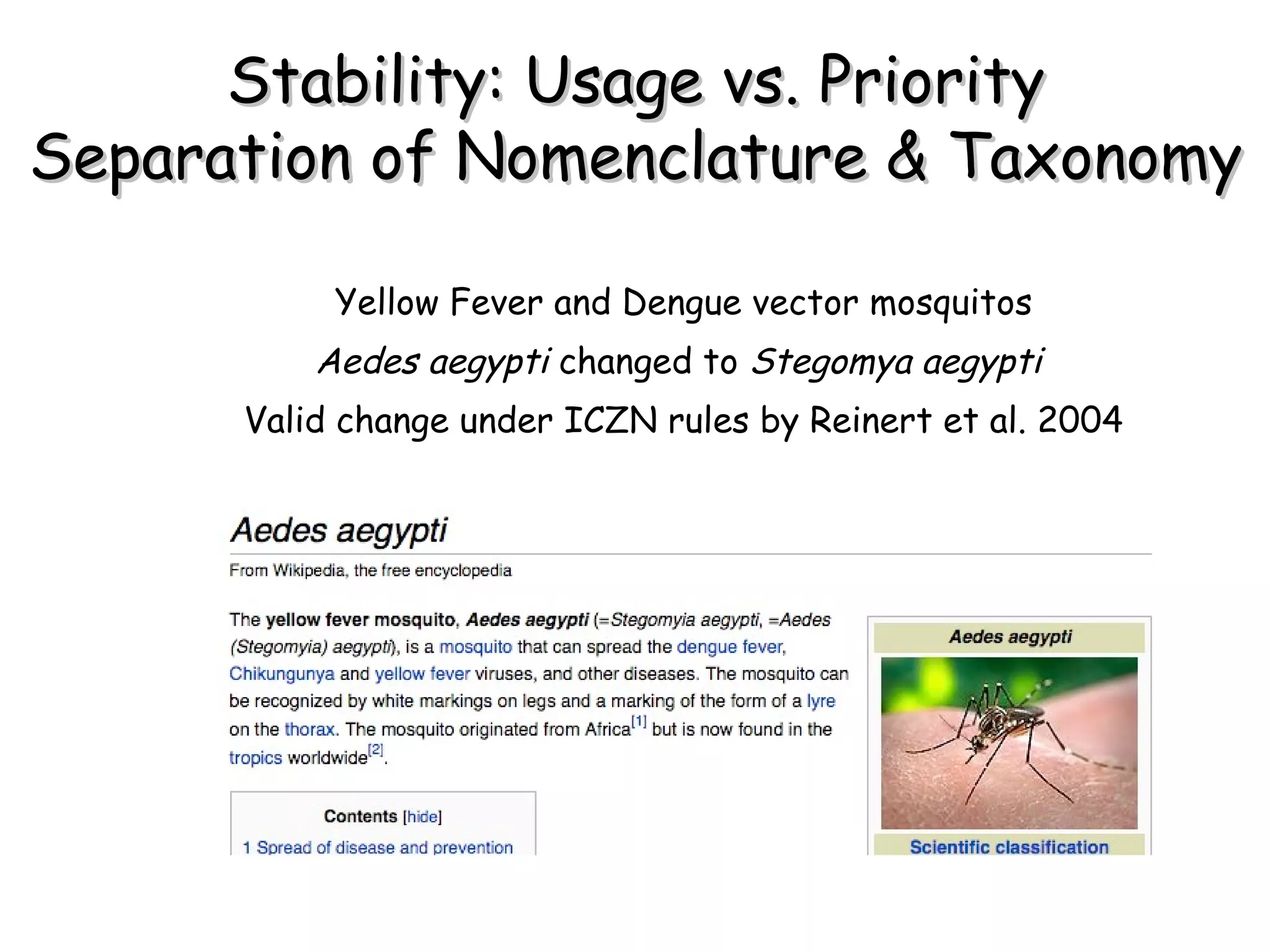
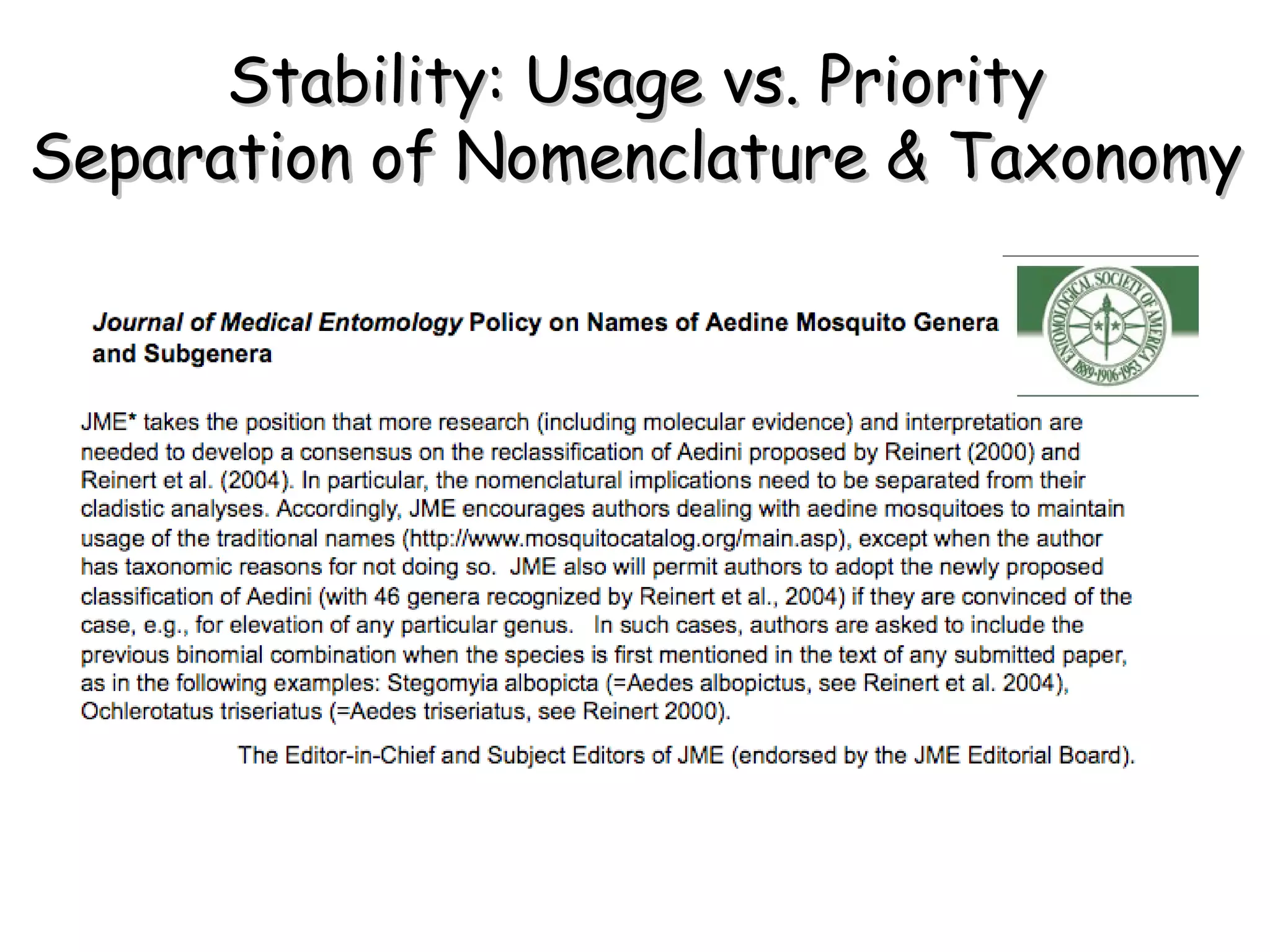
Stability: Usage vs. Priority Separation of Nomenclature & Taxonomy Yellow Fever and Dengue vector mosquitos Aedes aegypti  changed to  Stegomya aegypti   Valid change under ICZN rules by Reinert et al. 2004
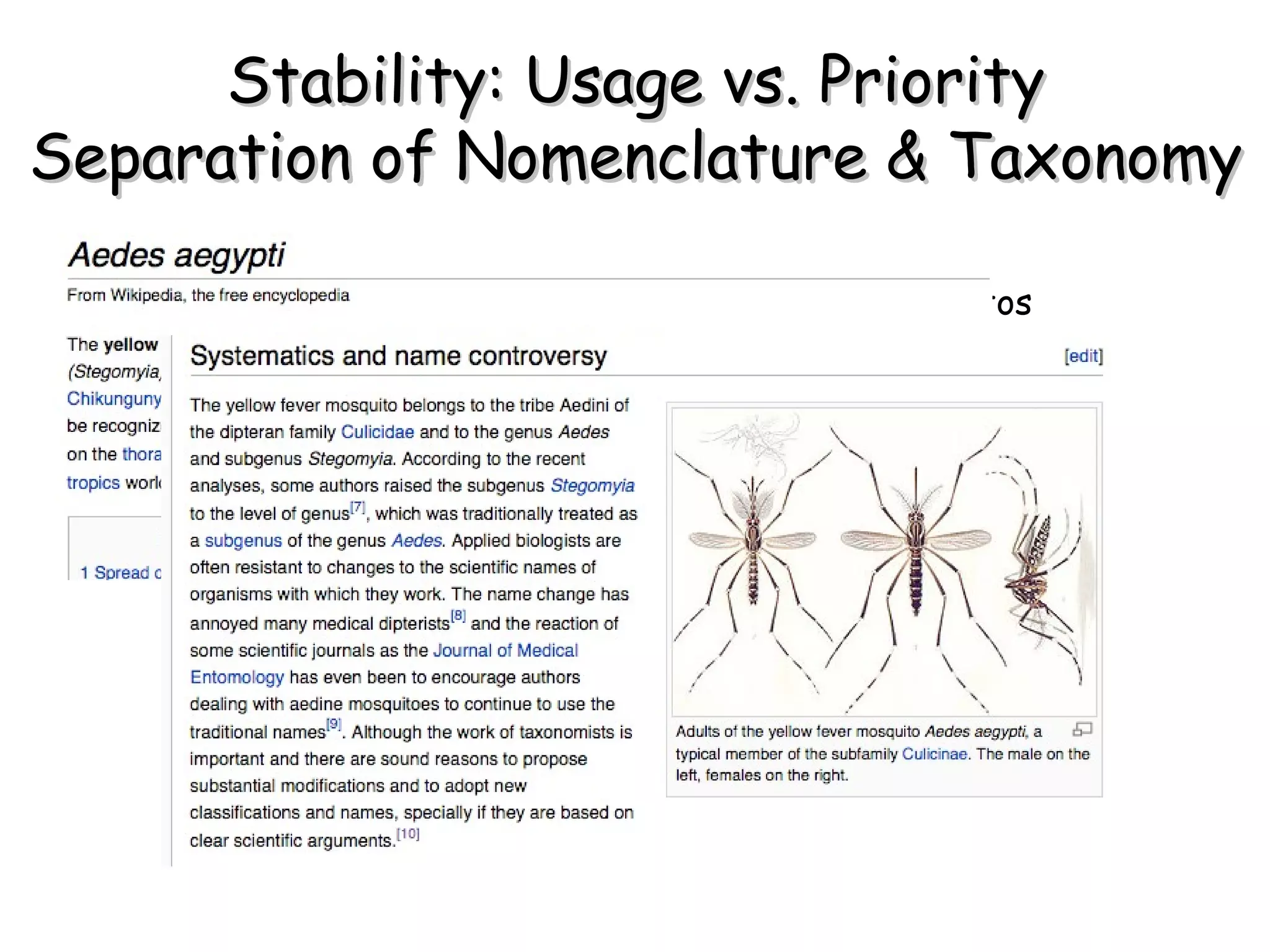
Stability: Usage vs. Priority Separation of Nomenclature & Taxonomy Yellow Fever and Dengue vector mosquitos Aedes aegypti  changed to  Stegomya aegypti
Stability: Usage vs. Priority Separation of Nomenclature & Taxonomy
Nomenclature and biodiversity informatics: what are the data we use to get ‘the big patterns for the big questions’?
Nomenclature and biodiversity informatics:  a common pantropical reef coral A species search engine iSpecies is a test of E O Wilson's idea of a web page for each species. The data displayed are generated "on the fly" by querying other data sources ( learn how it works  ). Send comments to  r. [email_address] . gla .ac. uk , or visit the  iSpecies blog .  Search:  Montastrea Yahoo tags stable isotopes trace metals zooxanthellae environmental regulation biomass florida keys reef coral montastrea caribbean reproduction  Genomics from NCBI TaxId:  48497  Montastraea [stony corals] Sequences:  4222  nucleotide,  206  protein Barcodes of Life   Global Biodiversity Information Facility   Hexacorallians  of the World   Integrated Taxonomic Information System   Global Biodiversity Information Facility   Nomenclator Zoologicus   Map from GBIF   Images from Yahoo           Articles from Google â € ¦ of prolonged  “ bleaching ”  on the tissue biomass and reproduction of the reef coral  Montastrea  â € ¦   â € ¦ : Physiological and Environmental Regulation of Stable Isotopes and Trace Metals in  Montastrea  â € ¦   Growth and form in the reef-building coral  Montastrea annularis   Reduced growth rate of  Montastrea annularis  following the 1987 – 1988 coral-bleaching event   Recovery of the coral  Montastrea annularis  in the Florida Keys after the 1987 Caribbean  “ bleaching â € ¦   Depth-dependent  photoadaption  by  zooxanthellae  of the reef coral  Montastrea annularis             View My Stats   ispecies search :  Montastrea
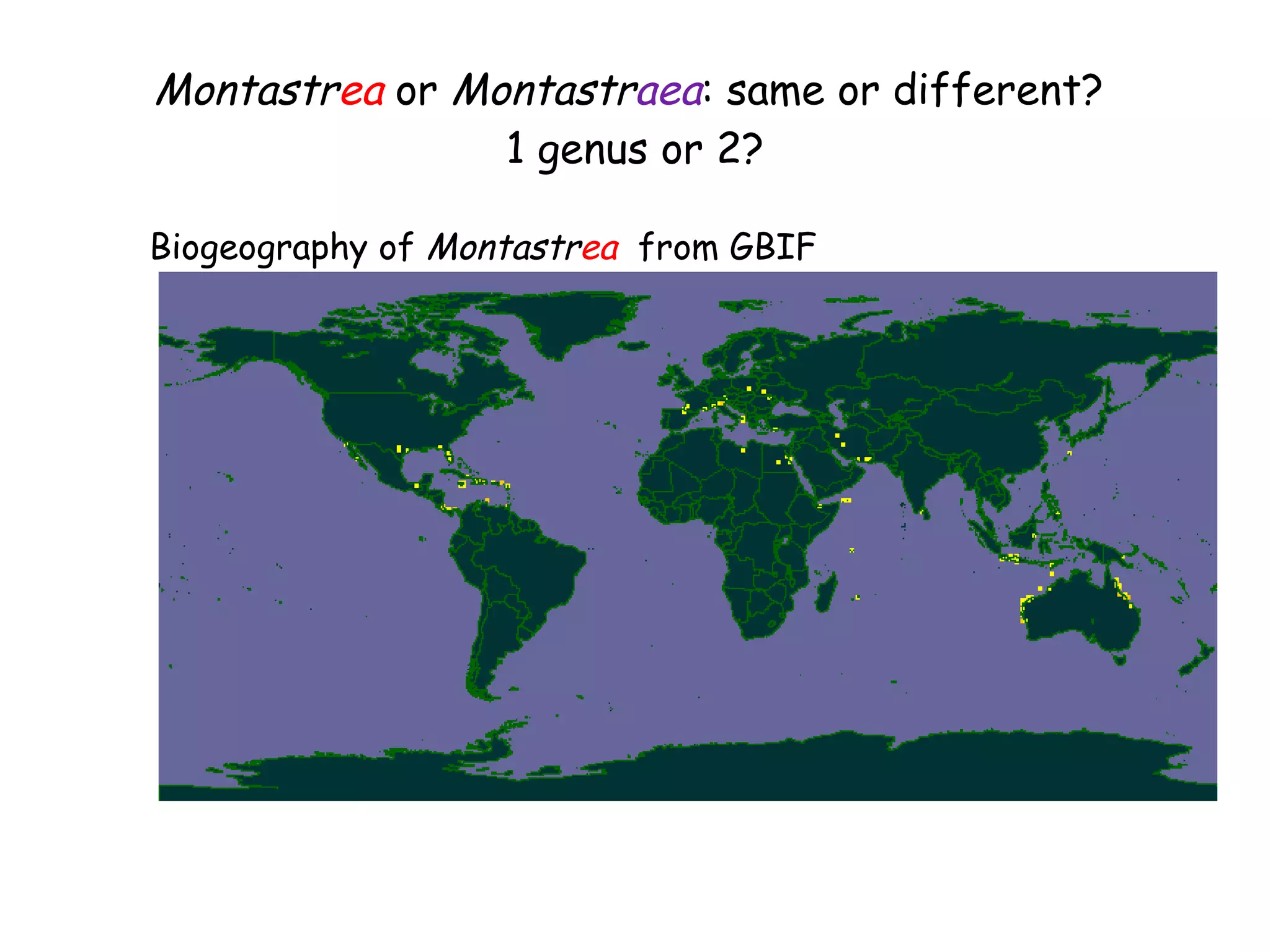
Montastr ea  or  Montastr aea :  same or different?  1 genus or 2? Biogeography of  Montastr ea  from GBIF
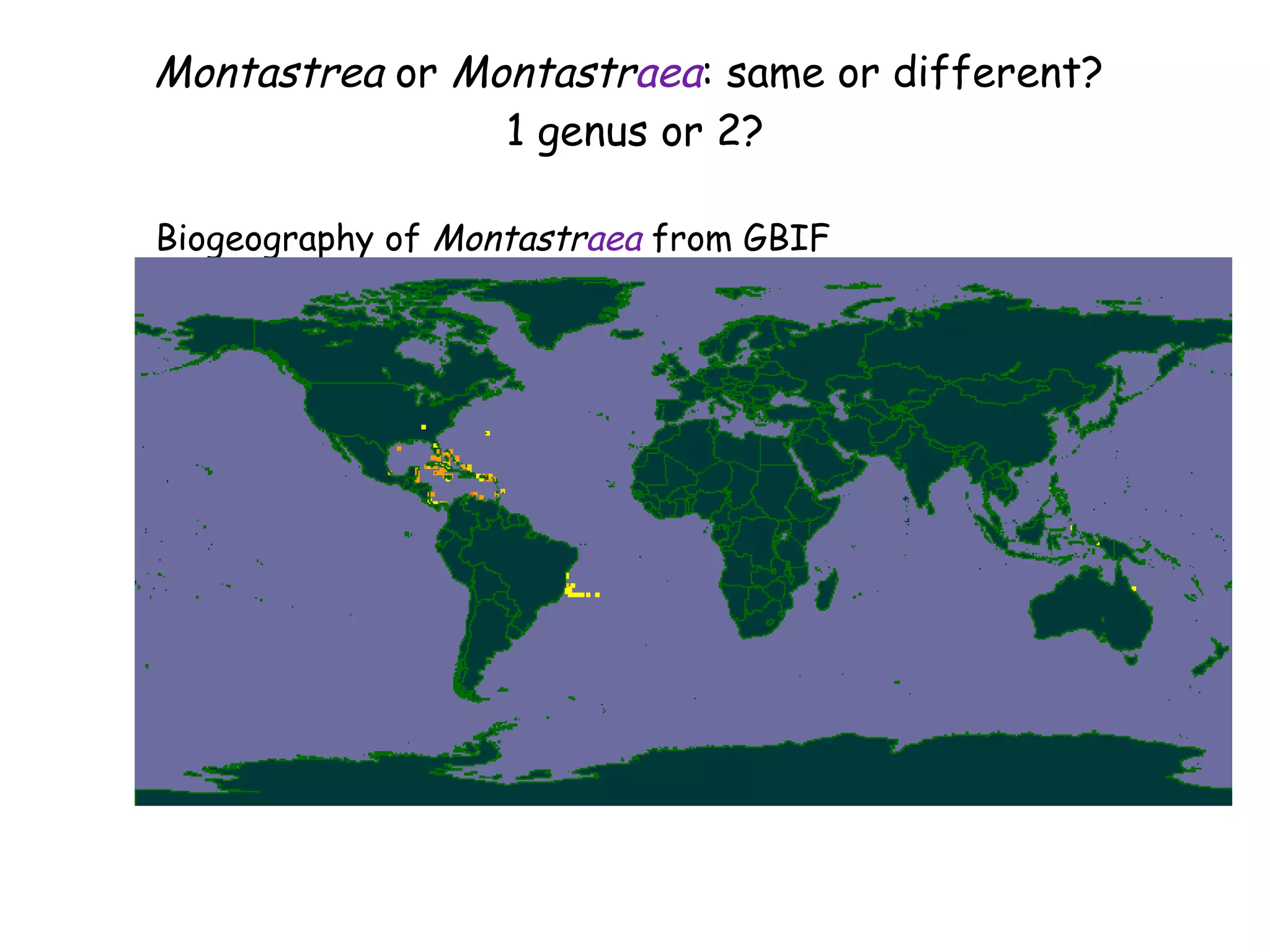
Montastrea  or  Montastr aea : same or different?  1 genus or 2? Biogeography of  Montastr aea  from GBIF
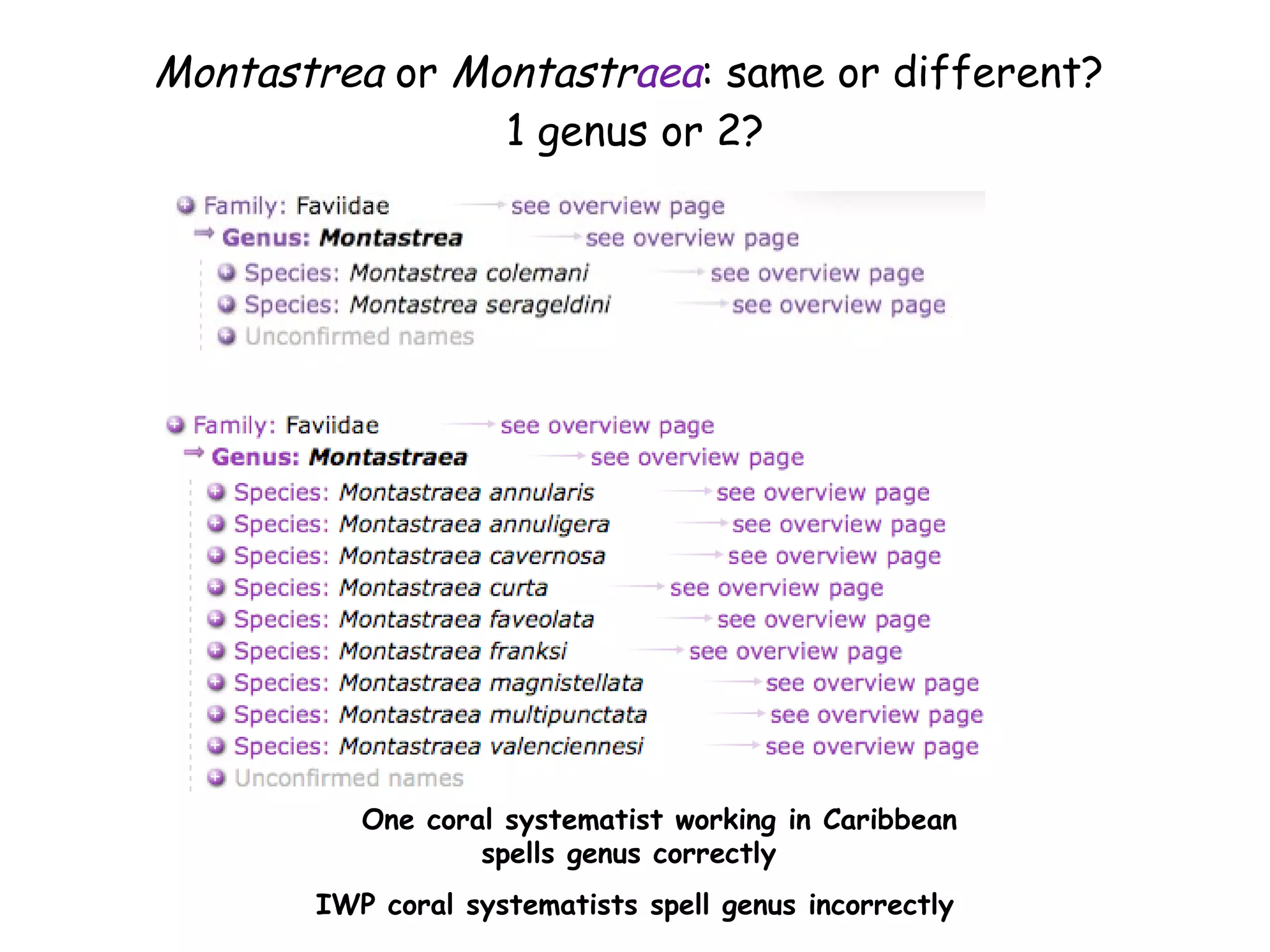
Montastrea  or  Montastr aea : same or different?  1 genus or 2? One coral systematist working in Caribbean spells genus correctly  IWP coral systematists spell genus incorrectly
Questions?
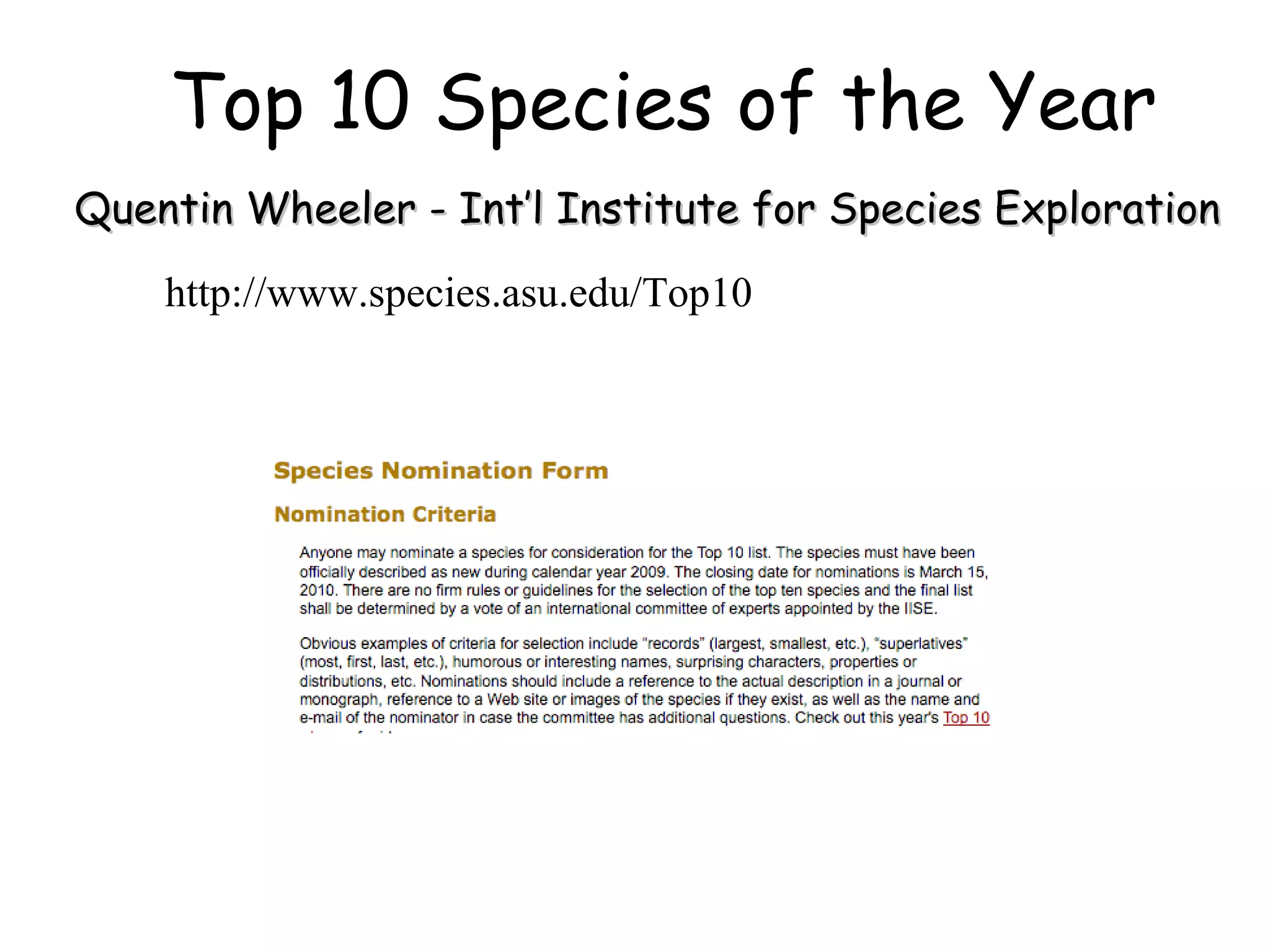
Top 10 Species of the Year Quentin Wheeler - Int’l Institute for Species Exploration http://www.species.asu.edu/Top10
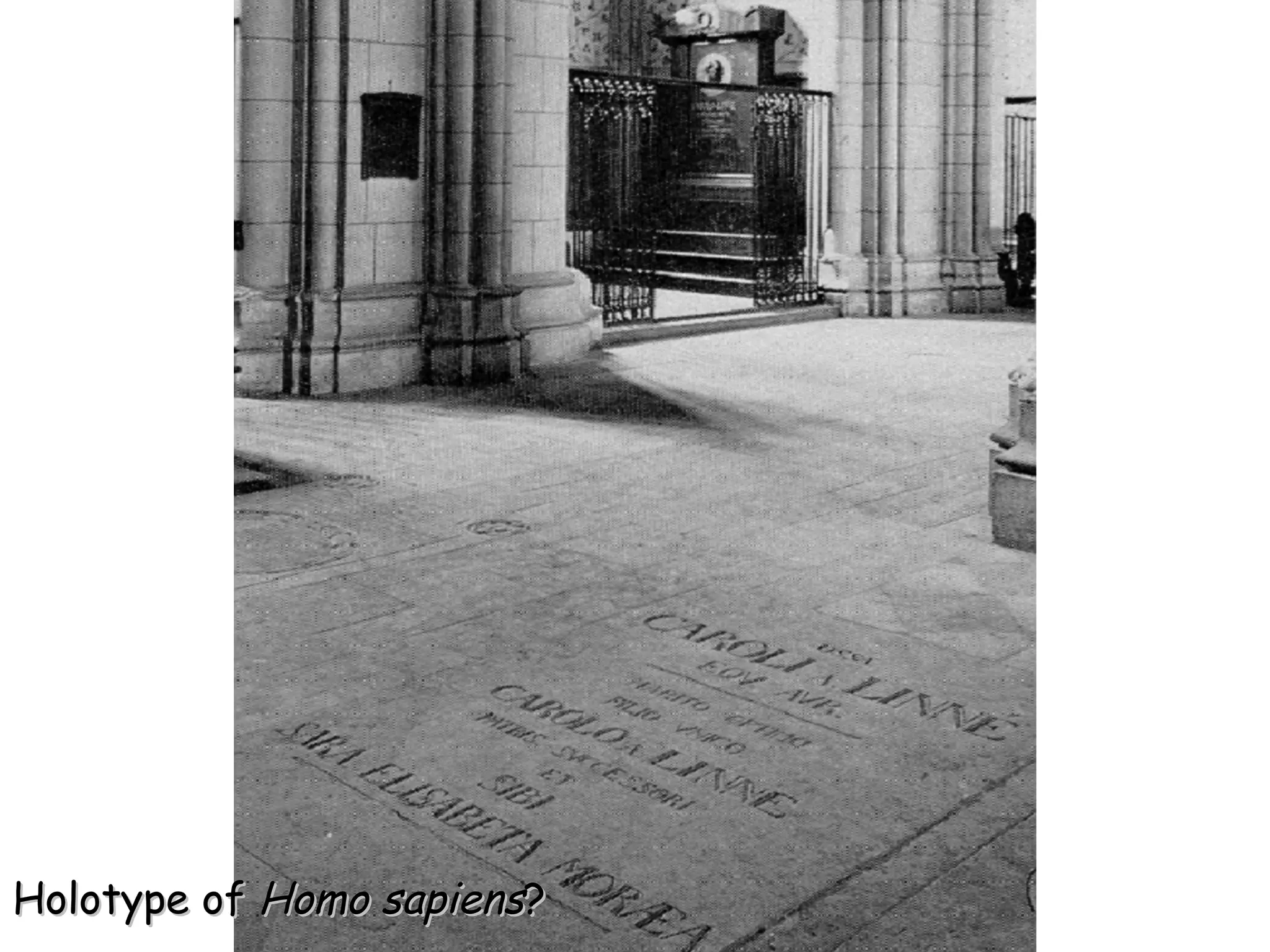
Holotype of  Homo sapiens ?

Introduction to zoological nomenclature and the ICZN

  • 1.
    , Natural HistoryMuseum, London, U.K. iczn@nhm.ac.uk www.iczn.org Ellinor Michel International Commission on Zoological Nomenclature(ICZN) Zoological Nomenclature
  • 2.
    The International Commission on Zoological Nomenclature Present Role: To revise and publish the International Code of Zoological Nomenclature To consider and rule on specific cases of nomenclatural uncertainty in zoology Mandate: ‘Sense & Stability in Animal Names’ Support Convention on Biological Diversity, Decisions adopted by the 4th meeting of the Conference of the Parties (Bratislava, 4-15 May 1998)
  • 3.
    Early codes: Stricklandian(1843 & 1866) Kiesenwetter (1858) Lewis & Sharp (1872-1875) Dall (1878) American Ornithologists’ Union (1886) Blanchard (1889) Deutsche Zoologische Gesellschaft (1894)
  • 4.
    A universal codefor all animals: Commission established: 1895 Publication of the “R è gles”: 1905 1 st International Code: 1961 2 nd : 1964; 3 rd : 1985; 4 th : 1999 5: in the works for 2012
  • 5.
    “ adopted bythe International Union of Biological Sciences” (IUBS - ICSU)
  • 6.
  • 7.
    Ideally, this isa do-it-yourself manual!
  • 8.
  • 9.
  • 10.
  • 11.
    When Trouble Strikes!Take a case to the Commission 28 distinguished scientists from 20 countries Sit judgment on cases
  • 12.
  • 13.
    Where a problemis discovered concerning the naming of animals which can not be dealt with by direct application of the rules of the Code, applicants present an argument , a “Case” which is published in BZN Counter arguments or support ( “Comments” ) are published subsequently The Commission votes on the application and a decision, called an “Opinion” , is then published
  • 14.
    What the ICZNdoesn’t do Make taxonomic decisions Give names to organisms Enforce correct use of names Change names (we make decisions between existing alternatives)
  • 15.
    What the ICZNdoesn’t do Petition To Change Human Beings’ Zoological Name WHEREAS ‘ c o mplex’ describes human beings far more comprehensively than does ‘ s a pient’ and so the Latin complexus describes human beings and differentiates our species from others more accurately than does sapiens ; Whereas human beings act based on names and descriptors, accurate or not, at least as much as on demonstrated reality; Whereas calling themselves by the inaccurate name Homo sapiens promotes and perpetuates an attitude in human beings of their own exceptionalism & superiority; Whereas Carolus Linnaeus acted non-scientifically when he invented the name Homo sapiens – deferring to a belief in human exceptionalism & superiority based on established religion, to avoid persecution due to the lack of legal protection for free speech & thought in his time; Whereas calling themselves by the inaccurate name Homo sapiens and deeming themselves inherently superior to and more worthy of consideration than other beings is a factor in human behavior that unjustly and to humans’ and all other beings’ disadvantage destroys other beings and disrupts Earth’s ecosystems & biosphere; Whereas, as long as the International Commission on Zoological Nomenclature and the scientific community generally sanctions use of the Homo sapiens for human beings, those who strive to teach ecology and ethics and to reverse ecologically destructive behavior and its consequences will be in the untenable position of referring to the beings perpetuating such behavior as sapient; Whereas recognizing hyper-complexity rather than sapience as their distinguishing trait, human beings will be more likely to establish a less-unjust and less-destructive relationship to other beings and the rest of nature than they have wrought to date; Whereas the International Commission on Zoological Nomenclature is accepted worldwide as the authority on species names and therefore is in a position to change human thought and behavior for the better by giving our species a more accurate name; THEREFORE, Responsible Policies for Animals, Inc., located in Glenside, Pennsylvania, USA, with members and supporters throughout the human world, urges the International Commission on Zoological Nomenclature, c/o The Natural History Museum, Cromwell Road, London SW7 5BD, UK, to change human beings’ species name to Homo complexus and to announce this change to the scientific community and to the human world generally. Respectfully submitted this 5th Day of August, 2008. THEREFORE, Responsible Policies for Animals, Inc., located in Glenside, Pennsylvania, USA, with members and supporters throughout the human world, urges the International Commission on Zoological Nomenclature, c/o The Natural History Museum, Cromwell Road, London SW7 5BD, UK, to change human beings’ species name to Homo complexus and to announce this change to the scientific community and to the human world generally. Respectfully submitted this 5th Day of August, 2008.
  • 16.
    The Code Criteria& Principles Online: www.iczn.org/iczn/index.jsp Code of Ethics General Recommendations
  • 17.
    The Code: Criteria& Principles Criteria of Publication Criteria of Availability Principle of Priority Principle of Coordination Principle of Homonymy Principle of Typification Code of Ethics General Recommendations
  • 18.
    Code of Ethics:“ 4. No author should propose a name that, to his or her knowledge or reasonable belief, would be likely to give offence on any grounds. 5. Intemperate language should not be used in any discussion which involves zoological nomenclature, and all debates should be conducted in a courteous and friendly manner” General Recommendations: 5. “New names should be in latin form; they should be euphonious and easily memorable……”
  • 19.
    The Code: Namewise– anything goes
  • 20.
    The Code: Namewise– anything goes (almost)
  • 21.
    Carolus Linnaeus 1707-1778The founder of binominal / binomial organismal nomenclature Primarily a botanist Set a bad example for generations of biologists? Principles of orderliness & amusement?
  • 22.
    Phallus impudicus Linnaeus, 1753
  • 23.
    Clitoria ternatea Linnaeus, 1753
  • 24.
    Johan Sigesbeck publisheda diatribe criticising Linnaeus. Linnaeus’s chose a small-flowered weedy composite to bear the name “Sigesbeckia” Retaliation?
  • 25.
    Alexandre Arsene Girault (1884-1941) Shillingsworthia shillingsworthi Mozartella beethoveni Homo perniciosus
  • 26.
    Cornelius Becker Philip (1900-1987) Chrysops balzaphire Tabanus rhizonshine Trombicula fujigmo
  • 27.
    Cornelius Becker Philip (1900-1987) Chrysops balzaphire Tabanus rhizonshine Trombicula f u j i g m o u a o y r c c t d k k e r s
  • 28.
    James Mark Brennan (1905-1984) Trombicula doreme … .fasolla … tido
  • 29.
    Orsonwelles Hormiga(a fat spider) Pinocchio Pagliano & Scaramozzino (a wasp) Lucifer Doderlein (a fish) Satan Hubbs & Bailey (a catfish)
  • 30.
    Abra cadabra Eames & Wilkins (a bivalve) Agra phobia Irwin (a beetle) Ohmyia omya Thompson (a fly)
  • 31.
    Pieza kake Piezapi Pieza rhea Pieza deresistans For more curious scientific names: http://cache.ucr.edu/~heraty/yanega.html#Curious%20Scientific%20Names
  • 32.
    Record Setters LongestGenus Name Gammaracanthuskytodermogammarus Dybowski (an amphipod) Longest Genus and Species Name Brachyta interrogationis interrogationis var. nigrohumeralisscutellohumeroconjuncta Plavilstshikov (a cerambycid beetle) Shortest Genus and Species Combination Ia io Thomas (a bat)
  • 33.
    Offensive Names? Anophthalmushitleri Scheibel, 1937 a blind cave-dwelling beetle named as an honorific by a Nazi taxonomist
  • 34.
    Offensive Names? ‘Followers of Hitler are hunting them so vigorously for mementos that the species is like to become extinct. Martin Bähr, an entomologist at the Zoological State Collection in Munich, said: “There has been a run on these creatures. Collectors are scouring their natural habitat for them. Almost all of our specimens at the museum have been stolen.”’ Telegraph, November 2006
  • 35.
    Offensive Names? Agathidiumbushi Miller & Wheeler 2005 Agathidium cheneyi Miller & Wheeler 2005 Agathidium rumsfeldi Miller & Wheeler 2005 - slime-mould beetles
  • 36.
    Agathidium bushi Miller & Wheeler Agathidium cheneyi Miller & Wheeler Agathidium rumsfeldi Miller & Wheeler - slime-mould beetles
  • 37.
    Criteria of PublicationCriteria of Availability Principle of Priority Principle of Coordination Principle of Homonymy Principle of Typification Zoological Code: Criteria & Principles
  • 38.
  • 39.
  • 40.
  • 41.
  • 42.
  • 43.
    Criteria of PublicationCriteria of Availability Principle of Priority Principle of Coordination Principle of Homonymy Principle of Typification Zoological Code: Criteria & Principles
  • 44.
    Criteria of AvailabilityZoological Code: Criteria & Principles
  • 45.
    Criteria of AvailabilityZoological Code: Criteria & Principles
  • 46.
    Criteria of PublicationCriteria of Availability Principle of Priority Principle of Coordination Principle of Homonymy Principle of Typification Zoological Code: Criteria & Principles
  • 47.
    Principle of Prioritythe oldest name has priority Senior synonym Junior synonym Objective synonym Subjective synonym Zoological Code: Criteria & Principles
  • 48.
    Starting point ofzoological nomenclature: 1758 –
  • 49.
    International Code ofZoological Nomenclature 3 rd Ed. (1985) Starting point of zoological nomenclature: 1758 – except…
  • 50.
    Principle of PriorityPrinciple of the First Reviser If two or more items have the same date of publication, the first subsequent author who deals with the matter, makes a choice and publishes the decision in the required manner, the First Reviser, is to be followed. [Art. 24.2]. Zoological Code: Criteria & Principles
  • 51.
    Criteria of PublicationCriteria of Availability Principle of Priority Principle of Coordination Principle of Homonymy Principle of Typification Zoological Code: Criteria & Principles
  • 52.
    Principle of Coordinationthe act of publishing a new zoological name thereby automatically and simultaneously establishes all the corresponding names in the relevant other ranks, with the same type Zoological Code: Criteria & Principles
  • 53.
    Challenges in thepresent Code: Principle of Typification DEAD or ALIVE?
  • 54.
    Principle of TypificationArticle 16.4.2: authors of new taxa must publish a statement of intent that extant types will be deposited in a collection Article 73.1.4 “Designation of an illustration of a single specimen as a holotype is to be treated as designation of the specimen illustrated; the fact that the specimen no longer exists or cannot be traced does not of itself invalidate the designation.” Challenges in the present Code:
  • 55.
    Principle of TypificationThe Article, as formulated, thereby permits the description of threatened animals or those for whom the collection of specimens is otherwise impractical, impossible, or unethical. Challenges in the present Code:
  • 56.
    Ichnotaxa Challenges inthe present Code:
  • 57.
    Thalassinoides burrows produced by crustaceans, from the Middle Jurassic, Makhtesh Qatan, southern Israel. Helminthopsis ichnosp. a trace fossil from the Logan Formation (Lower Carboniferous) of Wooster, Ohio. Ichnotaxa
  • 58.
  • 59.
    Ambiregnal organisms photosynthesizing= plant non-photosynthesizing = animal Challenges in the present Code:
  • 60.
  • 61.
  • 62.
    Ambiregnal organisms (+Principle of Typification) Challenges in the present Code:
  • 63.
    Criteria of publicationelectronic-only publication Challenges in the present Code:
  • 64.
    Other problems withthe present Code: Alternative Languages
  • 65.
    The Code isan evolving document New edition under construction now for publication in 2012 (ah, right, lets get busy!)
  • 66.
    Homonyms & SynonymsArticle 53.2. Homonyms in the genus group. In the genus group, two or more available names established with the same spelling are homonyms. Article 60.2. Junior homonyms with synonyms. If the rejected junior homonym has one or more available and potentially valid synonyms, the oldest of these becomes the valid name of the taxon with its own authorship and date.
  • 67.
    Homonyms & SynonymsDiscovered (by Europeans) 1798 Described as Platypus anatinus Shaw, 1799 Platypus , is Latin derived from the Greek words π λατύς ("platys", flat, broad) and π ους ("pous", foot), meaning "flat foot", and anatinus means "duck-like" in Latin.
  • 68.
    Homonyms & SynonymsA homonym was quickly discovered Platypus for the ambrosia beetle was established by Herbst, 1793 Platypus Shaw, 1799 is a junior homonym of Platypus Herbst, 1793. Which one is the Platypus ?
  • 69.
    Homonyms & SynonymsIndependently described as Ornithorhynchus paradoxus Blumenbach, 1800. Ornithorhynchus is derived from ορνιθόρυνχος ("ornithorhynkhos"), which literally means "bird snout" in Greek.
  • 70.
    Homonyms & SynonymsOrnithorhynchus Blumenbach, 1793 is a junior synonym of Platypus Shaw, 1799, therefore the correct name for the genus is Ornithorhynchus Blumenbach, 1800. . But the correct name for the species is Ornithorhynchus anatinus (Shaw, 1799).
  • 71.
    Homonyms & SynonymsArticle 53.2. Homonyms in the genus group. In the genus group, two or more available names established with the same spelling are homonyms. Platypus Shaw, 1799 is a junior homonym of Platypus Herbst, 1793, so is rejected. Article 60.2. Junior homonyms with synonyms. If the rejected junior homonym has one or more available and potentially valid synonyms, the oldest of these becomes the valid name of the taxon with its own authorship and date. Ornithorhynchus Blumenbach, 1800 is a junior synonym of Platypus Shaw, 1799, so steps in to fill the gap. (and the species name from Shaw, 1799, stays alive)
  • 72.
    Homonyms Article 52.1.Statement of the Principle of Homonymy:   When two or more taxa are distinguished from each other they must not be denoted by the same name. Article 52.2. Operation of the Principle of Homonymy. When two or more names are homonyms, only the senior, as determined by the Principle of Priority may be used as a valid name.
  • 73.
    Homonyms Fairmaire (1869)established the name Syntarsus Fairmaire for a genus of beetle (Coleoptera, Zopheridae) Type species of Syntarsus is Syntarsus asperulus Fairmaire, 1869 designated by Dajoz 1980 for a colydiine from Madagascar.
  • 74.
    Homonyms One hundredyears later, Raath (1969) named a genus of coelurosaurian dinosaur Syntarsus Raath, 1969 Type Species: Syntarsus rhodesiensis Raath, 1969 from the Triassic of Zimbabwe. An additional species Syntarsus kayentakatae Rowe, 1989 described from the Jurassic of Arizona
  • 75.
    Homonyms ‘ Syntarsus’ was used as the name of the in-house journal of the National Museums and Monuments of Zimbabwe. This homonymy had gone unnoticed until…. Megapnosaurus Ivie, Slipinski & Wegrzynowicz, 2001 proposed (Greek: megas (big) apnos (dead) and sauros (lizard)) as a replacement name … . in an entomological journal INSECTA MUNDI
  • 76.
    Name changes canbe contentious “ 'Big dead lizard' is named and shamed Entomologist Michael Ivie says that his new name for the dinosaur formerly known as Syntarsus was meant as a joke. But his choice of Megapnosaurus , which means 'big dead lizard', has not amused palaeontologists. Ivie, based at Montana State University in Bozeman, renamed Syntarsus after realizing that a beetle discovered in 1869 already had the same name. Following recognized taxonomy guidelines, Ivie issued a correction and attempted to inform the discoverer of Syntarsus , Mike Raath of the University of the Witwatersrand in Johannesburg. But palaeontologists were not impressed. Some pointed out that the name is inaccurate, as Syntarsus was not big by dinosaur standards, and others have disputed Ivie's right to rename it. The controversy highlights problems with duplicate names. Thousands of biological species are thought to share the same names, and a recent paper (J. Alroy, Proceedings of the National Academy of Sciences ; 10.1073/pnas.062691099; 2002) suggests that this and other taxonomy problems may have led to overestimates of global diversity. Nature 416, 21 March 21, 2002
  • 77.
    Name changes canbe contentious MEDIA COVERAGE “ Entomogist's name change bugs paleontologists “ - USA Today”, March 11, 2002 “ Beetle beats Jurassic dinosaur” – CSIRO media release, 12 May, 2002 Big dead lizard' is named and shamed – Nature 416, 21 March 21, 2002
  • 78.
    Name changes canbe difficult to enforce Inexplicably, the name Syntarsus is still commonly in use for the dinosaur e.g. on the website site of the Natural History Museum www.nhm.ac.uk /.../ detail.dsml?Genus = Syntarsus which says: “ Taxonomy: Dinosauria, Saurischia, Theropoda, Neotherapoda, Ceratosauria, Coelophysoidea, Coelophysidae, Syntarsus Named by: Raath (1969) Type species: rhodesiensis Other names used: Megapnosaurus Ivie, Slipinsky & Wegrzynowicz (2001), Syntarsus colberti Hunt & Lucas 1991= Coelophysis bauri Other species: S. kayentakatae Rowe 1989 ”
  • 79.
    Challenging taxa Article1.2. Scope Article 1.2.1. The scientific names of extant or extinct animals include names based on domesticated animals , names based on fossils that are substitutions (replacements, impressions, moulds and casts) for the actual remains of animals, names based on the fossilized work of organisms (ichnotaxa), and names established for collective groups.
  • 80.
    Challenging taxa RingedDove Streptopelia roseogrisea/risoria - domestic and wild forms : one species with two names
  • 81.
    Challenging taxa RingedDove Streptopelia risoria/roseogrisea - domestic and wild forms : one species with two names Columba risoria (ringed dove, ringed turtle-dove or barbary dove) was described by Linnaeus (1758) … and later transferred to the genus Streptopelia by Bonaparte (1855). Columba roseogrisea (African collared dove) was described by Sundevall (1857)
  • 82.
    Challenging taxa RingedDove Streptopelia risoria/roseogrisea - domestic and wild forms : one species with two names Streptopelia risoria (Linnaeus, 1758) Streptopelia roseogrisea (Sundevall, 1857)
  • 83.
    Challenging taxa RingedDove Streptopelia risoria/roseogrisea - domestic and wild forms : one species with two names Streptopelia risoria (Linnaeus, 1758) Streptopelia roseogrisea (Sundevall, 1857) Domestic Wild morphology interbreeding
  • 84.
    Challenging taxa RingedDove Streptopelia risoria/roseogrisea - domestic and wild forms : one species with two names Streptopelia risoria (Linnaeus, 1758) Streptopelia roseogrisea (Sundevall, 1857) Domestic Wild Senior synonym, but… ICZN requested to use its plenary power to rule that the name Columba roseogrisea Sundevall, 1857 is not invalid by virtue of being pre-dated by a name based on the domestic form Columba risoria Linnaeus 1758.
  • 85.
    Challenging taxa Article1.2. Scope Article 1.2.1. The scientific names of extant or extinct animals include names based on domesticated animals , names based on fossils that are substitutions (replacements, impressions, moulds and casts) for the actual remains of animals, names based on the fossilized work of organisms (ichnotaxa), and names established for collective groups. Columba roseogrisea Sundevall, 1857 could be made invalid by Columba risoria Linnaeus 1758 - commission intervention sought This is the situation for many domestic-wild comparisons - cats, dogs, camels, llamas, cattle, etc. Loss of information if these names are synonyomized.
  • 86.
    Homonyms Article 52.1.Statement of the Principle of Homonymy:   When two or more taxa are distinguished from each other they must not be denoted by the same name. Article 52.2. Operation of the Principle of Homonymy. When two or more names are homonyms, only the senior, as determined by the Principle of Priority may be used as a valid name. Syntarsus Raath, 1969, the dinosaur, must give way to Syntarsus Fairmaire, 1869, the beetle.
  • 87.
    Stability: Usage vs.Priority Article 23.2. Purpose. In accordance with the objects of the Code the Principle of Priority is to be used to promote stability and it is not intended to be used to upset a long-accepted name in its accustomed meaning by the introduction of a name that is its senior synonym or homonym.
  • 88.
    Glyptodon Owen1839 Megatherium Cuvier, 1796 Stability: Usage vs. Priority The saga of how this nearly lost its name to one of these in 2005…
  • 89.
    Stability: Usage vs.Priority Megatherium Cuvier, 1796 Weiss (1830) found some fossils which he assigned to Megatherium Cuvier, 1796 Geoffroy Saint-Hilaire (1833) decided they were not Megatherium and established the name Lepitherium for the these remains D’Alton (1834) recognized that they do not belong to anything like a Megatherium
  • 90.
    Stability: Usage vs.Priority meanwhile Glyptondon was getting off to a rough start…. Owen in Parish (1838) gave the name Glyptodon to a genus primarily based on an isolated indeterminable tooth. As the tooth has been lost this name is generally considered as a nomen dubium ( impossible to determine whether a specimen belongs to that group or not) . (In fact, this tooth probably belonged to what is currently known as Panochthus Burmeister, 1866, so not a glyptodon at all.) ? ? ? ? ? ?
  • 91.
    Stability: Usage vs.Priority Owen (1839) established the name Glyptodon clavipes for a tooth and part of the skeleton of an impressive fossil animal from Argentina. Glyptodons are now widely recognized…
  • 92.
    Stability: Usage vs.Priority The name problem: The name Lepitherium Geoffroy Saint-Hilaire, 1833 is the earliest available name for what is now recognized as a glyptodont. Stability would be threatened if the priority of Lepitherium Geoffroy Saint-Hilaire, 1833 is maintained over Glyptodon Owen 1839. In order to conserve the name Glyptodon Owen, 1839 it is proposed that the names Glyptodon Owen in Parish, 1838 and Lepitherium Geoffroy Saint-Hilaire, 1833 be suppressed.
  • 93.
    Stability: Usage vs.Priority Article 23.2. Purpose. In accordance with the objects of the Code the Principle of Priority is to be used to promote stability and it is not intended to be used to upset a long-accepted name in its accustomed meaning by the introduction of a name that is its senior synonym or homonym. Lepitherium Geoffroy Saint-Hilaire, 1833 is suppressed so Glyptodon Owen in Parish, 1838, can continue to be used
  • 94.
    Stability: Usage vs.Priority The Giant River Prawn Macrobrachium rosenbergii (De Man, 1879) One of the most commercially important crustaceans in the world: Widely fished in South and Southeast Asia Extensively cultured in Asia, America and Africa . . The overall production is 205,033 tons with a net value of US$896,263,000. In the last decade, average M. rosenbergii production rose by some 35% in quantity and almost 20% in value .
  • 95.
    Stability: Usage vs.Priority First recorded in Southeast Asia by Rumphius (1705) Before Linnaeus’ Systema Naturae (1758), thus does not provide nomenclatural priority Macrobrachium rosenbergii (De Man, 1879)
  • 96.
    Stability: Usage vs.Priority De Man (1879) described Palaemon carcinus var. rosenbergii from Andai, New Guinea (today Papua, Indonesia ) on the basis of a single female. He believed it to be only a ‘variety’ (nowadays - subspecies) of P. carcinus Linnaeus, 1758 (American species). Macrobrachium rosenbergii (De Man, 1879)
  • 97.
    Stability: Usage vs.Priority Sunier (1925) showed that P. carcinus is a species in America only, proposed Palaemon dacqueti Sunier, 1925, for specimens from the Indo-West Pacific with Java as a type locality. Cowles (1914) noted 2 distinct forms in Indian and Philippine material, but continued to use the name P. carcinus for both.
  • 98.
    Stability: Usage vs.Priority Types for: dacqueti rosenbergii M. dacqueti M.rosenbergii
  • 99.
    Stability: Usage vs.Priority THE BIG PROBLEM: The species of prawn that is predominantly fished, cultured and studied by biologists is the one to the WEST of Huxley’s Line and is defined by a specimen (lectotype) of Macrobrachium dacqueti , but is universally known as Macrobrachium rosenbergii . A series of other nomenclatural changes at the subspecific level have taken place in the meantime, but in a nutshell it has become clear there are 2 species, one in aquaculture, from different parts of the region.
  • 100.
    Stability: Usage vs.Priority Substantial confusion will result if the names are changed. Surprising proposal: set aside the holotype of Macrobrachium rosenbergii (De Man, 1879) and designate the lectotype of Macrobrachium dacqueti (Sunier, 1925) as neotype of Macrobrachium rosenbergii in its place. M. dacqueti M.rosenbergii
  • 101.
    Stability: Usage vs.Priority If the Commission votes FOR the proposal The name M. rosenbergii will be retained for the commercially valuable species. The name Macrobrachium dacqueti will be taken out of circulation. For the species defined by the current holotype of M. rosenbergii , a new name has been proposed: Macrobrachium wallacei (Wowor & Ng).
  • 102.
    Stability: Usage vs.Priority M.rosenbergii M. wallacei If the Commission votes FOR the proposal The name M. rosenbergii will be retained for the commercially valuable species. The name Macrobrachium dacqueti will be taken out of circulation.
  • 103.
    Stability: Usage vs.Priority Article 23.2. Purpose. In accordance with the objects of the Code the Principle of Priority is to be used to promote stability and it is not intended to be used to upset a long-accepted name in its accustomed meaning by the introduction of a name that is its senior synonym or homonym.
  • 104.
    Stability: Usage vs.Priority Separation of Nomenclature & Taxonomy Drosophila Fallen, 1832 new results suggest the genus is paraphyletic splitting the genus will bring Sophophora Sturtevant, 1939 back to valid generic use (among others) guess who won’t be in the remaining Drosophila ?! ‘ Sophophora melanogaster’! Drosophilia melanogaster is the type species for Sophophora Sturtevant 1939
  • 105.
    Stability: Usage vs.Priority Separation of Nomenclature & Taxonomy Is Drosophila melanogaster Meigen, 1830 so important that it should be designated as the type species for the genus?
  • 106.
    Stability: Usage vs.Priority Separation of Nomenclature & Taxonomy
  • 107.
    Stability: Usage vs.Priority Separation of Nomenclature & Taxonomy Yellow Fever and Dengue vector mosquitos Aedes aegypti changed to Stegomya aegypti Valid change under ICZN rules by Reinert et al. 2004
  • 108.
    Stability: Usage vs.Priority Separation of Nomenclature & Taxonomy Yellow Fever and Dengue vector mosquitos Aedes aegypti changed to Stegomya aegypti
  • 109.
    Stability: Usage vs.Priority Separation of Nomenclature & Taxonomy
  • 110.
    Nomenclature and biodiversityinformatics: what are the data we use to get ‘the big patterns for the big questions’?
  • 111.
    Nomenclature and biodiversityinformatics: a common pantropical reef coral A species search engine iSpecies is a test of E O Wilson's idea of a web page for each species. The data displayed are generated "on the fly" by querying other data sources ( learn how it works ). Send comments to r. [email_address] . gla .ac. uk , or visit the iSpecies blog . Search: Montastrea Yahoo tags stable isotopes trace metals zooxanthellae environmental regulation biomass florida keys reef coral montastrea caribbean reproduction Genomics from NCBI TaxId: 48497  Montastraea [stony corals] Sequences: 4222 nucleotide, 206 protein Barcodes of Life Global Biodiversity Information Facility Hexacorallians of the World Integrated Taxonomic Information System Global Biodiversity Information Facility Nomenclator Zoologicus Map from GBIF Images from Yahoo Articles from Google â € ¦ of prolonged  “ bleaching ” on the tissue biomass and reproduction of the reef coral Montastrea â € ¦ â € ¦ : Physiological and Environmental Regulation of Stable Isotopes and Trace Metals in Montastrea â € ¦ Growth and form in the reef-building coral Montastrea annularis Reduced growth rate of Montastrea annularis following the 1987 – 1988 coral-bleaching event Recovery of the coral Montastrea annularis in the Florida Keys after the 1987 Caribbean  “ bleaching â € ¦ Depth-dependent photoadaption by zooxanthellae of the reef coral Montastrea annularis View My Stats ispecies search : Montastrea
  • 112.
    Montastr ea or Montastr aea : same or different? 1 genus or 2? Biogeography of Montastr ea from GBIF
  • 113.
    Montastrea or Montastr aea : same or different? 1 genus or 2? Biogeography of Montastr aea from GBIF
  • 114.
    Montastrea or Montastr aea : same or different? 1 genus or 2? One coral systematist working in Caribbean spells genus correctly IWP coral systematists spell genus incorrectly
  • 115.
  • 116.
    Top 10 Speciesof the Year Quentin Wheeler - Int’l Institute for Species Exploration http://www.species.asu.edu/Top10
  • 117.
    Holotype of Homo sapiens ?