Name Registration: One Less Impediment to
Taxonomy
Jim Woolley
Texas A&M University
Revolutionising taxonomy through an open-access web-register for
animal names and descriptions
ESA Program Symposium
December, 2005
• Collecting
• Preparation of
specimens
• Study of specimens
• Revisions, monographs
• Access to literature
• New Technologies
A Renaissance in Systematics
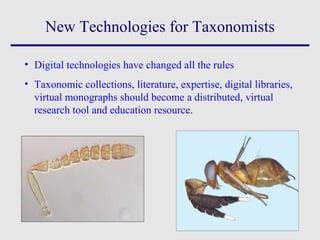
• Digital technologies have changed all the rules
• Taxonomic collections, literature, expertise, digital libraries,
virtual monographs should become a distributed, virtual
research tool and education resource.
New Technologies for Taxonomists
• Web-based - Web provides a single, global point of access
• Distributed - eg > 350 web sites for Lepidoptera
• Authoritative - need Electronic Catalog of Life
• Accessible to multiple audiences
• Relevant to societal concerns - natural resource
management, invasive species, agriculture, medicine etc.
• Taxonomic publications should not be end points, but
“version control” devices
The New Taxonomy
(thanks to Malcolm Scoble, Natural History Museum)
• Lack of funding
• Funding for taxonomy is insufficient
• Most funding for systematics is devoted to constructing
molecular phylogenies, not taxonomy
• Not enough taxonomists
• Taxonomy is too difficult to learn and to practice
•Requires years to accumulate literature, specimens etc.
• Critical resources are scattered and available to only a few
workers
•Literature
•Museum specimens
• There are few centralized sources of information
Impediments to The New Taxonomy
• Planetary Biodiversity Inventory (PBI)
• Global assaults on taxonomy of
major groups
• RevSys - Revisionary Syntheses in
Systematics
• Species-level treatments
• Develop new methodologies for
revisionary work
• PEET - Partnerships for Enhanced
expertise in Taxonomy
• Long-term monographic research
• Major training component
NSF has recognized the funding issues
ZOOBANK
• ZOOBANK will go a long way towards
providing centralized sources of
information
• We may quibble about the details and plan
for implementation
• But this is really essential for progress
“The Atkins Report”
• Daniel Atkins,
University of
Michigan
• 8 other authors
from academia
and industry
Atkins Report
• “The Panel’s overarching finding is that a
new age has dawned in scientific and
engineering research,
• pushed by continuing progress in
computing, information, and
communication technology,
• and pulled by expanding complexity, scope
and scale of today’s challenges”
Atkins Report
• The capacity of this technology has crossed
thresholds that now make possible a
comprehensive “cyberinfrastructure”
• on which to build new types of scientific
and engineering knowledge environments
and organizations,
• and to pursue research in new ways and
with increased efficiency
Atkins Report
• use cyberinfrastructure to build more ubiquitous, comprehensive
digital environments
• interactive and functionally complete for research communities
in terms of people, data, information, tools, and instruments
• operate at unprecedented levels of computational, storage, and
data transfer capacity
Cyberinfrastructure will include
• grids of computational centers, some with
computing power second to none
• comprehensive libraries of digital objects including
programs and literature
• multidisciplinary, well-curated, federated
collections of scientific data
• thousands of on-line instruments and sensor arrays,
• convenient software toolkits for resource, discovery,
modeling and interactive visualization
• ability to collaborate with physically distributed
teams of people using all of these capabilities
Atkins Report
• many contemporary projects require
effective federations
• distributed resources (data and facilities)
• distributed, multidisciplinary expertise
• (harvest of legacy data)
Virtual Science Communities
• National Ecological Observatory Network
(NEON)
• National Virtual Observatory (NVO)
• Space Physics and Aeronomy Research
Collaboratory (SPARC)
• Grid Physics Network (GriPhyN)
• Biomedical Informatics Research Network
(BIRN)
• National Science Digital Library (NDSL)
• Workshop to Produce Decadal Vision for Taxonomy and
Natural History Collections, Gainesville, November 2003
• Development of a National Systematics Infrastructure: A
Virtual Instrument for the 21st
Century, New York Botanical
Garden, December 2003
• Workshop to Establish a Comprehensive Database for Plant
Systematics, Gainesville, December 2003
• Biological Image Database Workshop, Tallahassee, Florida,
September 2004
Recent Workshops Sponsored by NSF
A BIODIVERSITY OBSERVATORY
LINNÉ
LEGACY INFRASTRUCTURE NETWORK
FOR NATURAL ENVIRONMENTS
Each collection or taxonomic research facility is potentially a
node of a NATIONAL CYBERLABORATORY
•Each node will contribute
its own particular strengths
to the network
•(e.g., taxonomic or
geographic uniqueness,
unique instrumentation)
•The resources of each node
will be available to all
nodes
•(e.g., specimens, images,
literature, DNA data)
Implementation of LINNE will
• Modernize the national infrastructure for taxonomic
research
– high resolution 2D and 3D surface and internal scanning using computer
tomography
– Remote-controlled, digital microscopy
– Comprehensive digital libraries
• Modernize collection facilities
• Provide comprehensive access to taxonomic and
collections information, worldwide
• Provide new tools for education and outreach
Virtual Research Platform
• Remove the ‘taxonomic
impediment’
• See across historical and
geological time,
continents and seas,
species and clades,
ontogenetic paths &
ecosystems.
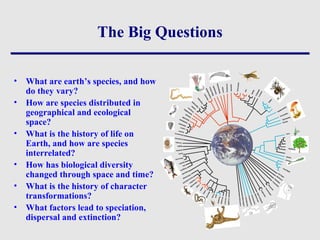
The Big Questions
• What are earth’s species, and how
do they vary?
• How are species distributed in
geographical and ecological
space?
• What is the history of life on
Earth, and how are species
interrelated?
• How has biological diversity
changed through space and time?
• What is the history of character
transformations?
• What factors lead to speciation,
dispersal and extinction?
Is the vision impossibly grand?
• Virtually all of the
necessary technology
is is already in place or
will be in the next few
years
• Many national and
international activities
are already underway
Key Activities Related to
Collections and Bioinformatics
•SEEK
•NESCent
•CIPRES
•Species Analyst
•MaNIS
•HerpNET
•FishNetII
•ORNIS
•ENHSIN
•BioCASE
•BioCISE
•MaPSTEDI
•DiGIR
•Specify
•BioGeoMancer
•Species2000
•ITIS
•TDWG
•OBIS
•uBIO
•IPNI
•DRSC
•Index
Herbariorum
•PBI
•ERIN
•CONABIO
•CBIN
•CHM
•WDC
•IABIN
•PBIF
•CBOL
•MorphBank
•MorphoBank
•Digimorph
•and ???
•Zoobank
•NBII
•GBIF
•Synthesys
•EBNI
•CHRONOS
•NEON
•NSCA
• Linking databases, informatics products and analytical
tools for data sharing among governmental agencies,
NGO’s, academic institutions and industry
• At intersection of science, policy and applications
• 47 member countries
• Access - move data not people
• Diversity - access to all types of data
• Taxonomic Standards - need Electronic Catalog of
Life
• Data Quality - data cleaning tools
• Interoperability - global identifiers for specimens,
collections, etc.
• Working Together - campaign approach to setting
priorities
• GBIF can provide critical components of
cyber-framework for LINNE
• In exchange, LINNE will provide data to
GBIF
• 20 European Natural History Museums and
Botanic Gardens
• FPVI European-funded Integrated Infrastructure
Initiative Grant
• Create integrated European infrastructure for
researchers in the natural sciences
• Started 2004 - five year project
• 20 institutions
• 11 national Taxonomic Facilities
• Part 1 - Access - enables European researchers to access
earth and life science collections, facilities and
taxonomic expertise
• Part 2 - Networking Activities
• Complementarity - bring together information on
collections and expertise
• Standards - long term preservation of collections
• Databases - coordinate development of collection
databases
• New Collections - e.g. tissue samples
• New Methodologies - e.g. computerized tomography
• European contribution to GBIF
• Network for digitization and sharing of biodiversity data
• Enhance communication and cooperation among GBIF nodes,
biodiversity institutes and related initiatives
• 69 Partners
• 26 Countries
• Including all major natural history collections and systematics
institutes
European Network for
Biodiversity Information
• CHRONOS
• Earth Science Community
• Dynamic, interactive and time-calibrated network of
databases and visualization and analytical
methodologies for sedimentary geology and
paleobiology
• NEON - National Ecological Observatory Network
– LINNE will provide critical baseline information for ecological
research
– NEON will provide resources for acquiring data and voucher
specimens and improving collections infrastructure at selected
locations
• Provides ideal communications forum and
network to collections nationwide
• Provides presence in Washington D.C.
• Provides mechanism for tactical response if
collections are threatened
The Foundations are Already in Place
• The challenge is not to invent all of the necessary
components de novo
• But rather, to identify what is already there
• Identify and implement the new
cyberinfrastructure
• And integrate these components into an
operational system
• To do this will require that we establish a common
vision and research agenda
• And that we work as a community, worldwide to
achieve it
This will require a change in our scientific
culture
• Integrated, “big-science” approach
• Need to identify common goals and work together
• Other communities have done this, but there were
some tough transitions
• For example, particle physicists had terrible
problems with career recognition and rewards with
the switch to a big science paradigm
Challenges
• It will cost billions of dollars
• It will require Congressional action
• It will require state action
• It will require a unified user community
• It will take many years
• It will not be easy
LINNE Steering Committee
• Hank Bart, Jr., Tulane University
• Reed Beaman, Yale University
• Lynn Bohs, University of Utah
• Brandi Coyner, Oklahoma State University (student)
• Linda Deck, Idaho State Museum
• Vicki Funk, Smithsonian Institution
• Diana Lipscomb, George Washington University
• Mike Mares, University of Oklahoma (co-chair)
• Larry Page, Florida Museum of Natural History
• Alan Prather, Michigan State University
• Jan and Dennis Stevenson, New York Botanical Garden
• Quentin Wheeler, Natural History Museum
• Jim Woolley, Texas A&M University (co-chair)
LINNE WILL PRESERVE OUR
HERITAGE AND REVITALIZE
TAXONOMY
LINNE WILL BE THE MOST
IMPORTANT NEW TOOL
AVAILABLE TO BIOLOGISTS
IN THE 21ST CENTURY
Thank you

Jim Woolley - Name Registration: One Less Impediment to Taxonomy

  • 1.
    Name Registration: OneLess Impediment to Taxonomy Jim Woolley Texas A&M University Revolutionising taxonomy through an open-access web-register for animal names and descriptions ESA Program Symposium December, 2005
  • 2.
    • Collecting • Preparationof specimens • Study of specimens • Revisions, monographs • Access to literature • New Technologies A Renaissance in Systematics
  • 3.
    • Digital technologieshave changed all the rules • Taxonomic collections, literature, expertise, digital libraries, virtual monographs should become a distributed, virtual research tool and education resource. New Technologies for Taxonomists
  • 4.
    • Web-based -Web provides a single, global point of access • Distributed - eg > 350 web sites for Lepidoptera • Authoritative - need Electronic Catalog of Life • Accessible to multiple audiences • Relevant to societal concerns - natural resource management, invasive species, agriculture, medicine etc. • Taxonomic publications should not be end points, but “version control” devices The New Taxonomy (thanks to Malcolm Scoble, Natural History Museum)
  • 5.
    • Lack offunding • Funding for taxonomy is insufficient • Most funding for systematics is devoted to constructing molecular phylogenies, not taxonomy • Not enough taxonomists • Taxonomy is too difficult to learn and to practice •Requires years to accumulate literature, specimens etc. • Critical resources are scattered and available to only a few workers •Literature •Museum specimens • There are few centralized sources of information Impediments to The New Taxonomy
  • 6.
    • Planetary BiodiversityInventory (PBI) • Global assaults on taxonomy of major groups • RevSys - Revisionary Syntheses in Systematics • Species-level treatments • Develop new methodologies for revisionary work • PEET - Partnerships for Enhanced expertise in Taxonomy • Long-term monographic research • Major training component NSF has recognized the funding issues
  • 7.
    ZOOBANK • ZOOBANK willgo a long way towards providing centralized sources of information • We may quibble about the details and plan for implementation • But this is really essential for progress
  • 8.
    “The Atkins Report” •Daniel Atkins, University of Michigan • 8 other authors from academia and industry
  • 9.
    Atkins Report • “ThePanel’s overarching finding is that a new age has dawned in scientific and engineering research, • pushed by continuing progress in computing, information, and communication technology, • and pulled by expanding complexity, scope and scale of today’s challenges”
  • 10.
    Atkins Report • Thecapacity of this technology has crossed thresholds that now make possible a comprehensive “cyberinfrastructure” • on which to build new types of scientific and engineering knowledge environments and organizations, • and to pursue research in new ways and with increased efficiency
  • 11.
    Atkins Report • usecyberinfrastructure to build more ubiquitous, comprehensive digital environments • interactive and functionally complete for research communities in terms of people, data, information, tools, and instruments • operate at unprecedented levels of computational, storage, and data transfer capacity
  • 12.
    Cyberinfrastructure will include •grids of computational centers, some with computing power second to none • comprehensive libraries of digital objects including programs and literature • multidisciplinary, well-curated, federated collections of scientific data • thousands of on-line instruments and sensor arrays, • convenient software toolkits for resource, discovery, modeling and interactive visualization • ability to collaborate with physically distributed teams of people using all of these capabilities
  • 13.
    Atkins Report • manycontemporary projects require effective federations • distributed resources (data and facilities) • distributed, multidisciplinary expertise • (harvest of legacy data)
  • 14.
    Virtual Science Communities •National Ecological Observatory Network (NEON) • National Virtual Observatory (NVO) • Space Physics and Aeronomy Research Collaboratory (SPARC) • Grid Physics Network (GriPhyN) • Biomedical Informatics Research Network (BIRN) • National Science Digital Library (NDSL)
  • 15.
    • Workshop toProduce Decadal Vision for Taxonomy and Natural History Collections, Gainesville, November 2003 • Development of a National Systematics Infrastructure: A Virtual Instrument for the 21st Century, New York Botanical Garden, December 2003 • Workshop to Establish a Comprehensive Database for Plant Systematics, Gainesville, December 2003 • Biological Image Database Workshop, Tallahassee, Florida, September 2004 Recent Workshops Sponsored by NSF
  • 16.
    A BIODIVERSITY OBSERVATORY LINNÉ LEGACYINFRASTRUCTURE NETWORK FOR NATURAL ENVIRONMENTS
  • 17.
    Each collection ortaxonomic research facility is potentially a node of a NATIONAL CYBERLABORATORY •Each node will contribute its own particular strengths to the network •(e.g., taxonomic or geographic uniqueness, unique instrumentation) •The resources of each node will be available to all nodes •(e.g., specimens, images, literature, DNA data)
  • 18.
    Implementation of LINNEwill • Modernize the national infrastructure for taxonomic research – high resolution 2D and 3D surface and internal scanning using computer tomography – Remote-controlled, digital microscopy – Comprehensive digital libraries • Modernize collection facilities • Provide comprehensive access to taxonomic and collections information, worldwide • Provide new tools for education and outreach
  • 19.
    Virtual Research Platform •Remove the ‘taxonomic impediment’ • See across historical and geological time, continents and seas, species and clades, ontogenetic paths & ecosystems.
  • 20.
    The Big Questions •What are earth’s species, and how do they vary? • How are species distributed in geographical and ecological space? • What is the history of life on Earth, and how are species interrelated? • How has biological diversity changed through space and time? • What is the history of character transformations? • What factors lead to speciation, dispersal and extinction?
  • 21.
    Is the visionimpossibly grand? • Virtually all of the necessary technology is is already in place or will be in the next few years • Many national and international activities are already underway
  • 22.
    Key Activities Relatedto Collections and Bioinformatics •SEEK •NESCent •CIPRES •Species Analyst •MaNIS •HerpNET •FishNetII •ORNIS •ENHSIN •BioCASE •BioCISE •MaPSTEDI •DiGIR •Specify •BioGeoMancer •Species2000 •ITIS •TDWG •OBIS •uBIO •IPNI •DRSC •Index Herbariorum •PBI •ERIN •CONABIO •CBIN •CHM •WDC •IABIN •PBIF •CBOL •MorphBank •MorphoBank •Digimorph •and ??? •Zoobank •NBII •GBIF •Synthesys •EBNI •CHRONOS •NEON •NSCA
  • 23.
    • Linking databases,informatics products and analytical tools for data sharing among governmental agencies, NGO’s, academic institutions and industry
  • 24.
    • At intersectionof science, policy and applications • 47 member countries • Access - move data not people • Diversity - access to all types of data • Taxonomic Standards - need Electronic Catalog of Life • Data Quality - data cleaning tools • Interoperability - global identifiers for specimens, collections, etc. • Working Together - campaign approach to setting priorities
  • 25.
    • GBIF canprovide critical components of cyber-framework for LINNE • In exchange, LINNE will provide data to GBIF
  • 26.
    • 20 EuropeanNatural History Museums and Botanic Gardens • FPVI European-funded Integrated Infrastructure Initiative Grant • Create integrated European infrastructure for researchers in the natural sciences
  • 27.
    • Started 2004- five year project • 20 institutions • 11 national Taxonomic Facilities • Part 1 - Access - enables European researchers to access earth and life science collections, facilities and taxonomic expertise
  • 28.
    • Part 2- Networking Activities • Complementarity - bring together information on collections and expertise • Standards - long term preservation of collections • Databases - coordinate development of collection databases • New Collections - e.g. tissue samples • New Methodologies - e.g. computerized tomography
  • 29.
    • European contributionto GBIF • Network for digitization and sharing of biodiversity data • Enhance communication and cooperation among GBIF nodes, biodiversity institutes and related initiatives • 69 Partners • 26 Countries • Including all major natural history collections and systematics institutes European Network for Biodiversity Information
  • 30.
    • CHRONOS • EarthScience Community • Dynamic, interactive and time-calibrated network of databases and visualization and analytical methodologies for sedimentary geology and paleobiology
  • 31.
    • NEON -National Ecological Observatory Network – LINNE will provide critical baseline information for ecological research – NEON will provide resources for acquiring data and voucher specimens and improving collections infrastructure at selected locations
  • 32.
    • Provides idealcommunications forum and network to collections nationwide • Provides presence in Washington D.C. • Provides mechanism for tactical response if collections are threatened
  • 33.
    The Foundations areAlready in Place • The challenge is not to invent all of the necessary components de novo • But rather, to identify what is already there • Identify and implement the new cyberinfrastructure • And integrate these components into an operational system • To do this will require that we establish a common vision and research agenda • And that we work as a community, worldwide to achieve it
  • 34.
    This will requirea change in our scientific culture • Integrated, “big-science” approach • Need to identify common goals and work together • Other communities have done this, but there were some tough transitions • For example, particle physicists had terrible problems with career recognition and rewards with the switch to a big science paradigm
  • 35.
    Challenges • It willcost billions of dollars • It will require Congressional action • It will require state action • It will require a unified user community • It will take many years • It will not be easy
  • 36.
    LINNE Steering Committee •Hank Bart, Jr., Tulane University • Reed Beaman, Yale University • Lynn Bohs, University of Utah • Brandi Coyner, Oklahoma State University (student) • Linda Deck, Idaho State Museum • Vicki Funk, Smithsonian Institution • Diana Lipscomb, George Washington University • Mike Mares, University of Oklahoma (co-chair) • Larry Page, Florida Museum of Natural History • Alan Prather, Michigan State University • Jan and Dennis Stevenson, New York Botanical Garden • Quentin Wheeler, Natural History Museum • Jim Woolley, Texas A&M University (co-chair)
  • 37.
    LINNE WILL PRESERVEOUR HERITAGE AND REVITALIZE TAXONOMY LINNE WILL BE THE MOST IMPORTANT NEW TOOL AVAILABLE TO BIOLOGISTS IN THE 21ST CENTURY
  • 38.