Origin and Evolution
of Mammals
BY- Sanju Sah
St. Xavier’s College, Maitighar, Kathmandu
Department of Microbiology
1
Origin of Mammals
• The earliest mammals appeared in Jurassic period of Mesozoic
era.
• They were the descendants of some of the true mammal-like
reptiles, the Therapsida.
• However, two thoughts exist about the origin and ancestry of
mammals:
1. Ancestry through Amphibia, and
2. Ancestry through Reptilia
2
1. Mammalian Ancestry through Amphibia
• T. H. Huxley (1880) proposed amphibian ancestry of mammals.
• Justifications:
1. There are two occipital condyles in the skulls of both Amphibia
and Mammalia.
2. Presence of left aortic arch in mammals.
3. Highly glandular skin in both the classes.
• Criticisms on Huxley's theory:
1. The occipital condyles are derived from exoccipitals in Amphibia
but from basioccipital in Mammalia.
2. The two classes have different modes of life and display many
fundamental differences.
• Not reliable.
3
2. Mammalian Ancestry through Reptiles
• Paleontological evidences support reptilian ancestry of mammals.
• There is enough evidence from extinct reptiles and mammals for
this universally accepted view that mammals had a reptilian
ancestry.
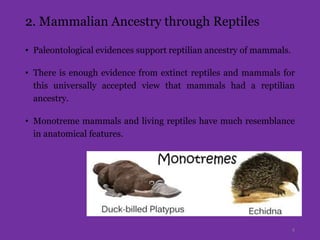
• Monotreme mammals and living reptiles have much resemblance
in anatomical features.
4
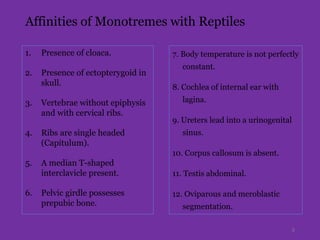
Affinities of Monotremes with Reptiles
1. Presence of cloaca.
2. Presence of ectopterygoid in
skull.
3. Vertebrae without epiphysis
and with cervical ribs.
4. Ribs are single headed
(Capitulum).
5. A median T-shaped
interclavicle present.
6. Pelvic girdle possesses
prepubic bone.
5
7. Body temperature is not perfectly
constant.
8. Cochlea of internal ear with
lagina.
9. Ureters lead into a urinogenital
sinus.
10. Corpus callosum is absent.
11. Testis abdominal.
12. Oviparous and meroblastic
segmentation.
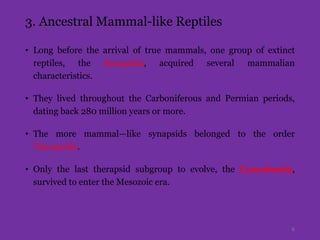
3. Ancestral Mammal-like Reptiles
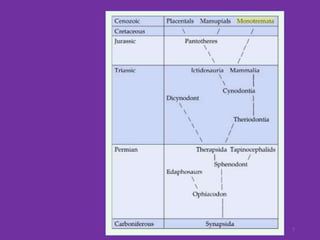
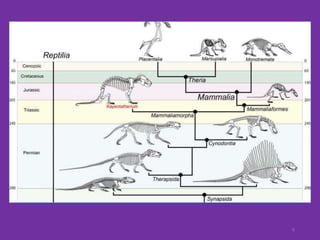
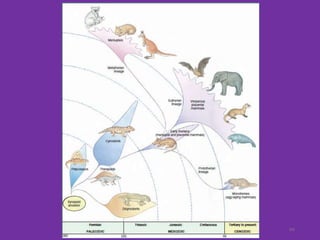
• Long before the arrival of true mammals, one group of extinct
reptiles, the Synapsida, acquired several mammalian
characteristics.
• They lived throughout the Carboniferous and Permian periods,
dating back 280 million years or more.
• The more mammal—like synapsids belonged to the order
Therapsida.
• Only the last therapsid subgroup to evolve, the Cynodontia,
survived to enter the Mesozoic era.
6
7
• The Cynodonts evolved several novel
features-
• a high metabolic rate, which supported a
more active life;
• increased jaw musculature, permitting a
stronger bite;
• several skeletal changes, supporting
greater agility; and
• a secondary bony palate enabling the
animal to breathe while holding prey or
chewing food.
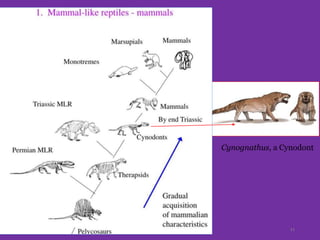
• One of the more advanced Cynodonts was
called Cynognathus (dog jaw).
• Cynognathus lived during the early
Triassic period.
8
9
10
Cynognathus, a Cynodont
11
Mammalian Characters in Therapsids
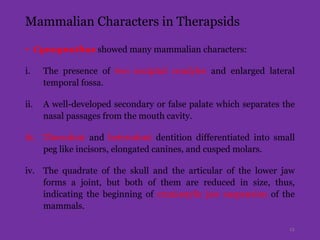
• Cynognathus showed many mammalian characters:
i. The presence of two occipital condyles and enlarged lateral
temporal fossa.
ii. A well-developed secondary or false palate which separates the
nasal passages from the mouth cavity.
iii. Thecodont and heterodont dentition differentiated into small
peg like incisors, elongated canines, and cusped molars.
iv. The quadrate of the skull and the articular of the lower jaw
forms a joint, but both of them are reduced in size, thus,
indicating the beginning of craniostylic jaw suspension of the
mammals.
12
Mammalian Characters in Therapsids
v. The dentary of lower jaw is greatly enlarged and other
reptilian bones of the lower jaw reduced or altogether absent
vi. The scapula at its front border was everted or turned out
which is the beginning of the scapular spine of the mammals.
vii. The number of phalanges in the digits are reduced to two in
the thumb and great toe, and three in all others.
viii. The sacrum and consequently the ilia are elongated, the ilium
form anterior iliac blades.
ix. Typical upright mammalian limbs capable of generating
considerable speed.
13
Reptilian Characters in Therapsids
• Therapsids retained several reptile-like features also.
i. Their skull was intermediate between that of reptiles and
mammals, having small cranium, parietal foramen, single
middle ear bone, reduced quadrate and quadratojugal, many
lower jaw bones, etc.
ii. It is also not known whether therapsids were warm-blooded,
had hairs instead of scales and nursed their young.
iii. They were not necessarily the direct ancestors of present day
mammals.
14
4. First True Mammals
• Very few evidences from the fossil remains, mainly teeth and jaws,
which reveal very little about the first true mammals.
• They were mostly tiny creatures not bigger than rats and mice and
were ecologically insignificant.
• They could still manage to survive by exploiting different ways of
life from those practiced by the contemporary gigantic reptilian
enemies.
• They were nocturnal, thus, avoiding direct conflict and
competition with the mostly diurnal reptiles.
15
• They were either burrowing hunting for insects, or arboreal in
contrast to their ground-dwelling herbivorous or carnivorous
contemporaries.
• They had a regulated high body temperature (endothermic), hairy
integument, and probably cared their young in pouches for further
development after birth, and safety.
• They were provided with larger brains and greater intelligence.
16
• By the end of Cretaceous period (Mesozoic era) the vast majority
of dominant reptiles became extinct for reasons which are still not
understood well.
• Many ecological niches (space and resources) were now left open
to mammals who started their great adaptive radiation.
• By the close of Cretaceous period, placental mammals became
distinct from marsupials.
• During Coenozoic era, there were established all the orders of
placental mammals, so that it is called the Age of Mammals.
17
5. Polyphyletic Origin of Mammals
• Whether mammalian evolution is monophyletic (from single
ancestor) or polyphyletic (from multiple ancestors)?
• Living mammals are divided into two different reproductive
subclasses:
1. The primitive reptile-like egg-laying (oviparous) monotremes
are in the subclass Prototheria.
2. All other mammals give birth to living young (viviparous) and
form the subclass Theria.
• The living therians are divided into marsupials or infraclass
Metatheria, and placental or infraclass Eutheria.
• Nothing is known about the origin of primitive Prototheria, for fossils
older than Pleistocene are unknown.
18
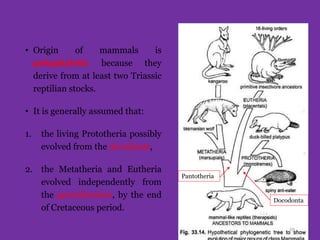
• Origin of mammals is
polyphyletic because they
derive from at least two Triassic
reptilian stocks.
• It is generally assumed that:
1. the living Prototheria possibly
evolved from the docodonts,
2. the Metatheria and Eutheria
evolved independently from
the pantotherians, by the end
of Cretaceous period.
Pantotheria
Docodonta
19
Adaptive Radiations in
Mammals
20
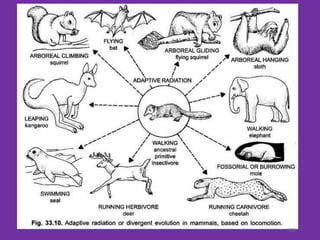
Adaptive Radiation
• The process of rapid divergence of multiple species from a single
ancestral lineage is called adaptive radiation.
• The concept of adaptive radiation in evolution was developed by H.F.
Osborn (1898).
• Adaptive radiation is a process in which organism diversify rapidly
from an ancestral species into a multitude of new forms (Smith, 1976).
• Causes of adaptive radiation:
o Entry into an adaptive zone by evolution of a key innovation or
by invasion into a new habitat,
o Extinction of competition,
o Ecological opportunity
21
Conditions for Adaptive Radiations
• A new habitat has opened up: E.g., a volcano, formation of a
large new lake habitat, an extinction event opening up niches that
were previously occupied by species that no longer exist, etc.
• The new habitat is relatively isolated: If a newly formed
habitat is isolated, the species that colonize it will likely be
somewhat random and uncommon arrivals.
• The new habitat has a wide availability of niche space.
The rare colonist can only adaptively radiate into as many forms
as there are niches.
22
Adaptive Radiation in Mammals
• Mammals evolved from Synapsids in the Mesozoic era.
• They were mouse-like with quadrupedal locomotion.
• Mesozoic mammals were small, generalized and rare.
• They remained small till Cretaceous due to the presence of
Dinosaurs.
• ~65 million years ago, after the extinction of Dinosaurs, in the
early Coenozoic era the number and diversity of mammals
expanded into varied evolutionary patterns.
• During Eocene and Oligocene epochs, most of the orders of
mammals originated.
23
Adaptive Radiation in Mammalian Limbs
• Mammalian limbs are the modifications of the pentadactyl limb.
• Primitive, ancestral mammals- short legged, pentadactyl, terrestrial,
ground dwelling.
• Adaptive radiation occurred in five different lines or habitats with
modifications in their limb structure:
i. Running (cursorial),
ii. Burrowing (fossorial),
iii. Tree-climbing (arboreal),
iv. Flying (aerial), and
v. Swimming (aquatic).
• All the mammals of different radiating lines have limbs more or less
adapted for some particular mode of locomotion.
24
25
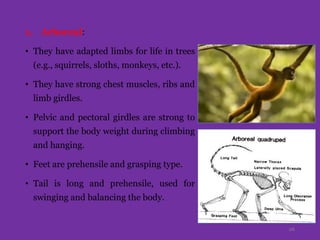
1. Arboreal:
• They have adapted limbs for life in trees
(e.g., squirrels, sloths, monkeys, etc.).
• They have strong chest muscles, ribs and
limb girdles.
• Pelvic and pectoral girdles are strong to
support the body weight during climbing
and hanging.
• Feet are prehensile and grasping type.
• Tail is long and prehensile, used for
swinging and balancing the body.
26
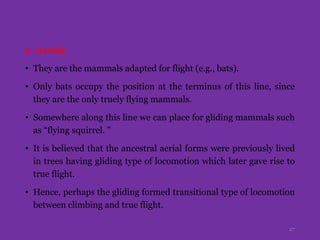
2. Aerial:
• They are the mammals adapted for flight (e.g., bats).
• Only bats occupy the position at the terminus of this line, since
they are the only truely flying mammals.
• Somewhere along this line we can place for gliding mammals such
as “flying squirrel. ”
• It is believed that the ancestral aerial forms were previously lived
in trees having gliding type of locomotion which later gave rise to
true flight.
• Hence, perhaps the gliding formed transitional type of locomotion
between climbing and true flight.
27
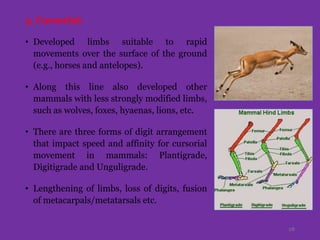
3. Cursorial:
• Developed limbs suitable to rapid
movements over the surface of the ground
(e.g., horses and antelopes).
• Along this line also developed other
mammals with less strongly modified limbs,
such as wolves, foxes, hyaenas, lions, etc.
• There are three forms of digit arrangement
that impact speed and affinity for cursorial
movement in mammals: Plantigrade,
Digitigrade and Unguligrade.
• Lengthening of limbs, loss of digits, fusion
of metacarpals/metatarsals etc.
28
4. Fossorial:
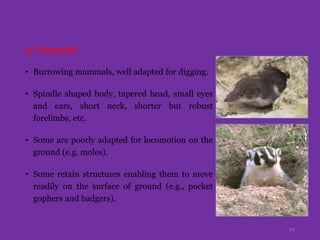
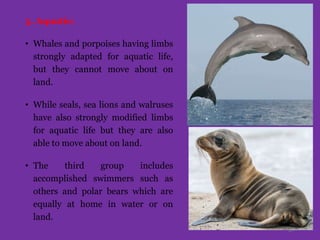
• Burrowing mammals, well adapted for digging.
• Spindle shaped body, tapered head, small eyes
and ears, short neck, shorter but robust
forelimbs, etc.
• Some are poorly adapted for locomotion on the
ground (e.g. moles).
• Some retain structures enabling them to move
readily on the surface of ground (e.g., pocket
gophers and badgers).
29
5. Aquatic:
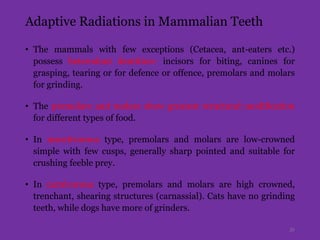
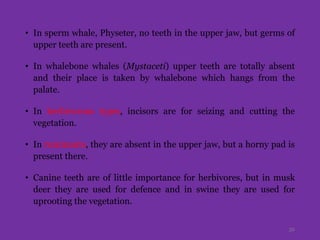
• Whales and porpoises having limbs
strongly adapted for aquatic life,
but they cannot move about on
land.
• While seals, sea lions and walruses
have also strongly modified limbs
for aquatic life but they are also
able to move about on land.
• The third group includes
accomplished swimmers such as
others and polar bears which are
equally at home in water or on
land.
30
Adaptive Radiations in Mammalian Teeth
• The mammals with few exceptions (Cetacea, ant-eaters etc.)
possess heterodont dentition- incisors for biting, canines for
grasping, tearing or for defence or offence, premolars and molars
for grinding.
• The premolars and molars show greatest structural modification
for different types of food.
• In insectivorous type, premolars and molars are low-crowned
simple with few cusps, generally sharp pointed and suitable for
crushing feeble prey.
• In carnivorous type, premolars and molars are high crowned,
trenchant, shearing structures (carnassial). Cats have no grinding
teeth, while dogs have more of grinders.
31
• In sperm whale, Physeter, no teeth in the upper jaw, but germs of
upper teeth are present.
• In whalebone whales (Mystaceti) upper teeth are totally absent
and their place is taken by whalebone which hangs from the
palate.
• In herbivorous types, incisors are for seizing and cutting the
vegetation.
• In ruminants, they are absent in the upper jaw, but a horny pad is
present there.
• Canine teeth are of little importance for herbivores, but in musk
deer they are used for defence and in swine they are used for
uprooting the vegetation.
32
• Grinders (premolar and molars) may be:
• Short-crowned and brachydont (low crowned teeth) adapted for
succulent leaves and twigs,
• Long-crowned and hypsodont (high-crowned teeth) adapted for
harsh grasses.
• In myrmecophagous type teeth have disappeared, jaws reduced
and mouth opens at the extreme anterior end of tubular snout
with a highly extensible and prehensile adhesive tongue for eating
ants.
33
Adaptive Convergence
in Mammals
34
• Distantly related animals inhabiting similar habitats, often
develop independently similar morphological features that make
them look similar. This phenomenon is termed adaptive
convergence or convergent evolution.
• The same or similar niches produce great similarities in very
different species.
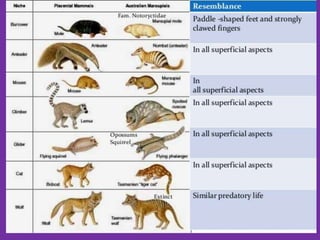
• It is the opposite phenomenon of adaptive radiation.
35
1. Adaptive Convergence in Placental and
Marsupial Mammals.
• During Paleocene, Eocene and Oligocene, the marsupials in Australia
and the placentals in the rest of the world underwent much adaptive
radiation, moving into habitats vacated due to extinction of dinosaurs.
• Marsupial and placental mammals are not closely related as they have
polyphyletic origin.
• But, convergent evolution has resulted in similar looking members in
both the groups occupying similar ecological niches and leading
similar ways of life.
• Thus, there are marsupial wolves, mice, cats, anteaters, moles, sloths,
flying phalangers and wombats.
• These are not related to their true counterparts in placental mammals
but resemble them due to convergent evolution.
36
37
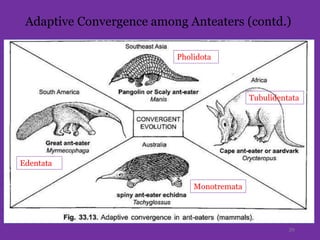
2. Adaptive Convergence among Anteaters
• Anteaters belong to different orders of class Mammalia (e.g.,
Monotremata, Pholidota, Edentata, Tubulidentata, etc.); not
closely related.
• They have evolved from different non-ant-eating ancestors
independently, acquiring similar features or adaptations for a diet
of ants, termites and other smaller insects.
• Thus all anteaters have teeth much reduced or absent, elongated
snout, long extensile sticky tongue and sharp stout claws on front
legs for digging into termite mounds, rotten logs, etc.
38
Adaptive Convergence among Anteaters (contd.)
39
Monotremata
Pholidota
Edentata
Tubulidentata

Origin and Evolution of Mammals

  • 1.
    Origin and Evolution ofMammals BY- Sanju Sah St. Xavier’s College, Maitighar, Kathmandu Department of Microbiology 1
  • 2.
    Origin of Mammals •The earliest mammals appeared in Jurassic period of Mesozoic era. • They were the descendants of some of the true mammal-like reptiles, the Therapsida. • However, two thoughts exist about the origin and ancestry of mammals: 1. Ancestry through Amphibia, and 2. Ancestry through Reptilia 2
  • 3.
    1. Mammalian Ancestrythrough Amphibia • T. H. Huxley (1880) proposed amphibian ancestry of mammals. • Justifications: 1. There are two occipital condyles in the skulls of both Amphibia and Mammalia. 2. Presence of left aortic arch in mammals. 3. Highly glandular skin in both the classes. • Criticisms on Huxley's theory: 1. The occipital condyles are derived from exoccipitals in Amphibia but from basioccipital in Mammalia. 2. The two classes have different modes of life and display many fundamental differences. • Not reliable. 3
  • 4.
    2. Mammalian Ancestrythrough Reptiles • Paleontological evidences support reptilian ancestry of mammals. • There is enough evidence from extinct reptiles and mammals for this universally accepted view that mammals had a reptilian ancestry. • Monotreme mammals and living reptiles have much resemblance in anatomical features. 4
  • 5.
    Affinities of Monotremeswith Reptiles 1. Presence of cloaca. 2. Presence of ectopterygoid in skull. 3. Vertebrae without epiphysis and with cervical ribs. 4. Ribs are single headed (Capitulum). 5. A median T-shaped interclavicle present. 6. Pelvic girdle possesses prepubic bone. 5 7. Body temperature is not perfectly constant. 8. Cochlea of internal ear with lagina. 9. Ureters lead into a urinogenital sinus. 10. Corpus callosum is absent. 11. Testis abdominal. 12. Oviparous and meroblastic segmentation.
  • 6.
    3. Ancestral Mammal-likeReptiles • Long before the arrival of true mammals, one group of extinct reptiles, the Synapsida, acquired several mammalian characteristics. • They lived throughout the Carboniferous and Permian periods, dating back 280 million years or more. • The more mammal—like synapsids belonged to the order Therapsida. • Only the last therapsid subgroup to evolve, the Cynodontia, survived to enter the Mesozoic era. 6
  • 7.
  • 8.
    • The Cynodontsevolved several novel features- • a high metabolic rate, which supported a more active life; • increased jaw musculature, permitting a stronger bite; • several skeletal changes, supporting greater agility; and • a secondary bony palate enabling the animal to breathe while holding prey or chewing food. • One of the more advanced Cynodonts was called Cynognathus (dog jaw). • Cynognathus lived during the early Triassic period. 8
  • 9.
  • 10.
  • 11.
  • 12.
    Mammalian Characters inTherapsids • Cynognathus showed many mammalian characters: i. The presence of two occipital condyles and enlarged lateral temporal fossa. ii. A well-developed secondary or false palate which separates the nasal passages from the mouth cavity. iii. Thecodont and heterodont dentition differentiated into small peg like incisors, elongated canines, and cusped molars. iv. The quadrate of the skull and the articular of the lower jaw forms a joint, but both of them are reduced in size, thus, indicating the beginning of craniostylic jaw suspension of the mammals. 12
  • 13.
    Mammalian Characters inTherapsids v. The dentary of lower jaw is greatly enlarged and other reptilian bones of the lower jaw reduced or altogether absent vi. The scapula at its front border was everted or turned out which is the beginning of the scapular spine of the mammals. vii. The number of phalanges in the digits are reduced to two in the thumb and great toe, and three in all others. viii. The sacrum and consequently the ilia are elongated, the ilium form anterior iliac blades. ix. Typical upright mammalian limbs capable of generating considerable speed. 13
  • 14.
    Reptilian Characters inTherapsids • Therapsids retained several reptile-like features also. i. Their skull was intermediate between that of reptiles and mammals, having small cranium, parietal foramen, single middle ear bone, reduced quadrate and quadratojugal, many lower jaw bones, etc. ii. It is also not known whether therapsids were warm-blooded, had hairs instead of scales and nursed their young. iii. They were not necessarily the direct ancestors of present day mammals. 14
  • 15.
    4. First TrueMammals • Very few evidences from the fossil remains, mainly teeth and jaws, which reveal very little about the first true mammals. • They were mostly tiny creatures not bigger than rats and mice and were ecologically insignificant. • They could still manage to survive by exploiting different ways of life from those practiced by the contemporary gigantic reptilian enemies. • They were nocturnal, thus, avoiding direct conflict and competition with the mostly diurnal reptiles. 15
  • 16.
    • They wereeither burrowing hunting for insects, or arboreal in contrast to their ground-dwelling herbivorous or carnivorous contemporaries. • They had a regulated high body temperature (endothermic), hairy integument, and probably cared their young in pouches for further development after birth, and safety. • They were provided with larger brains and greater intelligence. 16
  • 17.
    • By theend of Cretaceous period (Mesozoic era) the vast majority of dominant reptiles became extinct for reasons which are still not understood well. • Many ecological niches (space and resources) were now left open to mammals who started their great adaptive radiation. • By the close of Cretaceous period, placental mammals became distinct from marsupials. • During Coenozoic era, there were established all the orders of placental mammals, so that it is called the Age of Mammals. 17
  • 18.
    5. Polyphyletic Originof Mammals • Whether mammalian evolution is monophyletic (from single ancestor) or polyphyletic (from multiple ancestors)? • Living mammals are divided into two different reproductive subclasses: 1. The primitive reptile-like egg-laying (oviparous) monotremes are in the subclass Prototheria. 2. All other mammals give birth to living young (viviparous) and form the subclass Theria. • The living therians are divided into marsupials or infraclass Metatheria, and placental or infraclass Eutheria. • Nothing is known about the origin of primitive Prototheria, for fossils older than Pleistocene are unknown. 18
  • 19.
    • Origin ofmammals is polyphyletic because they derive from at least two Triassic reptilian stocks. • It is generally assumed that: 1. the living Prototheria possibly evolved from the docodonts, 2. the Metatheria and Eutheria evolved independently from the pantotherians, by the end of Cretaceous period. Pantotheria Docodonta 19
  • 20.
  • 21.
    Adaptive Radiation • Theprocess of rapid divergence of multiple species from a single ancestral lineage is called adaptive radiation. • The concept of adaptive radiation in evolution was developed by H.F. Osborn (1898). • Adaptive radiation is a process in which organism diversify rapidly from an ancestral species into a multitude of new forms (Smith, 1976). • Causes of adaptive radiation: o Entry into an adaptive zone by evolution of a key innovation or by invasion into a new habitat, o Extinction of competition, o Ecological opportunity 21
  • 22.
    Conditions for AdaptiveRadiations • A new habitat has opened up: E.g., a volcano, formation of a large new lake habitat, an extinction event opening up niches that were previously occupied by species that no longer exist, etc. • The new habitat is relatively isolated: If a newly formed habitat is isolated, the species that colonize it will likely be somewhat random and uncommon arrivals. • The new habitat has a wide availability of niche space. The rare colonist can only adaptively radiate into as many forms as there are niches. 22
  • 23.
    Adaptive Radiation inMammals • Mammals evolved from Synapsids in the Mesozoic era. • They were mouse-like with quadrupedal locomotion. • Mesozoic mammals were small, generalized and rare. • They remained small till Cretaceous due to the presence of Dinosaurs. • ~65 million years ago, after the extinction of Dinosaurs, in the early Coenozoic era the number and diversity of mammals expanded into varied evolutionary patterns. • During Eocene and Oligocene epochs, most of the orders of mammals originated. 23
  • 24.
    Adaptive Radiation inMammalian Limbs • Mammalian limbs are the modifications of the pentadactyl limb. • Primitive, ancestral mammals- short legged, pentadactyl, terrestrial, ground dwelling. • Adaptive radiation occurred in five different lines or habitats with modifications in their limb structure: i. Running (cursorial), ii. Burrowing (fossorial), iii. Tree-climbing (arboreal), iv. Flying (aerial), and v. Swimming (aquatic). • All the mammals of different radiating lines have limbs more or less adapted for some particular mode of locomotion. 24
  • 25.
  • 26.
    1. Arboreal: • Theyhave adapted limbs for life in trees (e.g., squirrels, sloths, monkeys, etc.). • They have strong chest muscles, ribs and limb girdles. • Pelvic and pectoral girdles are strong to support the body weight during climbing and hanging. • Feet are prehensile and grasping type. • Tail is long and prehensile, used for swinging and balancing the body. 26
  • 27.
    2. Aerial: • Theyare the mammals adapted for flight (e.g., bats). • Only bats occupy the position at the terminus of this line, since they are the only truely flying mammals. • Somewhere along this line we can place for gliding mammals such as “flying squirrel. ” • It is believed that the ancestral aerial forms were previously lived in trees having gliding type of locomotion which later gave rise to true flight. • Hence, perhaps the gliding formed transitional type of locomotion between climbing and true flight. 27
  • 28.
    3. Cursorial: • Developedlimbs suitable to rapid movements over the surface of the ground (e.g., horses and antelopes). • Along this line also developed other mammals with less strongly modified limbs, such as wolves, foxes, hyaenas, lions, etc. • There are three forms of digit arrangement that impact speed and affinity for cursorial movement in mammals: Plantigrade, Digitigrade and Unguligrade. • Lengthening of limbs, loss of digits, fusion of metacarpals/metatarsals etc. 28
  • 29.
    4. Fossorial: • Burrowingmammals, well adapted for digging. • Spindle shaped body, tapered head, small eyes and ears, short neck, shorter but robust forelimbs, etc. • Some are poorly adapted for locomotion on the ground (e.g. moles). • Some retain structures enabling them to move readily on the surface of ground (e.g., pocket gophers and badgers). 29
  • 30.
    5. Aquatic: • Whalesand porpoises having limbs strongly adapted for aquatic life, but they cannot move about on land. • While seals, sea lions and walruses have also strongly modified limbs for aquatic life but they are also able to move about on land. • The third group includes accomplished swimmers such as others and polar bears which are equally at home in water or on land. 30
  • 31.
    Adaptive Radiations inMammalian Teeth • The mammals with few exceptions (Cetacea, ant-eaters etc.) possess heterodont dentition- incisors for biting, canines for grasping, tearing or for defence or offence, premolars and molars for grinding. • The premolars and molars show greatest structural modification for different types of food. • In insectivorous type, premolars and molars are low-crowned simple with few cusps, generally sharp pointed and suitable for crushing feeble prey. • In carnivorous type, premolars and molars are high crowned, trenchant, shearing structures (carnassial). Cats have no grinding teeth, while dogs have more of grinders. 31
  • 32.
    • In spermwhale, Physeter, no teeth in the upper jaw, but germs of upper teeth are present. • In whalebone whales (Mystaceti) upper teeth are totally absent and their place is taken by whalebone which hangs from the palate. • In herbivorous types, incisors are for seizing and cutting the vegetation. • In ruminants, they are absent in the upper jaw, but a horny pad is present there. • Canine teeth are of little importance for herbivores, but in musk deer they are used for defence and in swine they are used for uprooting the vegetation. 32
  • 33.
    • Grinders (premolarand molars) may be: • Short-crowned and brachydont (low crowned teeth) adapted for succulent leaves and twigs, • Long-crowned and hypsodont (high-crowned teeth) adapted for harsh grasses. • In myrmecophagous type teeth have disappeared, jaws reduced and mouth opens at the extreme anterior end of tubular snout with a highly extensible and prehensile adhesive tongue for eating ants. 33
  • 34.
  • 35.
    • Distantly relatedanimals inhabiting similar habitats, often develop independently similar morphological features that make them look similar. This phenomenon is termed adaptive convergence or convergent evolution. • The same or similar niches produce great similarities in very different species. • It is the opposite phenomenon of adaptive radiation. 35
  • 36.
    1. Adaptive Convergencein Placental and Marsupial Mammals. • During Paleocene, Eocene and Oligocene, the marsupials in Australia and the placentals in the rest of the world underwent much adaptive radiation, moving into habitats vacated due to extinction of dinosaurs. • Marsupial and placental mammals are not closely related as they have polyphyletic origin. • But, convergent evolution has resulted in similar looking members in both the groups occupying similar ecological niches and leading similar ways of life. • Thus, there are marsupial wolves, mice, cats, anteaters, moles, sloths, flying phalangers and wombats. • These are not related to their true counterparts in placental mammals but resemble them due to convergent evolution. 36
  • 37.
  • 38.
    2. Adaptive Convergenceamong Anteaters • Anteaters belong to different orders of class Mammalia (e.g., Monotremata, Pholidota, Edentata, Tubulidentata, etc.); not closely related. • They have evolved from different non-ant-eating ancestors independently, acquiring similar features or adaptations for a diet of ants, termites and other smaller insects. • Thus all anteaters have teeth much reduced or absent, elongated snout, long extensile sticky tongue and sharp stout claws on front legs for digging into termite mounds, rotten logs, etc. 38
  • 39.
    Adaptive Convergence amongAnteaters (contd.) 39 Monotremata Pholidota Edentata Tubulidentata