Taxonomic Publication.
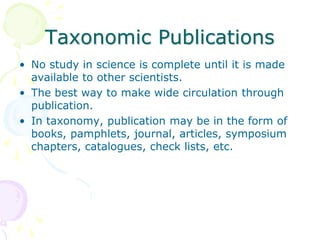
Taxonomic Publications
• No study in science is complete until it is made
available to other scientists.
• The best way to make wide circulation through
publication.
• In taxonomy, publication may be in the form of
books, pamphlets, journal, articles, symposium
chapters, catalogues, check lists, etc.
Types of taxonomic publications
1. Publications of new taxa: these are ordinary
descriptive papers of new subspecies, species
and genera
2. Synopses and reviews: these include brief
summaries of current taxonomic knowledge of a
group.
3. Taxonomic revisions: these summarise and
evaluate previous taxonomic works of a group
incorporating new information.
4. Monographs: these are the most complete
systematic publications involving full systematic
treatment of all species., subspecies and
taxnomic units.
5. Faunal studies: these are detailed studies of the
fauna of a single region.
6. Atlases: these show comparative characters of
animals in the picture form.
7. Catalogue: a catalogue is mainly an index to taxa
arranged in such a way as to give a vivid picture of
references for both zoological and nomenclatural
purposes.
8. Checklist: a checklist is an abbreviated synopsis
and presents a list of names.
9. Field guide: some works are prepared by the
taxonomists for the non-taxonomists to help to
identify the common animals in the field.
10. Manual: the manuals are also published in simple
language including key characters of common
species.
11. Handbooks: the term handbook is used either
for field guides, manuals or occasionally
comprehensive volumes on a group of animals of
relatively complete taxonomic treatment.
12. Treatise: handbooks are also sometimes
named as treatise.
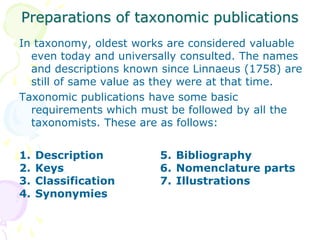
Preparations of taxonomic publications
In taxonomy, oldest works are considered valuable
even today and universally consulted. The names
and descriptions known since Linnaeus (1758) are
still of same value as they were at that time.
Taxonomic publications have some basic
requirements which must be followed by all the
taxonomists. These are as follows:
1. Description
2. Keys
3. Classification
4. Synonymies
5. Bibliography
6. Nomenclature parts
7. Illustrations
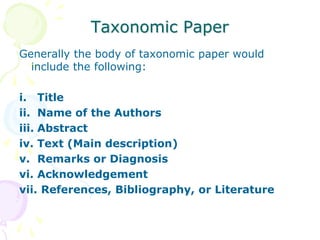
Taxonomic Paper
Generally the body of taxonomic paper would
include the following:
i. Title
ii. Name of the Authors
iii. Abstract
iv. Text (Main description)
v. Remarks or Diagnosis
vi. Acknowledgement
vii. References, Bibliography, or Literature

Taxonomic publication

  • 1.
  • 2.
    Taxonomic Publications • Nostudy in science is complete until it is made available to other scientists. • The best way to make wide circulation through publication. • In taxonomy, publication may be in the form of books, pamphlets, journal, articles, symposium chapters, catalogues, check lists, etc.
  • 3.
    Types of taxonomicpublications 1. Publications of new taxa: these are ordinary descriptive papers of new subspecies, species and genera 2. Synopses and reviews: these include brief summaries of current taxonomic knowledge of a group. 3. Taxonomic revisions: these summarise and evaluate previous taxonomic works of a group incorporating new information. 4. Monographs: these are the most complete systematic publications involving full systematic treatment of all species., subspecies and taxnomic units.
  • 4.
    5. Faunal studies:these are detailed studies of the fauna of a single region. 6. Atlases: these show comparative characters of animals in the picture form. 7. Catalogue: a catalogue is mainly an index to taxa arranged in such a way as to give a vivid picture of references for both zoological and nomenclatural purposes. 8. Checklist: a checklist is an abbreviated synopsis and presents a list of names. 9. Field guide: some works are prepared by the taxonomists for the non-taxonomists to help to identify the common animals in the field. 10. Manual: the manuals are also published in simple language including key characters of common species.
  • 5.
    11. Handbooks: theterm handbook is used either for field guides, manuals or occasionally comprehensive volumes on a group of animals of relatively complete taxonomic treatment. 12. Treatise: handbooks are also sometimes named as treatise.
  • 6.
    Preparations of taxonomicpublications In taxonomy, oldest works are considered valuable even today and universally consulted. The names and descriptions known since Linnaeus (1758) are still of same value as they were at that time. Taxonomic publications have some basic requirements which must be followed by all the taxonomists. These are as follows: 1. Description 2. Keys 3. Classification 4. Synonymies 5. Bibliography 6. Nomenclature parts 7. Illustrations
  • 7.
    Taxonomic Paper Generally thebody of taxonomic paper would include the following: i. Title ii. Name of the Authors iii. Abstract iv. Text (Main description) v. Remarks or Diagnosis vi. Acknowledgement vii. References, Bibliography, or Literature