1
Digital Audio
Multimedia Systems (Module 1 Lesson 1)
Summary:
 Basic concepts
underlying sound
 Facts about human
perception of sound
 Computer
representation of
sound (Audio)
 A brief introduction to
MIDI
Sources:
 My research notes
 Dr. Ze-Nian Li’s course
material at:
http://www.cs.sfu.ca/CourseCentral/365/li/
2
Sound Facts
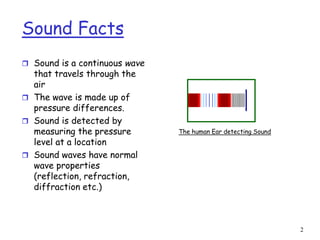
 Sound is a continuous wave
that travels through the
air
 The wave is made up of
pressure differences.
 Sound is detected by
measuring the pressure
level at a location
 Sound waves have normal
wave properties
(reflection, refraction,
diffraction etc.)
The human Ear detecting Sound
3
Sound Facts
Wave Characteristics
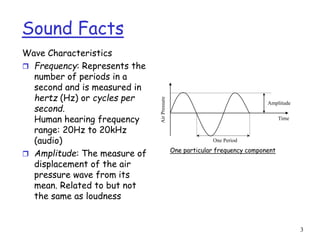
 Frequency: Represents the
number of periods in a
second and is measured in
hertz (Hz) or cycles per
second.
Human hearing frequency
range: 20Hz to 20kHz
(audio)
 Amplitude: The measure of
displacement of the air
pressure wave from its
mean. Related to but not
the same as loudness
Time
Amplitude
One Period
Air
Pressure
One particular frequency component
4
Principles of Digitization
 Why Digitize?
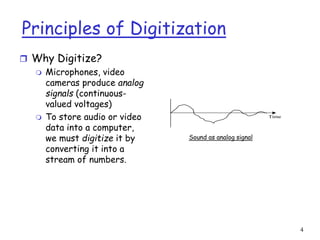
 Microphones, video
cameras produce analog
signals (continuous-
valued voltages)
 To store audio or video
data into a computer,
we must digitize it by
converting it into a
stream of numbers.
Time
Sound as analog signal
5
Principles of Digitization
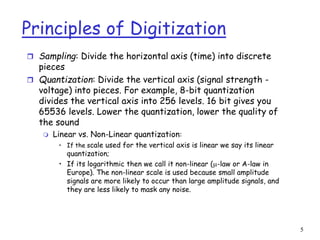
 Sampling: Divide the horizontal axis (time) into discrete
pieces
 Quantization: Divide the vertical axis (signal strength -
voltage) into pieces. For example, 8-bit quantization
divides the vertical axis into 256 levels. 16 bit gives you
65536 levels. Lower the quantization, lower the quality of
the sound
 Linear vs. Non-Linear quantization:
• If the scale used for the vertical axis is linear we say its linear
quantization;
• If its logarithmic then we call it non-linear (-law or A-law in
Europe). The non-linear scale is used because small amplitude
signals are more likely to occur than large amplitude signals, and
they are less likely to mask any noise.
6
Sampling and Quantization
Time
Sample
Time
Sample
Sampling 3-bit quantization
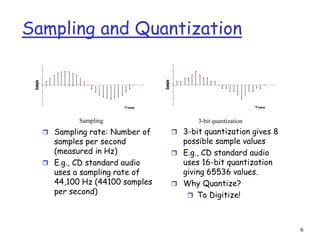
 Sampling rate: Number of
samples per second
(measured in Hz)
 E.g., CD standard audio
uses a sampling rate of
44,100 Hz (44100 samples
per second)
 3-bit quantization gives 8
possible sample values
 E.g., CD standard audio
uses 16-bit quantization
giving 65536 values.
 Why Quantize?
 To Digitize!
7
Nyquist Theorem
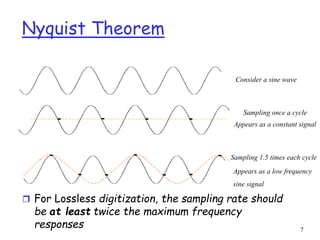
 For Lossless digitization, the sampling rate should
be at least twice the maximum frequency
responses
Sampling once a cycle
Sampling 1.5 times each cycle
Appears as a constant signal
Appears as a low frequency
sine signal
Consider a sine wave
8
Application of Nyquist Theorem
 Nyquist theorem is used to calculate the optimum sampling
rate in order to obtain good audio quality.
 The CD standard sampling rate of 44100 Hz means that the
waveform is sampled 44100 times per sec.
 Digitally sampled audio has a bandwidth of (20 Hz - 20 KHz).
By sampling at twice the maximum frequency (40 KHz) we
could have achieved good audio quality.
 CD audio slightly exceeds this, resulting in an ability to
represent a bandwidth of around 22050 Hz.
9
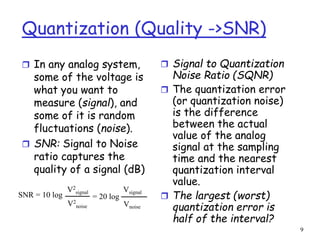
Quantization (Quality ->SNR)
 In any analog system,
some of the voltage is
what you want to
measure (signal), and
some of it is random
fluctuations (noise).
 SNR: Signal to Noise
ratio captures the
quality of a signal (dB)
 Signal to Quantization
Noise Ratio (SQNR)
 The quantization error
(or quantization noise)
is the difference
between the actual
value of the analog
signal at the sampling
time and the nearest
quantization interval
value.
 The largest (worst)
quantization error is
half of the interval?
SNR = 10 log
V2
signal
V2
noise
Vsignal
Vnoise
= 20 log
10
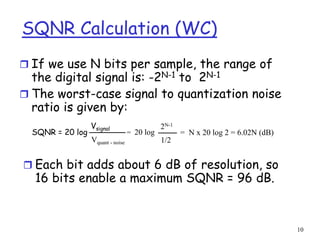
SQNR Calculation (WC)
 If we use N bits per sample, the range of
the digital signal is: -2N-1 to 2N-1
 The worst-case signal to quantization noise
ratio is given by:
 Each bit adds about 6 dB of resolution, so
16 bits enable a maximum SQNR = 96 dB.
SQNR = 20 log
Vsignal
Vquant - noise
= 20 log
2N-1
1/2
= N x 20 log 2 = 6.02N (dB)
11
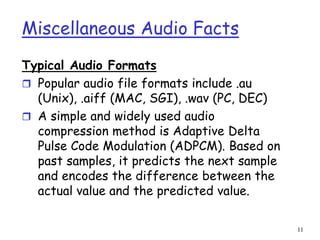
Miscellaneous Audio Facts
Typical Audio Formats
 Popular audio file formats include .au
(Unix), .aiff (MAC, SGI), .wav (PC, DEC)
 A simple and widely used audio
compression method is Adaptive Delta
Pulse Code Modulation (ADPCM). Based on
past samples, it predicts the next sample
and encodes the difference between the
actual value and the predicted value.
12
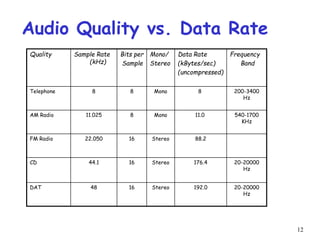
Audio Quality vs. Data Rate
Quality Sample Rate
(kHz)
Bits per
Sample
Mono/
Stereo
Data Rate
(kBytes/sec)
(uncompressed)
Frequency
Band
Telephone 8 8 Mono 8 200-3400
Hz
AM Radio 11.025 8 Mono 11.0 540-1700
KHz
FM Radio 22.050 16 Stereo 88.2
CD 44.1 16 Stereo 176.4 20-20000
Hz
DAT 48 16 Stereo 192.0 20-20000
Hz
13
MIDI
 Musical Instrument Digital Interface
a protocol that enables computer, synthesizers, keyboards,
and other musical devices to communicate with each
other.
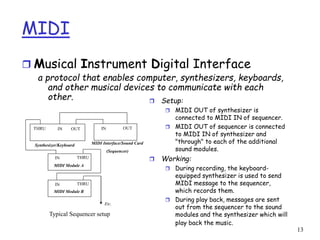
Typical Sequencer setup
 Setup:
 MIDI OUT of synthesizer is
connected to MIDI IN of sequencer.
 MIDI OUT of sequencer is connected
to MIDI IN of synthesizer and
"through" to each of the additional
sound modules.
 Working:
 During recording, the keyboard-
equipped synthesizer is used to send
MIDI message to the sequencer,
which records them.
 During play back, messages are sent
out from the sequencer to the sound
modules and the synthesizer which will
play back the music.
THRU
THRU
THRU
IN OUT IN OUT
IN
IN
MIDI Interface/Sound Card
(Sequencer)
Synthesizer/Keyboard
MIDI Module A
MIDI Module B
Etc.
14
MIDI: Data Format
 Information traveling through the hardware is encoded in
MIDI data format.
 The encoding includes note information like beginning of
note, frequency and sound volume; upto 128 notes
 The MIDI data format is digital
 The data are grouped into MIDI messages
 Each MIDI message communicates one musical event
between machines. An event might be pressing keys, moving
slider controls, setting switches and adjusting foot pedals.
 10 mins of music encoded in MIDI data format is about 200
Kbytes of data. (compare against CD-audio!)

M1L1-2.ppt

  • 1.
    1 Digital Audio Multimedia Systems(Module 1 Lesson 1) Summary:  Basic concepts underlying sound  Facts about human perception of sound  Computer representation of sound (Audio)  A brief introduction to MIDI Sources:  My research notes  Dr. Ze-Nian Li’s course material at: http://www.cs.sfu.ca/CourseCentral/365/li/
  • 2.
    2 Sound Facts  Soundis a continuous wave that travels through the air  The wave is made up of pressure differences.  Sound is detected by measuring the pressure level at a location  Sound waves have normal wave properties (reflection, refraction, diffraction etc.) The human Ear detecting Sound
  • 3.
    3 Sound Facts Wave Characteristics Frequency: Represents the number of periods in a second and is measured in hertz (Hz) or cycles per second. Human hearing frequency range: 20Hz to 20kHz (audio)  Amplitude: The measure of displacement of the air pressure wave from its mean. Related to but not the same as loudness Time Amplitude One Period Air Pressure One particular frequency component
  • 4.
    4 Principles of Digitization Why Digitize?  Microphones, video cameras produce analog signals (continuous- valued voltages)  To store audio or video data into a computer, we must digitize it by converting it into a stream of numbers. Time Sound as analog signal
  • 5.
    5 Principles of Digitization Sampling: Divide the horizontal axis (time) into discrete pieces  Quantization: Divide the vertical axis (signal strength - voltage) into pieces. For example, 8-bit quantization divides the vertical axis into 256 levels. 16 bit gives you 65536 levels. Lower the quantization, lower the quality of the sound  Linear vs. Non-Linear quantization: • If the scale used for the vertical axis is linear we say its linear quantization; • If its logarithmic then we call it non-linear (-law or A-law in Europe). The non-linear scale is used because small amplitude signals are more likely to occur than large amplitude signals, and they are less likely to mask any noise.
  • 6.
    6 Sampling and Quantization Time Sample Time Sample Sampling3-bit quantization  Sampling rate: Number of samples per second (measured in Hz)  E.g., CD standard audio uses a sampling rate of 44,100 Hz (44100 samples per second)  3-bit quantization gives 8 possible sample values  E.g., CD standard audio uses 16-bit quantization giving 65536 values.  Why Quantize?  To Digitize!
  • 7.
    7 Nyquist Theorem  ForLossless digitization, the sampling rate should be at least twice the maximum frequency responses Sampling once a cycle Sampling 1.5 times each cycle Appears as a constant signal Appears as a low frequency sine signal Consider a sine wave
  • 8.
    8 Application of NyquistTheorem  Nyquist theorem is used to calculate the optimum sampling rate in order to obtain good audio quality.  The CD standard sampling rate of 44100 Hz means that the waveform is sampled 44100 times per sec.  Digitally sampled audio has a bandwidth of (20 Hz - 20 KHz). By sampling at twice the maximum frequency (40 KHz) we could have achieved good audio quality.  CD audio slightly exceeds this, resulting in an ability to represent a bandwidth of around 22050 Hz.
  • 9.
    9 Quantization (Quality ->SNR) In any analog system, some of the voltage is what you want to measure (signal), and some of it is random fluctuations (noise).  SNR: Signal to Noise ratio captures the quality of a signal (dB)  Signal to Quantization Noise Ratio (SQNR)  The quantization error (or quantization noise) is the difference between the actual value of the analog signal at the sampling time and the nearest quantization interval value.  The largest (worst) quantization error is half of the interval? SNR = 10 log V2 signal V2 noise Vsignal Vnoise = 20 log
  • 10.
    10 SQNR Calculation (WC) If we use N bits per sample, the range of the digital signal is: -2N-1 to 2N-1  The worst-case signal to quantization noise ratio is given by:  Each bit adds about 6 dB of resolution, so 16 bits enable a maximum SQNR = 96 dB. SQNR = 20 log Vsignal Vquant - noise = 20 log 2N-1 1/2 = N x 20 log 2 = 6.02N (dB)
  • 11.
    11 Miscellaneous Audio Facts TypicalAudio Formats  Popular audio file formats include .au (Unix), .aiff (MAC, SGI), .wav (PC, DEC)  A simple and widely used audio compression method is Adaptive Delta Pulse Code Modulation (ADPCM). Based on past samples, it predicts the next sample and encodes the difference between the actual value and the predicted value.
  • 12.
    12 Audio Quality vs.Data Rate Quality Sample Rate (kHz) Bits per Sample Mono/ Stereo Data Rate (kBytes/sec) (uncompressed) Frequency Band Telephone 8 8 Mono 8 200-3400 Hz AM Radio 11.025 8 Mono 11.0 540-1700 KHz FM Radio 22.050 16 Stereo 88.2 CD 44.1 16 Stereo 176.4 20-20000 Hz DAT 48 16 Stereo 192.0 20-20000 Hz
  • 13.
    13 MIDI  Musical InstrumentDigital Interface a protocol that enables computer, synthesizers, keyboards, and other musical devices to communicate with each other. Typical Sequencer setup  Setup:  MIDI OUT of synthesizer is connected to MIDI IN of sequencer.  MIDI OUT of sequencer is connected to MIDI IN of synthesizer and "through" to each of the additional sound modules.  Working:  During recording, the keyboard- equipped synthesizer is used to send MIDI message to the sequencer, which records them.  During play back, messages are sent out from the sequencer to the sound modules and the synthesizer which will play back the music. THRU THRU THRU IN OUT IN OUT IN IN MIDI Interface/Sound Card (Sequencer) Synthesizer/Keyboard MIDI Module A MIDI Module B Etc.
  • 14.
    14 MIDI: Data Format Information traveling through the hardware is encoded in MIDI data format.  The encoding includes note information like beginning of note, frequency and sound volume; upto 128 notes  The MIDI data format is digital  The data are grouped into MIDI messages  Each MIDI message communicates one musical event between machines. An event might be pressing keys, moving slider controls, setting switches and adjusting foot pedals.  10 mins of music encoded in MIDI data format is about 200 Kbytes of data. (compare against CD-audio!)