Cerebellum
Prof. Dr. Rashid Mahmood
MCQ 1 of 3
• A 55 years old man was referred to a neurologist with
complaints of ataxia and slurred speech. Examination
revealed that the patient had Nystagmus and was
unable to stand on his feet without support even with
his eyes open. This man is most probably suffering
from a lesion involving:
A. basal ganglia
B. dorsal columns
C. cerebellum
D. mid brain
E. spinal cord
12-Dec-17 Cerebellum | © Prof. Dr. Rashid Mahmood
C
MCQ 2 of 3
• A seventy year old man presents with rigidity of
much of the musculature of the body,
involuntary tremors & difficulty in initiating
movement. The most likely diagnosis is:
A. Alzheimer’s disease
B. Cerebellar Ataxia
C. Huntington’s Chorea
D. Parkinson’s disease
E. Thyrotoxicosis
12-Dec-17 Cerebellum | © Prof. Dr. Rashid Mahmood
D
MCQ 3 of 3
• A patient presents with a disturbance of
voluntary movements of one arm & leg,
decreased muscle tone, absent superficial
reflexes & slow deep reflexes. Which of the
following is diseased?
A. Cerebellum
B. Pyramidal Tract
C. Rubrospinal Tract
D. Basal Ganglia
E. Vestibule-Spinal Tract12-Dec-17 Cerebellum | © Prof. Dr. Rashid Mahmood
B
Components of motor movement that need
to be controlled
• Timing
• Rapidity
• Smooth progression from to next
movement
• Prediction of next movement
• Intensity when muscle load
changes
• Interplay between agonists and
antagonists
12-Dec-17 Cerebellum | © Prof. Dr. Rashid Mahmood
• Plan and Control Complex movements
• Relative intensities of separate
movements
• Direction of movements &
• Sequencing of multiple sequential
movements to achieve complicated
motor goal
Cerebellum Basal Ganglia
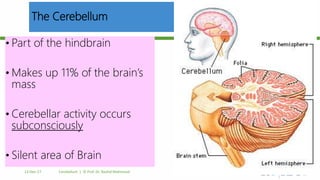
The Cerebellum
• Part of the hindbrain
• Makes up 11% of the brain’s
mass
• Cerebellar activity occurs
subconsciously
• Silent area of Brain
12-Dec-17 Cerebellum | © Prof. Dr. Rashid Mahmood
Objectives
12-Dec-17 Cerebellum | © Prof. Dr. Rashid Mahmood
• Goal /Aim:
• By the end of this session students should be able to
understand the Physiology of Cerebellum
• Specific Objectives
At the end of the lecture the students will be able to
• Describe functional anatomy of cerebellum
• Explain connections of cerebellum to other parts of nervous
system
• Describe functions of cerebellum
• Enlist deep nuclei of cerebellum
Lesson Contents
•Functional Anatomy of Cerebellum
•Physiological divisions
•Deep Cerebellar Nuclei
•Afferent and Efferent pathways
•Neural Circuit
•Functions of Each Part of Cerebellum
12-Dec-17 Cerebellum | © Prof. Dr. Rashid Mahmood
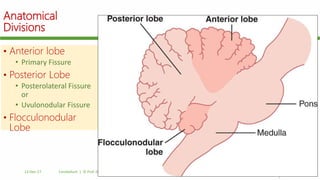
Anatomical
Divisions
• Anterior lobe
• Primary Fissure
• Posterior Lobe
• Posterolateral Fissure
or
• Uvulonodular Fissure
• Flocculonodular
Lobe
12-Dec-17 Cerebellum | © Prof. Dr. Rashid Mahmood
Physiological
Divisions
Contd….12-Dec-17 Cerebellum | © Prof. Dr. Rashid Mahmood
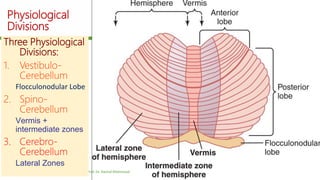
Three Physiological
Divisions:
1. Vestibulo-
Cerebellum
Flocculonodular Lobe
2. Spino-
Cerebellum
Vermis +
intermediate zones
3. Cerebro-
Cerebellum
Lateral Zones
Assessment -1
•Name the Physiological divisions of Cerebellum.
12-Dec-17 Cerebellum | © Prof. Dr. Rashid Mahmood
1. Vestibulo-Cerebellum
Flocculonodular Lobe
Control of Equilibrium
Contd….12-Dec-17 Cerebellum | © Prof. Dr. Rashid Mahmood
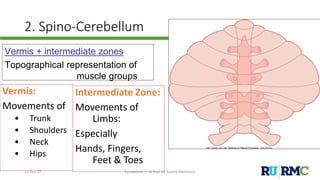
2. Spino-Cerebellum
Vermis:
Movements of
• Trunk
• Shoulders
• Neck
• Hips
Intermediate Zone:
Movements of
Limbs:
Especially
Hands, Fingers,
Feet & Toes
Vermis + intermediate zones
Topographical representation of
muscle groups
12-Dec-17 Cerebellum | © Prof. Dr. Rashid Mahmood
3. Cerebro-Cerebellum
Lateral Zones
Planning and coordination of sequential motor
activities
Contd….12-Dec-17 Cerebellum | © Prof. Dr. Rashid Mahmood
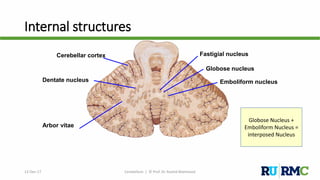
Deep cerebellar nuclei
12-Dec-17 Cerebellum | © Prof. Dr. Rashid Mahmood
• Outer: Grey matter (cortex)
• Inner: White matter
Groups of nerve cell bodies embedded in white
matter
Three
1. Fastigial nucleus
2. Interposed nucleus
Internal structures
Cerebellar cortex
Dentate nucleus
Fastigial nucleus
Globose nucleus
Emboliform nucleus
Arbor vitae
12-Dec-17 Cerebellum | © Prof. Dr. Rashid Mahmood
Globose Nucleus +
Emboliform Nucleus =
interposed Nucleus
Afferent & Efferent Pathways
Input Signals:
i. From respective body parts
ii. Corresponding topographical areas of motor
cortex
Output Signals:
i. Same areas of motor cortex
ii. Red nucleus
iii. Reticular formation
Contd….12-Dec-17 Cerebellum | © Prof. Dr. Rashid Mahmood
Downloaded from: StudentConsult (on 17 December 2012 04:46 AM)
© 2005 Elsevier
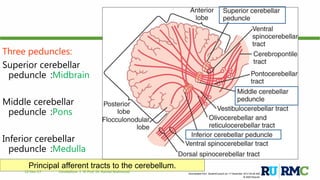
Three peduncles:
Superior cerebellar
peduncle :Midbrain
Middle cerebellar
peduncle :Pons
Inferior cerebellar
peduncle :Medulla
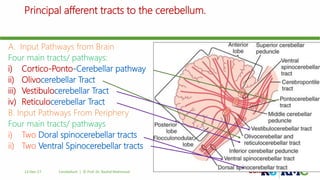
Principal afferent tracts to the cerebellum.
12-Dec-17 Cerebellum | © Prof. Dr. Rashid Mahmood
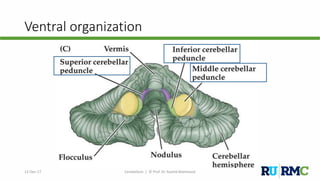
Ventral organization
12-Dec-17 Cerebellum | © Prof. Dr. Rashid Mahmood
Principal afferent tracts to the cerebellum.
A. Input Pathways from Brain
Four main tracts/ pathways:
i) Cortico-Ponto-Cerebellar pathway
ii) Olivocerebellar Tract
iii) Vestibulocerebellar Tract
iv) Reticulocerebellar Tract
B. Input Pathways From Periphery
Four main tracts/ pathways
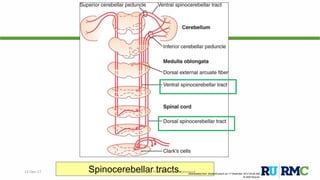
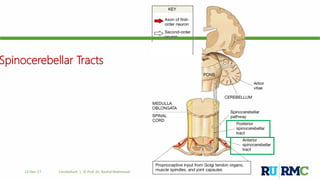
i) Two Doral spinocerebellar tracts
ii) Two Ventral Spinocerebellar tracts
Contd….12-Dec-17 Cerebellum | © Prof. Dr. Rashid Mahmood
Spinocerebellar tracts. Downloaded from: StudentConsult (on 17 December 2012 04:46 AM)
© 2005 Elsevier
12-Dec-17 Cerebellum | © Prof. Dr. Rashid Mahmood
Spinocerebellar Tracts
12-Dec-17 Cerebellum | © Prof. Dr. Rashid Mahmood
Assessment Q.2
•Name the input pathways of Cerebellum
that originate in the periphery
12-Dec-17 Cerebellum | © Prof. Dr. Rashid Mahmood
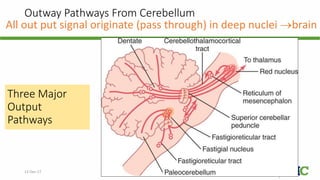
Outway Pathways From Cerebellum
All out put signal originate (pass through) in deep nuclei ď‚®brain
12-Dec-17 Cerebellum | © Prof. Dr. Rashid Mahmood
Three Major
Output
Pathways
12-Dec-17 Cerebellum | © Prof. Dr. Rashid Mahmood
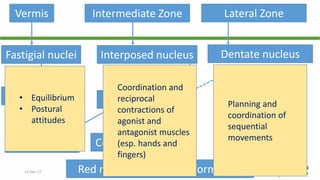
Vermis Intermediate Zone Lateral Zone
Fastigial nuclei
Medulla & Pons
Interposed nucleus
Thalamus
Cerebral cortexBasal Ganglia
Red nucleus & reticular formation
Dentate nucleus
• Equilibrium
• Postural
attitudes
Coordination and
reciprocal
contractions of
agonist and
antagonist muscles
(esp. hands and
fingers)
Planning and
coordination of
sequential
movements
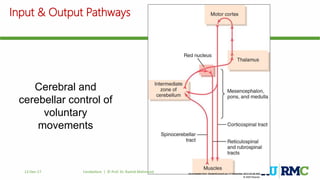
Cerebral and
cerebellar control of
voluntary
movements
Downloaded from: StudentConsult (on 17 December 2012 04:46 AM)
© 2005 Elsevier
Input & Output Pathways
12-Dec-17 Cerebellum | © Prof. Dr. Rashid Mahmood
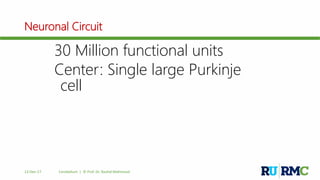
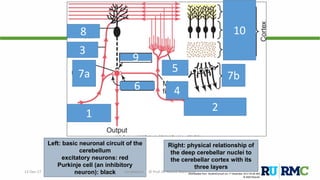
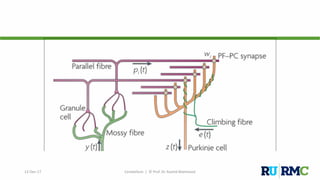
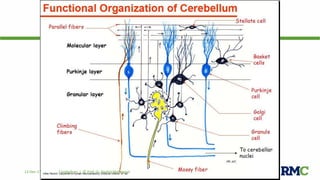
Neuronal Circuit
30 Million functional units
Center: Single large Purkinje
cell
12-Dec-17 Cerebellum | © Prof. Dr. Rashid Mahmood
Left: basic neuronal circuit of the
cerebellum
excitatory neurons: red
Purkinje cell (an inhibitory
neuron): black Downloaded from: StudentConsult (on 17 December 2012 04:46 AM)
© 2005 Elsevier
Right: physical relationship of
the deep cerebellar nuclei to
the cerebellar cortex with its
three layers
12-Dec-17 Cerebellum | © Prof. Dr. Rashid Mahmood
1
2
3
6
5
4
7a 7b
8
9
10
12-Dec-17 Cerebellum | © Prof. Dr. Rashid Mahmood
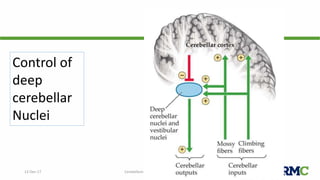
Control of
deep
cerebellar
Nuclei
12-Dec-17 Cerebellum | © Prof. Dr. Rashid Mahmood
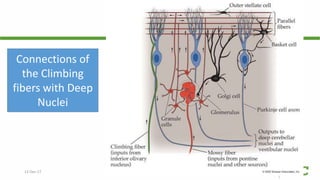
Connections of
the Climbing
fibers with Deep
Nuclei
12-Dec-17 Cerebellum | © Prof. Dr. Rashid Mahmood
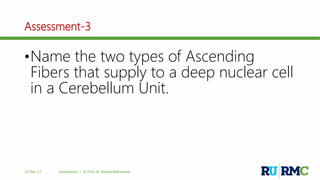
Assessment-3
•Name the two types of Ascending
Fibers that supply to a deep nuclear cell
in a Cerebellum Unit.
12-Dec-17 Cerebellum | © Prof. Dr. Rashid Mahmood
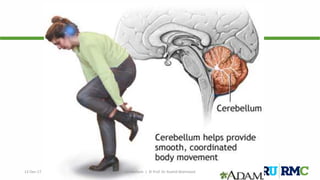
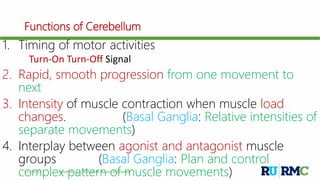
Functions of Cerebellum
1. Timing of motor activities
Turn-On Turn-Off Signal
2. Rapid, smooth progression from one movement to
next
3. Intensity of muscle contraction when muscle load
changes. (Basal Ganglia: Relative intensities of
separate movements)
4. Interplay between agonist and antagonist muscle
groups (Basal Ganglia: Plan and control
complex pattern of muscle movements)12-Dec-17 Cerebellum | © Prof. Dr. Rashid Mahmood
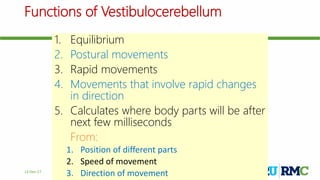
Functions of Vestibulocerebellum
12-Dec-17 Cerebellum | © Prof. Dr. Rashid Mahmood
1. Equilibrium
2. Postural movements
3. Rapid movements
4. Movements that involve rapid changes
in direction
5. Calculates where body parts will be after
next few milliseconds
From:
1. Position of different parts
2. Speed of movement
3. Direction of movement
Functions of Spinocerebellum
1. Coordination and reciprocal contraction of agonist and
antagonist muscles Turn-on Turn-off signals
Spinocerebellum receives three types of information when a
movement is performed: COMPARES
i) Direct information from motor cortex & Red nucleus, telling
cerebellum about intended movement
(Cortico-Ponto-Cerebellar Tract)
ii) From Sensory Relay Neurons: Tells cerebellum that signals have
arrived
(Ventral Spinocerebellar Tract)
iii) From Sensory Receptors: Tells that Actual Movement has occurred
Contd….12-Dec-17 Cerebellum | © Prof. Dr. Rashid Mahmood
Functions of Spinocerebellum (Contd…)
12-Dec-17 Cerebellum | © Prof. Dr. Rashid Mahmood
2. Damping function:
Pendulous / overshoot If not stopped at intended point.
3. Control of ballistic movements:
Most rapidly occurring movements e.g. Typing,
Preplanned
Cerebellum Removed:
i. Movements slow to develop
ii. Force development is weak
iii. Slow to Turn-off
iv. Loss of Automatism
Functions of Cerebro Cerebellum:
• No direct input from peripheral body parts
• Two-way communication with cerebral cortex and
basal ganglia
1. Planning & coordination of sequential movements
Smooth Progression Orderly sequence
2. Timing Function
Time the sequential movements when to start and stop
3. Extramotor predictive function
Can predict from changing visual scenes how rapidly a person
is approaching an object.
12-Dec-17 Cerebellum | © Prof. Dr. Rashid Mahmood
Learning Resources
12-Dec-17 Cerebellum | © Prof. Dr. Rashid Mahmood
• Guyton and Hall (Text book of physiology), 13th
Edition
• Ganong (Text book of physiology), 25th Edition
• Lecture Notes Neurophysiology by Prof. Dr.
Muhammad Tariq 2nd Edition, Reprint (Co-
Author: Prof. Dr. Rashid Mahmood)
• Neurophysiology for Medical Students by Prof.
Dr. Masood Ahmed Khan 2nd Edition (Co-Author:
Prof. Dr. Rashid Mahmood)
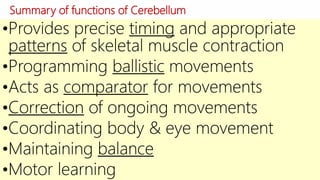
Summary of functions of Cerebellum
12-Dec-17 Cerebellum | © Prof. Dr. Rashid Mahmood
•Provides precise timing and appropriate
patterns of skeletal muscle contraction
•Programming ballistic movements
•Acts as comparator for movements
•Correction of ongoing movements
•Coordinating body & eye movement
•Maintaining balance
•Motor learning
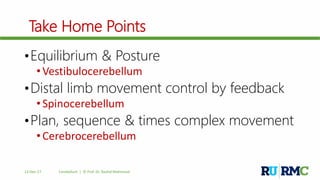
Take Home Points
•Equilibrium & Posture
•Vestibulocerebellum
•Distal limb movement control by feedback
•Spinocerebellum
•Plan, sequence & times complex movement
•Cerebrocerebellum
12-Dec-17 Cerebellum | © Prof. Dr. Rashid Mahmood
Assessment Q.4
•What is the main function of
Spinocerebellum?
12-Dec-17 Cerebellum | © Prof. Dr. Rashid Mahmood
The End
Questions ?
Comments ?
drrashid62@gmail.com
rashid.mahmood@rmi.edu.pk
ppt also available at
https://www.slideshare.net
Cerebellum | © Prof. Dr. Rashid12-Dec-17
Thank You
12-Dec-17 Cerebellum | © Prof. Dr. Rashid Mahmood

Cerebellum

  • 1.
  • 2.
    MCQ 1 of3 • A 55 years old man was referred to a neurologist with complaints of ataxia and slurred speech. Examination revealed that the patient had Nystagmus and was unable to stand on his feet without support even with his eyes open. This man is most probably suffering from a lesion involving: A. basal ganglia B. dorsal columns C. cerebellum D. mid brain E. spinal cord 12-Dec-17 Cerebellum | © Prof. Dr. Rashid Mahmood C
  • 3.
    MCQ 2 of3 • A seventy year old man presents with rigidity of much of the musculature of the body, involuntary tremors & difficulty in initiating movement. The most likely diagnosis is: A. Alzheimer’s disease B. Cerebellar Ataxia C. Huntington’s Chorea D. Parkinson’s disease E. Thyrotoxicosis 12-Dec-17 Cerebellum | © Prof. Dr. Rashid Mahmood D
  • 4.
    MCQ 3 of3 • A patient presents with a disturbance of voluntary movements of one arm & leg, decreased muscle tone, absent superficial reflexes & slow deep reflexes. Which of the following is diseased? A. Cerebellum B. Pyramidal Tract C. Rubrospinal Tract D. Basal Ganglia E. Vestibule-Spinal Tract12-Dec-17 Cerebellum | © Prof. Dr. Rashid Mahmood B
  • 5.
    Components of motormovement that need to be controlled • Timing • Rapidity • Smooth progression from to next movement • Prediction of next movement • Intensity when muscle load changes • Interplay between agonists and antagonists 12-Dec-17 Cerebellum | © Prof. Dr. Rashid Mahmood • Plan and Control Complex movements • Relative intensities of separate movements • Direction of movements & • Sequencing of multiple sequential movements to achieve complicated motor goal Cerebellum Basal Ganglia
  • 6.
    The Cerebellum • Partof the hindbrain • Makes up 11% of the brain’s mass • Cerebellar activity occurs subconsciously • Silent area of Brain 12-Dec-17 Cerebellum | © Prof. Dr. Rashid Mahmood
  • 7.
    12-Dec-17 Cerebellum |© Prof. Dr. Rashid Mahmood
  • 8.
    Objectives 12-Dec-17 Cerebellum |© Prof. Dr. Rashid Mahmood • Goal /Aim: • By the end of this session students should be able to understand the Physiology of Cerebellum • Specific Objectives At the end of the lecture the students will be able to • Describe functional anatomy of cerebellum • Explain connections of cerebellum to other parts of nervous system • Describe functions of cerebellum • Enlist deep nuclei of cerebellum
  • 9.
    Lesson Contents •Functional Anatomyof Cerebellum •Physiological divisions •Deep Cerebellar Nuclei •Afferent and Efferent pathways •Neural Circuit •Functions of Each Part of Cerebellum 12-Dec-17 Cerebellum | © Prof. Dr. Rashid Mahmood
  • 10.
    Anatomical Divisions • Anterior lobe •Primary Fissure • Posterior Lobe • Posterolateral Fissure or • Uvulonodular Fissure • Flocculonodular Lobe 12-Dec-17 Cerebellum | © Prof. Dr. Rashid Mahmood
  • 11.
    Physiological Divisions Contd….12-Dec-17 Cerebellum |© Prof. Dr. Rashid Mahmood Three Physiological Divisions: 1. Vestibulo- Cerebellum Flocculonodular Lobe 2. Spino- Cerebellum Vermis + intermediate zones 3. Cerebro- Cerebellum Lateral Zones
  • 12.
    Assessment -1 •Name thePhysiological divisions of Cerebellum. 12-Dec-17 Cerebellum | © Prof. Dr. Rashid Mahmood
  • 13.
    1. Vestibulo-Cerebellum Flocculonodular Lobe Controlof Equilibrium Contd….12-Dec-17 Cerebellum | © Prof. Dr. Rashid Mahmood
  • 14.
    2. Spino-Cerebellum Vermis: Movements of •Trunk • Shoulders • Neck • Hips Intermediate Zone: Movements of Limbs: Especially Hands, Fingers, Feet & Toes Vermis + intermediate zones Topographical representation of muscle groups 12-Dec-17 Cerebellum | © Prof. Dr. Rashid Mahmood
  • 15.
    3. Cerebro-Cerebellum Lateral Zones Planningand coordination of sequential motor activities Contd….12-Dec-17 Cerebellum | © Prof. Dr. Rashid Mahmood
  • 16.
    Deep cerebellar nuclei 12-Dec-17Cerebellum | © Prof. Dr. Rashid Mahmood • Outer: Grey matter (cortex) • Inner: White matter Groups of nerve cell bodies embedded in white matter Three 1. Fastigial nucleus 2. Interposed nucleus
  • 17.
    Internal structures Cerebellar cortex Dentatenucleus Fastigial nucleus Globose nucleus Emboliform nucleus Arbor vitae 12-Dec-17 Cerebellum | © Prof. Dr. Rashid Mahmood Globose Nucleus + Emboliform Nucleus = interposed Nucleus
  • 18.
    Afferent & EfferentPathways Input Signals: i. From respective body parts ii. Corresponding topographical areas of motor cortex Output Signals: i. Same areas of motor cortex ii. Red nucleus iii. Reticular formation Contd….12-Dec-17 Cerebellum | © Prof. Dr. Rashid Mahmood
  • 19.
    Downloaded from: StudentConsult(on 17 December 2012 04:46 AM) © 2005 Elsevier Three peduncles: Superior cerebellar peduncle :Midbrain Middle cerebellar peduncle :Pons Inferior cerebellar peduncle :Medulla Principal afferent tracts to the cerebellum. 12-Dec-17 Cerebellum | © Prof. Dr. Rashid Mahmood
  • 20.
    Ventral organization 12-Dec-17 Cerebellum| © Prof. Dr. Rashid Mahmood
  • 21.
    Principal afferent tractsto the cerebellum. A. Input Pathways from Brain Four main tracts/ pathways: i) Cortico-Ponto-Cerebellar pathway ii) Olivocerebellar Tract iii) Vestibulocerebellar Tract iv) Reticulocerebellar Tract B. Input Pathways From Periphery Four main tracts/ pathways i) Two Doral spinocerebellar tracts ii) Two Ventral Spinocerebellar tracts Contd….12-Dec-17 Cerebellum | © Prof. Dr. Rashid Mahmood
  • 22.
    Spinocerebellar tracts. Downloadedfrom: StudentConsult (on 17 December 2012 04:46 AM) © 2005 Elsevier 12-Dec-17 Cerebellum | © Prof. Dr. Rashid Mahmood
  • 23.
    Spinocerebellar Tracts 12-Dec-17 Cerebellum| © Prof. Dr. Rashid Mahmood
  • 24.
    Assessment Q.2 •Name theinput pathways of Cerebellum that originate in the periphery 12-Dec-17 Cerebellum | © Prof. Dr. Rashid Mahmood
  • 25.
    Outway Pathways FromCerebellum All out put signal originate (pass through) in deep nuclei brain 12-Dec-17 Cerebellum | © Prof. Dr. Rashid Mahmood Three Major Output Pathways
  • 26.
    12-Dec-17 Cerebellum |© Prof. Dr. Rashid Mahmood Vermis Intermediate Zone Lateral Zone Fastigial nuclei Medulla & Pons Interposed nucleus Thalamus Cerebral cortexBasal Ganglia Red nucleus & reticular formation Dentate nucleus • Equilibrium • Postural attitudes Coordination and reciprocal contractions of agonist and antagonist muscles (esp. hands and fingers) Planning and coordination of sequential movements
  • 27.
    Cerebral and cerebellar controlof voluntary movements Downloaded from: StudentConsult (on 17 December 2012 04:46 AM) © 2005 Elsevier Input & Output Pathways 12-Dec-17 Cerebellum | © Prof. Dr. Rashid Mahmood
  • 28.
    Neuronal Circuit 30 Millionfunctional units Center: Single large Purkinje cell 12-Dec-17 Cerebellum | © Prof. Dr. Rashid Mahmood
  • 29.
    Left: basic neuronalcircuit of the cerebellum excitatory neurons: red Purkinje cell (an inhibitory neuron): black Downloaded from: StudentConsult (on 17 December 2012 04:46 AM) © 2005 Elsevier Right: physical relationship of the deep cerebellar nuclei to the cerebellar cortex with its three layers 12-Dec-17 Cerebellum | © Prof. Dr. Rashid Mahmood 1 2 3 6 5 4 7a 7b 8 9 10
  • 30.
    12-Dec-17 Cerebellum |© Prof. Dr. Rashid Mahmood
  • 31.
    12-Dec-17 Cerebellum |© Prof. Dr. Rashid Mahmood Control of deep cerebellar Nuclei
  • 32.
    12-Dec-17 Cerebellum |© Prof. Dr. Rashid Mahmood Connections of the Climbing fibers with Deep Nuclei
  • 33.
    12-Dec-17 Cerebellum |© Prof. Dr. Rashid Mahmood
  • 34.
    Assessment-3 •Name the twotypes of Ascending Fibers that supply to a deep nuclear cell in a Cerebellum Unit. 12-Dec-17 Cerebellum | © Prof. Dr. Rashid Mahmood
  • 35.
    Functions of Cerebellum 1.Timing of motor activities Turn-On Turn-Off Signal 2. Rapid, smooth progression from one movement to next 3. Intensity of muscle contraction when muscle load changes. (Basal Ganglia: Relative intensities of separate movements) 4. Interplay between agonist and antagonist muscle groups (Basal Ganglia: Plan and control complex pattern of muscle movements)12-Dec-17 Cerebellum | © Prof. Dr. Rashid Mahmood
  • 36.
    Functions of Vestibulocerebellum 12-Dec-17Cerebellum | © Prof. Dr. Rashid Mahmood 1. Equilibrium 2. Postural movements 3. Rapid movements 4. Movements that involve rapid changes in direction 5. Calculates where body parts will be after next few milliseconds From: 1. Position of different parts 2. Speed of movement 3. Direction of movement
  • 37.
    Functions of Spinocerebellum 1.Coordination and reciprocal contraction of agonist and antagonist muscles Turn-on Turn-off signals Spinocerebellum receives three types of information when a movement is performed: COMPARES i) Direct information from motor cortex & Red nucleus, telling cerebellum about intended movement (Cortico-Ponto-Cerebellar Tract) ii) From Sensory Relay Neurons: Tells cerebellum that signals have arrived (Ventral Spinocerebellar Tract) iii) From Sensory Receptors: Tells that Actual Movement has occurred Contd….12-Dec-17 Cerebellum | © Prof. Dr. Rashid Mahmood
  • 38.
    Functions of Spinocerebellum(Contd…) 12-Dec-17 Cerebellum | © Prof. Dr. Rashid Mahmood 2. Damping function: Pendulous / overshoot If not stopped at intended point. 3. Control of ballistic movements: Most rapidly occurring movements e.g. Typing, Preplanned Cerebellum Removed: i. Movements slow to develop ii. Force development is weak iii. Slow to Turn-off iv. Loss of Automatism
  • 39.
    Functions of CerebroCerebellum: • No direct input from peripheral body parts • Two-way communication with cerebral cortex and basal ganglia 1. Planning & coordination of sequential movements Smooth Progression Orderly sequence 2. Timing Function Time the sequential movements when to start and stop 3. Extramotor predictive function Can predict from changing visual scenes how rapidly a person is approaching an object. 12-Dec-17 Cerebellum | © Prof. Dr. Rashid Mahmood
  • 40.
    Learning Resources 12-Dec-17 Cerebellum| © Prof. Dr. Rashid Mahmood • Guyton and Hall (Text book of physiology), 13th Edition • Ganong (Text book of physiology), 25th Edition • Lecture Notes Neurophysiology by Prof. Dr. Muhammad Tariq 2nd Edition, Reprint (Co- Author: Prof. Dr. Rashid Mahmood) • Neurophysiology for Medical Students by Prof. Dr. Masood Ahmed Khan 2nd Edition (Co-Author: Prof. Dr. Rashid Mahmood)
  • 41.
    Summary of functionsof Cerebellum 12-Dec-17 Cerebellum | © Prof. Dr. Rashid Mahmood •Provides precise timing and appropriate patterns of skeletal muscle contraction •Programming ballistic movements •Acts as comparator for movements •Correction of ongoing movements •Coordinating body & eye movement •Maintaining balance •Motor learning
  • 42.
    Take Home Points •Equilibrium& Posture •Vestibulocerebellum •Distal limb movement control by feedback •Spinocerebellum •Plan, sequence & times complex movement •Cerebrocerebellum 12-Dec-17 Cerebellum | © Prof. Dr. Rashid Mahmood
  • 43.
    Assessment Q.4 •What isthe main function of Spinocerebellum? 12-Dec-17 Cerebellum | © Prof. Dr. Rashid Mahmood
  • 44.
    The End Questions ? Comments? drrashid62@gmail.com rashid.mahmood@rmi.edu.pk ppt also available at https://www.slideshare.net Cerebellum | © Prof. Dr. Rashid12-Dec-17
  • 45.
    Thank You 12-Dec-17 Cerebellum| © Prof. Dr. Rashid Mahmood