Neurophysiology
(cerebellum)
Cerebellum
• The cerebellum plays major roles in the timing
of motor activities and in rapid, smooth
progression from one muscle movement to
the next.
• It also helps to control intensity of muscle
contraction when the muscle load changes, as
well as controlling necessary instantaneous
interplay between agonist and antagonist
muscle groups.
Cerebellum & its Motor Functions
• “Silent area of the brain”, principally because
electrical excitation of the cerebellum does not cause
any conscious sensation and rarely causes any motor
movement.
• Removal, however, does cause body movements to
become highly abnormal
• vital during rapid muscular activities such as running,
typing, playing the piano, and even talking
• Loss of this area of the brain can cause almost total
incoordination of these activities even though its loss
causes paralysis of no muscles.
• it helps to sequence the motor activities and
also monitors and makes corrective
adjustments in the body’s motor activities
while they are being executed so that they will
conform to the motor signals directed by the
cerebral motor cortex and other parts of the
brain.
• The cerebellum receives continuously updated information about
the desired sequence of muscle contractions from the brain motor
control areas
• it also receives continuous sensory information from the peripheral
parts of the body, giving sequential changes in the status of each
part of the body (its position, rate of movement, forces acting on it
etc).
• The cerebellum then compares the actual movements as depicted
by the peripheral sensory feedback information with the
movements intended by the motor system.
• If the two do not compare favorably, then instantaneous
subconscious corrective signals are transmitted back into the
motor system to increase or decrease the levels of activation of
specific muscles.
• The cerebellum also aids the cerebral cortex in planning
the next sequential movement a fraction of a second in
advance while the current movement is still being
executed,
• thus helping the person to progress smoothly from one
movement to the next.
• Also, it learns by its mistakes, that is, if a movement does
not occur exactly as intended, the cerebellar circuit learns
to make a stronger or weaker movement the next time.
• To do this, changes occur in the excitability of appropriate
cerebellar neurons, thus bringing subsequent muscle
contractions into better correspondence with the intended
movements.
Anatomical Functional Areas
of the Cerebellum
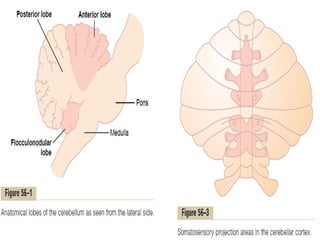
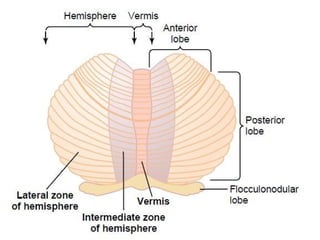
• Anatomically, the cerebellum is divided into three lobes by
two deep fissures
1. the anterior lobe
2. the posterior lobe
3. the flocculonodular lobe.
• The flocculonodular lobe is the oldest of all portions of the
cerebellum; it developed along with (and functions with)
the vestibular system in controlling body equilibrium
• The human cerebellar cortex is actually a large folded
sheet, about 17cm wide by 120cm long
• Each fold is called a folium. Lying deep beneath the folded
mass of cerebellar cortex are deep cerebellar nuclei.
Functional Divisions of the Anterior
and Posterior Lobes
• From a functional point of view, the anterior and posterior lobes are
organized not by lobes but along the longitudinal axis
• center of the cerebellum a narrow band called the vermis, separated from
the remainder of the cerebellum by shallow grooves. In this area, most
cerebellar control functions for muscle movements of the axial body, neck,
shoulders, and hips are located.
• To each side of the vermis is a large, laterally protruding cerebellar
hemisphere, and each of these hemispheres is divided into an
intermediate zone and a lateral zone.
• The intermediate zone of the hemisphere is concerned with controlling
muscle contractions in the distal portions of the upper and lower
limbs, especially the hands and fingers and feet and toes
• The lateral zone joins with the cerebral cortex in the overall planning of
sequential motor movements. Without this lateral zone, most discrete
motor activities of the body lose their appropriate timing and sequencing
and therefore become incoordinated
Topographical representation
• axial portions of the body lie in the vermis
part of the cerebellum, whereas the limbs and
facial regions lie in the intermediate zones
• Afferent signals from the body
• To and fro, from the cerebral cortex
• To the Red Nucleus
Neuronal Circuit of the Cerebellum
Afferent Pathways from Other Parts of
the Brain
• Corticopontocerebellar pathway
– Originates in the cerebral motor and premotor cortices and also in the
cerebral somatosensory cortex. It passes by way of the pontile nuclei and
pontocerebellar tracts mainly to the lateral divisions of the cerebellar
hemispheres on the opposite side of the brain from the cerebral areas
• olivocerebellar tract
– which passes from the inferior olive to all parts of the cerebellum and is
excited in the olive by fibers from the cerebral motor cortex, basal ganglia,
widespread areas of the reticular formation, and spinal cord
• vestibulocerebellar fibers
– originate in the vestibular apparatus itself and others from the brain stem
vestibular nuclei—almost all of these terminate in the flocculonodular lobe
and fastigial nucleus of the cerebellum
• Reticulocerebellar fibers
– which originate in different portions of the brain stem reticular formation and
terminate in the midline cerebellar areas (mainly in the vermis)
Afferent Pathways from the Periphery
• The cerebellum also receives important sensory signals
directly from the peripheral parts of the body mainly
through four tracts on each side, two of which are
located dorsally in the cord and two ventrally
• The spinocerebellar pathways can transmit impulses at
velocities up to 120 m/sec, which is the most rapid
conduction in any pathway in the central nervous
system. This extremely rapid conduction is important
for instantaneous apprisal of the cerebellum of
changes in peripheral muscle actions.
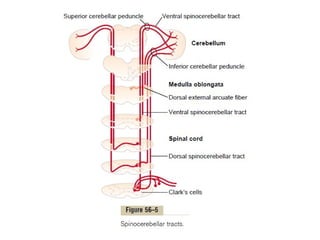
Dorsal spinocerebellar tract
• enters the cerebellum through the inferior cerebellar
peduncle and terminates in the vermis and intermediate
zones of the cerebellum on the same side as its origin.
• The signals transmitted in the dorsal spinocerebellar tracts
come mainly from the muscle spindles and to a lesser
extent from other somatic receptors throughout the body,
such as Golgi tendon organs, large tactile receptors of the
skin, and joint receptors. All these signals apprise the
cerebellum of the momentary status of
(1) muscle contraction,
(2) degree of tension on the muscle tendons,
(3) positions and rates of movement of the parts of the body, and
(4) forces acting on the surfaces of the body
ventral spinocerebellar tract
• enters the cerebellum through the superior cerebellar
peduncle, but it terminates in both sides of the cerebellum.
• the ventral spinocerebellar tracts receive less information
from the peripheral receptors.
• Instead, they are excited mainly by motor signals arriving
in
the anterior horns of the spinal cord from
• (1) the brain through the corticospinal and rubrospinal
tracts and
• (2) the internal motor pattern generators in the cord
itself.
• Thus, this ventral fiber pathway tells the cerebellum which
motor signals have arrived at the anterior horns; this
feedback is called the efference copy of the anterior horn
motor drive.
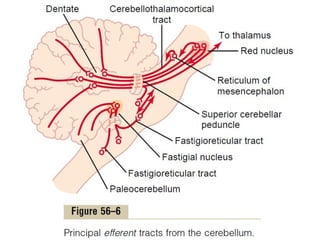
Output Signals from the Cerebellum
Deep Cerebellar Nuclei and the
Efferent Pathways.
• Located deep in the cerebellar mass on each side
are three deep cerebellar nuclei—the dentate,
interposed, and fastigial.
• (The vestibular nuclei in the medulla also function
in some respects as if they were deep cerebellar
nuclei because of their direct connections with
the cortex of the flocculonodular lobe.)
• All the deep cerebellar nuclei receive signals from
two sources:
(1) the cerebellar cortex and
(2) the deep sensory afferent tracts to the cerebellum.
• Each time an input signal arrives in the cerebellum, it
divides and goes in two directions:
– (1) directly to one of the cerebellar deep nuclei and
– (2) to a corresponding area of the cerebellar cortex overlying
the deep nucleus.
• Then, a fraction of a second later, the cerebellar cortex
relays an inhibitory output signal to the deep nucleus.
• Thus, all input signals that enter the cerebellum eventually
end in the deep nuclei in the form of initial excitatory
signals followed a fraction of a second later by inhibitory
signals.
• From the deep nuclei, output signals leave the cerebellum
and are distributed to other parts of the brain.
1. A pathway that originates in the midline structures of the cerebellum
(the vermis) and then passes through the fastigial nuclei into the
medullary and pontile regions of the brain stem. This circuit functions in
close association with the equilibrium apparatus and brain stem
vestibular nuclei to control equilibrium, and also in association with the
reticular formation of the brain stem to control the postural attitudes of
the body.
2. A pathway that originates in (1) the intermediate zone of the cerebellar
hemisphere and then passes through (2) the interposed nucleus to (3)
the ventrolateral and ventroanterior nuclei of the thalamus and then to
(4) the cerebral cortex, to (5) several midline structures of the thalamus
and then to (6) the basal ganglia and (7) the red nucleus and reticular
formation of the upper portion of the brain stem. This complex circuit
helps to coordinate mainly the reciprocal contractions of agonist and
antagonist muscles in the peripheral portions of the limbs, especially in
the hands, fingers, and thumbs.
3. A pathway that begins in the cerebellar cortex of the lateral zone of the
cerebellar hemisphere and then passes to the dentate nucleus, next to
the ventrolateral and ventroanterior nuclei of the thalamus, and, finally,
to the cerebral cortex. This pathway plays an important role in helping
coordinate sequential motor activities initiated by the cerebral cortex.
(9) cerebelluml (1).pptx presentation pp

(9) cerebelluml (1).pptx presentation pp

  • 2.
  • 3.
    Cerebellum • The cerebellumplays major roles in the timing of motor activities and in rapid, smooth progression from one muscle movement to the next. • It also helps to control intensity of muscle contraction when the muscle load changes, as well as controlling necessary instantaneous interplay between agonist and antagonist muscle groups.
  • 4.
    Cerebellum & itsMotor Functions • “Silent area of the brain”, principally because electrical excitation of the cerebellum does not cause any conscious sensation and rarely causes any motor movement. • Removal, however, does cause body movements to become highly abnormal • vital during rapid muscular activities such as running, typing, playing the piano, and even talking • Loss of this area of the brain can cause almost total incoordination of these activities even though its loss causes paralysis of no muscles.
  • 5.
    • it helpsto sequence the motor activities and also monitors and makes corrective adjustments in the body’s motor activities while they are being executed so that they will conform to the motor signals directed by the cerebral motor cortex and other parts of the brain.
  • 6.
    • The cerebellumreceives continuously updated information about the desired sequence of muscle contractions from the brain motor control areas • it also receives continuous sensory information from the peripheral parts of the body, giving sequential changes in the status of each part of the body (its position, rate of movement, forces acting on it etc). • The cerebellum then compares the actual movements as depicted by the peripheral sensory feedback information with the movements intended by the motor system. • If the two do not compare favorably, then instantaneous subconscious corrective signals are transmitted back into the motor system to increase or decrease the levels of activation of specific muscles.
  • 7.
    • The cerebellumalso aids the cerebral cortex in planning the next sequential movement a fraction of a second in advance while the current movement is still being executed, • thus helping the person to progress smoothly from one movement to the next. • Also, it learns by its mistakes, that is, if a movement does not occur exactly as intended, the cerebellar circuit learns to make a stronger or weaker movement the next time. • To do this, changes occur in the excitability of appropriate cerebellar neurons, thus bringing subsequent muscle contractions into better correspondence with the intended movements.
  • 8.
    Anatomical Functional Areas ofthe Cerebellum • Anatomically, the cerebellum is divided into three lobes by two deep fissures 1. the anterior lobe 2. the posterior lobe 3. the flocculonodular lobe. • The flocculonodular lobe is the oldest of all portions of the cerebellum; it developed along with (and functions with) the vestibular system in controlling body equilibrium • The human cerebellar cortex is actually a large folded sheet, about 17cm wide by 120cm long • Each fold is called a folium. Lying deep beneath the folded mass of cerebellar cortex are deep cerebellar nuclei.
  • 12.
    Functional Divisions ofthe Anterior and Posterior Lobes • From a functional point of view, the anterior and posterior lobes are organized not by lobes but along the longitudinal axis • center of the cerebellum a narrow band called the vermis, separated from the remainder of the cerebellum by shallow grooves. In this area, most cerebellar control functions for muscle movements of the axial body, neck, shoulders, and hips are located. • To each side of the vermis is a large, laterally protruding cerebellar hemisphere, and each of these hemispheres is divided into an intermediate zone and a lateral zone. • The intermediate zone of the hemisphere is concerned with controlling muscle contractions in the distal portions of the upper and lower limbs, especially the hands and fingers and feet and toes • The lateral zone joins with the cerebral cortex in the overall planning of sequential motor movements. Without this lateral zone, most discrete motor activities of the body lose their appropriate timing and sequencing and therefore become incoordinated
  • 13.
    Topographical representation • axialportions of the body lie in the vermis part of the cerebellum, whereas the limbs and facial regions lie in the intermediate zones • Afferent signals from the body • To and fro, from the cerebral cortex • To the Red Nucleus
  • 14.
    Neuronal Circuit ofthe Cerebellum
  • 15.
    Afferent Pathways fromOther Parts of the Brain • Corticopontocerebellar pathway – Originates in the cerebral motor and premotor cortices and also in the cerebral somatosensory cortex. It passes by way of the pontile nuclei and pontocerebellar tracts mainly to the lateral divisions of the cerebellar hemispheres on the opposite side of the brain from the cerebral areas • olivocerebellar tract – which passes from the inferior olive to all parts of the cerebellum and is excited in the olive by fibers from the cerebral motor cortex, basal ganglia, widespread areas of the reticular formation, and spinal cord • vestibulocerebellar fibers – originate in the vestibular apparatus itself and others from the brain stem vestibular nuclei—almost all of these terminate in the flocculonodular lobe and fastigial nucleus of the cerebellum • Reticulocerebellar fibers – which originate in different portions of the brain stem reticular formation and terminate in the midline cerebellar areas (mainly in the vermis)
  • 16.
    Afferent Pathways fromthe Periphery • The cerebellum also receives important sensory signals directly from the peripheral parts of the body mainly through four tracts on each side, two of which are located dorsally in the cord and two ventrally • The spinocerebellar pathways can transmit impulses at velocities up to 120 m/sec, which is the most rapid conduction in any pathway in the central nervous system. This extremely rapid conduction is important for instantaneous apprisal of the cerebellum of changes in peripheral muscle actions.
  • 17.
    Dorsal spinocerebellar tract •enters the cerebellum through the inferior cerebellar peduncle and terminates in the vermis and intermediate zones of the cerebellum on the same side as its origin. • The signals transmitted in the dorsal spinocerebellar tracts come mainly from the muscle spindles and to a lesser extent from other somatic receptors throughout the body, such as Golgi tendon organs, large tactile receptors of the skin, and joint receptors. All these signals apprise the cerebellum of the momentary status of (1) muscle contraction, (2) degree of tension on the muscle tendons, (3) positions and rates of movement of the parts of the body, and (4) forces acting on the surfaces of the body
  • 18.
    ventral spinocerebellar tract •enters the cerebellum through the superior cerebellar peduncle, but it terminates in both sides of the cerebellum. • the ventral spinocerebellar tracts receive less information from the peripheral receptors. • Instead, they are excited mainly by motor signals arriving in the anterior horns of the spinal cord from • (1) the brain through the corticospinal and rubrospinal tracts and • (2) the internal motor pattern generators in the cord itself. • Thus, this ventral fiber pathway tells the cerebellum which motor signals have arrived at the anterior horns; this feedback is called the efference copy of the anterior horn motor drive.
  • 20.
    Output Signals fromthe Cerebellum Deep Cerebellar Nuclei and the Efferent Pathways. • Located deep in the cerebellar mass on each side are three deep cerebellar nuclei—the dentate, interposed, and fastigial. • (The vestibular nuclei in the medulla also function in some respects as if they were deep cerebellar nuclei because of their direct connections with the cortex of the flocculonodular lobe.) • All the deep cerebellar nuclei receive signals from two sources: (1) the cerebellar cortex and (2) the deep sensory afferent tracts to the cerebellum.
  • 21.
    • Each timean input signal arrives in the cerebellum, it divides and goes in two directions: – (1) directly to one of the cerebellar deep nuclei and – (2) to a corresponding area of the cerebellar cortex overlying the deep nucleus. • Then, a fraction of a second later, the cerebellar cortex relays an inhibitory output signal to the deep nucleus. • Thus, all input signals that enter the cerebellum eventually end in the deep nuclei in the form of initial excitatory signals followed a fraction of a second later by inhibitory signals. • From the deep nuclei, output signals leave the cerebellum and are distributed to other parts of the brain.
  • 22.
    1. A pathwaythat originates in the midline structures of the cerebellum (the vermis) and then passes through the fastigial nuclei into the medullary and pontile regions of the brain stem. This circuit functions in close association with the equilibrium apparatus and brain stem vestibular nuclei to control equilibrium, and also in association with the reticular formation of the brain stem to control the postural attitudes of the body. 2. A pathway that originates in (1) the intermediate zone of the cerebellar hemisphere and then passes through (2) the interposed nucleus to (3) the ventrolateral and ventroanterior nuclei of the thalamus and then to (4) the cerebral cortex, to (5) several midline structures of the thalamus and then to (6) the basal ganglia and (7) the red nucleus and reticular formation of the upper portion of the brain stem. This complex circuit helps to coordinate mainly the reciprocal contractions of agonist and antagonist muscles in the peripheral portions of the limbs, especially in the hands, fingers, and thumbs. 3. A pathway that begins in the cerebellar cortex of the lateral zone of the cerebellar hemisphere and then passes to the dentate nucleus, next to the ventrolateral and ventroanterior nuclei of the thalamus, and, finally, to the cerebral cortex. This pathway plays an important role in helping coordinate sequential motor activities initiated by the cerebral cortex.