APPROACH TO ATAXIA
Dr. Deep Chandh Raja.S
SYNOPSIS
Important concepts in Ataxia
ATAXIA MIMICKERS
Tests of Cerebellar dysfunction
Step-wise approach to Cerebellar Ataxias
Summary
ALGORITHM for cerebellar ataxias
‘In Simple Terms…”
• ATAXIA- “Absence of ORDER” (Greek Word)
• In Neurological Terms-
“Incoordination of movement”
• A major feature of a disease or just one of the
various clinical features of a disease
Definition
• Ataxia is the inability to make smooth,
accurate and coordinated movements
• Arises from disorders of:
––Cerebellum
––Sensory pathways (Sensory Ataxia)
––Posterior columns, dorsal root ganglia,
peripheral nerves
––Frontal lobe lesions
––Extra pyramidal system
––Vestibular system
Tests to differentiate Various systems
in Ataxia- “The Ataxia Mimickers”
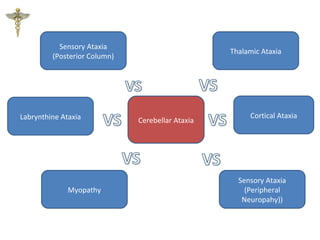
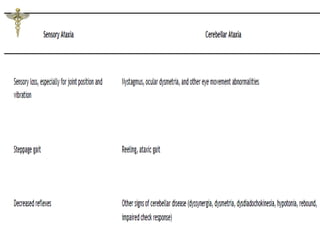
Cerebellar Ataxia
Cortical Ataxia
Myopathy
Labrynthine Ataxia
Sensory Ataxia
(Posterior Column)
Thalamic Ataxia
Sensory Ataxia
(Peripheral
Neuropahy))
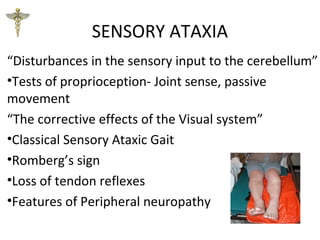
SENSORY ATAXIA
“Disturbances in the sensory input to the cerebellum”
•Tests of proprioception- Joint sense, passive
movement
“The corrective effects of the Visual system”
•Classical Sensory Ataxic Gait
•Romberg’s sign
•Loss of tendon reflexes
•Features of Peripheral neuropathy
• Caveats
Friederick’s ataxia, Multiple sclerosis…
• Overlap of clinical features to be expected in
clinical practice
Muscle weakness
• In the Miller-Fisher syndrome, which is
considered to be a variant of acute Guillain-Barré
polyneuropathy
• The severe ataxia and intention tremor are
presumably a result of a highly selective
peripheral disorder of spinocerebellar nerve
fibers
• Simple “tests of muscle power” can help detect
muscle weakness in various muscle groups
• CAVEAT- lead poisoning
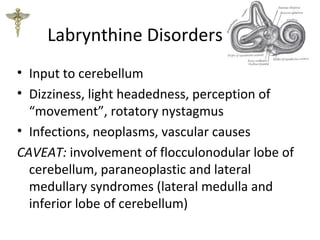
Labrynthine Disorders
• Input to cerebellum
• Dizziness, light headedness, perception of
“movement”, rotatory nystagmus
• Infections, neoplasms, vascular causes
CAVEAT: involvement of flocculonodular lobe of
cerebellum, paraneoplastic and lateral
medullary syndromes (lateral medulla and
inferior lobe of cerebellum)
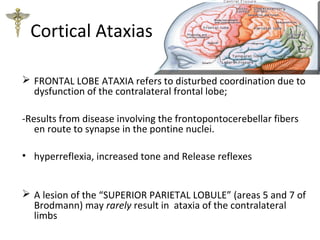
Cortical Ataxias
 FRONTAL LOBE ATAXIA refers to disturbed coordination due to
dysfunction of the contralateral frontal lobe;
-Results from disease involving the frontopontocerebellar fibers
en route to synapse in the pontine nuclei.
• hyperreflexia, increased tone and Release reflexes
 A lesion of the “SUPERIOR PARIETAL LOBULE” (areas 5 and 7 of
Brodmann) may rarely result in ataxia of the contralateral
limbs
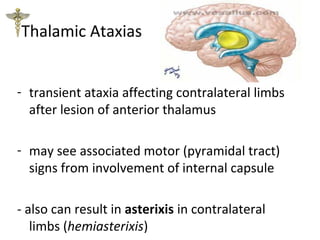
Thalamic Ataxias
- transient ataxia affecting contralateral limbs
after lesion of anterior thalamus
- may see associated motor (pyramidal tract)
signs from involvement of internal capsule
- also can result in asterixis in contralateral
limbs (hemiasterixis)
BEWARE OF EXTREMELY ANXIOUS PATIENTS!!!
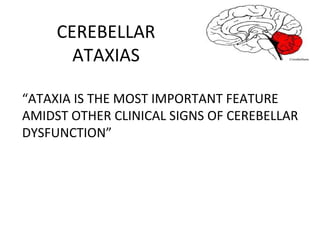
CEREBELLAR
ATAXIAS
“ATAXIA IS THE MOST IMPORTANT FEATURE
AMIDST OTHER CLINICAL SIGNS OF CEREBELLAR
DYSFUNCTION”
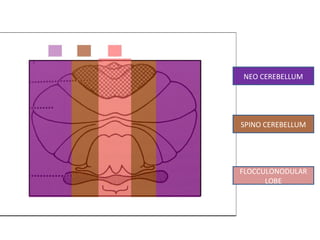
NEO CEREBELLUM
FLOCCULONODULAR
LOBE
SPINO CEREBELLUM
TESTS OF CEREBELLAR DYSFUNCTION
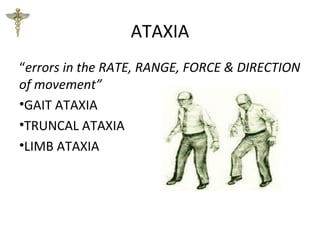
ATAXIA
“errors in the RATE, RANGE, FORCE & DIRECTION
of movement”
•GAIT ATAXIA
•TRUNCAL ATAXIA
•LIMB ATAXIA
CLASSIC FEATURES AND TESTS
Dyssynergia: results in jerky decomposed
movements (heel-knee-shin test)
Dysmetria: due to delayed activation of
antagonists
•- often correction to target by series of jerky
corrections (finger nose test)
•- may lead to intention tremor in limbs with
finger-to-nose or foot-to-target testing as
rhythmic oscillation emerges close to target
Dysdiadochokinesis: irregularities of force,
speed, and rhythm
Other features
Hypotonia: decrease in resistance to passive movement of
muscles related to depression of gamma motor neuron
activity (usually seen transiently in acute phase of
cerebellar lesions), pendullar knee jerk
Rebound phenomenon: related to poor tone and weak
check response, so when tap or displace limb, wider range
of movement in return to static position, incl. Holmes
phenomenon when suddenly release flexed arm held
against resistance - unable to stop flexion and arm strike
self (delay in activation of antagonist triceps muscle)
Dysarthria: often scanning type with irregularities in tone,
with words broken into syllables; often slow with
occasional rapid portions ("explosive speech")
Other features
Ocular Motor Abnormalities:
- usually if vestibular connections or flocculonodular lobe
affected
- pursuit movements no longer smooth, but saccadic
- may over- or under-shoot target with attempts at fixation
(ocular dysmetria)
- in primary position may see saccadic intrusions (such
as macro square-wave jerks) or primary nystagmus (incl.
vertical, esp up-beat nystagmus) or periodic alternating
nystagmus
-rebound nystagmus can occur with contralateral-beating
nystagmus on return of eyes to primary position after
eccentric gaze evoked nystagmus to one side
Writing abnormalities
Positional projectile vomiting (posterior fossa lesions)
APPROACH TO CEREBELLAR ATAXIA
IN ADULTS
THE “FOUR” QUESTIONS????
• Mode of ONSET ?
• PROGRESSION ?
• Focal /Symmetric involvement ?
• Localisation of the cerebellar lesion ?
HISTORY
EXAMINATION
MODE OF ONSET
• ACUTE- hours to days
• SUB ACUTE- days to weeks
• CHRONIC- months to years
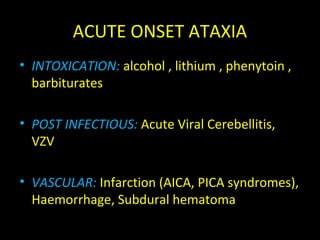
ACUTE ONSET ATAXIA
• INTOXICATION: alcohol , lithium , phenytoin ,
barbiturates
• POST INFECTIOUS: Acute Viral Cerebellitis,
VZV
• VASCULAR: Infarction (AICA, PICA syndromes),
Haemorrhage, Subdural hematoma
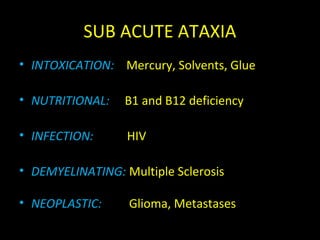
SUB ACUTE ATAXIA
• INTOXICATION: Mercury, Solvents, Glue
• NUTRITIONAL: B1 and B12 deficiency
• INFECTION: HIV
• DEMYELINATING: Multiple Sclerosis
• NEOPLASTIC: Glioma, Metastases
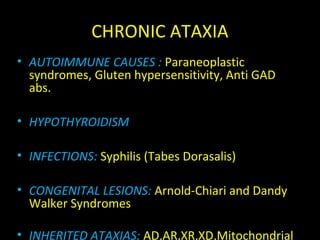
CHRONIC ATAXIA
• AUTOIMMUNE CAUSES : Paraneoplastic
syndromes, Gluten hypersensitivity, Anti GAD
abs.
• HYPOTHYROIDISM
• INFECTIONS: Syphilis (Tabes Dorasalis)
• CONGENITAL LESIONS: Arnold-Chiari and Dandy
Walker Syndromes
• INHERITED ATAXIAS: AD,AR,XR,XD,Mitochondrial
PROGRESSION
• Progressive
• Static
• Intermittent symptoms
• Reversible Ataxias
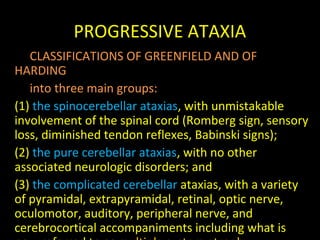
PROGRESSIVE ATAXIA
CLASSIFICATIONS OF GREENFIELD AND OF
HARDING
into three main groups:
(1) the spinocerebellar ataxias, with unmistakable
involvement of the spinal cord (Romberg sign, sensory
loss, diminished tendon reflexes, Babinski signs);
(2) the pure cerebellar ataxias, with no other
associated neurologic disorders; and
(3) the complicated cerebellar ataxias, with a variety
of pyramidal, extrapyramidal, retinal, optic nerve,
oculomotor, auditory, peripheral nerve, and
cerebrocortical accompaniments including what is
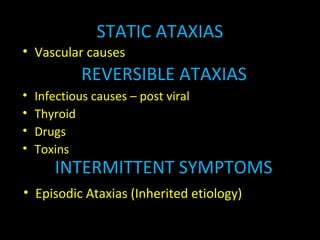
STATIC ATAXIAS
• Vascular causes
REVERSIBLE ATAXIAS
• Infectious causes – post viral
• Thyroid
• Drugs
• Toxins
INTERMITTENT SYMPTOMS
• Episodic Ataxias (Inherited etiology)
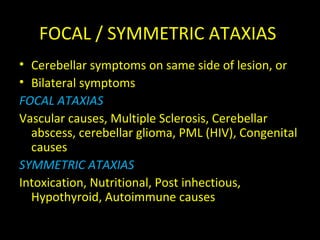
FOCAL / SYMMETRIC ATAXIAS
• Cerebellar symptoms on same side of lesion, or
• Bilateral symptoms
FOCAL ATAXIAS
Vascular causes, Multiple Sclerosis, Cerebellar
abscess, cerebellar glioma, PML (HIV), Congenital
causes
SYMMETRIC ATAXIAS
Intoxication, Nutritional, Post inhectious,
Hypothyroid, Autoimmune causes
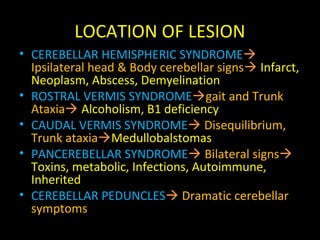
LOCATION OF LESION
• CEREBELLAR HEMISPHERIC SYNDROME
Ipsilateral head & Body cerebellar signs Infarct,
Neoplasm, Abscess, Demyelination
• ROSTRAL VERMIS SYNDROMEgait and Trunk
Ataxia Alcoholism, B1 deficiency
• CAUDAL VERMIS SYNDROME Disequilibrium,
Trunk ataxiaMedullobalstomas
• PANCEREBELLAR SYNDROME Bilateral signs
Toxins, metabolic, Infections, Autoimmune,
Inherited
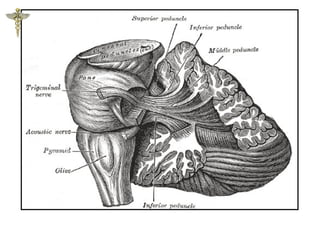
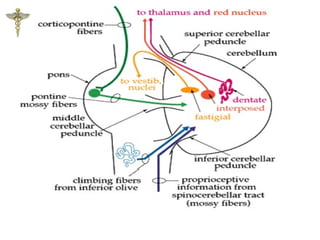
• CEREBELLAR PEDUNCLES Dramatic cerebellar
symptoms
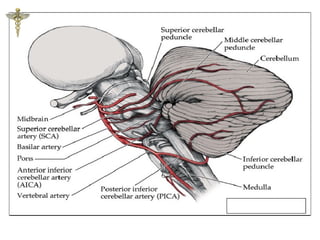
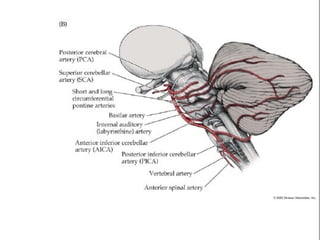
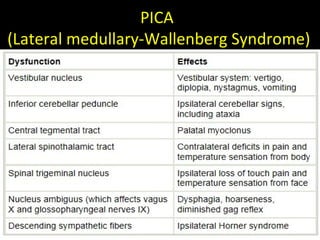
PICA
(Lateral medullary-Wallenberg Syndrome)
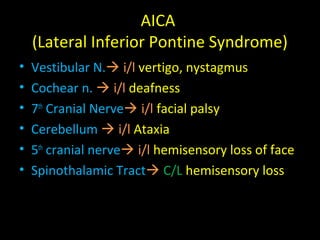
AICA
(Lateral Inferior Pontine Syndrome)
• Vestibular N. i/l vertigo, nystagmus
• Cochear n.  i/l deafness
• 7th
Cranial Nerve i/l facial palsy
• Cerebellum  i/l Ataxia
• 5th
cranial nerve i/l hemisensory loss of face
• Spinothalamic Tract C/L hemisensory loss
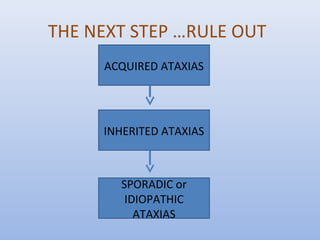
THE NEXT STEP …RULE OUT
ACQUIRED ATAXIAS
INHERITED ATAXIAS
SPORADIC or
IDIOPATHIC
ATAXIAS
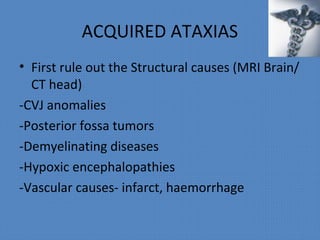
ACQUIRED ATAXIAS
• First rule out the Structural causes (MRI Brain/
CT head)
-CVJ anomalies
-Posterior fossa tumors
-Demyelinating diseases
-Hypoxic encephalopathies
-Vascular causes- infarct, haemorrhage
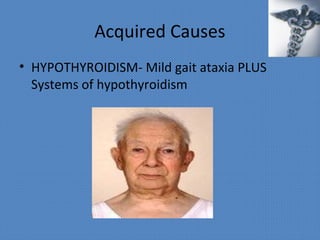
Acquired Causes
• HYPOTHYROIDISM- Mild gait ataxia PLUS
Systems of hypothyroidism
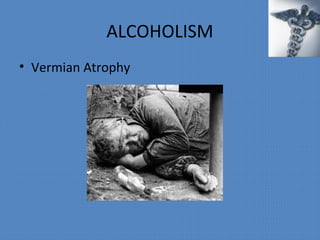
ALCOHOLISM
• Vermian Atrophy
TOXINS
• Cancer chemotherapeutics 5 FU, Cytarabine
• Metals Bismuth, Mercury (parasthesiass,
restricted visual defects), Lead
• SolventsPaint thinners , toluene (Cognitive
defects PLUS pyramidal tract signs)
• AnticonvulsantsPhenytoin (purkinje cell
loss)avoid in epileptics with ataxia
INFECTIONS
• VZV in children
• EBV in children
• Bickerstaff’s encephalitis (brain
stemophthalmoplegia,ataxia,lower c.n
palsies)
• HIV ( Lymphomas, PML, Infections,
Toxoplasmosis)
• CJD (17% classic CJD, Ataxic variant of CJD)
• Syphilis (Tabes Dorsalis)
• Whipple’s disease
AUTOIMMUNE CAUSES
PARANEOPLASTIC SYNDROMES
•ANTI Hu abs. Small Cell Cancer Lung
(extrapyramidal signs)
•ANTI Yo abs. Ovarian cancer
•ANTI Ri abs. Breast cancer (opsoclonus –
saccadomania, Trunk ataxia)
•ANTI Tr abs. Hodgkin’s lymphoma (hearing
loss)
• GLUTEN SENSITIVITY - Anti Gliadin abs.
(ataxia, brisk reflexes, peripheral neuropathies)
• ANTI GAD abs. – Diabetes, hypothyroidism,
peripheral neuropathySTIFF PERSON
syndrome
AUTOIMMUNE CAUSES
NUTRITIONAL CAUSES
• FAT MALABSORPTION- Vit. E deficiency
• Vit. B12 , B1 deficiencies
INHERITED ATAXIAS
• AD
• AR
• MITOCHONDRIAL DISTURBANCES
• X LINKED RECESSIVE
• X LINKED DOMINANT
INHERITED ATAXIAS
INHERITED ATAXIAS
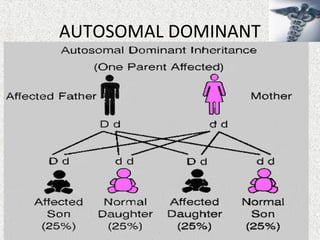
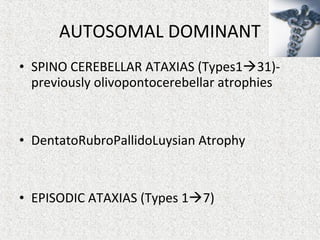
AUTOSOMAL DOMINANT
• SPINO CEREBELLAR ATAXIAS (Types131)-
previously olivopontocerebellar atrophies
• DentatoRubroPallidoLuysian Atrophy
• EPISODIC ATAXIAS (Types 17)
AUTOSOMAL DOMINANT
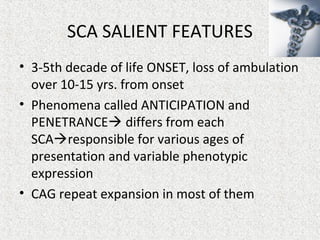
SCA SALIENT FEATURES
• 3-5th decade of life ONSET, loss of ambulation
over 10-15 yrs. from onset
• Phenomena called ANTICIPATION and
PENETRANCE differs from each
SCAresponsible for various ages of
presentation and variable phenotypic
expression
• CAG repeat expansion in most of them
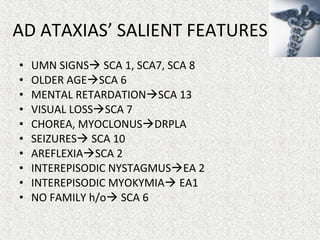
• UMN SIGNS SCA 1, SCA7, SCA 8
• OLDER AGESCA 6
• MENTAL RETARDATIONSCA 13
• VISUAL LOSSSCA 7
• CHOREA, MYOCLONUSDRPLA
• SEIZURES SCA 10
• AREFLEXIASCA 2
• INTEREPISODIC NYSTAGMUSEA 2
• INTEREPISODIC MYOKYMIA EA1
• NO FAMILY h/o SCA 6
AD ATAXIAS’ SALIENT FEATURES
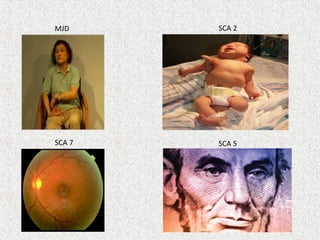
SCA 5
SCA 2MJD
SCA 7
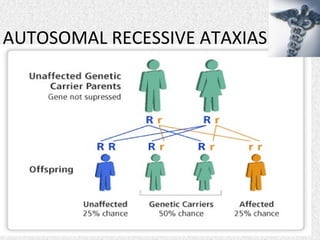
AUTOSOMAL RECESSIVE ATAXIAS
• FRIEDERICK’S ATAXIA
• ATAXIA TELANGIECTASIA
• ATAXIA WITH ISOLATED VIT.E DEFICIENCY
• ABETALIPOPROTEINEMIA
• ENZYME DEFICIENCIES (Maple Syrup urine
disease, Urea cycle defects, Sialidosis,
Adrenoleucodystrophy,Organic aciduria,
Pyruvate dehydogenase def.)
AUTOSOMAL RECESSIVE ATAXIAS
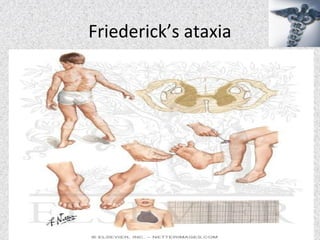
Friederick’s ataxia
• Unstable expansion of GAA repeatsFRATAXIN
proteiniron accumulation in
mitochondrianito.injuryneuronal injury
• DORSAL GANGLION CELLS- absent reflexes
• DORSAL COLUMN DEGENERATION-
dec.post.column senses
• SPINOCEREBELLAR TRACT-gait atxia, dysarthria
• CORTICOSPINAL TRACT- Babinski Positive
• OTHER SIGNS- dysphagia,optic atrophy, spinal and
foot deformities, diabetes (10%), cardiac defects
(50%)
Friederick’s ataxia
• NATURAL HISTORY:
-onset <25 yrs. At ADOLESCENCE
-loss of ambulation 15 yrs. Since onset
-Death usualyy due to cardiac complications
• VARIANTS:
-FA with Retained reflexes
-Late onset FA
Friederick’s ataxia
ATAXIA TELANGIECTASIA
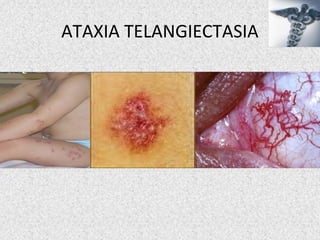
• OCULOMOTOR APRAXIA , TELANGIECATSIAS
IN EYES, SKIN
• Hematological malignancies (defective DNA
repairs)
• Infections (Ig deficiencies)
• Other features-peripheral neuropathy,
choreoathetosis
ATAXIA TELANGIECTASIA
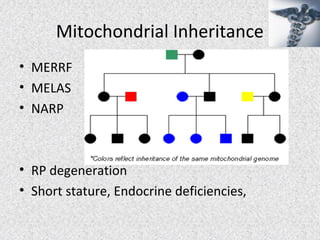
Mitochondrial Inheritance
• MERRF
• MELAS
• NARP
• RP degeneration
• Short stature, Endocrine deficiencies,
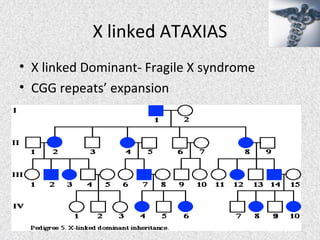
X linked ATAXIAS
• X linked Dominant- Fragile X syndrome
• CGG repeats’ expansion
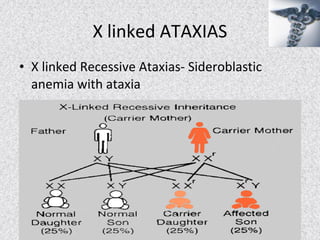
• X linked Recessive Ataxias- Sideroblastic
anemia with ataxia
X linked ATAXIAS
SPORADIC or IDIOPATHIC ATAXIAS
• Unknown genetic defects after ruling out
acquired causes
• Old age of onset
• Presents with Dysautonomia –Orthostatic
hypotension, erectile dysfunction, Urinary
incontinence
Investigations
• MRI Brain and Upper cervical cord
• CT Head
• Vit. E, B12 levels
• Total cholesterol levels, Thyroid hormones
• NCV and EMG studies (to rule out other systems’
involvement)
• Toxicology screen (includes phenytoin levels)
• Serology screen (for autoantibodies)
• CSF analysis
• Genetic Analyses (GAA, CGG, CAG repeat
analyses)
TREATMENT
• Reversible causes to be identified and treated
• Structural lesions to be considered for surgery
• Dietary modifications
• IDEBENONE- in Friederick’s Ataxia
• RILUZOLE- in Friederick’s Ataxia
• ACETAZOLAMIDE- in Episodc Ataxia
• GENETIC COUNSELLING
HISTORY SUMMARY
1. Duration: acute, subacute vs chronic
2. Rate of Progression: static vs progressive
3. Constant vs Paroxysmal
4. Associated features:
- headache & vomiting suggesting mass lesion with raised ICP
- previous neurological events (similar with ataxia - as in
episodic ataxias, or other as in multiple sclerosis or
vertebrobasilar TIAs)
5. Medical History:
- recent infection, Hx of malignancy or weight loss, breast
mass / tenderness, cough / hemoptysis
- drug use / intoxication, medications, alcohol, smoking,
environmental exposures
6. Family History positive or negative (in siblings or cousins
but not parents suggesting autosomal recessive or parents
and/or sibs suggesting autosomal dominant inheritance
EXAMINATION SUMMARY
General examination:
- signs of primary neoplasm (with paraneoplastic or metastatic
ataxia), vascular disease (stroke), cardiac abnormality (
Friedreick's) or Kayser-Fleischer rings (Wilson's)
-short stature and cataracts with mitochondrial disease
Higher Mental Functions:
- confusion associated with ataxia in Wernicke's, drug or
environmental toxicity, prion diseases or any condition
obstructing 4th ventricle leading to hydrocephalus with raised
ICP
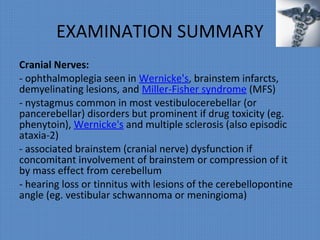
Cranial Nerves:
- ophthalmoplegia seen in Wernicke's, brainstem infarcts,
demyelinating lesions, and Miller-Fisher syndrome (MFS)
- nystagmus common in most vestibulocerebellar (or
pancerebellar) disorders but prominent if drug toxicity (eg.
phenytoin), Wernicke's and multiple sclerosis (also episodic
ataxia-2)
- associated brainstem (cranial nerve) dysfunction if
concomitant involvement of brainstem or compression of it
by mass effect from cerebellum
- hearing loss or tinnitus with lesions of the cerebellopontine
angle (eg. vestibular schwannoma or meningioma)
EXAMINATION SUMMARY
EXAMINATION SUMMARY
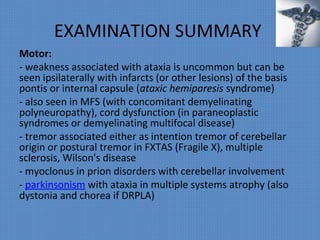
Motor:
- weakness associated with ataxia is uncommon but can be
seen ipsilaterally with infarcts (or other lesions) of the basis
pontis or internal capsule (ataxic hemiparesis syndrome)
- also seen in MFS (with concomitant demyelinating
polyneuropathy), cord dysfunction (in paraneoplastic
syndromes or demyelinating multifocal disease)
- tremor associated either as intention tremor of cerebellar
origin or postural tremor in FXTAS (Fragile X), multiple
sclerosis, Wilson's disease
- myoclonus in prion disorders with cerebellar involvement
- parkinsonism with ataxia in multiple systems atrophy (also
dystonia and chorea if DRPLA)
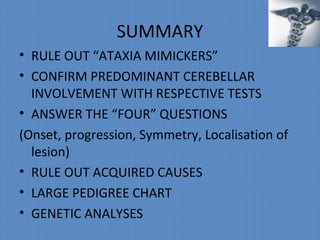
SUMMARY
• RULE OUT “ATAXIA MIMICKERS”
• CONFIRM PREDOMINANT CEREBELLAR
INVOLVEMENT WITH RESPECTIVE TESTS
• ANSWER THE “FOUR” QUESTIONS
(Onset, progression, Symmetry, Localisation of
lesion)
• RULE OUT ACQUIRED CAUSES
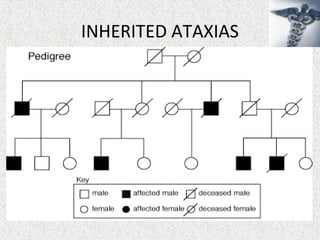
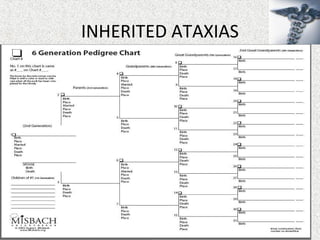
• LARGE PEDIGREE CHART
• GENETIC ANALYSES
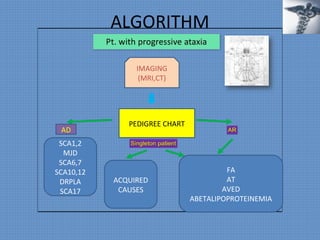
ALGORITHM
PEDIGREE CHART
ACQUIRED
CAUSES
AD
IMAGING
(MRI,CT)
SCA1,2
MJD
SCA6,7
SCA10,12
DRPLA
SCA17
FA
AT
AVED
ABETALIPOPROTEINEMIA
Ataxia

Ataxia

  • 1.
    APPROACH TO ATAXIA Dr.Deep Chandh Raja.S
  • 2.
    SYNOPSIS Important concepts inAtaxia ATAXIA MIMICKERS Tests of Cerebellar dysfunction Step-wise approach to Cerebellar Ataxias Summary ALGORITHM for cerebellar ataxias
  • 3.
    ‘In Simple Terms…” •ATAXIA- “Absence of ORDER” (Greek Word) • In Neurological Terms- “Incoordination of movement” • A major feature of a disease or just one of the various clinical features of a disease
  • 4.
    Definition • Ataxia isthe inability to make smooth, accurate and coordinated movements • Arises from disorders of: ––Cerebellum ––Sensory pathways (Sensory Ataxia) ––Posterior columns, dorsal root ganglia, peripheral nerves ––Frontal lobe lesions ––Extra pyramidal system ––Vestibular system
  • 5.
    Tests to differentiateVarious systems in Ataxia- “The Ataxia Mimickers”
  • 6.
    Cerebellar Ataxia Cortical Ataxia Myopathy LabrynthineAtaxia Sensory Ataxia (Posterior Column) Thalamic Ataxia Sensory Ataxia (Peripheral Neuropahy))
  • 7.
    SENSORY ATAXIA “Disturbances inthe sensory input to the cerebellum” •Tests of proprioception- Joint sense, passive movement “The corrective effects of the Visual system” •Classical Sensory Ataxic Gait •Romberg’s sign •Loss of tendon reflexes •Features of Peripheral neuropathy
  • 9.
    • Caveats Friederick’s ataxia,Multiple sclerosis… • Overlap of clinical features to be expected in clinical practice
  • 10.
    Muscle weakness • Inthe Miller-Fisher syndrome, which is considered to be a variant of acute Guillain-Barré polyneuropathy • The severe ataxia and intention tremor are presumably a result of a highly selective peripheral disorder of spinocerebellar nerve fibers • Simple “tests of muscle power” can help detect muscle weakness in various muscle groups • CAVEAT- lead poisoning
  • 11.
    Labrynthine Disorders • Inputto cerebellum • Dizziness, light headedness, perception of “movement”, rotatory nystagmus • Infections, neoplasms, vascular causes CAVEAT: involvement of flocculonodular lobe of cerebellum, paraneoplastic and lateral medullary syndromes (lateral medulla and inferior lobe of cerebellum)
  • 12.
    Cortical Ataxias  FRONTALLOBE ATAXIA refers to disturbed coordination due to dysfunction of the contralateral frontal lobe; -Results from disease involving the frontopontocerebellar fibers en route to synapse in the pontine nuclei. • hyperreflexia, increased tone and Release reflexes  A lesion of the “SUPERIOR PARIETAL LOBULE” (areas 5 and 7 of Brodmann) may rarely result in ataxia of the contralateral limbs
  • 13.
    Thalamic Ataxias - transientataxia affecting contralateral limbs after lesion of anterior thalamus - may see associated motor (pyramidal tract) signs from involvement of internal capsule - also can result in asterixis in contralateral limbs (hemiasterixis)
  • 14.
    BEWARE OF EXTREMELYANXIOUS PATIENTS!!!
  • 15.
    CEREBELLAR ATAXIAS “ATAXIA IS THEMOST IMPORTANT FEATURE AMIDST OTHER CLINICAL SIGNS OF CEREBELLAR DYSFUNCTION”
  • 16.
  • 20.
  • 21.
    ATAXIA “errors in theRATE, RANGE, FORCE & DIRECTION of movement” •GAIT ATAXIA •TRUNCAL ATAXIA •LIMB ATAXIA
  • 22.
    CLASSIC FEATURES ANDTESTS Dyssynergia: results in jerky decomposed movements (heel-knee-shin test) Dysmetria: due to delayed activation of antagonists •- often correction to target by series of jerky corrections (finger nose test) •- may lead to intention tremor in limbs with finger-to-nose or foot-to-target testing as rhythmic oscillation emerges close to target Dysdiadochokinesis: irregularities of force, speed, and rhythm
  • 23.
    Other features Hypotonia: decreasein resistance to passive movement of muscles related to depression of gamma motor neuron activity (usually seen transiently in acute phase of cerebellar lesions), pendullar knee jerk Rebound phenomenon: related to poor tone and weak check response, so when tap or displace limb, wider range of movement in return to static position, incl. Holmes phenomenon when suddenly release flexed arm held against resistance - unable to stop flexion and arm strike self (delay in activation of antagonist triceps muscle) Dysarthria: often scanning type with irregularities in tone, with words broken into syllables; often slow with occasional rapid portions ("explosive speech")
  • 24.
    Other features Ocular MotorAbnormalities: - usually if vestibular connections or flocculonodular lobe affected - pursuit movements no longer smooth, but saccadic - may over- or under-shoot target with attempts at fixation (ocular dysmetria) - in primary position may see saccadic intrusions (such as macro square-wave jerks) or primary nystagmus (incl. vertical, esp up-beat nystagmus) or periodic alternating nystagmus -rebound nystagmus can occur with contralateral-beating nystagmus on return of eyes to primary position after eccentric gaze evoked nystagmus to one side Writing abnormalities Positional projectile vomiting (posterior fossa lesions)
  • 25.
    APPROACH TO CEREBELLARATAXIA IN ADULTS
  • 26.
    THE “FOUR” QUESTIONS???? •Mode of ONSET ? • PROGRESSION ? • Focal /Symmetric involvement ? • Localisation of the cerebellar lesion ? HISTORY EXAMINATION
  • 27.
    MODE OF ONSET •ACUTE- hours to days • SUB ACUTE- days to weeks • CHRONIC- months to years
  • 28.
    ACUTE ONSET ATAXIA •INTOXICATION: alcohol , lithium , phenytoin , barbiturates • POST INFECTIOUS: Acute Viral Cerebellitis, VZV • VASCULAR: Infarction (AICA, PICA syndromes), Haemorrhage, Subdural hematoma
  • 29.
    SUB ACUTE ATAXIA •INTOXICATION: Mercury, Solvents, Glue • NUTRITIONAL: B1 and B12 deficiency • INFECTION: HIV • DEMYELINATING: Multiple Sclerosis • NEOPLASTIC: Glioma, Metastases
  • 30.
    CHRONIC ATAXIA • AUTOIMMUNECAUSES : Paraneoplastic syndromes, Gluten hypersensitivity, Anti GAD abs. • HYPOTHYROIDISM • INFECTIONS: Syphilis (Tabes Dorasalis) • CONGENITAL LESIONS: Arnold-Chiari and Dandy Walker Syndromes • INHERITED ATAXIAS: AD,AR,XR,XD,Mitochondrial
  • 31.
    PROGRESSION • Progressive • Static •Intermittent symptoms • Reversible Ataxias
  • 32.
    PROGRESSIVE ATAXIA CLASSIFICATIONS OFGREENFIELD AND OF HARDING into three main groups: (1) the spinocerebellar ataxias, with unmistakable involvement of the spinal cord (Romberg sign, sensory loss, diminished tendon reflexes, Babinski signs); (2) the pure cerebellar ataxias, with no other associated neurologic disorders; and (3) the complicated cerebellar ataxias, with a variety of pyramidal, extrapyramidal, retinal, optic nerve, oculomotor, auditory, peripheral nerve, and cerebrocortical accompaniments including what is
  • 33.
    STATIC ATAXIAS • Vascularcauses REVERSIBLE ATAXIAS • Infectious causes – post viral • Thyroid • Drugs • Toxins INTERMITTENT SYMPTOMS • Episodic Ataxias (Inherited etiology)
  • 34.
    FOCAL / SYMMETRICATAXIAS • Cerebellar symptoms on same side of lesion, or • Bilateral symptoms FOCAL ATAXIAS Vascular causes, Multiple Sclerosis, Cerebellar abscess, cerebellar glioma, PML (HIV), Congenital causes SYMMETRIC ATAXIAS Intoxication, Nutritional, Post inhectious, Hypothyroid, Autoimmune causes
  • 35.
    LOCATION OF LESION •CEREBELLAR HEMISPHERIC SYNDROME Ipsilateral head & Body cerebellar signs Infarct, Neoplasm, Abscess, Demyelination • ROSTRAL VERMIS SYNDROMEgait and Trunk Ataxia Alcoholism, B1 deficiency • CAUDAL VERMIS SYNDROME Disequilibrium, Trunk ataxiaMedullobalstomas • PANCEREBELLAR SYNDROME Bilateral signs Toxins, metabolic, Infections, Autoimmune, Inherited • CEREBELLAR PEDUNCLES Dramatic cerebellar symptoms
  • 37.
  • 38.
    AICA (Lateral Inferior PontineSyndrome) • Vestibular N. i/l vertigo, nystagmus • Cochear n.  i/l deafness • 7th Cranial Nerve i/l facial palsy • Cerebellum  i/l Ataxia • 5th cranial nerve i/l hemisensory loss of face • Spinothalamic Tract C/L hemisensory loss
  • 39.
    THE NEXT STEP…RULE OUT ACQUIRED ATAXIAS INHERITED ATAXIAS SPORADIC or IDIOPATHIC ATAXIAS
  • 40.
    ACQUIRED ATAXIAS • Firstrule out the Structural causes (MRI Brain/ CT head) -CVJ anomalies -Posterior fossa tumors -Demyelinating diseases -Hypoxic encephalopathies -Vascular causes- infarct, haemorrhage
  • 41.
    Acquired Causes • HYPOTHYROIDISM-Mild gait ataxia PLUS Systems of hypothyroidism
  • 42.
  • 43.
    TOXINS • Cancer chemotherapeutics5 FU, Cytarabine • Metals Bismuth, Mercury (parasthesiass, restricted visual defects), Lead • SolventsPaint thinners , toluene (Cognitive defects PLUS pyramidal tract signs) • AnticonvulsantsPhenytoin (purkinje cell loss)avoid in epileptics with ataxia
  • 44.
    INFECTIONS • VZV inchildren • EBV in children • Bickerstaff’s encephalitis (brain stemophthalmoplegia,ataxia,lower c.n palsies) • HIV ( Lymphomas, PML, Infections, Toxoplasmosis) • CJD (17% classic CJD, Ataxic variant of CJD) • Syphilis (Tabes Dorsalis) • Whipple’s disease
  • 45.
    AUTOIMMUNE CAUSES PARANEOPLASTIC SYNDROMES •ANTIHu abs. Small Cell Cancer Lung (extrapyramidal signs) •ANTI Yo abs. Ovarian cancer •ANTI Ri abs. Breast cancer (opsoclonus – saccadomania, Trunk ataxia) •ANTI Tr abs. Hodgkin’s lymphoma (hearing loss)
  • 46.
    • GLUTEN SENSITIVITY- Anti Gliadin abs. (ataxia, brisk reflexes, peripheral neuropathies) • ANTI GAD abs. – Diabetes, hypothyroidism, peripheral neuropathySTIFF PERSON syndrome AUTOIMMUNE CAUSES
  • 47.
    NUTRITIONAL CAUSES • FATMALABSORPTION- Vit. E deficiency • Vit. B12 , B1 deficiencies
  • 48.
    INHERITED ATAXIAS • AD •AR • MITOCHONDRIAL DISTURBANCES • X LINKED RECESSIVE • X LINKED DOMINANT
  • 49.
  • 50.
  • 51.
  • 52.
    • SPINO CEREBELLARATAXIAS (Types131)- previously olivopontocerebellar atrophies • DentatoRubroPallidoLuysian Atrophy • EPISODIC ATAXIAS (Types 17) AUTOSOMAL DOMINANT
  • 53.
    SCA SALIENT FEATURES •3-5th decade of life ONSET, loss of ambulation over 10-15 yrs. from onset • Phenomena called ANTICIPATION and PENETRANCE differs from each SCAresponsible for various ages of presentation and variable phenotypic expression • CAG repeat expansion in most of them
  • 54.
    • UMN SIGNSSCA 1, SCA7, SCA 8 • OLDER AGESCA 6 • MENTAL RETARDATIONSCA 13 • VISUAL LOSSSCA 7 • CHOREA, MYOCLONUSDRPLA • SEIZURES SCA 10 • AREFLEXIASCA 2 • INTEREPISODIC NYSTAGMUSEA 2 • INTEREPISODIC MYOKYMIA EA1 • NO FAMILY h/o SCA 6 AD ATAXIAS’ SALIENT FEATURES
  • 55.
  • 56.
  • 57.
    • FRIEDERICK’S ATAXIA •ATAXIA TELANGIECTASIA • ATAXIA WITH ISOLATED VIT.E DEFICIENCY • ABETALIPOPROTEINEMIA • ENZYME DEFICIENCIES (Maple Syrup urine disease, Urea cycle defects, Sialidosis, Adrenoleucodystrophy,Organic aciduria, Pyruvate dehydogenase def.) AUTOSOMAL RECESSIVE ATAXIAS
  • 58.
    Friederick’s ataxia • Unstableexpansion of GAA repeatsFRATAXIN proteiniron accumulation in mitochondrianito.injuryneuronal injury • DORSAL GANGLION CELLS- absent reflexes • DORSAL COLUMN DEGENERATION- dec.post.column senses • SPINOCEREBELLAR TRACT-gait atxia, dysarthria • CORTICOSPINAL TRACT- Babinski Positive • OTHER SIGNS- dysphagia,optic atrophy, spinal and foot deformities, diabetes (10%), cardiac defects (50%)
  • 59.
  • 60.
    • NATURAL HISTORY: -onset<25 yrs. At ADOLESCENCE -loss of ambulation 15 yrs. Since onset -Death usualyy due to cardiac complications • VARIANTS: -FA with Retained reflexes -Late onset FA Friederick’s ataxia
  • 61.
    ATAXIA TELANGIECTASIA • OCULOMOTORAPRAXIA , TELANGIECATSIAS IN EYES, SKIN • Hematological malignancies (defective DNA repairs) • Infections (Ig deficiencies) • Other features-peripheral neuropathy, choreoathetosis
  • 62.
  • 63.
    Mitochondrial Inheritance • MERRF •MELAS • NARP • RP degeneration • Short stature, Endocrine deficiencies,
  • 64.
    X linked ATAXIAS •X linked Dominant- Fragile X syndrome • CGG repeats’ expansion
  • 65.
    • X linkedRecessive Ataxias- Sideroblastic anemia with ataxia X linked ATAXIAS
  • 66.
    SPORADIC or IDIOPATHICATAXIAS • Unknown genetic defects after ruling out acquired causes • Old age of onset • Presents with Dysautonomia –Orthostatic hypotension, erectile dysfunction, Urinary incontinence
  • 67.
    Investigations • MRI Brainand Upper cervical cord • CT Head • Vit. E, B12 levels • Total cholesterol levels, Thyroid hormones • NCV and EMG studies (to rule out other systems’ involvement) • Toxicology screen (includes phenytoin levels) • Serology screen (for autoantibodies) • CSF analysis • Genetic Analyses (GAA, CGG, CAG repeat analyses)
  • 68.
    TREATMENT • Reversible causesto be identified and treated • Structural lesions to be considered for surgery • Dietary modifications • IDEBENONE- in Friederick’s Ataxia • RILUZOLE- in Friederick’s Ataxia • ACETAZOLAMIDE- in Episodc Ataxia • GENETIC COUNSELLING
  • 69.
    HISTORY SUMMARY 1. Duration:acute, subacute vs chronic 2. Rate of Progression: static vs progressive 3. Constant vs Paroxysmal 4. Associated features: - headache & vomiting suggesting mass lesion with raised ICP - previous neurological events (similar with ataxia - as in episodic ataxias, or other as in multiple sclerosis or vertebrobasilar TIAs) 5. Medical History: - recent infection, Hx of malignancy or weight loss, breast mass / tenderness, cough / hemoptysis - drug use / intoxication, medications, alcohol, smoking, environmental exposures 6. Family History positive or negative (in siblings or cousins but not parents suggesting autosomal recessive or parents and/or sibs suggesting autosomal dominant inheritance
  • 70.
    EXAMINATION SUMMARY General examination: -signs of primary neoplasm (with paraneoplastic or metastatic ataxia), vascular disease (stroke), cardiac abnormality ( Friedreick's) or Kayser-Fleischer rings (Wilson's) -short stature and cataracts with mitochondrial disease Higher Mental Functions: - confusion associated with ataxia in Wernicke's, drug or environmental toxicity, prion diseases or any condition obstructing 4th ventricle leading to hydrocephalus with raised ICP
  • 71.
    Cranial Nerves: - ophthalmoplegiaseen in Wernicke's, brainstem infarcts, demyelinating lesions, and Miller-Fisher syndrome (MFS) - nystagmus common in most vestibulocerebellar (or pancerebellar) disorders but prominent if drug toxicity (eg. phenytoin), Wernicke's and multiple sclerosis (also episodic ataxia-2) - associated brainstem (cranial nerve) dysfunction if concomitant involvement of brainstem or compression of it by mass effect from cerebellum - hearing loss or tinnitus with lesions of the cerebellopontine angle (eg. vestibular schwannoma or meningioma) EXAMINATION SUMMARY
  • 72.
    EXAMINATION SUMMARY Motor: - weaknessassociated with ataxia is uncommon but can be seen ipsilaterally with infarcts (or other lesions) of the basis pontis or internal capsule (ataxic hemiparesis syndrome) - also seen in MFS (with concomitant demyelinating polyneuropathy), cord dysfunction (in paraneoplastic syndromes or demyelinating multifocal disease) - tremor associated either as intention tremor of cerebellar origin or postural tremor in FXTAS (Fragile X), multiple sclerosis, Wilson's disease - myoclonus in prion disorders with cerebellar involvement - parkinsonism with ataxia in multiple systems atrophy (also dystonia and chorea if DRPLA)
  • 73.
    SUMMARY • RULE OUT“ATAXIA MIMICKERS” • CONFIRM PREDOMINANT CEREBELLAR INVOLVEMENT WITH RESPECTIVE TESTS • ANSWER THE “FOUR” QUESTIONS (Onset, progression, Symmetry, Localisation of lesion) • RULE OUT ACQUIRED CAUSES • LARGE PEDIGREE CHART • GENETIC ANALYSES
  • 74.

Editor's Notes

  • #5 Atxaia can be a component of any of these systems involvement….
  • #16 BUT THEN HOW ARE WE GOING TO SAY THAT THE ATAXIA OF THE PT IS BECAUSE ONLY BCOS OF CEREBELLAR INVOLVEMENT…BY TESTING THE CELEBELLAR FUNCTIONS….WE MUST KNOW WHAT TESTS ARE TO BE DONE TO ELICIT THIS DYSFXN….THATS EASY TO UNDERSATND IF WE KNOW THE CLINICAL ASPECTS OF ANATOMY, PHYSIO AND VASCULAR SUPPLY IF CERE….
  • #17 LOCALOSATION OF SYMP AND SIGNS…
  • #19 INVOLVEMENT OF THESE====FLORID DRAMATIC CEREBELLAR SYNMPTOMS
  • #20 VASCULAR SYNDROMES…
  • #23 IN ADDITION TO ATAXIA………OTHER…..trouble coordinating complex movements including contraction of agonist and antagonist muscle pairs; inaccuracy in reaching target due to premature arrest of movement (hypometria) or overshoot the target (hypermetria) trouble with rapid alternating movements such as pronation-supination of arm, with
  • #24 Abnormalitites in breathing and its integration with speech
  • #29 We are looking at the variuos causes and salient features of each will be discussed shortly……
  • #58 Many others not men.
  • #59 Cardiac- hocm, conduction defects