VESTIBULAR FUNCTION
TESTS AND ITS CLINICAL
EXAMINATION
By: Khushali Jogani
The SarvajanikCollege Of Physiotherapy
Rampura,Surat
CONTENTS
 Introduction
 Anatomy
 Physiology
 Examination
-History
-scales
-physical examination
-Bedside testing and manuevers
-Laboratory testing
 References
INTRODUCTION
 Incidence of dizziness is 5.5 percent or greater
than 15 million people per year in united states
 It increases as age increases
 Cawthorne and Cookey were the first one to
introduce exercises for dizziness
 Accurate diagnosis –minimization of functional
limitation-prevention of disability
 Mostly peripheral vestibular system is the origin
for patients signs and symptoms
 Function of peripheral vestibular system
-stabilization of visual images on the fovea of
retina during head movement to allow clear vision
-maintaining postural stability, especially during
movement of head
-providing information used for spatial orientation
ANATOMY
PHYSIOLOGY
 Important for understanding the signs and
symptoms
 Principles are:
-tonic firing rate
-Vestibular reflexes
-push-pull mechansim
-inhibitory cut off
-velocity storage system
1. Tonic firing rate
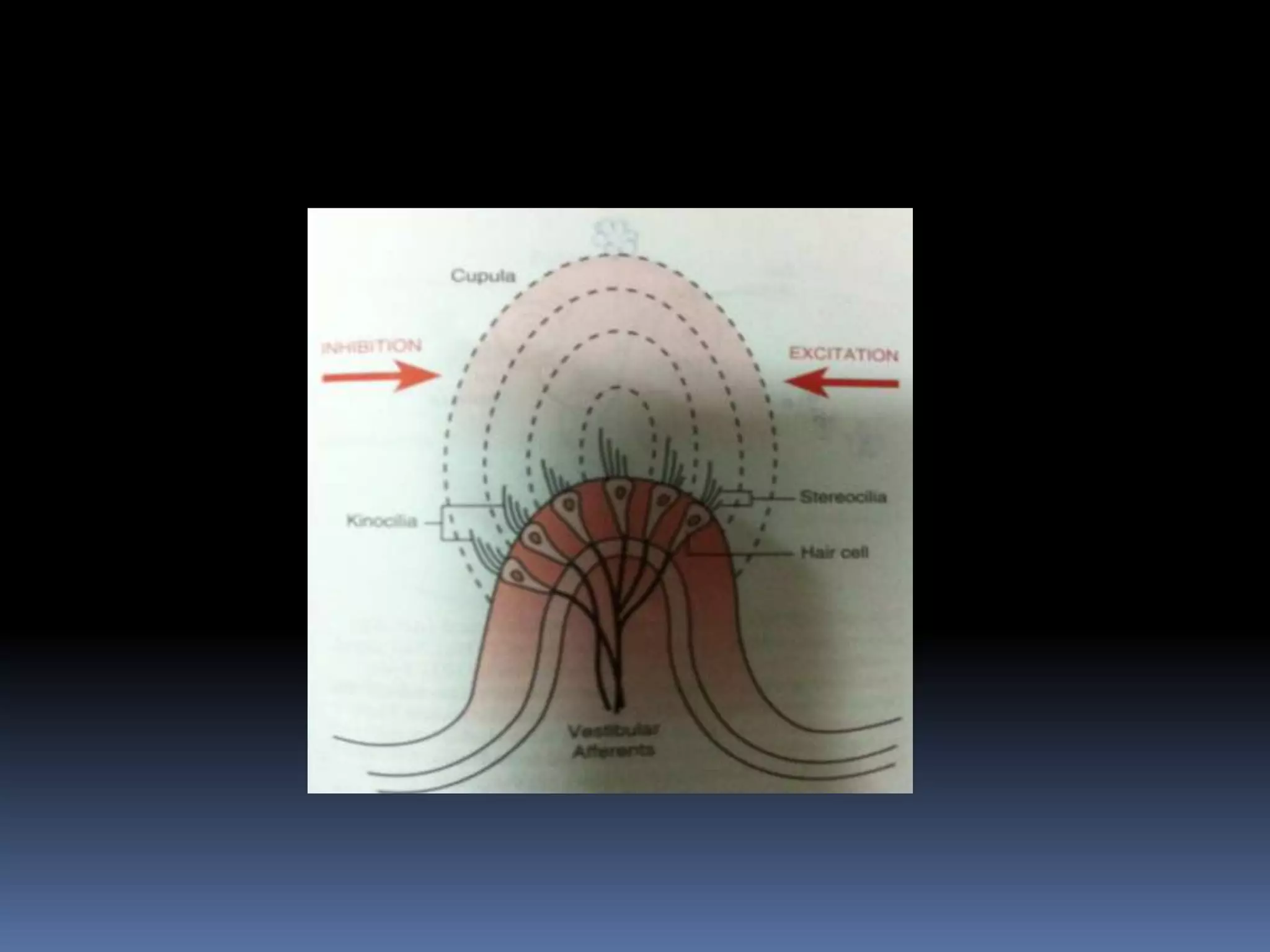
 resting firing rate is 70 to 100 spikes/s
 increase tonic firing rate means each vestibular
system detects head motion through excitation or
inhibition
2. Vestibular reflexes
 vestibulospinal reflex ( it helps to maination
centre of gravity)
 vestibulocollic reflex(it helps to maintain stability
of head during movement of torso)
 (VOR) vestibular ocular reflex( it helps in
maintaining stability of an image on the fovea of
retina during rapid head movements)
-pathway can be describes as three neuron arc
-horizontal head rotation about the vertical Z-
axis (yaw)
- head extension or flexion about the horizontal
Y-axis(pitch)
-lateral head tilt about the horizontal X-axis (roll)
 VOR gain
eye velocity/head velocity= -1
 VOR phase
described as zero phase shift
 VOR operates at head velocities as great as 350 to
400 degree/s
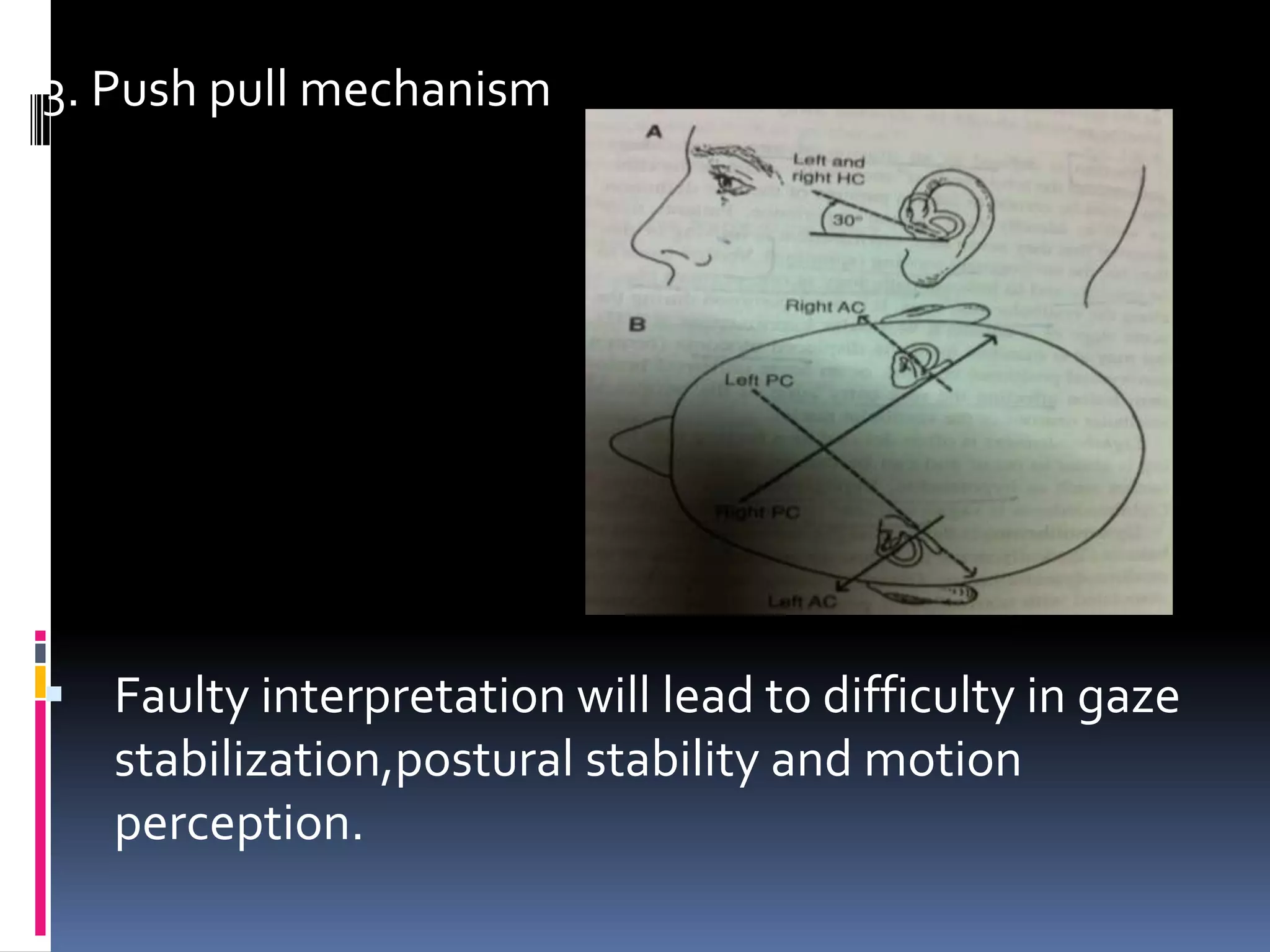
3. Push pull mechanism
 Faulty interpretation will lead to difficulty in gaze
stabilization,postural stability and motion
perception.
4. Inhibitory cut off
5. Velocity storage system
EXAMINATION
HISTORY
 It can be divided into:-
-elements that help with diagnosis
-elements that lead to goals for management
including physical therapy
 Elements that help with diagnosis are :
-tempo
-symptoms
1.vertigo
2.dysequilibrium
3.oscillopsia
4.light headedness
5.rocking or swaying
6.motion sickness
7. nausea and vomiting
-circumstances
-how it affects the patients life
-medications
 Elements that lead to goals for management,
including physical therapy
-obtaining patient subjective complaints
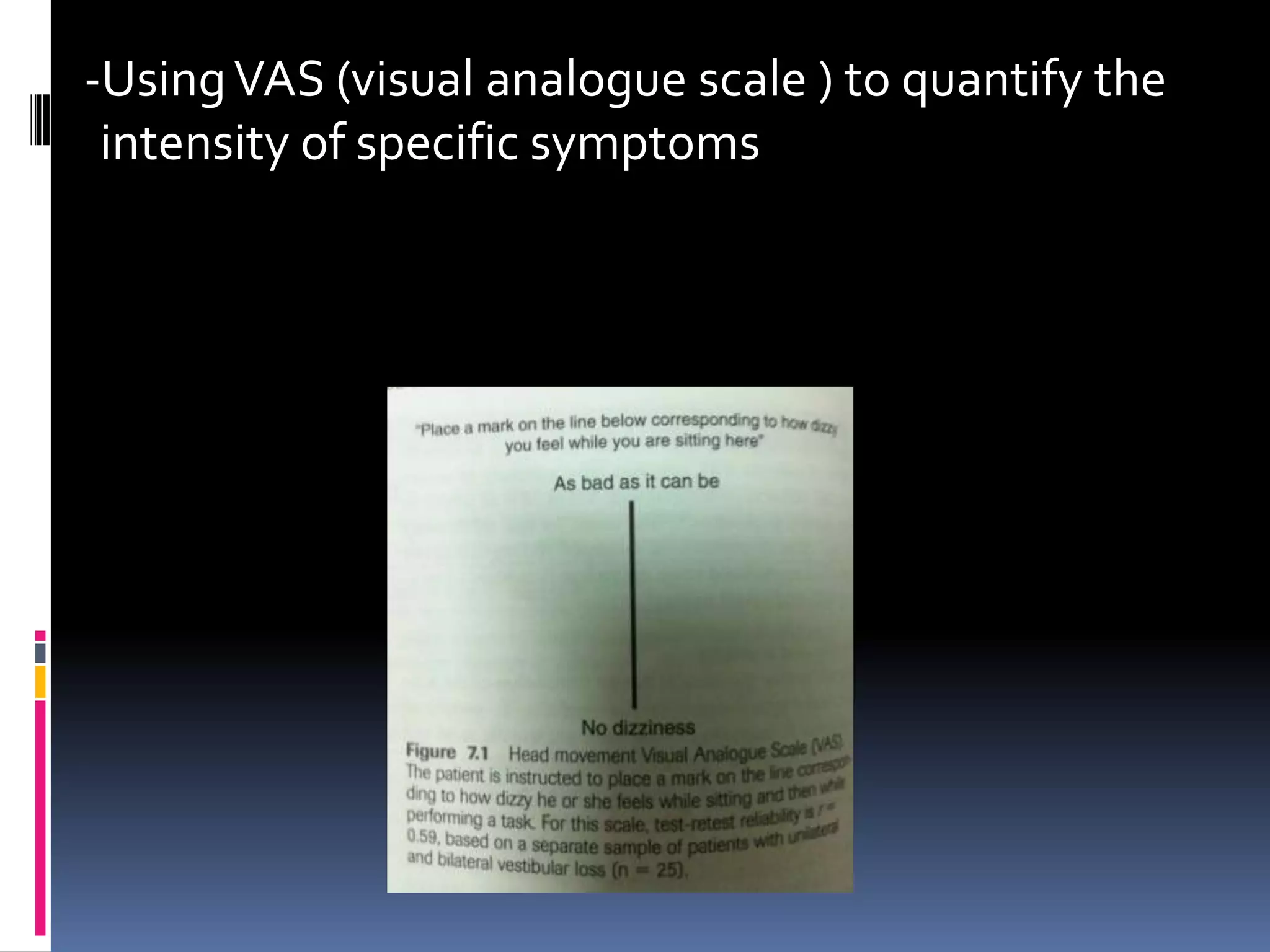
-UsingVAS (visual analogue scale ) to quantify the
intensity of specific symptoms
-impact on functional activities using
MULTIDIMENSIONAL DIZZINESS INVENTORY
-perceived disability
-fall history
-where, when, what was thinking about
- frequency of falls, any injuries associated with
that
-confidence in balance using ABC scale(Activities
Specific Balance Confidence Scale)
-interference with daily activities
-interference with recovery
-PANAS scale( Positive Affect Negative Affect
Scale) if anxiety or depression is affecting
-Dizziness Handicap Inventory
-Motion Sensitivity Quotient
PHYSICAL EXAMINATION
- what is nystagmus
-observation for nystagmus
tools used are 1. frenzel lenses
2.infrared camera system
3.opthalmoscope
4.ganzfeld
-skew eye deviation
-problems withVOR
-static imbalance
-dynamic imbalance
BED SIDE TESTING
 HeadThrust test
 Head Shaking NystagmusTest
 ClinicalVestibular DynamicVisual
acuityTest
1.HeadThrustTest
- used to examine semicircular canal function
- it can give indication for complete loss of
function in affected labyrinth
-less sensitive in detecting hypofunction in
patients with incomplete loss of function
2.Head Shaking Induced Nystagmus
Test
-useful in diagnosis of unilateral peripheral
vestibular defect.
3. DynamicVisual AcuityTest
-it is measurement of visual acuity during
horizontal motion of head
Maneuver –Induced vertigo
and eye movements
if mechanical problem (BPPV) dan certain
manuevers should be performed that evoke
nystagmus
1. positional testing( Hallpike-Dix test)
Hallpike –dix test
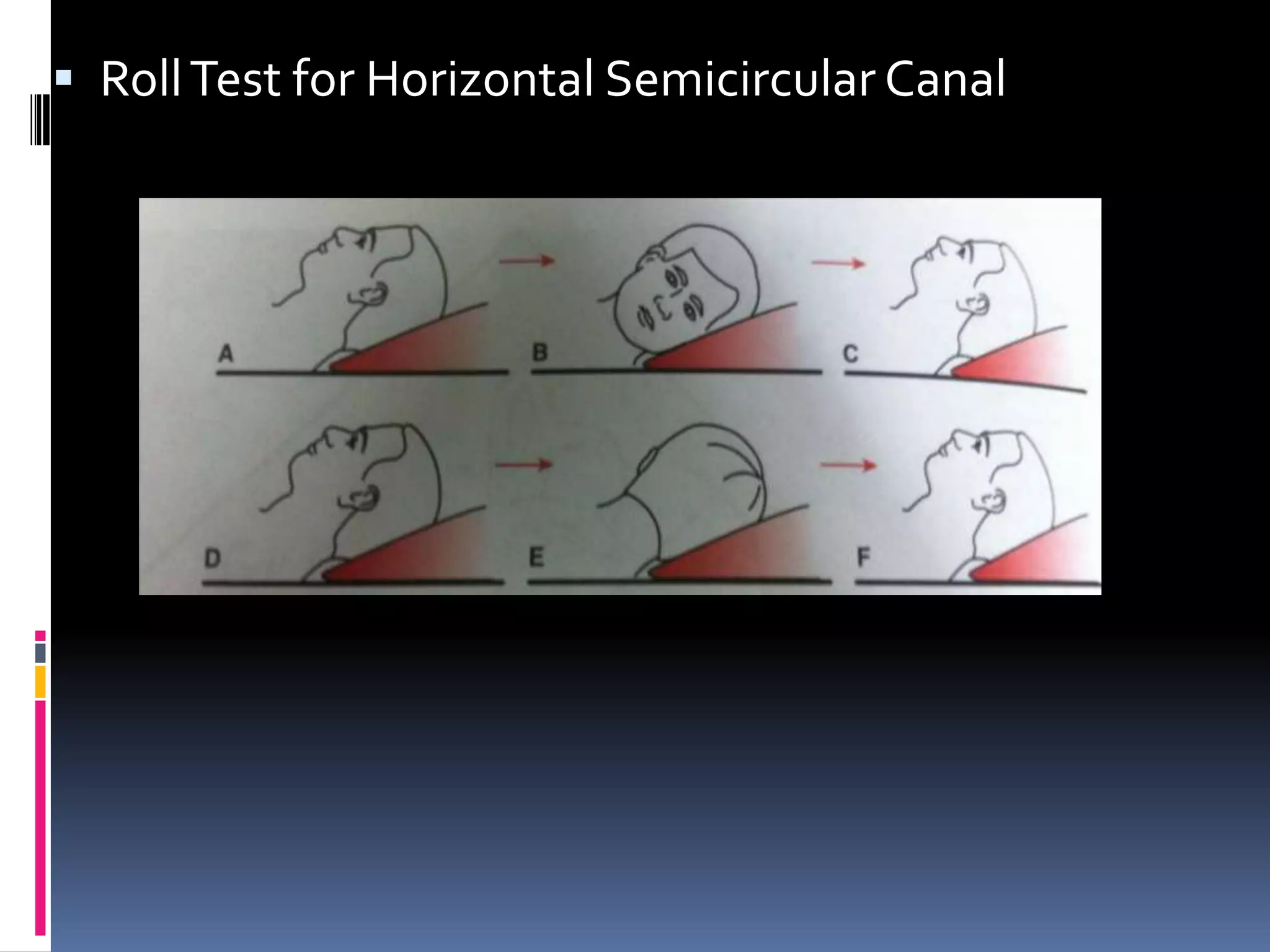
 RollTest for Horizontal Semicircular Canal
Visual tracking
-smooth pursuit eye movement
-cancellation of vestibulo ocular reflex
-saccadic eye movement
Stance and gait examination
-Romberg test
-Sharpened romberg (heel to toe tandem stance) test
-Fukuda’s Stepping test
-Retropulsion test
LABORATORYTESTS
 Electronystagmography(ENG) or
Videonystagmography (VNG)
 CaloricTesting
 Rotatory ChairTesting
 Quantified DynamicVisual Acuity
 SubjectiveVisualVertical
 Computerised Dynamic Posturography
 Vestibular Evoked Myogenic PotentialTest(VEMP)
Electronystagmography
CaloricTesting
Rotatory ChairTesting
Quantified DynamicVisual AcuityTest
Computerised Dynamic Posturography
REFERNCES
 Physical Rehabilitation
By Susan B O’ Sullivan(fifth edition)
 Vestibular Rehabiliation
By Susan J. Herdman( third edition)
 Rehabiliation Medicine :Principles and
Practice
By Joel A Delisa and Bruce M. Gans(third
edition)
 General vestibualr testing
ByT. Brandt, M. Strupp/ClinicalNeurophysiology
 American physical therapy association
By Barbara Susan Robinson
THANKYOU

Vestibular function test and its clinical examination

  • 1.
    VESTIBULAR FUNCTION TESTS ANDITS CLINICAL EXAMINATION By: Khushali Jogani The SarvajanikCollege Of Physiotherapy Rampura,Surat
  • 2.
    CONTENTS  Introduction  Anatomy Physiology  Examination -History -scales -physical examination -Bedside testing and manuevers -Laboratory testing  References
  • 3.
    INTRODUCTION  Incidence ofdizziness is 5.5 percent or greater than 15 million people per year in united states  It increases as age increases  Cawthorne and Cookey were the first one to introduce exercises for dizziness  Accurate diagnosis –minimization of functional limitation-prevention of disability  Mostly peripheral vestibular system is the origin for patients signs and symptoms
  • 4.
     Function ofperipheral vestibular system -stabilization of visual images on the fovea of retina during head movement to allow clear vision -maintaining postural stability, especially during movement of head -providing information used for spatial orientation
  • 5.
  • 7.
    PHYSIOLOGY  Important forunderstanding the signs and symptoms  Principles are: -tonic firing rate -Vestibular reflexes -push-pull mechansim -inhibitory cut off -velocity storage system
  • 8.
    1. Tonic firingrate  resting firing rate is 70 to 100 spikes/s  increase tonic firing rate means each vestibular system detects head motion through excitation or inhibition 2. Vestibular reflexes  vestibulospinal reflex ( it helps to maination centre of gravity)  vestibulocollic reflex(it helps to maintain stability of head during movement of torso)
  • 9.
     (VOR) vestibularocular reflex( it helps in maintaining stability of an image on the fovea of retina during rapid head movements) -pathway can be describes as three neuron arc -horizontal head rotation about the vertical Z- axis (yaw) - head extension or flexion about the horizontal Y-axis(pitch) -lateral head tilt about the horizontal X-axis (roll)
  • 12.
     VOR gain eyevelocity/head velocity= -1  VOR phase described as zero phase shift  VOR operates at head velocities as great as 350 to 400 degree/s
  • 13.
    3. Push pullmechanism  Faulty interpretation will lead to difficulty in gaze stabilization,postural stability and motion perception.
  • 14.
    4. Inhibitory cutoff 5. Velocity storage system
  • 15.
    EXAMINATION HISTORY  It canbe divided into:- -elements that help with diagnosis -elements that lead to goals for management including physical therapy
  • 16.
     Elements thathelp with diagnosis are : -tempo -symptoms 1.vertigo 2.dysequilibrium 3.oscillopsia 4.light headedness 5.rocking or swaying 6.motion sickness 7. nausea and vomiting -circumstances -how it affects the patients life -medications
  • 17.
     Elements thatlead to goals for management, including physical therapy -obtaining patient subjective complaints
  • 19.
    -UsingVAS (visual analoguescale ) to quantify the intensity of specific symptoms
  • 20.
    -impact on functionalactivities using MULTIDIMENSIONAL DIZZINESS INVENTORY
  • 21.
  • 22.
    -fall history -where, when,what was thinking about - frequency of falls, any injuries associated with that -confidence in balance using ABC scale(Activities Specific Balance Confidence Scale) -interference with daily activities -interference with recovery -PANAS scale( Positive Affect Negative Affect Scale) if anxiety or depression is affecting
  • 24.
  • 25.
  • 26.
    PHYSICAL EXAMINATION - whatis nystagmus -observation for nystagmus tools used are 1. frenzel lenses 2.infrared camera system 3.opthalmoscope 4.ganzfeld -skew eye deviation -problems withVOR -static imbalance -dynamic imbalance
  • 27.
    BED SIDE TESTING HeadThrust test  Head Shaking NystagmusTest  ClinicalVestibular DynamicVisual acuityTest
  • 28.
    1.HeadThrustTest - used toexamine semicircular canal function - it can give indication for complete loss of function in affected labyrinth -less sensitive in detecting hypofunction in patients with incomplete loss of function
  • 30.
    2.Head Shaking InducedNystagmus Test -useful in diagnosis of unilateral peripheral vestibular defect. 3. DynamicVisual AcuityTest -it is measurement of visual acuity during horizontal motion of head
  • 31.
    Maneuver –Induced vertigo andeye movements if mechanical problem (BPPV) dan certain manuevers should be performed that evoke nystagmus 1. positional testing( Hallpike-Dix test)
  • 32.
  • 33.
     RollTest forHorizontal Semicircular Canal
  • 34.
    Visual tracking -smooth pursuiteye movement -cancellation of vestibulo ocular reflex -saccadic eye movement Stance and gait examination -Romberg test -Sharpened romberg (heel to toe tandem stance) test -Fukuda’s Stepping test -Retropulsion test
  • 35.
    LABORATORYTESTS  Electronystagmography(ENG) or Videonystagmography(VNG)  CaloricTesting  Rotatory ChairTesting  Quantified DynamicVisual Acuity  SubjectiveVisualVertical  Computerised Dynamic Posturography  Vestibular Evoked Myogenic PotentialTest(VEMP)
  • 36.
  • 37.
  • 38.
  • 39.
  • 40.
  • 41.
    REFERNCES  Physical Rehabilitation BySusan B O’ Sullivan(fifth edition)  Vestibular Rehabiliation By Susan J. Herdman( third edition)  Rehabiliation Medicine :Principles and Practice By Joel A Delisa and Bruce M. Gans(third edition)
  • 42.
     General vestibualrtesting ByT. Brandt, M. Strupp/ClinicalNeurophysiology  American physical therapy association By Barbara Susan Robinson
  • 43.