Presented by
Dr. PANKAJ YADAV
drpankajyadav05@gmail.com
1drpankajyadav05@gmail.com
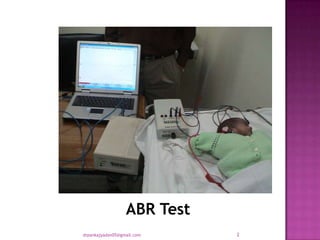
ABR Test
2drpankajyadav05@gmail.com
 Approximately 1 of every 1000 children is born
deaf. Many more are born with less severe degrees
of hearing impairment, while others may acquire
hearing loss during early childhood.
 combination of technological advances in ABR and
otoacoustic emissions (OAE) testing methods are
used for evaluation of hearing in newborns.
3drpankajyadav05@gmail.com
 Automated auditory brainstem response (AABR)
testing (eg, Algo-1 Plus) as an effective screening
tool in the evaluation of hearing in newborns, with
a sensitivity of 100% and specificity of 96-98%.
 To screen for normal hearing, each ear may be
evaluated independently, with a stimulus presented
at an intensity level of 35-40 dB nHL.
 Click-evoked ABR is highly correlated with hearing
sensitivity in the frequency range from 1000-4000
Hz.
4drpankajyadav05@gmail.com
 1. Parental concern about hearing levels in
their child
 2. Family history of hearing loss
 3. Pre and post natal infections
 4. Low birth weight babies
 5. Hyperbilirubinemia
 6. Cranio facial deformities
 7. Head injury
 8. Persistent otitis media
 9. Exposure to ototoxic drugs
5drpankajyadav05@gmail.com
 Auditory brainstem response (ABR) audiometry is a
neurologic test of auditory brainstem function in
response to auditory (click) stimuli.
 Brain stem evoked response audiometry,
 Auditory brain stem response, ABR audiometry,
 BAER (Brainstem auditory evoked response
audiometry).
 First described by Jewett and Williston in 1971
6drpankajyadav05@gmail.com
 ABR audiometry refers to an evoked potential generated
by a brief click or tone pip transmitted from an acoustic
transducer in the form of an insert earphone or
headphone. The elicited waveform response is
measured by surface electrodes typically placed at the
vertex of the scalp and ear lobes.
 The amplitude (microvoltage) of the signal is averaged
and charted against the time (millisecond), much like
an EEG.
 The waveform peaks are labeled I-VII.
 These waveforms normally occur within a 10-millisecond
time period after a click stimulus presented at high
intensities (70-90 dB normal hearing level [nHL]).
7drpankajyadav05@gmail.com
 Electrode Placement:
Disposable electrodes are placed using the following
guideline for “Dual Channel System Configuration”:
 Red, Side A: Right Mastoids
 Red, Side B: Left Mastoid
 Black: Forehead below blue
 Blue: Forehead above black
 Impedance Testing:
 Before performing ABR testing, electrode impedances were
checked.
 Checking for Electrical Noise:
 Before beginning the test, it was checked to make sure the
EEG activity, in the EEG and Amplifier window, was normal
for a relaxed state and that the signal did not contain
artifacts waveforms reflecting electrical noise.
8drpankajyadav05@gmail.com
The following settings are used:
 Stimulus: 0.1 milliseconds Broadband Click
 Rate: 29.3/sec
 Polarity: Rarefaction
 Transducers: Insert Earphones
 Intensity: 90 dB HL down to 30 dB HL for threshold
detection (wave V)
 Filters: 100 – 3000 Hz
 Notch Filter: ON
 Amplification: 100x
 Runs: 2-4
 Analysis Time Window: 12.8 milliseconds
 Sweeps: 2048
 Electrode Montage: contra-lateral Array
9drpankajyadav05@gmail.com
 Recording of ABR:
 The recordings were started from 70 dB intensity and
than successively increased or decreased as per
identification of wave V peak.
 Wave V was traced at successively lower intensities to
find out minimum intensity at which it is elicited
known as “Hearing Threshold”.
 Both ipsi-lateral and contra-lateral recordings were
made for each ear.
 Multiple recordings were carried out at each intensity
and were superimposed, to check the reproducibility
of the waves thus obtained.
 The median time taken for ABR 25 min including 10
min of patient preparation.
10drpankajyadav05@gmail.com
11drpankajyadav05@gmail.com
12drpankajyadav05@gmail.com
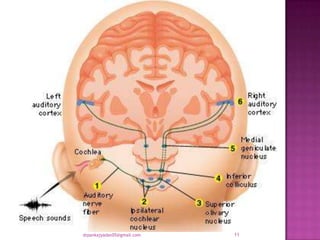
 Wave I - The ABR wave I response is the
representation of the compound auditory nerve
action potential in the distal portion of cranial
nerve (CN) VIII from afferent activity of the CN VIII
fibers (first-order neurons) as they leave the
cochlea and enter the internal auditory canal.
 Wave II - The ABR wave II is generated by the
proximal VIII nerve as it enters the brain stem.
13drpankajyadav05@gmail.com
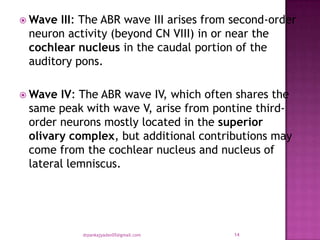
 Wave III: The ABR wave III arises from second-order
neuron activity (beyond CN VIII) in or near the
cochlear nucleus in the caudal portion of the
auditory pons.
 Wave IV: The ABR wave IV, which often shares the
same peak with wave V, arise from pontine third-
order neurons mostly located in the superior
olivary complex, but additional contributions may
come from the cochlear nucleus and nucleus of
lateral lemniscus.
14drpankajyadav05@gmail.com
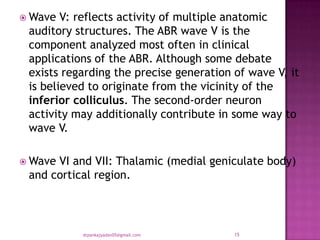
 Wave V: reflects activity of multiple anatomic
auditory structures. The ABR wave V is the
component analyzed most often in clinical
applications of the ABR. Although some debate
exists regarding the precise generation of wave V, it
is believed to originate from the vicinity of the
inferior colliculus. The second-order neuron
activity may additionally contribute in some way to
wave V.
 Wave VI and VII: Thalamic (medial geniculate body)
and cortical region.
15drpankajyadav05@gmail.com
16drpankajyadav05@gmail.com
1. Absolute latency interaural difference wave V
(IT5) - Prolonged
2. I-V interpeak interval interaural difference -
Prolonged
3. Absolute latency of wave V - Prolonged as
compared with normative data
4. Absolute latencies and interpeak intervals
latencies I-III, I-V, III-V - Prolonged as compared
with normative data
5. Absent auditory brainstem response in the
involved ear
17drpankajyadav05@gmail.com
 1. It is an effective screening tool for
evaluating cases of deafness due to
retrocochlear pathology i.e. (Acoustic
schwannoma).
 2. Used in screening newborns for deafness
 3. Used for intraoperative monitoring of
central and peripheral nervous system
 4. Monitoting patients in intensive care units
 5. Diagnosing suspected demyelination
disorders
18drpankajyadav05@gmail.com
1. 1. All waves are absent in severe hearing loss as
well as in a large acoustic neuroma.
2. 2. A normal BERA response virtually rules out an
acoustic neuroma; but doesn’t at all rule out
intrinsic brainstem lesion or even non-acoustic
tumor of the CP angle e.g. Meningioma.
19drpankajyadav05@gmail.com
20drpankajyadav05@gmail.com

Auditory brainstem response (ABR)

  • 1.
    Presented by Dr. PANKAJYADAV drpankajyadav05@gmail.com 1drpankajyadav05@gmail.com
  • 2.
  • 3.
     Approximately 1of every 1000 children is born deaf. Many more are born with less severe degrees of hearing impairment, while others may acquire hearing loss during early childhood.  combination of technological advances in ABR and otoacoustic emissions (OAE) testing methods are used for evaluation of hearing in newborns. 3drpankajyadav05@gmail.com
  • 4.
     Automated auditorybrainstem response (AABR) testing (eg, Algo-1 Plus) as an effective screening tool in the evaluation of hearing in newborns, with a sensitivity of 100% and specificity of 96-98%.  To screen for normal hearing, each ear may be evaluated independently, with a stimulus presented at an intensity level of 35-40 dB nHL.  Click-evoked ABR is highly correlated with hearing sensitivity in the frequency range from 1000-4000 Hz. 4drpankajyadav05@gmail.com
  • 5.
     1. Parentalconcern about hearing levels in their child  2. Family history of hearing loss  3. Pre and post natal infections  4. Low birth weight babies  5. Hyperbilirubinemia  6. Cranio facial deformities  7. Head injury  8. Persistent otitis media  9. Exposure to ototoxic drugs 5drpankajyadav05@gmail.com
  • 6.
     Auditory brainstemresponse (ABR) audiometry is a neurologic test of auditory brainstem function in response to auditory (click) stimuli.  Brain stem evoked response audiometry,  Auditory brain stem response, ABR audiometry,  BAER (Brainstem auditory evoked response audiometry).  First described by Jewett and Williston in 1971 6drpankajyadav05@gmail.com
  • 7.
     ABR audiometryrefers to an evoked potential generated by a brief click or tone pip transmitted from an acoustic transducer in the form of an insert earphone or headphone. The elicited waveform response is measured by surface electrodes typically placed at the vertex of the scalp and ear lobes.  The amplitude (microvoltage) of the signal is averaged and charted against the time (millisecond), much like an EEG.  The waveform peaks are labeled I-VII.  These waveforms normally occur within a 10-millisecond time period after a click stimulus presented at high intensities (70-90 dB normal hearing level [nHL]). 7drpankajyadav05@gmail.com
  • 8.
     Electrode Placement: Disposableelectrodes are placed using the following guideline for “Dual Channel System Configuration”:  Red, Side A: Right Mastoids  Red, Side B: Left Mastoid  Black: Forehead below blue  Blue: Forehead above black  Impedance Testing:  Before performing ABR testing, electrode impedances were checked.  Checking for Electrical Noise:  Before beginning the test, it was checked to make sure the EEG activity, in the EEG and Amplifier window, was normal for a relaxed state and that the signal did not contain artifacts waveforms reflecting electrical noise. 8drpankajyadav05@gmail.com
  • 9.
    The following settingsare used:  Stimulus: 0.1 milliseconds Broadband Click  Rate: 29.3/sec  Polarity: Rarefaction  Transducers: Insert Earphones  Intensity: 90 dB HL down to 30 dB HL for threshold detection (wave V)  Filters: 100 – 3000 Hz  Notch Filter: ON  Amplification: 100x  Runs: 2-4  Analysis Time Window: 12.8 milliseconds  Sweeps: 2048  Electrode Montage: contra-lateral Array 9drpankajyadav05@gmail.com
  • 10.
     Recording ofABR:  The recordings were started from 70 dB intensity and than successively increased or decreased as per identification of wave V peak.  Wave V was traced at successively lower intensities to find out minimum intensity at which it is elicited known as “Hearing Threshold”.  Both ipsi-lateral and contra-lateral recordings were made for each ear.  Multiple recordings were carried out at each intensity and were superimposed, to check the reproducibility of the waves thus obtained.  The median time taken for ABR 25 min including 10 min of patient preparation. 10drpankajyadav05@gmail.com
  • 11.
  • 12.
  • 13.
     Wave I- The ABR wave I response is the representation of the compound auditory nerve action potential in the distal portion of cranial nerve (CN) VIII from afferent activity of the CN VIII fibers (first-order neurons) as they leave the cochlea and enter the internal auditory canal.  Wave II - The ABR wave II is generated by the proximal VIII nerve as it enters the brain stem. 13drpankajyadav05@gmail.com
  • 14.
     Wave III:The ABR wave III arises from second-order neuron activity (beyond CN VIII) in or near the cochlear nucleus in the caudal portion of the auditory pons.  Wave IV: The ABR wave IV, which often shares the same peak with wave V, arise from pontine third- order neurons mostly located in the superior olivary complex, but additional contributions may come from the cochlear nucleus and nucleus of lateral lemniscus. 14drpankajyadav05@gmail.com
  • 15.
     Wave V:reflects activity of multiple anatomic auditory structures. The ABR wave V is the component analyzed most often in clinical applications of the ABR. Although some debate exists regarding the precise generation of wave V, it is believed to originate from the vicinity of the inferior colliculus. The second-order neuron activity may additionally contribute in some way to wave V.  Wave VI and VII: Thalamic (medial geniculate body) and cortical region. 15drpankajyadav05@gmail.com
  • 16.
  • 17.
    1. Absolute latencyinteraural difference wave V (IT5) - Prolonged 2. I-V interpeak interval interaural difference - Prolonged 3. Absolute latency of wave V - Prolonged as compared with normative data 4. Absolute latencies and interpeak intervals latencies I-III, I-V, III-V - Prolonged as compared with normative data 5. Absent auditory brainstem response in the involved ear 17drpankajyadav05@gmail.com
  • 18.
     1. Itis an effective screening tool for evaluating cases of deafness due to retrocochlear pathology i.e. (Acoustic schwannoma).  2. Used in screening newborns for deafness  3. Used for intraoperative monitoring of central and peripheral nervous system  4. Monitoting patients in intensive care units  5. Diagnosing suspected demyelination disorders 18drpankajyadav05@gmail.com
  • 19.
    1. 1. Allwaves are absent in severe hearing loss as well as in a large acoustic neuroma. 2. 2. A normal BERA response virtually rules out an acoustic neuroma; but doesn’t at all rule out intrinsic brainstem lesion or even non-acoustic tumor of the CP angle e.g. Meningioma. 19drpankajyadav05@gmail.com
  • 20.