Speech- Language
Pathologist
Elizabeth Cox
What is a Speech Language
Pathologist (SLP)?
 Someone who prevents, evaluates, diagnoses,
and treats speech, language, social & cognitive
communication, and swallowing disorders in
individuals of all ages.
 Ranging from children to elderly
 Someone who not only diagnoses patients, but then
determines the severity of the problem and the best
future treatment.
 Someone who educates and trains families or
caregivers as well as other medical professionals
regarding patients.
History
 1925: Speech Pathology became a profession
 1926: American Academy of Speech Correction established
 Originally focused on effective communication and then grew into focusing on
communication disabilities and rehabilitation. Colleges eventually created
programs to educate students on diagnosing and treating communication
disorders
 Early SLPs only had an undergraduate degree in speech-correction
 First schools to teach speech correction were Wayne State University and the
University of Michigan
 1950’s: Soldiers returned from war with brain disabilities that resulted in
speech problems. SLPs began to focus more on brain processing abilities in
relation to speech
 1970’s: Language disorders were now treated separately from speech
disorders
Speech Language Pathology:
Areas of Importance
Most commonly work with individuals who have 1 or more of the following disorders…
 Speech Disorders: Difficulty making certain speech sounds correctly or vocal
problems.
 Ex: Stuttering, Dysarthria, Apraxia, Speech Sound Disorders (Articulation)
 Language Disorders: Difficulty sharing thoughts or expressing feelings or
difficulty understanding others.
 Ex: Aphasia (most common in adults and caused by a stroke)
 Child-Related Disorders
 Language Based Learning Disabilities
 Preschool Language Disorders
 Selective Mutism
 Social Communication Disorders: Difficulty communicating verbally or
nonverbally especially in social settings
 Cognitive Communication Disorders: Difficulty paying attention, organizing and
remember things, or problem solving.
 Swallowing Disorders: Difficulty with feeding or swallowing.
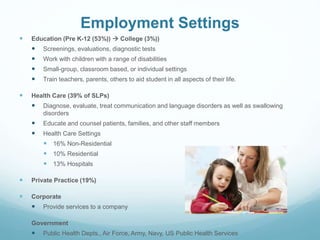
Employment Settings
 Education (Pre K-12 (53%))  College (3%))
 Screenings, evaluations, diagnostic tests
 Work with children with a range of disabilities
 Small-group, classroom based, or individual settings
 Train teachers, parents, others to aid student in all aspects of their life.
 Health Care (39% of SLPs)
 Diagnose, evaluate, treat communication and language disorders as well as swallowing
disorders
 Educate and counsel patients, families, and other staff members
 Health Care Settings
 16% Non-Residential
 10% Residential
 13% Hospitals
 Private Practice (19%)
 Corporate
 Provide services to a company
 Government
 Public Health Depts., Air Force, Army, Navy, US Public Health Services
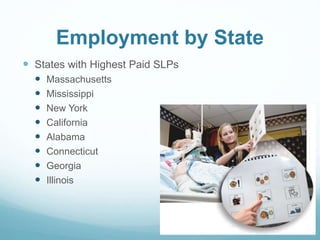
Employment by State
 States with Highest Paid SLPs
 Massachusetts
 Mississippi
 New York
 California
 Alabama
 Connecticut
 Georgia
 Illinois
Salary
 Annual Salary
 Average: $71,550
 Below: $44,000-$56,000
 Above: $90,000-$111,000
 Annual Salary by Employment
1. Home Health Care Services (~$95,000)
2. Nursing Care Facilities (~$89,000)
3. Offices of Other Health Practitioners (~$80,000)
4. Specialty Hospitals (~$80,000)
5. General Medical/Surgical Hospitals (~$79,000)
6. Elementary/Secondary Schools (~$67,000)
Growth Potential
 Growth Rate (2014-2024): 21%
 Average Growth Rate for all Occupations: 7%
 Employment Change Rate (2014-2024): +28,900 jobs
 Average Salary: Increased from $66,920 to $73,970
(2010-2013)
ASLHA Standards for an SLP
(American Speech Language Hearing Association)
 Undergraduate Degree in CSD
(not required)
 Graduate Degree in Speech-
Language Pathology
 Post-Graduate Clinical
Fellowship
 Pass the PRAXIS exam
 Used for ASHA Certification, State
Professional Licensure, State Teacher
Credential
Graduate Programs
 University of South Carolina (USC)- Columbia, SC
 Pre-requisites:
 Human Biological Science
 Social/Behavioral Science
 Physics/Chemistry
 Statistics
 *Anatomy & Physiology of the Speech & Hearing Mechanism
 *Phonetics
 *Language Development
 *Articulation Disorders
 25 hours of supervised observation
 Average GPA: 3.70
 Average GRE score: 153 (verbal) 148 (quantitative)
 Costs:
 In-State Tuition: $22,896
 More than 80% of students in this program have financial aid
 Scholarships are available
*May be completed in the summer
before starting the program in the fall.
*Since I did not take these courses as a part of my undergraduate degree
I will have to take these courses during the summer program
before beginning my master’s degree at USC
Graduate Programs
 University of North Carolina (UNC), Chapel Hill, NC
 Prerequisites
 Biological Sciences (2 credit hours)
 Physics/Chemistry (2 credit hours)
 Social/Behavioral Sciences (2 credit hours)
 Statistics (2 credit hours)
 *Anatomy & Physiology of the Speech and Hearting Mechanism
 *Speech Science
 *Intro to Audiology
 *Normal Language Acquisition
 *Phonetics
 Average GPA: 3.74
 Average GRE score: >50th percentile
 100% Praxis passing rate
 100% employment rate post-graduation
*Priority given to students who have completed these courses prior to
admission.
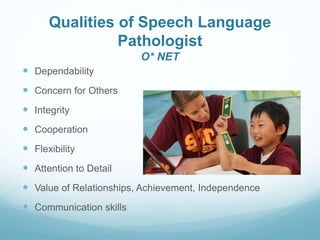
Qualities of Speech Language
Pathologist
O* NET
 Dependability
 Concern for Others
 Integrity
 Cooperation
 Flexibility
 Attention to Detail
 Value of Relationships, Achievement, Independence
 Communication skills
Why is it for me?
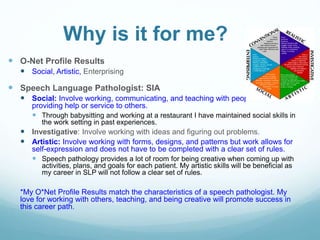
 O-Net Profile Results
 Social, Artistic, Enterprising
 Speech Language Pathologist: SIA
 Social: Involve working, communicating, and teaching with people and
providing help or service to others.
 Through babysitting and working at a restaurant I have maintained social skills in
the work setting in past experiences.
 Investigative: Involve working with ideas and figuring out problems.
 Artistic: Involve working with forms, designs, and patterns but work allows for
self-expression and does not have to be completed with a clear set of rules.
 Speech pathology provides a lot of room for being creative when coming up with
activities, plans, and goals for each patient. My artistic skills will be beneficial as
my career in SLP will not follow a clear set of rules.
*My O*Net Profile Results match the characteristics of a speech pathologist. My
love for working with others, teaching, and being creative will promote success in
this career path.
My Ideal SLP Career
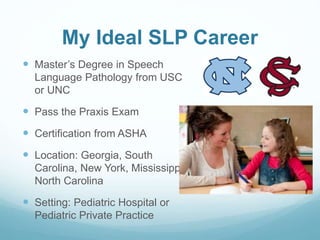
 Master’s Degree in Speech
Language Pathology from USC
or UNC
 Pass the Praxis Exam
 Certification from ASHA
 Location: Georgia, South
Carolina, New York, Mississippi,
North Carolina
 Setting: Pediatric Hospital or
Pediatric Private Practice
References
"Degree Programs: Communication Sciences and Disorders." USC: Communication Sciences
and Disorders. University of South Carolina. Web. 18 Jan. 2016.
"Employment Settings for SLPs." American Speech-Language-Hearing Association. American
Speech-Language-Hearing Association. Web. 18 Jan. 2016.
Lubinski R. 2010. Speech Therapy or Speech-Language Pathology. In: JH Stone, M Blouin,
editors. International Encyclopedia of Rehabilitation.
"Speech-Language Pathologists." American Speech-Language-Hearing Association. American
Speech-Language-Hearing Association. Web. 18 Jan. 2016.
Speech and Hearing Sciences." MS in Speech-Language Pathology. University of North
Carolina. Web. 18 Jan. 2016.
"Speech-Language Pathologists." O*Net Online. American Job Center Network, 2014. Web.
18 Jan.2016.
"Speech-Language Pathologist Salary by State - Salary By State." Salary By State. 24 Mar.
2013. Web. 18 Jan. 2016.
"Speech-Language Pathologists." U.S. Bureau of Labor Statistics. U.S. Bureau of Labor
Statistics, 2014. Web. 18 Jan. 2016.

Speech Language Pathology

  • 1.
  • 2.
    What is aSpeech Language Pathologist (SLP)?  Someone who prevents, evaluates, diagnoses, and treats speech, language, social & cognitive communication, and swallowing disorders in individuals of all ages.  Ranging from children to elderly  Someone who not only diagnoses patients, but then determines the severity of the problem and the best future treatment.  Someone who educates and trains families or caregivers as well as other medical professionals regarding patients.
  • 3.
    History  1925: SpeechPathology became a profession  1926: American Academy of Speech Correction established  Originally focused on effective communication and then grew into focusing on communication disabilities and rehabilitation. Colleges eventually created programs to educate students on diagnosing and treating communication disorders  Early SLPs only had an undergraduate degree in speech-correction  First schools to teach speech correction were Wayne State University and the University of Michigan  1950’s: Soldiers returned from war with brain disabilities that resulted in speech problems. SLPs began to focus more on brain processing abilities in relation to speech  1970’s: Language disorders were now treated separately from speech disorders
  • 4.
    Speech Language Pathology: Areasof Importance Most commonly work with individuals who have 1 or more of the following disorders…  Speech Disorders: Difficulty making certain speech sounds correctly or vocal problems.  Ex: Stuttering, Dysarthria, Apraxia, Speech Sound Disorders (Articulation)  Language Disorders: Difficulty sharing thoughts or expressing feelings or difficulty understanding others.  Ex: Aphasia (most common in adults and caused by a stroke)  Child-Related Disorders  Language Based Learning Disabilities  Preschool Language Disorders  Selective Mutism  Social Communication Disorders: Difficulty communicating verbally or nonverbally especially in social settings  Cognitive Communication Disorders: Difficulty paying attention, organizing and remember things, or problem solving.  Swallowing Disorders: Difficulty with feeding or swallowing.
  • 5.
    Employment Settings  Education(Pre K-12 (53%))  College (3%))  Screenings, evaluations, diagnostic tests  Work with children with a range of disabilities  Small-group, classroom based, or individual settings  Train teachers, parents, others to aid student in all aspects of their life.  Health Care (39% of SLPs)  Diagnose, evaluate, treat communication and language disorders as well as swallowing disorders  Educate and counsel patients, families, and other staff members  Health Care Settings  16% Non-Residential  10% Residential  13% Hospitals  Private Practice (19%)  Corporate  Provide services to a company  Government  Public Health Depts., Air Force, Army, Navy, US Public Health Services
  • 6.
    Employment by State States with Highest Paid SLPs  Massachusetts  Mississippi  New York  California  Alabama  Connecticut  Georgia  Illinois
  • 7.
    Salary  Annual Salary Average: $71,550  Below: $44,000-$56,000  Above: $90,000-$111,000  Annual Salary by Employment 1. Home Health Care Services (~$95,000) 2. Nursing Care Facilities (~$89,000) 3. Offices of Other Health Practitioners (~$80,000) 4. Specialty Hospitals (~$80,000) 5. General Medical/Surgical Hospitals (~$79,000) 6. Elementary/Secondary Schools (~$67,000)
  • 8.
    Growth Potential  GrowthRate (2014-2024): 21%  Average Growth Rate for all Occupations: 7%  Employment Change Rate (2014-2024): +28,900 jobs  Average Salary: Increased from $66,920 to $73,970 (2010-2013)
  • 9.
    ASLHA Standards foran SLP (American Speech Language Hearing Association)  Undergraduate Degree in CSD (not required)  Graduate Degree in Speech- Language Pathology  Post-Graduate Clinical Fellowship  Pass the PRAXIS exam  Used for ASHA Certification, State Professional Licensure, State Teacher Credential
  • 10.
    Graduate Programs  Universityof South Carolina (USC)- Columbia, SC  Pre-requisites:  Human Biological Science  Social/Behavioral Science  Physics/Chemistry  Statistics  *Anatomy & Physiology of the Speech & Hearing Mechanism  *Phonetics  *Language Development  *Articulation Disorders  25 hours of supervised observation  Average GPA: 3.70  Average GRE score: 153 (verbal) 148 (quantitative)  Costs:  In-State Tuition: $22,896  More than 80% of students in this program have financial aid  Scholarships are available *May be completed in the summer before starting the program in the fall. *Since I did not take these courses as a part of my undergraduate degree I will have to take these courses during the summer program before beginning my master’s degree at USC
  • 11.
    Graduate Programs  Universityof North Carolina (UNC), Chapel Hill, NC  Prerequisites  Biological Sciences (2 credit hours)  Physics/Chemistry (2 credit hours)  Social/Behavioral Sciences (2 credit hours)  Statistics (2 credit hours)  *Anatomy & Physiology of the Speech and Hearting Mechanism  *Speech Science  *Intro to Audiology  *Normal Language Acquisition  *Phonetics  Average GPA: 3.74  Average GRE score: >50th percentile  100% Praxis passing rate  100% employment rate post-graduation *Priority given to students who have completed these courses prior to admission.
  • 12.
    Qualities of SpeechLanguage Pathologist O* NET  Dependability  Concern for Others  Integrity  Cooperation  Flexibility  Attention to Detail  Value of Relationships, Achievement, Independence  Communication skills
  • 13.
    Why is itfor me?  O-Net Profile Results  Social, Artistic, Enterprising  Speech Language Pathologist: SIA  Social: Involve working, communicating, and teaching with people and providing help or service to others.  Through babysitting and working at a restaurant I have maintained social skills in the work setting in past experiences.  Investigative: Involve working with ideas and figuring out problems.  Artistic: Involve working with forms, designs, and patterns but work allows for self-expression and does not have to be completed with a clear set of rules.  Speech pathology provides a lot of room for being creative when coming up with activities, plans, and goals for each patient. My artistic skills will be beneficial as my career in SLP will not follow a clear set of rules. *My O*Net Profile Results match the characteristics of a speech pathologist. My love for working with others, teaching, and being creative will promote success in this career path.
  • 14.
    My Ideal SLPCareer  Master’s Degree in Speech Language Pathology from USC or UNC  Pass the Praxis Exam  Certification from ASHA  Location: Georgia, South Carolina, New York, Mississippi, North Carolina  Setting: Pediatric Hospital or Pediatric Private Practice
  • 15.
    References "Degree Programs: CommunicationSciences and Disorders." USC: Communication Sciences and Disorders. University of South Carolina. Web. 18 Jan. 2016. "Employment Settings for SLPs." American Speech-Language-Hearing Association. American Speech-Language-Hearing Association. Web. 18 Jan. 2016. Lubinski R. 2010. Speech Therapy or Speech-Language Pathology. In: JH Stone, M Blouin, editors. International Encyclopedia of Rehabilitation. "Speech-Language Pathologists." American Speech-Language-Hearing Association. American Speech-Language-Hearing Association. Web. 18 Jan. 2016. Speech and Hearing Sciences." MS in Speech-Language Pathology. University of North Carolina. Web. 18 Jan. 2016. "Speech-Language Pathologists." O*Net Online. American Job Center Network, 2014. Web. 18 Jan.2016. "Speech-Language Pathologist Salary by State - Salary By State." Salary By State. 24 Mar. 2013. Web. 18 Jan. 2016. "Speech-Language Pathologists." U.S. Bureau of Labor Statistics. U.S. Bureau of Labor Statistics, 2014. Web. 18 Jan. 2016.

Editor's Notes

  • #4 International Encyclopedia of Rehabilitation- http://cirrie.buffalo.edu/encyclopedia/en/article/333/
  • #5 American Speech-Language-Hearing Association- http://www.asha.org/Students/Speech-Language-Pathologists/
  • #6 American Speech-Language-Hearing Association- http://www.asha.org/Students/Employment-Settings-for-SLPs/
  • #7 Salary By State- http://salarybystate.org/healthcare/speech-language-pathologist-salary-by-state
  • #8 Bureau of Labor Statistics- http://www.bls.gov/oes/current/oes291127.htm
  • #9 Bureau of Labor Statistics- http://www.bls.gov/ooh/healthcare/speech-language-pathologists.htm
  • #10 American Speech-Language-Hearing Association- http://www.asha.org/Students/Speech-Language-Pathologists/
  • #11 University of South Carolina- http://www.sph.sc.edu/comd/degreeprograms.htm
  • #12 University of North Carolina- https://www.med.unc.edu/ahs/sphs/programs/ms-slp
  • #13 O*Net Profiler- http://www.onetonline.org/link/summary/29-1127.00
  • #14 O*Net Profiler- http://www.onetonline.org/link/summary/29-1127.00