Download to read offline







![• A number of CAPD screening tests are currently in use including –
1. The Children's Auditory Performance Scale (CHAPS), a 25-item scale that utilizes a
scaling continuum related to the child's auditory behaviors (Smoski, Brunt, &
Tannahill, 1992);
2. The Children's Home Inventory for Listening Difficulties (CHILD), for use with
children between the ages of 3 and 12 which is completed by a parent (Anderson &
Smaldino, 2000);
3. The Listening Inventory (TLI) developed by Geffner and Ross-Swain (2006);
4. The Screening Instrument for Targeting Educational Risk (SIFTER) from Anderson
and Matkin (1989); and
5. The Listening Inventory for Education (LIFE) (Anderson & Smaldino, 1998).
6. Screening Test for Auditory Processing (STAP) {Indian Test} [Yathiraj & Maggu] -
The test was designed to address auditory separation/closure, binaural integration,
temporal resolution, and auditory memory in school-age children; The study also
aimed to examine the number of children who are at risk for different auditory
processes; Age Range: 8 Years to 13 Years
7. Screening checklist for auditory processing (SCAP) {Indian Test} [Yathiraj and
Maggu, 2013]](https://image.slidesharecdn.com/introductiontocapd-signssymptoms-210223092427/75/Introduction-to-CAPD-Signs-Symptoms-20-2048.jpg)




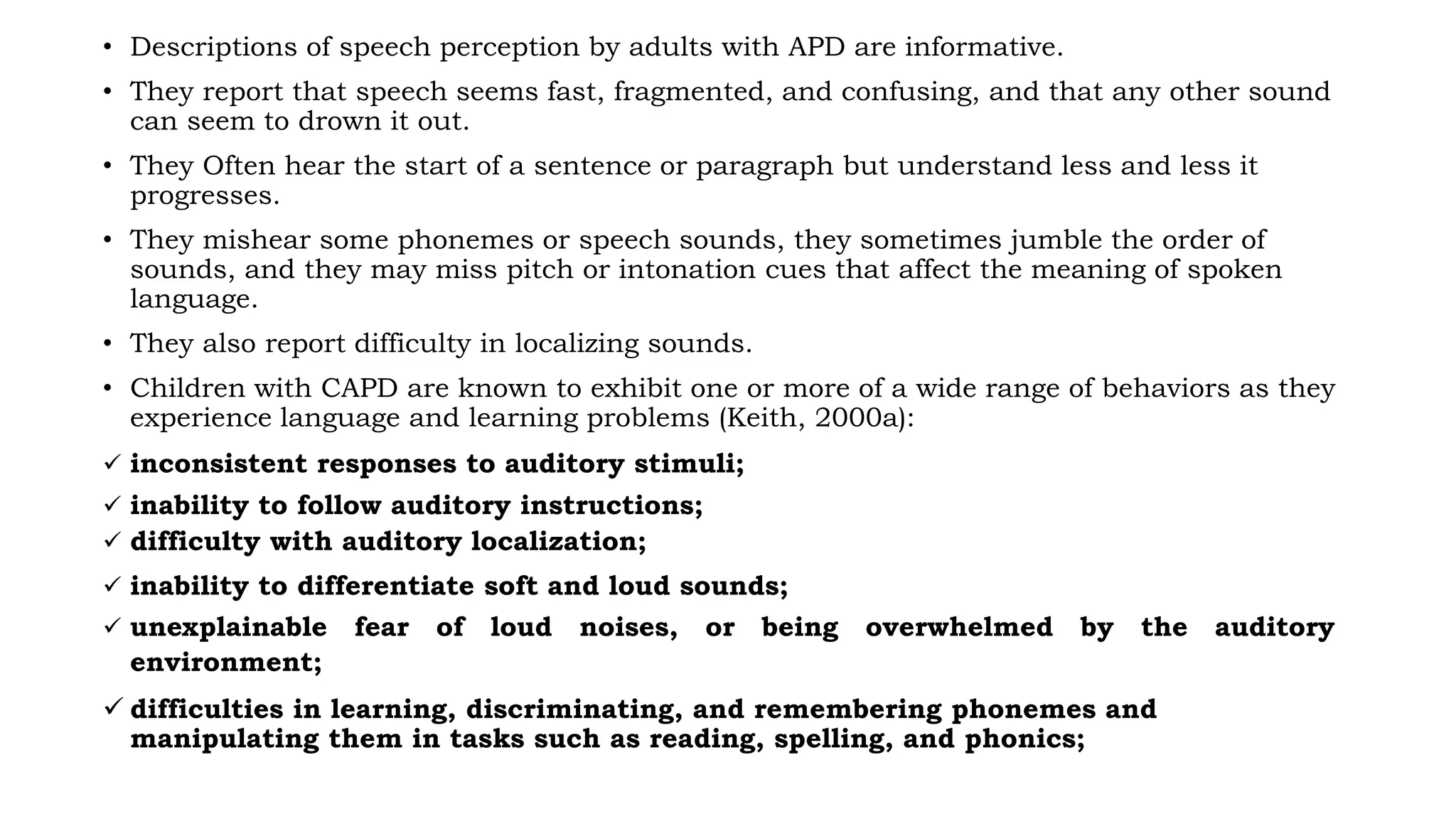
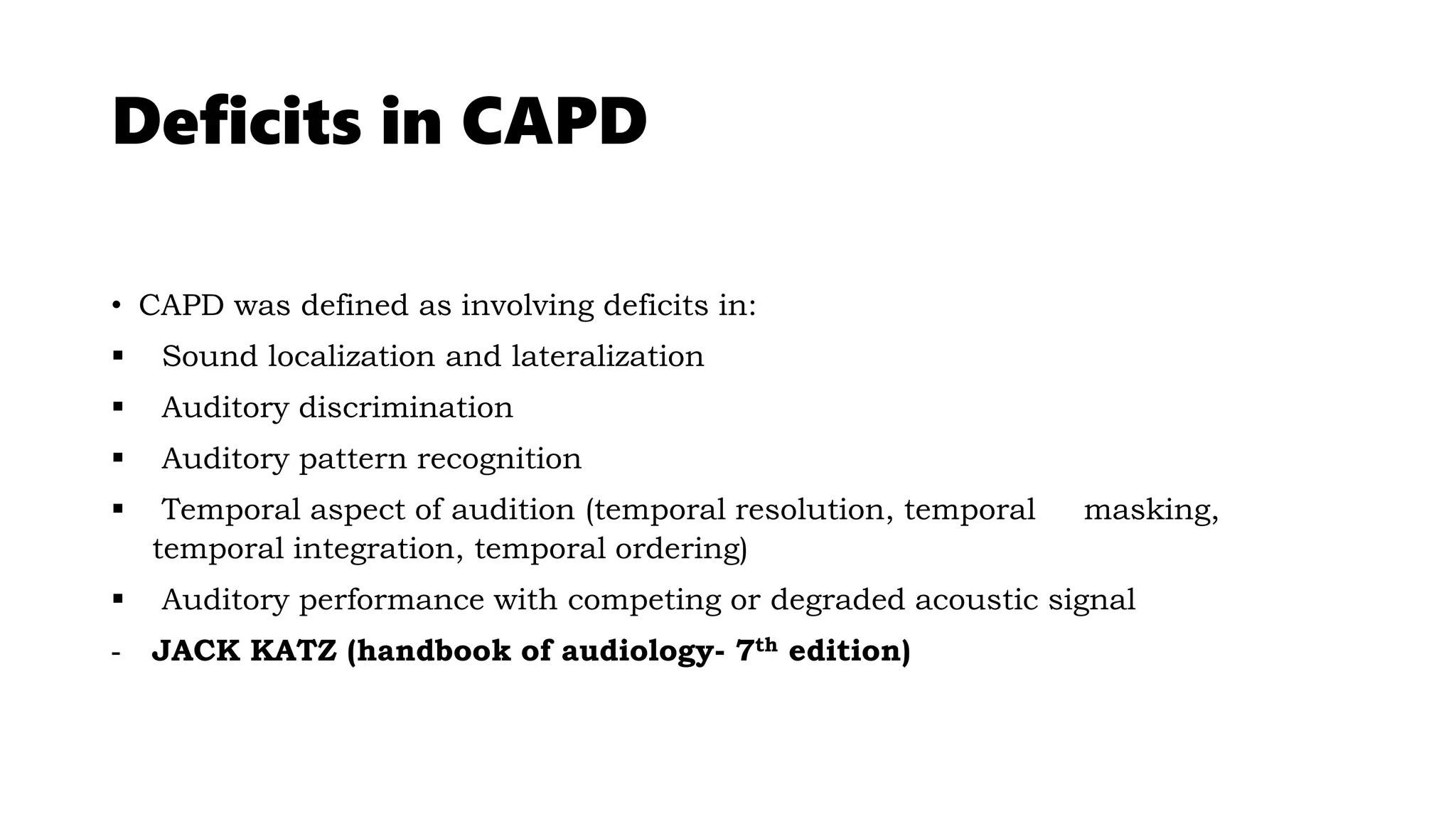
This document provides an introduction to central auditory processing disorder (CAPD), including definitions, prevalence, symptoms, screening, classification of deficits, and processes involved. CAPD is estimated to affect 2-7% of school-aged children and is characterized by difficulties processing auditory information in the central nervous system despite normal peripheral hearing. Symptoms include problems understanding speech in noise, sequencing sounds, and auditory attention. Screening tools evaluate skills like auditory closure, memory, and figure-ground processing to identify children for full evaluation.


