Chapter 10
Auditory Middle Latency Response
(AMLR)
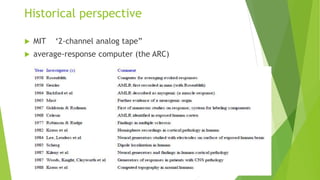
Historical perspective
 MIT ‘2-channel analog tape”
 average-response computer (the ARC)
Early Clinical Studies
 Offered as a potential technique for clinically estimating the auditory
sensitivity
 Less than-optimal clinical experiences in pediatric populations
 In the 1980s ABR emerged as the preferred technique for
electrophysiological hearing assessment of infants and young children
 Growing clinical interest in an electrophysiological measure of
auditory function at the thalamic and cortical level rostral to the
brainstem
AMLR Today
1) electrophysiological estimation of auditory thresholds
2) diagnostic use of AMLR : electrophysiological index of cortical auditory function CNS
abnormalities
3) assessment of higher level auditory functioning
4) valuable information on thalamic and primary auditory cortex function, including
auditory processing disorders
5) sensory gating” with the Pb component of the AMLR
6) certain neurological disorders, including post-traumatic stress disorder (PTSD)
7) quantifying the depth of anesthesia
MLR generators
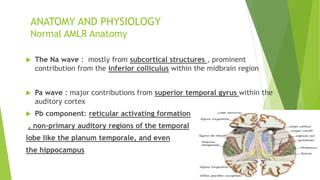
ANATOMY AND PHYSIOLOGY
Normal AMLR Anatomy
 The Na wave : mostly from subcortical structures , prominent
contribution from the inferior colliculus within the midbrain region
 Pa wave : major contributions from superior temporal gyrus within the
auditory cortex
 Pb component: reticular activating formation
, non-primary auditory regions of the temporal
lobe like the planum temporale, and even
the hippocampus
 The primary or thalamo-cortical sensory pathways : in processing
auditory information.
These pathways are involved in patient performance on basic hearing tests
such as word recognition and the perception of auditory signals in the
presence of background noise
 Secondary or “non-primary” structures or “association” or “extra-
lemniscal” pathways
These pathways play an important role in auditory attention and the
integration of information from auditory and other modalities like vision
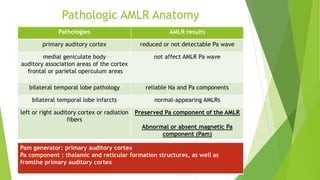
Pathologic AMLR Anatomy
Pathologies AMLR results
primary auditory cortex reduced or not detectable Pa wave
medial geniculate body
auditory association areas of the cortex
frontal or parietal operculum areas
not affect AMLR Pa wave
bilateral temporal lobe pathology reliable Na and Pa components
bilateral temporal lobe infarcts normal-appearing AMLRs
left or right auditory cortex or radiation
fibers
Preserved Pa component of the AMLR
Abnormal or absent magnetic Pa
component (Pam)
Pam generator: primary auditory cortex
Pa component : thalamic and reticular formation structures, as well as
fromthe primary auditory cortex
Stimulus Parameters
Summary of Stimulus Parameters
Summary of Stimulus Parameters…
Transducer: Air-conduction and Bone
Conduction
advantage of insert earphones:
 increased inter-aural attenuation
 heightened attenuation of ambient sounds
 greater comfort
 enhanced infection control with disposable insert cushions
 Not advantage of insert earphones:
stimulus artifact interference of TDH39, Even the Na component, the
shortest latency wave within the AMLR, occurs 10 to 15 milliseconds far
beyond the time frame of stimulus artifacts.
Stimulus Type
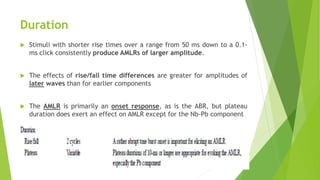
Duration
 Stimuli with shorter rise times over a range from 50 ms down to a 0.1-
ms click consistently produce AMLRs of larger amplitude.
 The effects of rise/fall time differences are greater for amplitudes of
later waves than for earlier components
 The AMLR is primarily an onset response, as is the ABR, but plateau
duration does exert an effect on AMLR except for the Nb-Pb component
Intensity on latency
 for a click stimulus up to about 40 to 50 dB SL:
click-stimulus intensity level increases AMLR
latency(Pa) decreases
 for higher intensity levels :
Latency remains relatively constant
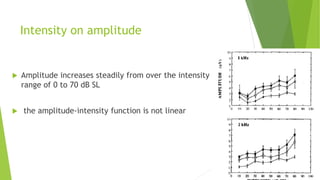
Intensity on amplitude
 Amplitude increases steadily from over the intensity
range of 0 to 70 dB SL
 the amplitude-intensity function is not linear
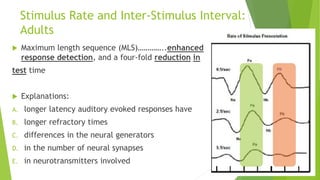
Stimulus Rate and Inter-Stimulus
Interval: Adults
 Interaction of age, body temperature, drugs, and central
nervous system dysfunction with stimulus
 rate in the region of 8 to 11 stimuli/second
1/s 15/s 40/s
Rate
Stimulus Rate and Inter-Stimulus Interval:
Adults
 Maximum length sequence (MLS)…………..enhanced
response detection, and a four-fold reduction in
test time
 Explanations:
A. longer latency auditory evoked responses have
B. longer refractory times
C. differences in the neural generators
D. in the number of neural synapses
E. in neurotransmitters involved
Stimulus Rate and Inter-Stimulus Interval:
Infants and Children
 Slower stimulus rates should be utilized
 Rates :0.5/s
temperature Rate MLR results
37 C 11.1 stimuli/second reliable AMLR waveform
hyperthermia 11.1 stimuli/second No AMLR was observed
hyperthermia 5.1 stimuli/second A small amplitude
response
hyperthermia 1.1 stimuli/second robust response
Stimulus Rate and Inter-Stimulus
Interval: Infants and Children
 Maximum length sequence (MLS)…………..enhanced
response detection, and a four-fold reduction in test time
 later latency Pb wave is recorded more consistently
with the MLS paradigm
Number of Stimulus Presentations
Investigations of some fundamental auditory system
processes via:
 pairs of clicks,
 combinations of tone bursts,
 trains of clicks
 the oddball paradigm
 double click paradigm(in studies of schizophrenia)
studies of sensory gating
Habituation and inhibition
Decrease of
• first stimulus (S1)
• second stimulus(S2)
• Two conventional clicks
• ratio (S2/S1) or simple
mathematical difference (S1- S2)
• larger differences are consistent
with more inhibition or “gating
out”
• “novel”, then larger ratios and
smaller differences or no
difference gating in” or a pre-
attentive response
Polarity
 In contrast to ECochG and ABR, stimulus polarity
is not a critical measurement parameter for the
AMLR. An AMLR is usually recorded with any
stimulus polarity option
Monaural versus Binaural Stimulation
 AMLR is rarely evoked with binaural stimulation in clinical settings.
 amplitude for the AMLR Pa component for binaural < sum of monaural
responses
 Importance of elimination PAM artifacts
 AMLR binaural interaction :deficits in binaural processing
Right Ear versus Left Ear Stimulation
 The Na and Pa components of the AMLR are evoked similarly with right
and left ear monaural stimulation
 The Pb is consistently recorded on for right ear and binaural stimulus
conditions, and only inconsistently observed with left ear stimulation
ACQUISITION PARAMETERS
Analysis Time and data point
 15 to 60-ms region???
 An analysis time of 100-ms is suggested
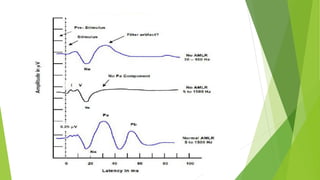
 Data point: 256 per channel…………100ms/256: 0.39=0.4
 Simultaneous ABR and AMLR:
 Use of 1024 data points for the 100-ms analysis time
 Use of 10-1500 Hz
Electrodes
 Estimation of hearing thresholds:
single channel using the conventional ABR electrode array
Electrodes
 central nervous system dysfunction including
auditory processing disorders:
10-20 International Electrode System
 Diagnostic information on function of the
thalamus-cortical auditory pathways
 Contribution of primary auditory cortex in the
temporal lobe
Inverting Electrodes
 Assessment of central auditory nervous
system function and not peripheral auditory
function
 Minimized or eliminated contributions
from the ears.
 “jumper cable”
 Pam contamination?? non-cephalic reference electrode
Pa,
1.0 to 1.20 μV
Pa at the Fz site
and Pb at the Cz
site
amplitude is
slightly less than
1.0 μV for C5 and
C6
Latency of the Pa
component
Filtering
 analog filter settings, typically for cutoff frequencies from 30 to 100
Hz.
 Pronounced filter effects on AMLR:
1. Phase distortion with latency shifts
2. reduced power with diminished amplitude for certain components
3. artifacts that resemble the Pa wave
Filtering
 major power :30 to 50 Hz
 Filtering: 10-200 Hz
0.1 about200Hz for Pb
10-200…………….30-200 All AMLR components are observed
10-200……………..40-200 Pb component disappears
10-200……………..50-200 Na and Pa components decreases
10-200…………….60-200 the AMLR entirely disappears
An effective AMLR protocol for consistent
detection of the Pb component
Closing Comments on Stimulus and Acquisition
Parameters
ANALYSIS AND INTERPRETATION
Nomenclature
 Goldstein chose the labels Na, Pa, and Nb to designate
polarity with N for negative and P for positive.
 Na = 16.25 to 30.00-ms;
 Pa = 30.00 to 45.00-ms
 Nb = 46.25 to 56.25-ms
 the interval Na and Pa from: 7.50 to 18.75-ms
Normal Waveform Variations
 Analysis of AMLR waveforms is more concerned with
amplitude than latency:
1.latency is less important than with ABR
 30 to 50 Hz
2. Auditory dysfunction within the central nervous system
exerts a more pronounced effect on amplitude than latency
Three main techniques for amplitude
measurement(1-2-3)
1
2
3
Determining Response Presence versus
Absence
 Artifacts:
1.PAM
 sharply peaked component
 13 to 15-ms region
 Amplitude of the PAM activity is much greater than amplitude of the Pa component
 tense patient with an electrode on the ipsilateral ear
2.Artifacts by filter settings and steep filter slopes
 with a filter bandwidth of 30 to 100 Hz and/or slopes of 24 to 48 dB/octave
Solution: wide filter settings, extension of the high pass filter setting downward to a
lower frequency cutoff
Morphology Variations
 P0……………. PAM
 Pa …...…………….variability
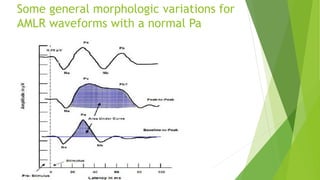
Some general morphologic variations for
AMLR waveforms with a normal Pa
Analysis Techniques for the Pb (P50)
Component: Sensory Gating
 S2/S1
 S2-S1
 schizophrenia and PTSD
(Post-traumatic stress disorder)
Gate out
Gate in
Abnormal Patterns
Causes of vivid abnormal patterns
1) considerable normal variability in waveform morphology
2) The Nb and Pb components are present only
inconsistently in normal subjects
3) normative data for AMLR analysis are scarce
4) patterns of AMLR abnormalities for a patient are based on
recording from multiple electrode arrays versus
recordings in a single waveform.
NON-PATHOLOGIC FACTORS IN AMLR ANALYSIS
Age
Infancy and Childhood
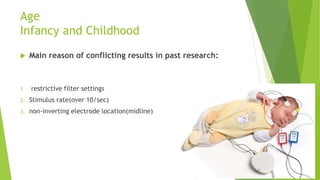
 Main reason of conflicting results in past research:
1. restrictive filter settings
2. Stimulus rate(over 10/sec)
3. non-inverting electrode location(midline)
Age
Infancy and Childhood
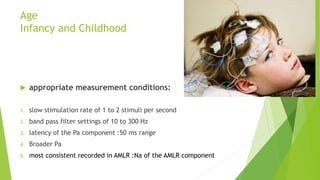
 appropriate measurement conditions:
1. slow stimulation rate of 1 to 2 stimuli per second
2. band pass filter settings of 10 to 300 Hz
3. latency of the Pa component :50 ms range
4. Broader Pa
5. most consistent recorded in AMLR :Na of the AMLR component
Bringing up …
 Increasement amplitude of Pa steadily
 maturational changes in the latency of the AMLR Pb wave
 reached adult values at above age 15 years
 AMLR findings in children under the age of 8 to 10 years must be
analyzed and interpreted with extreme caution
Pb component
 Pb wave for AMLR is equivalent to the P1 wave for the ALR.
 anatomic generators of the Pb (P1) wave require the effects of auditory
stimulation for maturation.
 auditory cortex is capable of maturation.
Advancing Age
 including poorer waveform morphology
 increased latency
 increased amplitude
 increased P50 amplitude
 Reasons for increased amplitude :
 reduction in the inhibition of auditory cortex function
from sub-cortical regions, (IC, MGB)and reciprocal
inhibition from layer V and VI to MGB and IC
 reduction in white matter within the pre-frontal regions
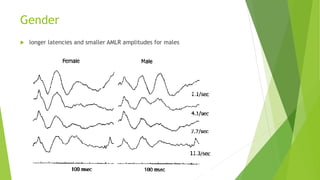
Gender
 longer latencies and smaller AMLR amplitudes for males
Handedness and Body Temperature
 AMLR Pa wave and, particularly, the Pb wave for left versus
righthanded normal hearing persons
as body temperature is elevated:
 decreased latency yet reduced
amplitude of the Pa component
Muscle Interference (Artifact)
Post-Auricular Muscle Response
 Low frequency muscle artifact is very troublesome
 Solution: patient motionless and resting comfortably with the head
supported and the neck neither flexed nor extended
 PAM artifact is more likely to occur in:
 tense patients
 Ipsilateral inverting electrode on the earlobe or mastoid
 intensity levels > 70 dB nHL
Attention
 Habituation
 amplitude of the AMLR Pb (P50) component decreases
 sensory gating
 not an adaptation due to neural fatigue or the inability of
the neurons to continue firing at a constant rate
Habituation VS Sensory gating
sensory gating experiments :
 shorter and more consistent intervals
 transient signal durations of 0.1 ms clicks
 analysis of amplitude for the Pb
Habituation:
 Longer intervals
 longer duration tones exceeding 30-ms
 N100 wave of the ALR
State of Arousal and Sleep
State of Arousal and Sleep in adults
 Stability of the AMLR Pa wave is expected in sleep states 1
and 2, and in REM
 Amplitude of the Pa reduced in sleep stages 3 and 4.
 the detection of the AMLR is more likely as the rate of
signal presentation is reduced for all stages of sleep
State of Arousal and Sleep for infants
and young children
 AMLR can be clearly recorded in REM sleep and also sleep
stages 1
 more variable and inconsistent AMLR in sleep stage 2
 rarely detected in sleep stage 3
 absent in sleep stage 4.
Sedatives and Anesthetic Agents
Amplitude of AMLR is decreased and latency may
be increased:
 Chloral hydrate
 Droperidol (dehydrobenzperidol)
 Halogenated Inhalational Agents
 Enflurane
 Desflurane
 Fluorothane
 Propofol: use of AMLR as an index of depth of anesthesia induced or
maintained during surgery with propofol
 Etomidate
Sedatives and Anesthetic Agents
no apparent effect on AMLR:
 Meperidine
 Fentanyl
 Remifentanil
 Ketamine.
 Neuromuscular Blockers (Chemical Paralyzing Agents)
 Pentobarbital. Pentobarbital is a fast-acting barbiturate
that severely or totally suppresses AMLR
Other Drugs Influencing AERs
 Alcohol: conflicting results
 Nicotine: increase in the Na-Pa amplitude
the Na-Pa amplitude was augmented more in male than female
subjects
 Marijuana: increased amplitude for the AMLR Pb (P50)
 Cocaine: With the paired click paradigm, no decreased for Pb
(P50) wave
an inhibitory deficit in pre-attentive information processing
CLINICAL APPLICATIONS AND
PATIENT POPULATIONS
Assessment of Auditory Sensitivity
 three advantages of AMLR:
1) amplitude of wave Pa is relatively large
2) is easily evoked with frequency-specific tone burst signals
of relatively long durations such as 10-ms or more
3) instrumentation and electrode array used for recording an
ABR is appropriate
 Disadvantages:
 Muscle and movement interference is a practical problem
for physically active infants and young children
Assessment of Auditory Sensitivity
Clinical Findings
 In infant and children:
rapid clinical shift from AMLR to ABR ; independence of ABR from the effects of
sedation and
 In adult:
is quite limited
Performance of AMLR in threshold estimation in adult patients is equivalent to
accuracy of frequency-specific ABR measurements
 Mostly AMLR is helpful in when:
1) the findings for behavioral audiometry are incomplete
2) unreliable due to false hearing loss including malingering
3) low cognitive functioning
4) the differentiation of conductive versus sensory versus mixed types
Assessment of Central Auditory Function
 Parameter: Amplitude
 Concept: intrasubject consistency in the AMLR with electrodes of C3 and
C4
 Goal: ascertain symmetry of Pa amplitude among these two or three
electrode
 Analyses: Reduction in amplitude of the Pa wave in right or the left
temporal lobe : consistent with auditory dysfunction in this region
 Abnormal:
 is less than 50% of the amplitude for the response recorded with a midline
(Fz)
 smaller than the amplitude for the ABR wave V with stimulation of the same
ear
Pa Amp
component
normal
Latency
prolongation
and Amp
reduction for
Na and Pa
Pb
component
Shorter
ABR
latencies
Increased S2/S1
Predicting Cognitive and Communicative
Outcome in Head Injury
 AMLR waveforms were defined as follows:
1. Normal. A reliable Pa component bilaterally with amplitude (Pa-Nb)
0.30 μV excellent recovery, good recovery and fair recovery
2. Abnormal. A reliable Pa component unilaterally or bilaterally with an
amplitude of less than 0.30 μV : poor recovery
3. No response. No reliable Pa component :poor recovery
Latent Pa
Absent Pa
Poor morphology
Hemispheric asymmetry
Higher S2/S1
Schizophrenia
 No difference for P50
 Larger S2/S1 ratio compared to control group
 Evidence of sensory gating deficit , lack of normal suppression
 No effect of anti-psychotic drugs
Degenerative Diseases
 Friedreich ataxia: an abnormal delay in Pa latency
 Machado-Joseph disease (MJD): higher S2/S1 P50 amplitude ratios
 Huntington’s disease (HD): reduction in the S2/S1 ratio
 AMLR Pb component is at least partly generated within the cholinergic
pedunculopontine nucleus (PPN) that contributes to the reticular activating system.
Monitoring Depth of Anesthesia
 With inadequate depth of general anesthesia:
1.remember intra-operative events with a negative impact on behavior, quality
of life
2. impact post-operative recovery
 suppression of important physiologic parameters:
1.acute intra-operative medical crises
2. poor post-operative neurological outcome
3.sometimes death
 The AMLR is exquisitely sensitive to the effects of commonly
used anesthetic agents
Test Protocol
 click
 binaurally
 moderate intensity level such as 70 to 75 dB nHL
 rate in the range of about 4 to 6/second like odd
presentation rate(5.7 or 6.1/second)
 non-inverting electrode at the vertex (Cz) or forehead
(Fz)
 inverting electrodes at the mastoid, ear lobe, or the inion
 pre-amplifier : near the patient’s head
 Band pass filter settings to minimize possible interference
from external electrical signals
AMLR Analysis Techniques During Anesthesia
 Nb component
 deeper anesthesia :
1. prolongation in Nb latency
2. reduction in Nb amplitude
3. Higher Pa latency
 Approaches:
1) auditory evoked potential index:
 disadvantage : time required for averaging a response to 256 sweeps
1) A-Line ARX Index (AAI)
 less than 25 sweeps, time: only 6 seconds
Benefits of Monitoring Depth of
Anesthesia with AMLR
1. reducing the likelihood of unexpected awareness during surgery
2. improving quality of recovery after surgery
3. utilize lower concentrations of volatile anesthetic agents
4. Speed of post-operative recovery
5. reduction in side effects, nausea, vomiting, headache, and dizziness
6. higher post-operative scores on the Quality of Recovery scale
7. for pre-school children older than 2 years
Documentation of Cochlear Implant and
Hearing Aid Performance
 at the time of implantation EMLRs: rarely detected
 on the day of device activation: detected only in 35%
 after at least one year after implantation : 100%
detectability
 Older children
 reflects developmental plasticity of the
thalamus-cortical pathways
Documentation of Cochlear Implant and
Hearing Aid Performance
 a link between EAMLR and speech perception in adults
 Larger EAMLR amplitudes and lower thresholds for the
Na-Pa complex were associated with higher speech
perception scores
 role of the concerned neural generators (thalamus and
primary auditory cortex) in speech perception
CONCLUDING COMMENTS
 The AMLR has considerable potential as a tool for objective
assessment of central auditory function
 Advantages for clinical application of the AMLR:
1) origin in auditory cortex
2) value in lateralizing auditory cortical dysfunction
3) presence in young children
4) feasibility of evoking the response with tonal and other complex
stimuli like speech
5) sensitivity to non-lemniscal auditory pathways including the reticular
activating system
6) suitability for assessing sensory gating mechanisms
Auditory Middle Latency Response (AMLR)

Auditory Middle Latency Response (AMLR)

  • 1.
    Chapter 10 Auditory MiddleLatency Response (AMLR)
  • 2.
  • 3.
    Historical perspective  MIT‘2-channel analog tape”  average-response computer (the ARC)
  • 4.
    Early Clinical Studies Offered as a potential technique for clinically estimating the auditory sensitivity  Less than-optimal clinical experiences in pediatric populations  In the 1980s ABR emerged as the preferred technique for electrophysiological hearing assessment of infants and young children  Growing clinical interest in an electrophysiological measure of auditory function at the thalamic and cortical level rostral to the brainstem
  • 5.
    AMLR Today 1) electrophysiologicalestimation of auditory thresholds 2) diagnostic use of AMLR : electrophysiological index of cortical auditory function CNS abnormalities 3) assessment of higher level auditory functioning 4) valuable information on thalamic and primary auditory cortex function, including auditory processing disorders 5) sensory gating” with the Pb component of the AMLR 6) certain neurological disorders, including post-traumatic stress disorder (PTSD) 7) quantifying the depth of anesthesia
  • 7.
  • 8.
    ANATOMY AND PHYSIOLOGY NormalAMLR Anatomy  The Na wave : mostly from subcortical structures , prominent contribution from the inferior colliculus within the midbrain region  Pa wave : major contributions from superior temporal gyrus within the auditory cortex  Pb component: reticular activating formation , non-primary auditory regions of the temporal lobe like the planum temporale, and even the hippocampus
  • 12.
     The primaryor thalamo-cortical sensory pathways : in processing auditory information. These pathways are involved in patient performance on basic hearing tests such as word recognition and the perception of auditory signals in the presence of background noise  Secondary or “non-primary” structures or “association” or “extra- lemniscal” pathways These pathways play an important role in auditory attention and the integration of information from auditory and other modalities like vision
  • 13.
    Pathologic AMLR Anatomy PathologiesAMLR results primary auditory cortex reduced or not detectable Pa wave medial geniculate body auditory association areas of the cortex frontal or parietal operculum areas not affect AMLR Pa wave bilateral temporal lobe pathology reliable Na and Pa components bilateral temporal lobe infarcts normal-appearing AMLRs left or right auditory cortex or radiation fibers Preserved Pa component of the AMLR Abnormal or absent magnetic Pa component (Pam) Pam generator: primary auditory cortex Pa component : thalamic and reticular formation structures, as well as fromthe primary auditory cortex
  • 14.
  • 15.
  • 16.
    Summary of StimulusParameters…
  • 17.
    Transducer: Air-conduction andBone Conduction advantage of insert earphones:  increased inter-aural attenuation  heightened attenuation of ambient sounds  greater comfort  enhanced infection control with disposable insert cushions  Not advantage of insert earphones: stimulus artifact interference of TDH39, Even the Na component, the shortest latency wave within the AMLR, occurs 10 to 15 milliseconds far beyond the time frame of stimulus artifacts.
  • 18.
  • 19.
    Duration  Stimuli withshorter rise times over a range from 50 ms down to a 0.1- ms click consistently produce AMLRs of larger amplitude.  The effects of rise/fall time differences are greater for amplitudes of later waves than for earlier components  The AMLR is primarily an onset response, as is the ABR, but plateau duration does exert an effect on AMLR except for the Nb-Pb component
  • 20.
    Intensity on latency for a click stimulus up to about 40 to 50 dB SL: click-stimulus intensity level increases AMLR latency(Pa) decreases  for higher intensity levels : Latency remains relatively constant
  • 21.
    Intensity on amplitude Amplitude increases steadily from over the intensity range of 0 to 70 dB SL  the amplitude-intensity function is not linear
  • 22.
    Stimulus Rate andInter-Stimulus Interval: Adults  Interaction of age, body temperature, drugs, and central nervous system dysfunction with stimulus  rate in the region of 8 to 11 stimuli/second 1/s 15/s 40/s Rate
  • 23.
    Stimulus Rate andInter-Stimulus Interval: Adults  Maximum length sequence (MLS)…………..enhanced response detection, and a four-fold reduction in test time  Explanations: A. longer latency auditory evoked responses have B. longer refractory times C. differences in the neural generators D. in the number of neural synapses E. in neurotransmitters involved
  • 24.
    Stimulus Rate andInter-Stimulus Interval: Infants and Children  Slower stimulus rates should be utilized  Rates :0.5/s temperature Rate MLR results 37 C 11.1 stimuli/second reliable AMLR waveform hyperthermia 11.1 stimuli/second No AMLR was observed hyperthermia 5.1 stimuli/second A small amplitude response hyperthermia 1.1 stimuli/second robust response
  • 25.
    Stimulus Rate andInter-Stimulus Interval: Infants and Children  Maximum length sequence (MLS)…………..enhanced response detection, and a four-fold reduction in test time  later latency Pb wave is recorded more consistently with the MLS paradigm
  • 26.
    Number of StimulusPresentations Investigations of some fundamental auditory system processes via:  pairs of clicks,  combinations of tone bursts,  trains of clicks  the oddball paradigm  double click paradigm(in studies of schizophrenia)
  • 27.
    studies of sensorygating Habituation and inhibition Decrease of • first stimulus (S1) • second stimulus(S2) • Two conventional clicks • ratio (S2/S1) or simple mathematical difference (S1- S2) • larger differences are consistent with more inhibition or “gating out” • “novel”, then larger ratios and smaller differences or no difference gating in” or a pre- attentive response
  • 28.
    Polarity  In contrastto ECochG and ABR, stimulus polarity is not a critical measurement parameter for the AMLR. An AMLR is usually recorded with any stimulus polarity option
  • 29.
    Monaural versus BinauralStimulation  AMLR is rarely evoked with binaural stimulation in clinical settings.  amplitude for the AMLR Pa component for binaural < sum of monaural responses  Importance of elimination PAM artifacts  AMLR binaural interaction :deficits in binaural processing
  • 30.
    Right Ear versusLeft Ear Stimulation  The Na and Pa components of the AMLR are evoked similarly with right and left ear monaural stimulation  The Pb is consistently recorded on for right ear and binaural stimulus conditions, and only inconsistently observed with left ear stimulation
  • 31.
  • 32.
  • 34.
    Analysis Time anddata point  15 to 60-ms region???  An analysis time of 100-ms is suggested  Data point: 256 per channel…………100ms/256: 0.39=0.4  Simultaneous ABR and AMLR:  Use of 1024 data points for the 100-ms analysis time  Use of 10-1500 Hz
  • 35.
    Electrodes  Estimation ofhearing thresholds: single channel using the conventional ABR electrode array
  • 36.
    Electrodes  central nervoussystem dysfunction including auditory processing disorders: 10-20 International Electrode System  Diagnostic information on function of the thalamus-cortical auditory pathways  Contribution of primary auditory cortex in the temporal lobe
  • 37.
    Inverting Electrodes  Assessmentof central auditory nervous system function and not peripheral auditory function  Minimized or eliminated contributions from the ears.  “jumper cable”  Pam contamination?? non-cephalic reference electrode
  • 38.
    Pa, 1.0 to 1.20μV Pa at the Fz site and Pb at the Cz site amplitude is slightly less than 1.0 μV for C5 and C6 Latency of the Pa component
  • 40.
    Filtering  analog filtersettings, typically for cutoff frequencies from 30 to 100 Hz.  Pronounced filter effects on AMLR: 1. Phase distortion with latency shifts 2. reduced power with diminished amplitude for certain components 3. artifacts that resemble the Pa wave
  • 42.
    Filtering  major power:30 to 50 Hz  Filtering: 10-200 Hz 0.1 about200Hz for Pb 10-200…………….30-200 All AMLR components are observed 10-200……………..40-200 Pb component disappears 10-200……………..50-200 Na and Pa components decreases 10-200…………….60-200 the AMLR entirely disappears
  • 43.
    An effective AMLRprotocol for consistent detection of the Pb component
  • 44.
    Closing Comments onStimulus and Acquisition Parameters
  • 45.
  • 46.
    Nomenclature  Goldstein chosethe labels Na, Pa, and Nb to designate polarity with N for negative and P for positive.  Na = 16.25 to 30.00-ms;  Pa = 30.00 to 45.00-ms  Nb = 46.25 to 56.25-ms  the interval Na and Pa from: 7.50 to 18.75-ms
  • 47.
    Normal Waveform Variations Analysis of AMLR waveforms is more concerned with amplitude than latency: 1.latency is less important than with ABR  30 to 50 Hz 2. Auditory dysfunction within the central nervous system exerts a more pronounced effect on amplitude than latency
  • 48.
    Three main techniquesfor amplitude measurement(1-2-3) 1 2 3
  • 49.
    Determining Response Presenceversus Absence  Artifacts: 1.PAM  sharply peaked component  13 to 15-ms region  Amplitude of the PAM activity is much greater than amplitude of the Pa component  tense patient with an electrode on the ipsilateral ear 2.Artifacts by filter settings and steep filter slopes  with a filter bandwidth of 30 to 100 Hz and/or slopes of 24 to 48 dB/octave Solution: wide filter settings, extension of the high pass filter setting downward to a lower frequency cutoff
  • 50.
    Morphology Variations  P0…………….PAM  Pa …...…………….variability
  • 51.
    Some general morphologicvariations for AMLR waveforms with a normal Pa
  • 52.
    Analysis Techniques forthe Pb (P50) Component: Sensory Gating  S2/S1  S2-S1  schizophrenia and PTSD (Post-traumatic stress disorder) Gate out Gate in
  • 53.
    Abnormal Patterns Causes ofvivid abnormal patterns 1) considerable normal variability in waveform morphology 2) The Nb and Pb components are present only inconsistently in normal subjects 3) normative data for AMLR analysis are scarce 4) patterns of AMLR abnormalities for a patient are based on recording from multiple electrode arrays versus recordings in a single waveform.
  • 54.
  • 55.
    Age Infancy and Childhood Main reason of conflicting results in past research: 1. restrictive filter settings 2. Stimulus rate(over 10/sec) 3. non-inverting electrode location(midline)
  • 56.
    Age Infancy and Childhood appropriate measurement conditions: 1. slow stimulation rate of 1 to 2 stimuli per second 2. band pass filter settings of 10 to 300 Hz 3. latency of the Pa component :50 ms range 4. Broader Pa 5. most consistent recorded in AMLR :Na of the AMLR component
  • 57.
    Bringing up … Increasement amplitude of Pa steadily  maturational changes in the latency of the AMLR Pb wave  reached adult values at above age 15 years  AMLR findings in children under the age of 8 to 10 years must be analyzed and interpreted with extreme caution
  • 58.
    Pb component  Pbwave for AMLR is equivalent to the P1 wave for the ALR.  anatomic generators of the Pb (P1) wave require the effects of auditory stimulation for maturation.  auditory cortex is capable of maturation.
  • 59.
    Advancing Age  includingpoorer waveform morphology  increased latency  increased amplitude  increased P50 amplitude  Reasons for increased amplitude :  reduction in the inhibition of auditory cortex function from sub-cortical regions, (IC, MGB)and reciprocal inhibition from layer V and VI to MGB and IC  reduction in white matter within the pre-frontal regions
  • 60.
    Gender  longer latenciesand smaller AMLR amplitudes for males
  • 61.
    Handedness and BodyTemperature  AMLR Pa wave and, particularly, the Pb wave for left versus righthanded normal hearing persons as body temperature is elevated:  decreased latency yet reduced amplitude of the Pa component
  • 62.
    Muscle Interference (Artifact) Post-AuricularMuscle Response  Low frequency muscle artifact is very troublesome  Solution: patient motionless and resting comfortably with the head supported and the neck neither flexed nor extended  PAM artifact is more likely to occur in:  tense patients  Ipsilateral inverting electrode on the earlobe or mastoid  intensity levels > 70 dB nHL
  • 63.
    Attention  Habituation  amplitudeof the AMLR Pb (P50) component decreases  sensory gating  not an adaptation due to neural fatigue or the inability of the neurons to continue firing at a constant rate
  • 64.
    Habituation VS Sensorygating sensory gating experiments :  shorter and more consistent intervals  transient signal durations of 0.1 ms clicks  analysis of amplitude for the Pb Habituation:  Longer intervals  longer duration tones exceeding 30-ms  N100 wave of the ALR
  • 65.
  • 66.
    State of Arousaland Sleep in adults  Stability of the AMLR Pa wave is expected in sleep states 1 and 2, and in REM  Amplitude of the Pa reduced in sleep stages 3 and 4.  the detection of the AMLR is more likely as the rate of signal presentation is reduced for all stages of sleep
  • 67.
    State of Arousaland Sleep for infants and young children  AMLR can be clearly recorded in REM sleep and also sleep stages 1  more variable and inconsistent AMLR in sleep stage 2  rarely detected in sleep stage 3  absent in sleep stage 4.
  • 68.
    Sedatives and AnestheticAgents Amplitude of AMLR is decreased and latency may be increased:  Chloral hydrate  Droperidol (dehydrobenzperidol)  Halogenated Inhalational Agents  Enflurane  Desflurane  Fluorothane  Propofol: use of AMLR as an index of depth of anesthesia induced or maintained during surgery with propofol  Etomidate
  • 69.
    Sedatives and AnestheticAgents no apparent effect on AMLR:  Meperidine  Fentanyl  Remifentanil  Ketamine.  Neuromuscular Blockers (Chemical Paralyzing Agents)  Pentobarbital. Pentobarbital is a fast-acting barbiturate that severely or totally suppresses AMLR
  • 70.
    Other Drugs InfluencingAERs  Alcohol: conflicting results  Nicotine: increase in the Na-Pa amplitude the Na-Pa amplitude was augmented more in male than female subjects  Marijuana: increased amplitude for the AMLR Pb (P50)  Cocaine: With the paired click paradigm, no decreased for Pb (P50) wave an inhibitory deficit in pre-attentive information processing
  • 71.
  • 72.
    Assessment of AuditorySensitivity  three advantages of AMLR: 1) amplitude of wave Pa is relatively large 2) is easily evoked with frequency-specific tone burst signals of relatively long durations such as 10-ms or more 3) instrumentation and electrode array used for recording an ABR is appropriate  Disadvantages:  Muscle and movement interference is a practical problem for physically active infants and young children
  • 73.
    Assessment of AuditorySensitivity Clinical Findings  In infant and children: rapid clinical shift from AMLR to ABR ; independence of ABR from the effects of sedation and  In adult: is quite limited Performance of AMLR in threshold estimation in adult patients is equivalent to accuracy of frequency-specific ABR measurements  Mostly AMLR is helpful in when: 1) the findings for behavioral audiometry are incomplete 2) unreliable due to false hearing loss including malingering 3) low cognitive functioning 4) the differentiation of conductive versus sensory versus mixed types
  • 74.
    Assessment of CentralAuditory Function  Parameter: Amplitude  Concept: intrasubject consistency in the AMLR with electrodes of C3 and C4  Goal: ascertain symmetry of Pa amplitude among these two or three electrode  Analyses: Reduction in amplitude of the Pa wave in right or the left temporal lobe : consistent with auditory dysfunction in this region  Abnormal:  is less than 50% of the amplitude for the response recorded with a midline (Fz)  smaller than the amplitude for the ABR wave V with stimulation of the same ear
  • 75.
  • 76.
  • 77.
  • 78.
    Predicting Cognitive andCommunicative Outcome in Head Injury  AMLR waveforms were defined as follows: 1. Normal. A reliable Pa component bilaterally with amplitude (Pa-Nb) 0.30 μV excellent recovery, good recovery and fair recovery 2. Abnormal. A reliable Pa component unilaterally or bilaterally with an amplitude of less than 0.30 μV : poor recovery 3. No response. No reliable Pa component :poor recovery
  • 79.
    Latent Pa Absent Pa Poormorphology Hemispheric asymmetry Higher S2/S1
  • 80.
    Schizophrenia  No differencefor P50  Larger S2/S1 ratio compared to control group  Evidence of sensory gating deficit , lack of normal suppression  No effect of anti-psychotic drugs
  • 81.
    Degenerative Diseases  Friedreichataxia: an abnormal delay in Pa latency  Machado-Joseph disease (MJD): higher S2/S1 P50 amplitude ratios  Huntington’s disease (HD): reduction in the S2/S1 ratio  AMLR Pb component is at least partly generated within the cholinergic pedunculopontine nucleus (PPN) that contributes to the reticular activating system.
  • 82.
    Monitoring Depth ofAnesthesia  With inadequate depth of general anesthesia: 1.remember intra-operative events with a negative impact on behavior, quality of life 2. impact post-operative recovery  suppression of important physiologic parameters: 1.acute intra-operative medical crises 2. poor post-operative neurological outcome 3.sometimes death  The AMLR is exquisitely sensitive to the effects of commonly used anesthetic agents
  • 83.
    Test Protocol  click binaurally  moderate intensity level such as 70 to 75 dB nHL  rate in the range of about 4 to 6/second like odd presentation rate(5.7 or 6.1/second)  non-inverting electrode at the vertex (Cz) or forehead (Fz)  inverting electrodes at the mastoid, ear lobe, or the inion  pre-amplifier : near the patient’s head  Band pass filter settings to minimize possible interference from external electrical signals
  • 84.
    AMLR Analysis TechniquesDuring Anesthesia  Nb component  deeper anesthesia : 1. prolongation in Nb latency 2. reduction in Nb amplitude 3. Higher Pa latency  Approaches: 1) auditory evoked potential index:  disadvantage : time required for averaging a response to 256 sweeps 1) A-Line ARX Index (AAI)  less than 25 sweeps, time: only 6 seconds
  • 85.
    Benefits of MonitoringDepth of Anesthesia with AMLR 1. reducing the likelihood of unexpected awareness during surgery 2. improving quality of recovery after surgery 3. utilize lower concentrations of volatile anesthetic agents 4. Speed of post-operative recovery 5. reduction in side effects, nausea, vomiting, headache, and dizziness 6. higher post-operative scores on the Quality of Recovery scale 7. for pre-school children older than 2 years
  • 86.
    Documentation of CochlearImplant and Hearing Aid Performance  at the time of implantation EMLRs: rarely detected  on the day of device activation: detected only in 35%  after at least one year after implantation : 100% detectability  Older children  reflects developmental plasticity of the thalamus-cortical pathways
  • 87.
    Documentation of CochlearImplant and Hearing Aid Performance  a link between EAMLR and speech perception in adults  Larger EAMLR amplitudes and lower thresholds for the Na-Pa complex were associated with higher speech perception scores  role of the concerned neural generators (thalamus and primary auditory cortex) in speech perception
  • 88.
    CONCLUDING COMMENTS  TheAMLR has considerable potential as a tool for objective assessment of central auditory function  Advantages for clinical application of the AMLR: 1) origin in auditory cortex 2) value in lateralizing auditory cortical dysfunction 3) presence in young children 4) feasibility of evoking the response with tonal and other complex stimuli like speech 5) sensitivity to non-lemniscal auditory pathways including the reticular activating system 6) suitability for assessing sensory gating mechanisms